
Knowledge Process Outsourcing (KPO) Market Overview
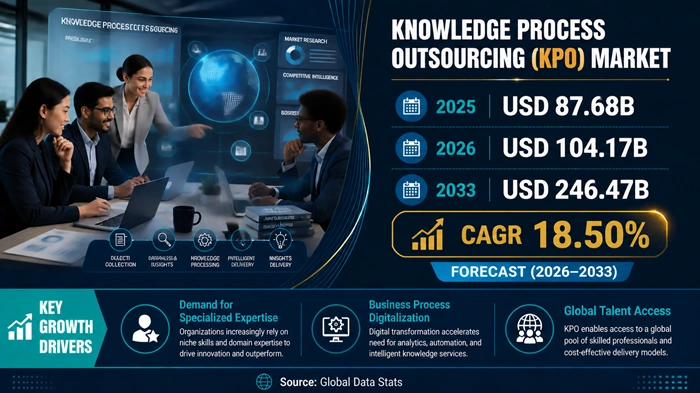
The global knowledge process outsourcing (KPO) market size is valued at USD 87.68 billion in 2025 and is predicted to increase from USD 104.17 billion in 2026 to approximately USD 246.47 billion by 2033, growing at a CAGR of 18.50% from 2026 to 2033.
This exceptional expansion reflects the strategic transformation of enterprises across industries as they shift from traditional cost-reduction tactics to intelligence-led operations that demand specialized expertise and domain knowledge. The knowledge process outsourcing market has matured significantly beyond simple task execution to become an integral component of corporate strategy where businesses leverage external partners for high-value functions including financial analysis, legal research, healthcare intelligence, engineering design, and data-driven decision support.
Organizations increasingly recognize KPO providers as strategic partners rather than mere vendors, seeking collaborative relationships that contribute directly to core business objectives and competitive differentiation. The knowledge process outsourcing market benefits from widespread digital transformation initiatives that create demand for specialized technological expertise, advanced analytical capabilities, and domain-specific insights that internal teams cannot efficiently deliver. Modern KPO engagements encompass sophisticated services such as regulatory compliance management, supply chain analytics, actuarial services, pharmaceutical research, and AI model validation that require deep subject matter expertise combined with cutting-edge technological proficiency. This evolution positions the knowledge process outsourcing market at the intersection of business strategy and operational excellence where value creation supersedes simple cost arbitrage as the primary driver of outsourcing decisions.
AI Impact on the Knowledge Process Outsourcing Industry
Transforming Service Delivery Through Intelligent Automation and Advanced Analytics
Artificial intelligence fundamentally reshapes the knowledge process outsourcing market by introducing automation capabilities, machine learning algorithms, and intelligent data analytics that enhance process efficiency, accuracy, and turnaround times while reducing operational costs by substantial margins. AI-powered technologies including natural language processing, robotic process automation, and cognitive computing enable real-time data extraction, sentiment analysis, predictive modeling, and automated content generation that were previously impossible with traditional methods. The knowledge process outsourcing market witnesses accelerated AI adoption with implementation rates projected to grow at approximately 25% CAGR over the next five years as providers integrate these technologies across service delivery functions. Organizations leveraging AI-driven KPO solutions experience efficiency improvements of 30-50% in operational costs while simultaneously achieving superior quality outcomes through reduced human error and enhanced analytical precision.
The integration of generative AI represents a particularly transformative development within the knowledge process outsourcing market as these technologies reshape service delivery across diverse sectors including publishing outsourcing, actuarial services, legal research, and financial analysis. Leading KPO providers invest heavily in proprietary AI solutions and strategic technology partnerships to differentiate service offerings and capture premium market positioning. The knowledge process outsourcing market benefits from AI capabilities that enable agile methodologies, cloud-based platforms, and dynamic business process management that respond rapidly to changing client requirements. Blockchain technology integration enhances data security and creates transparent audit trails for sensitive operations, while machine learning algorithms continuously improve performance through pattern recognition and predictive analytics. This technological convergence positions AI-enabled KPO services as essential infrastructure for enterprises pursuing digital transformation enablement and data-driven decision support across complex operational environments.
Growth Factors
Digital Transformation and Operational Efficiency Drive Strategic Outsourcing Adoption
The knowledge process outsourcing market experiences robust expansion driven by enterprise-wide digital transformation initiatives that fuel demand for specialized knowledge services and advanced technological expertise beyond internal organizational capabilities. Companies across banking, financial services, insurance, healthcare, pharmaceuticals, legal, and manufacturing sectors increasingly outsource knowledge-intensive tasks including research and development, financial process outsourcing, legal process outsourcing, and data analytics to access specialized skills without substantial internal investment. This strategic shift reflects organizational recognition that focusing resources on core competencies while leveraging external expertise for complex supporting functions delivers superior business outcomes. The knowledge process outsourcing market capitalizes on the growing complexity of regulatory environments where compliance demands, cross-border litigation challenges, and ESG reporting requirements necessitate specialized domain knowledge that general internal teams cannot efficiently maintain.
The proliferation of delivery centers in key outsourcing destinations creates enhanced access to global talent pools with competitive cost structures that enable significant operational savings without compromising quality standards. Asia Pacific regions particularly India, Philippines, Vietnam, and Malaysia serve as critical offshore hubs offering deep domain expertise, English proficiency, and favorable economic conditions that attract multinational enterprises seeking scalable solutions. The knowledge process outsourcing market benefits from government support initiatives, infrastructure investments, and education systems that produce highly skilled workforces capable of delivering sophisticated analytical services. Technological advancements in connectivity infrastructure, cloud computing platforms, and collaborative tools eliminate geographical barriers and enable seamless integration between client organizations and outsourcing partners. The transition from legacy systems to cloud-native architectures facilitates modular service offerings, outcome-based pricing models, and flexible engagement structures that reduce traditional barriers to KPO adoption particularly for small and medium enterprises that previously lacked access to specialized knowledge services.
Market Outlook
Sustained High-Growth Trajectory Supported by Strategic Value Recognition
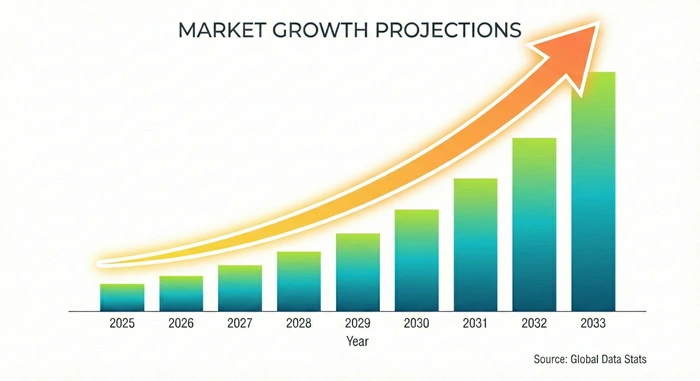
The knowledge process outsourcing market outlook remains exceptionally positive through 2033 as multiple converging factors support sustained double-digit growth across geographic regions and industry verticals. North America continues driving substantial market demand accounting for approximately 40% of incremental growth as enterprises prioritize advanced outsourcing solutions in healthcare, finance, and information technology sectors where innovation and early technology adoption create competitive advantages. The knowledge process outsourcing market witnesses intensifying competition as traditional BPO providers expand into higher-value KPO services while specialized boutique firms target niche verticals with deep domain expertise. This dynamic landscape encourages continuous service innovation, technological integration, and strategic partnership models that deliver comprehensive solutions addressing complex client challenges across multiple functional areas.
Asia Pacific emerges as the fastest-growing regional market with exceptional expansion rates exceeding 19% CAGR as the region combines cost-efficient delivery with rapid adoption of AI-enhanced research and analytics capabilities. The knowledge process outsourcing market in this region benefits from vast talent pools, multilingual capabilities, and strategic positioning as preferred destinations for offshore service delivery across diverse industries. Growing recognition of KPO as strategic enabler rather than tactical cost-reduction mechanism drives larger contract values, longer engagement durations, and hybrid delivery models that combine onshore, nearshore, and offshore resources optimized for specific client requirements. Market maturation in developed economies coincides with accelerated adoption in emerging markets where improving digital infrastructure, expanding middle-class populations, and liberalizing regulatory frameworks create favorable conditions for knowledge services growth. The knowledge process outsourcing market transformation toward value-based relationships, multi-tower engagements, and centers of excellence structures positions the industry for sustained expansion as enterprises increasingly depend on external expertise for competitive differentiation and operational excellence.
Expert Speaks
-
Industry leaders emphasize that AI integration reduces operational costs by 30-50% while simultaneously improving accuracy and turnaround times, fundamentally transforming how KPO providers deliver specialized knowledge services across financial, legal, and healthcare sectors.
-
Technology executives highlight that generative AI adoption in knowledge process outsourcing enables automated content generation, predictive analytics, and cognitive computing capabilities that create new service offerings previously impossible with traditional methodologies.
-
Outsourcing strategists note the pivotal shift from cost arbitrage to value creation models where enterprises view KPO providers as strategic partners contributing to innovation, digital transformation enablement, and data-driven decision support rather than simple task executors.
Key Report Takeaways
-
North America leads the knowledge process outsourcing market with dominant positioning and approximately 40% contribution to incremental market growth, driven by advanced technological infrastructure, high adoption of specialized outsourcing solutions, and strong demand from healthcare, BFSI, and IT sectors requiring innovation-focused services.
-
Asia Pacific represents the fastest-growing region with exceptional CAGR of 19.10% from 2026 to 2033, fueled by vast skilled workforces, cost-efficient delivery models, government support initiatives, and rapid adoption of AI-enhanced analytics across India, Philippines, Vietnam, and Malaysia as preferred offshore destinations.
-
Legal Process Outsourcing (LPO) constitutes the fastest-growing segment with projected CAGR of 21.30% through 2033, accelerated by rising legal complexity, cross-border litigation demands, compliance challenges, and increased adoption of AI-powered legal research and contract analytics tools particularly in US, UK, and European markets.
-
Banking, Financial Services, and Insurance (BFSI) sector dominates with 28.40% market share as the largest contributor to KPO demand, heavily relying on outsourced knowledge functions for regulatory compliance, credit risk modeling, financial analytics, wealth management support, and ESG reporting.
-
Small and Medium Enterprises (SMEs) emerge as fastest-growing client segment with 18.10% CAGR driven by broader access to modular cloud-native KPO offerings, outcome-based pricing models, and AI-augmented services that reduce traditional entry barriers and enable specialized expertise access.
-
AI integration serves as primary innovation driver with adoption rates growing at 25% CAGR as providers leverage natural language processing, robotic process automation, machine learning, and cognitive computing to deliver transformational efficiency improvements and enhanced analytical capabilities.
Market Scope
| Report Coverage | Details |
|---|---|
| Market Size by 2033 | USD 246.47 Billion |
| Market Size by 2025 | USD 87.68 Billion |
| Market Size by 2026 | USD 104.17 Billion |
| Market Growth Rate from 2026 to 2033 | CAGR of 18.50% |
| Dominating Region | North America |
| Fastest Growing Region | Asia Pacific |
| Base Year | 2025 |
| Forecast Period | 2026 to 2033 |
| Segments Covered | Service Type, End User Industry, Enterprise Size, Delivery Model |
| Regions Covered | North America, Europe, Asia Pacific, Latin America, Middle East & Africa |
Market Dynamics
Drivers Impact Analysis
Strategic Value Recognition and Digital Transformation Accelerate Market Expansion
| Impact Factor | (≈) % Impact on CAGR Forecast | Geographic Relevance | Impact Timeline |
|---|---|---|---|
| Digital Transformation Initiatives | 4.8% | Global (Led by North America, Europe) | 2026-2033 |
| Specialized Expertise Access | 3.9% | Global (Particularly Developed Markets) | 2026-2033 |
| Regulatory Complexity & Compliance | 3.2% | North America, Europe, Asia Pacific | 2026-2033 |
| AI & Automation Integration | 2.8% | Global (Technology-Forward Regions) | 2026-2033 |
| Cost Optimization & Efficiency | 2.4% | Emerging Markets Focus | 2026-2033 |
| Global Talent Pool Access | 1.4% | Asia Pacific, Eastern Europe | 2026-2033 |
The knowledge process outsourcing market derives substantial momentum from widespread digital transformation across industries that creates unprecedented demand for specialized knowledge services and advanced technological expertise beyond internal organizational capabilities. Enterprises increasingly recognize that competitive differentiation requires focusing internal resources on core competencies while strategically outsourcing complex supporting functions to specialized providers offering deep domain expertise. This fundamental shift from viewing outsourcing as simple cost reduction to recognizing strategic value creation drives larger contract values, longer engagement durations, and more comprehensive service scopes. The knowledge process outsourcing market benefits as organizations across banking, insurance, healthcare, pharmaceuticals, legal, and manufacturing sectors pursue operational excellence through access to specialized analytical capabilities, regulatory expertise, and research competencies that would require substantial investment to develop internally.
Regulatory complexity continues escalating across industries with compliance requirements, cross-border litigation challenges, ESG reporting mandates, and data governance frameworks creating demand for specialized knowledge services that interpret evolving regulations and ensure organizational adherence. The knowledge process outsourcing market witnesses particular strength in legal process outsourcing and financial process outsourcing segments where regulatory environments change rapidly and require continuous expertise updates. AI and automation integration transforms service delivery by enabling efficiency improvements of 30-50% while simultaneously enhancing accuracy through reduced human error and advanced analytical capabilities including predictive modeling and cognitive computing. The proliferation of offshore delivery centers in cost-effective destinations with skilled workforces creates compelling value propositions combining expertise with favorable economics, while cloud-based platforms and agile methodologies enable flexible engagement models accessible to enterprises of all sizes including SMEs that previously lacked resources for specialized knowledge services.
Restraints Impact Analysis
Data Security Concerns and Talent Management Challenge Growth Momentum
| Impact Factor | (≈) % Impact on CAGR Forecast | Geographic Relevance | Impact Timeline |
|---|---|---|---|
| Data Security & Privacy Concerns | -2.6% | Global (Particularly Europe, North America) | 2026-2033 |
| Regulatory Compliance Complexity | -1.8% | Europe, Developed Markets | 2026-2033 |
| Talent Acquisition & Retention | -1.4% | Asia Pacific, Offshore Hubs | 2027-2033 |
| Geopolitical Uncertainties | -1.1% | Global | 2026-2033 |
| Client Transition Challenges | -0.9% | All Regions | 2026-2030 |
Data security and confidentiality concerns represent the most significant restraint affecting knowledge process outsourcing market growth as enterprises hesitate to share sensitive information including legal files, financial data, proprietary business intelligence, and patient records with third-party vendors. Organizations face legitimate anxieties regarding potential data breaches, unauthorized access, intellectual property theft, and regulatory penalties if strict compliance standards are not maintained throughout outsourcing relationships. The knowledge process outsourcing market must navigate increasingly stringent data protection regulations including GDPR in Europe, CCPA in California, and sector-specific frameworks such as HIPAA for healthcare that create substantial compliance burdens and operational constraints. Implementation costs for robust cybersecurity frameworks including end-to-end encryption, multi-factor authentication, access controls, and continuous monitoring systems create significant barriers particularly for smaller KPO providers and client organizations with limited security budgets.
Talent acquisition and retention challenges constrain the knowledge process outsourcing market as demand for highly skilled professionals with specialized domain expertise exceeds available supply particularly in emerging technology areas including AI, machine learning, data science, and advanced analytics. Leading offshore destinations face intensifying competition for qualified talent as salaries increase and employee turnover rates rise in response to expanding opportunities across multiple industries. The knowledge process outsourcing market experiences pressure from large enterprises establishing Global Capability Centers that hire directly in preferred offshore locations, bypassing traditional outsourcing providers and creating talent competition. Geopolitical uncertainties including trade tensions, regulatory changes affecting cross-border data flows, and shifting political relationships create operational risks and strategic hesitations that delay outsourcing decisions or favor nearshore and onshore delivery models despite higher costs. Client transition challenges including knowledge transfer complexity, process documentation requirements, and cultural alignment needs create implementation friction that extends timelines and increases perceived risks particularly for complex knowledge-intensive functions requiring deep organizational understanding.
Opportunities Impact Analysis
Emerging Technologies and Market Segments Create Expansion Pathways
| Impact Factor | (≈) % Impact on CAGR Forecast | Geographic Relevance | Impact Timeline |
|---|---|---|---|
| Generative AI Service Integration | 3.6% | Global (Led by Technology Markets) | 2026-2033 |
| SME Market Penetration | 2.9% | Global (Particularly Emerging Markets) | 2026-2033 |
| Industry-Specific Vertical Solutions | 2.4% | North America, Europe, Asia Pacific | 2027-2033 |
| Hybrid Delivery Model Innovation | 1.7% | Global | 2026-2033 |
| Cybersecurity Services Expansion | 1.5% | North America, Europe | 2026-2033 |
| Emerging Market Geographic Expansion | 1.3% | Southeast Asia, Africa, Latin America | 2027-2033 |
The knowledge process outsourcing market stands to gain substantially from generative AI integration that creates entirely new service categories and transforms existing offerings through automated content generation, advanced natural language processing, and cognitive computing capabilities. Providers developing proprietary AI solutions or establishing strategic partnerships with technology companies position themselves for premium market segments and differentiated value propositions that justify higher pricing. Machine learning applications in predictive analytics, sentiment analysis, and pattern recognition enable KPO providers to deliver insights previously impossible with traditional analytical methods, creating compelling client value beyond simple cost savings. The knowledge process outsourcing market benefits from AI adoption that reduces dependency on large workforce scaling while simultaneously improving quality, consistency, and turnaround times across service delivery functions.
Small and Medium Enterprise segment represents substantial untapped potential as these organizations increasingly access modular cloud-native KPO offerings with outcome-based pricing models that eliminate traditional barriers related to minimum engagement sizes and long-term contract commitments. The knowledge process outsourcing market expansion into SME segment accelerates as providers develop standardized service packages, self-service platforms, and flexible engagement structures tailored to resource-constrained organizations requiring specialized expertise for specific projects or ongoing support. Industry-specific vertical solutions create differentiation opportunities as KPO providers develop deep domain expertise in sectors such as healthcare life sciences, legal services, financial services, and engineering where specialized knowledge commands premium pricing and generates strong client loyalty. Hybrid delivery models combining onshore consulting, nearshore coordination, and offshore execution optimize cost-quality-risk trade-offs while addressing client preferences for geopolitical risk mitigation and data sovereignty compliance. Cybersecurity services represent high-growth adjacency as data protection concerns drive demand for specialized expertise in encryption, access management, compliance auditing, and incident response that KPO providers can integrate with core knowledge services. Geographic expansion into emerging markets including Southeast Asia, Africa, and Latin America creates new client acquisition opportunities and alternative delivery locations that diversify operational risk while accessing expanding talent pools.
Segment Analysis
By Service Type
Legal Process Outsourcing Emerges as Fastest-Growing Segment with Technology-Enabled Transformation
Legal Process Outsourcing (LPO) demonstrates exceptional growth momentum with projected CAGR of 21.30% through 2033, significantly outpacing other service categories as law firms and corporate legal departments increasingly outsource document review, e-discovery, legal research, contract drafting, and compliance functions to specialized providers. This segment benefits from escalating legal complexity including cross-border litigation, regulatory compliance challenges, intellectual property management, and contract analytics that create overwhelming workloads for internal legal teams. The knowledge process outsourcing market witnesses accelerated LPO adoption driven by AI-powered legal research tools, contract analytics platforms, and automated document review systems that dramatically reduce costs while improving accuracy and consistency. Document review and e-discovery represent the largest LPO applications with law firms outsourcing review of millions of documents in litigation and regulatory matters, achieving cost savings of 60-70% compared to internal execution while maintaining quality standards through technology-enabled workflows.
Regional adoption patterns show particularly strong growth in United States, United Kingdom, and European markets where legal cost pressures, regulatory requirements, and competitive dynamics drive outsourcing acceptance among traditionally conservative legal profession stakeholders. The knowledge process outsourcing market benefits from industry consolidation as leading LPO providers including Pangea3 (Thomson Reuters), CPA Global, Integreon, and Axiom expand service portfolios and geographic footprints through acquisitions and organic growth initiatives. Technology integration distinguishes competitive positioning as providers implementing AI, machine learning, and natural language processing capabilities deliver superior value propositions compared to traditional labor arbitrage models. The segment captures premium pricing despite offshore delivery as specialized legal expertise, regulatory knowledge, and technology investments justify higher rates than general BPO services. Market dynamics indicate sustained high growth as legal departments expand outsourcing beyond routine tasks to include strategic functions such as legal operations consulting, matter management, and legal technology implementation that position LPO providers as integral components of corporate legal strategies rather than simple cost reduction tools.
By End User Industry
BFSI Sector Dominates with Sophisticated Knowledge Services Demand
The Banking, Financial Services, and Insurance (BFSI) sector maintains dominant market position with 28.40% share representing the largest contributor to knowledge process outsourcing market demand as financial institutions rely heavily on outsourced expertise for regulatory compliance, credit risk modeling, financial analytics, actuarial services, and wealth management support. This sector demonstrates sustained high growth driven by ongoing digital transformation initiatives, escalating regulatory complexity particularly post-financial crisis, and strategic shifts toward data-driven decision making that require advanced analytical capabilities. The knowledge process outsourcing market within BFSI encompasses sophisticated services including ESG reporting and sustainability audits, algorithmic trading support, fraud detection analytics, mortgage processing, insurance claims adjudication, and financial planning research that demand specialized domain expertise combined with technological proficiency. Financial institutions increasingly view KPO providers as strategic partners capable of delivering innovation, compliance assurance, and competitive intelligence beyond simple operational cost reduction.
Regional distribution shows North America and Europe leading BFSI segment adoption with approximately 65% combined share driven by stringent regulatory environments, mature financial services industries, and competitive pressures demanding operational excellence. The knowledge process outsourcing market benefits from relationships with leading global financial institutions including major banks, insurance companies, asset managers, and financial technology firms headquartered in these regions. Key providers serving BFSI segment include Genpact, WNS, ExlService, Accenture, Cognizant, and Capgemini which combine industry expertise with technology capabilities and global delivery infrastructure. Market dynamics reflect increasing sophistication as engagements expand from back-office processing to front-office analytics, customer insights, and strategic consulting that directly impact revenue generation and competitive positioning. The segment projects continued strong growth with CAGR exceeding overall market averages as financial services digital transformation, fintech disruption, regulatory evolution, and customer experience priorities create persistent demand for specialized knowledge services that enable innovation while managing risk and ensuring compliance across increasingly complex operating environments.
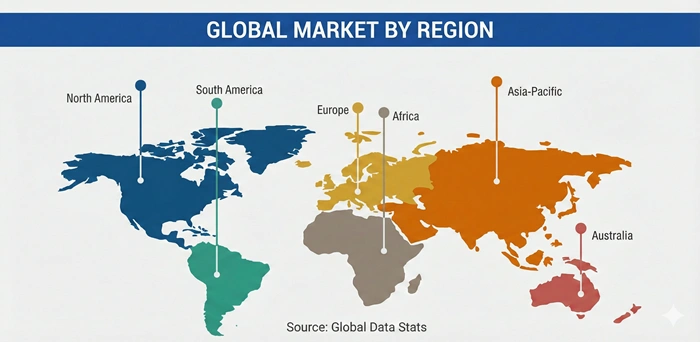
Regional Insights
North America
Market Leadership Through Advanced Infrastructure and Strategic Outsourcing Adoption
North America maintains dominant knowledge process outsourcing market leadership with substantial share and approximately 40% contribution to incremental market growth, reflecting the region's advanced technological infrastructure, early adoption of specialized outsourcing solutions, and strong demand from healthcare, BFSI, and information technology sectors requiring innovation-focused knowledge services. The regional market benefits from mature outsourcing acceptance among enterprises that view KPO as strategic enabler for competitive differentiation rather than simple cost reduction, creating larger average contract values and comprehensive multi-tower engagements. Corporate cultures emphasizing operational efficiency, shareholder value optimization, and digital transformation create favorable environments for outsourcing high-value knowledge functions to specialized providers offering superior expertise and capabilities.
The knowledge process outsourcing market in North America demonstrates robust CAGR of approximately 17.80% from 2026 to 2033 as market expansion in healthcare analytics, legal services, financial process outsourcing, and engineering research offset maturation in some established segments. Leading companies dominating the regional landscape include Accenture (United States) which maintains premier positioning through comprehensive capabilities and continuous acquisitions, Genpact (United States) leveraging deep BFSI expertise and digital transformation services, IBM (United States) combining KPO with technology consulting and infrastructure services, and ExlService Holdings (United States) focusing on analytics-driven knowledge services across insurance, healthcare, and financial sectors. Market dynamics reflect intensifying competition as global providers expand North American operations while regional boutique firms target specialized verticals including legal tech, healthcare analytics, and regulatory compliance where domain expertise creates defensible competitive advantages and premium pricing power.
Asia Pacific
Fastest Regional Growth Powered by Talent Availability and Cost Competitiveness
Asia Pacific emerges as the fastest-growing regional knowledge process outsourcing market with exceptional CAGR of 19.10% from 2026 to 2033, driven by vast skilled workforces, cost-efficient delivery models, government support initiatives, and rapid adoption of AI-enhanced research and analytics capabilities across India, Philippines, Vietnam, and Malaysia as preferred offshore destinations. The regional market benefits from deep domain talent pools with specialized expertise in finance, healthcare, legal services, engineering, and analytics combined with English language proficiency and favorable time zone positioning for serving Western clients. Educational infrastructure producing millions of qualified graduates annually, supportive government policies encouraging knowledge services industry development, and established technology ecosystems enable Asia Pacific to maintain competitive advantages in global KPO delivery.
The knowledge process outsourcing market in Asia Pacific demonstrates approximately 44% regional share with India serving as dominant hub followed by Philippines, China, and emerging locations across Southeast Asia. Regional market leaders include Tata Consultancy Services (India) offering comprehensive KPO services integrated with IT consulting and digital transformation, Wipro (India) combining domain expertise with technology capabilities across multiple industries, Infosys (India) delivering analytics-driven knowledge services and engineering research, Cognizant (United States with major India operations) providing specialized vertical solutions, and WNS (India) focusing on industry-specific BPS with knowledge-intensive components. Market expansion strategies emphasize moving up value chain from routine processing to advanced analytics, research services, and consulting that command higher rates while leveraging automation and AI to maintain cost competitiveness. The region faces emerging challenges including wage inflation, talent retention pressures from multinational direct hiring and Global Capability Center establishment, and infrastructure requirements for supporting sophisticated knowledge services that require ongoing investment by providers and government stakeholders to sustain competitive positioning.
Top Key Players
-
Accenture plc (Ireland/United States)
-
Genpact Limited (United States)
-
Tata Consultancy Services Limited (India)
-
Cognizant Technology Solutions Corporation (United States)
-
Infosys Limited (India)
-
Wipro Limited (India)
-
IBM Corporation (United States)
-
Capgemini SE (France)
-
ExlService Holdings Inc. (United States)
-
WNS (Holdings) Ltd. (India)
-
HCL Technologies Ltd. (India)
-
McKinsey & Company (United States)
-
Moody's Corporation (United States)
-
Oracle Corporation (United States)
-
SAP SE (Germany)
Recent Developments
-
Capgemini (2025): Completed strategic acquisition of WNS for approximately USD 3.3 billion, creating industry leader in agentic AI-powered intelligent operations and significantly expanding digital business process services capabilities across healthcare, financial services, and technology sectors with enhanced automation and analytics expertise.
-
Accenture (2025): Executed 23 acquisitions throughout the year including CyberCX representing largest cybersecurity acquisition, Percipient for banking digital twin platforms, TalentSprint for deep-tech education programs, NeuraFlash for Salesforce and generative AI consulting, and Decho for Palantir-powered transformation services, demonstrating aggressive growth strategy targeting AI, cybersecurity, and specialized consulting capabilities.
-
Genpact (2024-2025): Expanded analytics and AI capabilities through strategic investments in proprietary platforms and continued focus on industry-specific vertical solutions including healthcare life sciences, banking financial services, insurance, and consumer products with emphasis on digital transformation enablement and outcome-based engagement models.
-
Tata Consultancy Services (2025): Strengthened knowledge services portfolio through investments in AI research labs, partnerships with leading technology providers, and expansion of specialized delivery centers focused on engineering research services, financial analytics, and healthcare intelligence while navigating competitive talent market dynamics in India.
-
IBM (2025): Continued integration of consulting and technology services with emphasis on hybrid cloud, AI-powered automation, and industry-specific solutions while optimizing global delivery network to balance onshore strategic consulting with offshore knowledge services execution across multiple geographies and client segments.
Market Trends
Technology Integration and Strategic Partnership Models Reshape Competitive Dynamics
The knowledge process outsourcing market experiences fundamental transformation as providers evolve from labor arbitrage models to technology-enabled value creation paradigms where AI integration, automation platforms, and advanced analytics capabilities differentiate competitive positioning. Leading KPO providers invest substantially in proprietary technology development, strategic partnerships with enterprise software vendors, and acquisition of specialized boutique firms bringing targeted capabilities in areas such as generative AI, machine learning, natural language processing, and cognitive computing. This strategic shift reflects client demand for partners delivering innovation and continuous improvement beyond simple cost savings, with engagement structures incorporating outcome-based pricing, gain-sharing arrangements, and performance metrics tied to business impact rather than activity volumes. The knowledge process outsourcing market witnesses convergence between traditional IT services firms expanding into KPO, BPO providers moving upmarket into knowledge-intensive services, and pure-play KPO specialists defending positions through deep domain expertise and vertical specialization.
Hybrid delivery models gain prominence as enterprises balance cost optimization with risk mitigation concerns including data sovereignty, geopolitical uncertainties, and operational control preferences. The knowledge process outsourcing market responds through flexible architectures combining onshore strategic advisory and client-facing functions, nearshore coordination and specialized capabilities, and offshore high-volume execution that optimize economic efficiency while addressing client proximity and regulatory requirements. Sustainability considerations emerge as selection criteria as clients evaluate vendor environmental practices, social responsibility commitments, and governance frameworks alongside traditional service delivery metrics. Market consolidation accelerates through mergers and acquisitions as scale advantages, comprehensive service portfolios, and global delivery networks create competitive requirements that favor larger integrated providers while specialized boutique firms maintain niches through unique expertise or technological capabilities. The knowledge process outsourcing market evolution toward strategic outsourcing partnerships, multi-year engagements, and centers of excellence structures indicates industry maturation where long-term relationships, continuous innovation, and business outcome alignment replace transactional vendor relationships that characterized earlier market development phases.
Segments Covered in the Report
By Service Type:
-
Legal Process Outsourcing (LPO)
-
Financial Process Outsourcing (FPO)
-
Research and Development Outsourcing
-
Data Analytics and Business Intelligence
-
Healthcare and Medical Services
-
Engineering and Technical Services
-
Market Research and Consulting
-
Publishing and Content Services
-
Other Knowledge Services
By End User Industry:
-
Banking, Financial Services, and Insurance (BFSI)
-
Healthcare and Pharmaceuticals
-
Legal Services
-
Manufacturing and Engineering
-
Information Technology and Telecommunications
-
Retail and E-commerce
-
Media and Entertainment
-
Other Industries
By Enterprise Size:
-
Large Enterprises
-
Small and Medium Enterprises (SMEs)
By Delivery Model:
-
Offshore
-
Onshore
-
Nearshore
-
Hybrid
By Region:
-
North America (United States, Canada, Mexico)
-
Europe (United Kingdom, Germany, France, Netherlands, Rest of Europe)
-
Asia Pacific (India, Philippines, China, Malaysia, Vietnam, Australia, Rest of Asia Pacific)
-
Latin America (Brazil, Argentina, Rest of Latin America)
-
Middle East & Africa (UAE, Saudi Arabia, South Africa, Rest of MEA)
Frequently Asked Questions
Question 1: What is the knowledge process outsourcing market size and growth forecast?
Answer: The global knowledge process outsourcing market is valued at USD 87.68 billion in 2025 and projected to reach USD 246.47 billion by 2033, growing at a CAGR of 18.50% from 2026 to 2033. This exceptional growth reflects strategic transformation toward value-based outsourcing relationships.
Question 2: Which region dominates the knowledge process outsourcing market currently?
Answer: North America leads the knowledge process outsourcing market with dominant share and approximately 40% contribution to incremental growth, driven by advanced infrastructure and strategic adoption. Asia Pacific represents the fastest-growing region with 19.10% CAGR fueled by skilled talent pools and cost efficiency.
Question 3: What are the key drivers of knowledge process outsourcing market growth?
Answer: Primary drivers include widespread digital transformation initiatives, access to specialized expertise, escalating regulatory complexity, AI and automation integration, and cost optimization objectives. Strategic value recognition beyond simple cost reduction accelerates adoption across industries.
Question 4: Which service segment leads knowledge process outsourcing market expansion?
Answer: Legal Process Outsourcing represents the fastest-growing segment with 21.30% CAGR through 2033, driven by rising legal complexity and AI-powered tools. BFSI sector dominates with 28.40% market share requiring specialized regulatory compliance and financial analytics services.
Question 5: How is AI technology impacting the knowledge process outsourcing market?
Answer: AI integration fundamentally reshapes the knowledge process outsourcing market through automation, machine learning, and cognitive computing that reduce operational costs by 30-50% while improving accuracy. Generative AI creates entirely new service categories and transforms existing offerings through advanced capabilities.