
Knee Replacement Market Overview
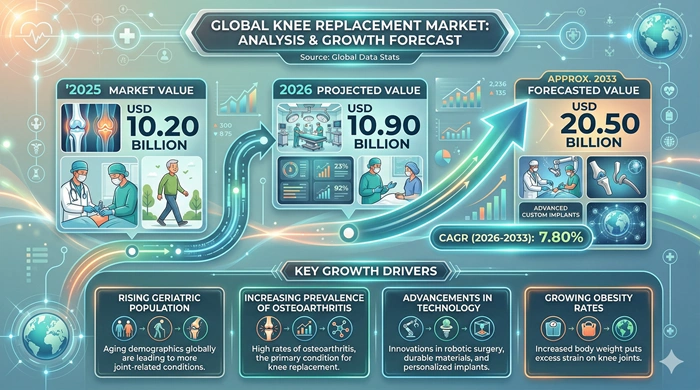
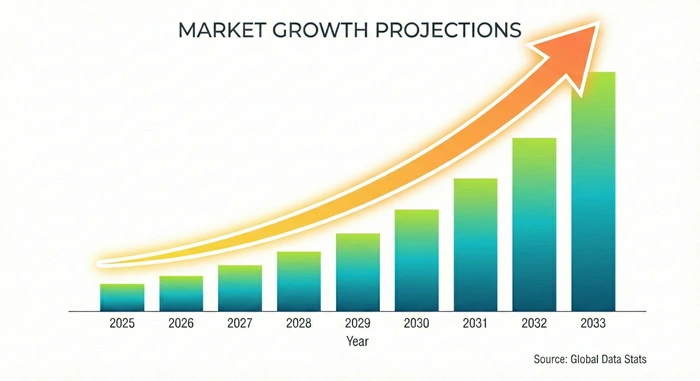
The global Knee Replacement market size is valued at USD 10.20 billion in 2025 and is predicted to increase from USD 10.90 billion in 2026 to approximately USD 20.50 billion by 2033, growing at a CAGR of 7.80% from 2026 to 2033.
Knee replacement surgery — also referred to as knee arthroplasty — is a well-established and increasingly performed orthopedic procedure in which damaged or worn knee joint surfaces are resurfaced with artificial implant components made from metal alloys, high-performance polyethylene, and ceramic materials to relieve chronic pain, restore joint function, and improve quality of life in patients with advanced knee osteoarthritis, rheumatoid arthritis, post-traumatic arthritis, and related degenerative joint conditions. The procedure encompasses total knee replacement — which resurfaces all three compartments of the knee joint — as well as partial knee replacement approaches that address a single diseased compartment while preserving healthy tissue, and revision procedures that replace or repair previously implanted knee components that have failed or worn beyond acceptable performance thresholds. The Knee Replacement market is experiencing consistent and commercially robust growth driven by the rising global prevalence of knee osteoarthritis — intensified by aging populations and the obesity epidemic — the progressive adoption of robotic-assisted surgical systems that are improving implant positioning accuracy and clinical outcomes, and the growing clinical willingness to perform knee arthroplasty procedures in younger and more active patients as implant material durability and longevity evidence strengthens.
AI Impact on the Knee Replacement Industry
Artificial Intelligence Is Transforming Preoperative Planning Accuracy, Robotic Surgical System Performance, Implant Size Prediction, Postoperative Outcome Monitoring, and Patient Selection for Knee Arthroplasty in Ways That Are Meaningfully Advancing Clinical Results and Commercial Adoption Across the Global Knee Replacement Market*
Artificial intelligence is delivering its most immediately impactful contributions to the Knee Replacement market through AI-powered preoperative surgical planning platforms — where machine learning algorithms analyze patient knee imaging data including X-rays, CT scans, and MRI studies to generate precise three-dimensional knee joint models, predict optimal implant size and positioning parameters, identify patient-specific anatomical variations requiring surgical adaptation, and simulate post-implantation mechanical alignment outcomes before a single surgical incision is made. Companies including Zimmer Biomet (Persona IQ), Stryker (Mako SmartRobotics), and Smith+Nephew (CORI Surgical System) are embedding AI-powered planning capabilities within their robotic and computer-navigated knee replacement platforms — enabling orthopedic surgeons to define highly personalized surgical plans based on patient-specific anatomy that the robotic execution system then implements with submillimeter precision during the procedure. This AI-enhanced planning and execution combination is progressively demonstrating improved implant alignment reproducibility, reduced soft tissue trauma, and faster patient recovery compared to conventional manual surgical techniques — generating growing surgeon and hospital administrator demand for AI-integrated knee arthroplasty platforms across leading orthopedic surgical centers globally.
AI is simultaneously advancing postoperative outcome monitoring and patient recovery management within the knee replacement market — where sensor-integrated smart implants and wearable motion analysis devices combined with machine learning outcome prediction algorithms enable continuous monitoring of implant performance, patient rehabilitation progress, and early detection of complications including infection, implant loosening, or component wear. Zimmer Biomet's Persona IQ smart knee implant — incorporating an embedded sensor that continuously measures patient step count, walking speed, gait symmetry, and range of motion — generates longitudinal functional outcome data that both informs individual patient recovery management and contributes to large-scale real-world implant performance datasets that AI models use to progressively refine outcome prediction capabilities. The progressive integration of AI-powered patient selection algorithms into orthopedic electronic health record systems — where machine learning models identify patients with knee osteoarthritis severity, functional limitation patterns, conservative treatment failure histories, and comorbidity profiles most likely to benefit from knee replacement surgery — is additionally improving the clinical appropriateness of surgical referral decisions and expanding the appropriately identified surgical candidate population within the existing osteoarthritis patient population.
Growth Factors
Rising Global Knee Osteoarthritis Prevalence Driven by Aging Populations and Obesity, Robotic Surgical System Adoption Improving Outcomes, Younger Patient Acceptance of Knee Arthroplasty, and Emerging Market Orthopedic Infrastructure Expansion Driving the Knee Replacement Market's Consistent Revenue Growth*
The most structurally significant and commercially durable growth driver of the Knee Replacement market is the escalating global prevalence of knee osteoarthritis — where the convergence of the world's aging population and the obesity epidemic is generating a continuously expanding patient population experiencing debilitating knee joint degeneration that ultimately requires surgical intervention after conservative management options are exhausted. Globally, knee osteoarthritis affects an estimated 365 million people — with prevalence increasing substantially in adults over 65, overweight and obese individuals whose excess body weight generates damaging mechanical stress across knee joint surfaces, and physically active populations experiencing sports-related joint injury that accelerates cartilage deterioration. The progressive increase in the proportion of adults aged 65 and over across North America, Europe, Japan, and increasingly China and India — combined with rising global obesity rates — is generating a structurally growing knee osteoarthritis patient population that translates directly into expanding knee replacement procedure volumes that sustain strong and predictable long-term Knee Replacement market revenue growth.
The rapid commercial adoption of robotic-assisted knee replacement systems — led by Stryker's Mako robotic platform, Smith+Nephew's CORI system, and Zimmer Biomet's Rosa Knee system — represents the second most commercially significant growth driver of the knee replacement market, driving both unit volume growth and average procedure revenue expansion simultaneously. Robotic-assisted knee replacement procedures are demonstrating measurable improvements in implant alignment accuracy, reduced bone resection volume, lower complication rates, and faster functional recovery compared to conventional manual technique — generating strong surgeon adoption demand and progressive hospital capital equipment investment as orthopedic programs seek competitive differentiation through robotic surgery capability. The growing clinical acceptance of total and partial knee replacement surgery in patients under 65 — historically a more conservative surgical indication — is additionally expanding the addressable patient population for knee arthroplasty procedures, as improved implant material longevity evidence demonstrates acceptable long-term outcomes in younger, more active recipients that progressively shifts clinical practice toward earlier surgical intervention in appropriately selected younger patients.
Market Outlook
With Robotic Knee Surgery Penetration Accelerating, Smart Implant Technology Advancing, Emerging Market Orthopedic Access Expanding, and Implant Material Innovation Extending Prosthesis Longevity, the Knee Replacement Market Outlook Is Strongly Positive Through 2033*
The long-term outlook for the Knee Replacement market is firmly positive and structurally well-supported — with a compelling combination of demographic-driven procedure volume growth, technology-driven outcome improvement, geographic market expansion, and premium implant product innovation collectively expected to sustain strong near double-digit revenue growth throughout the 2026–2033 forecast period. The most commercially transformative near-term development within the knee replacement ecosystem is the accelerating adoption of robotic-assisted surgical platforms across hospital and ambulatory surgical center settings — where Stryker's Mako system has already achieved significant installed base penetration in North American and European leading orthopedic centers, and competitive robotic platforms from Smith+Nephew, Zimmer Biomet, and Johnson & Johnson are progressively expanding robotic surgery access across a broader range of hospital facility types and geographic markets. As robotic system capital costs moderate and procedure efficiency improves through accumulated surgeon experience, robotic-assisted knee replacement is expected to transition from a differentiating premium service available only at high-volume academic centers to a broadly accessible standard-of-care surgical approach across a much wider range of orthopedic surgery settings globally.
The progressive development of smart knee implants — incorporating embedded sensors that continuously measure joint biomechanics, temperature, and activity metrics transmitted wirelessly to clinical monitoring systems — represents a particularly commercially interesting product innovation frontier within the knee replacement market that is generating growing surgeon and hospital administrator interest. Smart implant platforms enable entirely new categories of post-operative clinical monitoring, remote rehabilitation supervision, and long-term implant performance surveillance that conventional passive implants cannot support — creating premium product differentiation opportunities for implant manufacturers willing to invest in the sensor integration, data platform development, and regulatory validation required for commercial market entry. The enormous and largely underpenetrated emerging market orthopedic surgery opportunity — particularly across China, India, Brazil, and Southeast Asian healthcare systems that are rapidly building orthopedic surgical infrastructure and expanding public health insurance coverage for joint replacement procedures — represents a transformative long-term geographic expansion of the global Knee Replacement market addressable patient population that will generate substantial revenue growth throughout and beyond the forecast period.
Expert Speaks
-
Kevin Lobo, CEO, Stryker Corporation — "Robotic-assisted surgery is fundamentally changing how orthopedic surgeons approach knee replacement — enabling a level of precision and personalization in implant placement that was simply not achievable with conventional manual techniques, and generating measurable improvements in patient functional outcomes and recovery trajectories that are driving strong and accelerating clinical adoption of the Mako platform across our global orthopedic surgery customer base. The combination of robotic precision, AI-powered planning, and connected smart implant monitoring is transforming knee replacement from a standardized procedure into a highly personalized surgical experience — and Stryker is uniquely positioned to lead this technology-driven transformation across the global knee arthroplasty market."
-
Ivan Tornos, CEO, Zimmer Biomet — "The knee replacement market is undergoing a genuine technological renaissance — driven by the convergence of robotic surgical execution, AI-enhanced preoperative planning, smart implant performance monitoring, and data-driven outcome management tools that are collectively elevating the clinical standard of knee arthroplasty to levels that were not achievable even five years ago. Zimmer Biomet's comprehensive portfolio spanning Rosa Knee robotics, Persona IQ smart implant, and cementless implant technology positions us extremely well to benefit from the strong and demographically driven procedure volume growth that will characterize the knee replacement market throughout this decade."
-
Gary Blackford, CEO, Universal Hospital Services (Orthopedic Division) — "The combination of rapidly aging patient populations, rising obesity prevalence, and the growing clinical evidence supporting knee replacement in younger and more active patients is generating structural procedure volume growth in the knee arthroplasty market that orthopedic programs are actively investing in robotic and technology-assisted surgical capabilities to capture. Healthcare systems that invest strategically in robotic knee replacement platforms, surgeon training programs, and connected patient monitoring infrastructure are generating measurably better patient outcomes and stronger competitive positioning in an increasingly quality- and outcomes-differentiated orthopedic surgery market."
Key Report Takeaways
-
North America dominates the Knee Replacement market, holding approximately 42.80% of global market share in 2025, driven by the highest knee replacement procedure volumes globally — with the United States performing more than 750000 total knee replacement procedures annually — the most advanced robotic surgical system adoption across hospital and ambulatory surgical center settings, the strongest FDA companion diagnostic and implant approval framework, and the highest concentration of leading knee implant manufacturers including Stryker, Zimmer Biomet, Johnson & Johnson DePuy Synthes, and Smith+Nephew.
-
Asia Pacific is the fastest-growing regional market for knee replacement, projected to expand at a CAGR of approximately 9.80% from 2026 to 2033, driven by China's enormous and rapidly growing elderly population with high knee osteoarthritis prevalence, India's rapidly expanding private orthopedic hospital sector and rising middle-class healthcare utilization, and progressive national health insurance coverage expansion for knee arthroplasty procedures across major Asian economies that is progressively making surgical access financially viable for a much larger portion of the osteoarthritis patient population.
-
Total knee replacement is the dominant implant type segment, accounting for approximately 71.40% of total market revenue in 2025, reflecting the high proportion of advanced knee osteoarthritis patients requiring complete tri-compartmental joint resurfacing rather than single-compartment partial replacement — with cemented total knee replacement remaining the most widely performed fixation technique due to its well-established long-term outcome evidence and broad surgeon familiarity across global orthopedic surgery practice.
-
Robotic-assisted knee replacement is the fastest-growing procedure type segment, projected to expand at a CAGR of approximately 14.60% through 2033, driven by rapidly expanding hospital robotic platform installed base penetration, strong clinical evidence for robotic-assisted procedure accuracy and outcome advantages, growing surgeon training program investment across leading orthopedic centers, and progressive capital equipment cost moderation that is expanding robotic knee surgery access beyond elite academic medical centers to community hospital and ambulatory surgical center settings.
-
Hospitals are the dominant end user segment, contributing approximately 68.30% of total market revenue in 2025, reflecting the high-acuity surgical environment, post-operative monitoring capability, and comprehensive rehabilitation infrastructure that inpatient hospital settings provide for knee replacement procedures — particularly for complex primary and revision procedures in elderly and medically complex patients who require extended clinical supervision during the immediate post-surgical recovery period.
-
Cementless total knee replacement is the fastest-growing implant fixation subsegment, expected to grow at a CAGR of approximately 11.20% through 2033, driven by growing clinical evidence demonstrating superior long-term biological bone ingrowth fixation outcomes in younger and more active patients — generating strong adoption in the expanding younger patient knee arthroplasty population for whom implant longevity over multi-decade timeframes represents a particularly important clinical outcome priority.
Market Scope
| Report Coverage | Details |
|---|---|
| Market Size by 2033 | USD 20.50 Billion |
| Market Size by 2025 | USD 10.20 Billion |
| Market Size by 2026 | USD 10.90 Billion |
| Market Growth Rate (2026–2033) | CAGR of 7.80% |
| Dominating Region | North America |
| Fastest Growing Region | Asia Pacific |
| Base Year | 2025 |
| Forecast Period | 2026–2033 |
| Segments Covered | Implant Type, Material, Procedure Type, End User |
| Regions Covered | North America, Europe, Asia Pacific, Latin America, Middle East & Africa |
Market Dynamics
Drivers Impact Analysis
Rising Knee Osteoarthritis Prevalence from Aging and Obesity, Robotic Surgical System Adoption, Younger Patient Acceptance of Arthroplasty, and Emerging Market Orthopedic Infrastructure Growth Are the Core Pillars Driving the Knee Replacement Market*
| Driver | ≈ % Impact on CAGR Forecast | Geographic Relevance | Impact Timeline |
|---|---|---|---|
| Rising knee osteoarthritis prevalence driven by aging population and obesity epidemic | ~34% | Global | Short to Long-term |
| Rapid commercial adoption of robotic-assisted knee replacement surgical systems | ~27% | North America, Europe | Short to Long-term |
| Growing clinical acceptance of knee arthroplasty in younger and more active patients | ~22% | North America, Europe | Short to Medium-term |
| Emerging market orthopedic infrastructure expansion and insurance coverage growth | ~17% | Asia Pacific, Latin America | Short to Long-term |
The most commercially durable and structurally significant driver of the Knee Replacement market is the continuously escalating global prevalence of knee osteoarthritis — the leading indication for knee arthroplasty — where the simultaneous global trends of population aging, rising obesity rates, and growing rates of sports and physical activity-related knee injury are collectively generating a continuously expanding patient population experiencing progressive knee joint degeneration that ultimately reaches the severity threshold warranting surgical intervention. The United States alone is projected to experience a 50% increase in total knee replacement procedure volumes over the next decade — driven primarily by demographic aging and obesity prevalence trends — while China, India, and other rapidly aging emerging economies are expected to generate even larger absolute procedure volume growth as healthcare access barriers to knee arthroplasty progressively diminish. The compounding effect of a growing osteoarthritis patient population, progressive reduction in surgical age thresholds as implant longevity evidence improves, and increasing patient awareness of knee replacement as an effective quality-of-life intervention collectively generate a powerfully reinforcing demand dynamic that positions the knee replacement market for strong and structurally sustained procedure volume growth throughout the 2026–2033 forecast period.
The rapid commercial adoption of robotic-assisted surgical systems represents the most commercially transformative technology driver of the knee replacement market — where Stryker's Mako platform, Smith+Nephew's CORI system, Zimmer Biomet's Rosa Knee robot, and Johnson & Johnson's Velys system are collectively generating strong capital equipment and associated disposable implant and instrument revenue while simultaneously improving clinical outcomes in ways that are generating expanding surgeon adoption demand across global orthopedic surgery programs. Robotic-assisted procedures consistently demonstrate superior implant alignment reproducibility — reducing outlier positioning cases that represent a primary risk factor for early implant failure and revision surgery requirements — while enabling more precise bone conservation, better soft tissue balancing, and more personalized surgical execution based on real-time intraoperative anatomical data that conventional manual technique cannot achieve. The simultaneous revenue effect of robotic system capital equipment sales, premium robotic procedure implant and instrument kit pricing, and growing procedure volumes collectively amplify the revenue growth contribution of robotic adoption well beyond the proportional volume share that robotic procedures represent — generating a meaningful average revenue per procedure uplift across robotic-performing healthcare institutions that benefits leading implant manufacturers commercially.
Restraints Impact Analysis
High Implant and Surgical Procedure Costs, Reimbursement Pressure in Cost-Constrained Healthcare Systems, Surgeon Learning Curve for New Technologies, and Revision Surgery Risk Perception Moderating Faster Knee Replacement Market Penetration*
| Restraint | ≈ % Impact on CAGR Forecast | Geographic Relevance | Impact Timeline |
|---|---|---|---|
| High total procedure cost and implant pricing limiting access in cost-constrained markets | ~35% | Emerging markets, Rural settings | Short to Long-term |
| Reimbursement pressure and bundled payment model adoption constraining implant pricing | ~28% | North America, Europe | Short to Long-term |
| Robotic surgical system learning curve and capital investment barriers for smaller facilities | ~22% | Global — community hospitals | Short to Medium-term |
| Patient concerns regarding revision surgery requirements and long-term implant performance | ~15% | Global | Short to Long-term |
The most broadly experienced and commercially limiting barrier constraining faster knee replacement market penetration — particularly in emerging and price-sensitive healthcare markets — is the substantial total cost of knee arthroplasty procedures, encompassing implant component costs, operating room time expenses, anesthesia fees, post-surgical rehabilitation costs, and extended hospital stay requirements that collectively make knee replacement one of the more expensive elective surgical procedures within the orthopedic specialty. In the United States, the progressive shift toward bundled payment reimbursement models for knee replacement — where a single fixed payment covers all costs associated with the episode of care including the implant, procedure, hospitalization, and 90-day post-discharge care — is creating direct financial pressure on implant manufacturers to moderate implant pricing and on orthopedic programs to reduce length-of-stay and post-acute care utilization in ways that constrain premium implant adoption and average revenue per procedure growth. The considerable capital investment required for robotic surgical system installation — where Stryker's Mako system and comparable platforms require capital investment of USD 1.0 to USD 1.5 million plus ongoing service and disposable costs — represents a meaningful access barrier for smaller community hospitals, rural orthopedic programs, and healthcare systems in emerging markets that limits the geographic diffusion of robotic knee surgery beyond well-resourced leading orthopedic centers.
Patient awareness of revision surgery risk — where approximately 10–20% of total knee replacements ultimately require revision within 10–20 years for reasons including implant wear, loosening, infection, or component malposition — creates patient hesitancy regarding early surgical acceptance, particularly among younger patients who may require multiple revision procedures over their expected lifetime. This patient-level concern regarding long-term implant durability is intensified by high-profile media coverage of knee implant recall events and litigation surrounding specific implant designs in recent years — creating reputational headwinds that orthopedic manufacturers and clinical societies must actively address through comprehensive patient education programs, expanded long-term outcome registries, and transparent implant performance reporting. The combination of cost barriers, reimbursement pressures, capital investment requirements, and patient hesitancy collectively moderate the knee replacement market's growth trajectory below its theoretical maximum — representing commercially significant restraints that market participants must address through product innovation, procedure cost reduction, and patient engagement strategies.
Opportunities Impact Analysis
Robotic Surgery Platform Expansion to Ambulatory Settings, Cementless and Smart Implant Innovation, Outpatient Knee Arthroplasty Program Development, and Emerging Market Penetration Create Significant Knee Replacement Market Opportunities*
| Opportunity | ≈ % Impact on CAGR Forecast | Geographic Relevance | Impact Timeline |
|---|---|---|---|
| Robotic and technology-assisted surgery platform expansion to ambulatory surgical centers | ~31% | North America, Europe | Short to Medium-term |
| Cementless and smart implant technology development for younger, more active patients | ~27% | North America, Europe | Short to Long-term |
| Outpatient knee arthroplasty program development enabling same-day discharge procedures | ~25% | North America | Short to Medium-term |
| Emerging market insurance coverage expansion increasing knee replacement surgical access | ~17% | Asia Pacific, Latin America, MEA | Medium to Long-term |
The most commercially significant and near-term realizable opportunity within the Knee Replacement market is the progressive migration of knee arthroplasty procedures from inpatient hospital settings to ambulatory surgical centers — where the combination of enhanced recovery after surgery protocol advances, improved anesthesia techniques, better perioperative pain management, and patient optimization programs are enabling same-day or next-day discharge for appropriately selected knee replacement patients. Ambulatory surgical centers offer meaningfully lower per-procedure facility costs compared to inpatient hospital operating rooms — making them commercially attractive settings for orthopedic surgeons, payers, and patients seeking cost-effective knee replacement procedure options — with the progressive expansion of hospital robotic system technology into ASC settings creating the platform infrastructure required for high-quality robotic-assisted ambulatory knee arthroplasty that maintains the clinical outcome advantages of robotic surgery while achieving the cost efficiency of the ASC setting. Leading implant manufacturers including Stryker and Zimmer Biomet are actively developing ASC-optimized implant and instrumentation portfolios, robotic system configurations suited to ambulatory facility environments, and clinical efficiency tools specifically designed to support successful outpatient knee replacement program implementation.
The enormous and rapidly expanding knee replacement opportunity across major Asian, Latin American, and Middle Eastern healthcare markets — where growing elderly populations, rising osteoarthritis prevalence, increasing middle-class healthcare utilization, and progressive national health insurance coverage expansion for joint replacement procedures are collectively generating large new patient populations seeking knee arthroplasty access — represents perhaps the most commercially transformative long-term geographic growth opportunity for knee implant manufacturers over the 2026–2033 forecast period. China's progressively expanding urban hospital orthopedic surgery infrastructure, India's rapidly growing private hospital sector focused on joint replacement as a premium clinical service, and Brazil and Southeast Asian market healthcare system development collectively represent a large and currently underpenetrated knee replacement geographic market that international implant manufacturers are actively investing in through local manufacturing partnerships, surgeon training programs, value-segment implant development, and distributor network expansion. The combination of ambulatory surgery migration, smart implant innovation, cementless fixation technology advancement, and emerging market geographic expansion represents a commercially powerful and multi-dimensional opportunity set that positions the knee replacement market for strong growth well beyond the current forecast period.
Segment Analysis
By Implant Type
Total Knee Replacement Dominates the Knee Replacement Market Revenue While Partial Knee Replacement Registers the Fastest Growth Among Implant Subcategories*
Total knee replacement holds the clearly dominant position in the Knee Replacement market, accounting for approximately 71.40% of total global market revenue in 2025, driven by the high proportion of advanced knee osteoarthritis patients who present with tri-compartmental joint involvement requiring complete resurfacing of the femoral, tibial, and patellar joint surfaces — and by the extensive long-term outcome evidence base for total knee arthroplasty accumulated over more than four decades of clinical use globally that gives surgeons and patients high confidence in total knee replacement as the appropriate definitive treatment for end-stage knee arthritis. The cemented total knee replacement subsegment remains the most widely performed fixation technique globally — supported by decades of outcome registry evidence demonstrating reliable long-term fixation across diverse patient populations — while the cementless fixation segment is the fastest-growing total knee subsegment, expanding at approximately 11.20% CAGR as clinical evidence for biological bone ingrowth fixation in younger patients strengthens. North America generates the largest total knee replacement revenue — driven by the highest procedure volumes globally, the greatest robotic system adoption rate, and the strongest demand for premium implant technologies from well-insured patient populations — while Asia Pacific is the fastest-growing total knee replacement region as hospital infrastructure and insurance coverage expansion progressively bring total knee arthroplasty within reach of China and India's enormous and growing osteoarthritis patient populations. Leading companies including Zimmer Biomet, Stryker, Johnson & Johnson DePuy Synthes, and Smith+Nephew dominate the total Knee Replacement market globally through their comprehensive primary and revision total knee implant system portfolios.
Partial knee replacement — encompassing unicompartmental and bicompartmental implant approaches that resurface only the affected knee joint compartment while preserving healthy tissue — represents the most dynamically growing implant type subsegment within the knee replacement market, projected to expand at a CAGR of approximately 8.60% through 2033. Partial knee replacement offers clinically meaningful advantages for appropriately selected patients with single-compartment knee arthritis — including smaller surgical incisions, reduced bone and tissue sacrifice, faster functional recovery, preserved natural knee kinematics, and lower short-term complication rates compared to total knee replacement — making it an increasingly attractive surgical option as patient selection criteria refine and implant design improvements extend partial knee arthroplasty durability. Europe demonstrates the highest partial knee replacement adoption rate among major geographic markets — reflecting European orthopedic surgery culture's stronger historical emphasis on bone-conserving partial resurfacing approaches and the strong commercial presence of Stryker's Oxford Partial Knee system developed and clinically validated in the United Kingdom. Key companies serving the partial knee replacement market include Stryker (Oxford Partial Knee), Zimmer Biomet (Oxford Partial Knee distribution partnership), Exactech, and Corin Group — each advancing partial knee implant designs and patient selection tools to expand the eligible partial knee arthroplasty patient population.
By Procedure Type
Conventional Knee Replacement Maintains Volume Leadership While Robotic-Assisted Procedures Drive the Most Commercially Significant Revenue Growth*
Conventional manual technique knee replacement currently maintains volume leadership across the overall procedure type segment of the Knee Replacement market — reflecting the large established base of experienced orthopedic surgeons performing manual technique procedures, the procedure's well-validated long-term outcome evidence across diverse patient and implant combinations, and the continued cost-effectiveness of manual technique in healthcare settings where robotic capital investment is not yet justified by procedure volume or reimbursement rates. Conventional total knee replacement performed by highly experienced orthopedic surgeons at high-volume centers continues to achieve excellent clinical outcomes that compare favorably with early robotic system outcome data — maintaining the clinical credibility of manual technique as a high-quality standard of care approach that is not rapidly displaced but progressively complemented by technology-assisted alternatives. North America and Europe currently account for the largest conventional knee replacement procedure volumes globally — with thousands of experienced orthopedic surgeons performing high-quality manual technique procedures at established orthopedic programs — while Asia Pacific generates the fastest conventional volume growth as hospital infrastructure expansion and surgeon workforce development progressively increase procedure access across the region's large patient populations. Leading implant manufacturers serving conventional knee replacement procedures include Johnson & Johnson DePuy Synthes (ATTUNE Knee System), Zimmer Biomet (Persona Knee System), and Smith+Nephew (LEGION Total Knee System), each maintaining broad surgeon relationships built around their conventional technique implant portfolios.
Robotic-assisted knee replacement is the fastest-growing procedure type segment — projected at 14.60% CAGR through 2033 — as rapidly expanding robotic platform installed base penetration across leading orthopedic centers in North America and Europe generates growing procedure volumes, combined with progressive geographic adoption expansion as competitive robotic platforms from Stryker, Smith+Nephew, Zimmer Biomet, and Johnson & Johnson progressively penetrate mid-tier hospital markets that represent a much larger volume opportunity than the elite academic centers where robotic adoption initially concentrated. The clinical evidence supporting robotic-assisted procedure superiority in implant alignment accuracy, soft tissue preservation, and patient functional recovery is progressively strengthening through growing published outcome registry data — creating a reinforcing adoption cycle where better evidence drives greater surgeon and hospital adoption, which generates larger outcome datasets that further strengthen the evidence base. Asia Pacific is emerging as the fastest-growing robotic knee replacement adoption region — driven by Chinese and South Korean hospital systems' aggressive investment in cutting-edge surgical technology as a competitive differentiation strategy — while North America maintains clear robotic procedure revenue leadership through its high existing installed base density and premium procedure reimbursement rates.
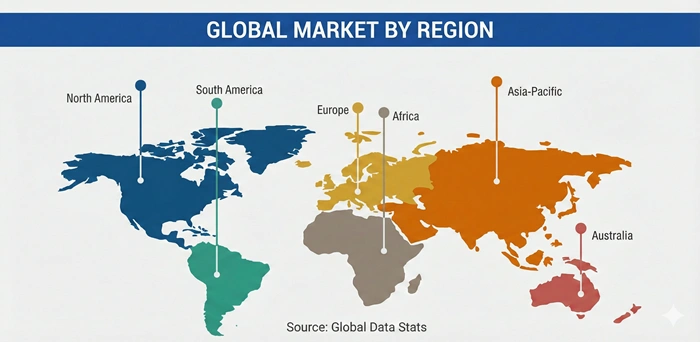
Regional Insights
North America
North America Leads the Global Knee Replacement Market at 42.80% Revenue Share, Driven by the World's Highest Procedure Volumes, Most Advanced Robotic Surgery Adoption, and Strongest Concentration of Leading Knee Implant Manufacturers*
North America holds the dominant position in the global Knee Replacement market, accounting for approximately 42.80% of total global market revenue in 2025, and is projected to sustain market leadership at a CAGR of approximately 7.40% from 2026 to 2033. The United States drives the overwhelming majority of North American revenue — generating more than 750000 total knee replacement procedures annually with the highest robotic surgical system penetration rate globally, the most comprehensive Medicare and commercial insurance reimbursement infrastructure for knee arthroplasty, and the world's largest concentration of leading knee implant manufacturers including Stryker (Kalamazoo, MI), Zimmer Biomet (Warsaw, IN), Johnson & Johnson DePuy Synthes, and Smith+Nephew North America. The North American market is leading global adoption of robotic-assisted knee arthroplasty — with Stryker's Mako platform commanding the largest robotic knee surgery installed base globally — as well as smart implant technology, outpatient knee arthroplasty program development, and cementless fixation expansion into older patient populations beyond its traditional younger patient indication.
Canada contributes meaningful orthopedic surgical volume to North American Knee Replacement market revenue — through its provincial public healthcare system's growing investment in reducing joint replacement waiting times and expanding procedural access for the country's aging population — while simultaneously demonstrating growing adoption of robotic surgical platforms in its leading academic orthopedic surgery centers. The progressive shift of knee replacement procedures to ambulatory surgical center settings — accelerating in North America as outpatient procedure protocols, enhanced recovery programs, and insurance reimbursement for outpatient knee arthroplasty mature — is generating new commercial opportunities for implant and technology manufacturers that develop products and workflows specifically optimized for the outpatient surgical environment. North America's combination of the world's largest procedure volume, highest technology adoption rates, and strongest implant manufacturer concentration positions it to sustain clear knee replacement market leadership through 2033.
Asia Pacific
Asia Pacific Is the Fastest-Growing Knee Replacement Market at 9.80% CAGR, Driven by China's Aging Population Scale, India's Growing Orthopedic Hospital Infrastructure, and Progressive Health Insurance Coverage Expansion Across the Region*
Asia Pacific is the fastest-growing regional segment in the Knee Replacement market, projected to expand at a CAGR of approximately 9.80% from 2026 to 2033 — the highest regional growth rate globally. China is the most commercially significant and rapidly growing Asia Pacific knee replacement market — where a population of more than 290 million adults over age 60 — the world's largest elderly population absolute count — combined with China's high rates of knee osteoarthritis and rapidly expanding hospital orthopedic surgery infrastructure is generating procedure volume growth that is among the fastest in any major healthcare market globally. India represents the second-largest and equally dynamic Asia Pacific knee replacement market — where the country's rapidly growing private hospital sector is aggressively expanding orthopedic surgery capability, the rising middle-class patient population is increasingly willing to pay for elective joint replacement procedures to maintain active lifestyles, and progressive government health insurance scheme expansion is progressively bringing knee replacement coverage to previously cost-excluded lower-income patient populations. Key companies serving the Asia Pacific Knee Replacement market include Johnson & Johnson DePuy Synthes Asia Pacific, Zimmer Biomet Asia Pacific, Stryker Asia, Smith+Nephew Asia, and domestic companies including Inor Implants (India) and Beijing Chunlizhengda Medical Instruments (China) that are developing competitive knee implant products for regional market deployment.
Japan and South Korea represent the most technologically advanced Asia Pacific knee replacement markets — with well-established public health insurance reimbursement for knee arthroplasty, strong domestic orthopedic implant manufacturing capabilities, and high clinical adoption of advanced implant technologies including robotic-assisted procedures at leading academic medical centers. Australia and New Zealand maintain well-functioning national joint replacement registries — providing high-quality long-term implant outcome data that informs both domestic clinical practice and global implant performance surveillance programs. The scale of Asia Pacific's aging population, combined with rapidly growing orthopedic surgery infrastructure investment and progressive insurance coverage expansion, positions the region as the most commercially dynamic and fastest-growing knee replacement market globally through 2033.
Top Key Players
-
Stryker Corporation (United States)
-
Zimmer Biomet Holdings Inc. (United States)
-
Johnson & Johnson MedTech — DePuy Synthes (United States)
-
Smith+Nephew plc (United Kingdom)
-
Exactech Inc. (United States)
-
Corin Group (United Kingdom)
-
Artivion Inc. (United States)
-
B. Braun Melsungen AG (Germany)
-
MicroPort Scientific Corporation (China)
-
Conformis Inc. (United States)
-
Medacta International SA (Switzerland)
-
Beijing Chunlizhengda Medical Instruments Co. Ltd. (China)
Recent Developments
-
Stryker Corporation (2025) — Reported continued strong global commercial adoption of its Mako robotic surgical system for total and partial knee replacement — with Mako-assisted procedures representing a growing proportion of total knee arthroplasty volume at Mako-installed hospital accounts — while simultaneously advancing the commercial rollout of its Triathlon X total knee system designed to optimize performance compatibility with the Mako robotic planning and execution platform and expanding Mako installation into mid-tier community hospital and ambulatory surgical center settings across North America and Europe.
-
Zimmer Biomet (2025) — Advanced the commercial launch of its Persona IQ smart knee implant — the world's first commercially available smart knee replacement incorporating an embedded tibial sensor measuring continuous patient activity and functional outcome metrics — while reporting strong commercial momentum for its Rosa Knee robotic system and announcing strategic partnerships with leading digital health platform developers to integrate Persona IQ outcome data into comprehensive patient recovery management applications for clinical and remote monitoring use.
-
Johnson & Johnson MedTech (2024) — Commercially launched the Velys Robotic-Assisted Solution for total knee arthroplasty — positioning its robotic platform as a table-mounted system with a smaller physical footprint and streamlined workflow integration compared to floor-based competitive robotic systems — while simultaneously reporting strong global growth for its ATTUNE Revision Knee System in the complex revision arthroplasty segment and advancing cementless fixation option expansion across its primary total knee implant portfolio.
-
Smith+Nephew (2025) — Reported continued strong international market expansion for its CORI Surgical System robotic-assisted platform — emphasizing CORI's compact table-mounted design advantage for facilities with limited operating room space including ambulatory surgical centers — while advancing the clinical validation program for its JOURNEY II XR total knee system and reporting growing adoption of its partial knee replacement portfolio across European and Australian orthopedic markets where unicompartmental arthroplasty adoption rates are historically higher than in North America.
-
Exactech Inc. (2024) — Received FDA clearance for expanded indications and design iterations of its Optetrak Logic total knee system following comprehensive post-market clinical data program completion — while simultaneously advancing commercial launch of its robotic-assisted surgical planning and execution platform for knee arthroplasty and reporting growing adoption of its GPS 3 navigation system for computer-assisted knee replacement surgery across North American and European orthopedic hospital accounts seeking technology-assisted alternatives to manual conventional technique at lower capital investment thresholds than full robotic systems require.
Market Trends
Robotic Precision Surgery Adoption, Smart Implant Data Integration, Outpatient Arthroplasty Program Expansion, and Personalized Implant Design Development Are the Most Commercially Defining Trends Reshaping the Knee Replacement Market Through 2033*
The most commercially transformative structural trend reshaping the Knee Replacement market is the accelerating penetration of robotic-assisted surgical systems across progressively broader categories of orthopedic surgical facilities — moving beyond initial early-adopter academic medical center installations toward systematic adoption across community hospitals, regional orthopedic specialty hospitals, and ambulatory surgical centers as capital costs moderate, surgeon training programs mature, and clinical outcome evidence accumulates. This robotic surgery diffusion trend is simultaneously driving premium implant attachment — where robotic system platforms generate strong commercial preference for the manufacturer's proprietary implant components optimized for robotic workflow compatibility — creating a powerful competitive dynamic where leading robotic platform developers including Stryker (Mako) and Zimmer Biomet (Rosa) are leveraging their installed base to drive implant portfolio preference and defend market share against conventional manual technique implant competitors. The progressive development of table-mounted compact robotic platforms — exemplified by Johnson & Johnson's Velys and Smith+Nephew's CORI systems — is additionally expanding robotic surgery accessibility to space-constrained operating room environments including ambulatory surgical centers that could not accommodate the larger floor-standing first-generation robotic systems, meaningfully accelerating the speed of robotic adoption diffusion across a broader facility type range.
The progressive integration of smart implant sensor technology, AI-powered outcome analytics, and digital rehabilitation platform connectivity into the knee replacement patient care pathway represents an equally significant structural trend that is transforming knee arthroplasty from a discrete surgical event into a continuously monitored and data-informed longitudinal care program. Zimmer Biomet's Persona IQ platform — combined with its mymobility digital patient engagement application — demonstrates the commercial potential of connected knee replacement ecosystems where implant performance data, patient-reported outcomes, rehabilitation compliance metrics, and clinical monitoring alerts are integrated into a single care management platform accessed by both patients and their clinical care teams. As smart implant manufacturing costs decline, regulatory frameworks for continuous implant monitoring mature, and payer recognition of connected care programs' cost-effectiveness evidence develops, smart knee replacement platforms are expected to progressively establish a premium product tier that generates substantially higher average revenue per procedure than conventional passive implant systems — driving both commercial value creation for leading manufacturers and improved patient outcome quality across the global knee replacement market.
Segments Covered in the Report
By Implant Type:
-
Total Knee Replacement
-
Cemented Total Knee Replacement
-
Cementless Total Knee Replacement
-
Hybrid Total Knee Replacement
-
Partial Knee Replacement
-
Unicompartmental Knee Replacement
-
Bicompartmental Knee Replacement
-
Revision Knee Replacement
By Material:
-
Cobalt-Chromium Alloys
-
Titanium Alloys
-
Polyethylene (Ultra-High Molecular Weight)
-
Zirconia
-
Others
By Procedure Type:
-
Conventional Knee Replacement
-
Minimally Invasive Knee Replacement
-
Robotic-Assisted Knee Replacement
-
Computer-Navigated Knee Replacement
By End User:
-
Hospitals
-
Orthopedic Clinics
-
Ambulatory Surgical Centers
-
Others
By Region:
-
North America
-
Europe
-
Asia Pacific
-
Latin America
-
Middle East & Africa
Frequently Asked Questions
Question 1: What is the current size of the Knee Replacement market and what is its projected value by 2033?
Answer: The Knee Replacement market was valued at USD 10.20 billion in 2025 and is projected to reach USD 20.50 billion by 2033, growing at a CAGR of 7.80% from 2026 to 2033. This strong growth is driven by rising global knee osteoarthritis prevalence from aging populations and obesity, rapid adoption of robotic-assisted surgical systems, growing clinical acceptance of knee arthroplasty in younger patients, and expanding emerging market orthopedic infrastructure investment.
Question 2: What are the main types of knee replacement procedures and implants available today?
Answer: The Knee Replacement market encompasses total knee replacement — resurfacing all three knee compartments — as the dominant implant type at approximately 71.40% revenue share, alongside partial knee replacement for single-compartment disease, and revision procedures replacing previously implanted components. Across procedure types, conventional manual technique remains the highest-volume approach globally while robotic-assisted knee replacement is the fastest-growing technology segment at approximately 14.60% CAGR through 2033 — progressively gaining share as clinical outcome evidence and robotic platform accessibility improve.
Question 3: How is robotic-assisted surgery changing the Knee Replacement market?
Answer: Robotic-assisted knee replacement systems from Stryker (Mako), Zimmer Biomet (Rosa Knee), Johnson & Johnson (Velys), and Smith+Nephew (CORI) are transforming the Knee Replacement market by enabling significantly more precise implant alignment, reduced soft tissue trauma, and more personalized surgical execution than conventional manual technique — generating measurable improvements in patient functional outcomes and recovery speed that are driving strong and accelerating clinical adoption across leading orthopedic programs globally. Robotic adoption is simultaneously driving premium implant attachment revenue and expanding into ambulatory surgical center settings — creating a powerful commercial growth dynamic that positions robotic-assisted procedures as the most strategically important growth segment within the knee arthroplasty market through 2033.
Question 4: Which region dominates the Knee Replacement market and which is growing the fastest?
Answer: North America dominates the Knee Replacement market with approximately 42.80% of global revenue in 2025 — driven by the world's highest knee replacement procedure volumes, leading robotic surgical system adoption, comprehensive payer reimbursement infrastructure, and the strongest concentration of global knee implant manufacturers. Asia Pacific is the fastest-growing region at approximately 9.80% CAGR through 2033 — driven by China's enormous aging population and rapidly expanding hospital orthopedic infrastructure, India's growing private healthcare sector, and progressive national health insurance coverage expansion for joint replacement procedures across major Asian economies.
Question 5: What is the outlook for smart knee implants in the Knee Replacement market?
Answer: Smart knee implants — incorporating embedded sensors that continuously measure patient activity, joint biomechanics, and functional recovery metrics transmitted wirelessly to clinical monitoring platforms — represent one of the most commercially promising product innovation frontiers in the Knee Replacement market, with Zimmer Biomet's Persona IQ establishing the first commercial smart knee implant platform and competitive smart implant programs advancing across other major manufacturers. As manufacturing costs for sensor integration decline and clinical evidence supporting smart implant patient outcome monitoring value accumulates, smart knee replacement platforms are expected to progressively establish a premium product tier that drives meaningfully higher average revenue per procedure for manufacturers and improved longitudinal patient care quality through continuous data-informed outcome management.