
IoT in Manufacturing Market Overview
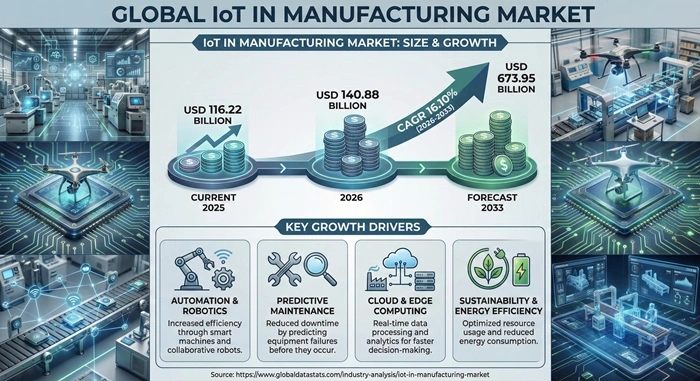
The global IoT in manufacturing market size is valued at USD 116.22 billion in 2025 and is predicted to increase from USD 140.88 billion in 2026 to approximately USD 673.95 billion by 2033, growing at a CAGR of 16.10% from 2026 to 2033. The Internet of Things in manufacturing represents the networking of physical equipment, machinery, sensors, and devices across production facilities, enabling real-time data collection, analysis, and automated decision-making that transforms traditional manufacturing into smart, connected industrial ecosystems. This technology leverages connected devices, cloud platforms, advanced analytics, and artificial intelligence to monitor equipment performance, optimize production processes, predict maintenance needs, and enhance operational efficiency throughout the manufacturing value chain.
The IoT in manufacturing market continues revolutionizing industrial operations through Industry 4.0 initiatives that integrate cyber-physical systems, creating intelligent factories where machines communicate autonomously, production lines adapt dynamically to demand fluctuations, and supply chains coordinate seamlessly across global networks. Organizations increasingly deploy IoT solutions to address competitive pressures requiring faster time-to-market, improved product quality, reduced operational costs, and enhanced customer responsiveness while navigating workforce shortages, sustainability mandates, and supply chain disruptions challenging traditional manufacturing models. The proliferation of affordable sensors, advancement of 5G connectivity, maturation of edge computing infrastructure, and integration with artificial intelligence and digital twin technologies drive sustained adoption across automotive, electronics, machinery, chemical, and consumer goods manufacturing sectors.
AI Impact on the IoT in Manufacturing Industry
Enabling Predictive Intelligence and Autonomous Decision-Making Across Production Systems
Artificial intelligence fundamentally transforms the IoT in manufacturing market by converting massive volumes of sensor data into actionable insights that enable predictive maintenance strategies, autonomous quality control, and self-optimizing production processes impossible through traditional analytics approaches. AI algorithms process real-time data from thousands of connected devices identifying subtle patterns indicating impending equipment failures, allowing manufacturers to schedule maintenance during planned downtime rather than experiencing unexpected breakdowns disrupting production schedules and causing costly delays. Machine learning models continuously improve by analyzing historical performance data, identifying correlations between operational parameters and quality outcomes, and automatically adjusting machine settings maintaining optimal output despite variations in raw materials, environmental conditions, or equipment wear.
Furthermore, AI-powered IoT manufacturing systems enable autonomous decision-making where production equipment self-diagnoses issues, reconfigures workflows responding to changing demand patterns, and coordinates with supply chain systems optimizing inventory levels without human intervention. Computer vision integrated with IoT sensors performs real-time quality inspection detecting defects invisible to human inspectors, while natural language processing analyzes maintenance logs and operator reports identifying recurring problems suggesting systematic issues requiring engineering intervention. Generative AI assists manufacturers by creating digital twins simulating production scenarios before physical implementation, optimizing factory layouts for maximum efficiency, and designing predictive models customized to specific equipment characteristics and operational contexts. The convergence of AI with IoT infrastructure creates intelligent manufacturing environments that continuously learn, adapt, and improve, delivering productivity gains and quality improvements exceeding capabilities of isolated automation systems lacking integrated intelligence.
Growth Factors
Industrial Automation Adoption and Operational Efficiency Demands Drive Market Expansion
The IoT in manufacturing market experiences robust growth driven by accelerating industrial automation adoption as manufacturers respond to global competition, rising labor costs, and quality consistency requirements that manual processes struggle to achieve reliably. Producers increasingly automate repetitive tasks, implement robotic assembly systems, and deploy automated material handling reducing direct labor costs while improving throughput, consistency, and product quality. IoT technologies enable this automation by providing real-time monitoring of automated equipment, coordinating complex multi-machine workflows, and ensuring seamless integration between manufacturing execution systems, enterprise resource planning platforms, and shop floor operations. The demand for mass customization where consumers expect personalized products delivered at mass production pricing requires flexible manufacturing systems that rapidly reconfigure production lines, and IoT provides the connectivity and intelligence enabling this agility.
Operational efficiency pressures from intensifying market competition, margin compression, and sustainability mandates drive IoT in manufacturing adoption as organizations seek to eliminate waste, optimize resource consumption, and maximize asset utilization. Manufacturers deploy IoT sensors monitoring energy consumption across facilities identifying optimization opportunities reducing utility costs, track material flows through production processes minimizing waste and rework, and implement predictive maintenance strategies extending equipment lifespans while reducing maintenance expenditures. Real-time production monitoring enabled by IoT allows managers to identify bottlenecks constraining throughput, optimize scheduling reducing changeover times, and improve overall equipment effectiveness measuring how efficiently production assets convert inputs into quality outputs. The increasing focus on sustainability and environmental responsibility creates additional incentives for IoT adoption as manufacturers track carbon emissions, monitor waste generation, and optimize processes reducing environmental footprints while meeting regulatory requirements and stakeholder expectations.
Market Outlook
Strong Growth Trajectory Supported by 5G Deployment and Digital Transformation Initiatives
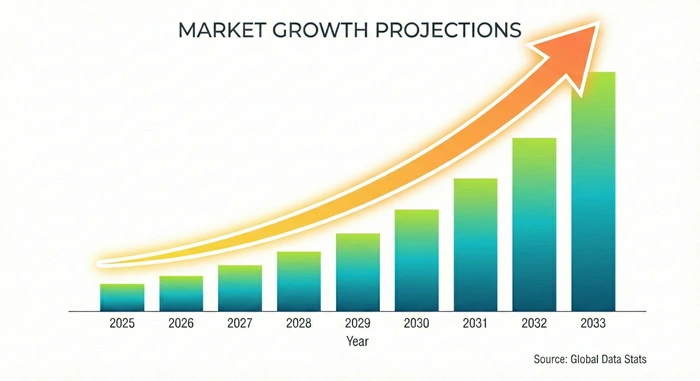
The IoT in manufacturing market demonstrates exceptional growth prospects through the forecast period, supported by global 5G network deployment enabling reliable low-latency connectivity supporting real-time control applications, massive sensor deployments generating actionable data, and edge computing processing reducing dependence on cloud infrastructure. North America maintains significant market share through advanced industrial infrastructure, early Industry 4.0 adoption, substantial technology investments by major manufacturers, and strong ecosystem of IoT solution providers, while Asia Pacific exhibits fastest growth rates driven by massive manufacturing capacity, government smart manufacturing initiatives, rapid industrialization across emerging economies, and aggressive technology adoption by Chinese, Japanese, and Korean manufacturers seeking global competitiveness.
Investment in the IoT in manufacturing market spans corporate spending on connected equipment and software platforms, venture capital funding for innovative IoT startups developing specialized manufacturing applications, and strategic acquisitions by established industrial automation vendors expanding IoT capabilities. The market benefits from increasing recognition that digital transformation represents strategic imperative rather than optional initiative, with manufacturers understanding that competitors leveraging IoT capabilities will achieve cost, quality, and speed advantages difficult to overcome through traditional approaches. Government programs including Germany's Industrie 4.0, China's Made in China 2025, and various smart manufacturing initiatives worldwide provide funding, infrastructure support, and policy frameworks accelerating adoption while addressing concerns around cybersecurity, data sovereignty, and workforce transition challenges requiring coordinated solutions beyond individual company capabilities.
Expert Speaks
-
Arpit Chhabra, CEO of IoTfy, stated that "digital-first expectations have made speed, intelligence, personalization, and transparency the cornerstones of IoTfy's AI-powered manufacturing vision, enabling brands to deliver future-ready, consumer-centric products at scale through intelligent, secure, and scalable IoT solutions".
-
Industry surveys reveal that "92% of manufacturers believe smart manufacturing will be the main driver for competitiveness over the next three years, while 85% of respondents believe their smart manufacturing initiatives will transform how products are made, improve agility, and attract new manufacturing talent".
-
Tony Hemmelgarn, CEO of Siemens Digital Industries, emphasized that "the real return on investment in manufacturing comes when you integrate digital tools together, enabling true productivity gains through systems approaches addressing multiphysics problems where software, mechanical, and electrical systems converge, pushing boundaries through customer collaboration".
Key Report Takeaways
-
North America leads the IoT in manufacturing market with the largest regional share of 30.72% in 2023, driven by advanced industrial infrastructure, early Industry 4.0 adoption, strong investments in smart manufacturing initiatives, and presence of major IoT solution providers across the United States and Canada
-
Asia Pacific emerges as the fastest-growing region during the forecast period with projected CAGR of 28.80%, fueled by rapid industrialization across China, Japan, India, and South Korea, government initiatives supporting manufacturing modernization, massive electronics and automotive production capacity, and aggressive digital transformation investments
-
Services segment dominates the offering category with 65.60% market share in 2025, driven by increasing demand for implementation, integration, consulting, training, maintenance, and managed services required to deploy and optimize complex IoT systems across manufacturing environments
-
Software solutions demonstrate the fastest growth rate with projected CAGR of 23.40% during the forecast period, as manufacturers invest in advanced analytics platforms, device management tools, and automation software enabling IoT functionality and delivering critical insights optimizing operations
-
Predictive maintenance holds the largest application segment share at 30% in 2025, transforming operational efficiency by utilizing IoT sensors and analytics to monitor equipment in real-time, predict failures before occurrence, minimize unplanned downtime, and reduce maintenance costs
-
Application management commands the largest platform segment share at 41% in 2024, driven by increasing need for efficient IoT application development, deployment, and monitoring enabling manufacturers to optimize operations through data-driven insights and productivity enhancements
Market Scope
| Report Coverage | Details |
|---|---|
| Market Size by 2033 | USD 673.95 Billion |
| Market Size by 2025 | USD 116.22 Billion |
| Market Size by 2026 | USD 140.88 Billion |
| Market Growth Rate from 2026 to 2033 | CAGR of 16.10% |
| Dominating Region | North America |
| Fastest Growing Region | Asia Pacific |
| Base Year | 2025 |
| Forecast Period | 2026 to 2033 |
| Segments Covered | Component, Platform, Offering, Application, Deployment Mode, Organization Size, Region |
| Regions Covered | North America, Europe, Asia Pacific, Latin America, Middle East & Africa |
Market Dynamics
Drivers Impact Analysis
Rising Demand for Smart Factory Implementation and Supply Chain Visibility
The increasing demand for smart factory implementation drives IoT in manufacturing market expansion as organizations transition from traditional production facilities into digitally connected environments where machines, systems, and humans collaborate through integrated technology platforms. Smart factories leverage IoT devices collecting real-time data from production equipment, environmental sensors, quality inspection systems, and material handling infrastructure, creating comprehensive visibility into operations enabling rapid response to issues and continuous optimization. Manufacturers deploy smart factory solutions to achieve flexible production accommodating customized products without sacrificing efficiency, implement lights-out manufacturing where facilities operate autonomously during non-business hours, and create digital twins simulating production processes before physical changes reducing implementation risks and costs.
Supply chain visibility requirements drive IoT in manufacturing adoption as organizations seek end-to-end transparency tracking materials from suppliers through production into distribution channels ensuring inventory accuracy, reducing stockouts, and improving delivery reliability. IoT sensors monitor shipment locations and conditions during transit, track work-in-process inventory moving through facilities, and coordinate with supplier systems enabling just-in-time delivery reducing carrying costs while maintaining production continuity. The increasing complexity of global supply chains spanning multiple continents, suppliers, and logistics providers creates coordination challenges that IoT addresses through real-time information sharing enabling all parties to anticipate disruptions, adjust plans proactively, and maintain service levels despite transportation delays, supplier issues, or demand fluctuations. The COVID-19 pandemic's exposure of supply chain vulnerabilities accelerated investments in visibility solutions as manufacturers recognized that reactive approaches to disruptions prove insufficient in volatile environments requiring predictive capabilities and rapid adaptation.
| Driver | ≈ Impact on CAGR Forecast | Geographic Relevance | Impact Timeline |
|---|---|---|---|
| Smart Factory Implementation and Industry 4.0 Adoption | High (+4-5%) | Global, particularly North America and Europe | Immediate to Long-term (2026-2033) |
| Supply Chain Visibility and Integration Requirements | High (+3-4%) | Global, particularly Asia Pacific and North America | Immediate to Long-term (2026-2033) |
Restraints Impact Analysis
Cybersecurity Concerns and Integration Complexity Challenges
Cybersecurity and data privacy concerns represent significant restraints affecting IoT in manufacturing market growth as increased connectivity creates expanded attack surfaces vulnerable to cyber threats including ransomware, data breaches, and operational disruptions. Manufacturing facilities incorporating thousands of connected devices, many lacking robust security features, create entry points for malicious actors seeking to steal intellectual property, disrupt production, or hold operations hostage demanding ransom payments. High-profile attacks on industrial facilities demonstrate real risks, making manufacturers cautious about expanding IoT deployments without comprehensive security strategies addressing device authentication, network segmentation, encryption, and continuous monitoring. Regulatory requirements around data protection add complexity as manufacturers must ensure IoT systems comply with various frameworks including GDPR, industry-specific regulations, and emerging cybersecurity mandates while maintaining operational efficiency.
Integration complexity creates barriers to IoT in manufacturing adoption as organizations struggle connecting diverse legacy equipment, modern IoT devices, enterprise software systems, and cloud platforms using incompatible protocols, data formats, and communication standards. Manufacturing facilities typically contain equipment spanning decades of technological evolution, much lacking connectivity capabilities designed into modern machinery, requiring expensive retrofitting or replacement to participate in IoT ecosystems. The proliferation of proprietary IoT platforms from different vendors creates interoperability challenges as manufacturers must navigate fragmented technology landscapes where solutions from one provider may not seamlessly integrate with competitors' offerings, forcing difficult choices between best-of-breed approaches requiring complex integration or single-vendor strategies limiting flexibility. The technical expertise required to implement, configure, and maintain complex IoT systems exceeds capabilities of many manufacturing organizations, particularly small and medium enterprises lacking dedicated IT resources, requiring external consultants or managed service providers adding costs and creating dependencies on third parties.
| Restraint | ≈ Impact on CAGR Forecast | Geographic Relevance | Impact Timeline |
|---|---|---|---|
| Cybersecurity Threats and Data Privacy Concerns | Medium (-2-3%) | Global, particularly regulated industries | Immediate to Long-term (2026-2033) |
| Integration Complexity and Legacy System Challenges | Medium (-2-3%) | Global, particularly SMEs and brownfield facilities | Immediate to Medium-term (2026-2030) |
Opportunities Impact Analysis
Edge Computing Integration and Sustainability Applications Expansion
The integration of edge computing with IoT infrastructure creates transformative opportunities for the IoT in manufacturing market by enabling real-time processing of sensor data at production sites rather than cloud data centers, reducing latency from hundreds of milliseconds to single digits required for time-critical control applications. Edge deployment addresses bandwidth constraints as manufacturers generate terabytes of data daily that prove impractical to transmit continuously to remote servers, enabling local processing extracting insights while transmitting only actionable information to centralized systems. Privacy and data sovereignty concerns favor edge computing as sensitive production data, intellectual property, and proprietary processes remain within facilities rather than transmitting to third-party cloud providers, while operational resilience improves as edge systems maintain functionality during network outages affecting cloud connectivity.
Sustainability applications present substantial growth opportunities as IoT in manufacturing enables comprehensive environmental monitoring, optimization, and reporting supporting corporate sustainability commitments and regulatory compliance. Manufacturers deploy IoT sensors tracking energy consumption at machine and facility levels identifying optimization opportunities reducing utility costs while lowering carbon footprints, monitor water usage and waste generation implementing circular economy practices minimizing environmental impacts, and measure emissions across operations demonstrating progress toward net-zero commitments. The increasing investor, customer, and regulatory pressure for environmental responsibility creates market demand for IoT solutions providing transparency into sustainability metrics, automating reporting requirements, and enabling data-driven decisions balancing operational efficiency with environmental stewardship. Digital twin technologies powered by IoT allow manufacturers to simulate production scenarios optimizing for sustainability outcomes including material efficiency, energy consumption, and waste reduction before implementing physical changes, while blockchain integration enables transparent tracking of products' environmental footprints throughout supply chains building consumer trust and premium positioning.
| Opportunity | ≈ Impact on CAGR Forecast | Geographic Relevance | Impact Timeline |
|---|---|---|---|
| Edge Computing Integration and Real-Time Processing | High (+4-5%) | Global, particularly industrial automation leaders | Immediate to Long-term (2026-2033) |
| Sustainability Applications and ESG Reporting | High (+3-4%) | Global, particularly Europe and North America | Medium to Long-term (2027-2033) |
Segment Analysis
Offering Analysis
Services Dominate Market While Software Solutions Demonstrate Rapid Growth
The services segment accounts for 65.60% of the IoT in manufacturing market share in 2025, driven by increasing demand for professional expertise implementing, integrating, and optimizing complex IoT ecosystems across manufacturing environments with diverse equipment, systems, and operational requirements. IoT services encompass consulting engagements helping manufacturers identify high-value use cases, assess technical readiness, and develop implementation roadmaps aligned with business objectives, while integration specialists connect IoT platforms with existing manufacturing execution systems, enterprise resource planning software, and operational technology infrastructure ensuring seamless information flow. Managed services prove particularly valuable as manufacturers lacking internal IT expertise outsource ongoing monitoring, maintenance, security management, and optimization of IoT deployments to specialized providers, allowing organizations to focus on core manufacturing competencies while leveraging advanced technologies.
The software solutions segment demonstrates the fastest projected growth rate at CAGR of 23.40% during the forecast period as manufacturers invest in advanced platforms enabling IoT functionality, analytics capabilities, and application development tools. IoT in manufacturing software includes device management platforms controlling thousands of connected sensors and machines, application management tools enabling custom workflow development, analytics engines processing massive data volumes extracting actionable insights, and visualization dashboards presenting real-time production metrics supporting rapid decision-making. The shift toward cloud-based software-as-a-service models reduces upfront capital investments traditionally required for enterprise software, provides scalability accommodating growth without infrastructure overprovisioning, and enables faster deployment compared to on-premises implementations requiring extensive customization. North America leads software adoption driven by mature technology markets and substantial enterprise software spending, while Asia Pacific exhibits rapid growth as manufacturers across China, India, and Southeast Asian nations accelerate digital transformation initiatives leveraging software platforms enabling competitive capabilities previously accessible only to global industry leaders.
Application Analysis
Predictive Maintenance Leads While Logistics Management Demonstrates Strong Growth
The predictive maintenance segment holds the largest share at 30% in the 2025 IoT in manufacturing market, driven by technology's transformative impact on operational efficiency through minimizing unplanned downtime, reducing maintenance costs, and extending equipment lifespans. Predictive maintenance utilizes IoT sensors continuously monitoring equipment vibration, temperature, pressure, and other parameters while machine learning algorithms analyze patterns identifying subtle changes indicating impending failures before breakdowns occur. This capability allows manufacturers to schedule maintenance during planned production breaks rather than experiencing unexpected equipment failures disrupting schedules, delaying customer orders, and requiring expensive emergency repairs often costing multiples of planned maintenance expenses. The segment benefits from proven return on investment as manufacturers quantify savings from reduced downtime, lower maintenance costs, and improved asset utilization justifying IoT investments to skeptical stakeholders.
The logistics and supply chain management segment exhibits the fastest projected CAGR of 26.80% during the forecast period as manufacturers recognize that production efficiency gains prove insufficient without corresponding supply chain optimization ensuring materials availability, finished goods delivery, and inventory optimization. IoT in manufacturing enables real-time tracking of materials through facilities identifying bottlenecks causing delays, monitors warehouse inventory levels triggering automatic replenishment preventing stockouts, and coordinates with transportation systems optimizing delivery routes and schedules. The increasing complexity of global supply chains and growing emphasis on just-in-time manufacturing minimizing inventory carrying costs create demand for sophisticated logistics management leveraging IoT connectivity and analytics. Europe leads logistics IoT adoption driven by sophisticated supply chains connecting multiple countries, extensive regulatory requirements around shipment tracking and documentation, and strong logistics industry providing infrastructure and expertise supporting implementation, while Asia Pacific demonstrates rapid growth as e-commerce expansion and manufacturing shifts create logistics complexity requiring technology solutions managing unprecedented volumes and velocity.
Regional Insights
North America
Industrial Infrastructure Maturity and Technology Leadership Drive Regional Dominance
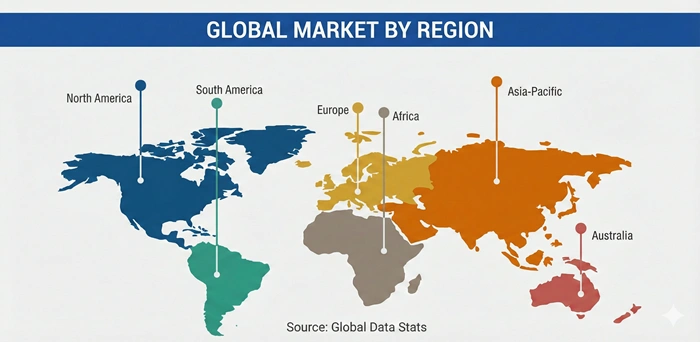
North America dominates the global IoT in manufacturing market with 30.72% market share in 2023, supported by sophisticated industrial infrastructure, early Industry 4.0 adoption across automotive and aerospace sectors, substantial corporate investments in digital transformation, and presence of leading IoT solution providers including Cisco, Microsoft, GE, Rockwell Automation, and PTC headquartered in the region. The United States leads North American activity with market value reaching USD 22.94 billion in 2025, driven by advanced manufacturing capabilities across diverse industries, high labor costs incentivizing automation investments, and technology-forward corporate cultures embracing innovation. The region benefits from strong collaboration between manufacturers, technology vendors, and research institutions advancing IoT capabilities, with organizations including Manufacturing USA institutes facilitating public-private partnerships developing next-generation manufacturing technologies.
The North American IoT in manufacturing market thrives due to government initiatives including the Advanced Manufacturing Partnership supporting Industry 4.0 adoption, tax incentives for capital equipment investments encouraging IoT-enabled machinery purchases, and cybersecurity frameworks providing guidance addressing industrial IoT security concerns. Major manufacturers including Ford, Boeing, Caterpillar, and Procter & Gamble demonstrate IoT leadership through smart factory implementations showcasing productivity improvements, quality enhancements, and operational insights achievable through connected manufacturing, creating benchmark examples inspiring broader adoption across industries. Canada contributes to regional growth through advanced manufacturing in automotive and aerospace sectors, government support for digital manufacturing initiatives, and strong technology ecosystem particularly around Toronto and Montreal. The region faces workforce challenges as aging manufacturing employees retire taking institutional knowledge while younger workers lack traditional manufacturing skills, creating urgency around digital systems capturing expertise and enabling less experienced operators to achieve productivity through technology assistance.
Asia Pacific
Rapid Industrialization and Government Support Fuel Fastest Regional Growth
Asia Pacific emerges as the fastest-growing region for the IoT in manufacturing market during the forecast period with projected CAGR of 28.80%, driven by massive manufacturing capacity concentrated across China, Japan, South Korea, and emerging Southeast Asian nations, rapid industrialization creating modern facilities built with connectivity capabilities, and aggressive government initiatives supporting Industry 4.0 adoption as economic development strategy. China dominates regional market activity with market value expected to reach USD 15.38 billion in 2025, driven by Made in China 2025 initiative prioritizing manufacturing upgrading, massive electronics and consumer goods production requiring efficiency improvements maintaining global competitiveness, and technology giants including Huawei, Alibaba, and Tencent developing industrial IoT platforms serving domestic and international markets. The region benefits from concentration of electronics manufacturing providing IoT hardware components at competitive prices, extensive 5G network deployment supporting industrial applications, and large pools of engineering talent supporting technology implementation and innovation.
The Asia Pacific IoT in manufacturing market demonstrates particular strength in discrete manufacturing sectors including automotive, electronics, and machinery where precision, quality consistency, and high-volume production drive IoT adoption. Japan contributes substantial market activity through advanced automotive and robotics industries implementing sophisticated IoT-enabled automation, while South Korea leverages electronics manufacturing leadership and government smart factory programs accelerating adoption across small and medium enterprises. India emerges as important growth market with expanding manufacturing sector, government Make in India initiative encouraging domestic production, rising labor costs incentivizing automation investments, and growing technology ecosystem developing localized IoT solutions addressing unique requirements of Indian manufacturing including power reliability challenges and varying technical sophistication levels. Southeast Asian nations including Vietnam, Thailand, and Indonesia exhibit rapid growth as manufacturing relocates from China seeking cost advantages and supply chain diversification, with governments offering incentives attracting foreign investment in modern facilities incorporating advanced manufacturing technologies from inception rather than retrofitting legacy operations.
Top Key Players
-
Cisco Systems Inc. (United States)
-
Rockwell Automation Inc. (United States)
-
General Electric Company (United States)
-
SAP SE (Germany)
-
Software AG (Germany)
-
Zebra Technologies Corporation (United States)
-
PTC Inc. (United States)
-
Microsoft Corporation (United States)
-
Siemens AG (Germany)
-
Schneider Electric SE (France)
-
Hitachi Ltd. (Japan)
-
IBM Corporation (United States)
-
Robert Bosch GmbH (Germany)
-
Texas Instruments Incorporated (United States)
-
Honeywell International Inc. (United States)
Recent Developments
-
2024: IBM Corporation partnered with ClearBlade to enable Edge IoT asset monitoring capabilities providing near-real-time asset management solutions allowing manufacturers to monitor equipment performance, predict maintenance requirements, and optimize operations through advanced edge computing integration
-
2024: Siemens AG expanded its Industrial IoT portfolio through continued development of MindSphere platform capabilities, enhancing connectivity between operational technology and information technology systems enabling comprehensive digital twin implementations across manufacturing facilities worldwide
-
2023: Microsoft Corporation enhanced Azure IoT services specifically targeting manufacturing applications, introducing advanced analytics capabilities, improved edge computing support, and strengthened security features addressing industrial cybersecurity concerns while enabling scalable IoT deployments
-
2023: Rockwell Automation Inc. announced strategic partnerships with cloud service providers expanding FactoryTalk platform capabilities, enabling manufacturers to leverage hybrid cloud architectures combining on-premises control with cloud-based analytics and centralized management across distributed operations
-
2022: General Electric launched Predix 2.0 with enhanced edge computing capabilities, improved developer tools, and expanded industry-specific application templates helping manufacturers accelerate IoT implementation timelines while reducing custom development requirements and associated costs
Market Trends
Digital Twin Technology and Generative AI Integration Transform Manufacturing Intelligence
The IoT in manufacturing market demonstrates clear trends toward digital twin technology enabling virtual representations of physical production assets, processes, and facilities synchronized with real-world operations through continuous IoT data feeds. Digital twins allow manufacturers to simulate production scenarios testing process changes, equipment configurations, and operational strategies virtually before physical implementation, reducing risks and costs associated with trial-and-error approaches on actual production lines. The technology enables predictive capabilities where digital models forecast equipment behavior, identify optimal maintenance timing, and recommend operational adjustments maximizing efficiency, while training applications allow operators to practice procedures in safe virtual environments before executing on actual equipment. The integration of IoT data with digital twins creates closed-loop systems where virtual models continuously update based on real-world performance while simulations inform physical operations, accelerating improvement cycles and enabling rapid adaptation to changing requirements.
Generative AI integration represents another significant trend as IoT in manufacturing systems leverage advanced language models and machine learning algorithms creating autonomous optimization capabilities, automated problem diagnosis, and intelligent assistance for human operators. Generative AI analyzes vast historical datasets from IoT sensors identifying patterns invisible to human analysts, automatically generating recommendations for process improvements, equipment settings, and maintenance schedules customized to specific operational contexts. The technology enables natural language interfaces where production managers query manufacturing systems conversationally receiving insights without specialized technical skills, while automated report generation summarizes complex operational data into actionable summaries for executive decision-making. The convergence of IoT data collection with generative AI analysis creates intelligent manufacturing environments that continuously learn, self-optimize, and provide decision support enhancing human capabilities rather than replacing experienced personnel, addressing workforce transition concerns while delivering productivity improvements exceeding capabilities of either technology deployed independently.
Segments Covered in the Report
By Component
-
Software
-
Services (Managed Services, Professional Services)
By Platform
-
Device Management
-
Application Management
-
Network Management
-
Connectivity Management Platform
By Offering
-
Software Solutions (Analytics Platforms, Device Management Tools, Automation Software)
-
Services (Consulting, Integration & Deployment, Training & Support, Managed Services)
By Application
-
Predictive Maintenance
-
Asset Performance Management
-
Asset Tracking & Management
-
Logistics & Supply Chain Management
-
Real-Time Workforce Tracking & Management
-
Quality Management
-
Emergency & Incident Management
-
Cognitive Process & Operations Management
By Deployment Mode
-
On-Premises
-
Cloud
-
Hybrid
By Organization Size
-
Small & Medium Enterprises
-
Large Enterprises
By Vertical
-
Process Manufacturing (Energy & Utilities, Chemical & Materials, Food & Beverages)
-
Discrete Manufacturing (Automotive, Machine Manufacturing, Semiconductor & Electronics, Medical Devices)
By Region
-
North America (United States, Canada, Mexico)
-
Europe (Germany, United Kingdom, France, Italy, Spain)
-
Asia Pacific (China, Japan, India, South Korea, Australia, Southeast Asia)
-
Latin America (Brazil, Argentina, Chile)
-
Middle East & Africa (UAE, Saudi Arabia, South Africa)
Frequently Asked Questions
Question 1: What is the IoT in manufacturing market size and projected growth?
Answer: The global IoT in manufacturing market is valued at USD 116.22 billion in 2025 and is predicted to reach USD 673.95 billion by 2033, growing at a CAGR of 16.10% from 2026 to 2033. This growth reflects increasing Industry 4.0 adoption, smart factory implementations, and demand for operational efficiency across global manufacturing sectors.
Question 2: Which region dominates the IoT in manufacturing market currently?
Answer: North America leads the IoT in manufacturing market with 30.72% market share in 2023, supported by advanced industrial infrastructure and early technology adoption. Asia Pacific demonstrates the fastest growth rate at CAGR of 28.80% driven by rapid industrialization, government manufacturing initiatives, and massive production capacity across China, Japan, and emerging economies.
Question 3: What applications drive the IoT in manufacturing market expansion?
Answer: Predictive maintenance holds the largest application share at 30% in 2025 through minimizing downtime and reducing costs, while logistics and supply chain management exhibits fastest growth at CAGR of 26.80%. Asset tracking, quality management, real-time workforce monitoring, and process optimization applications also contribute significantly to market development.
Question 4: How does the IoT in manufacturing market benefit from AI integration?
Answer: The IoT in manufacturing market leverages AI through predictive analytics enabling equipment failure forecasting, autonomous optimization automatically adjusting production parameters, and computer vision performing quality inspection. AI integration enables digital twins simulating operations, generative models recommending improvements, and intelligent systems supporting decision-making enhancing productivity and efficiency.
Question 5: What challenges affect IoT in manufacturing market adoption?
Answer: The IoT in manufacturing market faces challenges including cybersecurity threats creating attack vulnerabilities, integration complexity connecting diverse legacy systems, and high implementation costs requiring substantial investments. Data privacy concerns, interoperability issues between vendor platforms, and workforce skill gaps also constrain adoption particularly among small and medium manufacturing enterprises.