
Internet Security Market Overview
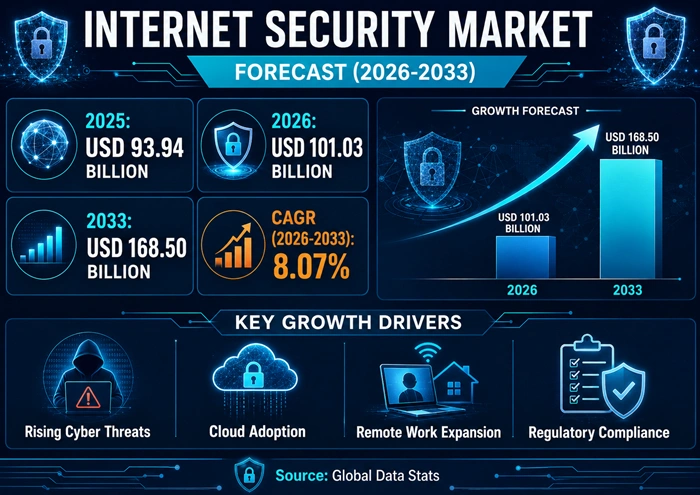
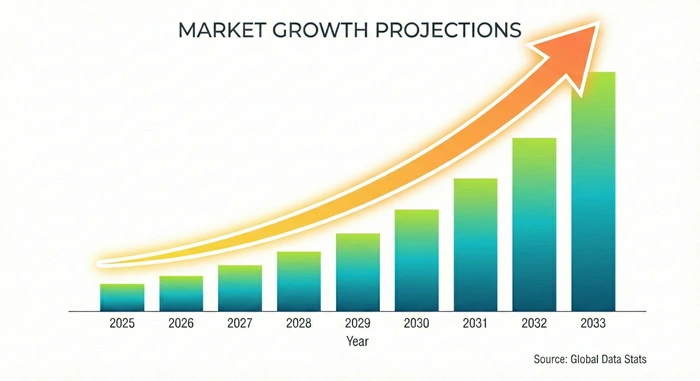
The global internet security market size is valued at USD 93.94 billion in 2025 and is predicted to increase from USD 101.03 billion in 2026 to approximately USD 168.50 billion by 2033, growing at a CAGR of 8.07% from 2026 to 2033.
As digital transformation accelerates across every sector of the global economy, the exposure of organizations and individuals to cyber threats is expanding at a pace that makes robust internet security infrastructure a non-negotiable business imperative. The escalating frequency and sophistication of ransomware attacks, state-sponsored intrusions, phishing campaigns, and data breaches are compelling enterprises across BFSI, healthcare, government, retail, and manufacturing to substantially increase their security technology spending. The growing adoption of cloud computing, remote work architectures, and connected IoT ecosystems is simultaneously expanding the digital attack surface that organizations must protect — creating strong, structurally embedded demand growth for the full spectrum of internet security solutions.
AI Impact on the Internet Security Industry
Artificial Intelligence Is Fundamentally Redefining Both the Attack and Defense Landscape of Internet Security, Creating Unprecedented Threat Intelligence Capabilities While Simultaneously Empowering More Sophisticated Adversaries
Artificial intelligence is transforming the internet security industry at its core — simultaneously arming defenders with powerful new capabilities and lowering the barrier for sophisticated cyberattacks. On the defensive side, AI-driven security platforms are enabling organizations to analyze billions of log events, network traffic records, and behavioral signals in real time — a scale of threat detection that would require thousands of human analysts to replicate manually. Machine learning models trained on vast threat intelligence datasets can identify subtle behavioral anomalies indicative of malware activity, lateral movement, and credential compromise within seconds of occurrence, dramatically compressing the detection-to-response window that determines how much damage a breach causes. Security operations centers (SOCs) deploying AI-augmented tools are seeing substantial reductions in analyst alert fatigue, mean-time-to-detect, and false positive rates — translating to measurably stronger security postures and lower total security operations costs per defended endpoint.
The offensive application of AI presents a genuinely alarming challenge for the internet security market. Generative AI tools are enabling cybercriminals with limited technical expertise to craft highly convincing phishing emails, impersonation content, and social engineering attacks at scale — undermining the user education strategies that organizations have relied on as a first line of phishing defense. AI-generated deepfake audio and video content is being exploited in business email compromise (BEC) attacks that bypass traditional email filtering, with documented cases of fraudulent wire transfers authorized based on AI-synthesized executive voice recordings. Large language models are also being used to rapidly develop and modify malware code — enabling threat actors to generate novel attack variants that evade signature-based detection systems at a speed that outpaces traditional update cycles. These developments are creating an urgent demand for AI-native security architectures capable of detecting threats by behavioral pattern recognition rather than known signature matching — representing the most significant product evolution the internet security market has experienced in its history.
Growth Factors
Escalating Cyber Threat Sophistication, Cloud Adoption, Regulatory Mandates, and the Expanding Digital Attack Surface Are Creating Multiple Interlocking Growth Levers That Sustain Long-Term Market Expansion
The most immediate and universally experienced growth driver in the internet security market is the relentless escalation in cyberattack frequency, scale, and sophistication across all industries and geographies. Global cybercrime costs are estimated to reach trillions of dollars annually — encompassing ransomware payments, business disruption costs, regulatory fines, legal liabilities, and reputational damage — creating a compelling financial case for security investment across organizations of every size. High-profile ransomware incidents targeting critical infrastructure, hospitals, financial institutions, and government agencies receive intense media coverage that accelerates board-level awareness of cyber risk and shortens budget approval cycles for security technology procurement. The emergence of Ransomware-as-a-Service (RaaS) platforms and cybercrime-as-a-service ecosystems has democratized access to sophisticated attack toolkits, dramatically expanding the threat actor population and making advanced attacks accessible to opportunistic criminals who previously lacked the technical capability to execute them.
The global migration of enterprise workloads to cloud platforms — and the associated collapse of traditional network perimeters — is creating a second fundamental growth driver that reshapes security architecture requirements rather than simply adding incremental protection layers. In on-premises architectures, organizations could protect assets by securing a defined network boundary; in cloud-native, multi-cloud, and hybrid environments, workloads, data, and identities span multiple providers and geographies simultaneously, requiring security controls that travel with data and identities rather than protecting a fixed perimeter. This architectural shift is driving strong demand for zero-trust network access (ZTNA) solutions, cloud security posture management (CSPM) tools, identity and access management (IAM) platforms, and cloud workload protection solutions — all of which represent high-growth segments within the internet security market that are expanding significantly faster than the overall market average. Growing regulatory compliance requirements — including NIS2 in Europe, SEC cybersecurity disclosure rules in the U.S., and sector-specific mandates across BFSI and healthcare — are further embedding security spending as a mandatory operational cost rather than a discretionary technology investment.
Market Outlook
The Internet Security Market Is Entering a Period of Platform Consolidation, AI-Native Security Adoption, and Zero-Trust Architecture Standardization That Will Reshape Competitive Dynamics Through 2033
The internet security market's outlook through 2033 is shaped by a defining structural transition from point-solution proliferation toward platform consolidation. Enterprise security teams have spent the past decade accumulating dozens of specialized security tools — endpoint protection, SIEM, email security, network detection, identity management, cloud security, and more — creating tool fatigue, integration complexity, and visibility gaps that sophisticated attackers exploit. Leading security vendors including Microsoft, Palo Alto Networks, CrowdStrike, and Fortinet are actively building unified security platforms that consolidate multiple security functions within integrated architectures, providing correlated threat intelligence across all protection domains from a single management interface. This consolidation trend is both narrowing the competitive field — favoring vendors with broad platform portfolios over niche point-solution providers — and expanding per-customer revenue as multi-product platform adoption increases average contract values across enterprise accounts.
The mandatory adoption of zero-trust architecture principles across U.S. federal government agencies — mandated by Executive Order 14028 — is creating a powerful reference framework that is accelerating zero-trust adoption across regulated industries and large enterprise segments globally. Zero-trust principles require continuous verification of every user, device, and workload requesting access to protected resources — a fundamentally different security model that renders traditional perimeter-based defenses obsolete and drives large-scale replacement procurement for identity, access, and network security technologies. By 2033, zero-trust architecture is expected to become the standard security framework across the majority of large enterprise deployments globally, creating a multi-year upgrade and modernization cycle that will sustain above-market growth rates in the identity, access management, and network security segments of the internet security market throughout the forecast period.
Expert Speaks
-
"Cybersecurity is no longer a technology issue — it is an enterprise risk issue that sits at the top of every board's agenda. The sophistication and persistence of today's threat actors demand that organizations move beyond reactive, compliance-driven security to proactive, intelligence-driven defense strategies that can adapt at the speed of the threat landscape." — Sundar Pichai, CEO, Alphabet / Google
-
"The proliferation of generative AI is creating both the greatest opportunity and the most significant challenge in the history of internet security. Security teams that deploy AI-native defense platforms will stay ahead of increasingly automated and personalized attack campaigns — while those that do not will face an asymmetric threat environment that puts their organizations at serious risk." — Satya Nadella, CEO, Microsoft
-
"Zero trust is not a product — it is a strategy. Organizations that embed zero-trust principles into their entire security architecture today are building the resilient, adaptive defenses required to protect their businesses in a world where the traditional network perimeter no longer exists and every identity is a potential attack vector." — Chuck Robbins, CEO, Cisco
Key Report Takeaways
-
North America leads the internet security market with over 38.4% of global 2024 revenues, driven by the world's highest concentration of enterprise technology organizations, the most active regulatory compliance environment including SEC, HIPAA, PCI-DSS, and federal zero-trust mandates, and sustained high levels of venture and corporate investment in cybersecurity technology innovation.
-
Asia Pacific is the fastest-growing region, recording a CAGR above the global market average, powered by rapid digital transformation across China, India, Japan, and South Korea, surging e-commerce and digital banking transaction volumes, and government-mandated national cybersecurity framework implementations across multiple APAC jurisdictions.
-
Large enterprises are the dominant end-user segment, accounting for approximately 65.2% of total 2024 market revenues, as complex multi-cloud environments, large employee and customer data estates, and stringent regulatory compliance requirements create both the greatest security surface area and the highest institutional willingness-to-pay for comprehensive internet security platforms.
-
Network security is the largest solution category, contributing approximately 30.7% of total 2024 revenues, reflecting the continued centrality of network traffic inspection, firewall management, and intrusion detection as foundational layers of enterprise security architecture even as cloud adoption progresses.
-
Cloud-based deployment is the most rapidly growing delivery model, advancing at approximately 13.6% CAGR through 2033, as organizations migrating workloads to public cloud platforms require security-as-a-service delivery models that provide consistent policy enforcement across distributed, multi-cloud environments without the management overhead of on-premises security appliances.
-
AI-driven threat detection and response is the fastest-growing future segment, expected to sustain a double-digit CAGR through 2033 with approximately 18.4% market share by 2030, as the escalation of AI-powered attack campaigns creates an urgent market for security platforms that use machine learning for real-time behavioral analysis, automated threat hunting, and AI-guided incident response across the full cyber kill chain.
Market Scope
| Report Coverage | Details |
|---|---|
| Market Size by 2033 | USD 168.50 Billion |
| Market Size by 2025 | USD 93.94 Billion |
| Market Size by 2026 | USD 101.03 Billion |
| Market Growth Rate from 2026 to 2033 | CAGR of 8.07% |
| Dominating Region | North America |
| Fastest Growing Region | Asia Pacific |
| Base Year | 2025 |
| Forecast Period | 2026 – 2033 |
| Segments Covered | By Solution Type, By Deployment Mode, By Organization Size, By End-User Vertical, By Region |
| Regions Covered | North America, Europe, Asia Pacific, Latin America, Middle East & Africa |
Market Dynamics
Drivers Impact Analysis
Soaring Cybercrime Costs, Cloud Infrastructure Expansion, and Regulatory Compliance Mandates Are the Structural Growth Engines Powering the Internet Security Market's Sustained Expansion
| Driver | ≈ % Impact on CAGR Forecast | Geographic Relevance | Impact Timeline |
|---|---|---|---|
| Escalating cyber threat frequency, sophistication, and financial impact | ~34% | Global | Long Term (≥ 4 years) |
| Cloud adoption and digital transformation driving security architecture renewal | ~29% | Global; North America and Europe lead | Long Term |
| Regulatory compliance mandates across BFSI, healthcare, and government | ~23% | North America, Europe, Asia Pacific | Medium to Long Term |
| AI-powered attack proliferation demanding AI-native security response platforms | ~14% | Global | Short to Medium Term |
The financial consequences of cyberattacks have reached a scale that positions internet security spending as essential business infrastructure rather than an optional IT cost. Average data breach costs now consistently exceed USD 4 million per incident across industries — and in highly regulated sectors including healthcare and financial services, breach costs including regulatory penalties, litigation expenses, and reputational damage can reach hundreds of millions of dollars. This economic reality has fundamentally transformed the security procurement decision from a technical infrastructure question to a risk management and business continuity imperative — shortening procurement cycles, expanding security budget authorizations, and driving adoption of comprehensive platform solutions over point products. The rise of cyber insurance as a risk management instrument has further institutionalized security investment, as insurers are now requiring documented evidence of specific security control implementations — including MFA, EDR, network monitoring, and patch management — as prerequisites for coverage qualification and premium optimization.
Cloud migration is reshaping the security architecture requirements and product preferences of organizations globally, creating powerful demand streams for next-generation security technologies that are displacing legacy on-premises solutions at an accelerating pace. Traditional perimeter security architectures — centered on on-premises firewalls, VPNs, and network access controls — provide inadequate protection for organizations operating hybrid cloud environments where data and workloads are continuously moving between on-premises, public cloud, and SaaS application environments. The shift to cloud-native security — encompassing CASB, CSPM, SASE, SSE, and cloud-delivered endpoint protection — is driving a generational equipment replacement cycle that is creating large new revenue opportunities for cloud-native security vendors while pressuring traditional appliance-based vendors to transform their delivery models. This architectural transition is expected to sustain above-average growth rates in the cloud security segment of the internet security market through 2033, with adoption accelerating across mid-market organizations that are completing their initial cloud migrations and now prioritizing cloud security posture improvements.
Restraints Impact Analysis
Cybersecurity Talent Shortages, Tool Complexity Fatigue, Budget Constraints Among SMEs, and Alert Fatigue in Security Operations Teams Are the Key Headwinds Limiting Market Growth Rate
| Restraint | ≈ % Impact on CAGR Forecast | Geographic Relevance | Impact Timeline |
|---|---|---|---|
| Global cybersecurity talent shortage limiting security program execution | ~35% | Global; most acute in developing markets | Medium to Long Term |
| Security tool proliferation creating integration complexity and management fatigue | ~28% | Global; most pronounced in large enterprises | Medium Term (2–4 years) |
| Budget constraints among SMEs limiting adoption of advanced security platforms | ~23% | LATAM, MEA, Southeast Asia | Medium Term |
| Alert fatigue reducing security team effectiveness despite tool investments | ~14% | Global | Short Term |
The global cybersecurity workforce gap remains the single most constraining operational challenge facing the internet security market's growth trajectory. Estimates consistently indicate a shortage of several million qualified cybersecurity professionals worldwide — a deficit that is widening rather than narrowing as digital transformation creates more security roles than training pipelines can fill. Organizations that purchase advanced internet security platforms often lack the skilled staff required to configure, operate, and extract full value from these tools — resulting in underutilized investments, misconfigured controls, and security capability gaps that undermine the ROI of technology spending. This talent constraint is simultaneously a restraint on market growth and an opportunity for managed security service providers (MSSPs) and security-as-a-service platforms that abstract technical complexity and deliver security outcomes without requiring in-house expertise.
The proliferation of security point solutions over the past decade has created a significant tool sprawl problem for enterprise security teams. The average large enterprise now operates between 45 and 70 distinct security tools — each with its own management interface, alert stream, data format, and update cycle. This fragmentation creates integration challenges, visibility gaps between tools, and analyst overwhelm from disconnected alert streams that collectively degrade security effectiveness despite high levels of technology investment. The remediation of this sprawl through platform consolidation is a growing procurement priority that benefits integrated platform vendors — but also represents a period of procurement pause while organizations rationalize existing investments rather than adding new solutions. This consolidation cycle can create temporary demand headwinds in specific security product categories even as overall market spending grows.
Opportunities Impact Analysis
Zero Trust Architecture Adoption, SME Market Penetration, Emerging Market Digitalization, and AI-Augmented Security Operations Are the Most Commercially Compelling Opportunities in the Internet Security Market
| Opportunity | ≈ % Impact on CAGR Forecast | Geographic Relevance | Impact Timeline |
|---|---|---|---|
| Zero-trust architecture adoption across enterprise and government sectors | ~33% | North America, Europe, Asia Pacific | Short to Medium Term |
| MSSP and security-as-a-service expansion into underserved SME market | ~28% | Global; LATAM, MEA, Southeast Asia priority | Medium Term (2–4 years) |
| Emerging market digital transformation creating first-time security investment | ~24% | India, Southeast Asia, Africa, LATAM | Medium to Long Term |
| AI-augmented SOC and automated threat response platform growth | ~15% | Global | Short Term |
Zero-trust architecture represents the most immediately actionable and commercially substantial opportunity across the internet security market in 2026. The U.S. federal government's zero-trust mandate, combined with equivalent framework adoption requirements being implemented across EU member states under NIS2 and in the U.K. under revised National Cyber Strategy guidelines, is creating mandatory procurement programs that span identity and access management, privileged access management, network micro-segmentation, endpoint detection and response, and security analytics — essentially requiring comprehensive security stack modernization across millions of enterprise and government organizations. Vendors positioned to offer integrated zero-trust platform solutions — including Microsoft, Palo Alto Networks, Zscaler, and Okta — are well-positioned to capture outsized shares of this regulatory-driven replacement cycle throughout the forecast period.
The global SME segment represents a massive, structurally underserved market opportunity for the internet security industry. Small and mid-sized businesses face security threats that are as sophisticated as those targeting large enterprises — indeed, they are disproportionately targeted by opportunistic attackers who recognize that their security defenses are typically weaker — but they lack the budget, staff, and technical expertise to deploy enterprise-grade security architectures. Managed security service providers and SaaS-delivered security platforms are steadily closing this gap by offering affordable, consumption-based security services that deliver enterprise-quality threat detection and response without requiring in-house security expertise. As MSSP business models mature, pricing becomes more accessible, and regulatory pressures begin applying to smaller businesses — particularly in regulated verticals like healthcare, finance, and critical infrastructure supply chains — the SME segment is expected to be a significant incremental growth contributor to the internet security market through 2033.
Segment Analysis
By Solution Type
Network Security Anchors the Market While Cloud Security and Identity Management Emerge as the Highest-Growth Solution Categories Reshaping the Internet Security Market's Future Revenue Mix
The network security segment holds the largest share of the internet security market at approximately 30.7% of 2024 revenues, reflecting the foundational role that network-level threat prevention plays in every organization's security architecture. This segment encompasses firewalls, intrusion detection and prevention systems (IDS/IPS), network traffic analysis tools, VPN solutions, DDoS mitigation services, and secure web gateways — collectively representing the first layer of defense against external threat actors attempting to infiltrate organizational networks. The segment is growing steadily in North America and Europe, driven by the need to upgrade legacy network security appliances to cloud-delivered, software-defined models capable of protecting hybrid environments where traffic flows across both on-premises and cloud-based resources simultaneously. Leading companies in the network security segment include Palo Alto Networks (United States), Fortinet (United States), Cisco Systems (United States), and Check Point Software Technologies (Israel) — all of which are actively evolving their product lines from hardware-centric appliance models to integrated SASE (Secure Access Service Edge) architectures that combine network and security functions in cloud-delivered platforms. The network security segment within the internet security market is expected to grow at a moderate CAGR through 2033, with the most dynamic growth occurring in the cloud-native and SASE sub-segments.
The cloud security segment is the fastest-growing solution type, advancing at approximately 13.6% CAGR through 2033, driven by the accelerating global migration of enterprise workloads to public cloud platforms and the growing complexity of multi-cloud security management. This segment includes cloud access security brokers (CASB), cloud security posture management (CSPM), cloud workload protection platforms (CWPP), cloud-native application protection platforms (CNAPP), and SaaS security posture management (SSPM) — all of which address the distinctive security challenges of cloud-native architectures that traditional perimeter security tools are structurally incapable of protecting. Asia Pacific is the fastest-growing region for cloud security adoption, as cloud migration is accelerating at a rapid pace across financial services, e-commerce, and manufacturing sectors in China, India, and Southeast Asia — creating large first-time procurement opportunities for cloud security platforms among organizations that are deploying cloud-first architectures without the legacy security infrastructure that constrains Western enterprises. Key companies leading the global cloud security market include Microsoft (United States), Palo Alto Networks (United States), CrowdStrike (United States), and Wiz Inc. (United States) — which has emerged as the fastest-growing cloud security startup in history through its CNAPP platform.
By End-User Vertical
BFSI Dominates Current Revenues While Healthcare and Government Represent the Fastest-Growing Verticals as Regulatory Pressure and Attack Frequency Drive Mandatory Security Investment
The BFSI (Banking, Financial Services, and Insurance) vertical is the largest end-user segment in the internet security market, contributing approximately 24.8% of total 2024 revenues, driven by the extreme sensitivity of financial data, the direct financial motivation of threat actors targeting BFSI systems, and the most demanding regulatory compliance environment of any industry sector. Financial institutions must comply with PCI-DSS for payment card security, SOX for financial reporting systems integrity, GLBA for customer financial data protection, and a growing array of sector-specific cybersecurity frameworks including the NYDFS Cybersecurity Regulation and the EU's DORA (Digital Operational Resilience Act) — creating mandatory, multi-year security investment programs that are locked in by regulatory obligation rather than discretionary budget cycles. North America and Europe dominate BFSI internet security spending, with key companies serving this vertical including IBM Security (United States), Broadcom (United States), Thales Group (France), and Palo Alto Networks (United States), which offer comprehensive compliance automation and financial sector threat intelligence capabilities alongside core security platform functionality. The BFSI segment is growing at a steady mid-single-digit CAGR, with the most dynamic growth occurring in fintech and digital banking sub-verticals that are deploying cloud-native security architectures for the first time.
The healthcare vertical is the fastest-growing end-user segment within the internet security market, expected to sustain a CAGR above the overall market average through 2033, as the digitalization of patient records, the proliferation of connected medical devices, and the extreme sensitivity of protected health information (PHI) combine to create an urgent security imperative across hospital systems, pharmaceutical companies, and healthcare technology providers. Healthcare organizations have become among the most frequently targeted victims of ransomware attacks globally — with attackers recognizing that the critical, life-dependent nature of healthcare services creates maximum pressure for rapid ransom payments. The financial and reputational damage of healthcare data breaches — which carry the highest average breach cost of any industry sector — is driving substantial increases in security technology investment across healthcare systems of all sizes. The United States is the dominant market for healthcare internet security given HIPAA compliance obligations and the large installed base of major health systems and pharmaceutical companies, with Asia Pacific emerging as the fastest-growing regional healthcare security market as the region's health digitalization programs accelerate.
Regional Insights
North America
North America's Technology Leadership, Dense Regulatory Compliance Environment, and World-Leading Cybersecurity Innovation Ecosystem Sustain Its Dominant Position in the Global Internet Security Market
The U.S. Federal Zero-Trust Mandate, Active SEC Cybersecurity Disclosure Rules, and Extraordinary Enterprise Security Spending Collectively Create North America's Enduring Market Revenue Leadership
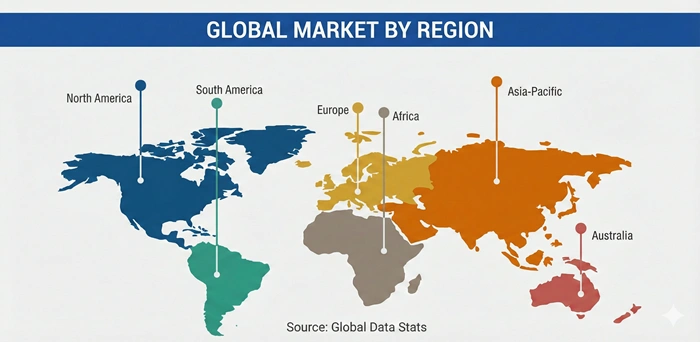
North America leads the internet security market with approximately 38.4% of global 2024 revenues, a position grounded in the region's unmatched combination of enterprise technology adoption, regulatory compliance intensity, and cybersecurity innovation density. The United States is the world's largest single internet security market, accounting for the overwhelming majority of North American revenues through a combination of enterprise security platform adoption, government cybersecurity investment under initiatives including the National Cybersecurity Strategy, and a thriving startup ecosystem that consistently produces globally significant security technology companies. Key companies anchoring the North American market include Microsoft (United States), Palo Alto Networks (United States), CrowdStrike (United States), Fortinet (United States), Broadcom / Symantec (United States), IBM Security (United States), and Cisco Systems (United States) — collectively representing multiple global leaders in network, endpoint, cloud, and identity security. North America is growing at a consistent mid-single-digit to low-double-digit CAGR within the internet security market, with growth concentrated in cloud security, identity management, and AI-driven threat detection platforms.
Canada contributes meaningfully to regional security spending through a large and sophisticated financial services sector, a growing technology industry, and government cybersecurity investment programs under the National Cyber Security Strategy. The Canadian Securities Administrators are also moving toward U.S.-aligned cybersecurity disclosure requirements for public companies, creating additional compliance-driven security investment across the country's capital markets participants. Mexico represents a fast-growing opportunity within North America as its manufacturing export sector modernizes and foreign direct investment in automotive, aerospace, and technology manufacturing increases the country's exposure to sophisticated supply chain attacks — driving growing institutional demand for enterprise-grade internet security across its expanding industrial and financial services sectors.
Asia Pacific
Asia Pacific's Extraordinary Digital Transformation Velocity, Rapidly Maturing Regulatory Frameworks, and the World's Largest Expanding Cyberthreat Surface Make It the Fastest-Growing Internet Security Market Region
Government Cybersecurity Investment Programs, E-Commerce Scale, and Rising Awareness of State-Sponsored Threat Actors Are Combining to Fuel APAC's Accelerating Internet Security Market Growth
Asia Pacific is the fastest-growing region in the internet security market, recording a CAGR above the global average driven by the extraordinary pace of digital transformation and the rapidly expanding cyber threat landscape across the region's major economies. China, India, Japan, South Korea, and Australia are the primary growth contributors, collectively representing a combination of massive digital infrastructure scale, increasingly sophisticated regulatory security requirements, and a rising frequency of nation-state and cybercriminal attacks targeting the region's financial, government, and critical infrastructure sectors. Japan's revised Cybersecurity Basic Act, India's Digital Personal Data Protection Act, and South Korea's Information Security Industry Promotion Act are among the policy frameworks creating mandatory security investment requirements across their respective markets — adding compliance-driven procurement to the region's already strong organically driven demand. Key companies leading the Asia Pacific internet security market include NTT Group (Japan), Trend Micro Inc. (Japan), Kaspersky Lab (Russia, strong regional presence), Samsung SDS (South Korea), and Tata Consultancy Services (India), alongside the global platform vendors expanding their APAC go-to-market capabilities.
India stands out as the most dynamically growing internet security market within Asia Pacific, driven by the rapid digitalization of its financial services sector under UPI and digital banking initiatives, the world's second-largest smartphone user population generating enormous mobile security demand, and a growing number of high-profile cyber incidents targeting government services and critical infrastructure that have elevated national security awareness. The Indian government's CERT-In reporting mandate — which requires organizations to report cybersecurity incidents within six hours — has raised board-level awareness of cyber risk and accelerated security platform procurement across both public and private sector organizations. Southeast Asian markets including Singapore, Indonesia, and Vietnam are also growing rapidly as regional digital economy expansion drives both enterprise and SME security investment, with Singapore emerging as a significant regional hub for internet security vendor operations and managed security service delivery.
Report Customization Available for All Regions and Countries
This Report Offers Full Region-Wise and Country-Wise Customization, Providing Organizations With the Precise Internet Security Market Intelligence Required to Support Geography-Specific Strategic Decisions
This report is available for comprehensive customization at the region and country level, delivering internet security market sizing, local competitive landscape analysis, regulatory framework assessments, threat landscape intelligence, and growth opportunity mapping tailored exactly to the geographic market your organization is targeting. From global platform vendors evaluating regional expansion priorities to investors assessing country-specific cybersecurity market maturity, the customized report delivers the precise intelligence your team needs.
Customized reports are available for the following regions and countries, with detailed market insights, analysis, and opportunities tailored to the selected geography:
North America
-
Customized insights available for U.S., Canada, and Mexico, covering federal zero-trust mandate impacts, SEC cybersecurity disclosure rule compliance demand, enterprise security platform adoption rates, regional threat actor profiles, and country-level competitive intelligence for the internet security market.
Europe
-
Tailored analysis available for U.K., Germany, France, Italy, and Rest of Europe, including NIS2 compliance procurement impacts, GDPR security enforcement trends, DORA requirements for BFSI, national cybersecurity strategy investment programs, and country-specific market dynamics.
Asia Pacific
-
Detailed coverage for China, India, Japan, South Korea, Australia, and Rest of Asia Pacific, encompassing national cybersecurity legislation impacts, digital economy growth correlation with security demand, regional threat actor intelligence, and country-level vendor competitive landscapes.
Latin America
-
Country-level customization for Brazil, Argentina, and Rest of Latin America, covering LGPD data protection compliance requirements, digital banking security demand, manufacturing sector cybersecurity investment trends, and regional MSSP market development.
Middle East & Africa
-
Targeted intelligence for UAE, Saudi Arabia, and Rest of MEA, addressing Vision 2030 digital transformation security requirements, critical infrastructure protection investment, financial sector cybersecurity regulations, and emerging market security adoption dynamics.
Top Key Players
-
Microsoft Corporation (United States)
-
Palo Alto Networks Inc. (United States)
-
CrowdStrike Holdings Inc. (United States)
-
Fortinet Inc. (United States)
-
Cisco Systems Inc. (United States)
-
Broadcom Inc. / Symantec (United States)
-
IBM Corporation (United States)
-
Check Point Software Technologies Ltd. (Israel)
-
Trend Micro Inc. (Japan)
-
Zscaler Inc. (United States)
-
Okta Inc. (United States)
-
McAfee Corp. (United States)
-
Kaspersky Lab (Russia)
-
NortonLifeLock Inc. (United States)
-
Thales Group (France)
Recent Developments
-
In April 2025, Palo Alto Networks completed the acquisition of IBM's QRadar SaaS cloud security operations platform assets, significantly expanding its AI-driven security operations center capabilities and adding thousands of enterprise accounts to its Cortex XSIAM platform — accelerating the company's strategy of consolidating the enterprise security operations market around a single AI-native platform.
-
In February 2025, CrowdStrike launched Falcon Exposure Management, an AI-powered attack surface management module within its Falcon platform, which integrates continuous discovery of internal and external attack surface assets with real-time vulnerability prioritization and automated remediation workflows — extending the company's platform scope from endpoint protection to full-spectrum exposure management.
-
In November 2024, Microsoft announced the general availability of Microsoft Security Copilot for all enterprise customers, marking the first large-scale commercial deployment of a generative AI assistant embedded directly within a major security operations platform — enabling SOC analysts to query threat intelligence, investigate alerts, and generate incident response reports through natural language interfaces that dramatically reduce analysis time.
-
In September 2024, Zscaler launched Zero Trust Everywhere, a comprehensive SASE platform update that introduced AI-powered data loss prevention with real-time generative AI content inspection capabilities — directly addressing the growing risk of employees inadvertently sharing sensitive organizational data with public large language model platforms through corporate devices.
-
In July 2024, Fortinet acquired Lacework, a leading cloud-native application protection platform (CNAPP) vendor, for an undisclosed sum, significantly bolstering Fortinet's cloud security portfolio and enabling the company to offer integrated threat detection across network, endpoint, and multi-cloud environments from a single vendor platform — a key competitive requirement for large enterprise internet security procurement decisions.
Market Trends
AI-Native Security Platform Adoption and the Convergence of Network, Cloud, and Identity Security Into Unified SASE Architectures Are the Defining Structural Trends of the Internet Security Market
The most consequential trend reshaping the internet security market is the accelerating transition from human-paced, tool-dependent security operations to AI-automated, platform-driven threat detection and response. Traditional security operations models — where human analysts manually investigate alerts generated by disconnected security tools and coordinate incident response across multiple teams — are structurally unable to keep pace with the volume, speed, and polymorphic nature of modern cyberattacks. AI-native security platforms that continuously ingest and correlate telemetry from endpoints, networks, cloud workloads, identities, and applications — and automatically triage, investigate, and respond to threats with minimal human intervention — are rapidly becoming the competitive standard for enterprise security architecture. Vendors that have built AI capabilities natively into their platform architectures, including CrowdStrike's Charlotte AI and Microsoft's Security Copilot, are demonstrating measurably faster detection and response outcomes that are driving strong competitive displacement of legacy security information and event management (SIEM) tools across the enterprise market.
Simultaneously, the convergence of networking and security into unified SASE (Secure Access Service Edge) and SSE (Security Service Edge) architectures is fundamentally changing how organizations purchase and operate their internet security infrastructure. SASE integrates SD-WAN, zero-trust network access, cloud access security brokerage, secure web gateway, and firewall-as-a-service into a single, cloud-delivered platform that provides consistent security policy enforcement regardless of where users, devices, or workloads are located. This architectural convergence simplifies security management, reduces total cost of ownership, and aligns security policy with the distributed, mobile-first, cloud-first reality of modern enterprise IT environments. The SASE market is growing at a double-digit CAGR — substantially faster than the overall internet security market average — as enterprises replace end-of-life perimeter security appliances and VPN concentrators with cloud-delivered SASE platforms that can simultaneously serve remote workers, branch offices, cloud applications, and partner access use cases from unified, globally distributed infrastructure.
Segments Covered in the Report
-
By Solution Type
-
Network Security (Firewalls, IDS/IPS, DDoS Mitigation, VPN, Secure Web Gateway)
-
Cloud Security (CASB, CSPM, CNAPP, CWPP, SSPM)
-
Endpoint Security (EDR, XDR, Antivirus, Device Management)
-
Identity and Access Management (IAM, PAM, MFA, SSO)
-
Email Security (Anti-Phishing, Secure Email Gateway, DMARC)
-
Application Security (WAF, API Security, DAST/SAST)
-
Security Operations (SIEM, SOAR, Threat Intelligence, MDR)
-
-
By Deployment Mode
-
On-Premises
-
Cloud-Based / SaaS
-
Hybrid
-
-
By Organization Size
-
Large Enterprises
-
Small and Medium-Sized Enterprises (SMEs)
-
-
By End-User Vertical
-
BFSI
-
Healthcare
-
Government & Defense
-
IT & Telecommunications
-
Retail & E-Commerce
-
Manufacturing
-
Energy & Utilities
-
Others
-
-
By Region
-
North America (U.S., Canada, Mexico)
-
Europe (U.K., Germany, France, Italy, Rest of Europe)
-
Asia Pacific (China, India, Japan, South Korea, Australia, Rest of Asia Pacific)
-
Latin America (Brazil, Argentina, Rest of Latin America)
-
Middle East & Africa (UAE, Saudi Arabia, Rest of MEA)
-
❝ Built for Every Level — From Startups to Industry Giants ❞
Here Is Exactly How This Report Works for You
-
From cybersecurity startups identifying the highest-growth market segments and least-saturated regional opportunity windows, to Tier 1 platform vendors benchmarking their product portfolio coverage against the full solution landscape, this report delivers the segment-level CAGR data, regional market share breakdowns, and competitive revenue intelligence required to identify precisely where the internet security market is concentrating its fastest growth — and what go-to-market, product positioning, and partnership strategies leading companies are deploying to capture it.
-
For investors, corporate development teams, and enterprise security buyers navigating the intersection of geopolitical risk — including nation-state cyber threats, cross-border data localization regulations, technology export controls, and supply chain security mandates — with rapidly evolving security technology markets, this report provides a rigorous, evidence-based analytical framework covering all major global regions, enabling confident capital allocation and strategic partnership decisions in an environment of increasing policy complexity and adversarial sophistication.
-
The full purchased version of this report includes complete competitor revenue profiles with detailed product revenue source breakdowns, demand-supply dynamics analysis, country-level market sizing, leading vendor market share tables, and a multi-scenario forecast framework covering base-case and accelerated-threat trajectories through 2033 — providing CISO decision-makers, technology investors, and corporate strategy teams with the comprehensive intelligence required to build winning, future-proof internet security business and investment strategies.
Frequently Asked Questions
Question 1: What is the current size of the internet security market and what growth is forecast through 2033?
Answer: The global internet security market is valued at USD 93.94 billion in 2025 and is projected to reach USD 168.50 billion by 2033, growing at a CAGR of 8.07% from 2026 to 2033. This sustained expansion is driven by escalating cyber threat sophistication, the global shift to cloud-native architectures, and mandatory regulatory compliance programs requiring security investment across all major industries and geographies.
Question 2: Which region leads the internet security market?
Answer: North America dominates the internet security market with approximately 38.4% of global 2024 revenues, driven by the highest concentration of enterprise technology organizations, the most demanding regulatory compliance environment, and the world's most active cybersecurity innovation ecosystem. Asia Pacific is the fastest-growing region, recording above-average CAGR through 2033 powered by accelerating digital transformation and rapidly maturing national cybersecurity regulatory frameworks.
Question 3: What are the key drivers in the internet security market?
Answer: The internet security market is primarily driven by the relentless escalation of ransomware, phishing, and state-sponsored cyberattacks that create urgent organizational demand for advanced threat protection, cloud adoption that dismantles traditional network perimeters and drives security architecture renewal, and an increasingly stringent regulatory environment across BFSI, healthcare, and government sectors. The proliferation of AI-powered attack tools is additionally creating an urgent competitive dynamic that is accelerating enterprise migration to AI-native security platforms.
Question 4: What are the main challenges affecting the internet security market?
Answer: The internet security market faces significant headwinds from a global cybersecurity workforce shortage estimated in the millions — limiting organizations' ability to operate advanced security platforms at full effectiveness. Security tool proliferation creating fragmented, difficult-to-manage tool estates and persistent SME budget constraints in developing markets are additional structural challenges that moderate adoption rates and create operational gaps even where technology investment is present.
Question 5: How is the zero-trust model shaping the future of the internet security market?
Answer: Zero-trust architecture is fundamentally reshaping procurement priorities across the internet security market, as U.S. federal mandates, EU NIS2 requirements, and enterprise risk management imperatives drive large-scale replacement of legacy perimeter-based security systems with identity-centric, continuously verified access control architectures. This regulatory and strategic shift is creating multi-year technology refresh cycles across enterprise and government segments globally that are sustaining above-average growth rates in identity, network, and cloud security solution categories through 2033.