
Interactive Voice Response Market Overview
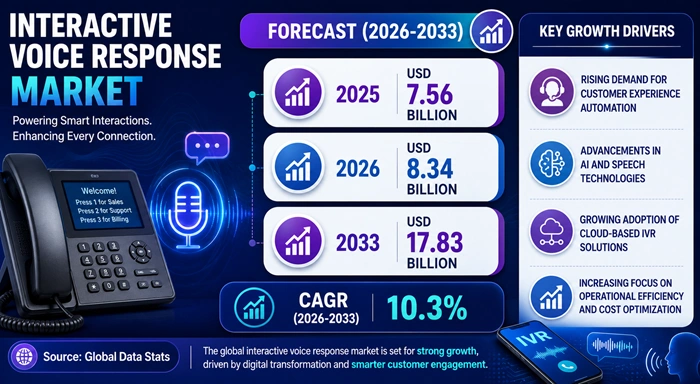
The global interactive voice response market size is valued at USD 7.56 billion in 2025 and is predicted to increase from USD 8.34 billion in 2026 to approximately USD 17.83 billion by 2033, growing at a CAGR of 10.3% from 2026 to 2033.
Interactive voice response (IVR) technology enables automated telephone systems to interact with callers, gather information, and route calls to the appropriate department or self-service resource using voice or keypad inputs. The IVR market is gaining significant momentum as businesses across industries prioritize customer experience automation, operational cost reduction, and 24/7 service availability. The convergence of AI, cloud computing, and natural language processing is transforming IVR from a basic call-routing tool into a sophisticated conversational self-service platform.
AI Impact on the Interactive Voice Response Industry
Artificial Intelligence and Natural Language Processing Are Fundamentally Transforming IVR Systems From Rigid Keypad-Based Menus Into Intelligent, Conversational Customer Engagement Platforms
Artificial intelligence is the single most disruptive technology reshaping the interactive voice response industry today. Traditional DTMF (dual-tone multi-frequency) IVR systems that forced callers through rigid menu trees are being rapidly replaced by conversational AI platforms that understand natural spoken language, interpret caller intent, and respond intelligently without requiring callers to memorize numbered menu options. Large language models (LLMs) and advanced speech recognition engines are enabling IVR systems to handle complex, multi-turn conversations that previously required a live human agent, dramatically expanding the range of tasks that can be automated through voice self-service.
Voice biometrics is another AI-powered capability that is transforming the IVR market. Financial institutions, telecommunications providers, and government agencies are integrating voice authentication into their IVR systems to verify caller identities passively — in the background as the call begins — eliminating the need for lengthy security question sequences and reducing the risk of account fraud. AI-driven sentiment analysis is also being embedded in IVR platforms to detect caller frustration in real time and automatically escalate calls to a live agent before a negative experience compounds, improving both customer satisfaction scores and first-call resolution rates.
Growth Factors
Rising Demand for Customer Service Automation, the Mass Adoption of Cloud-Based Contact Centers, and the Proliferation of AI-Enhanced Self-Service Are the Primary Forces Accelerating the Interactive Voice Response Market
The interactive voice response market is driven fundamentally by the universal business imperative to handle growing call volumes more efficiently without proportional increases in agent headcount. Contact centers managing hundreds of thousands of calls per month can reduce cost-per-interaction dramatically by deflecting routine inquiries — balance checks, appointment scheduling, order tracking, and payment processing — to AI-powered IVR self-service. With labor costs for contact center agents rising globally and customer expectations for instant service availability growing simultaneously, the business case for IVR automation has never been stronger.
The rapid adoption of cloud-based contact center platforms is equally central to market growth. Cloud IVR solutions eliminate the capital expenditure and IT management burden associated with on-premises telephony infrastructure, making sophisticated IVR capabilities accessible to mid-market and SME organizations that could not previously afford enterprise-grade systems. Cloud platforms also enable rapid feature updates, AI model improvements, and seamless integration with CRM, ticketing, and workforce management systems — capabilities that are essential in a market moving toward omnichannel customer engagement. As enterprises migrate their contact center operations to cloud platforms at scale, the interactive voice response market grows in direct proportion.
Market Outlook
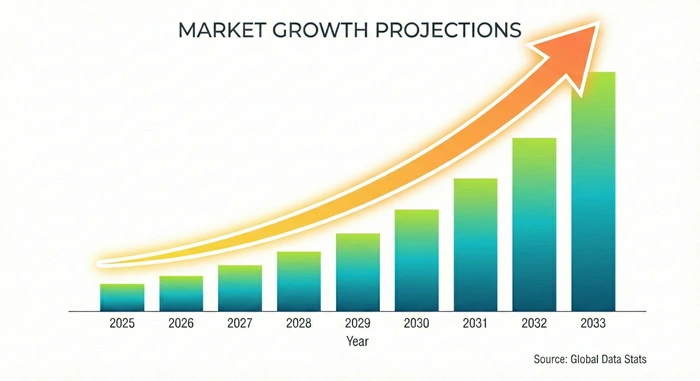
The Interactive Voice Response Market Is Set for Sustained Double-Digit Growth Through 2033, Powered by Conversational AI Adoption, API Integration Ecosystems, and the Global Shift to Cloud Contact Center Architectures
The medium-to-long-term outlook for the interactive voice response market is exceptionally positive, underpinned by several powerful and reinforcing technology trends. Conversational AI adoption is accelerating across every industry vertical that relies on telephone-based customer service, with natural language IVR deployments proving their commercial value through measurable improvements in containment rates, customer satisfaction scores, and agent utilization. As AI models continue to improve in their ability to handle complex, ambiguous, and multilingual conversations, the range of interactions suitable for IVR automation will continue to expand.
The integration of IVR with broader customer experience platforms — including CCaaS, CRM, and unified communications as a service (UCaaS) — is creating an ecosystem of interconnected voice and digital channels that elevates the strategic importance of IVR beyond simple call deflection. Modern IVR is increasingly the entry point for a seamless omnichannel journey, capable of initiating a phone interaction and transitioning it to a digital channel, a chatbot, or a live video consultation based on customer preference and context. As enterprises invest in comprehensive customer experience transformation programs, the interactive voice response market will remain a central and growing component of their technology architecture through 2033.
Expert Speaks
-
"Customer expectations for intelligent, effortless service are rising year after year. Our IVR and conversational AI investments are directly focused on enabling our customers to deliver the kind of natural, accurate, and fast self-service experience that modern consumers expect — eliminating the friction of legacy menu systems while dramatically improving contact center efficiency." — CEO, Avaya Holdings Corp.
-
"The convergence of AI and cloud contact center technology is creating an entirely new category of intelligent voice automation that goes far beyond what traditional IVR systems could ever achieve. We are at an inflection point where natural language self-service can genuinely resolve the majority of customer inquiries without human intervention, and that represents a transformative opportunity for every business that relies on voice-based customer service." — CEO, Genesys Telecommunications Laboratories
-
"Voice remains one of the most preferred channels for customers dealing with complex or sensitive issues, and AI-powered IVR is making voice interactions faster, smarter, and more satisfying than ever before. The companies that invest strategically in conversational voice automation today will have a significant competitive advantage in customer experience quality and operational efficiency through the rest of this decade." — CEO, NICE Ltd.
Key Report Takeaways
-
North America leads the interactive voice response market with approximately 38% of global market share in 2025, driven by high contact center density, widespread cloud IVR adoption, strong enterprise investment in customer experience technology, and the presence of most leading IVR platform vendors headquartered in the United States
-
Asia Pacific is the fastest-growing regional market, expanding at a CAGR of approximately 12.8% from 2026 to 2033, powered by rapid digital transformation, growing outsourced call center operations in India and the Philippines, expanding cloud infrastructure adoption, and increasing consumer demand for automated self-service in banking, telecommunications, and e-commerce
-
Cloud-based deployment is the dominant and fastest-growing delivery model for IVR systems, accounting for approximately 58% of total market revenue in 2025 and growing at a CAGR of approximately 12.1% as enterprises shift from legacy on-premises PBX and telephony infrastructure to scalable, AI-integrated cloud contact center platforms
-
The BFSI sector is the leading end-use application for interactive voice response systems, representing approximately 30% of total market revenue in 2025, driven by the high volume of routine customer inquiries — account balances, transaction confirmations, fraud alerts, and payment processing — that are well-suited for voice self-service automation
-
Large enterprises currently dominate IVR purchasing, accounting for approximately 60% of total market revenue in 2025, though the SME segment is growing rapidly as affordable cloud-based IVR-as-a-service offerings reduce cost and complexity barriers for smaller organizations seeking to automate customer service operations
-
Conversational AI-powered IVR is the fastest-growing product segment in the interactive voice response market, projected to expand at a CAGR of approximately 15.6% from 2026 to 2033 and capture approximately 42% of total market share by 2033, as natural language understanding replaces DTMF navigation as the dominant IVR interaction paradigm across enterprise contact centers globally
Market Scope
| Report Coverage | Details |
|---|---|
| Market Size by 2033 | USD 17.83 Billion |
| Market Size by 2025 | USD 7.56 Billion |
| Market Size by 2026 | USD 8.34 Billion |
| Market Growth Rate (2026–2033) | CAGR of 10.3% |
| Dominating Region | North America |
| Fastest Growing Region | Asia Pacific |
| Base Year | 2025 |
| Forecast Period | 2026 – 2033 |
| Segments Covered | Component, Technology, Deployment Model, Organization Size, End-Use Industry |
| Regions Covered | North America, Europe, Asia Pacific, Latin America, Middle East & Africa |
Market Dynamics
Drivers Impact Analysis
Accelerating Customer Service Automation, Cloud Contact Center Adoption, and AI Integration Are the Three Most Powerful Structural Drivers Propelling Exceptional Growth in the Interactive Voice Response Market
| Driver | ≈ % Impact on CAGR Forecast | Geographic Relevance | Impact Timeline |
|---|---|---|---|
| Rising enterprise demand for cost-effective customer service automation | ~34% | Global | Short to Medium Term |
| Mass adoption of cloud-based contact center as a service (CCaaS) platforms | ~27% | North America, Europe, Asia Pacific | Short to Medium Term |
| Integration of conversational AI and NLP into IVR systems | ~24% | North America, Europe, Asia Pacific | Medium to Long Term |
| Growing SME adoption through affordable IVR-as-a-service offerings | ~15% | Asia Pacific, Latin America, MEA | Long Term |
The interactive voice response market is experiencing one of its strongest growth phases, driven by the simultaneous intensification of two fundamental business pressures: growing call volumes and rising labor costs. Enterprises in industries handling millions of customer interactions per month — financial services, telecommunications, healthcare, and utilities — are facing unsustainable increases in contact center operating costs if they rely solely on human agents. IVR systems that can autonomously handle 40–70% of all inbound calls without agent involvement represent a compelling and immediate return on investment, making IVR automation a top-priority investment for contact center leaders globally.
The cloud transformation of contact center infrastructure is amplifying these dynamics by making advanced IVR capabilities available to a far broader range of organizations than ever before. Legacy on-premises IVR systems required significant upfront hardware investment, specialized IT skills, and lengthy deployment timelines that placed enterprise-grade automation beyond the reach of most SMEs. Cloud-based IVR platforms available on subscription pricing models have fundamentally changed this equation, enabling any organization with a customer service telephone line to deploy AI-powered voice self-service within days. This democratization of IVR technology is substantially expanding the total addressable market and accelerating adoption timelines.
Restraints Impact Analysis
Customer Frustration With Poorly Designed Systems, Integration Complexity, and Data Privacy Concerns Remain the Primary Barriers Moderating Faster Interactive Voice Response Market Growth
| Restraint | ≈ % Impact on CAGR Forecast | Geographic Relevance | Impact Timeline |
|---|---|---|---|
| Negative customer perception of poorly designed legacy IVR systems | ~36% | Global | Short Term |
| Integration complexity with existing CRM, ERP, and telephony infrastructure | ~28% | SME segment, developing markets | Medium Term |
| Data privacy and security concerns in voice data collection and storage | ~22% | North America, Europe | Short to Medium Term |
| High implementation and customization costs for complex deployments | ~14% | Latin America, MEA | Medium Term |
One of the most persistent challenges facing the interactive voice response market is the legacy of poor user experiences associated with early-generation DTMF IVR systems. Decades of frustrating experiences with complex menu trees, misrouted calls, and repetitive security questions have created a deeply embedded cultural aversion to IVR systems among a significant portion of consumers. This negative brand perception can make even well-designed modern IVR deployments face initial resistance, requiring companies to invest in change management, customer communication, and careful UX design to overcome historical bias and achieve strong containment rates for their new AI-powered IVR implementations.
Data privacy and security concerns are also creating meaningful friction, particularly in regulated industries and in geographies with stringent data protection laws. IVR systems capture sensitive personal data — including voice recordings, account details, and authentication credentials — that are subject to complex regulatory requirements under GDPR, CCPA, HIPAA, and PCI DSS. Ensuring that IVR platforms, including cloud-hosted systems managed by third-party vendors, meet all applicable data handling, consent, and retention requirements requires significant compliance investment. This regulatory complexity can delay deployment decisions and increase total cost of ownership in ways that moderate market growth in highly regulated sectors.
Opportunities Impact Analysis
Conversational AI Platforms, Voice Biometrics, and Omnichannel Integration Represent the Highest-Value Growth Opportunities Reshaping the Competitive Landscape of the Interactive Voice Response Market
| Opportunity | ≈ % Impact on CAGR Forecast | Geographic Relevance | Impact Timeline |
|---|---|---|---|
| Growth of conversational AI and large language model integration in IVR platforms | ~37% | North America, Europe, Asia Pacific | Short to Medium Term |
| Voice biometric authentication replacing traditional PIN and security question-based verification | ~27% | BFSI and Telecom sectors globally | Medium to Long Term |
| Omnichannel IVR integration connecting voice, chat, SMS, and digital service channels | ~22% | North America, Europe | Medium Term |
| IVR expansion in healthcare for appointment scheduling and patient engagement automation | ~14% | North America, Asia Pacific | Long Term |
The integration of large language models into IVR platforms represents the most transformative commercial opportunity currently available in the interactive voice response market. LLM-powered IVR systems can handle free-form, unscripted conversations with callers in a way that feels fundamentally different from traditional automated voice systems — more like interacting with a knowledgeable human agent than navigating a decision tree. This capability is dramatically raising the ceiling for IVR containment rates, enabling voice self-service to successfully resolve complex, multi-step inquiries that previously required escalation to a human agent. Companies that deploy LLM-integrated IVR at scale will achieve step-change improvements in both customer experience metrics and contact center cost efficiency.
Healthcare represents a particularly high-potential growth opportunity for IVR technology. Appointment scheduling, prescription refill requests, post-discharge follow-up, and care management reminders are all high-volume, structured interactions that are well-suited to voice automation — yet healthcare has historically been underserved by IVR relative to its potential. As healthcare systems face persistent workforce shortages and escalating administrative costs, the incentive to automate routine patient communication through intelligent voice self-service platforms is growing rapidly. North America and Asia Pacific are the primary geographies driving this opportunity, and vendors with healthcare-specific compliance certifications and workflow integrations are positioned to capture significant market share in this fast-growing segment.
Segment Analysis
By Technology
Conversational AI-Based IVR Is Overtaking DTMF as the Dominant Technology Segment, Driven by Rapid Advances in Natural Language Processing and the Demand for Human-Like Voice Self-Service Experiences
Conversational AI-based IVR holds a rapidly growing share within the technology segment of the interactive voice response market, currently at approximately 44% of total revenue in 2025 and projected to grow to approximately 55% by 2033. This shift reflects a decisive enterprise preference for natural language interaction over rigid menu-based navigation, as AI-powered systems consistently deliver higher containment rates, better customer satisfaction scores, and lower cost-per-interaction than their DTMF-based predecessors. North America leads in conversational AI IVR adoption, where large enterprises in BFSI, telecommunications, and healthcare are deploying sophisticated natural language platforms at scale to replace legacy systems. The segment is growing at a CAGR of approximately 15.6% from 2026 to 2033. Key vendors in this segment include Nuance Communications (Microsoft) (USA), Google Cloud Contact Center AI (USA), and NICE Ltd. (Israel), which collectively offer the most advanced conversational AI IVR platforms available commercially.
DTMF-based IVR systems retain meaningful market share at approximately 34% in 2025, primarily within smaller organizations, legacy contact center environments, and geographies where telephony infrastructure modernization is slower. While DTMF adoption is declining in North America and Europe, it remains the standard deployment in parts of Latin America, MEA, and smaller markets in Asia Pacific, where reliable broadband and cloud connectivity constraints make cloud-based AI IVR less accessible. The DTMF segment is growing at a moderate CAGR of approximately 4.2% from 2026 to 2033. Avaya Holdings Corp. (USA), Cisco Systems, Inc. (USA), and Vonage (USA) continue to serve large installed bases of DTMF IVR customers through maintenance and modernization programs as these organizations plan phased transitions to conversational AI platforms.
By End-Use Industry
BFSI Dominates as the Most Active End-Use Segment While Healthcare Is Emerging as the Fastest-Growing Industry Vertical in the Interactive Voice Response Market
The BFSI segment holds the largest end-use industry share within the interactive voice response market at approximately 30% of total revenue in 2025. Financial institutions are among the most intensive users of IVR technology globally because of the enormous volume of routine, structured customer interactions they must manage — from balance inquiries and transaction confirmations to loan payment processing and fraud notifications. Banks and insurance companies also benefit significantly from voice biometric authentication in IVR systems, which simultaneously improves security and reduces call handling time. The BFSI segment is growing at a CAGR of approximately 10.1% from 2026 to 2033, with North America and Europe accounting for the majority of revenue. Leading IVR vendors in the BFSI vertical include NICE Ltd. (Israel), Genesys (USA), and Avaya Holdings Corp. (USA), which provide specialized financial services IVR configurations with PCI DSS compliance, voice biometric integration, and CRM connectivity frameworks.
Healthcare is the fastest-growing end-use vertical in the interactive voice response market, projected to expand at a CAGR of approximately 13.7% from 2026 to 2033. The digitization of patient engagement — encompassing appointment booking, prescription management, post-care follow-up, and wellness check-ins — is creating enormous demand for automated voice interaction capabilities that can reduce administrative burden while improving patient access to care information. Healthcare IVR systems must meet strict HIPAA compliance requirements in the United States and equivalent data protection regulations in Europe and Asia Pacific, creating a premium market for specialized, compliance-ready IVR solutions. North America is the largest geography for healthcare IVR revenues, while Asia Pacific is growing most rapidly as regional healthcare systems invest in digital patient engagement infrastructure. Nuance Communications (Microsoft) (USA), Cisco Systems, Inc. (USA), and Aspect Software (USA) are among the leading players offering healthcare-specific IVR platforms with EHR integration and HIPAA-compliant deployment frameworks.
Regional Insights
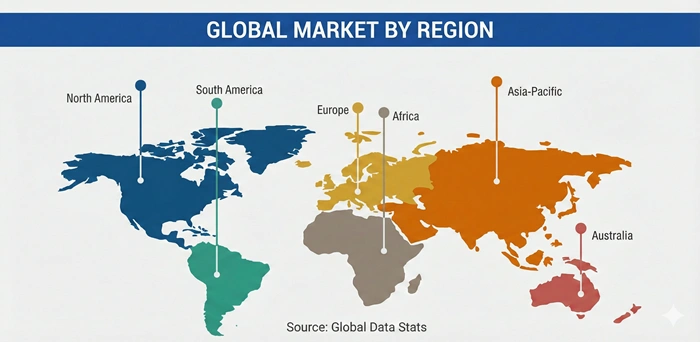
North America's Market Maturity and Asia Pacific's Explosive Digital Growth Are the Two Most Defining Geographic Forces Shaping the Global Interactive Voice Response Market Through 2033
North America
North America Leads the Interactive Voice Response Market Through Its High Contact Center Density, Early AI IVR Adoption, and the Dominant Presence of World-Leading IVR Platform Vendors
North America holds approximately 38% of global interactive voice response market share in 2025, growing at a regional CAGR of approximately 9.4% from 2026 to 2033. The United States is the single largest country market, home to the world's highest density of enterprise contact centers and most of the leading IVR platform vendors including Genesys (USA), Avaya Holdings Corp. (USA), NICE Ltd. (Israel), Cisco Systems, Inc. (USA), and Nuance Communications (Microsoft) (USA). Enterprises across BFSI, healthcare, retail, and telecommunications in North America are investing heavily in AI-powered IVR modernization, replacing legacy DTMF systems with conversational AI platforms that deliver measurably superior self-service experiences and cost efficiency.
The United States also leads globally in cloud IVR adoption, driven by the maturity of its CCaaS ecosystem and the strong competitive dynamics among cloud contact center providers that are constantly innovating to deliver superior AI capabilities. Canada is a growing contributor to North American IVR revenues, particularly in financial services and government, where bilingual English-French IVR capabilities are a distinctive market requirement. North America is expected to maintain its dominant market position through 2033, supported by continued enterprise investment in customer experience transformation and the deepening integration of AI into every aspect of contact center operations.
Asia Pacific
Asia Pacific Is the Fastest-Growing Region in the Interactive Voice Response Market, Driven by Its Massive Outsourced Contact Center Industry, Rapid Digital Transformation, and Growing AI Adoption
Asia Pacific is the fastest-growing regional market in the interactive voice response segment, projected to expand at a CAGR of approximately 12.8% from 2026 to 2033 and holding approximately 25% of global market share in 2025. The region's growth is anchored by India and the Philippines — the world's largest outsourced business process outsourcing (BPO) and contact center markets — where IVR technology is deployed at enormous scale to manage call volumes for global enterprise clients. China is also a significant and growing market, driven by the country's massive e-commerce, financial technology, and telecommunications sectors, all of which generate extraordinary call volumes that require automated voice self-service management. Key vendors competing in Asia Pacific include Cisco Systems, Inc. (USA), Genesys (USA), Avaya Holdings Corp. (USA), and regional players including Tencent Cloud (China) and Alibaba Cloud (China) offering integrated IVR capabilities within their cloud communication platforms.
Japan and South Korea contribute consistently to regional revenues through their highly digitized economies and demanding corporate standards for customer service quality. Australia is an important market for cloud IVR adoption within the region, where strong cloud infrastructure and early enterprise digital transformation initiatives have accelerated the shift from on-premises telephony to cloud contact center platforms. The regulatory landscape in Asia Pacific is also evolving, with growing data protection requirements in Singapore, Malaysia, and Indonesia driving enterprise investment in compliant IVR platforms that meet both local and international data handling standards.
Customization Available by Region and Country
This Interactive Voice Response Market Report Is Fully Customizable to Provide Targeted Regional and Country-Level Intelligence That Aligns With Your Business Strategy, Competitive Priorities, and Market Entry Requirements
Our interactive voice response market report offers complete region-wise and country-wise customization, enabling clients to access in-depth analysis, localized market sizing, end-use industry demand mapping, regulatory environment reviews, competitive landscape assessments, and growth opportunity identification tailored to any specific geography.
-
Customized interactive voice response market reports are available for all the following regions and countries:
North America
-
United States, Canada, Mexico — country-level IVR market sizing, cloud vs. on-premises deployment breakdown, regulatory compliance landscape, key contact center industry trends, and leading vendor market positioning specific to each North American market
Europe
-
United Kingdom, Germany, France, Italy, Rest of Europe — region-specific analysis covering GDPR compliance requirements for voice data, enterprise IVR modernization trends, financial and telecom sector IVR demand, and country-level competitive landscape mapping
Asia Pacific
-
China, India, Japan, South Korea, Australia, Rest of Asia Pacific — detailed country breakdowns covering BPO industry IVR demand, cloud adoption rates, local vendor landscape, regulatory data protection requirements, and sub-regional growth forecast drivers
Latin America
-
Brazil, Argentina, Rest of Latin America — market sizing, contact center industry activity, digital transformation investment trends, cloud IVR adoption rates, and competitive landscape specific to key Latin American markets
Middle East & Africa
-
UAE, Saudi Arabia, Rest of MEA — government digital transformation program impact, telecoms sector IVR demand, cloud infrastructure maturity, and market opportunity assessment for IVR solutions across the MEA region
Top Key Players
-
Genesys Telecommunications Laboratories, Inc. (United States)
-
Avaya Holdings Corp. (United States)
-
NICE Ltd. (Israel)
-
Cisco Systems, Inc. (United States)
-
Nuance Communications, Inc. (Microsoft Corporation) (United States)
-
Aspect Software, Inc. (United States)
-
Enghouse Interactive (Canada)
-
Vonage Holdings Corp. (Ericsson) (United States)
-
Five9, Inc. (United States)
-
Twilio Inc. (United States)
-
8x8, Inc. (United States)
-
Verint Systems Inc. (United States)
Recent Developments
-
In 2025, Genesys launched an enhanced AI-powered conversational IVR capability within its Genesys Cloud CX platform, integrating large language model technology to enable fully natural, unscripted voice self-service interactions across its enterprise customer base globally, marking a significant step beyond traditional intent-based IVR design.
-
In 2025, NICE Ltd. expanded its CXone platform with an advanced voice biometric authentication module integrated directly into its IVR flow builder, enabling enterprise customers to deploy passive caller verification without adding friction to the customer experience or extending average handle times.
-
In 2024, Cisco Systems, Inc. integrated its Webex Contact Center IVR capabilities with OpenAI's GPT-based language models, providing enterprise customers with AI-native conversational IVR experiences natively within the Webex cloud contact center environment and accelerating the platform's displacement of legacy on-premises telephony systems.
-
In 2025, Five9, Inc. completed the acquisition of Aceyus, a contact center data and analytics company, strengthening its AI IVR capabilities with enhanced real-time data visualization and reporting tools that enable enterprises to continuously optimize IVR performance and call containment rates.
-
In 2024–2025, Twilio Inc. significantly expanded its Programmable Voice and Studio IVR product line with new AI agent capabilities powered by its acquired Segment customer data platform, enabling developers and enterprises to build highly personalized, data-driven IVR experiences that adapt dynamically based on real-time caller history and intent signals.
Market Trends
The Shift From DTMF to Conversational AI-Powered IVR and the Integration of Voice Systems Into Omnichannel Customer Experience Platforms Are the Two Most Transformative Trends in the Interactive Voice Response Market
The most consequential trend reshaping the interactive voice response market is the wholesale replacement of legacy DTMF menu systems with conversational AI platforms. Organizations across industries are discovering that the difference in customer experience between being forced to navigate a numbered menu and being able to simply say what you need in natural language is enormous — and directly measurable in containment rates, customer satisfaction scores, and Net Promoter Score improvements. As the cost of deploying large language model-based voice AI continues to fall and the quality of commercial NLP engines continues to improve, the business case for DTMF system retirement is becoming increasingly compelling for organizations of all sizes.
A parallel and strategically important trend is the deepening integration of IVR into omnichannel customer experience ecosystems. Modern enterprises no longer view IVR as a standalone voice routing system — they see it as the voice-channel entry point of a connected, context-aware journey that can seamlessly transition across phone, chat, email, SMS, and digital self-service channels based on customer preference and interaction complexity. Contact center platforms that can maintain context continuity as a customer moves from an IVR session to a digital chat to a live agent conversation — without forcing the customer to repeat information — are becoming the new standard expectation, and IVR vendors that can deliver this connected experience will capture the most commercially valuable enterprise deployments through 2033.
Segments Covered in the Report
-
By Component
-
Solutions (IVR Software, IVR Hardware)
-
Services (Professional Services, Managed Services)
-
-
By Technology
-
Touch-Tone / DTMF-Based IVR
-
Speech-Enabled IVR
-
Conversational AI / NLP-Based IVR
-
-
By Deployment Model
-
Cloud-Based
-
On-Premises
-
Hybrid
-
-
By Organization Size
-
Large Enterprises
-
Small and Medium Enterprises (SMEs)
-
-
By End-Use Industry
-
BFSI
-
Healthcare
-
Telecommunications
-
Retail and E-Commerce
-
Government and Public Sector
-
Travel and Hospitality
-
Other End-Use Industries
-
-
By Region
-
North America (U.S., Canada, Mexico)
-
Europe (U.K., Germany, France, Italy, Rest of Europe)
-
Asia Pacific (China, India, Japan, South Korea, Australia, Rest of Asia Pacific)
-
Latin America (Brazil, Argentina, Rest of Latin America)
-
Middle East & Africa (UAE, Saudi Arabia, Rest of MEA)
-
❝ Built for Every Level — From Startups to Industry Giants ❞
Here Is Exactly How This Report Works for You
-
Whether you are a Tier 1 global contact center technology vendor benchmarking your IVR platform strategy, a Tier 2 regional communications company identifying high-growth vertical opportunities, or a startup building next-generation conversational AI voice automation — this report delivers comprehensive competitor revenue analysis, revenue source breakdowns, supply-demand dynamics, and geopolitical risk mapping that empowers every stakeholder across the interactive voice response market to make high-confidence, data-backed strategic decisions.
-
For investors and mid-level companies evaluating market entry, product portfolio expansion, or geographic growth strategies, the report provides rigorous analysis of how cloud contact center adoption rates, AI integration investment trends, and sector-specific customer service automation spending across key geographies translate into specific and quantifiable IVR revenue opportunities — including how pricing model shifts from perpetual licensing to subscription-based cloud delivery are reshaping competitive dynamics.
-
For senior executives and strategic planners at IVR vendors, contact center platform providers, and enterprise IT decision-makers, this report maps how evolving data privacy regulations, the transition from DTMF to conversational AI, and geopolitical factors affecting cloud infrastructure investment in key markets are reshaping technology procurement decisions — providing the intelligence your organization needs to build a winning market position and outpace the competition through 2033.
Frequently Asked Questions
Question 1: What is the current size and growth forecast of the interactive voice response market?
Answer: The interactive voice response market is valued at USD 7.56 billion in 2025 and is projected to reach USD 17.83 billion by 2033. It is growing at a CAGR of 10.3% from 2026 to 2033.
Question 2: What are the key factors driving growth in the interactive voice response market?
Answer: The primary growth drivers of the interactive voice response market include the rising enterprise demand for customer service automation, the mass adoption of cloud-based contact center platforms, and the integration of conversational AI and NLP technologies into IVR systems. Growing SME adoption through affordable cloud IVR services is also significantly expanding the addressable market.
Question 3: Which deployment model is most popular in the interactive voice response market?
Answer: Cloud-based deployment is the dominant model in the interactive voice response market, accounting for approximately 58% of total revenue in 2025. Its scalability, lower upfront cost, and seamless AI integration capabilities are making it the preferred choice over on-premises IVR infrastructure for enterprises of all sizes.
Question 4: Which region leads the interactive voice response market and which is the fastest growing?
Answer: North America leads the interactive voice response market with approximately 38% of global market share in 2025. Asia Pacific is the fastest-growing region, expanding at a CAGR of approximately 12.8% from 2026 to 2033, driven by its massive BPO industry and accelerating digital transformation.
Question 5: Who are the leading companies in the interactive voice response market?
Answer: The leading companies in the interactive voice response market include Genesys, Avaya, NICE Ltd., Cisco Systems, Nuance Communications (Microsoft), Five9, and Twilio, among others. These vendors compete through conversational AI capabilities, cloud delivery scale, industry-specific compliance frameworks, and deep CRM integration ecosystems.