
Industrial IoT Market Overview
The global Industrial IoT market size is valued at USD 439.79 billion in 2025 and is predicted to increase from USD 514.09 billion in 2026 to approximately USD 1717.21 billion by 2033, growing at a CAGR of 16.10% from 2026 to 2033.
The Industrial Internet of Things has transformed traditional manufacturing and industrial operations by connecting machines, devices, and systems through advanced sensor technologies and real-time data analytics. This technological revolution enables businesses to optimize production processes, reduce operational costs, and improve decision-making capabilities across various industrial sectors.
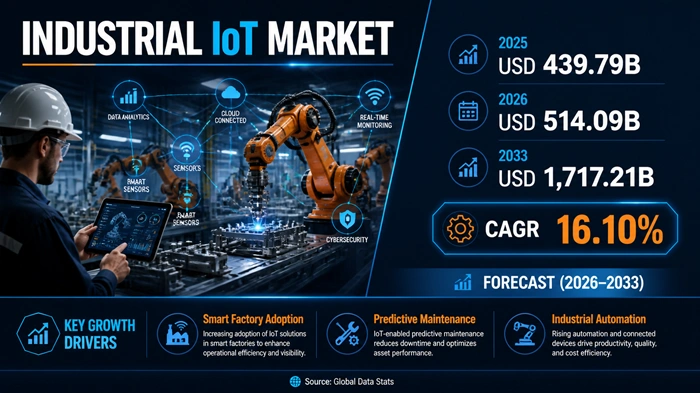
Revolutionizing Industrial Operations Through Connected Intelligence and Real-Time Data Analytics
The Industrial IoT market represents a fundamental shift in how industries leverage connected devices and intelligent systems to drive operational excellence and competitive advantage. By integrating sensors, actuators, gateways, and advanced analytics platforms, organizations can monitor equipment performance, predict maintenance needs, and automate complex workflows with unprecedented precision. The convergence of artificial intelligence, machine learning, and edge computing technologies has accelerated the adoption of IIoT solutions across manufacturing plants, energy facilities, healthcare institutions, and logistics networks worldwide. As businesses increasingly recognize the strategic value of data-driven insights, the Industrial IoT market continues to expand its footprint across diverse industrial applications and geographic regions.
AI Impact on the Industrial IoT Industry
Transforming Predictive Analytics and Autonomous Decision-Making Across Industrial Ecosystems
Artificial intelligence has emerged as a transformative force within the Industrial IoT industry, fundamentally changing how organizations analyze operational data and make critical business decisions. AI-powered analytics platforms process vast volumes of sensor data in real-time, identifying patterns and anomalies that would be impossible for human operators to detect manually. These intelligent systems enable predictive maintenance strategies that anticipate equipment failures before they occur, reducing unplanned downtime by 25-30% and significantly lowering repair costs across industrial facilities. Machine learning algorithms continuously improve their accuracy by learning from historical data, creating increasingly sophisticated models that optimize energy consumption, minimize material waste, and enhance production efficiency.
The integration of AI with Industrial IoT platforms has accelerated the development of autonomous industrial operations and smart factory implementations. Advanced AI agents now monitor production lines continuously, flagging quality issues and triggering immediate corrective actions without human intervention. Natural language processing capabilities enable operators to interact with complex IIoT systems through conversational interfaces, democratizing access to sophisticated analytics tools across the workforce. Computer vision systems powered by AI algorithms perform real-time quality inspections with greater accuracy than traditional methods, while reinforcement learning techniques optimize production scheduling and resource allocation dynamically. This convergence of AI and IIoT technologies is creating intelligent industrial ecosystems that adapt autonomously to changing market conditions and operational demands.
Growth Factors
Accelerating Digital Transformation Through Advanced Connectivity and Automation Technologies
The rapid expansion of the Industrial IoT market is driven by several converging technological and economic factors that are reshaping industrial landscapes globally. The proliferation of 5G networks has provided the high-speed, low-latency connectivity essential for real-time industrial applications, enabling seamless communication between distributed devices and centralized control systems. Global 5G connections are forecasted to reach 5.9 billion by the end of 2027, creating the infrastructure foundation necessary for widespread IIoT deployment across smart cities and industrial facilities. Simultaneously, the availability of affordable sensors and processors has democratized access to IIoT technologies, allowing small and medium-sized enterprises to implement sophisticated monitoring and automation solutions without prohibitive capital investments.
Government initiatives supporting digital transformation and Industry 4.0 adoption have created favorable regulatory environments and financial incentives for Industrial IoT market implementations. Smart city projects worldwide leverage IIoT technologies to optimize energy distribution, improve transportation efficiency, and enhance public infrastructure management, driving demand for interconnected industrial systems. The growing emphasis on operational efficiency and cost reduction has compelled manufacturing organizations to embrace automation technologies that minimize human errors and accelerate production timelines. Edge computing capabilities have addressed latency concerns by enabling local data processing at the device level, improving system resilience and reducing dependence on centralized cloud infrastructure. These technological advancements, combined with increasing awareness of IIoT benefits across industrial sectors, continue to fuel robust market growth and innovation.

Market Outlook
Sustained Growth Trajectory Driven by Manufacturing Modernization and Smart Infrastructure Development
The Industrial IoT market outlook remains exceptionally strong as organizations across multiple sectors recognize the strategic imperative of digital transformation. Manufacturing industries are leading IIoT adoption, accounting for 28.7% of total market revenue in 2025, as they implement smart factory initiatives that integrate connected machinery with advanced analytics platforms. The logistics and transportation segment demonstrates the fastest growth trajectory, expanding at a CAGR of 25.6% from 2026 to 2035, driven by demand for real-time tracking, inventory optimization, and autonomous vehicle technologies. Healthcare facilities are increasingly deploying IIoT solutions for remote patient monitoring, medical device management, and hospital asset tracking, expanding the market beyond traditional industrial applications.
Regional market dynamics reflect varying stages of industrial maturity and technology adoption patterns. North America maintains market leadership with a 34% revenue share in 2025, supported by early technology adoption, robust digital infrastructure, and significant private sector investments in automation. However, the Asia-Pacific region is experiencing the most rapid growth, with a projected CAGR of 26.7% from 2026 to 2035, fueled by aggressive industrialization in China and India, favorable government policies, and the emergence of manufacturing hubs across Southeast Asia. European markets continue advancing Industry 4.0 initiatives, with German manufacturers planning to invest EUR 10 billion annually into smart manufacturing technologies by 2025. This global momentum toward connected industrial ecosystems positions the Industrial IoT market for sustained expansion throughout the forecast period.
Expert Speaks
-
Jensen Huang, CEO of NVIDIA emphasized in 2025 that "Industrial AI and IoT convergence is creating the next wave of productivity gains, with autonomous factories and intelligent edge computing transforming manufacturing efficiency across global supply chains."
-
Satya Nadella, CEO of Microsoft stated during the 2025 technology summit that "The integration of Azure AI services with industrial IoT platforms is enabling predictive maintenance at unprecedented scales, reducing operational costs while improving sustainability outcomes for enterprises worldwide."
-
Greg Hayes, CEO of RTX Corporation noted in early 2026 that "Our aerospace manufacturing operations now leverage Industrial IoT sensors and AI analytics to achieve 99.9% uptime on critical production equipment, demonstrating the transformative potential of connected industrial systems."
Key Report Takeaways
-
North America leads the Industrial IoT market with a dominant market share of 34% in 2025, driven by advanced technological infrastructure, early adoption of automation technologies, and substantial investments from Fortune 500 manufacturing companies in smart factory initiatives and predictive maintenance solutions
-
Asia-Pacific emerges as the fastest-growing region with an impressive CAGR of 26.7% from 2026 to 2035, propelled by rapid industrialization in China and India, government-led manufacturing modernization programs, and the establishment of smart manufacturing hubs across emerging economies in Southeast Asia
-
Manufacturing segment dominates end-use applications capturing 28.7% of total market revenue in 2025, as automotive, electronics, and heavy machinery producers implement comprehensive IIoT solutions for production optimization, quality control, and supply chain visibility
-
Logistics and transportation segment demonstrates exceptional growth potential expanding at the highest CAGR of 25.6% from 2026 to 2035, driven by increasing demand for real-time fleet tracking, autonomous vehicle integration, warehouse automation, and sophisticated inventory management systems
-
Services component experiences rapid market expansion with a projected CAGR of 24.3% between 2026 and 2035, as enterprises increasingly rely on consulting, system integration, managed services, and continuous support to optimize their IIoT deployments and ensure scalable implementation
-
Predictive maintenance applications dominate IIoT use cases as organizations transition from reactive to proactive asset management strategies, leveraging advanced analytics and machine learning algorithms to extend equipment lifespan, reduce unplanned downtime, and minimize maintenance costs across industrial operations
Market Scope
| Report Coverage | Details |
|---|---|
| Market Size by 2033 | USD 1717.21 Billion |
| Market Size by 2025 | USD 439.79 Billion |
| Market Size by 2026 | USD 514.09 Billion |
| Market Growth Rate from 2026 to 2033 | CAGR of 16.10% |
| Dominating Region | North America |
| Fastest Growing Region | Asia-Pacific |
| Base Year | 2025 |
| Forecast Period | 2026 to 2033 |
| Segments Covered | Component, End-Use, Region |
| Regions Covered | North America, Europe, Asia-Pacific, Latin America, Middle East & Africa |
Market Dynamics
Driver Impact Analysis
Accelerating Automation Adoption and Smart Manufacturing Transformation
| Impact Factor | Details |
|---|---|
| ≈ Impact on CAGR Forecast | +3.5% to +5.2% |
| Geographic Relevance | Global, particularly strong in North America, Europe, and Asia-Pacific |
| Impact Timeline | 2026-2033 |
The Industrial IoT market is experiencing transformative growth driven by the accelerating adoption of automation technologies and smart manufacturing initiatives across global industrial sectors. Organizations are increasingly implementing IIoT solutions to reduce operational costs, minimize human errors, and optimize production workflows, creating significant competitive advantages in increasingly challenging market conditions. The integration of advanced sensor technologies with machine-to-machine communication capabilities enables real-time monitoring of equipment performance, allowing maintenance teams to identify potential failures before they cause costly production disruptions. Manufacturing facilities implementing predictive maintenance strategies report downtime reductions of 25-30%, translating into substantial cost savings and improved operational efficiency.
The convergence of artificial intelligence with Industrial IoT platforms has revolutionized decision-making processes across industrial operations. AI-powered analytics systems process vast quantities of operational data to identify optimization opportunities, recommend process improvements, and automatically adjust production parameters to maintain optimal performance levels. Energy management systems leveraging IIoT technologies help organizations reduce power consumption, minimize carbon emissions, and achieve sustainability targets while lowering utility costs. The development of 5G networks provides the high-speed, low-latency connectivity required for latency-critical applications such as autonomous robotics, remote operations, and real-time quality control systems. Government initiatives supporting Industry 4.0 transformation, including smart city projects and digital manufacturing incentives, provide additional momentum for Industrial IoT market adoption across developed and emerging economies.

Restraints Impact Analysis
Integration Complexity and Cybersecurity Vulnerabilities
| Impact Factor | Details |
|---|---|
| ≈ Impact on CAGR Forecast | -1.8% to -2.5% |
| Geographic Relevance | Global, particularly impactful in regions with legacy infrastructure |
| Impact Timeline | 2026-2030 |
The Industrial IoT market faces significant challenges related to the integration of modern connected systems with legacy industrial infrastructure and equipment. Many manufacturing facilities operate machinery installed decades ago, lacking the connectivity interfaces and digital capabilities required for seamless IIoT implementation. Retrofitting existing equipment with sensors and communication modules requires substantial capital investment and often necessitates production downtime, creating financial and operational barriers to adoption. Organizations must navigate complex technical challenges to ensure interoperability between diverse equipment manufacturers, communication protocols, and data formats, requiring specialized expertise that may not be readily available within existing workforce structures.
Cybersecurity concerns represent another critical restraint limiting Industrial IoT market expansion, as connected industrial systems create expanded attack surfaces vulnerable to malicious actors. The integration of operational technology with information technology networks exposes critical industrial processes to potential cyber threats, including ransomware attacks, data breaches, and unauthorized system access. High-profile security incidents affecting industrial facilities have heightened awareness of these vulnerabilities, causing some organizations to delay IIoT implementations until robust security frameworks can be established. The initial investment costs associated with comprehensive IIoT deployments, including hardware procurement, software licensing, system integration, and workforce training, can be prohibitive for small and medium-sized enterprises with limited capital budgets. Addressing these technical, financial, and security challenges requires ongoing innovation in IIoT platform design, security protocols, and implementation methodologies.
Opportunities Impact Analysis
Edge Computing and Digital Twin Technology Emergence
| Impact Factor | Details |
|---|---|
| ≈ Impact on CAGR Forecast | +2.8% to +4.1% |
| Geographic Relevance | Strong opportunity in Asia-Pacific, North America, and Europe |
| Impact Timeline | 2026-2033 |
The Industrial IoT market presents substantial growth opportunities through the emergence of edge computing technologies that address latency and bandwidth limitations inherent in cloud-based architectures. Edge computing brings data processing capabilities closer to industrial devices, enabling real-time analysis and decision-making without dependence on centralized cloud infrastructure. This distributed computing approach improves system resilience, reduces network congestion, and ensures operational continuity even during internet connectivity disruptions. Organizations implementing edge computing solutions can process time-sensitive data locally while transmitting only relevant information to cloud platforms for long-term analysis and strategic planning.
Digital twin technology represents another transformative opportunity within the Industrial IoT market, enabling organizations to create virtual replicas of physical assets and production processes. These sophisticated simulations allow engineers to test process modifications, predict equipment behavior under various operating conditions, and optimize maintenance schedules without disrupting actual production operations. Digital twins facilitate proactive asset management by continuously comparing real-world performance data with simulated models, identifying deviations that may indicate emerging problems or efficiency opportunities. The integration of low-code and no-code development platforms is democratizing IIoT application creation, enabling operational personnel without extensive programming expertise to build custom monitoring and automation solutions tailored to specific organizational needs. These technological innovations are expanding the addressable market for Industrial IoT solutions while reducing implementation barriers for organizations across diverse industrial sectors.

Segment Analysis
By Component: Services Segment
Accelerating Demand for Consulting, Integration, and Managed Service Offerings
The services segment within the Industrial IoT market is experiencing exceptional growth, projected to expand at a CAGR of 24.3% between 2026 and 2035, as organizations increasingly require external expertise to navigate the complexities of IIoT implementation. Professional services, including consulting, system design, and integration support, have become essential for enterprises seeking to optimize their connected infrastructure investments and ensure seamless interoperability between diverse technology platforms. Companies across manufacturing, energy, and logistics sectors recognize that successful IIoT deployments require specialized knowledge spanning operational technology, information technology, cybersecurity, and data analytics disciplines. This skills gap has created substantial demand for managed service providers who offer continuous monitoring, maintenance, and optimization support, allowing organizations to focus on core business operations while ensuring their IIoT systems maintain peak performance levels.
North America and Europe dominate the Industrial IoT services segment, driven by the presence of established consulting firms and technology integrators such as Accenture, IBM, and Cisco Systems, who have developed comprehensive IIoT service portfolios addressing diverse industry requirements. However, the Asia-Pacific region is witnessing the fastest services segment growth, with a projected regional CAGR exceeding 28% through 2035, as rapidly industrializing nations in China, India, and Southeast Asia invest heavily in smart manufacturing transformation initiatives. Local and international service providers are establishing regional delivery centers to support this growing demand, offering localized expertise combined with global best practices. The shift toward outcome-based service models, where providers guarantee specific performance improvements or efficiency gains, is further accelerating services adoption as organizations seek to minimize implementation risks and ensure measurable returns on their Industrial IoT market investments.
By End-Use: Manufacturing Segment
Smart Factory Initiatives and Industry 4.0 Transformation Drive Dominant Market Position
The manufacturing segment maintains its dominant position within the Industrial IoT market, accounting for 28.7% of total revenue in 2025, as automotive, electronics, pharmaceutical, and heavy machinery producers implement comprehensive connected infrastructure to enhance competitiveness. Smart factory implementations leverage IIoT technologies to create interconnected production environments where machines, materials, and management systems communicate seamlessly, enabling real-time visibility into production status, quality metrics, and resource utilization. Manufacturing organizations utilize Industrial IoT solutions for diverse applications including predictive maintenance, quality assurance, supply chain optimization, inventory management, and worker safety monitoring. The ability to collect and analyze granular production data enables continuous process improvement initiatives that incrementally enhance efficiency, reduce waste, and improve product quality across production cycles. Advanced manufacturing facilities now employ digital twin simulations to optimize production line configurations and test new processes virtually before physical implementation, minimizing disruption and accelerating innovation timelines.
Germany leads European manufacturing IIoT adoption, with industrial companies planning to invest EUR 10 billion annually into smart manufacturing technologies by 2025, reflecting the nation's commitment to maintaining global competitiveness through technological leadership. In Asia-Pacific, China has emerged as the fastest-growing manufacturing IIoT market, driven by government initiatives such as "Made in China 2025" and massive investments in 5G infrastructure supporting connected factory deployments. Leading industrial automation providers including Siemens, ABB, Rockwell Automation, and Schneider Electric have established strong footholds in key manufacturing regions, offering comprehensive IIoT platforms that integrate sensors, controllers, analytics software, and edge computing capabilities. The manufacturing segment's Industrial IoT market share is projected to remain stable through 2033, maintaining its leadership position with a sustained CAGR of approximately 15.8% as Industry 4.0 principles become standard practice across global production facilities.

Regional Insights
North America
Technology Leadership and Early Adoption Drive Regional Market Dominance
North America maintains its position as the dominant region in the Industrial IoT market, capturing approximately 34% of global revenue in 2025, supported by advanced technological infrastructure, substantial private sector investments, and a mature industrial ecosystem embracing digital transformation. The United States represents the largest national market within the region, with IoT spending reaching USD 421 billion in 2021 and continuing to expand as manufacturing, energy, and logistics sectors accelerate connected infrastructure deployments. American industrial companies benefit from early access to cutting-edge technologies, robust venture capital funding for innovative startups, and a concentration of leading IIoT platform providers including General Electric, Honeywell International, Rockwell Automation, and Intel Corporation, who maintain significant research and development operations within the region. The region's well-established cybersecurity frameworks and data protection regulations provide confidence for organizations implementing sensitive industrial monitoring systems, while government initiatives supporting manufacturing modernization create favorable conditions for continued Industrial IoT market expansion.
The North American Industrial IoT market is projected to grow at a CAGR of 17.43% from 2026 to 2035, with the United States market alone expanding from USD 122.42 billion in 2025 to USD 521.98 billion by 2035. Canada is emerging as an important contributor to regional growth, with approximately 98 companies providing industrial IoT solutions as of 2021, serving diverse sectors including natural resources, manufacturing, and transportation. Key industry players such as Cisco Systems, Microsoft, IBM, and ABB have established major operations across North America, collaborating with industrial customers to develop customized solutions addressing specific operational challenges. The region's manufacturing sector, particularly automotive and aerospace industries, has been early adopter of predictive maintenance and quality control applications, achieving documented efficiency improvements that encourage broader IIoT adoption across other industrial segments. Strong partnerships between technology providers, industrial equipment manufacturers, and end-user organizations continue to drive innovation and establish North America as the global reference point for Industrial IoT market best practices.
Asia-Pacific
Rapid Industrialization and Government Support Fuel Exceptional Regional Growth
The Asia-Pacific region represents the fastest-growing segment of the global Industrial IoT market, projected to expand at an exceptional CAGR of 26.7% from 2026 to 2035, driven by aggressive industrialization, supportive government policies, and massive infrastructure investments across emerging economies. China has established itself as the regional leader and global manufacturing hub, implementing ambitious national initiatives such as "Made in China 2025" that prioritize smart manufacturing adoption and digital transformation across industrial sectors. The Chinese government's investment of WON 4.7 trillion (approximately USD 3.2 billion) in innovative industrial technologies demonstrates the scale of public sector commitment to IIoT advancement. India presents enormous growth potential with its abundant availability of land, labor, and machinery at competitive costs, attracting multinational manufacturers who are establishing modern production facilities equipped with connected infrastructure from inception.
Major global IIoT providers including Siemens, ABB, Huawei Technologies, Bosch, and Rockwell Automation have established substantial regional operations across Asia-Pacific to capture market opportunities and provide localized support for rapidly expanding customer bases. Japan maintains technological leadership in industrial automation and robotics, contributing advanced sensor technologies and precision manufacturing expertise that enhance regional IIoT capabilities. South Korea has emerged as a significant player in 5G network deployment and smart factory implementation, with domestic technology giants supporting comprehensive industrial digitalization programs. The Asia-Pacific Industrial IoT market benefits from lower implementation costs compared to Western markets, making advanced technologies accessible to small and medium-sized enterprises that represent the majority of regional manufacturing capacity. Government incentives, tax relaxations, and regulatory support for companies adopting Industry 4.0 technologies create an exceptionally favorable environment for sustained Industrial IoT market growth throughout the forecast period.
Top Key Players
-
Siemens AG (Germany)
-
General Electric Company (United States)
-
ABB Ltd. (Switzerland)
-
Cisco Systems Inc. (United States)
-
Microsoft Corporation (United States)
-
Intel Corporation (United States)
-
International Business Machines Corporation (IBM) (United States)
-
Rockwell Automation Inc. (United States)
-
Honeywell International Inc. (United States)
-
Schneider Electric SE (France)
-
Huawei Technologies Co. Ltd. (China)
-
Robert Bosch GmbH (Germany)
-
SAP SE (Germany)
-
Emerson Electric Co. (United States)
-
PTC Inc. (United States)
-
Oracle Corporation (United States)
-
Hitachi Ltd. (Japan)
-
NEC Corporation (Japan)
-
KUKA AG (Germany)
-
Texas Instruments Incorporated (United States)
-
Arm Limited (United Kingdom)
-
Dassault Systèmes SE (France)
-
Accenture plc (Ireland)
-
Dell Technologies Inc. (United States)
Recent Developments
-
ABB collaborated with Microsoft in 2025 to integrate Azure OpenAI Service into its ABB Ability Genix Platform, improving AI analytics capabilities for predictive maintenance applications and reducing equipment downtime by up to 25-30% across industrial customer installations worldwide
-
Honeywell International Inc. partnered with Google Cloud in 2024 to incorporate advanced AI agents into Honeywell's industrial operations platforms, aiming to enhance operational autonomy, improve productivity metrics, and optimize workforce efficiency across manufacturing and process industries
-
General Electric expanded its digital industrial portfolio in 2024 by launching enhanced predictive analytics capabilities within its Predix platform, enabling customers to leverage machine learning algorithms for equipment optimization and energy management across power generation and manufacturing operations
-
Siemens AG announced in 2025 the expansion of its MindSphere industrial IoT ecosystem with new edge computing capabilities and enhanced cybersecurity features, supporting real-time data processing requirements for time-sensitive manufacturing applications and autonomous production systems
-
Rockwell Automation acquired in 2024 a specialized cybersecurity company to strengthen its industrial network security offerings, addressing growing customer concerns about protecting connected operational technology infrastructure from increasingly sophisticated cyber threats
Market Trends
Edge Computing and AI Integration Reshape Industrial IoT Architecture
The Industrial IoT market is experiencing a fundamental architectural shift toward edge computing implementations that process critical data locally rather than relying exclusively on centralized cloud infrastructure. This distributed computing approach addresses latency requirements for time-sensitive applications such as autonomous robotics, real-time quality control, and safety monitoring systems that cannot tolerate delays inherent in cloud round-trip communications. Edge computing also enhances system resilience by enabling continued operations during internet connectivity disruptions, a crucial capability for industrial facilities where production continuity directly impacts revenue. Organizations are increasingly deploying AI and machine learning algorithms at the edge, enabling autonomous decision-making capabilities that optimize processes without constant human oversight. The integration of 5G connectivity with edge computing platforms is creating unprecedented opportunities for mobile robotics, augmented reality maintenance support, and remote operations capabilities that were previously impractical due to bandwidth and latency constraints.
Digital twin technology has emerged as a transformative trend within the Industrial IoT market, enabling organizations to create comprehensive virtual replicas of physical assets, production lines, and entire facilities for simulation and optimization purposes. These sophisticated models continuously synchronize with real-world operations through IoT sensor data, allowing engineers to test process modifications, predict equipment behavior, and identify efficiency opportunities in virtual environments before implementing changes physically. Low-code and no-code development platforms are democratizing IIoT application creation, empowering operational personnel without extensive programming expertise to build customized monitoring dashboards and automation workflows tailored to specific organizational needs. Sustainability initiatives are driving increased adoption of IIoT solutions for energy optimization, waste reduction, and environmental monitoring as organizations seek to meet corporate responsibility commitments and regulatory compliance requirements. The convergence of these technological and business trends continues to expand the addressable market for Industrial IoT solutions while creating new use cases across diverse industrial sectors.
Segments Covered in the Report
By Component
-
Solution
-
Remote Monitoring
-
Data Management
-
Analytics
-
Security Solutions
-
Network Management
-
-
Services
-
Professional Services
-
Managed Services
-
System Integration
-
Consulting
-
-
Platform
-
Connectivity Management
-
Application Management
-
Device Management
-
-
Hardware
-
Sensors
-
Actuators
-
Gateways
-
RFID Tags
-
-
Software
-
Data Analytics Software
-
Visualization Software
-
Security Software
-
-
Connectivity
-
Wired Connectivity
-
Wireless Connectivity
-
By End-Use
-
Manufacturing
-
Discrete Manufacturing
-
Process Manufacturing
-
-
Energy & Power
-
Power Generation
-
Renewable Energy
-
Grid Management
-
-
Oil & Gas
-
Upstream
-
Midstream
-
Downstream
-
-
Healthcare
-
Medical Devices
-
Remote Patient Monitoring
-
Hospital Asset Management
-
-
Logistics & Transport
-
Fleet Management
-
Warehouse Automation
-
Supply Chain Optimization
-
-
Agriculture
-
Precision Farming
-
Livestock Monitoring
-
Smart Irrigation
-
-
Retail
-
Mining
-
Aerospace & Defense
-
Others
By Region
-
North America
-
United States
-
Canada
-
Mexico
-
-
Europe
-
Germany
-
United Kingdom
-
France
-
Italy
-
Spain
-
Rest of Europe
-
-
Asia-Pacific
-
China
-
Japan
-
India
-
South Korea
-
Australia
-
Southeast Asia
-
Rest of Asia-Pacific
-
-
Latin America
-
Brazil
-
Argentina
-
Rest of Latin America
-
-
Middle East & Africa
-
UAE
-
Saudi Arabia
-
South Africa
-
Rest of MEA
-
Frequently Asked Questions
Question 1: What is the projected Industrial IoT market size by 2033?
Answer: The global Industrial IoT market is projected to reach USD 1717.21 billion by 2033, growing from USD 514.09 billion in 2026. The market is expanding at a CAGR of 16.10% during the 2026-2033 forecast period driven by manufacturing automation and smart infrastructure adoption.
Question 2: Which region dominates the Industrial IoT market currently?
Answer: North America dominates the Industrial IoT market with approximately 34% revenue share in 2025, supported by advanced infrastructure and early technology adoption. However, Asia-Pacific is the fastest-growing region with a CAGR of 26.7% from 2026 to 2035.
Question 3: What are the key applications driving Industrial IoT market growth?
Answer: Predictive maintenance dominates Industrial IoT market applications as organizations transition to proactive asset management strategies. Supply chain management, quality control, and real-time monitoring are other critical applications driving adoption across manufacturing and logistics sectors.
Question 4: How is artificial intelligence impacting the Industrial IoT market?
Answer: Artificial intelligence is transforming the Industrial IoT market by enabling predictive analytics, autonomous decision-making, and process optimization capabilities. AI integration reduces equipment downtime by 25-30% and improves operational efficiency across manufacturing facilities.
Question 5: Which end-use segment leads the Industrial IoT market?
Answer: The manufacturing segment leads the Industrial IoT market, accounting for 28.7% of total revenue in 2025. However, logistics and transportation shows the fastest growth at 25.6% CAGR from 2026 to 2035 driven by automation and tracking requirements.