
Impact Investing Market Overview
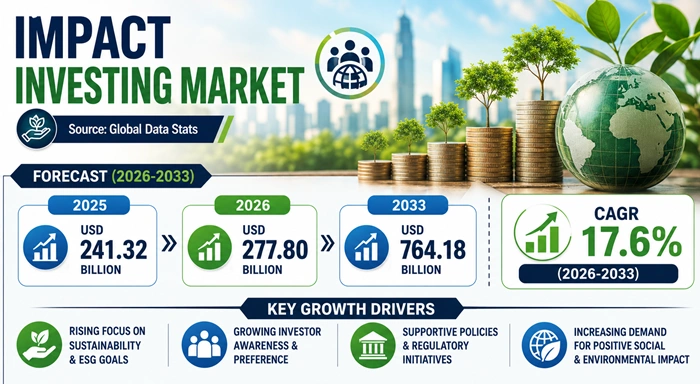
The global Impact Investing market size is valued at USD 241.32 billion in 2025 and is predicted to increase from USD 277.80 billion in 2026 to approximately USD 764.18 billion by 2033, growing at a CAGR of 17.6% from 2026 to 2033. Impact investing refers to investments made across asset classes — including private equity, green bonds, social enterprise financing, sustainable real estate, and microfinance — with the deliberate intention of generating measurable positive social and environmental outcomes alongside competitive financial returns. The convergence of heightened ESG awareness among institutional and individual investors, growing regulatory mandates for sustainable finance disclosure, rising climate urgency, and a new generation of wealth holders demanding values-aligned investment strategies is driving the impact investing landscape into a period of rapid and structural expansion.
AI Impact on the Impact Investing Industry
Artificial Intelligence Is Transforming How Impact Investments Are Sourced, Evaluated, Measured, and Reported — Enabling Greater Scale, Precision, and Accountability Across the Entire Sustainable Finance Ecosystem
Artificial intelligence is becoming a foundational technology layer for the impact investing industry, addressing two of its most persistent challenges: scalable deal sourcing and credible impact measurement. AI-powered data platforms are enabling investors to screen vast universes of private companies, social enterprises, and project finance opportunities against detailed ESG and impact criteria in real time — dramatically reducing the time and cost of investment due diligence. Natural language processing tools are analyzing corporate sustainability reports, regulatory filings, and news streams to identify authentic impact opportunities and flag potential greenwashing, giving institutional investors a far more rigorous and efficient means of portfolio construction in the growing impact investing market. Machine learning models are also being deployed to predict the social and environmental performance of investment candidates based on historical impact outcome data, improving ex-ante impact assessment quality.
On the measurement and reporting side, AI is enabling the transition from qualitative, survey-based impact reporting to continuous, data-driven outcome monitoring. Computer vision systems are analyzing satellite imagery to measure deforestation rates, track solar installation progress, and verify climate project claims in near real time. Predictive analytics platforms are modeling the expected long-term social outcomes of education, healthcare, and financial inclusion investments, helping fund managers demonstrate impact additionality with greater scientific rigor. As impact measurement frameworks like IRIS+, GRI, SASB, and the UN SDGs continue to evolve, AI tools that automatically align portfolio data to multiple reporting standards are helping investment managers reduce compliance burden while improving transparency. The growing availability of AI-powered impact analytics platforms is lowering the barriers to entry for smaller fund managers and institutional investors new to the impact investing space, broadening market participation significantly.
Growth Factors
Accelerating ESG Regulatory Mandates, the Great Wealth Transfer to Purpose-Driven Younger Investors, and the Expanding Pipeline of SDG-Aligned Investment Opportunities Are Driving Sustained Market Momentum
The most powerful structural growth driver for the impact investing market is the global acceleration of ESG and sustainable finance regulation, which is shifting impact-oriented investment from a voluntary practice to a compliance necessity for many large asset managers. The European Union's Sustainable Finance Disclosure Regulation (SFDR), the SEC's climate disclosure rules in the United States, and similar frameworks across Asia Pacific and Latin America are compelling institutional investors to systematically assess, document, and report the ESG impact of their portfolios. This regulatory pressure is driving enormous capital reallocation toward strategies that can credibly demonstrate positive impact outcomes — directly expanding the addressable market for impact-focused funds, advisory services, measurement platforms, and thematic investment products. As regulatory frameworks continue to tighten globally, compliance-driven impact investment adoption is expected to grow at an accelerating rate through 2033.
The generational wealth transfer underway as Baby Boomers pass an estimated USD 70+ trillion in assets to Millennials and Generation Z over the coming decade is creating an unprecedented demand surge for values-aligned investment products. Younger investors consistently demonstrate a far stronger preference for investments that align with their social and environmental values — and they are increasingly unwilling to accept the traditional trade-off narrative that impact investments must sacrifice financial returns for positive outcomes. The growing body of evidence demonstrating that many impact investment strategies deliver competitive or superior risk-adjusted returns compared to conventional alternatives is reinforcing this generational demand shift. Combined with expanding distribution channels — including digital wealth management platforms, robo-advisors, and impact investing apps that make socially responsible portfolio construction accessible to retail investors — this generational transition is creating powerful long-term demand tailwinds for the impact investing landscape.
Market Outlook
A Maturing Institutional Infrastructure, Expanding Asset Class Coverage, and Growing Emerging Market Capital Flows Are Building a Resilient and High-Growth Foundation for the Impact Investing Market Through 2033
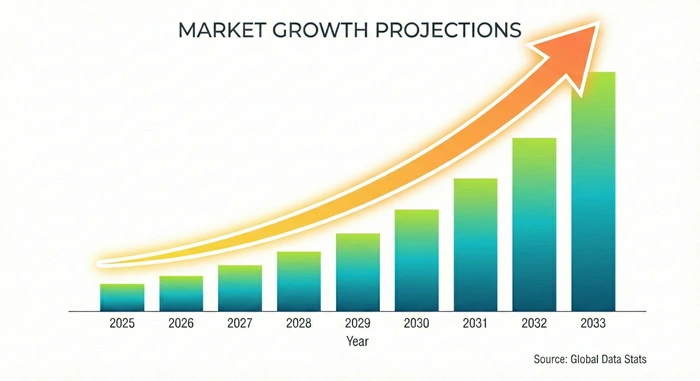
The impact investing market is entering a period of accelerating institutionalization, characterized by growing participation from sovereign wealth funds, pension funds, insurance companies, and central banks that are integrating impact considerations into core portfolio construction processes rather than treating them as peripheral allocations. This shift from niche to mainstream is driven by the convergence of regulatory pressure, beneficiary demand, fiduciary duty evolution, and compelling commercial evidence supporting the long-term value creation potential of sustainable and impact-oriented portfolios. As more institutional capital enters the space, the market infrastructure — including fund structures, measurement standards, secondary market liquidity, and rating methodologies for impact assets — is maturing rapidly, making it easier for new participants to deploy capital efficiently and confidently.
Looking toward 2033, climate-related impact investing is expected to be the dominant growth category, driven by the enormous financing needs associated with the global energy transition, nature-based solutions, climate adaptation infrastructure, and sustainable agriculture systems. Blended finance structures — combining public concessional capital with private impact investment to de-risk emerging market transactions — are gaining traction as a critical mechanism for channeling impact capital to the geographies and sectors where the need is greatest and the commercial risk is highest. Social impact bonds, pay-for-success financing structures, and outcome-based contracts are also scaling rapidly, particularly in healthcare, education, and workforce development applications. The combination of expanding asset class coverage, deepening secondary market liquidity, and growing multilateral development bank support for impact investment infrastructure makes the long-term market outlook through 2033 exceptionally strong.
Expert Speaks
-
"Impact investing is no longer a niche philanthropic exercise — it is becoming a central strategy for institutional capital allocation, and the evidence is increasingly clear that markets which integrate purpose with returns are not only more resilient but are actively generating superior long-term value for our clients and the communities where we invest," — Larry Fink, Chairman & CEO, BlackRock Inc., highlighting the mainstreaming of impact-oriented investment strategies across the global institutional asset management landscape.
-
"At Goldman Sachs, we see sustainable and impact-focused investment not as a constraint on returns but as a powerful source of alpha — the businesses and projects that are genuinely addressing climate change, social inequality, and access to opportunity are the ones creating durable value, and our clients increasingly understand this as both a moral and financial imperative," — David Solomon, Chairman & CEO, Goldman Sachs Group, underscoring the firm's commitment to leading in the impact investing market as sustainable finance approaches its commercial inflection point.
-
"The integration of environmental and social impact objectives into mainstream investment portfolios is accelerating faster than almost any trend we have observed in financial markets over the past two decades — and we believe this is structural, not cyclical, driven by regulatory change, generational wealth transfer, and the undeniable commercial logic of investing in a sustainable global economy," — Jane Fraser, CEO, Citigroup Inc., emphasizing the structural nature of the capital shift toward impact-oriented investment strategies that is reshaping the entire global asset management industry.
Key Report Takeaways
-
North America leads the global impact investing market with approximately 42% revenue share in 2025, anchored by the world's largest concentration of institutional impact investors, leading DFIs including the U.S. International Development Finance Corporation (DFC), and a deep ecosystem of impact-focused private equity funds, venture capital firms, and ESG-aligned asset managers that collectively manage hundreds of billions in impact-dedicated capital
-
Asia Pacific is the fastest-growing region, projected to expand at a CAGR of approximately 20.5% through 2033, driven by rapidly growing ESG regulatory frameworks in China, Japan, and South Korea, the enormous green infrastructure financing needs of developing Asia, and accelerating adoption of impact investing among Asian institutional investors including sovereign wealth funds and government pension programs
-
Institutional investors are the dominant investor type segment, commanding approximately 70% of total market volume in 2025, as pension funds, insurance companies, sovereign wealth funds, and development finance institutions deploy the largest absolute volumes of capital into impact investing strategies through both direct investments and fund-of-fund allocations
-
Climate and environmental impact investments represent the largest thematic application, contributing approximately 38% of total impact portfolio allocation in 2025, driven by the enormous and growing financing needs of renewable energy transition, green infrastructure, climate adaptation, and nature-based solutions projects across both developed and emerging markets
-
Private equity and venture capital structures are the most widely used investment vehicle in the impact investing landscape, holding a 45% share of the investment type segment in 2025, reflecting the strong alignment between private market investment models and the patient capital requirements of social enterprises and early-stage impact companies that need long-term committed capital to scale
-
Social and human development impact strategies are the fastest-growing thematic segment, expected to grow at a CAGR of approximately 22% through 2033 with a current share of 28%, driven by surging demand for investments targeting healthcare access, quality education, financial inclusion, affordable housing, and gender equality — areas where private capital is increasingly recognized as essential for closing the SDG financing gap left by public sector resources
Market Scope
| Report Coverage | Details |
|---|---|
| Market Size by 2025 | USD 241.32 Billion |
| Market Size by 2026 | USD 277.80 Billion |
| Market Size by 2033 | USD 764.18 Billion |
| Market Growth Rate from 2026 to 2033 | CAGR of 17.6% |
| Dominating Region | North America |
| Fastest Growing Region | Asia Pacific |
| Base Year | 2025 |
| Forecast Period | 2026 to 2033 |
| Segments Covered | By Investor Type, By Asset Class, By Sector/Theme, By Investment Structure, By Region |
| Regions Covered | North America, Europe, Asia Pacific, Latin America, Middle East & Africa |
Market Dynamics
Drivers Impact Analysis
Global ESG Regulatory Expansion, Generational Wealth Transfer to Purpose-Driven Investors, and the Mainstreaming of SDG-Aligned Capital Deployment Are Creating Powerful and Durable Growth Catalysts for the Impact Investing Market
| Driver | ≈ % Impact on CAGR Forecast | Geographic Relevance | Impact Timeline |
|---|---|---|---|
| Accelerating Global ESG and Sustainable Finance Regulation | ~5.0% | Global, primarily EU & North America | Near to Long Term |
| Generational Wealth Transfer to Millennial/Gen Z Investors | ~4.0% | North America, Europe, Asia Pacific | Medium to Long Term |
| Growing Institutional Investor Adoption | ~3.5% | Global | Near to Long Term |
| Expansion of Climate Finance and Green Bond Markets | ~3.0% | Global | Near to Long Term |
| Rising Evidence of Competitive Impact Investment Returns | ~2.1% | Global | Medium to Long Term |
The global acceleration of ESG regulation is the single most impactful systemic driver reshaping capital allocation toward the impact investing market. The EU SFDR framework — which classifies investment funds by their sustainability integration (Articles 6, 8, and 9) — has become a template that jurisdictions across Asia Pacific, Latin America, and the Middle East are actively adapting for their own regulatory environments. This regulatory convergence is compelling institutional investors worldwide to systematically build impact assessment capabilities, develop credible measurement frameworks, and allocate increasing proportions of managed assets to strategies that can demonstrate positive ESG outcomes. For fund managers, compliance with emerging sustainability disclosure requirements is driving product innovation toward Article 9-equivalent impact funds that attract premium investor demand and support higher fee structures, creating both compliance-driven and commercial incentives to expand impact investment offerings.
Institutional investor adoption is transitioning the impact investing market from a niche to a mainstream asset class. Global pension funds — including CalPERS, the Dutch pension giant APG, and Japan's GPIF — are making formal policy commitments to integrate ESG and impact criteria across their entire investment programs rather than limiting these considerations to dedicated sustainable investment sleeves. Sovereign wealth funds in Norway, Singapore, and the Gulf states are similarly formalizing impact investment allocations. This institutionalization brings not only enormous capital volumes but also the analytical rigor, governance standards, and market infrastructure development that attract further mainstream participation — creating a positive reinforcement cycle that is expected to sustain high market growth rates through the full forecast period.
Restraints Impact Analysis
Greenwashing Risk, Impact Measurement Standardization Gaps, and the Political Backlash Against ESG in Certain Markets Are Creating Meaningful Friction for the Impact Investing Market's Growth Trajectory
| Restraint | ≈ % Impact on CAGR Forecast | Geographic Relevance | Impact Timeline |
|---|---|---|---|
| Greenwashing Risk and Impact Credibility Concerns | ~-2.5% | Global | Near to Medium Term |
| Lack of Standardized Impact Measurement Frameworks | ~-2.0% | Global | Near to Medium Term |
| Anti-ESG Political Backlash in the United States | ~-1.5% | North America | Near to Medium Term |
| Limited Secondary Market Liquidity for Impact Assets | ~-1.0% | Global | Medium Term |
Greenwashing — the practice of overstating or misrepresenting the social and environmental impact of investment products — represents the most damaging reputational and regulatory threat facing the impact investing market. High-profile regulatory enforcement actions by the SEC and European financial regulators against asset managers for misrepresenting the ESG credentials of their products have elevated investor skepticism and raised the compliance costs associated with making impact investment claims. This credibility problem is particularly acute for retail investors who lack the analytical resources to independently verify the impact claims of fund managers, and it risks deterring new market entrants who are wary of inadvertently crossing regulatory lines. The development of more rigorous, standardized, and independently verifiable impact measurement standards is critical to resolving this challenge and maintaining investor confidence in the integrity of impact investment products.
The political backlash against ESG investing in certain U.S. states and among some federal policymakers represents a near-term headwind specifically affecting North American institutional market growth. State-level legislation in Texas, Florida, and other Republican-governed states that restricts state pension fund ESG investment mandates has created operational and reputational uncertainty for some institutional impact investment programs. While the underlying fundamental drivers of impact investing — including long-term risk management, fiduciary duty evolution, and beneficiary preference — remain compelling, this political environment introduces variability in the pace of mainstream institutional adoption that modestly constrains near-term market growth in North America relative to European and Asian markets where the regulatory and political environment is more consistently supportive of sustainable finance.
Opportunities Impact Analysis
Blended Finance Innovation, Emerging Market SDG Capital Deployment, and the Growth of Retail Access Platforms Are Creating Transformative New Growth Pathways for the Impact Investing Market
| Opportunity | ≈ % Impact on CAGR Forecast | Geographic Relevance | Impact Timeline |
|---|---|---|---|
| Blended Finance and DFI Co-Investment Structures | ~+4.5% | Emerging Markets, Global | Medium to Long Term |
| Retail and Digital Platform Democratization of Impact Investing | ~+3.5% | North America, Europe, Asia Pacific | Near to Medium Term |
| Expansion into Nature-Based Solutions and Biodiversity Finance | ~+3.0% | Global, primarily Emerging Markets | Medium to Long Term |
| Social Impact Bonds and Outcome-Based Finance | ~+2.6% | North America, Europe | Near to Long Term |
Blended finance — the strategic use of public or philanthropic capital to de-risk private impact investments and mobilize greater volumes of commercial capital — is the most powerful mechanism for deploying impact investing into the emerging markets where social and environmental needs are greatest and commercial risk is highest. Multilateral development banks including the IFC, ADB, EBRD, and the World Bank Group's IDA are actively expanding blended finance programs, providing first-loss capital, guarantees, and concessional co-financing that improve the risk-return profile of impact investments in frontier and emerging markets to levels acceptable for institutional private capital. The growth of blended finance vehicles is creating new and scalable access points for institutional impact investors seeking exposure to high-impact emerging market opportunities while managing downside risk — a combination that has historically been difficult to achieve and that represents a powerful growth enabler for the impact investing market.
The democratization of impact investing through digital platforms and robo-advisors represents a major long-term market expansion opportunity as retail investors gain access to impact investment products that were previously available only to institutional and high-net-worth investors. Fintech platforms including OpenInvest, Betterment's ESG portfolio options, and emerging impact-focused robo-advisory services are making it possible for individual investors to construct diversified impact portfolios with as little as USD 1000 in initial capital. As financial literacy around impact investing grows — driven by social media, educational content from fund managers, and mainstream financial journalism — the retail segment of the impact investing market is expected to grow at rates significantly above the overall market average, creating major new distribution channel opportunities for asset managers and technology platforms with accessible, low-cost impact product offerings.
Segment Analysis
By Investor Type
Institutional Investors Dominate Capital Deployment in the Impact Investing Market While a New Generation of Retail and High-Net-Worth Individual Investors Is Rapidly Reshaping Demand Dynamics
Institutional investors — encompassing pension funds, sovereign wealth funds, insurance companies, endowments, foundations, and development finance institutions — hold the commanding share of the impact investing market at approximately 70% in 2025, generating around USD 168.92 billion in managed impact assets. These investors bring the disciplined governance frameworks, long-term investment horizons, and substantial capital volumes needed to execute complex impact investment structures across private equity, infrastructure, green bonds, and blended finance vehicles at meaningful scale. North America leads globally in institutional impact capital deployment, supported by progressive pension fund governance models, large foundation endowments with explicit mission-related investment mandates, and U.S. development finance institutions like the DFC that actively catalyze private impact capital flows. Key institutional participants driving this segment include BlackRock, Goldman Sachs Asset Management, TPG Rise Climate, and Prudential Financial. This segment is expected to grow at a CAGR of approximately 16.5% through 2033, maintaining its dominant but gradually moderating share as retail participation grows.
Individual and high-net-worth investors represent approximately 18% of total market volume in 2025 but are growing at the fastest rate among investor type segments — projected at a CAGR of approximately 23% through 2033 — driven by the generational wealth transfer and the dramatic expansion of digital wealth management platforms that make impact investing accessible to a far broader audience. Family offices with a multi-generational stewardship ethos are among the most sophisticated and active individual investors in the impact space, often taking concentrated positions in social enterprises and patient capital vehicles aligned with specific cause areas such as education, healthcare access, and community development finance. Asia Pacific is the fastest-growing regional market for individual impact investor participation, driven by rising wealth levels, growing ESG consciousness among Asian high-net-worth individuals, and the expanding availability of impact investment products through regional private banking and wealth management platforms. Morgan Stanley, UBS Wealth Management, and Merrill Lynch Private Banking are among the leading institutions serving high-net-worth impact investors globally.
By Sector/Theme
Climate and Environmental Finance Leads Total Impact Capital Allocation While Social and Human Development Themes Represent the Fastest-Growing Investment Category in the Expanding Impact Investing Landscape
Climate and environmental impact investments hold the largest sectoral share in the impact investing market at approximately 38% in 2025, representing around USD 91.70 billion in deployed capital. This category encompasses investments across renewable energy generation, clean transportation infrastructure, sustainable forestry and agriculture, water and sanitation systems, green buildings, and climate adaptation technologies — all driven by the enormous and growing financing requirements of the global energy transition and Paris Agreement commitments. North America and Europe are the dominant markets for climate-themed impact investment, supported by established green bond markets, government renewable energy incentive programs, and a mature ecosystem of specialized climate impact fund managers including TPG Rise Climate, Breakthrough Energy Ventures, and Generate Capital. The climate investment segment is projected to grow at a CAGR of approximately 18% through 2033, driven by accelerating private sector climate commitments, growing green bond issuance, and expanding blended finance vehicles for climate adaptation in emerging markets.
Social and human development impact investments — covering healthcare access, quality education, affordable housing, financial inclusion, gender equality, and workforce development — account for approximately 28% of total market allocation in 2025 and represent the fastest-growing thematic category at a projected CAGR of approximately 22% through 2033. This segment is particularly compelling in the impact investing market because the social return on investment in these areas — measurable in improved health outcomes, higher educational attainment, reduced poverty rates, and expanded economic participation — is well-documented and increasingly quantifiable through rigorous impact measurement tools. Asia Pacific and Latin America are the fastest-growing regional markets for social impact investing, driven by the enormous unmet needs in healthcare infrastructure, financial inclusion for unbanked populations, and education quality in rapidly developing economies. LeapFrog Investments, Acumen, Bridges Fund Management, and BlueOrchard Finance are among the most active and respected fund managers deploying capital in this growing social impact investment segment.
Regional Insights
North America
North America's Deep Institutional Infrastructure, Progressive ESG Policy Framework, and World-Class Impact Investment Ecosystem Cement Its Position as the Leading Regional Market for Impact Investing
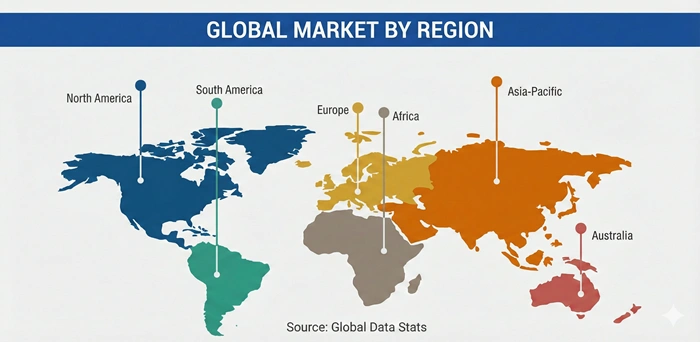
North America commands the largest share of the global impact investing market at approximately 42% in 2025, generating around USD 101.35 billion in managed impact assets, and is projected to grow at a CAGR of 16.8% through 2033. The United States is the undisputed hub of global impact investment activity, home to the largest concentration of specialized impact asset managers, development finance institutions, and mission-aligned foundations with substantial investment programs — including the Rockefeller Foundation, the Ford Foundation, and the Bill & Melinda Gates Foundation, which collectively pioneered many of the investment structures and measurement frameworks that now underpin the broader impact investing market. The U.S. government's development finance institution, the DFC, has committed billions to impact investments in emerging markets — creating important co-investment opportunities for commercial impact investors. Leading private market impact investors including BlackRock, TPG Rise Climate, Goldman Sachs Asset Management, and Bain Capital maintain their most sophisticated impact investment programs in North America.
Canada contributes significantly to the North American impact investing landscape through its mission-aligned pension funds and a growing community investment infrastructure, with institutions like the Quebec Solidarity Fund and provincial pension managers actively integrating impact criteria into their investment policies. The current U.S. political environment has created some near-term uncertainty around federal ESG investment mandates, but the fundamental commercial and fiduciary logic supporting impact investment continues to drive strong participation from private institutional investors, family offices, and high-net-worth individuals who are relatively insulated from political pressures. Despite short-term headwinds, North America is expected to sustain its market leadership position through 2033, driven by the largest pool of professionally managed institutional capital in the world and the deepest ecosystem of impact-specialized service providers, measurement platforms, and secondary market infrastructure.
Asia Pacific
Asia Pacific's Enormous SDG Financing Needs, Accelerating Regulatory Framework Development, and Rapidly Growing Institutional ESG Adoption Are Positioning It as the Most Dynamically Expanding Region in the Impact Investing Market
Asia Pacific is the fastest-growing region in the impact investing market with approximately 20% market share in 2025 and a projected CAGR of approximately 20.5% through 2033 — the highest of any region globally. The region's extraordinary growth trajectory reflects the convergence of massive unmet capital needs for sustainable development — particularly in South and Southeast Asia — with rapidly growing institutional and regulatory support for impact-oriented investment from governments across the region. China's green finance policy framework, Japan's GPIF sustainability integration mandate, and South Korea's ESG disclosure requirements for listed companies are all driving significant new institutional capital flows into the impact investment landscape. Temasek Holdings (Singapore), Japan Post Bank, and Korea Investment Corporation are among the leading Asian institutional investors expanding their impact investing programs.
India represents one of the most compelling emerging impact investment opportunities globally, offering the combination of enormous social and environmental needs, a rapidly growing technology-enabled social enterprise ecosystem, and government-backed impact finance frameworks including the Social Stock Exchange launched by SEBI. Southeast Asian nations — particularly Indonesia, the Philippines, and Vietnam — offer large and growing investment opportunities in climate adaptation, agricultural sustainability, financial inclusion, and affordable healthcare that are attracting increasing attention from both regional and international impact investors. The expansion of green bond markets across Asia Pacific, growing multilateral development bank blended finance programs, and the rising sophistication of regional impact measurement and reporting capabilities are collectively building the institutional infrastructure needed to support the next phase of accelerated impact capital deployment across the region through 2033.
Report Customization: Region-Wise and Country-Wise Insights Available on Request
Customized Regional and Country-Level Intelligence on the Impact Investing Market Is Available Across All Major Geographies — Delivering the Locally Specific Market Data and Strategic Insights That Institutional Investors, Fund Managers, and Policy Stakeholders Need to Deploy Capital with Confidence
This report is fully available for customization by region and country, providing in-depth market analysis, regulatory landscape assessment, investment flow data, key participant profiles, and sector-specific impact opportunity assessments tailored to the impact investing market in each selected geography and thematic focus area.
North America
-
U.S. — federal and state-level ESG regulatory environment, institutional impact investor landscape, green bond market analysis, DFC program co-investment opportunities, and retail impact investing platform growth analysis
-
Canada — pension fund ESG integration progress, community investment infrastructure, impact bond market development, and provincial government-supported impact finance programs
-
Mexico — development finance institution activity, social enterprise investment landscape, green bond market development, and SDG financing gap analysis
Europe
-
U.K. — FCA sustainable finance disclosure framework, Big Society Capital impact investment analysis, social impact bond market leadership, and private equity impact fund landscape
-
Germany — KfW development bank co-investment programs, green bond market depth, institutional pension ESG integration, and impact-focused mid-market private equity landscape
-
France — SFDR Article 9 fund landscape, CDC-driven impact finance programs, social enterprise investment ecosystem, and French sovereign green bond market analysis
-
Italy — CDP impact finance programs, social cooperative investment landscape, green bond market development, and ESG regulatory compliance timeline
-
Rest of Europe — Nordic impact investing leadership, Eastern European SDG investment needs, EU Taxonomy alignment analysis, and EBRD co-investment program opportunities
Asia Pacific
-
China — green finance regulatory framework, national green bond market, People's Bank of China sustainability policy, and institutional ESG adoption trajectory across state-owned enterprises
-
India — SEBI Social Stock Exchange analysis, microfinance impact investment landscape, green infrastructure financing needs, and growing family office impact investment activity
-
Japan — GPIF sustainability integration mandate, green bond market analysis, impact measurement framework adoption, and corporate ESG commitment landscape
-
South Korea — K-ESG guideline implementation, green bond market development, government-led impact investment programs, and chaebol ESG transformation investment opportunities
-
Australia — APRA climate risk guidance, superannuation fund ESG integration, social impact bond market, and responsible investment association leadership
-
Rest of Asia Pacific — Southeast Asian SDG financing needs, ADB blended finance program analysis, and emerging impact investment regulatory frameworks across ASEAN member states
Latin America
-
Brazil — Amazon conservation investment landscape, green bond market development, impact fintech ecosystem, and BNDES co-investment programs for SDG-aligned projects
-
Argentina — social enterprise investment landscape, economic recovery impact finance opportunities, and regional development finance institution activity
-
Rest of Latin America — Inter-American Development Bank impact co-investment programs, regional microfinance investment landscape, and renewable energy impact investment pipeline
Middle East & Africa
-
UAE — DIFC sustainable finance hub analysis, Gulf sovereign wealth fund ESG integration progress, green sukuk market development, and climate finance leadership in the GCC region
-
Saudi Arabia — Vision 2030 sustainability investment programs, green bond market development, Public Investment Fund ESG mandates, and climate transition financing needs
-
Rest of MEA — Africa-focused impact investment fund landscape, IFC and development finance institution activity, financial inclusion investment opportunities, and conservation finance programs across sub-Saharan Africa
Top Key Players
-
BlackRock Inc. (United States)
-
Goldman Sachs Asset Management (United States)
-
TPG Rise Climate (United States)
-
Bain Capital LP (United States)
-
Morgan Stanley Investment Management (United States)
-
Prudential Financial Inc. (United States)
-
BlueOrchard Finance Ltd. (Switzerland)
-
LeapFrog Investments (United Kingdom)
-
Bridges Fund Management (United Kingdom)
-
Triodos Investment Management (Netherlands)
-
Acumen (United States)
-
Vital Capital (Israel)
-
Community Investment Management LLC (United States)
-
Temasek Holdings Pte. Ltd. (Singapore)
-
Generate Capital (United States)
Recent Developments
-
In 2025, BlackRock expanded its impact investing platform with the launch of a dedicated Global Renewable Power infrastructure fund targeting over USD 3 billion in commitments from institutional investors, reinforcing its position as the world's leading asset manager in the climate impact investing space and responding to growing institutional demand for large-scale clean energy investment vehicles.
-
In 2025, TPG Rise Climate closed its second climate impact fund at approximately USD 7 billion — one of the largest dedicated climate private equity funds ever raised — with commitments from a diverse range of global pension funds, sovereign wealth funds, and insurance companies, marking a significant milestone in the institutionalization of the impact investing market.
-
In 2026, Goldman Sachs Asset Management announced the expansion of its Sustainable Investing platform with dedicated coverage teams for social and human development impact strategies across Asia Pacific and Latin America, responding to growing institutional investor demand for portfolio exposure to SDG-aligned social enterprise and inclusive finance investment opportunities in emerging markets.
-
In 2025, BlueOrchard Finance — the Schroders-owned impact investment manager — launched a new blended finance vehicle targeting financial inclusion investments in Sub-Saharan Africa and South Asia, combining IFC and development bank first-loss capital with institutional private investor participation to create an attractive risk-adjusted impact investment product for mainstream institutional allocators.
-
In 2025, Bridges Fund Management celebrated its 25th anniversary by announcing the launch of a new Generation Fund targeting GBP 200 million for impact investments in social infrastructure, affordable housing, and sustainable health and wellbeing enterprises across the United Kingdom, demonstrating the continued maturation and institutional scaling of one of Europe's most established dedicated impact investment managers.
Market Trends
The Convergence of Outcome-Based Finance Structures and the Rapid Growth of Nature and Biodiversity Investment Are Defining the Next Evolution of the Impact Investing Market Through 2033
One of the most significant emerging trends reshaping the impact investing market is the rapid growth of nature-based solutions (NbS) and biodiversity finance as investment categories. Following the adoption of the Global Biodiversity Framework at COP15 in 2022 and growing regulatory recognition of nature-related financial risks through frameworks like TNFD, institutional investors are beginning to build allocations specifically targeting investments that protect, restore, and sustainably manage natural ecosystems. Blue carbon investments in coastal wetland restoration, voluntary carbon market projects linked to verified biodiversity outcomes, sustainable land use investment vehicles, and biodiversity-linked bond structures are all growing rapidly as investable impact categories. For the impact investing market, this represents a major new asset class that could attract hundreds of billions in institutional capital over the coming decade as pricing mechanisms, measurement standards, and regulatory frameworks for biodiversity investments continue to mature.
A second defining trend is the scaling of outcomes-based finance — including social impact bonds, development impact bonds, and pay-for-success structures — as a mainstream mechanism for deploying impact capital toward specific, measurable social outcomes. These instruments align investor returns directly with independently verified social outcome achievement — for example, reduced recidivism rates, improved employment outcomes for vulnerable populations, or reduced hospital readmission rates — creating powerful accountability mechanisms that address the additionality and measurement challenges that have historically limited the credibility of some impact investment claims. Governments in the United Kingdom, the United States, Australia, and Canada are expanding outcome-based commissioning programs that create growing pipelines of social impact bond opportunities, while multilateral development banks are adapting the structure for emerging market applications through development impact bonds. The commercial success of well-structured outcomes-based instruments is building institutional investor confidence and attracting new capital to this innovative corner of the impact investing landscape.
Segments Covered in the Report
By Investor Type
-
Institutional Investors
-
Pension Funds
-
Sovereign Wealth Funds
-
Insurance Companies
-
Endowments and Foundations
-
Development Finance Institutions (DFIs)
-
-
Individual and High-Net-Worth Investors
-
Family Offices
-
Retail Impact Investors (via Digital Platforms)
-
-
Corporate and Strategic Investors
By Asset Class
-
Private Equity and Venture Capital
-
Social Enterprise Venture Capital
-
Impact-Focused Growth Equity
-
-
Green Bonds and Sustainability-Linked Bonds
-
Microfinance and Financial Inclusion Products
-
Social Impact Bonds and Outcome-Based Finance
-
Sustainable Real Estate and Infrastructure
-
Others (Blended Finance, Pay-for-Success)
By Sector/Theme
-
Climate and Environmental Impact
-
Renewable Energy
-
Climate Adaptation Infrastructure
-
Nature-Based Solutions and Biodiversity
-
-
Social and Human Development
-
Healthcare Access
-
Quality Education
-
Affordable Housing
-
Financial Inclusion
-
-
Agricultural and Food Systems Sustainability
-
Gender Lens Investing
-
Others
By Investment Structure
-
Fund-of-Funds
-
Direct Investment
-
Blended Finance Vehicles
-
Co-Investment Structures
By Region
-
North America (U.S., Canada, Mexico)
-
Europe (U.K., Germany, France, Italy, Rest of Europe)
-
Asia Pacific (China, India, Japan, South Korea, Australia, Rest of Asia Pacific)
-
Latin America (Brazil, Argentina, Rest of Latin America)
-
Middle East & Africa (UAE, Saudi Arabia, Rest of MEA)
❝ Built for Every Level — From Startups to Industry Giants ❞
Here Is Exactly How This Report Works for You
-
For Tier 1 institutional asset managers, sovereign wealth funds, and large-scale impact investment platforms evaluating strategic positioning in the impact investing market, this report provides a granular competitor capital deployment and revenue analysis — including fund performance benchmarking, investor base composition, geographic exposure strategies, and thematic sector allocation for leading firms including BlackRock, TPG Rise Climate, and Goldman Sachs Asset Management — alongside a structured assessment of how geopolitical dynamics including U.S.-China tensions, EU regulatory leadership versus U.S. ESG rollbacks, and emerging market sovereign risk are shaping global impact capital allocation decisions and long-term portfolio strategy across all major investment themes and geographies.
-
For Tier 2 and Tier 3 regional impact fund managers, social enterprise investors, ESG advisory firms, and development finance institutions seeking to scale their impact investment programs, this report maps detailed supply-demand dynamics across every major asset class, thematic category, and geographic market — identifying where unmet capital needs and regulatory frameworks are creating the most attractive deployment opportunities, how co-investment and blended finance structures can de-risk emerging market engagement, and which thematic categories are attracting the fastest-growing institutional investor demand that mid-market managers can competitively serve.
-
For private equity investors, venture capital firms, family offices, and strategic corporate investors evaluating entry, expansion, or exit strategies within the rapidly evolving impact investing market, this report provides a rigorous forecast with segment-level CAGR projections, a comprehensive review of fund launches, M&A activity, and institutional partnership developments, and an in-depth analysis of how the convergence of nature-based solutions, outcomes-based finance, digital platform democratization, and ESG regulatory evolution is creating transformative new value creation opportunities across the global impact investment landscape through 2033.
Frequently Asked Questions
Question 1: What is the current size of the impact investing market and what is its expected growth by 2033?
Answer: The impact investing market is valued at USD 241.32 billion in 2025 and is projected to grow to approximately USD 764.18 billion by 2033. The market is expanding at a strong CAGR of 17.6% from 2026 to 2033, driven by ESG regulatory acceleration, institutional adoption, and growing generational demand for purpose-aligned investment strategies.
Question 2: What types of investments fall under the impact investing market?
Answer: The impact investing market encompasses a diverse range of asset classes including private equity and venture capital in social enterprises, green bonds, microfinance instruments, social impact bonds, sustainable infrastructure, and blended finance vehicles. What distinguishes these instruments from conventional investments is the intentional commitment to generating measurable positive social or environmental outcomes alongside competitive financial returns.
Question 3: Which region dominates the global impact investing market and which region is growing fastest?
Answer: North America leads the impact investing market with approximately 42% market share in 2025, supported by the world's largest concentration of institutional impact investors and a deep ecosystem of specialized impact fund managers. Asia Pacific is the fastest-growing region with a projected CAGR of approximately 20.5% through 2033, driven by accelerating ESG regulatory frameworks, massive SDG financing needs, and rapidly growing institutional adoption across China, Japan, India, and Southeast Asia.
Question 4: How is impact investing different from ESG investing?
Answer: While both approaches consider environmental, social, and governance factors, the impact investing market goes further by requiring the intentionality of generating specific, measurable positive outcomes as a primary investment objective — not simply screening out harmful activities or integrating ESG risk factors into financial analysis. Impact investors also commit to measuring and reporting on the actual social and environmental outcomes achieved, creating a higher accountability standard than typical ESG investment strategies.
Question 5: What are the key challenges facing the impact investing market today?
Answer: The most significant challenges include the persistent risk of greenwashing — where investment products overstate their impact credentials — and the lack of universally standardized impact measurement frameworks that make it difficult for investors to compare and verify impact claims across different funds and asset classes. The political backlash against ESG investing in certain U.S. markets and limited secondary market liquidity for some impact asset structures also create near-term headwinds that the impact investing market must navigate through improved transparency, standardization, and regulatory engagement.