
Higher Education Market Overview
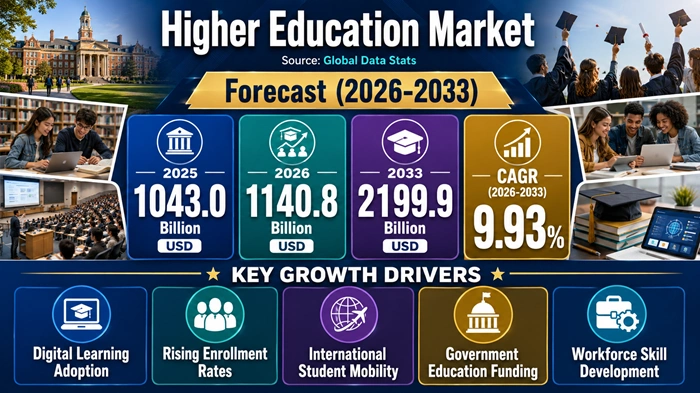
The global higher education market size is valued at USD 1043.0 billion in 2025 and is predicted to increase from USD 1140.8 billion in 2026 to approximately USD 2199.9 billion by 2033, growing at a CAGR of 9.93% from 2026 to 2033.
This robust expansion reflects rising global enrollment, growing demand for skill-based credentials, and accelerating adoption of digital and hybrid learning models across universities and colleges worldwide. Increasing investment in edtech infrastructure, expanding access to online degree programs, and strong employer demand for advanced qualifications continue to strengthen momentum across the global higher education sector.
AI Impact on the Higher Education Industry
Artificial Intelligence Is Quietly Transforming How Universities Teach, Assess, and Support Students at Scale
Artificial intelligence is beginning to play a meaningful role in reshaping how universities and colleges deliver instruction and support student success. Adaptive learning platforms powered by machine learning are helping institutions personalize coursework based on individual student performance, allowing faculty to identify at-risk learners far earlier than traditional grading cycles would reveal. AI-driven tutoring tools and automated grading systems are also reducing administrative burden on faculty, freeing up time for more meaningful student engagement and curriculum innovation across the higher education market.
Beyond the classroom, AI is improving institutional decision-making around enrollment forecasting, financial aid allocation, and student retention strategy. Predictive analytics tools now help university administrators identify students likely to drop out, enabling timely intervention through counseling or academic support programs. As generative AI tools become embedded in research, writing, and coursework, institutions are also investing heavily in academic integrity software and new assessment models, an area that has become central to curriculum design following the rapid mainstream adoption of AI writing tools.
Growth Factors
Rising Global Enrollment and Expanding Digital Learning Infrastructure Are Accelerating Demand for Higher Education Services
One of the strongest growth drivers for the higher education market is the steadily rising global demand for postsecondary credentials as employers increasingly require advanced qualifications for skilled roles. As economies shift toward knowledge-based and technology-driven industries, more students are pursuing bachelor's, master's, and specialized certificate programs to remain competitive in the job market. This trend is particularly strong in emerging economies where growing middle-class populations are prioritizing higher education as a pathway to economic mobility.
At the same time, the rapid expansion of online and hybrid learning infrastructure is making higher education more accessible to non-traditional students, including working professionals and learners in remote geographies. Universities are increasingly partnering with edtech providers to launch flexible degree programs, micro-credentials, and stackable certificates that appeal to a broader student base. Growing government funding for public universities, combined with rising private investment in specialized training institutes, continues to widen access to higher education across both developed and emerging markets.
Market Outlook
Expanding Credential Formats and Employer-Aligned Curriculum Design Are Setting the Stage for Sustained Long-Term Growth
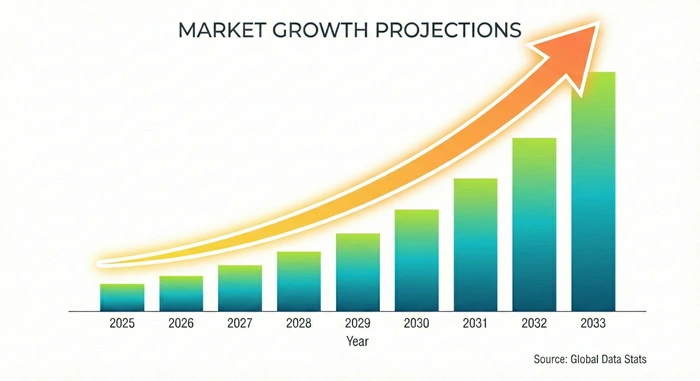
Looking ahead, the higher education industry is positioned for sustained growth as institutions continue diversifying their program offerings beyond traditional degree structures. The rising popularity of micro-credentials, professional certificates, and competency-based education reflects a broader shift toward flexible, career-aligned learning pathways that better match evolving employer expectations. This expanding credential landscape suggests continued double-digit growth potential through the forecast period.
Universities are also increasingly forming direct partnerships with corporations to design curriculum aligned with specific workforce needs, strengthening graduate employability while creating new revenue streams for institutions. Combined with growing international student mobility and expanding cross-border university partnerships, the outlook for the higher education market remains strongly positive. Analysts expect competitive intensity to increase as online-first universities and traditional institutions compete for the same expanding pool of global learners.
Expert Speaks
-
"Higher education is undergoing its most significant transformation in decades, and institutions that embrace flexible, technology-enabled learning models will be best positioned to serve the next generation of students." — CEO, Pearson plc
-
"We continue to see strong demand for career-aligned credentials that combine academic rigor with practical workforce skills, and this trend will define institutional strategy across the sector going forward." — CEO, Coursera Inc.
-
"As artificial intelligence reshapes how students learn and how employers evaluate talent, universities must adapt their curriculum and assessment models quickly to remain relevant in this changing landscape." — CEO, Chegg Inc.
Key Report Takeaways
-
North America leads the global higher education market, holding the largest regional share in 2025, supported by a high concentration of established universities, strong research funding, and widespread adoption of digital learning platforms.
-
Asia Pacific is the fastest-growing regional market, expected to expand at a CAGR exceeding 12% through 2033, driven by rising middle-class enrollment, expanding government education investment, and growing demand for skill-based credentials in China and India.
-
Undergraduate programs represent the dominant customer segment, accounting for the largest enrollment share due to their role as the primary entry point into postsecondary education worldwide.
-
Online and distance learning contributes the largest share within the delivery mode segment, reflecting growing learner preference for flexible, accessible study formats.
-
Blended learning models remain the most widely adopted instructional approach, combining the benefits of in-person engagement with digital course delivery.
-
The micro-credentials and certificate programs segment is expected to grow fastest going forward, holding an estimated 17% market share by 2033 and expanding at a CAGR above 15%, driven by rising employer demand for targeted, skills-based qualifications.
Market Scope
| Report Coverage | Details |
|---|---|
| Market Size by 2033 | USD 2199.9 Billion |
| Market Size by 2025 | USD 1043.0 Billion |
| Market Size by 2026 | USD 1140.8 Billion |
| Market Growth Rate from 2026 to 2033 | CAGR of 9.93% |
| Dominating Region | North America |
| Fastest Growing Region | Asia Pacific |
| Base Year | 2025 |
| Forecast Period | 2026 to 2033 |
| Segments Covered | Program Type, Delivery Mode, End User, Institution Type, Region |
| Regions Covered | North America, Europe, Asia Pacific, Latin America, Middle East & Africa |
Market Dynamics
Drivers Impact Analysis
Rising Global Enrollment and Expanding Digital Learning Adoption Are the Two Most Powerful Forces Propelling This Market Forward
| Driver | (≈) % Impact on CAGR Forecast | Geographic Relevance | Impact Timeline |
|---|---|---|---|
| Rising demand for postsecondary credentials | ~34% | Global, especially Asia Pacific & North America | Short to long-term |
| Expansion of online and hybrid learning platforms | ~29% | Global | Medium-term |
| Growing employer demand for skill-based qualifications | ~22% | North America, Europe | Long-term |
| Increasing government funding for public universities | ~15% | Asia Pacific, Latin America, MEA | Medium to long-term |
The rising global demand for postsecondary credentials is without question the single most powerful demand driver in the higher education market. As knowledge-based economies expand, employers increasingly require advanced qualifications for skilled roles, pushing more students toward bachelor's, master's, and specialized certificate programs. This trend is especially strong in emerging economies where education is increasingly viewed as a direct pathway to improved economic outcomes and social mobility.
The rapid expansion of online and hybrid learning platforms represents the second critical driver reshaping this market. Universities are increasingly partnering with technology providers to deliver flexible degree programs that reach non-traditional students, including working professionals and learners in remote geographies. This shift toward accessible, technology-enabled instruction continues to widen the addressable student population across the global higher education market.
Restraints Impact Analysis
Rising Tuition Costs and Persistent Skepticism About Return on Investment Continue to Present Real-World Barriers to Enrollment Growth
| Restraint | (≈) % Impact on CAGR Forecast | Geographic Relevance | Impact Timeline |
|---|---|---|---|
| Rising tuition costs and student debt burden | ~37% | North America, Europe | Short to long-term |
| Growing skepticism about degree return on investment | ~29% | Global | Medium-term |
| Declining traditional-age population in developed markets | ~21% | North America, Europe, East Asia | Long-term |
| Regulatory complexity around cross-border education | ~13% | Global | Short to medium-term |
The most significant structural restraint in the higher education market is the escalating cost of tuition, which has left many students burdened with substantial debt and increasingly cautious about pursuing traditional four-year degrees. This affordability challenge is particularly pronounced in North America, where rising education costs have outpaced wage growth for graduates entering the workforce.
Growing skepticism about the return on investment of certain degree programs is further compounding this restraint, as students increasingly weigh the cost of enrollment against expected career outcomes. Declining traditional college-age populations in several developed markets add further pressure on enrollment-dependent revenue models. These combined factors are prompting institutions to diversify program offerings and pricing structures to maintain enrollment momentum across the global higher education market.
Opportunities Impact Analysis
Micro-Credential Expansion and Corporate Partnership Models Represent the Most Commercially Significant Growth Opportunities
| Opportunity | (≈) % Impact on CAGR Forecast | Geographic Relevance | Impact Timeline |
|---|---|---|---|
| Growth of micro-credentials and stackable certificates | ~39% | Global, led by North America, Europe | Medium to long-term |
| Expansion of corporate-university partnership programs | ~34% | Global | Medium-term |
| Rising international student mobility to emerging markets | ~27% | Asia Pacific, MEA | Long-term |
The growing popularity of micro-credentials and stackable certificate programs represents one of the most commercially attractive opportunities within the higher education sector. These flexible, shorter-format credentials appeal to working professionals seeking targeted skill development without committing to full degree programs, opening new revenue streams for institutions willing to innovate beyond traditional program structures.
Expanding corporate-university partnerships are also creating significant opportunity, as employers increasingly co-design curriculum with institutions to ensure graduates possess directly applicable workforce skills. Meanwhile, rising international student mobility toward emerging education hubs in Asia Pacific and the Middle East is opening new enrollment pipelines for universities willing to expand global recruitment efforts, strengthening long-term growth prospects across the higher education market.
Segment Analysis
By Program Type
Undergraduate Programs Lead the Category, Driven by Their Role as the Primary Entry Point Into Postsecondary Education
Undergraduate programs hold the dominant position in the higher education market, accounting for the largest share of total enrollment given their role as the foundational credential most students pursue after secondary school. This dominance stems from consistent global demand for bachelor's degrees as a baseline qualification for entry-level professional roles across nearly every industry sector. North America remains the leading region for this segment due to its large concentration of accredited four-year institutions and well-established student financing infrastructure. Leading institutions and platforms such as Pearson, Coursera, and 2U continue to expand their undergraduate program partnerships through online delivery models that extend access to non-traditional student populations.
Asia Pacific is emerging as a fast-growing region for undergraduate enrollment, expanding at a CAGR exceeding 12% as rising middle-class populations in China and India prioritize higher education access. The region's growing network of private universities and government-backed education initiatives is generating substantial institutional demand for both campus-based and online undergraduate delivery models. Companies such as Byju's and upGrad have strengthened their regional presence through localized content and flexible financing options tailored to price-sensitive student populations, reinforcing this segment's continued relevance across the broader higher education market.
By Delivery Mode
Online and Distance Learning Gains Momentum, Supported by Growing Learner Preference for Flexible Study Formats
Online and distance learning represents one of the fastest-expanding delivery mode segments within the higher education market, as students increasingly prioritize flexibility, affordability, and accessibility over traditional campus-based instruction. This shift has been accelerated by growing employer acceptance of online degrees as legitimate credentials, removing a historical barrier that once limited enrollment in fully digital programs. North America continues to lead this segment, supported by a mature ecosystem of accredited online universities and established digital learning infrastructure. Companies such as 2U, Coursera, and Chegg have built strong positions through partnerships with traditional universities seeking to expand their online program portfolios.
Asia Pacific is witnessing particularly rapid growth in online delivery adoption, driven by expanding internet penetration and rising smartphone-based learning access across rural and semi-urban populations. This segment is expected to grow at a CAGR near 14% through 2033, outpacing traditional campus-based delivery formats considerably. Growing government support for digital education infrastructure across the region is reinforcing this trend, positioning online and distance learning as an increasingly central component of the global higher education market.
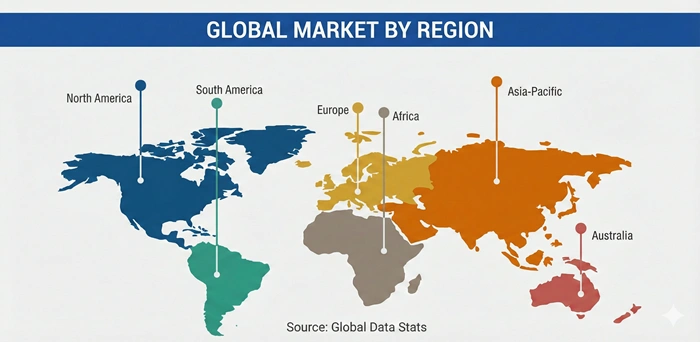
Regional Insights
North America
Established University Networks and Strong Research Funding Have Positioned North America as the Clear Market Leader
North America commands the largest share of the global higher education market, supported by a dense network of accredited universities, strong government and private research funding, and widespread early adoption of digital learning technologies. The United States drives the majority of regional demand, home to leading edtech and education platforms including Coursera, Pearson, and 2U, all of which maintain deep partnerships with traditional universities across the country. This region currently holds an estimated 34% share of global revenue, driven by high per-student spending and strong international student enrollment.
Canada also contributes meaningfully to regional growth, with its universities increasingly attracting international students seeking affordable, high-quality education alternatives to the United States. Growing investment in hybrid learning infrastructure and expanding corporate-university partnership models are reinforcing North America's leadership position within the higher education market. With continued strength in graduate and professional program enrollment, the region is projected to maintain steady growth at a CAGR near 9% through 2033.
Asia Pacific
Rising Middle-Class Enrollment and Expanding Government Investment Are Driving Rapid Growth Across Key Regional Markets
Asia Pacific stands out as the fastest-growing region within the higher education market, fueled by rising middle-class populations, expanding government education budgets, and growing demand for skill-based credentials among young learners. Countries including China, India, and South Korea are witnessing rapid growth in both traditional university enrollment and online learning platform adoption, supported by companies such as Byju's, upGrad, and NIIT establishing strong regional footprints. This region is expected to grow at a CAGR exceeding 12% through 2033, outpacing all other geographies globally.
Government initiatives promoting digital education infrastructure, combined with growing private investment in university and vocational training capacity, are making the region increasingly attractive for global education technology providers. India's expanding higher education ecosystem, supported by national skill development programs, is generating substantial enrollment growth across both public and private institutions. As affordability and access remain central priorities across the region, Asia Pacific is set to capture a growing share of the global higher education market in the years ahead.
Region-Wise and Country-Wise Report Customization
Tailored Regional Breakdowns Allow Decision-Makers to Focus Their Strategy on the Specific Geographies That Matter Most to Their Business
This report can be customized to provide detailed, country-specific insights covering market analysis, trends, opportunities, and other relevant information specific to each geography, covering the following:
North America
-
U.S., Canada, Mexico
Europe
-
U.K., Germany, France, Italy, Rest of Europe
Asia Pacific
-
China, India, Japan, South Korea, Australia, Rest of Asia Pacific
Latin America
-
Brazil, Argentina, Rest of Latin America
Middle East & Africa
-
UAE, Saudi Arabia, Rest of MEA
Customized versions of this report deliver granular, geography-specific data tailored to your chosen market and keyword combination, helping institutions and edtech companies make informed regional decisions with greater precision.
Top Key Players
-
Pearson plc (United Kingdom)
-
Coursera Inc. (United States)
-
2U Inc. (United States)
-
Chegg Inc. (United States)
-
Byju's (India)
-
upGrad Education Private Limited (India)
-
NIIT Limited (India)
-
Laureate Education Inc. (United States)
-
Kaplan Inc. (United States)
-
New Oriental Education & Technology Group Inc. (China)
-
Adtalem Global Education Inc. (United States)
-
Blackboard Inc. (United States)
Recent Developments
-
In 2025, Coursera Inc. expanded its partnership network with leading universities to launch new AI-focused degree programs, strengthening its position in career-aligned online credentials.
-
In 2025, Pearson plc acquired a specialized workforce skills assessment platform to strengthen its corporate learning and certification portfolio.
-
In 2024, 2U Inc. restructured its online program management partnerships with several universities, focusing on higher-margin degree offerings and micro-credential expansion.
-
In 2025, upGrad Education Private Limited expanded its presence across Southeast Asia through new university partnerships targeting working professional learners.
-
In 2024, Byju's underwent significant organizational restructuring while continuing to expand its test-preparation and higher education content offerings across South Asian markets.
Market Trends
The Higher Education Market Is Rapidly Shifting Toward Skills-Based Credentials and AI-Integrated Learning Platforms That Match Evolving Employer Expectations
Two of the most consequential trends reshaping the higher education landscape are the growing adoption of micro-credentials and stackable certificate programs, and the mainstreaming of AI-powered adaptive learning tools within traditional degree pathways. Universities are increasingly unbundling degree programs into smaller, verifiable credentials that students can complete individually or combine over time, reflecting a broader shift toward flexible, career-relevant education that better matches the pace of employer skill demands.
The second major trend is the deepening integration of artificial intelligence into course design, assessment, and student support services across institutions of all sizes. As generative AI tools become embedded in academic work, universities are simultaneously investing in updated assessment models and academic integrity safeguards, creating a new layer of institutional investment focused on responsibly integrating AI into the higher education experience while preserving the value of earned credentials.
Segments Covered in the Report
By Program Type
-
Undergraduate Programs
-
Graduate and Postgraduate Programs
-
Doctoral Programs
-
Diploma and Certificate Programs
-
Micro-Credentials
By Delivery Mode
-
On-Campus Learning
-
Online and Distance Learning
-
Blended and Hybrid Learning
By End User
-
Public Universities
-
Private Universities
-
Community Colleges
-
Vocational and Technical Institutes
By Institution Type
-
Research Universities
-
Liberal Arts Institutions
-
Specialized Professional Schools
-
Online-First Universities
By Region
-
North America (U.S., Canada, Mexico)
-
Europe (U.K., Germany, France, Italy, Rest of Europe)
-
Asia Pacific (China, India, Japan, South Korea, Australia, Rest of Asia Pacific)
-
Latin America (Brazil, Argentina, Rest of Latin America)
-
Middle East & Africa (UAE, Saudi Arabia, Rest of MEA)
❝ Built for Every Level — From Startups to Industry Giants ❞
Here Is Exactly How This Report Works for You
-
For tier 1 universities, edtech investors, and high-level decision-makers, this report delivers competitor revenue analysis, detailed revenue source breakdowns, enrollment trend forecasting, and supply-demand dynamics that enable confident capital allocation, program expansion, and strategic market entry decisions in the higher education space.
-
For tier 2 and tier 3 institutions, mid-level education providers, and startups, this report provides a practical roadmap of the most commercially viable program formats, regional opportunities, and technology investment priorities, helping you compete effectively against established players and identify white spaces before they become crowded.
-
For all decision-makers across the education value chain, this report explains exactly how regulatory shifts, demographic changes, employer demand trends, and competitor positioning are converging to shape market direction through 2033, giving you the intelligence framework to make proactive, evidence-based decisions rather than reactive ones.
Frequently Asked Questions
Question 1: What is the current size of the global higher education market and how is it expected to grow?
Answer: The global higher education market was valued at USD 1043.0 billion in 2025 and is projected to reach USD 2199.9 billion by 2033. This growth is driven by rising enrollment and expanding digital learning adoption worldwide.
Question 2: Which factors are driving growth in the higher education market?
Answer: The primary drivers of the higher education market include rising demand for postsecondary credentials and expanding online learning infrastructure. Growing employer preference for skill-based qualifications is also accelerating adoption globally.
Question 3: Which region holds the largest share in the higher education market?
Answer: North America currently dominates the higher education market, supported by established university networks and strong research funding. Asia Pacific is the fastest-growing region, driven by rising middle-class enrollment and government investment.
Question 4: What are the key program type segments driving growth in the higher education market?
Answer: Undergraduate programs account for the largest enrollment share in the higher education market, reflecting their role as the primary entry point into postsecondary study. Micro-credentials and certificate programs are also gaining significant momentum.
Question 5: Who are the leading companies operating in the higher education market?
Answer: Leading players in the higher education market include Pearson, Coursera, 2U, Chegg, and Byju's. These companies compete through expanding program portfolios and strong university partnership networks.