
High Throughput Screening (HTS) Market Overview
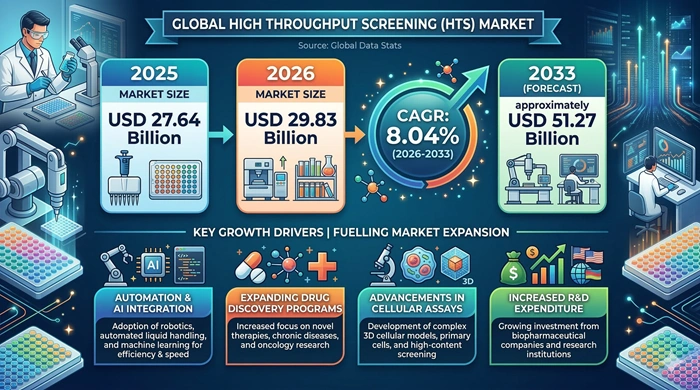
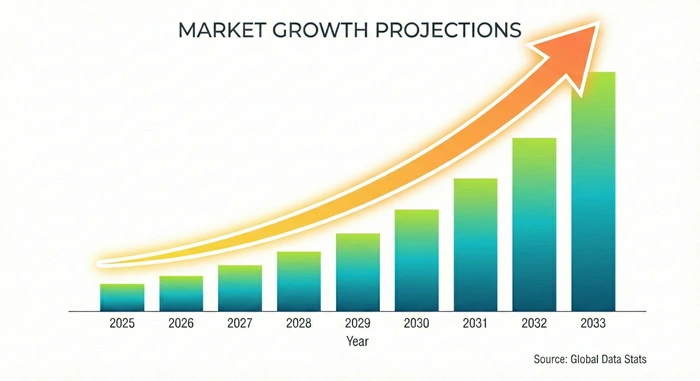
The global High Throughput Screening (HTS) market size is valued at USD 27.64 Billion in 2025 and is predicted to increase from USD 29.83 Billion in 2026 to approximately USD 51.27 Billion by 2033, growing at a CAGR of 8.04% from 2026 to 2033. The market is expanding due to rising drug discovery activity, increasing use of automation in life sciences, stronger demand for fast assay-based testing, and growing investment in precision medicine and biologics research. Related terms such as high-throughput assay market and drug discovery screening market also reflect the broader commercial landscape.
Automation Driven Discovery Platforms Are Reshaping Research Productivity And Creating Strong Demand For Faster More Accurate And Scalable Screening Workflows
The High Throughput Screening (HTS) market includes instruments, consumables, software, assay kits, reagents, robotics, and integrated screening platforms used to evaluate large volumes of biological or chemical compounds quickly. HTS is a core technology in pharmaceutical and biotechnology research because it helps identify active compounds, validate drug targets, and prioritize candidates early in the discovery pipeline. It is widely used across oncology, neurology, infectious disease, immunology, and metabolic disorder research.
The market is also gaining momentum from the shift toward more data-rich and automation-led workflows. Research organizations want faster cycle times, lower manual error, and better screening throughput across large compound libraries. As a result, demand is rising for integrated screening systems that combine liquid handling, imaging, detection, software analytics, and plate-based automation. This is helping the market expand across both established pharma labs and contract research environments.
AI Impact on the High Throughput Screening (HTS) Industry
Artificial Intelligence Is Improving Hit Identification Assay Interpretation And Workflow Optimization Across The High Throughput Screening Industry
Artificial intelligence is becoming an important enabler in the High Throughput Screening (HTS) market because screening generates large volumes of complex assay data. AI and machine learning tools can help researchers identify promising compound patterns, reduce false positives, optimize assay conditions, and improve lead prioritization. This shortens the time between raw screening output and decision-ready insight. It also improves efficiency in early-stage drug discovery.
AI is also supporting image-based screening and predictive modeling. In cell-based assays, high-content screening workflows can produce complex visual datasets that are difficult to evaluate manually at scale. AI tools help extract meaningful patterns, classify phenotypes, and improve reproducibility. Over time, this should strengthen the High Throughput Screening (HTS) market by making automation platforms more intelligent and scalable.
Growth Factors
Expanding Drug Discovery Pipelines Higher R And D Spending And Rising Demand For Rapid Assay Automation Are Driving Market Growth
One of the strongest growth factors in the High Throughput Screening (HTS) market is the increase in pharmaceutical and biotechnology research activity. Companies are under pressure to improve discovery speed while controlling cost and failure risk. HTS helps them screen large libraries of molecules against disease targets in a structured and repeatable way. This makes it a valuable tool for faster candidate identification.
Another key growth factor is the wider adoption of automation across life science laboratories. Manual screening is slower, less scalable, and more prone to variability, especially in large-volume research programs. Automated platforms improve reproducibility, throughput, and workflow integration. As R and D teams seek more efficient early-stage discovery, the High Throughput Screening (HTS) market continues to gain operational relevance.
Market Outlook
The Market Outlook Remains Strong As Screening Technologies Become More Integrated Data Intensive And Central To Modern Drug Discovery
The outlook for the High Throughput Screening (HTS) market remains positive through 2033. Demand is expected to increase as pharmaceutical companies, biotech firms, and contract research organizations push for faster and more reliable compound evaluation. HTS will remain essential in hit identification, target validation, toxicity screening, and phenotypic research. It is also likely to benefit from the expansion of biologics and cell-based discovery workflows.
In the coming years, the market should gain from improvements in miniaturization, multiplex assays, automation software, and lab informatics. Integrated screening ecosystems that combine robotics, imaging, data analytics, and cloud-based workflow control are likely to become more common. This positions the High Throughput Screening (HTS) market for healthy long-term growth across both mature and emerging research hubs.
Expert Speaks
-
Robert B. Ford (United States), CEO of Abbott, has emphasized the importance of faster innovation cycles and smarter diagnostic and life science workflows, a trend that supports increasing use of automation-led research tools such as HTS.
-
Marc N. Casper (United States), Chairman and CEO of Thermo Fisher Scientific, has highlighted ongoing demand for high-performance lab technologies that improve scientific productivity, which closely aligns with the growth of screening platforms and assay automation.
-
Kevin Ali (United States), CEO of Organon, has stressed the need for more efficient development pathways in healthcare innovation, reinforcing the broader value of scalable drug discovery technologies.
Key Report Takeaways
-
North America leads the High Throughput Screening (HTS) market with an estimated 41.3% share in 2026 due to strong pharmaceutical research spending, advanced laboratory infrastructure, and early adoption of automation platforms.
-
Asia Pacific is the fastest-growing region and is projected to register a CAGR of 9.47% from 2026 to 2033 because of expanding biotech ecosystems, rising research outsourcing, and increasing investment in life sciences infrastructure.
-
Pharmaceutical and biotechnology companies are the largest customer group in the High Throughput Screening (HTS) market, accounting for nearly 56.9% of demand because they rely heavily on screening tools for lead identification and early discovery.
-
Drug discovery applications contribute the highest market share at around 44.2%, supported by rising compound library screening, target validation activity, and increasing pipeline complexity.
-
Cell-based assays remain the most widely used screening approach because they provide biologically relevant results and support phenotypic evaluation in modern drug discovery programs.
-
High-content screening and imaging-integrated platforms are expected to grow quickly, holding an estimated 19.6% share in 2026 and a projected CAGR of 9.12% through 2033 due to strong demand for richer biological insights.
Market Scope
| Scope Item | Details |
|---|---|
| Market Size by 2033 | USD 51.27 Billion |
| Market Size by 2025 | USD 27.64 Billion |
| Market Size by 2026 | USD 29.83 Billion |
| Market Growth Rate from 2026 to 2033 | CAGR of 8.04% |
| Dominating Region | North America |
| Fastest Growing Region | Asia Pacific |
| Base Year | 2025 |
| Forecast Period | 2026 to 2033 |
| Segments Covered | By Product and Service By Technology By Application By End User By Region |
| Regions Covered | North America Europe Asia Pacific Latin America Middle East & Africa |
Market Dynamics
Drivers Impact Analysis
Growing Research Complexity Faster Lead Identification Needs And Broad Laboratory Automation Are Accelerating The High Throughput Screening (HTS) Market
| Driver | (≈) % Impact on CAGR Forecast | Geographic Relevance | Impact Timeline |
|---|---|---|---|
| Rising drug discovery activity | 2.3% | Global | Short to Long Term |
| Increasing laboratory automation adoption | 1.8% | North America Europe Asia Pacific | Medium to Long Term |
| Growth in biologics and precision medicine research | 1.4% | Global | Medium Term |
The High Throughput Screening (HTS) market is strongly supported by the need to accelerate discovery timelines. Pharmaceutical and biotech companies are screening larger libraries and more diverse targets than before. This makes manual workflows inefficient and difficult to scale. HTS platforms solve this challenge by combining speed, repeatability, and data generation in one workflow.
Another important driver is the expansion of complex therapeutic research. Biologics, cell therapies, and targeted drugs require more refined assay models and faster experimental cycles. The High Throughput Screening (HTS) market benefits because it helps researchers compare compounds quickly and identify promising signals earlier. This improves productivity and supports pipeline development across multiple therapeutic areas.
Restraints Impact Analysis
High System Costs Workflow Integration Challenges And Assay Variability Continue To Restrain Faster High Throughput Screening (HTS) Market Growth
| Restraint | (≈) % Impact on CAGR Forecast | Geographic Relevance | Impact Timeline |
|---|---|---|---|
| High capital cost of advanced platforms | -1.3% | Global | Short to Medium Term |
| Complexity of workflow integration | -1.0% | Global | Medium Term |
| Assay development and reproducibility issues | -0.8% | Global | Long Term |
The High Throughput Screening (HTS) market faces an important restraint in the form of high platform cost. Fully automated screening systems require significant investment in robotics, readers, software, liquid handling systems, and data infrastructure. Smaller firms and academic labs may not always have the budget to adopt advanced solutions at scale. This can slow penetration in cost-sensitive research settings.
Another challenge is workflow complexity. Screening success depends not only on hardware but also on assay design, sample quality, data interpretation, and laboratory integration. If these elements are not optimized, results can be inconsistent or difficult to reproduce. These operational barriers can reduce adoption speed in some parts of the market.
Opportunities Impact Analysis
AI Enabled Screening Contract Research Expansion And Next Generation Assay Development Are Creating New Growth Opportunities In The High Throughput Screening (HTS) Market
| Opportunity | (≈) % Impact on CAGR Forecast | Geographic Relevance | Impact Timeline |
|---|---|---|---|
| AI-driven screening analytics | 1.5% | Global | Short to Medium Term |
| Growth of CRO outsourcing demand | 1.6% | North America Europe Asia Pacific | Medium to Long Term |
| Expansion of cell-based and high-content assays | 1.7% | Global | Medium to Long Term |
A major opportunity in the High Throughput Screening (HTS) market is the rapid growth of contract research outsourcing. Many pharma and biotech firms now rely on CROs for flexible discovery support, especially when speed and scale matter. This creates strong demand for advanced HTS infrastructure outside traditional in-house labs. CRO-led adoption is therefore becoming a major commercial growth lever.
Another strong opportunity lies in next-generation assay development. Researchers increasingly want more predictive models, including 3D cell cultures, organoid systems, and high-content phenotypic screens. These applications require smarter screening tools and richer data interpretation. As these methods become more common, the High Throughput Screening (HTS) market will gain new value across discovery workflows.
Segment Analysis
By Product and Service
Consumables And Reagents Lead Revenue Because They Support Recurring Assay Activity Across Continuous Screening Programs
The consumables and reagents segment holds the largest share of the High Throughput Screening (HTS) market at approximately 46.7% in 2026. This segment includes assay kits, reagents, plates, probes, buffers, labels, and other materials used repeatedly in screening workflows. It leads because every screening cycle creates recurring demand for these products, unlike capital instruments that are purchased less frequently. North America remains the largest regional contributor because of its dense concentration of pharmaceutical and biotechnology laboratories.
The segment is also expanding quickly in Europe and Asia Pacific as research activity broadens across public and private labs. Leading companies in these regions benefit from recurring purchase patterns and the need for assay standardization. The High Throughput Screening (HTS) market for consumables and reagents is expected to grow at a CAGR of 8.18% through 2033. Growth is supported by rising screening volume and broader use of cell-based assays.
By Application
Drug Discovery Remains The Largest Application Area Because HTS Is Deeply Embedded In Early Stage Candidate Identification And Validation
The drug discovery segment accounts for about 44.2% of the High Throughput Screening (HTS) market in 2026, making it the leading application area. This segment includes hit identification, lead optimization support, target validation, and early pharmacology workflows. It dominates because pharmaceutical and biotechnology firms depend on HTS to evaluate large compound libraries rapidly and systematically. North America leads this segment due to high R and D spending, strong innovation ecosystems, and broad availability of advanced laboratory infrastructure.
The segment is projected to expand at a CAGR of 8.36% through 2033, with particularly strong momentum in Asia Pacific as regional biotech capacity grows. Companies such as Thermo Fisher Scientific, Agilent Technologies, PerkinElmer, Danaher, and Bio-Rad Laboratories are supporting this expansion through instruments, assay tools, automation systems, and analysis software. As pipeline complexity increases, the High Throughput Screening (HTS) market will continue to rely heavily on drug discovery as its primary revenue engine.
Regional Insights
North America
Advanced Research Infrastructure Strong Pharma Presence And Early Technology Adoption Keep North America At The Front Of The Market
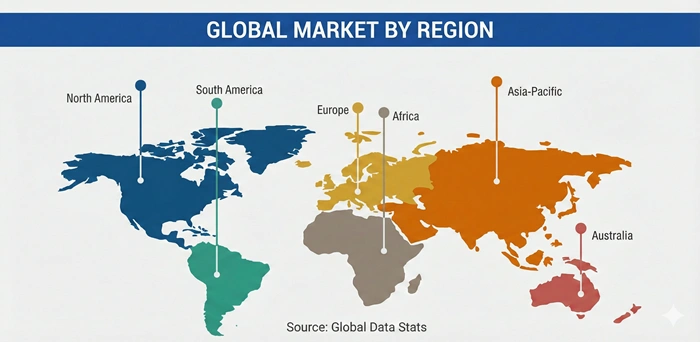
North America leads the High Throughput Screening (HTS) market with an estimated 41.3% share in 2026. The region benefits from strong pharmaceutical and biotech spending, advanced lab automation, and a high concentration of leading screening technology providers. The United States remains the major revenue generator because it has a mature discovery ecosystem and strong demand for scalable research tools. Major players such as Thermo Fisher Scientific, Danaher, Agilent Technologies, and Bio-Rad Laboratories support this regional strength.
The regional market is expected to grow at a CAGR of 7.66% through 2033. Growth is supported by sustained R and D investment, expansion of biologics research, and broad use of AI-enabled lab analytics. Academic research centers and CROs also contribute meaningfully to demand. This keeps North America in the leading position within the High Throughput Screening (HTS) market.
Asia Pacific
Expanding Biotech Capacity Lower Cost Research Support And Rising Innovation Spending Make Asia Pacific The Fastest Growing Regional Market
Asia Pacific is the fastest-growing region in the High Throughput Screening (HTS) market and is projected to register a CAGR of 9.47% from 2026 to 2033. The region is benefiting from biotech ecosystem development, government support for innovation, increasing CRO activity, and lower-cost research operations in selected markets. China, India, Japan, South Korea, and Singapore are key growth centers. These countries are expanding laboratory infrastructure and strengthening drug discovery capabilities.
Asia Pacific held an estimated 25.8% share of the market in 2026 and is expected to rise steadily over the forecast period. Regional growth is supported by increasing outsourcing demand and broader access to modern screening tools. Global companies and local distributors are expanding their footprint to meet this demand. As a result, the High Throughput Screening (HTS) market in Asia Pacific should remain the fastest-growing regional opportunity.
Top Key Players
-
Thermo Fisher Scientific Inc. (United States)
-
Danaher Corporation (United States)
-
Agilent Technologies Inc. (United States)
-
Bio-Rad Laboratories Inc. (United States)
-
Merck KGaA (Germany)
-
PerkinElmer Inc. (United States)
-
Revvity Inc. (United States)
-
Tecan Group Ltd. (Switzerland)
-
Hamilton Company (United States)
-
Corning Incorporated (United States)
-
Aurora Biomed Inc. (Canada)
-
Molecular Devices LLC (United States)
Recent Developments
-
2025: Thermo Fisher Scientific continued expanding its automation and life science workflow portfolio, supporting higher demand for integrated screening and assay solutions across pharma and biotech labs.
-
2025: Agilent Technologies strengthened its laboratory automation and cell analysis capabilities, helping improve data quality and workflow efficiency in screening applications.
-
2024: Danaher advanced its life sciences and diagnostics toolset through continued portfolio development, supporting broader research productivity across discovery environments.
-
2024: Revvity expanded its life science and screening-related solutions after its strategic portfolio repositioning, increasing focus on workflow efficiency and assay-driven research support.
-
2024: Tecan Group continued enhancing automated liquid handling and lab workflow systems, reinforcing its role in scalable screening infrastructure for research organizations.
Market Trends
Miniaturization High Content Screening And Workflow Integration Are Emerging As Defining Trends Across The High Throughput Screening Market
One important trend in the High Throughput Screening (HTS) market is the move toward higher-content and more biologically relevant screening models. Researchers now want more than simple binary assay results. They increasingly need multi-parameter outputs, imaging-based phenotypes, and cell-level insight. This is driving demand for platforms that combine screening speed with richer biological data.
Another major trend is greater workflow integration. Labs are adopting systems that connect liquid handling, plate reading, data analysis, and informatics in a more seamless way. This reduces error and improves reproducibility across high-volume studies. As these integrated environments become more common, the High Throughput Screening (HTS) market is becoming more software-led, automated, and scalable.
Segments Covered in the Report
-
By Product and Service: Instruments, consumables and reagents, software, services
-
By Technology: Cell-based assays, biochemical assays, label-free technology, high-content screening, ultra-high-throughput screening
-
By Application: Drug discovery, toxicity testing, target identification and validation, stem cell research, genomics and proteomics research
-
By End User: Pharmaceutical and biotechnology companies, contract research organizations, academic and research institutes, government laboratories
-
By Workflow: Primary screening, secondary screening, counter screening, hit confirmation
-
By Region: North America, Europe, Asia Pacific, Latin America, Middle East & Africa
Frequently Asked Questions
Question 1: What is the current size of the High Throughput Screening (HTS) market?
Answer: The High Throughput Screening (HTS) market is valued at USD 27.64 Billion in 2025. It is expected to reach USD 51.27 Billion by 2033.
Question 2: What is driving the High Throughput Screening (HTS) market growth?
Answer: The High Throughput Screening (HTS) market is growing because drug discovery programs need faster and more scalable testing tools. Rising automation and biologics research are also supporting demand.
Question 3: Which region leads the High Throughput Screening (HTS) market?
Answer: North America leads the High Throughput Screening (HTS) market. The region has strong research funding, advanced labs, and a large concentration of major life science companies.
Question 4: Which region is growing fastest in the High Throughput Screening (HTS) market?
Answer: Asia Pacific is the fastest-growing region in the High Throughput Screening (HTS) market. Growth is supported by biotech expansion, outsourcing demand, and improving research infrastructure.
Question 5: Which application contributes the most to the High Throughput Screening (HTS) market?
Answer: Drug discovery contributes the most to the High Throughput Screening (HTS) market. It remains the main use case because HTS is essential for early-stage compound evaluation.