
Hair Dryer Market Overview
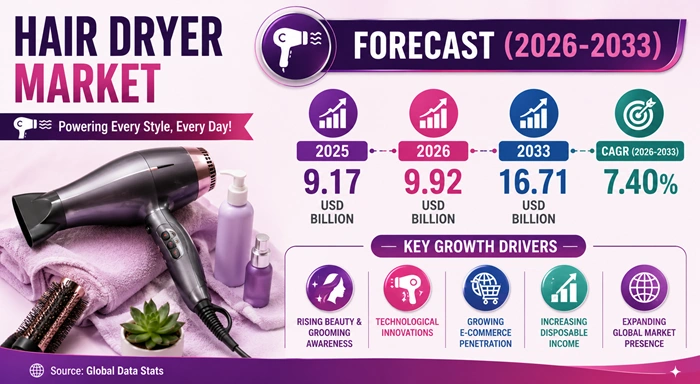
The global hair dryer market size is valued at USD 9.17 billion in 2025 and is predicted to increase from USD 9.92 billion in 2026 to approximately USD 16.71 billion by 2033, growing at a CAGR of 7.40% from 2026 to 2033. Personal grooming and beauty consciousness are transforming consumer behavior worldwide, driving demand for advanced hair drying solutions that combine efficiency with hair health protection. Modern consumers seek products that deliver salon-quality results at home while minimizing heat damage and styling time.
AI Impact on the Hair Dryer Industry
Smart Technology Integration Revolutionizing Hair Care and Styling Experiences
Artificial intelligence is fundamentally transforming the hair dryer market by introducing intelligent features that automatically adjust temperature, airflow, and drying patterns based on hair type, moisture levels, and environmental conditions. Machine learning algorithms embedded in premium hair dryers analyze real-time data from multiple sensors monitoring hair temperature, ambient humidity, and distance from the scalp to optimize heat settings dynamically, preventing thermal damage while maintaining effective drying performance. Computer vision systems integrated with smart hair dryers can detect hair texture, thickness, and color to recommend personalized drying programs that deliver optimal results for each individual user's unique hair characteristics. AI-powered voice assistants enable hands-free operation where users can adjust settings, activate specific drying modes, or receive styling guidance through simple voice commands without interrupting their grooming routines.
Predictive maintenance algorithms monitor motor performance, heating element efficiency, and airflow consistency to alert users about potential component failures before they occur, extending equipment lifespan while preventing unexpected breakdowns. Natural language processing systems integrated with companion mobile applications provide personalized hair care recommendations, styling tutorials, and product suggestions based on user preferences, hair goals, and seasonal environmental factors. Advanced AI systems learn from millions of user interactions globally to continuously improve drying algorithms, identify emerging styling trends, and develop new features that address evolving consumer needs. Smart connectivity features enable hair dryers to integrate seamlessly with comprehensive beauty ecosystems, synchronizing with other smart grooming devices, tracking hair health metrics over time, and providing data-driven insights that help users optimize their hair care routines for better long-term results in the hair dryer market.
Growth Factors
Rising Beauty Consciousness and Professional Salon Expansion Drive Market Momentum
The hair dryer market is experiencing robust growth driven by heightened consumer awareness regarding personal appearance, professional grooming standards, and the proliferation of beauty salons and styling centers worldwide. Social media platforms including Instagram, TikTok, and YouTube have created unprecedented visibility for beauty influencers and professional stylists who demonstrate advanced hair styling techniques, product comparisons, and grooming routines that inspire millions of followers to invest in quality hair care equipment. Urbanization continues accelerating across developing regions, concentrating populations in cities where modern lifestyles, professional work environments, and social expectations create strong demand for polished personal appearances that require regular hair styling and maintenance. Rising disposable incomes particularly in emerging markets enable growing middle-class populations to afford premium personal care appliances that were previously considered luxury items accessible only to affluent consumers.
The explosive growth of professional beauty salons, barbershops, and styling studios creates sustained demand for high-performance commercial-grade hair dryers capable of withstanding continuous daily use while delivering consistent results across diverse hair types. Celebrity endorsements and brand collaborations with popular personalities significantly influence purchasing decisions, particularly among younger demographics who closely follow fashion trends and beauty recommendations from their favorite entertainers and social media influencers. Technological innovations including ionic technology, tourmaline ceramic components, and infrared heating systems address consumer concerns about heat damage while delivering faster drying times and improved styling results compared to traditional hair dryers. The growing acceptance of male grooming and increasing participation of men in personal care routines expands the addressable market beyond the traditionally female-dominated consumer base, creating new growth opportunities for manufacturers developing products targeting male consumers in the hair dryer market.
Market Outlook
Innovation and Sustainability Define Future Product Development Strategies
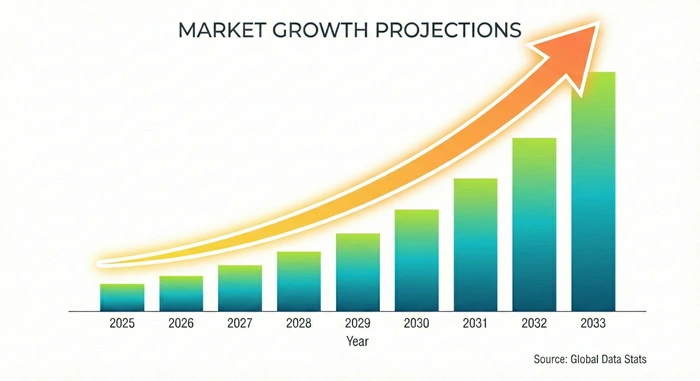
The hair dryer market is positioned for sustained expansion through 2033 as manufacturers invest heavily in research and development to create next-generation products incorporating advanced technologies, sustainable materials, and enhanced user experiences. Cordless and battery-powered hair dryers continue gaining market share as lithium-ion battery technology improvements enable longer operating times, faster charging capabilities, and power output approaching corded models while delivering unprecedented portability for travelers and mobile styling professionals. Energy-efficient motor designs including brushless digital motors reduce electricity consumption significantly compared to traditional AC motors while generating more powerful airflow and operating with substantially lower noise levels that enhance user comfort during extended styling sessions. Lightweight materials and ergonomic designs address consumer demands for comfortable handling during prolonged use, with manufacturers employing advanced polymers, carbon fiber components, and balanced weight distribution that minimize hand and arm fatigue.
Smart hair dryers equipped with Bluetooth connectivity, companion mobile applications, and cloud-based styling platforms create comprehensive digital ecosystems that provide personalized recommendations, track hair health metrics, and enable firmware updates that continuously enhance product functionality. Sustainability initiatives drive development of eco-friendly hair dryers manufactured using recycled plastics, biodegradable packaging materials, and energy-efficient components that reduce environmental impact while appealing to environmentally conscious consumers. The premiumization trend continues as affluent consumers willingly pay higher prices for advanced features including intelligent heat control, multiple airflow patterns, magnetic attachments, and professional-grade performance that deliver superior results compared to budget alternatives. Emerging markets in Asia Pacific, Latin America, and Middle East regions present enormous growth opportunities as expanding middle classes, increasing urbanization, and rising beauty consciousness create favorable conditions for rapid market penetration throughout the hair dryer market.
Expert Speaks
-
Jim Craigie, Chairman and Chief Executive Officer of Church & Dwight Co., Inc., emphasized that the company's personal care segment including hair styling products continues showing strong growth driven by innovation, strategic brand positioning, and increasing consumer focus on at-home grooming solutions that deliver professional-quality results without requiring salon visits.
-
Laurent Freixe, Chief Executive Officer of Nestlé S.A., highlighted that consumer wellness trends extend beyond food and nutrition into personal care categories, with growing demand for products combining convenience, performance, and health benefits reflecting broader lifestyle shifts toward holistic self-care approaches across all consumer demographics.
-
Ramon Laguarta, Chairman and Chief Executive Officer of PepsiCo Inc., noted that digital transformation and direct-to-consumer strategies represent critical priorities across all business segments, enabling companies to build deeper customer relationships, gather valuable behavioral insights, and develop personalized product experiences that drive brand loyalty and sustainable growth.
Key Report Takeaways
-
North America leads the hair dryer market with approximately 33% market share in 2025, driven by high disposable incomes, strong beauty culture, advanced retail infrastructure, and consumer willingness to invest in premium grooming appliances that deliver professional styling results at home.
-
Asia Pacific is growing the fastest with a projected CAGR of 8.70% from 2026 to 2033, fueled by rapid urbanization, expanding middle-class populations, increasing beauty consciousness, growing influence of K-beauty trends, and improving distribution networks across China, India, Japan, and Southeast Asian markets.
-
Individual consumers represent the primary user segment for hair dryers, accounting for approximately 61% of market consumption as at-home styling practices become increasingly popular, driven by convenience, cost savings compared to salon visits, and improving product performance enabling professional results.
-
The corded hair dryer segment contributes the most to overall market revenue with approximately 82% share in 2025, reflecting reliable performance, unlimited operating duration, consistent power output, and affordability that appeal to both professional stylists and individual consumers requiring dependable daily use equipment.
-
Offline distribution channels dominate sales with approximately 71% market share as consumers prefer physically examining products, testing weight and ergonomics, and receiving expert guidance from retail staff before purchasing, though online channels are growing rapidly through expanded selections and competitive pricing.
-
The professional application segment will grow quickly with an estimated CAGR of 8.30% and market share expanding as salon industry growth, increasing demand for specialized styling services, and professional stylists' requirements for high-performance durable equipment drive commercial purchases throughout the forecast period.
Market Scope
| Report Coverage | Details |
|---|---|
| Market Size by 2033 | USD 16.71 Billion |
| Market Size by 2025 | USD 9.17 Billion |
| Market Size by 2026 | USD 9.92 Billion |
| Market Growth Rate from 2026 to 2033 | CAGR of 7.40% |
| Dominating Region | North America |
| Fastest Growing Region | Asia Pacific |
| Base Year | 2025 |
| Forecast Period | 2026 to 2033 |
| Segments Covered | Product, Application, Distribution Channel, Region |
| Regions Covered | North America, Europe, Asia Pacific, Latin America, Middle East and Africa |
Market Dynamics
Driver Impact Analysis
Expanding Professional Salon Industry and Beauty Service Demand Fuel Market Growth
The remarkable expansion of professional beauty salons, styling studios, and grooming centers worldwide represents the most significant driver propelling the hair dryer market toward sustained growth across all geographic regions and consumer segments. The global salon industry has experienced tremendous growth over the past decade as rising disposable incomes, urbanization, and changing lifestyle patterns drive increasing demand for professional hair care and styling services that require high-quality commercial equipment. Major salon chains including Regis Corporation, Toni&Guy, and numerous regional operators continue expanding aggressively into emerging markets where growing middle-class populations seek access to professional beauty services previously unavailable in their communities. Professional stylists require durable, powerful hair dryers capable of withstanding continuous daily use across multiple clients while maintaining consistent performance, creating sustained demand for premium commercial-grade equipment.
The increasing sophistication of hair styling techniques including balayage, ombré, keratin treatments, and other chemical services creates opportunities for stylists to upsell complementary blow-drying and styling services that generate additional revenue per client visit. Social media influence drives consumer expectations for perfectly styled hair, motivating salon visits for special occasions, regular maintenance appointments, and learning proper styling techniques that can be replicated at home using quality equipment. The hair dryer market benefits from professional salon purchases that typically involve higher-priced models with advanced features, extended warranties, and bulk ordering patterns that generate substantial revenue for manufacturers serving the commercial segment. Growing awareness about hair health and damage prevention motivates consumers to seek professional styling services and invest in quality home equipment that protects hair integrity while achieving desired aesthetic results.
| Driver | ≈ % Impact on CAGR Forecast | Geographic Relevance | Impact Timeline |
|---|---|---|---|
| Professional Salon Expansion | +1.95% | Global, particularly Asia Pacific | 2026-2033 |
| Rising Beauty Consciousness | +1.70% | North America, Europe, Urban Asia | 2026-2033 |
| Social Media Influence | +1.45% | Global, strongest among youth demographics | 2026-2033 |
| Technological Innovation | +1.20% | Developed markets globally | 2026-2033 |
Restraints Impact Analysis
High-End Product Pricing and Market Saturation Limit Growth Potential
The hair dryer market confronts significant challenges related to premium product pricing, market saturation in developed regions, and intense competition that constrains profitability and limits market penetration among price-sensitive consumer segments. Advanced hair dryers incorporating ionic technology, digital motors, intelligent heat control, and premium materials command substantially higher prices ranging from USD 200 to over USD 400, creating affordability barriers for middle and lower-income consumers in both developed and emerging markets. Economic uncertainty, inflation pressures, and currency fluctuations in developing countries constrain household discretionary spending, forcing consumers to prioritize essential purchases over premium grooming appliances that may be perceived as luxury items rather than necessities. Market saturation in developed regions including North America and Western Europe limits growth opportunities as household penetration rates exceed 90%, with replacement cycles extending 5-7 years or longer as consumers retain functional equipment despite availability of newer models.
The proliferation of low-cost alternatives from unbranded manufacturers and private-label products sold through discount retailers creates intense price competition that erodes profit margins for established brands unable to compete solely on price. Consumer perception that basic hair dryers provide adequate functionality for everyday needs reduces willingness to pay premium prices for advanced features that may offer marginal perceived benefits compared to budget alternatives costing one-third the price. Product durability and longevity paradoxically constrain market growth as well-manufactured hair dryers can function effectively for many years, reducing replacement frequency and limiting opportunities for repeat purchases from existing customers. Environmental concerns and sustainability awareness motivate some consumers to extend product lifecycles, repair rather than replace malfunctioning equipment, or reduce overall consumption of electrical appliances, potentially limiting new unit sales in the hair dryer market.
| Restraint | ≈ % Impact on CAGR Forecast | Geographic Relevance | Impact Timeline |
|---|---|---|---|
| Premium Pricing Barriers | -1.10% | Emerging markets, lower-income segments | 2026-2033 |
| Market Saturation | -0.85% | North America, Western Europe | 2026-2030 |
| Intense Price Competition | -0.60% | Global, particularly online channels | 2026-2033 |
Opportunities Impact Analysis
Cordless Technology and Emerging Market Penetration Create Growth Avenues
The rapid advancement of cordless hair dryer technology presents enormous opportunities for the hair dryer market to capture new customer segments, drive premiumization, and differentiate products in increasingly competitive markets. Lithium-ion battery improvements enable modern cordless hair dryers to deliver power output approaching corded models while operating for 30-45 minutes on single charges, making them viable alternatives for regular use rather than just travel applications. Portability advantages appeal strongly to frequent travelers, mobile professionals, gym members, and outdoor enthusiasts who value the flexibility to dry and style hair anywhere without requiring electrical outlets. Premium positioning and higher price points for cordless models enable manufacturers to capture additional margin while offering meaningful differentiation from commoditized corded alternatives that compete primarily on price.
Emerging market penetration represents substantial untapped growth opportunities as billions of consumers in developing regions begin adopting modern personal care appliances for the first time as rising incomes make these products affordable. Strategic partnerships with local distributors, e-commerce platforms, and retail chains facilitate market entry while minimizing capital requirements and operational risks in unfamiliar markets. Product customization addressing specific regional preferences including voltage compatibility, climate adaptations, and culturally relevant design aesthetics enhances market acceptance and competitive positioning. Sustainability-focused product development incorporating recyclable materials, energy-efficient motors, repairable designs, and take-back programs appeals to environmentally conscious consumers while addressing regulatory requirements and corporate responsibility objectives. Digital connectivity features enable manufacturers to build ongoing customer relationships extending beyond initial product sales, creating opportunities for subscription services, personalized recommendations, and ecosystem development that generates recurring revenue streams throughout the hair dryer market.
| Opportunity | ≈ % Impact on CAGR Forecast | Geographic Relevance | Impact Timeline |
|---|---|---|---|
| Cordless Technology Advancement | +1.85% | Global, particularly developed markets | 2026-2033 |
| Emerging Market Expansion | +1.60% | Asia Pacific, Latin America, Africa | 2026-2033 |
| Sustainability Innovation | +1.15% | Europe, North America | 2027-2033 |
| Smart Connected Features | +0.95% | Tech-savvy consumers globally | 2027-2033 |
Segment Analysis
Corded Hair Dryer
Market Leadership Through Reliability and Performance Consistency
The corded hair dryer segment dominates the market with approximately 82% share in 2025, reflecting fundamental advantages including unlimited operating duration, consistent power output, reliable performance, and affordability that appeal to both professional stylists and individual consumers requiring dependable equipment for daily use. This segment's market leadership stems from corded models' ability to deliver continuous high-power airflow without battery limitations, making them ideal for professional salon environments where stylists service multiple clients consecutively throughout workdays lasting eight hours or longer. Cost advantages represent crucial competitive positioning as corded hair dryers typically retail at prices 30-50% lower than comparable cordless models, making them accessible to broader consumer segments including budget-conscious shoppers, students, and families purchasing multiple units for household members. Proven reliability and simpler mechanical designs minimize maintenance requirements and reduce failure rates compared to more complex cordless models incorporating battery management systems, charging circuits, and wireless components.
North America shows particularly strong corded hair dryer adoption with approximately 85% segment share, supported by established consumer preferences, extensive salon industry infrastructure, and reliability expectations that favor proven technologies over newer alternatives. Leading manufacturers including Conair Corporation, Dyson Limited, Koninklijke Philips N.V., and Panasonic Holdings Corporation dominate this segment through comprehensive product portfolios spanning entry-level models priced under USD 30 to professional-grade units exceeding USD 300 incorporating advanced features like ionic technology, tourmaline ceramic components, and multiple heat/speed settings. The segment maintains strong growth momentum with a CAGR of 7.10% from 2026 to 2033, driven by continuous technological improvements including brushless digital motors, intelligent heat control systems, and ergonomic designs that enhance performance while maintaining the fundamental advantages of corded operation. Asia Pacific markets show increasing corded hair dryer adoption as expanding salon industries, growing individual consumer purchases, and preference for reliable proven technologies support regional segment expansion throughout the hair dryer market.
Cordless Hair Dryer
Fastest Growing Segment Driven by Portability and Convenience Demand
The cordless hair dryer segment represents the fastest-growing product category in the hair dryer market with a projected CAGR of 8.40% from 2026 to 2033, driven by revolutionary improvements in battery technology, growing consumer demand for portability, and lifestyle changes favoring flexible grooming solutions. Lithium-ion battery advancements enable modern cordless hair dryers to operate 30-45 minutes on single charges while delivering airflow velocities and heating performance approaching corded models, eliminating historical performance compromises that previously limited cordless adoption to travel-only applications. Convenience benefits appeal strongly to busy professionals, frequent travelers, gym members, and mobile individuals who value flexibility to dry and style hair anywhere without dependence on electrical outlets or dealing with tangled power cords. Premium positioning allows manufacturers to command higher prices for cordless models, with many premium offerings retailing between USD 300-450 compared to USD 150-250 for comparable corded alternatives, generating superior profit margins that justify ongoing research and development investments.
Europe and North America lead cordless adoption with segment shares approaching 22% and CAGRs exceeding 8.50%, driven by affluent consumer segments willing to pay premium prices for convenience, high smartphone and smart device adoption rates facilitating acceptance of rechargeable appliances, and frequent international travel patterns among professional demographics. Key manufacturers including Dyson Limited with its Supersonic models, Shark Ninja Operating LLC, and Dreame Technology develop sophisticated cordless hair dryers incorporating digital motors spinning at 100,000+ RPM, intelligent heat control preventing thermal damage, and multiple magnetic attachments enabling versatile styling applications. The segment benefits from increasing consumer acceptance of cordless personal care appliances across categories including electric toothbrushes, shavers, and styling tools that demonstrate reliability and performance parity with corded alternatives. Marketing emphasis on freedom, flexibility, and modern lifestyles resonates particularly strongly with millennial and Gen-Z consumers who represent high-growth demographic segments driving future market expansion throughout the hair dryer market.
Regional Insights
North America
Market Leadership Through Consumer Affluence and Beauty Culture Maturity
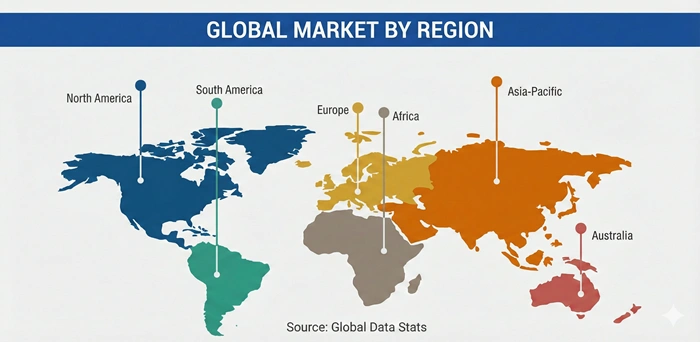
North America maintains its position as the dominant region in the hair dryer market, commanding approximately 33% of global market share in 2025 with an estimated value of USD 3.03 billion, projected to reach USD 5.18 billion by 2033 growing at a CAGR of 6.90%. The region's leadership stems from multiple reinforcing factors including high per capita disposable incomes enabling consumer spending on premium personal care appliances, mature beauty and grooming culture with deep-rooted practices of daily hair styling and maintenance, and sophisticated retail infrastructure spanning department stores, specialty beauty retailers, and advanced e-commerce platforms. The United States represents the largest market within North America, accounting for approximately 76% of regional revenue with an estimated market size of USD 2.30 billion in 2025, driven by population exceeding 330 million, strong consumer brand loyalty, and continuous product innovation from leading manufacturers.
Consumer preferences in North America increasingly favor premium hair dryers incorporating advanced technologies including ionic conditioning, intelligent heat control, lightweight ergonomic designs, and professional-grade performance that deliver salon-quality results at home. The hair dryer market in this region benefits from high salon density with over 80,000 professional hair salons operating across the United States employing more than 650,000 stylists who collectively purchase thousands of commercial-grade hair dryers annually. Leading companies dominating the North American market including Conair Corporation, Helen of Troy Limited, Dyson Limited, Koninklijke Philips N.V., and Revlon Inc. invest heavily in marketing campaigns, celebrity endorsements, and retail partnerships that maintain strong brand visibility and consumer engagement. Canada contributes approximately 18% of North American revenue driven by similar consumer preferences, high grooming standards, and strong e-commerce adoption that facilitates product discovery and purchasing convenience.
Asia Pacific
Explosive Growth Driven by Urbanization and Rising Beauty Consciousness
Asia Pacific represents the fastest-growing region in the hair dryer market with a projected CAGR of 8.70% from 2026 to 2033, with market value expected to increase from USD 2.66 billion in 2025 to USD 4.92 billion by 2033, capturing an expanding share of global revenue. The region's exceptional growth trajectory stems from massive urbanization programs concentrating hundreds of millions of people in cities where modern lifestyles and professional environments create strong demand for personal grooming appliances. Rising middle-class populations across China, India, Indonesia, Vietnam, and other developing markets experience rapidly improving living standards, increasing disposable incomes, and growing willingness to invest in quality personal care products that enhance appearance and self-confidence. K-beauty trends originating from South Korea and J-beauty influences from Japan significantly impact consumer preferences across the broader Asian region, promoting sophisticated grooming routines and styling techniques that require quality equipment.
China dominates the Asia Pacific hair dryer market with approximately 42% regional share, driven by population exceeding 1.4 billion, massive e-commerce infrastructure led by Alibaba and JD.com facilitating product accessibility, and rapidly expanding domestic beauty industry supporting both individual and professional demand. Key manufacturers serving this dynamic region including Panasonic Holdings Corporation, Xiaomi Corporation, Dreame Technology, Philips, and Dyson operate extensive manufacturing facilities and distribution networks tailored to local market conditions, preferences, and price sensitivities. India shows particularly explosive growth with a CAGR exceeding 9.20%, fueled by young demographic profile, accelerating smartphone adoption enabling e-commerce access, growing beauty awareness driven by Bollywood influences, and expanding organized retail networks introducing modern grooming appliances to mass markets. The salon industry throughout Asia Pacific experiences robust expansion with thousands of new establishments opening annually across urban centers, creating sustained commercial demand for professional-grade hair dryers throughout the forecast period in the hair dryer market.
Top Key Players
-
Conair Corporation (United States)
-
Dyson Limited (United Kingdom)
-
Koninklijke Philips N.V. (Netherlands)
-
Panasonic Holdings Corporation (Japan)
-
Revlon Inc. (United States)
-
Spectrum Brands Holdings Inc. (United States)
-
Helen of Troy Limited (Bermuda)
-
Ghd (Jemella Ltd.) (United Kingdom)
-
Braun GmbH (Germany)
-
Harry Josh Pro Tools (United States)
-
Dreame Technology Co., Ltd. (China)
-
Xiaomi Corporation (China)
-
Vega Industries Private Limited (India)
-
Havells India Ltd. (India)
-
Tescom Co., Ltd. (Japan)
Recent Developments
-
Philips (2025): Launched the Philips Hair Dryer 8000 Series in June 2025 featuring advanced ThermoShield sensors, Dual Airstream technology, and over 200 million ions delivering fast drying while protecting hair strength, reducing frizz, and locking moisture for healthier-looking results, priced at INR 19,995 and available through online and retail channels across India targeting premium consumer segments.
-
Dyson Limited (2024): Unveiled the compact Supersonic r professional hair dryer in February 2024 designed specifically for salon use, featuring smaller size and lighter weight than the original Supersonic while maintaining powerful performance through streamlined high-power heater and Hyperdymium motor, with smart RFID-enabled attachments and new colorways expanding consumer choice and professional styling capabilities.
-
Dreame Technology (2024): Entered India's personal grooming market in August 2024 with five products including three high-speed hair dryers (Pocket, Glory, and Gleam) featuring 100,000+ RPM motors and negative ion technology, plus an AirStyle 5-in-1 styling system and IPL hair removal device, priced from ₹6,999 to ₹24,999 and available through Amazon from September 2024.
-
L'Oréal (2024): Unveiled AirLight Pro professional-grade hair dryer in January 2024 developed in collaboration with startup Zuvi, utilizing patented infrared light and high-speed airflow to dry hair faster while maintaining hydration with significantly lower energy consumption compared to leading premium dryers, targeting environmentally conscious professional stylists and sustainability-focused salons.
-
Conair Corporation (2023): Expanded product portfolio with launch of InfinitiPRO by Conair hair dryer series incorporating advanced AC motor technology, tourmaline ceramic components, and ionic conditioning delivering salon-quality performance at accessible price points below USD 100, strengthening competitive positioning in mid-range segment and expanding retail distribution across major North American chains.
Market Trends
Smart Connectivity and Personalization Reshape Consumer Expectations
The hair dryer market is experiencing transformative shifts driven by smart technology integration, personalization capabilities, and connected ecosystems that fundamentally alter how consumers interact with styling appliances. Premium hair dryers increasingly incorporate Bluetooth connectivity, companion mobile applications, and cloud-based platforms that enable users to access personalized styling recommendations, track hair health metrics over time, and receive firmware updates that continuously enhance product functionality without requiring hardware replacement. Artificial intelligence algorithms analyze user behavior patterns, styling preferences, and hair characteristics to automatically optimize heat and airflow settings, providing customized drying experiences tailored to individual needs while preventing thermal damage through intelligent temperature monitoring. Voice control integration with popular virtual assistants including Amazon Alexa, Google Assistant, and Apple Siri enables hands-free operation where users can adjust settings, activate specific drying modes, or access styling tutorials through simple voice commands without interrupting their grooming routines.
Sustainability considerations increasingly influence purchasing decisions as environmentally conscious consumers evaluate products based on energy efficiency, material composition, packaging waste, and corporate environmental commitments. Manufacturers respond by developing energy-efficient hair dryers utilizing brushless digital motors that consume 30-40% less electricity than traditional AC motors while delivering superior performance and longer operational lifespans. Recyclable materials including post-consumer recycled plastics, biodegradable packaging, and modular repairable designs address waste concerns while appealing to values-driven consumer segments willing to pay premium prices for products aligning with their environmental principles. The premiumization trend continues accelerating as affluent consumers invest in luxury hair dryers priced above USD 300 from brands like Dyson, offering advanced features including intelligent heat control, professional-grade performance, sophisticated industrial design, and comprehensive accessory systems that justify higher prices through demonstrable performance advantages and enhanced user experiences throughout the hair dryer market.
Segments Covered in the Report
By Product
-
Corded Hair Dryer
-
Cordless Hair Dryer
By Application
-
Professional
-
Salons
-
Spas
-
Beauty Centers
-
-
Individual
-
Home Use
-
Travel Use
-
By Distribution Channel
-
Online
-
E-commerce Platforms
-
Company Websites
-
Online Retailers
-
-
Offline
-
Hypermarkets and Supermarkets
-
Specialty Stores
-
Department Stores
-
Electronics Stores
-
By Region
-
North America
-
United States
-
Canada
-
Mexico
-
-
Europe
-
United Kingdom
-
Germany
-
France
-
Italy
-
Spain
-
Rest of Europe
-
-
Asia Pacific
-
China
-
India
-
Japan
-
South Korea
-
Australia
-
Indonesia
-
Rest of Asia Pacific
-
-
Latin America
-
Brazil
-
Argentina
-
Rest of Latin America
-
-
Middle East and Africa
-
United Arab Emirates
-
Saudi Arabia
-
South Africa
-
Rest of Middle East and Africa
-
Frequently Asked Questions
Question 1: What is the projected hair dryer market size by 2033?
Answer: The hair dryer market is projected to reach USD 16.71 billion by 2033, growing from USD 9.92 billion in 2026. This represents significant expansion driven by rising beauty consciousness, increasing professional salon demand, and continuous technological innovation delivering superior performance and hair health protection.
Question 2: Which region dominates the global hair dryer market share?
Answer: North America dominates the global hair dryer market with approximately 33% market share in 2025, valued at USD 3.03 billion. This leadership position is supported by high disposable incomes, mature beauty culture, strong consumer brand loyalty, and sophisticated retail infrastructure across the United States and Canada.
Question 3: What factors are driving the hair dryer market growth?
Answer: Key factors driving hair dryer market growth include expanding professional salon industry worldwide, rising personal grooming awareness, increasing social media influence on beauty standards, technological innovations in ionic and ceramic technologies, and growing urbanization creating demand for modern styling appliances. Cordless technology advancements also significantly contribute to market expansion.
Question 4: Which product segment holds the largest share in the hair dryer market?
Answer: The corded hair dryer segment holds the largest share in the hair dryer market with approximately 82% in 2025. This dominance reflects reliable unlimited operating duration, consistent power output, affordability advantages, and proven performance that appeals to both professional stylists and individual consumers requiring dependable daily use equipment.
Question 5: What are the emerging trends in the hair dryer market?
Answer: Emerging trends in the hair dryer market include rapid cordless technology adoption with improved battery performance, smart connectivity features with AI-powered personalization, sustainability focus through energy-efficient motors and recyclable materials, premiumization with luxury offerings exceeding USD 300, and lightweight ergonomic designs. Professional-grade features for at-home use also gain significant traction among consumers.