
Green Power Market Overview
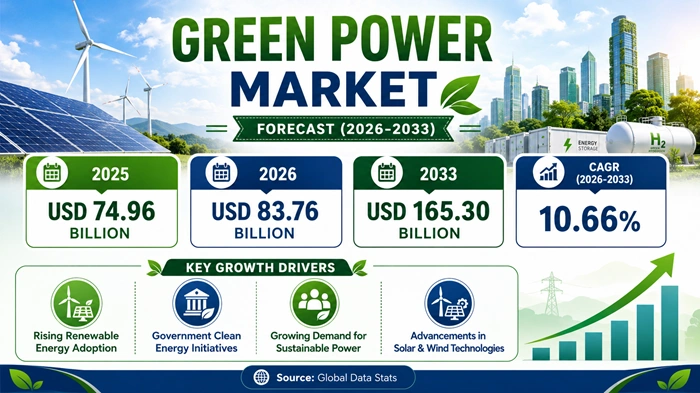
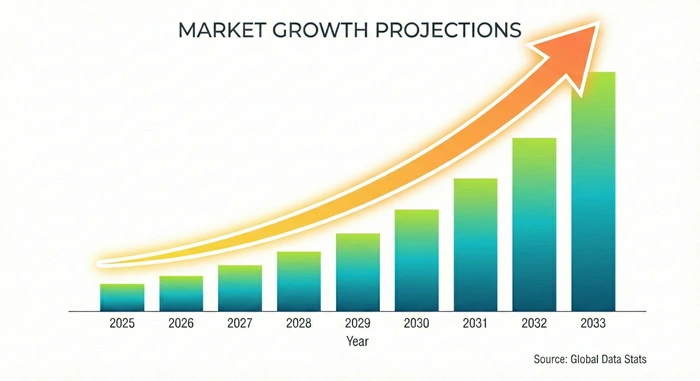
The global green power market size is valued at USD 74.96 billion in 2025 and is predicted to increase from USD 83.76 billion in 2026 to approximately USD 165.30 billion by 2033, growing at a CAGR of 10.66% from 2026 to 2033.
Green power generation involves producing electricity from renewable and environmentally sustainable sources including solar, wind, hydropower, geothermal, and biomass. These clean energy sources deliver substantial environmental advantages over conventional fossil fuels by generating minimal greenhouse gas emissions throughout their operational lifecycle. The shift toward renewable electricity sources accelerates as nations worldwide commit to carbon neutrality targets while industries embrace sustainable operations to meet corporate environmental responsibilities and consumer expectations for cleaner energy alternatives.
AI Impact On The Green Power Industry
Transforming Energy Production Through Intelligent Systems And Predictive Analytics
Artificial intelligence revolutionizes green power operations by optimizing energy production efficiency across solar farms and wind installations through advanced weather forecasting models. Machine learning algorithms analyze historical weather patterns, atmospheric conditions, and real-time meteorological data to predict renewable energy generation capacity with remarkable accuracy. These predictive systems enable grid operators to balance supply and demand more effectively while reducing reliance on fossil fuel backup generators during periods of variable renewable output. AI-powered maintenance systems monitor equipment performance continuously, detecting anomalies that signal potential component failures before they occur, thereby minimizing downtime and extending the operational lifespan of expensive renewable energy infrastructure.
Smart grid management benefits tremendously from AI integration as sophisticated algorithms coordinate distributed energy resources including rooftop solar installations, battery storage systems, and electric vehicle charging networks. Real-time optimization balances renewable electricity flows across transmission networks while managing voltage fluctuations inherent in intermittent power sources. The green power market experiences enhanced economic viability as AI reduces operational costs through automated energy trading platforms that capitalize on price differentials between peak and off-peak demand periods. Emerging applications in green hydrogen production leverage AI to optimize electrolysis processes, reducing energy consumption while increasing production efficiency for this carbon-free fuel alternative that promises to decarbonize industrial sectors traditionally dependent on fossil fuels.
Growth Factors
Accelerating Global Decarbonization Commitments Driving Renewable Energy Adoption
International climate agreements and national carbon reduction mandates create unprecedented momentum for renewable electricity generation worldwide. Governments implement ambitious renewable energy targets requiring utilities to source specific percentages of electricity from clean sources by designated deadlines. Corporate sustainability commitments drive substantial demand as multinational corporations establish net-zero carbon goals requiring complete transition away from fossil fuel-generated electricity across global operations. The green power market benefits from power purchase agreements where businesses contract directly with renewable energy developers for long-term electricity supplies at fixed prices, providing project financing certainty while hedging against volatile fossil fuel costs.
Technological innovations combined with manufacturing scale economies substantially reduce renewable energy costs below fossil fuel alternatives in most geographic markets. Solar photovoltaic module prices declined over 80% during the past decade while wind turbine efficiency improvements increased electricity generation capacity per installed megawatt. Energy storage technologies address intermittency challenges through grid-scale battery systems that store excess renewable generation during peak production periods for discharge during high demand intervals. The green power market expands rapidly as energy storage costs decrease, enabling utilities to maintain grid reliability while integrating higher percentages of variable renewable sources into electricity supply portfolios without compromising system stability or requiring expensive fossil fuel backup capacity.
Market Outlook
Robust Investment Momentum And Infrastructure Development Shaping Future Growth Trajectory
Investment capital flows into renewable energy projects at unprecedented levels as financial institutions recognize attractive risk-adjusted returns from stable regulatory frameworks supporting clean energy development. Institutional investors including pension funds and insurance companies allocate substantial portfolio percentages toward renewable infrastructure assets valued for predictable cash flows and inflation-protected returns. Development pipelines contain hundreds of gigawatts of planned solar and wind capacity across major markets worldwide, with projects progressing through permitting and construction phases that will deliver substantial capacity additions throughout the forecast period. The green power market attracts innovation capital supporting breakthrough technologies including floating offshore wind platforms, advanced geothermal drilling techniques, and next-generation solar cell materials promising higher efficiency at lower manufacturing costs.
Transmission infrastructure investments accelerate to connect remote renewable resource regions with population centers requiring electricity supply. High-voltage direct current transmission lines enable long-distance electricity transport with minimal losses, unlocking wind and solar development in geographically optimal locations regardless of distance from demand centers. Distributed generation models gain traction as rooftop solar installations combined with battery storage systems allow residential and commercial customers to generate substantial portions of their electricity needs locally. The green power market witnesses fundamental transformation of electricity sector business models as traditional centralized generation paradigms give way to hybrid systems integrating utility-scale renewable projects with distributed energy resources coordinated through sophisticated digital platforms managing bidirectional power flows across modernized grid infrastructure.
Expert Speaks
-
Srivatsan Iyer, Global CEO at Hero Future Energies, emphasized expectations for surge in renewable energy investments throughout 2025, driven by increased participation from both private and public sectors, which will establish strong foundations for continued expansion as corporate commitments to sustainability accelerate alongside supportive policy frameworks enabling rapid deployment of clean energy infrastructure across emerging and developed markets.
-
Rohit Bajaj, Joint Managing Director at Indian Energy Exchange, highlighted how development of innovative market models including battery storage arbitrage, frequency regulation, and virtual power purchase agreements will drive evolution of power markets globally, contributing significantly to successful energy transition as renewable penetration increases and grid operators require flexible solutions managing variable generation patterns.
-
Markus Krebber, CEO at RWE AG, has been instrumental in steering strategic shifts toward renewable energy across European markets, overseeing substantial investments in green technologies as part of comprehensive growth strategies that position major utilities to capitalize on accelerating demand for clean electricity while transitioning legacy fossil fuel generation portfolios toward sustainable alternatives meeting stringent emissions reduction mandates.
Key Report Takeaways
-
North America dominates the green power market capturing approximately 38% regional market share valued at around USD 28.48 billion in 2025, driven by extensive technological innovation, substantial corporate sustainability commitments, robust policy support for renewable energy deployment, and mature financing mechanisms enabling rapid capacity expansion across utility-scale and distributed generation segments.
-
Asia Pacific emerges as the fastest-growing region with projected CAGR exceeding 11.2% through 2033, fueled by massive government infrastructure investments in countries like China and India, declining solar and wind technology costs, soaring electricity demand from expanding industrial bases, and ambitious national renewable energy targets supporting carbon reduction commitments.
-
Utility end-users represent the largest consuming segment accounting for approximately 44% market share as power generation companies install gigawatt-scale solar farms and wind parks to meet renewable portfolio standards, satisfy wholesale electricity demand, and comply with emissions regulations while capitalizing on favorable economics of utility-scale renewable projects.
-
Electricity generation applications contribute the most significant demand representing roughly 52% of total green power deployment as renewable sources increasingly displace coal and natural gas generation across global power grids, supported by falling technology costs and improved grid integration capabilities managing variable renewable output.
-
Hydropower maintains dominant position among power types commanding nearly 36% market share due to established infrastructure providing baseload generation capacity, energy storage through pumped hydro facilities, and continuing development of run-of-river and reservoir projects across regions with suitable water resources and topography.
-
Solar energy segment exhibits fastest future growth trajectory projected to expand at 13.8% CAGR through 2033 with market share reaching approximately 32%, driven by dramatic cost reductions in photovoltaic modules, technological efficiency improvements, and versatility enabling deployment across utility-scale installations, commercial rooftops, and residential applications worldwide.
Market Scope
| Report Coverage | Details |
|---|---|
| Market Size by 2033 | USD 165.30 Billion |
| Market Size by 2025 | USD 74.96 Billion |
| Market Size by 2026 | USD 83.76 Billion |
| Market Growth Rate from 2026 to 2033 | CAGR of 10.66% |
| Dominating Region | North America |
| Fastest Growing Region | Asia Pacific |
| Base Year | 2025 |
| Forecast Period | 2026 to 2033 |
| Segments Covered | Power Type, Application, End-User, Region |
| Regions Covered | North America, Europe, Asia-Pacific, Latin America, Middle East and Africa |
Market Dynamics
Drivers Impact Analysis
Government Policies And Corporate Commitments Accelerating Renewable Energy Transition
| Factor | (≈) % Impact on CAGR Forecast | Geographic Relevance | Impact Timeline |
|---|---|---|---|
| Renewable portfolio standards | 18-24% | North America, Europe, Asia Pacific | 2026-2033 |
| Carbon pricing mechanisms | 14-19% | Europe, North America, select Asian markets | 2026-2033 |
| Corporate net-zero commitments | 15-22% | Global (strongest in developed economies) | 2026-2033 |
Regulatory frameworks worldwide establish mandatory renewable energy quotas requiring utilities to generate or purchase specific percentages of electricity from clean sources by designated compliance dates. These renewable portfolio standards create guaranteed demand for green power generation, providing investment certainty that attracts development capital toward solar, wind, and hydropower projects. Carbon pricing systems including cap-and-trade programs and carbon taxes increase operating costs for fossil fuel generators while simultaneously improving economic competitiveness of zero-emission renewable alternatives. The green power market expands rapidly as utilities facing compliance obligations procure renewable electricity through long-term contracts, own-and-operate project development, or renewable energy certificate purchases satisfying regulatory requirements.
Corporate procurement represents increasingly significant demand driver as Fortune 500 companies establish science-based carbon reduction targets requiring transition to 100% renewable electricity across global operations. Virtual power purchase agreements enable corporations to support new renewable project development while securing fixed-price electricity supplies hedging against volatile fossil fuel markets. Technology companies, manufacturing enterprises, and financial institutions compete to demonstrate environmental leadership through renewable energy commitments that resonate with investors, customers, and employees prioritizing sustainability. The green power market benefits from this corporate demand creating additional revenue streams beyond traditional utility procurement channels, with corporate contracts often providing premium pricing that improves project economics while accelerating renewable capacity deployment across regions where companies maintain significant operational footprints and electricity consumption.
Restraints Impact Analysis
Grid Integration Challenges And Intermittency Concerns Limiting Deployment Pace
| Factor | (≈) % Impact on CAGR Forecast | Geographic Relevance | Impact Timeline |
|---|---|---|---|
| Transmission infrastructure limitations | -9 to -14% | Regions with underdeveloped grids | 2026-2033 |
| Energy storage costs | -7 to -11% | Markets with high renewable penetration | 2026-2030 |
| Intermittency management complexity | -6 to -9% | Grid systems lacking flexibility | 2026-2028 |
Electricity transmission networks face capacity constraints preventing renewable energy projects from connecting to grid systems and delivering generated power to demand centers. Remote locations offering optimal wind and solar resources often lack adequate transmission infrastructure, requiring expensive line construction adding years to project timelines and significantly increasing development costs. Grid operators in regions with aging transmission systems struggle to accommodate bidirectional power flows from distributed generation resources, necessitating costly upgrades to substations, transformers, and control systems. The green power market experiences development delays as project pipelines await transmission capacity allocation or financing for necessary infrastructure improvements before construction can commence.
Variable renewable energy sources produce electricity dependent on weather conditions creating challenges for grid operators maintaining constant balance between supply and demand. Solar generation ceases after sunset precisely when residential electricity consumption peaks for lighting, cooking, and climate control. Wind output fluctuates based on atmospheric conditions that may not correlate with periods of high electricity demand. Energy storage systems address these timing mismatches but add significant capital costs to renewable projects, particularly in markets where battery prices remain elevated. The green power market faces adoption headwinds in regions where grid operators express concerns about reliability implications of high renewable penetration without sufficient dispatchable backup capacity or expensive storage infrastructure ensuring uninterrupted electricity supply during extended periods of low renewable resource availability.
Opportunities Impact Analysis
Emerging Technologies And Export Markets Creating New Revenue Channels
| Factor | (≈) % Impact on CAGR Forecast | Geographic Relevance | Impact Timeline |
|---|---|---|---|
| Green hydrogen production | +13 to +18% | Europe, Middle East, Australia | 2027-2033 |
| Offshore wind development | +11 to +16% | Coastal regions globally | 2026-2033 |
| International electricity trade | +9 to +14% | Interconnected regional markets | 2027-2033 |
Green hydrogen production through electrolysis powered by renewable electricity opens substantial new demand for clean power generation beyond traditional electricity applications. Industrial sectors including steel manufacturing, chemical production, and long-distance transportation require carbon-free fuel alternatives that hydrogen provides when produced using renewable energy sources. The green power market benefits as electrolyzer facilities consume massive amounts of electricity, creating anchor loads that improve economics of large-scale renewable projects while supporting grid stability through flexible demand that can absorb excess generation during periods of high renewable output and low conventional electricity demand.
Offshore wind technology advances enable access to superior wind resources available in marine environments where sustained high-velocity winds generate electricity more consistently than land-based installations. Floating platform designs allow turbine deployment in deep water locations previously considered technically infeasible, dramatically expanding available development areas. The green power market experiences accelerated growth as coastal nations with limited land availability for renewable projects pursue offshore wind development, supported by declining installation costs and proven operational performance from early demonstration projects. Cross-border electricity trading frameworks emerge allowing renewable-rich regions to export clean power to neighboring markets through high-voltage interconnections, creating economic incentives for capacity development exceeding domestic demand while providing importing nations with cost-effective pathways toward decarbonization goals.
Segment Analysis
By Power Type: Hydropower
Established Infrastructure And Baseload Capability Maintaining Market Leadership Position
Hydropower commands the largest share within the green power market at approximately 36%, valued at around USD 27 billion in 2025 due to extensive existing infrastructure providing reliable baseload generation capacity. Large reservoir systems offer inherent energy storage capabilities allowing operators to dispatch electricity during peak demand periods while reducing output when consumption declines. Run-of-river installations generate consistent power from flowing water without requiring massive dam construction, making development feasible across diverse geographic contexts. The green power market benefits from hydropower's operational flexibility complementing variable solar and wind generation as dispatchable renewable capacity balancing grid supply and demand without fossil fuel backup requirements.
Asia Pacific leads global hydropower development with massive projects under construction across the Himalayas, Southeast Asian river systems, and Chinese provinces where topography and water resources support large-scale generation facilities. Companies including China Three Gorges Corporation, NHPC Limited, and Salini Impregilo develop multi-gigawatt installations generating electricity for rapidly expanding industrial economies while providing flood control and water management benefits. North American markets focus on facility upgrades and small-scale hydropower development as environmental regulations restrict new large dam construction. The green power market sees this segment maintaining steady growth near 8.4% CAGR through 2033 as pumped storage hydropower gains prominence providing grid-scale energy storage essential for integrating higher percentages of intermittent renewables into electricity systems worldwide.
By End-User: Utility
Large-Scale Procurement Requirements And Regulatory Mandates Driving Segment Dominance
Utility end-users represent the dominant segment in the green power market capturing approximately 44% share valued near USD 33 billion in 2025 as electric power companies procure or generate renewable electricity satisfying wholesale demand and regulatory compliance obligations. Investor-owned utilities, municipal power authorities, and rural electric cooperatives develop utility-scale solar farms and wind parks delivering economies of scale through large installations spreading fixed development costs across substantial generation capacity. Renewable portfolio standard compliance drives procurement decisions as utilities facing mandatory clean energy quotas contract for renewable electricity through long-term power purchase agreements or own project portfolios directly.
North America and Europe exhibit particularly strong utility-segment demand as established regulatory frameworks mandate increasing renewable energy percentages while mature wholesale electricity markets facilitate trading and procurement. Leading utilities including NextEra Energy Resources, Duke Energy, and Southern Company operate multi-gigawatt renewable portfolios across their service territories. The green power market witnesses this segment expanding at robust 9.7% CAGR through 2033 as utilities worldwide respond to decarbonization mandates, competitive pressure from corporate renewable procurement, and improving economics favoring new renewable capacity over fossil fuel alternatives. Energy storage integration accelerates as utilities deploy grid-scale battery systems enabling renewable energy to provide reliable capacity previously supplied exclusively by dispatchable fossil fuel generators, fundamentally transforming utility business models toward clean energy-centric operations.
Regional Insights
North America
Technological Leadership And Policy Support Driving Regional Market Dominance
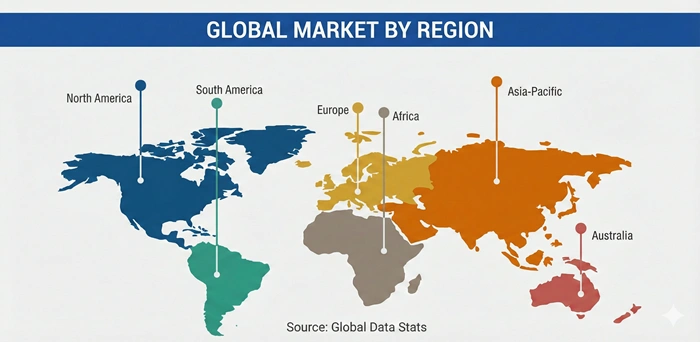
North America dominates the green power market commanding approximately 38% global share valued at USD 28.48 billion in 2025, projected to reach USD 62.85 billion by 2033 growing at 10.3% CAGR. United States renewable capacity exceeds 545 gigawatts with aggressive expansion plans targeting 778 gigawatts by 2031 driven by federal tax incentives, state renewable portfolio standards, and corporate procurement commitments. Solar and wind installations accelerate across Texas, California, and Great Plains states offering optimal resource conditions while transmission infrastructure investments connect remote generation sites to population centers requiring electricity supply.
Corporate sustainability commitments create substantial demand as technology companies, manufacturers, and financial institutions headquartered across North America establish ambitious carbon neutrality goals requiring complete renewable electricity transition. The green power market benefits from sophisticated financing mechanisms including tax equity structures, green bonds, and institutional infrastructure investment funds channeling capital toward renewable project development. Leading regional players include NextEra Energy, Brookfield Renewable Corporation, and GE Renewable Energy operating across utility-scale generation, distributed solar, and technology manufacturing segments. Canadian provinces leverage extensive hydropower resources while expanding wind capacity across prairie regions, positioning North America for continued market leadership through the forecast period supported by technological innovation, policy stability, and abundant renewable resources.
Asia Pacific
Massive Capacity Additions And Government Investment Fueling Fastest Regional Growth
Asia Pacific emerges as the fastest-growing region in the green power market with CAGR exceeding 11.2% from 2026 to 2033, with market value expanding from approximately USD 26 billion in 2025 toward USD 63 billion by 2033. China leads global renewable capacity additions installing over 200 gigawatts annually across solar, wind, and hydropower projects supported by national carbon neutrality commitments and industrial policy prioritizing clean energy technology manufacturing. India pursues ambitious targets reaching 500 gigawatts renewable capacity by 2030 through competitive auctions delivering record-low electricity prices while attracting substantial international investment.
Government infrastructure spending supports transmission network expansion, grid modernization, and energy storage deployment essential for integrating massive renewable capacity additions into existing electricity systems. The green power market witnesses rapid technology cost declines as regional manufacturing scale economies reduce solar module and wind turbine prices globally. Major players including Adani Green Energy, Tata Power, Suzlon Energy, and Envision Group develop multi-gigawatt project portfolios across the region. Southeast Asian nations including Vietnam, Thailand, and Indonesia accelerate renewable deployment capitalizing on abundant solar resources and declining technology costs while addressing soaring electricity demand from economic development and urbanization. Regional market leadership positions Asia Pacific as the primary growth engine for global green power expansion throughout the forecast period.
Top Key Players
-
NextEra Energy (United States)
-
Iberdrola SA (Spain)
-
Enel SpA (Italy)
-
Adani Green Energy Limited (India)
-
GE Renewable Energy (United States)
-
Vestas Wind Systems A/S (Denmark)
-
Siemens Gamesa Renewable Energy (Spain)
-
Tata Power (India)
-
Brookfield Renewable Corporation (Canada)
-
Ørsted A/S (Denmark)
-
RWE AG (Germany)
-
Duke Energy (United States)
-
JinkoSolar Holding (China)
-
First Solar (United States)
-
Suzlon Energy Limited (India)
Recent Developments
-
ONGC NTPC Green (2024): Joint venture between ONGC and NTPC completed acquisition of Ayana Renewable Power in India, expanding their renewable energy portfolio to support national decarbonization goals while diversifying traditional fossil fuel operations toward clean energy generation and establishing substantial presence across solar and wind development markets.
-
JSW Neo Energy (April 2025): Acquired 4.7 gigawatt renewable platform from O2 Power backed by EQT and Temasek, representing one of India's largest renewable energy transactions and significantly expanding JSW's clean energy capacity across solar, wind, and hybrid projects supporting corporate sustainability commitments.
-
BluPine Energy (March 2024): Announced acquisition of 369 megawatts of solar capacity power assets from Acme Group, increasing total renewable energy capacity to 2.4 gigawatts with expansion plans targeting 4 gigawatts across solar, wind, and hybrid assets complemented with battery energy storage systems over subsequent five years.
-
Jakson Green (March 2024): Signed agreement with Solar Energy Corporation of India to establish grid-connected solar projects nationwide, taking responsibility for site identification, installation, ownership, necessary approvals, and connection to interstate transmission network to supply power supporting India's renewable energy targets.
-
Tata Power (July 2025): Inaugurated Green Energy Skill Centre in Rohini, New Delhi, focused on training workforce in renewable energy technologies including solar installation, wind turbine maintenance, and energy storage systems to prepare skilled labor supporting India's expanding clean energy sector and creating employment opportunities.
Market Trends
Distributed Generation Models And Corporate Procurement Reshaping Industry Dynamics
Distributed energy resources fundamentally transform electricity sector business models as rooftop solar installations combined with battery storage enable residential and commercial customers to generate substantial portions of their consumption locally. Net metering policies allowing customers to sell excess generation back to utilities accelerate adoption across favorable regulatory jurisdictions. The green power market witnesses proliferation of virtual power plant concepts aggregating thousands of distributed resources into coordinated systems providing grid services traditionally supplied by centralized power plants. Community solar programs expand access to renewable energy benefits for renters and property owners with unsuitable rooftops, creating subscription models allowing participants to support clean energy development while receiving electricity bill credits.
Corporate power purchase agreements evolve beyond traditional structures as sophisticated financial instruments including virtual PPAs and green tariffs enable businesses to support renewable project development regardless of geographic location relative to their electricity consumption. Technology companies, manufacturers, and retailers compete to achieve 100% renewable electricity goals through diverse procurement strategies spanning on-site generation, direct project investment, and market purchases. The green power market benefits from corporate demand providing additional revenue certainty for project developers while accelerating capacity deployment beyond levels achievable through utility procurement alone. Blockchain technology emerges enabling peer-to-peer renewable electricity trading where distributed generators sell excess production directly to nearby consumers through automated platforms managing transactions and settlements without traditional utility intermediation.
Segments Covered In The Report
By Power Type
-
Hydropower
-
Solar Energy
-
Wind Energy
-
Geothermal Energy
-
Bioenergy
By Application
-
Electricity Generation
-
Transportation
-
Heating
-
Others
By End-User
-
Utility
-
Residential
-
Industrial
-
Commercial
By Region
-
North America (United States, Canada, Mexico)
-
Europe (Germany, United Kingdom, France, Spain, Italy, Rest of Europe)
-
Asia-Pacific (China, India, Japan, South Korea, Australia, Southeast Asia, Rest of Asia-Pacific)
-
Latin America (Brazil, Argentina, Rest of Latin America)
-
Middle East and Africa (Saudi Arabia, UAE, South Africa, Rest of MEA)
Frequently Asked Questions
Question 1: What is the projected size of the green power market by 2033?
Answer: The global green power market is expected to reach approximately USD 165.30 billion by 2033, expanding from USD 83.76 billion in 2026. This growth reflects accelerating renewable energy adoption driven by climate commitments, technological cost reductions, and corporate sustainability initiatives worldwide.
Question 2: Which region dominates the green power market currently?
Answer: North America dominates the green power market with approximately 38% market share due to technological innovation, mature regulatory frameworks, and robust corporate commitments. The region benefits from extensive renewable resources, established financing mechanisms, and supportive policies driving substantial capacity additions.
Question 3: What CAGR will the green power market experience from 2026 to 2033?
Answer: The green power market will grow at a compound annual growth rate of 10.66% from 2026 to 2033. This expansion reflects increasing renewable energy competitiveness, grid integration improvements, energy storage advancements, and government policies supporting clean electricity generation.
Question 4: Which power type segment holds the largest share in the green power market?
Answer: Hydropower commands the largest share in the green power market at approximately 36% due to established infrastructure providing baseload capacity and energy storage. This segment benefits from operational flexibility, proven reliability, and capability to balance variable solar and wind generation.
Question 5: What are the primary growth drivers for the green power market?
Answer: Primary drivers include renewable portfolio standards mandating clean energy quotas, carbon pricing mechanisms improving renewable competitiveness, and corporate net-zero commitments requiring electricity transition. The green power market also benefits from declining technology costs, improved energy storage solutions, and government incentives supporting renewable energy deployment globally.