
Generator Market Overview
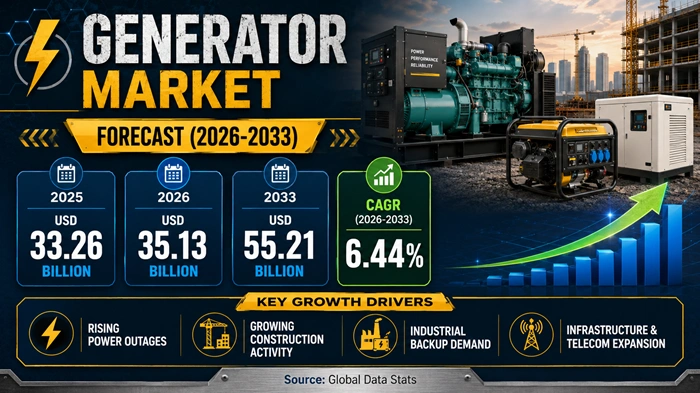
The global generator market size is valued at USD 33.26 billion in 2025 and is predicted to increase from USD 35.13 billion in 2026 to approximately USD 55.21 billion by 2033, growing at a CAGR of 6.44% from 2026 to 2033. The generator market encompasses power generation systems that convert mechanical energy into electrical energy, serving as primary or backup power sources across residential, commercial, and industrial applications. These versatile systems utilize various fuel types including diesel, natural gas, gasoline, LPG, and increasingly renewable energy sources to meet diverse power requirements globally.
Generators play a critical role in maintaining operational continuity during grid failures, supporting off-grid operations, and providing emergency backup power across multiple sectors. The technology has evolved significantly from traditional mechanical systems to advanced digital platforms equipped with smart monitoring capabilities, automated load management systems, and remote diagnostic features that enhance efficiency and reliability.
AI Impact on the Generator Industry
Transforming Power Generation Through Intelligent Automation and Predictive Analytics
Artificial intelligence is revolutionizing the generator market by introducing advanced predictive maintenance capabilities, real-time performance optimization, and automated load management systems. AI algorithms now enable generator systems to automatically detect anomalies, adjust operational parameters based on demand patterns, and predict maintenance requirements before equipment failures occur. These intelligent control panels utilize machine learning models to analyze vast datasets from IoT-connected sensors, providing actionable insights that reduce downtime by up to 30% and optimize fuel consumption significantly. The integration of AI-driven analytics platforms allows operators to monitor multiple generator installations remotely, streamline maintenance schedules, and minimize human intervention in system management processes.
Automation technologies are also transforming manufacturing processes within the generator industry through robotic integration and machine vision systems that improve quality assurance and accelerate assembly operations. AI-powered monitoring solutions now provide dynamic demand forecasting, enabling generators to align their performance with real-time energy requirements and grid conditions. Natural language processing and advanced analytics enable manufacturers to understand customer behavior patterns, predict market trends, and develop next-generation products that meet evolving industry demands. The convergence of AI and automation is accelerating the shift toward self-regulating, highly efficient generator systems capable of seamless integration with smart grid infrastructure and renewable energy platforms.
Growth Factors
Rising Power Infrastructure Demands and Increasing Grid Instability Driving Market Expansion
The generator market is experiencing robust growth driven by escalating demand for uninterrupted power supply across residential, commercial, and industrial sectors worldwide. Frequent power outages caused by aging infrastructure, natural disasters, and grid instability in both developed and developing nations are compelling businesses and households to invest in reliable backup power solutions. The rapid expansion of data centers supporting cloud computing, artificial intelligence applications, and digital services has created unprecedented demand for high-capacity generator systems capable of delivering continuous power during grid failures. Industrial sectors including manufacturing, mining, oil and gas, telecommunications, and healthcare require dependable onsite power generation to maintain critical operations, prevent revenue losses, and ensure safety compliance.
Growing urbanization and infrastructure development in emerging economies are significantly expanding the generator market footprint, particularly in regions with unreliable electricity supply and ongoing rural electrification programs. Large-scale construction projects, smart city initiatives, and industrial park developments require temporary and permanent power solutions that generators uniquely provide. The increasing frequency of extreme weather events and climate-related disruptions has heightened awareness about energy security, prompting governments and enterprises to invest in resilient power generation systems. Additionally, the proliferation of hybrid generator technologies combining traditional fuel sources with renewable energy integration is attracting environmentally conscious customers seeking sustainable yet reliable power alternatives.
Market Outlook
Technological Innovation and Regional Expansion Shaping Future Growth Trajectory
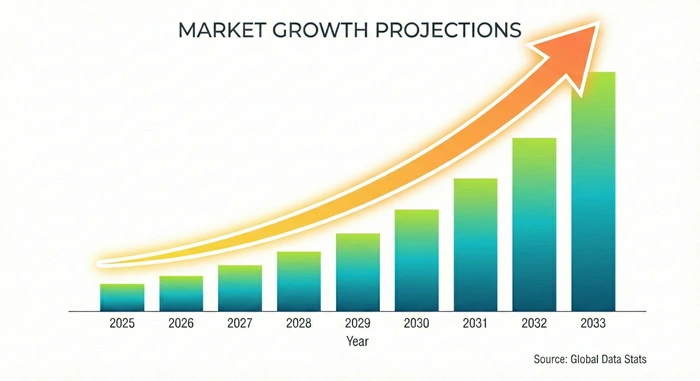
The generator market outlook remains highly positive through 2033, with significant technological advancements driving product innovation and market penetration across diverse applications. Manufacturers are increasingly focusing on developing fuel-efficient, low-emission generator systems that comply with stringent environmental regulations while delivering superior performance and operational reliability. The integration of digital technologies including IoT connectivity, cloud-based monitoring platforms, and AI-powered control systems is transforming generators from standalone equipment into intelligent power management ecosystems. Hybrid and renewable energy generators are gaining substantial market traction as organizations pursue sustainability goals and seek to reduce carbon footprints without compromising power reliability.
Regional expansion strategies are intensifying as leading manufacturers target high-growth markets in Asia Pacific, the Middle East, and Africa where infrastructure development and electrification initiatives are accelerating. North America and Europe continue to represent mature markets with steady replacement demand and growing interest in advanced generator technologies featuring smart grid integration and renewable energy compatibility. The competitive landscape is evolving with increased investments in research and development, strategic partnerships focused on hydrogen and alternative fuel technologies, and manufacturing capacity expansions to meet surging demand from data center and industrial sectors. Market participants are also leveraging digital sales channels, enhanced after-sales services, and flexible financing options to capture emerging opportunities and strengthen customer relationships.
Expert Speaks
-
Aaron Jagdfeld, President and CEO of Generac Power Systems, highlighted the company's strategic focus on expanding presence in the data center segment and anticipated generating over $400 million in free cash flow in 2025, driven by increased demand for reliable backup power solutions across residential and commercial applications.
-
Jennifer Rumsey, President and CEO of Cummins Inc., emphasized the company's commitment to investing $200 million across power generation manufacturing sites globally to double production capacity for large-scale engines powering data centers, reflecting confidence in sustained market growth driven by AI infrastructure expansion.
-
Jim Umpleby, Chairman and CEO of Caterpillar Inc., announced the launch of next-generation diesel generator sets delivering best-in-class power density with up to 13% reduction in floor space requirements and 32% lighter weight, positioning the company to capture growing demand for space-efficient power solutions in constrained environments.
Key Report Takeaways
-
Asia Pacific leads the generator market with a dominant share of 31.67% in 2025, driven by rapid industrialization, infrastructure development, and unreliable grid infrastructure in major economies including China, India, and Southeast Asian nations.
-
North America is growing as the fastest-developing region in the generator market, propelled by aging power infrastructure, frequent natural disasters causing grid disruptions, and substantial investments in data center facilities requiring reliable backup power systems.
-
Diesel generators dominate fuel type segments with approximately 45.6% market share in 2025, attributed to their high energy density, reliability, established infrastructure, and widespread fuel availability across industrial and commercial applications.
-
Commercial and industrial applications contribute the largest revenue to the generator market, accounting for over 55% of total demand as businesses prioritize operational continuity, minimize downtime costs, and comply with safety regulations requiring backup power systems.
-
Standby power generation represents the most popular application with more than 60% market share, as organizations across healthcare, telecommunications, data centers, and critical infrastructure sectors invest in emergency backup systems to ensure uninterrupted operations.
-
The fuel cells segment will experience rapid future growth with a projected CAGR exceeding 12% through 2033, driven by increasing demand for clean energy solutions, technological advancements improving efficiency, and supportive government policies promoting zero-emission power generation technologies.
Market Scope
| Report Coverage | Details |
|---|---|
| Market Size by 2033 | USD 55.21 Billion |
| Market Size by 2025 | USD 33.26 Billion |
| Market Size by 2026 | USD 35.13 Billion |
| Market Growth Rate from 2026 to 2033 | CAGR of 6.44% |
| Dominating Region | Asia Pacific |
| Fastest Growing Region | North America |
| Base Year | 2025 |
| Forecast Period | 2026 to 2033 |
| Segments Covered | Fuel Type, Power Rating, Application, End User, Portability, Region |
| Regions Covered | North America, Europe, Asia Pacific, Middle East & Africa, South America |
Market Dynamics
Drivers Impact Analysis
Escalating Data Center Investments and Digital Infrastructure Expansion
The exponential growth of data centers driven by cloud computing, artificial intelligence, and digital transformation initiatives represents a primary driver propelling the generator market forward. Technology companies and cloud service providers are investing billions in hyperscale data center facilities requiring massive backup power capacities to ensure 99.999% uptime guarantees and protect against costly service disruptions. These facilities demand high-capacity generator systems ranging from 500 kW to over 3,500 kW that can activate within seconds of grid failures and sustain operations indefinitely. The surge in AI computing workloads has intensified power requirements, with some data centers consuming electricity equivalent to small cities, creating unprecedented demand for reliable standby power generation systems. Manufacturers like Cummins and Caterpillar are doubling production capacity for large-displacement engines specifically designed for data center applications, reflecting confidence in sustained demand growth.
The digital economy's expansion across emerging markets is multiplying data center construction projects in Asia Pacific, Middle East, and Latin American regions where grid reliability remains inconsistent. Telecommunications infrastructure supporting 5G networks, edge computing facilities, and colocation centers all require robust backup power systems that generators uniquely provide. Financial services, healthcare, and government sectors are also intensifying investments in mission-critical facilities where power interruptions could result in catastrophic consequences including data loss, security breaches, and life-threatening situations. This driver exhibits high impact on CAGR forecast with approximately 8-10% contribution, demonstrates global geographic relevance with concentration in technology hubs, and maintains immediate to long-term impact timeline as digital infrastructure investments accelerate through 2033.
| Driver | (≈) % Impact on CAGR Forecast | Geographic Relevance | Impact Timeline |
|---|---|---|---|
| Data Center & Digital Infrastructure Expansion | 8-10% | Global (concentrated in North America, Asia Pacific) | Immediate to Long-term (2026-2033) |
| Grid Instability & Aging Infrastructure | 6-8% | Global (highest in developing nations) | Immediate to Medium-term (2026-2030) |
| Industrial Growth & Electrification | 5-7% | Asia Pacific, Middle East, Africa | Medium to Long-term (2027-2033) |
Restraints Impact Analysis
Stringent Environmental Regulations and Emission Control Requirements
Increasingly strict environmental regulations targeting diesel generator emissions represent a significant restraint challenging market growth, particularly in developed regions with aggressive decarbonization policies. Regulatory agencies across North America, Europe, and parts of Asia are enforcing stringent emission standards limiting nitrogen oxides, particulate matter, and carbon emissions from generator systems. Compliance with these regulations requires substantial research and development investments in advanced emission control technologies including selective catalytic reduction, diesel particulate filters, and ultra-low sulfur fuel systems that increase manufacturing costs significantly. Many jurisdictions are implementing carbon pricing mechanisms and environmental taxes that raise the total cost of ownership for diesel generators, making them less economically attractive compared to cleaner alternatives.
The global push toward renewable energy and net-zero emission targets is creating policy uncertainties that complicate long-term investment decisions in traditional generator technologies. Some regions are considering outright bans on diesel generator installations in urban areas or imposing operational restrictions that limit runtime hours and require mandatory emission testing. These regulatory pressures are forcing manufacturers to accelerate transitions toward gas-powered, hybrid, and fuel cell generator technologies that require entirely new design platforms and supply chain infrastructures. The restraint exhibits moderate to high negative impact on CAGR forecast with approximately 4-6% dampening effect, shows highest relevance in developed markets with strict environmental policies, and maintains immediate to medium-term impact timeline as regulations tighten through 2030.
| Restraint | (≈) % Impact on CAGR Forecast | Geographic Relevance | Impact Timeline |
|---|---|---|---|
| Environmental Regulations & Emission Standards | -4 to -6% | Europe, North America, Developed Asia Pacific | Immediate to Medium-term (2026-2030) |
| High Initial Investment & Maintenance Costs | -3 to -5% | Global (highest impact in price-sensitive markets) | Immediate to Long-term (2026-2033) |
| Competition from Renewable Energy & Battery Storage | -3 to -4% | Global (concentrated in markets with renewable incentives) | Medium to Long-term (2028-2033) |
Opportunities Impact Analysis
Hybrid Generator Systems and Renewable Energy Integration
The emerging opportunity for hybrid generator systems combining traditional fuel sources with renewable energy technologies represents a transformative growth avenue for the generator market. These innovative systems integrate solar panels, wind turbines, or battery storage with conventional generators to create flexible, efficient power solutions that reduce fuel consumption, lower emissions, and optimize operational costs. Hybrid configurations appeal to environmentally conscious customers seeking to balance reliability requirements with sustainability goals, particularly in off-grid applications including remote industrial sites, island communities, and temporary construction projects. Technology advancements are making hybrid systems increasingly cost-competitive while delivering superior performance characteristics including automatic fuel source switching, peak shaving capabilities, and seamless integration with microgrid architectures.
Government incentives and corporate sustainability commitments are accelerating adoption of hybrid generator technologies across commercial and industrial segments. Organizations pursuing ESG objectives and carbon neutrality targets view hybrid generators as practical solutions that maintain power security while demonstrably reducing environmental footprints. The opportunity extends to retrofit markets where existing generator installations can be upgraded with renewable energy components and intelligent control systems that optimize energy source utilization based on cost, availability, and environmental impact. This opportunity exhibits high positive impact potential on CAGR forecast with approximately 7-9% contribution, demonstrates global geographic relevance with early adoption in sustainability-focused markets, and maintains medium to long-term impact timeline as hybrid technologies mature and scale through 2033.
| Opportunity | (≈) % Impact on CAGR Forecast | Geographic Relevance | Impact Timeline |
|---|---|---|---|
| Hybrid Systems & Renewable Integration | 7-9% | Global (early adoption in Europe, North America) | Medium to Long-term (2027-2033) |
| Hydrogen & Alternative Fuel Technologies | 5-7% | Developed markets with hydrogen infrastructure | Long-term (2029-2033+) |
| Smart Grid Integration & IoT Connectivity | 6-8% | Global (fastest in technology-advanced regions) | Immediate to Long-term (2026-2033) |
Segment Analysis
Diesel Generators Dominate Fuel Type Segment
Established Reliability and Infrastructure Advantages Sustaining Market Leadership
Diesel generators maintain commanding market leadership with approximately 45.6% share in 2025, projected to reach a market value exceeding USD 25 billion by 2033 while growing at a CAGR of 6.2% during the forecast period. This dominance stems from diesel fuel's superior energy density delivering approximately 35-40 megajoules per liter compared to gasoline's 32 megajoules, enabling longer runtime and higher power output from comparably sized engines. The widespread availability of diesel fuel through established global distribution networks, combined with proven reliability in demanding industrial applications, makes diesel generators the preferred choice for mission-critical facilities including hospitals, data centers, telecommunications infrastructure, and emergency services. Major manufacturers including Caterpillar, Cummins, and Mitsubishi Heavy Industries continue investing heavily in advanced diesel generator technologies featuring improved fuel efficiency, reduced emissions through selective catalytic reduction systems, and extended maintenance intervals that lower total cost of ownership.
The diesel generator segment demonstrates particularly strong performance in Asia Pacific markets where China, India, and Southeast Asian nations account for over 40% of regional demand driven by industrial expansion and infrastructure development projects. Leading companies have established manufacturing facilities and service networks across these high-growth markets to capitalize on demand from construction, manufacturing, and mining sectors requiring robust power solutions capable of operating in harsh environmental conditions. North American and Middle Eastern markets also contribute significantly to diesel generator revenues, with oil and gas operations, remote mining sites, and backup power applications for critical infrastructure driving sustained demand. Despite facing regulatory pressures in some developed markets, diesel generators continue dominating segments where power density, reliability, and fuel availability outweigh emission concerns.
Commercial End Users Drive Significant Market Revenue
Business Continuity Requirements and Operational Reliability Needs Fueling Commercial Adoption
The commercial end user segment captures approximately 38% of the generator market share in 2025, expected to grow at a robust CAGR of 6.8% through 2033 as businesses prioritize operational continuity and risk mitigation strategies. Commercial establishments including retail centers, office buildings, hotels, restaurants, financial institutions, and healthcare facilities increasingly recognize that power disruptions translate directly into revenue losses, customer dissatisfaction, and potential safety liabilities. A typical commercial generator installation ranging from 50 kW to 500 kW can cost between USD 15,000 to USD 250,000 depending on capacity and features, yet businesses view these investments as essential insurance against downtime costs that can reach thousands of dollars per hour. The proliferation of digital payment systems, cloud-based operations, and electronic inventory management has made reliable power access absolutely critical for modern commercial operations across all sectors.
North America leads commercial generator adoption with estimated market share exceeding 35%, driven by aging electrical infrastructure, frequent weather-related outages, and stringent building codes mandating backup power systems for certain facility types. Major players including Generac Power Systems, Kohler, and Briggs & Stratton have developed comprehensive commercial product portfolios featuring smart monitoring capabilities, automatic transfer switches, and remote management platforms that appeal to business customers seeking turnkey power solutions. The Asia Pacific commercial segment is experiencing the fastest growth with CAGR approaching 8.5%, fueled by rapid urbanization, expanding service sectors, and increasing awareness about business continuity planning among small and medium enterprises. European markets demonstrate steady commercial generator demand supported by regulatory requirements for backup power in healthcare facilities, data centers, and critical infrastructure applications where power interruptions could compromise public safety or essential services.
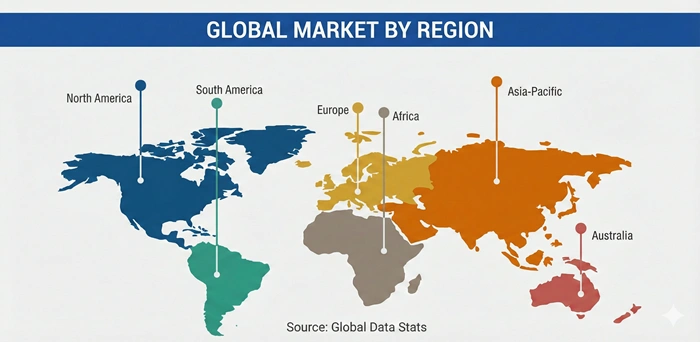
Regional Insights
Asia Pacific Maintains Market Leadership Position
Industrial Expansion and Infrastructure Development Driving Regional Dominance
Asia Pacific dominates the global generator market with a commanding 31.67% share in 2025, valued at approximately USD 10.5 billion and projected to maintain leadership through 2033 while growing at a steady CAGR of 6.2%. The region's supremacy stems from massive industrial expansion across manufacturing, construction, and infrastructure sectors in China, India, Japan, South Korea, and ASEAN nations requiring dependable power generation solutions. China alone accounts for nearly 40% of Asia Pacific generator demand, driven by continuous urbanization, smart city initiatives, and manufacturing facilities requiring backup power systems to maintain production schedules and prevent costly equipment damage during grid interruptions. India's generator market is expanding rapidly with estimated CAGR of 7.1%, fueled by persistent power supply gaps in tier-2 and tier-3 cities, ongoing rural electrification programs, and explosive growth in telecommunications infrastructure supporting mobile network expansion.
Leading global players including Caterpillar, Cummins, Kohler, Generac, and Mitsubishi Heavy Industries have established extensive manufacturing facilities and distribution networks across Asia Pacific to capitalize on regional growth opportunities. These companies are increasingly localizing product development to meet specific regional requirements including tropical climate resilience, dust and humidity resistance, and competitive pricing structures aligned with local market conditions. Japan demonstrates strong demand for advanced gas-powered and hybrid generator systems reflecting the nation's focus on clean energy technologies and disaster preparedness following natural calamities. Southeast Asian markets including Indonesia, Vietnam, Thailand, and the Philippines are experiencing accelerated generator adoption driven by infrastructure investments, expanding industrial parks, and persistent electricity supply challenges in rural areas.
North America Emerges as Fastest Growing Region
Aging Infrastructure and Data Center Boom Accelerating Market Expansion
North America represents the fastest growing regional market for generators with projected CAGR of 7.3% from 2026 to 2033, driven by deteriorating electrical infrastructure, extreme weather events, and explosive data center construction. The United States generator market alone is expected to reach USD 16.8 billion by 2033, propelled by frequent power outages caused by aging transmission systems averaging over 70 years old in many regions and increasing frequency of hurricanes, wildfires, and winter storms disrupting grid operations. The proliferation of hyperscale data centers across Virginia, Texas, Oregon, and other technology hubs has created unprecedented demand for high-capacity backup generators, with some facilities requiring 50-100 megawatts of standby power capacity representing investments exceeding USD 50 million in generator infrastructure. Residential generator adoption is surging as homeowners invest in whole-house backup systems following prolonged outages that leave communities without power for days or weeks.
Generac Power Systems, Caterpillar, Cummins, Kohler, and Briggs & Stratton dominate the North American generator market with estimated combined market share exceeding 65%. These manufacturers have developed region-specific product lines optimized for North American electrical standards, environmental regulations, and customer preferences including natural gas-powered units that connect directly to residential gas lines eliminating fuel storage requirements. Canada's generator market is expanding steadily with CAGR of 5.8%, driven by mining operations in remote locations, oil and gas facilities, and growing awareness about climate resilience among residential and commercial customers. Mexico demonstrates strong growth potential with increasing manufacturing investments, border region maquiladora facilities, and infrastructure development projects requiring temporary and permanent power generation solutions throughout construction phases and ongoing operations.
Top Key Players
-
Caterpillar Inc. (United States)
-
Cummins Inc. (United States)
-
Generac Power Systems, Inc. (United States)
-
Kohler Co. (United States)
-
Mitsubishi Heavy Industries, Ltd. (Japan)
-
Rolls-Royce plc (United Kingdom)
-
Siemens AG (Germany)
-
Honda Motor Co., Ltd. (Japan)
-
Briggs & Stratton, LLC (United States)
-
Greaves Cotton Limited (India)
-
Kirloskar Oil Engines Limited (India)
-
Yanmar Holdings Co., Ltd. (Japan)
-
Atlas Copco AB (Sweden)
-
Wartsila Corporation (Finland)
Recent Developments
-
Caterpillar Inc. (2025) – Launched the Cat D1500 diesel generator set in August 2025, featuring best-in-class power density with 1.5 MW standby power from a compact 32.1-liter engine, occupying 13% less floor space and weighing 32% lighter than previous models, specifically designed for space-constrained data center applications.
-
Cummins Inc. (2025) – Announced a strategic USD 200 million investment across power generation manufacturing facilities in India, England, and the United States in 2025, aimed at doubling production capacity for large-displacement 95-liter engines powering hyperscale data center generator systems.
-
Generac Power Systems (2025) – Reported second quarter 2025 earnings exceeding expectations with projected free cash flow generation surpassing USD 400 million for the year, driven by expanding market share in residential, commercial, and data center segments through innovative smart-connected backup power solutions.
-
Cummins Inc. and Chevron Corporation (2024) – Formed a strategic collaboration in 2024 focused on developing hydrogen fuel cell technologies and renewable energy solutions for next-generation generator systems, targeting zero-emission power generation applications across industrial and commercial sectors.
-
Honda Motor Company (2024) – Expanded North American manufacturing operations with new production facility in North Carolina during 2024, increasing capacity for portable and inverter generator systems serving residential and light commercial markets across the United States and Canada.
Market Trends
Emerging Patterns Reshaping the Generator Industry Landscape
The generator market is witnessing accelerated adoption of digital transformation technologies including IoT connectivity, cloud-based monitoring platforms, and AI-powered predictive maintenance systems that fundamentally change how organizations deploy and manage backup power infrastructure. Modern generator systems now feature advanced telematics capabilities enabling real-time performance monitoring, remote diagnostics, automated alerts, and comprehensive fleet management through centralized dashboards accessible via smartphones and web interfaces. These smart generator platforms collect extensive operational data including runtime hours, fuel consumption, load profiles, and component health metrics that machine learning algorithms analyze to predict maintenance requirements, optimize performance parameters, and prevent unexpected failures. The integration of automatic transfer switches with sophisticated control logic enables seamless power transitions during grid failures, often activating backup generators within 10-15 seconds to maintain continuous operations for critical systems.
Sustainability initiatives and corporate environmental commitments are driving substantial interest in alternative fuel generator technologies including natural gas, propane, biodiesel, and emerging hydrogen fuel cell systems. Organizations pursuing carbon neutrality targets increasingly view traditional diesel generators as transitional technologies while exploring cleaner alternatives that deliver comparable reliability with dramatically reduced emissions profiles. The modular microgrid concept combining generators with solar arrays, wind turbines, and battery storage systems is gaining traction in off-grid applications, island communities, and resilient power installations seeking to balance sustainability objectives with reliability requirements. Manufacturers are responding by developing multi-fuel capable generators, hybrid configurations, and retrofit solutions that enable existing installations to incorporate renewable energy components without complete system replacements.
Segments Covered in the Report
By Fuel Type
-
Diesel
-
Natural Gas
-
Gasoline
-
LPG (Liquefied Petroleum Gas)
-
Biofuels
-
Fuel Cells
-
Others (Coal Gas, Producer Gas)
By Power Rating
-
Up to 50 KW
-
51-280 KW
-
281-500 KW
-
501-2,000 KW
-
2,001-3,500 KW
-
Above 3,500 KW
By Application
-
Standby Power
-
Prime Power
-
Peak Shaving
By End User
-
Residential
-
Commercial
-
Industrial
By Portability
-
Stationary
-
Portable
By Region
-
North America (United States, Canada, Mexico)
-
Europe (Germany, United Kingdom, France, Italy, Spain, Rest of Europe)
-
Asia Pacific (China, India, Japan, South Korea, Australia, Southeast Asia, Rest of Asia Pacific)
-
Middle East & Africa (Saudi Arabia, UAE, South Africa, Nigeria, Rest of Middle East & Africa)
-
South America (Brazil, Argentina, Rest of South America)
Frequently Asked Questions
Question 1: What is the projected generator market size by 2033?
Answer: The global generator market is expected to reach approximately USD 55.21 billion by 2033, growing from USD 35.13 billion in 2026 at a CAGR of 6.44%. This growth reflects increasing demand for reliable backup power across residential, commercial, and industrial applications worldwide.
Question 2: Which fuel type dominates the generator market currently?
Answer: Diesel generators dominate the generator market with approximately 45.6% market share in 2025, valued for their high energy density, reliability, and widespread fuel availability. However, natural gas and fuel cell generators are gaining market traction due to environmental regulations and sustainability initiatives.
Question 3: What factors are driving generator market growth through 2033?
Answer: Key factors driving the generator market include increasing data center investments, aging electrical infrastructure causing frequent power outages, rapid industrialization in emerging economies, and growing awareness about business continuity planning. Climate-related disruptions and grid instability also contribute significantly to market expansion.
Question 4: Which region leads the global generator market in terms of market share?
Answer: Asia Pacific leads the global generator market with a dominant 31.67% share in 2025, driven by rapid industrialization, infrastructure development, and unreliable grid supply in major economies. North America represents the fastest growing region with projected CAGR of 7.3% through 2033.
Question 5: How is artificial intelligence impacting the generator market industry?
Answer: Artificial intelligence is transforming the generator market through predictive maintenance capabilities, automated load management, and real-time performance optimization that reduce downtime by up to 30%. AI-powered monitoring systems enable remote diagnostics, fuel efficiency improvements, and seamless integration with smart grid infrastructure.