
Gas Insulated Substation Market Overview
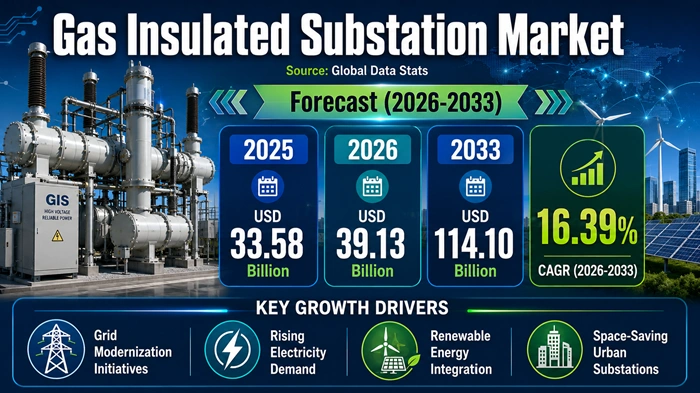
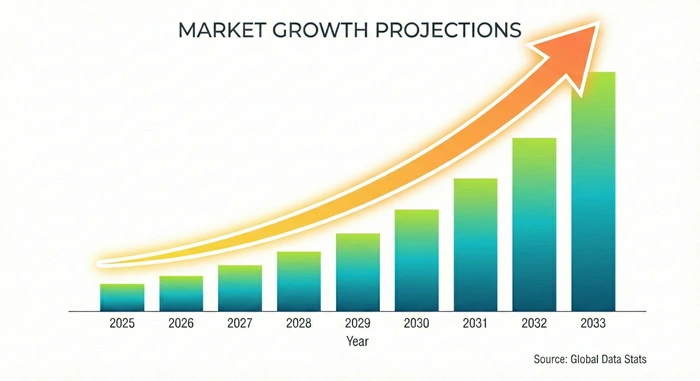
The global gas insulated substation market size is valued at USD 33.58 billion in 2025 and is predicted to increase from USD 39.13 billion in 2026 to approximately USD 114.10 billion by 2033, growing at a CAGR of 16.39% from 2026 to 2033.
Gas insulated substations represent advanced electrical infrastructure utilizing sulfur hexafluoride or alternative gases as insulation medium rather than conventional air, enabling dramatically reduced footprints compared to traditional air-insulated designs. These compact systems house high-voltage equipment including circuit breakers, disconnectors, current transformers, and busbars within sealed metal enclosures filled with insulating gas. The gas insulated substation market encompasses applications across urban power distribution, industrial facilities, renewable energy integration, and transmission networks where space constraints, environmental conditions, or safety requirements favor compact, reliable, and low-maintenance solutions over conventional outdoor substation designs.
AI Impact On The Gas Insulated Substation Industry
Revolutionizing Predictive Maintenance And Operational Efficiency Through Digital Intelligence
Artificial intelligence transforms gas insulated substation operations by enabling predictive maintenance capabilities detecting potential failures before catastrophic equipment damage occurs. Machine learning algorithms analyze sensor data including partial discharge monitoring, gas pressure measurements, temperature profiles, and vibration patterns identifying subtle degradation signatures invisible to traditional inspection methods. AI systems correlate operational data across fleet installations recognizing failure patterns and predicting remaining useful life for critical components. The gas insulated substation market benefits from reduced unplanned downtime, optimized maintenance scheduling, and extended equipment lifespans as utilities transition from time-based preventive maintenance toward condition-based strategies maximizing asset utilization while minimizing operational costs through targeted interventions only when actually required.
Digital twin technology creates virtual replicas of physical gas insulated substations enabling engineers to simulate operational scenarios, validate upgrade strategies, and optimize protection settings without risking actual equipment. AI-powered energy management systems optimize substation loading, minimize losses, and coordinate distributed energy resources including renewable generation and energy storage. The gas insulated substation market witnesses enhanced cybersecurity as machine learning algorithms detect anomalous network traffic patterns indicating potential cyber threats targeting critical substation control systems. Automated fault location and isolation systems powered by AI respond to disturbances within milliseconds, minimizing outage duration and improving grid reliability. Computer vision applications inspect equipment during manufacturing and commissioning, detecting assembly defects and ensuring quality standards before energization. These intelligent capabilities position AI as fundamental enabler of next-generation smart substations delivering superior performance, reliability, and operational efficiency throughout extended service lifespans.
Growth Factors
Urbanization Pressures And Renewable Energy Integration Driving Robust Market Expansion
Rapid urbanization creates compelling demand for space-efficient electrical infrastructure as land availability in dense metropolitan areas becomes increasingly scarce and expensive. Gas insulated substations occupy only 10-15% of footprint required by equivalent air-insulated designs, enabling utilities to locate critical infrastructure within urban centers minimizing transmission distances to load concentrations. Underground and indoor installation capabilities allow substation integration into building structures, transit facilities, and commercial developments impossible with traditional outdoor equipment. The gas insulated substation market expands as cities worldwide invest in infrastructure modernization replacing aging facilities with compact designs accommodating growing electricity demand within constrained urban footprints. Environmental resilience advantages including immunity to pollution, dust, humidity, and extreme weather eliminate performance degradation affecting air-insulated equipment in harsh conditions, reducing maintenance requirements and improving reliability.
Renewable energy deployment accelerates gas insulated substation adoption as wind farms, solar installations, and hydroelectric facilities require grid connection infrastructure, often in remote locations with challenging environmental conditions. Offshore wind projects particularly favor GIS technology for platform-mounted substations where space, weight, and corrosion resistance prove critical. The gas insulated substation market benefits from grid modernization initiatives as utilities upgrade transmission and distribution networks accommodating bidirectional power flows, distributed generation, and advanced control systems characteristic of modern smart grids. Government infrastructure investment programs worldwide allocate substantial funding toward electrical grid enhancement supporting economic development, energy security, and decarbonization objectives. Regulatory frameworks increasingly mandate compact, low-emission substation technologies particularly in environmentally sensitive areas and urban zones where traditional designs prove unsuitable. Industrial sector growth across manufacturing, data centers, mining, and chemical processing creates demand for reliable, compact power infrastructure supporting facility operations while minimizing land use and environmental impact.
Market Outlook
SF6 Alternatives And Digital Transformation Shaping Industry Evolution
Environmental sustainability considerations drive technology evolution as manufacturers develop SF6-free alternatives addressing concerns regarding sulfur hexafluoride's potent greenhouse gas characteristics with global warming potential 23500 times CO2. Clean air insulation systems utilizing dry air or nitrogen combinations achieve equivalent dielectric performance while eliminating SF6 emissions. Vacuum insulation technologies advance for medium-voltage applications offering environmentally benign alternatives. The gas insulated substation market witnesses growing adoption of eco-efficient designs as regulatory frameworks including California Air Resources Board rules and European Union F-gas regulations establish phase-out schedules for SF6 equipment. Next-generation insulating gases including fluoronitriles and fluoroketones deliver superior environmental profiles with global warming potentials below 1% of SF6 while maintaining or exceeding dielectric strength enabling direct retrofit applications in existing designs.
Digitalization transforms substation architecture as integrated sensors, intelligent electronic devices, and communication networks enable real-time monitoring, automated control, and advanced analytics. Digital substations eliminate conventional copper wiring replacing with fiber optic communication reducing installation complexity, improving reliability, and enabling flexible protection and control schemes. The gas insulated substation market benefits from interoperability standards including IEC 61850 facilitating seamless integration across multi-vendor equipment and enabling advanced applications including wide-area protection, adaptive relay coordination, and grid optimization algorithms. Modular designs accelerate deployment as factory-assembled, pre-tested equipment modules reduce on-site construction duration, improve quality control, and minimize commissioning challenges. Hybrid configurations combining gas insulated and air-insulated components optimize cost-performance tradeoffs for specific applications. Technology convergence with energy storage, electric vehicle charging infrastructure, and microgrids creates integrated energy hubs where gas insulated substations serve as foundational infrastructure enabling diverse applications beyond traditional power distribution.
Expert Speaks
-
Claudio Facchin, President of Power Grids Division at Hitachi Energy, emphasized through recent communications that grid modernization and renewable energy integration drive accelerating demand for space-efficient, reliable substation technologies, noting that Hitachi Energy's SF6-free portfolio including eco-efficient GIS solutions positions the company addressing customer sustainability priorities while delivering superior technical performance across voltage classes from medium to ultra-high voltage applications.
-
Tim Holt, President of Grid Solutions at GE Vernova, highlighted during product launch events that GE's g3 gas technology replacing SF6 with environmentally sustainable alternatives represents fundamental innovation addressing industry's most pressing environmental challenge, emphasizing that utilities worldwide adopt these solutions meeting regulatory requirements while maintaining operational performance and safety standards expected from conventional SF6 equipment.
-
Sabine Erlinghagen, CEO of Grid Technologies Division at Siemens Energy, noted through investor presentations that digital substation technologies integrating advanced sensors, analytics, and automation capabilities transform grid operations, positioning Siemens Energy's Blue GIS portfolio combining SF6-free insulation with digital readiness as comprehensive solution addressing both environmental and operational imperatives driving utility investment decisions globally.
Key Report Takeaways
-
Asia Pacific dominates the gas insulated substation market capturing approximately 42% regional share valued around USD 14.10 billion in 2025, driven by rapid urbanization across China, India, and Southeast Asia, massive infrastructure investment programs, expanding renewable energy capacity, and government grid modernization initiatives supporting economic development across emerging economies.
-
North America emerges as fastest-growing region with projected CAGR exceeding 17.1% through 2033, fueled by aging infrastructure replacement programs, grid resilience investments, renewable energy integration requirements, and regulatory frameworks promoting environmentally sustainable substation technologies including SF6-free alternatives.
-
Medium voltage represents the largest voltage rating segment accounting for approximately 52% market share due to widespread application in urban distribution networks, commercial facilities, industrial plants, and infrastructure projects including metro systems where compact design, reliability, and cost-effectiveness prove decisive selection criteria.
-
Power transmission applications contribute the most significant demand representing roughly 50% of total market as utilities invest in backbone infrastructure supporting long-distance electricity transfer, renewable energy evacuation, and cross-border power trading requiring high-capacity, highly reliable substation equipment.
-
Hybrid GIS maintains dominant type position commanding nearly 61% market share owing to optimal balance between performance and cost, combining gas insulation for critical components with conventional designs for less demanding sections, and proven reliability across diverse applications from transmission substations to industrial facilities.
-
Indoor installation segment exhibits fastest growth trajectory projected to expand at 17.5% CAGR through 2033 with market share approaching 72%, driven by urban substation requirements, building-integrated designs, harsh environmental conditions favoring enclosed installations, and safety advantages eliminating public exposure to high-voltage equipment.
Market Scope
| Report Coverage | Details |
|---|---|
| Market Size by 2033 | USD 114.10 Billion |
| Market Size by 2025 | USD 33.58 Billion |
| Market Size by 2026 | USD 39.13 Billion |
| Market Growth Rate from 2026 to 2033 | CAGR of 16.39% |
| Dominating Region | Asia Pacific |
| Fastest Growing Region | North America |
| Base Year | 2025 |
| Forecast Period | 2026 to 2033 |
| Segments Covered | Voltage Rating, Type, Installation Type, Application, End-User Industry, Region |
| Regions Covered | North America, Europe, Asia-Pacific, Latin America, Middle East and Africa |
Market Dynamics
Drivers Impact Analysis
Grid Modernization Initiatives And Space Constraints Accelerating Technology Adoption
| Factor | (≈) % Impact on CAGR Forecast | Geographic Relevance | Impact Timeline |
|---|---|---|---|
| Urban infrastructure development | 23-29% | Asia Pacific, Middle East | 2026-2033 |
| Renewable energy grid integration | 19-25% | Europe, North America, Asia Pacific | 2026-2033 |
| Aging infrastructure replacement | 16-22% | North America, Europe | 2026-2033 |
Government infrastructure investment programs worldwide allocate substantial funding toward electrical grid modernization supporting economic development, energy access expansion, and power reliability improvements. Utilities upgrade aging infrastructure nearing end of operational life with modern equipment delivering enhanced performance, reduced maintenance, and improved safety. The gas insulated substation market benefits from smart grid initiatives integrating advanced monitoring, automated control, and communication technologies enabling real-time grid management, demand response, and distributed energy resource coordination. Underground transmission projects particularly in dense urban areas mandate compact substation designs fitting within constrained spaces while maintaining high reliability and safety standards. Metro rail systems, airports, commercial developments, and industrial facilities integrate substations directly into building structures utilizing GIS space efficiency advantages.
Renewable energy capacity additions create substantial grid infrastructure requirements as wind farms, solar installations, and hydroelectric projects require substations evacuating generated power into transmission networks. Offshore wind developments particularly favor gas insulated substations for platform installations where weight, footprint, corrosion resistance, and reliability prove critical. The gas insulated substation market expands as renewable portfolio standards, feed-in tariffs, and decarbonization commitments drive accelerating clean energy deployment across markets worldwide. Grid operators invest in transmission capacity expansion and distribution network reinforcement accommodating growing electricity demand, peak load increases, and changing consumption patterns driven by electrification of transportation, heating, and industrial processes. Interconnection projects linking regional grids, enabling power trading, and improving system resilience require high-capacity substations along transmission corridors. Industrial sector growth including data centers, manufacturing facilities, mining operations, and chemical plants drives demand for reliable, compact electrical infrastructure supporting facility operations while minimizing environmental impact and land use.
Restraints Impact Analysis
High Initial Costs And Technical Complexity Limiting Adoption Pace
| Factor | (≈) % Impact on CAGR Forecast | Geographic Relevance | Impact Timeline |
|---|---|---|---|
| Capital cost premium versus AIS | -14 to -19% | Price-sensitive developing markets | 2026-2033 |
| SF6 environmental concerns | -11 to -16% | Environmentally regulated regions | 2026-2030 |
| Specialized maintenance requirements | -8 to -13% | Markets lacking technical expertise | 2026-2033 |
Gas insulated substations command significant cost premiums compared to conventional air-insulated alternatives with capital expenses 2-3 times higher for equivalent voltage and capacity ratings. Equipment procurement, specialized installation, and project execution require substantial upfront investment creating budget constraints particularly for utilities in developing markets with limited financial resources. The gas insulated substation market faces adoption barriers as cost-sensitive buyers prioritize lowest initial expense over lifecycle benefits including reduced maintenance, higher reliability, and space savings. Economic calculations favoring GIS prove most compelling where land costs exceed certain thresholds making space savings financially valuable, yet many rural and suburban applications find air-insulated designs adequate and economically preferable despite larger footprints and higher maintenance requirements.
Environmental concerns regarding sulfur hexafluoride create regulatory pressures as potent greenhouse gas characteristics motivate phase-out initiatives across multiple jurisdictions. Equipment manufacturers invest substantially in SF6-free alternative technologies yet cost premiums, performance validation requirements, and limited operational track records slow adoption. The gas insulated substation market confronts uncertainty as utilities evaluate tradeoffs between proven SF6 equipment and emerging alternatives offering superior environmental profiles but introducing technology risk. Retrofit challenges exist as legacy GIS installations require specialized procedures for SF6 recovery, equipment decommissioning, and disposal meeting environmental regulations. Technical expertise requirements create workforce challenges as GIS maintenance, troubleshooting, and repair demand specialized training, diagnostic equipment, and procedures distinct from conventional substation technologies. Utilities particularly in developing regions struggle recruiting and retaining qualified personnel capable of maintaining sophisticated equipment. Supply chain concentration among limited manufacturers creates procurement challenges with extended delivery lead times and limited competition potentially affecting pricing dynamics.
Opportunities Impact Analysis
Digital Substations And Emerging Market Expansion Creating Growth Avenues
| Factor | (≈) % Impact on CAGR Forecast | Geographic Relevance | Impact Timeline |
|---|---|---|---|
| SF6-free technology migration | +17 to +23% | Environmentally regulated markets | 2026-2033 |
| Smart city infrastructure | +15 to +21% | Urban centers globally | 2027-2033 |
| Offshore renewable energy | +13 to +18% | Coastal regions with wind resources | 2027-2033 |
Digital substation architecture represents transformative opportunity as utilities adopt IEC 61850 communication standards, process bus technologies, and integrated protection and control systems. Digital GIS installations eliminate conventional copper wiring replacing with fiber optic communication reducing installation complexity, improving reliability, and enabling flexible protection schemes. The gas insulated substation market captures value from condition monitoring systems providing real-time equipment health assessment, predictive maintenance capabilities, and asset management optimization. Cybersecurity solutions addressing growing threats to critical infrastructure create service revenue opportunities. Integration with advanced distribution management systems, outage management applications, and enterprise asset management platforms positions digital substations as foundational smart grid infrastructure enabling operational transformation beyond traditional equipment functions.
Emerging market infrastructure investment creates substantial growth opportunities as developing economies expand electricity access, upgrade distribution networks, and modernize transmission systems supporting economic development. Urbanization trends particularly across Asia, Africa, and Latin America drive demand for space-efficient substation solutions accommodating load growth within constrained urban environments. The gas insulated substation market benefits from international development funding, government infrastructure programs, and private sector investment supporting grid expansion and reliability improvements. Offshore renewable energy deployment accelerates globally as wind farm development moves into deeper waters farther from shore requiring platform-mounted substations where GIS technology delivers optimal performance. Floating wind installations, wave energy projects, and offshore solar concepts create specialized applications demanding compact, lightweight, and corrosion-resistant electrical equipment. Industrial sector applications diversify including mining operations, oil and gas facilities, chemical plants, and manufacturing complexes adopting GIS technology for onsite power distribution where reliability, safety, and space efficiency justify premium pricing versus conventional alternatives.
Segment Analysis
By Voltage Rating: Medium Voltage
Urban Distribution Networks And Commercial Applications Driving Segment Leadership
Medium voltage equipment dominates the gas insulated substation market capturing approximately 52% share valued around USD 17.46 billion in 2025 owing to widespread application across urban distribution networks, commercial facilities, industrial plants, and infrastructure projects. Voltage ratings typically 1-52 kV serve primary distribution systems delivering electricity from transmission substations to end consumers. Compact designs prove particularly valuable in urban settings where space constraints limit conventional outdoor substation options. Metro rail systems globally adopt medium-voltage GIS for traction power substations located beneath city streets or within station structures. The gas insulated substation market benefits from data center proliferation requiring reliable, compact electrical infrastructure supporting mission-critical computing operations. Commercial building developments integrate substations directly into basement or ground-floor spaces utilizing GIS space efficiency and environmental protection advantages.
Asia Pacific leads medium-voltage GIS deployment with China, India, Japan, and South Korea installing substantial capacity supporting rapid urbanization and infrastructure development. North America and Europe adopt medium-voltage technology for distribution network modernization, underground residential developments, and building-integrated applications. The gas insulated substation market sees this segment maintaining steady growth near 15.8% CAGR through 2033 as urbanization continues globally. Leading regional manufacturers including ABB, Siemens, Schneider Electric, and Mitsubishi Electric offer comprehensive medium-voltage portfolios spanning standardized designs for common applications and customized solutions addressing specific project requirements. Technology evolution focuses on SF6-free alternatives including vacuum insulation, clean air technologies, and solid insulation systems meeting environmental regulations while maintaining compact footprints and performance characteristics. Modular designs accelerate installation and commissioning while simplification of maintenance procedures reduces lifecycle costs improving economic value proposition versus air-insulated alternatives across broader application spectrum.
By Installation Type: Indoor
Urban Applications And Environmental Protection Requirements Establishing Dominance
Indoor installation represents largest and fastest-growing segment in the gas insulated substation market commanding approximately 72% share valued around USD 24.18 billion in 2025, projected to expand at robust 17.5% CAGR through 2033. Indoor GIS installations protect equipment from environmental exposure including humidity, pollution, temperature extremes, and corrosive atmospheres extending operational life and reducing maintenance requirements. Urban substations particularly favor indoor configurations integrating facilities into buildings, underground vaults, or dedicated structures minimizing visual impact and land use while providing security. The gas insulated substation market benefits from harsh environment applications including coastal areas with salt exposure, industrial zones with chemical contamination, and desert regions with extreme temperatures and dust where enclosed installations prove essential for reliable long-term operation.
Europe and North America lead indoor GIS adoption for distribution network modernization within densely populated urban areas where outdoor substations prove impractical or undesirable. Asia Pacific markets increasingly specify indoor installations for commercial developments, transit systems, and industrial facilities. The gas insulated substation market witnesses this segment capturing growing investment as noise reduction, electromagnetic field containment, and public safety considerations favor enclosed designs particularly in populated areas. Leading suppliers including ABB Hitachi Energy, Siemens Energy, GE Vernova, and Schneider Electric offer factory-tested, pre-assembled indoor GIS modules reducing on-site installation duration and improving quality control. Advanced ventilation, fire suppression, and environmental monitoring systems ensure safe operation within buildings meeting stringent safety codes. Building-integrated photovoltaics, energy storage, and electric vehicle charging infrastructure create multifunctional energy hubs where indoor GIS serves as central component enabling diverse applications within compact urban footprints. Digital monitoring, remote operation capabilities, and automated protection systems eliminate need for continuous staffing improving economics while maintaining reliability across distributed installations throughout metropolitan areas.
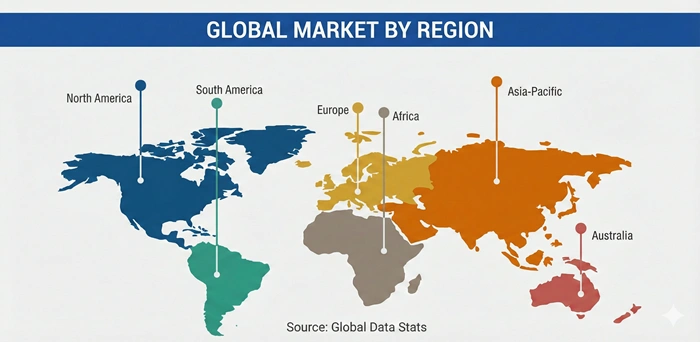
Regional Insights
Asia Pacific
Infrastructure Investment And Rapid Urbanization Cementing Regional Market Leadership
Asia Pacific dominates the gas insulated substation market commanding approximately 42% global share valued at USD 14.10 billion in 2025, projected to reach USD 47.78 billion by 2033 growing at 16.5% CAGR. China establishes overwhelming regional leadership through massive infrastructure investment including ultra-high-voltage transmission corridors evacuating renewable energy from western provinces to eastern load centers. State Grid Corporation and China Southern Power Grid operate world's most extensive high-voltage transmission networks incorporating thousands of gas insulated substations across voltage classes. Government Five-Year Plans allocate hundreds of billions toward electrical infrastructure modernization supporting economic development and energy transition objectives. The gas insulated substation market benefits from domestic manufacturing capacity as Chinese suppliers including XD Electric, Pinggao Electric, and Henan Pinggao produce equipment serving domestic and export markets.
India represents major growth opportunity as government programs including National Infrastructure Pipeline invest massively in power sector expansion, grid modernization, and renewable energy integration. Metro rail system construction across multiple cities creates substantial GIS demand for traction power infrastructure. Industrial corridor development and smart city initiatives specify compact substation technologies for urban applications. The gas insulated substation market witnesses Japan maintaining technological leadership through manufacturers including Toshiba, Mitsubishi Electric, and Hitachi supplying advanced equipment globally while domestic utilities adopt GIS for earthquake-resistant underground installations. South Korea's grid modernization and renewable energy targets drive continued GIS deployment. Southeast Asian nations including Thailand, Vietnam, Indonesia, and Philippines invest in transmission and distribution infrastructure supporting economic growth with GIS technology increasingly specified for urban and industrial applications. Regional manufacturing capabilities, government infrastructure priorities, abundant growth opportunities, and technological advancement position Asia Pacific maintaining dominant market position throughout forecast period.
North America
Infrastructure Replacement And Environmental Regulations Driving Fastest Regional Growth
North America emerges as fastest-growing region in the gas insulated substation market with CAGR exceeding 17.1% from 2026 to 2033, with market value expanding from approximately USD 10.06 billion in 2025 toward USD 35.95 billion by 2033. United States leads regional growth through Infrastructure Investment and Jobs Act allocating substantial funding toward electrical grid modernization, resilience improvements, and clean energy integration. Utilities replace aging air-insulated substations reaching end of operational life with modern GIS technology delivering enhanced reliability, reduced maintenance, and improved safety. The gas insulated substation market captures momentum from renewable energy deployment particularly wind generation across Great Plains and offshore wind development along Atlantic coast requiring grid infrastructure investments. California, Oregon, and Washington implement aggressive SF6 phase-out regulations driving adoption of environmentally sustainable alternatives including clean air insulation and vacuum technologies.
Urban distribution network modernization across major metropolitan areas favors GIS installations for underground and building-integrated applications addressing space constraints and aesthetic requirements. Data center construction boom particularly in Virginia, Texas, and Pacific Northwest creates demand for reliable electrical infrastructure supporting computing facilities. The gas insulated substation market benefits from Canadian infrastructure investment including provincial utility upgrades and interprovincial transmission projects. Mexico's industrial development and nearshoring trends drive electrical infrastructure requirements supporting manufacturing facilities. Leading North American utilities including Consolidated Edison, Pacific Gas & Electric, Southern California Edison, and Hydro-Québec deploy substantial GIS capacity. Equipment suppliers including ABB Hitachi Energy, GE Vernova, Siemens Energy, and Mitsubishi Electric maintain strong regional presence. Technology innovation, supportive policies, infrastructure investment, and environmental regulations position North America as primary growth engine for global gas insulated substation expansion throughout forecast period.
Top Key Players
-
ABB Ltd. (Hitachi Energy) (Switzerland/Japan)
-
Siemens Energy AG (Germany)
-
General Electric Company (GE Vernova) (United States)
-
Mitsubishi Electric Corporation (Japan)
-
Schneider Electric SE (France)
-
Toshiba Energy Systems & Solutions Corporation (Japan)
-
Hyundai Electric & Energy Systems Co., Ltd. (South Korea)
-
Larsen & Toubro Limited (India)
-
Fuji Electric Co., Ltd. (Japan)
-
CG Power and Industrial Solutions Ltd. (India)
-
Hyosung Heavy Industries Corporation (South Korea)
-
Meidensha Corporation (Japan)
-
Nissin Electric Co., Ltd. (Japan)
-
Powell Industries, Inc. (United States)
-
Eaton Corporation (Ireland)
Recent Developments
-
ABB Hitachi Energy (October 2025): Secured contract delivering 1100 kV gas insulated switchgear for Nanchang ultra-high-voltage substation in Jiangxi Province, China, supporting State Grid Corporation's UHV grid expansion program connecting renewable energy resources with load centers, demonstrating technical leadership in highest voltage GIS applications while advancing China's energy transition infrastructure development initiatives.
-
GE Vernova (August 2024): Announced Grid Solutions business manufacturing and delivering world's first 246-kilovolt SF6-free gas insulated substation for RTE in France, deploying g3 green gas technology eliminating sulfur hexafluoride emissions while maintaining operational performance, supporting European utility decarbonization objectives and regulatory compliance with environmental standards.
-
Hitachi Energy (August 2024): Launched breakthrough technology tackling sulfur hexafluoride emissions through AirPlus dry air insulation system deployable across gas-insulated switchgear, dead tank breakers, and live tank breakers, offering utilities comprehensive portfolio eliminating SF6 across voltage ratings supporting environmental sustainability commitments.
-
Siemens Energy (November 2024): Introduced NXPLUS C 24-blue medium-voltage GIS system to United States market featuring fluorinated-gas-free clean air insulation technology, offering lower CO2 footprint with arc-resistant design ensuring personnel safety, aligning with company's grid decarbonization mission while meeting stringent North American safety and environmental standards.
-
Schneider Electric (June 2024): Expanded digital substation portfolio launching integrated protection, control, and monitoring solutions compatible with IEC 61850 standards enabling seamless retrofit of existing installations, supporting utility digital transformation initiatives through advanced analytics, remote operation capabilities, and cybersecurity features enhancing grid reliability and operational efficiency.
Market Trends
Environmental Sustainability And Modular Design Reshaping Technology Development
SF6-free technology transition accelerates globally as manufacturers develop and commercialize environmentally sustainable insulation alternatives addressing regulatory pressures and customer sustainability commitments. Clean air technologies utilizing pressurized dry air or nitrogen mixtures achieve dielectric performance comparable to SF6 while eliminating greenhouse gas emissions. Fluoronitrile-based gases deliver superior environmental profiles with global warming potentials below 1% of SF6 while maintaining or exceeding insulation strength enabling direct retrofit into existing GIS designs. The gas insulated substation market witnesses growing adoption as utilities balance environmental objectives with technical performance, cost considerations, and operational reliability requirements. Technology maturation improves commercial availability across voltage ratings with medium-voltage applications achieving broadest alternative adoption while high-voltage and ultra-high-voltage systems continue SF6-free technology development. Lifecycle cost assessments increasingly favor environmentally sustainable alternatives as greenhouse gas accounting, carbon pricing mechanisms, and end-of-life disposal costs factor into equipment procurement decisions beyond traditional focus on initial capital expense and operational performance specifications alone.
Modular factory-assembled designs transform project execution as standardized, pre-tested equipment modules reduce on-site construction duration, improve quality control, and minimize commissioning challenges. Manufacturers offer containerized GIS solutions providing fully functional substations shipped as integrated units requiring only connection to external cables and control systems. The gas insulated substation market benefits from accelerated deployment timelines particularly for remote renewable energy projects, temporary installations, and rapid infrastructure expansion scenarios. Digital twin technology enables virtual factory acceptance testing, commissioning simulation, and operator training before equipment arrival on site reducing project risk and expediting energization schedules. Type-tested standardized designs reduce engineering effort, procurement lead times, and project costs compared to custom-engineered solutions while maintaining flexibility through modular configurations addressing diverse application requirements. Hybrid architectures combining gas insulated and air-insulated components optimize cost-performance tradeoffs for specific applications. Retrofittable designs enable GIS installation within existing air-insulated substation footprints supporting phased modernization strategies where complete facility replacement proves impractical or economically unjustifiable despite aging equipment condition and performance limitations.
Segments Covered In The Report
By Voltage Rating
-
Medium Voltage (1 kV to 52 kV)
-
High Voltage (52 kV to 220 kV)
-
Extra High Voltage (Above 220 kV)
By Type
-
Hybrid GIS
-
Compact GIS
-
Integrated Three-Phase GIS
-
Mobile GIS
By Installation Type
-
Indoor
-
Outdoor
By Application
-
Power Transmission
-
Power Distribution
-
Renewable Integration
-
Infrastructure (Railways, Airports, Metro)
By End-User Industry
-
Power Utilities
-
Industrial (Manufacturing, Mining, Oil & Gas)
-
Commercial (Data Centers, Buildings)
-
Transportation (Railways, Airports)
-
Renewable Energy (Wind, Solar, Hydro)
By Region
-
North America (United States, Canada, Mexico)
-
Europe (Germany, France, United Kingdom, Italy, Spain, Rest of Europe)
-
Asia-Pacific (China, India, Japan, South Korea, Australia, Southeast Asia, Rest of Asia-Pacific)
-
Latin America (Brazil, Argentina, Rest of Latin America)
-
Middle East and Africa (Saudi Arabia, UAE, South Africa, Rest of MEA)
Frequently Asked Questions
Question 1: What is the expected size of the gas insulated substation market by 2033?
Answer: The global gas insulated substation market is projected to reach approximately USD 114.10 billion by 2033, expanding from USD 39.13 billion in 2026. This substantial growth reflects accelerating urbanization, infrastructure modernization programs, renewable energy integration requirements, and adoption of environmentally sustainable SF6-free technologies worldwide.
Question 2: Which region dominates the gas insulated substation market currently?
Answer: Asia Pacific dominates the gas insulated substation market with approximately 42% market share due to massive infrastructure investment across China, India, and Southeast Asia supporting rapid urbanization and economic development. The region benefits from domestic manufacturing capacity, government grid modernization programs, and substantial renewable energy deployment driving sustained GIS adoption.
Question 3: What CAGR will the gas insulated substation market experience from 2026 to 2033?
Answer: The gas insulated substation market will grow at a compound annual growth rate of 16.39% from 2026 to 2033. This robust expansion reflects urban space constraints favoring compact designs, grid modernization initiatives, renewable energy grid integration requirements, and transition toward environmentally sustainable insulation technologies addressing SF6 phase-out regulations.
Question 4: Which voltage rating holds the largest share in the gas insulated substation market?
Answer: Medium voltage equipment commands the largest share at approximately 52% due to widespread application in urban distribution networks, commercial facilities, industrial plants, and infrastructure projects including metro systems. The gas insulated substation market benefits from this segment's cost-effectiveness, proven reliability, and suitability for space-constrained urban applications driving sustained adoption globally.
Question 5: What are the primary growth drivers for the gas insulated substation market?
Answer: Primary drivers include urban infrastructure development requiring space-efficient substations, renewable energy grid integration creating connection infrastructure demand, and aging infrastructure replacement programs. The gas insulated substation market also benefits from grid modernization initiatives, smart city development projects, environmental regulations promoting compact designs, and industrial sector growth requiring reliable electrical infrastructure in space-constrained or environmentally challenging locations.