
Field Programmable Gate Array Market Overview
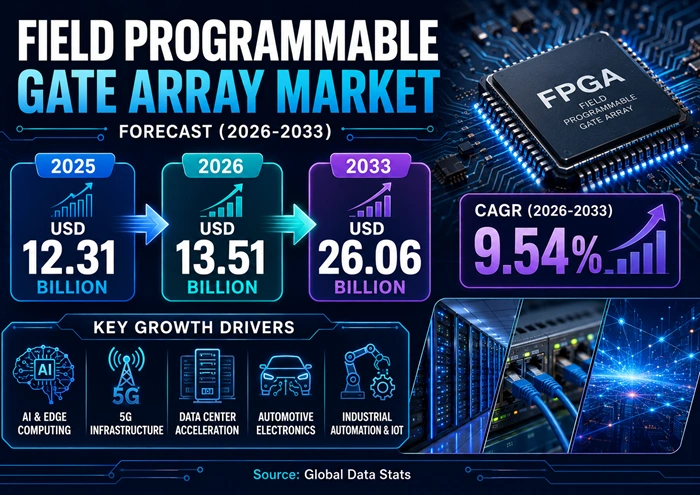
The global field programmable gate array market size is valued at USD 12.31 billion in 2025 and is predicted to increase from USD 13.51 billion in 2026 to approximately USD 26.06 billion by 2033, growing at a CAGR of 9.54% from 2026 to 2033. This robust expansion is driven by surging demand for high-performance, reconfigurable semiconductor devices across data centers, telecommunications, automotive, and AI accelerator applications, as hardware designers increasingly choose programmable logic over fixed ASICs for flexibility, faster time-to-market, and evolving performance requirements.
The FPGA industry has entered a new growth phase, shaped by the convergence of AI workloads, 5G infrastructure deployment, and edge computing architectures. As every major industry vertical undergoes digital transformation, demand for adaptable silicon that can be reprogrammed to meet shifting workload requirements continues to expand at an impressive pace.
AI Impact on the Field Programmable Gate Array Industry
Artificial Intelligence Acceleration Workloads Are Fundamentally Reshaping Demand Patterns, Design Complexity, and Competitive Dynamics Across the Global FPGA Industry
Artificial intelligence has become the single most transformative force acting on the field programmable gate array market today. The inherent parallelism and reconfigurability of FPGAs make them exceptionally well-suited to the types of matrix operations, convolution tasks, and inference pipelines that underpin modern AI and machine learning models. Unlike GPUs, which excel at training tasks with high power draw, FPGAs offer a compelling combination of low-latency inference performance, energy efficiency, and the ability to be reprogrammed as AI model architectures evolve — making them a strategic choice for hyperscale data centers, edge AI deployments, and autonomous system developers who need adaptive hardware without committing to a fixed ASIC design. AMD (Xilinx), Intel (Altera), and Achronix are all investing heavily in AI-optimized FPGA architectures, with embedded DSP blocks, on-chip memory expansion, and high-bandwidth memory interfaces designed specifically to accelerate neural network inference at scale.
Beyond inference acceleration, AI is also reshaping how FPGAs themselves are designed and programmed. High-Level Synthesis (HLS) tools augmented with machine learning are allowing software engineers without deep hardware expertise to implement complex FPGA-based designs significantly faster by automatically translating C++ or Python code into optimized hardware description language (HDL) outputs. This democratization of FPGA design lowers the specialized engineering barrier that has historically constrained adoption in mid-market applications and startups. As AI-assisted design tools mature and as pre-built IP cores for common AI inference tasks become more widely available, the addressable market for programmable gate array solutions is expected to expand well beyond its traditional customer base of defense contractors and telecom equipment manufacturers.
Growth Factors
The Rapid Expansion of 5G Infrastructure, Data Center AI Workloads, and Automotive ADAS Applications Are Collectively Powering Multi-Dimensional Growth Across the Field Programmable Gate Array Market
The 5G telecommunications build-out is one of the most powerful near-term demand drivers for the field programmable gate array market. Radio access network (RAN) equipment — including base stations, massive MIMO antenna systems, and fronthaul transport gear — requires extremely high-speed, low-latency digital signal processing that FPGAs deliver with unmatched flexibility. Unlike ASICs, FPGAs can be updated via firmware to support new 5G protocol revisions and frequency band configurations without hardware replacement, making them the preferred solution for telecom equipment manufacturers operating in a standard that is still actively evolving. With global 5G infrastructure investment running at hundreds of billions of dollars annually, the telecom sector represents a sustained and growing revenue stream for leading FPGA vendors.
The rapid growth of cloud computing and AI workloads is creating equally powerful tailwinds. Hyperscale data center operators including Microsoft, Amazon, Google, and Alibaba have deployed FPGAs at significant scale for tasks including network packet processing, video transcoding, database acceleration, and machine learning inference. As data center operators seek to maximize compute efficiency and minimize total cost of ownership per workload, the FPGA's combination of programmable hardware acceleration and efficient power-per-operation profile positions it favorably against both CPUs and specialized ASICs for many common data center workloads. The automotive sector adds a third major growth layer, as the transition to Advanced Driver Assistance Systems (ADAS), electric vehicle powertrain management, and eventually autonomous driving creates demand for high-speed, low-latency programmable logic capable of real-time sensor fusion, vision processing, and functional safety-compliant control system implementation.
Market Outlook
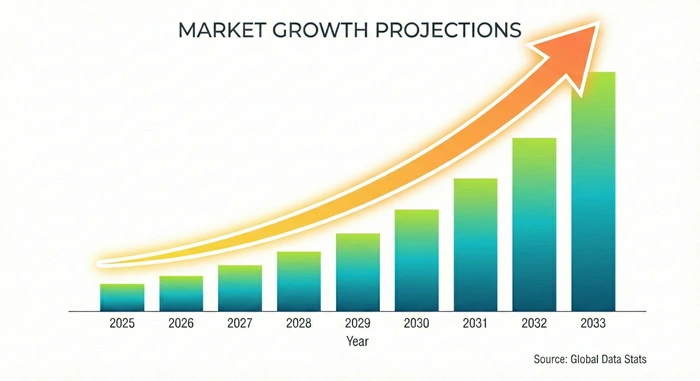
Continued Technology Node Miniaturization, Growing Automotive and Edge Computing Demand, and the Rise of AI-Optimized FPGA Architectures Position the Market for Sustained Double-Digit Growth Through 2033
Looking ahead through 2033, the field programmable gate array market is positioned for consistent expansion across all major end-use sectors. Technology node advancement — with leading FPGA vendors now producing devices at 7nm and pushing toward 3nm fabrication processes — is enabling dramatic increases in device density, performance, and energy efficiency that are opening entirely new application categories. These advanced-node devices are particularly important for the data center and AI acceleration segments, where higher transistor counts enable larger on-chip memory, more DSP blocks, and higher I/O bandwidth — all critical for handling the scale of modern AI model inference workloads.
The edge computing paradigm is creating a particularly compelling growth vector that extends well beyond traditional FPGA strongholds in defense and telecom. Edge AI applications — from smart cameras and industrial inspection systems to connected medical devices and autonomous agricultural equipment — require local processing of sensor data with real-time response times and strict power budgets that cloud-connected solutions cannot meet. FPGAs, particularly low-power mid-range and high-end edge-optimized devices, are emerging as the preferred platform for these applications because they offer the necessary combination of reconfigurability, low latency, and energy efficiency that no other semiconductor architecture can match across such a broad range of edge use cases. This expanding addressable market is expected to sustain the market's above-average growth trajectory well into the 2030s.
Expert Speaks
-
"The FPGA is no longer just a prototyping tool or a niche aerospace component — it has become a core building block of modern AI infrastructure. AMD is committed to leading the next generation of FPGA and adaptive computing solutions that will power the data centers, networks, and autonomous systems of the future." — CEO, AMD Inc.
-
"Intel's programmable solutions business is at the heart of our data center and network acceleration strategy. FPGAs give our customers the flexibility to accelerate specific workloads with hardware efficiency that software alone cannot achieve, and we see this market continuing to expand as AI and 5G deployments accelerate globally." — CEO, Intel Corporation
-
"At Lattice Semiconductor, we are focused on democratizing FPGA technology for edge applications — making programmable logic smaller, more power-efficient, and easier to program. The edge computing revolution is creating demand for FPGAs in places we haven't seen them before, and our addressable market is expanding rapidly as a result." — CEO, Lattice Semiconductor Corporation
Key Report Takeaways
-
North America dominates the field programmable gate array market with approximately 37% of global revenue share in 2025, driven by dominant FPGA vendors headquartered in the region, massive data center investment, 5G infrastructure deployment, and strong defense and aerospace procurement programs
-
Asia Pacific is the fastest-growing region, expected to expand at a CAGR of approximately 11.2% from 2026 to 2033, fueled by rapid 5G infrastructure buildout in China and South Korea, growing semiconductor manufacturing investments in Taiwan and Japan, and expanding electronics and automotive production ecosystems
-
IT & Telecom is the leading end-user industry, accounting for approximately 35% of market revenue in 2025, as 5G base station deployment, network switching infrastructure, and data center acceleration applications continue to drive the highest FPGA consumption volumes globally
-
Data center & cloud computing is the leading application segment by revenue contribution, representing approximately 30% of the total market in 2025, driven by hyperscale cloud operators deploying FPGAs at scale for AI inference acceleration, network packet processing, and storage controller offload tasks
-
SRAM-based FPGAs hold the dominant device type share at approximately 55% of the market in 2025, preferred for their high reconfigurability, fast programming cycles, and strong performance in high-speed digital signal processing applications across telecom, data center, and defense sectors
-
The automotive FPGA segment is expected to grow the fastest, projected to expand at a CAGR of approximately 17% from 2026 to 2033, capturing a growing share of the market as ADAS, EV battery management, and autonomous driving system development creates demand for high-performance, functionally safe, reprogrammable logic in vehicle electronic architectures
Market Scope
| Report Coverage | Details |
|---|---|
| Market Size by 2033 | USD 26.06 Billion |
| Market Size by 2025 | USD 12.31 Billion |
| Market Size by 2026 | USD 13.51 Billion |
| Market Growth Rate from 2026 to 2033 | CAGR of 9.54% |
| Dominating Region | North America |
| Fastest Growing Region | Asia Pacific |
| Base Year | 2025 |
| Forecast Period | 2026 – 2033 |
| Segments Covered | Device Type, Technology Node, Configuration, Application, End-User Industry, Region |
| Regions Covered | North America, Europe, Asia Pacific, Latin America, Middle East & Africa |
Market Dynamics
Drivers Impact Analysis
5G Infrastructure Deployment, Data Center AI Acceleration, and Automotive Electronics Growth Are the Three Most Powerful Forces Driving Expansion in the Field Programmable Gate Array Market
| Driver | ≈ % Impact on CAGR Forecast | Geographic Relevance | Impact Timeline |
|---|---|---|---|
| 5G base station and RAN infrastructure deployment | ~28% | Asia Pacific, North America, Europe | Short to Medium Term |
| AI and ML inference acceleration in data centers | ~26% | North America, Asia Pacific | Short to Long Term |
| Automotive ADAS and EV electronics adoption | ~20% | Asia Pacific, Europe, North America | Medium to Long Term |
| Edge computing and IoT expansion | ~16% | Global | Medium Term |
| Defense and aerospace modernization programs | ~10% | North America, Europe, MEA | Long Term |
The field programmable gate array market is experiencing a powerful and broad-based demand expansion primarily because its key end-use markets are all undergoing simultaneous, large-scale technology transitions. The 5G rollout is forcing telecom equipment manufacturers to redesign their entire baseband and fronthaul product lines using programmable hardware that can adapt to evolving radio standards. At the same time, hyperscale data centers are deploying FPGAs at scale as SmartNIC accelerators and inference engines. These two demand channels alone — telecom and data centers — are generating sustained multi-year procurement programs that provide high revenue visibility for leading FPGA vendors.
The automotive sector is adding a third and rapidly growing demand vector. The combination of ADAS feature proliferation in new vehicles — including adaptive cruise control, lane keeping assist, emergency braking, and parking automation — with the broader industry transition toward electric powertrains and centralized vehicle compute architectures is driving significant demand for FPGAs capable of meeting stringent automotive quality and functional safety standards (ISO 26262). Vehicle OEMs and Tier-1 suppliers prefer FPGAs for ADAS prototyping and volume production because the ability to update sensor fusion algorithms and control logic via field updates significantly reduces the risk of hardware obsolescence as autonomous driving technology matures. This structural shift in automotive electronics is expected to sustain above-average FPGA demand growth in the sector well beyond 2033.
Restraints Impact Analysis
High Device Complexity, Steep Engineering Learning Curves, and Intensifying Competition from ASICs and AI Accelerators Represent the Primary Constraints Moderating Growth in the FPGA Market
| Restraint | ≈ % Impact on CAGR Forecast | Geographic Relevance | Impact Timeline |
|---|---|---|---|
| High cost of advanced-node FPGA devices | ~-24% | Emerging markets, cost-sensitive applications | Ongoing |
| Steep hardware design learning curve and engineering scarcity | ~-22% | Global | Ongoing |
| Competition from purpose-built ASICs and AI accelerators | ~-20% | North America, Asia Pacific | Medium to Long Term |
| Supply chain constraints for advanced semiconductor nodes | ~-18% | Global | Short to Medium Term |
| High power consumption in high-end FPGA configurations | ~-10% | Data centers, edge deployments | Medium Term |
The most persistent restraint facing the field programmable gate array market is the high cost and complexity associated with advanced-node FPGA devices. High-end FPGAs at 7nm and below carry significant unit prices — often exceeding several thousand dollars per device — that make them unsuitable for cost-sensitive, high-volume consumer applications. The engineering effort required to achieve optimized implementations on complex FPGA architectures is also substantial, demanding specialists with expertise in hardware description languages, timing analysis, and design verification that are in short supply globally. This combination of high device cost and specialized talent requirements effectively limits FPGA adoption to well-funded organizations with dedicated hardware design teams, restricting market penetration in segments where simpler or lower-cost alternatives exist.
The growing availability and competitiveness of custom AI accelerators (ASICs designed by hyperscale companies such as Google with its TPU, Amazon with its Trainium, and Meta with its MTIA chips) represents a structural competitive threat to FPGAs in the data center AI acceleration segment. As AI workloads mature and model architectures stabilize for specific tasks, the economic case for investing in custom silicon often becomes compelling for the largest cloud operators — potentially capping FPGA share in segments where custom ASICs can offer superior performance-per-watt and cost-per-inference at scale. FPGA vendors are responding by enhancing their software tooling, expanding pre-built IP libraries, and offering as-a-service FPGA acceleration models that reduce the design burden, but the competitive pressure from custom silicon is expected to remain a meaningful restraint through the forecast period.
Opportunities Impact Analysis
AI-Optimized FPGA Architectures, Adaptive Compute Acceleration Platforms, and Expansion in Healthcare and Industrial IoT Represent the Highest-Value Growth Opportunities for the Field Programmable Gate Array Market
| Opportunity | ≈ % Impact on CAGR Forecast | Geographic Relevance | Impact Timeline |
|---|---|---|---|
| AI-native FPGA and adaptive SoC product development | ~+30% | North America, Asia Pacific | Short to Medium Term |
| SmartNIC and DPU deployment in hyperscale data centers | ~+24% | North America, Europe | Short to Medium Term |
| Industrial IoT and smart manufacturing applications | ~+20% | Asia Pacific, Europe | Medium to Long Term |
| Healthcare medical imaging and genomics processing | ~+14% | North America, Europe | Medium Term |
| Satellite and space-grade FPGA applications | ~+12% | North America, Europe, MEA | Long Term |
The most strategically significant opportunity for the field programmable gate array market lies in the development and deployment of AI-native FPGA and adaptive System-on-Chip (SoC) platforms that tightly integrate processor cores, dedicated AI inference engines, and programmable logic fabric on a single device. AMD's Versal AI Core series and Intel's Agilex platforms are early examples of this architectural convergence, and market response has been strongly positive. By combining the flexibility of traditional FPGAs with hardened AI acceleration blocks optimized for common neural network operations, these adaptive compute platforms dramatically improve performance-per-watt for AI inference workloads while maintaining the reprogrammability that distinguishes FPGAs from fixed ASICs.
Industrial IoT and smart manufacturing present another compelling growth opportunity, particularly as Industry 4.0 initiatives accelerate factory automation, real-time machine monitoring, and edge AI quality inspection deployments globally. These applications typically require processing of multiple high-speed sensor streams with very low latency, deterministic real-time response, and long product life cycles — a combination that FPGAs serve exceptionally well. European and Japanese manufacturing sectors, in particular, are aggressive adopters of FPGA-based industrial automation technology, creating sustained demand for mid-range and application-specific FPGA solutions tailored to industrial automation environments. As more industrial companies integrate AI-enabled visual inspection and predictive maintenance into their operations, the volume and value of FPGA deployments in the industrial sector is expected to grow significantly across the forecast period.
Segment Analysis
By Device Type
SRAM-Based FPGAs Maintain Dominant Market Leadership, While Flash-Based FPGAs Gain Momentum in Power-Sensitive Automotive and Military Edge Applications
SRAM-based FPGAs hold approximately 55% of the total field programmable gate array market share in 2025 and are projected to maintain leadership at a CAGR of approximately 9.0% through 2033. The dominance of SRAM-based devices reflects their fundamental architectural advantages — they offer the highest logic density, the fastest reprogramming cycles, and the widest compatibility with industry-standard FPGA development toolchains, making them the preferred choice for high-performance applications including data center acceleration, 5G base station signal processing, and real-time industrial control systems. North America is the primary growth geography for SRAM-based FPGAs, driven by hyperscale data center procurement and strong defense and aerospace program spending; AMD (Xilinx) and Intel (Altera) together command the majority of this segment's revenue, competing on device performance, DSP block count, and the quality of their respective EDA software toolchains. The primary limitation of SRAM-based devices — that they lose their configuration data at power-off and require an external flash memory device to reload their bitstream on startup — is a manageable engineering constraint in most professional applications.
Flash-based FPGAs account for approximately 30% of market revenue in 2025 and are expected to grow at a CAGR of approximately 10.8% through 2033, outpacing SRAM-based devices, driven by their inherent advantages in power-sensitive and security-critical applications. Flash-based FPGAs retain their configuration in non-volatile memory, enabling instant-on operation without external programming memory — a critical requirement in automotive safety systems, avionics, and military edge applications where boot time and power sequencing are tightly constrained. Microchip Technology (formerly Microsemi) is the leading supplier in this segment, with its PolarFire series offering a combination of low static power consumption, radiation tolerance, and security features that position it well for the growing automotive and defense end-markets. Asia Pacific is emerging as a growing adoption region for flash-based FPGAs as Japanese and South Korean automotive electronics manufacturers increasingly specify them in ADAS sensor interface and functional safety controller designs.
By Application
Data Center and Cloud Computing Leads Application Revenue While 5G Communications Infrastructure Drives the Highest Near-Term Volume Demand in the Field Programmable Gate Array Market
Data center and cloud computing represents the leading application segment in the field programmable gate array market, contributing approximately 30% of total market revenue in 2025 and expected to sustain a CAGR of approximately 11.5% through 2033. The hyperscale data center community — anchored by Microsoft Azure, Amazon Web Services, and Alibaba Cloud — has embraced FPGA deployment at significant scale for workloads ranging from network packet inspection and traffic management to database query acceleration, video transcoding, and increasingly, AI inference serving. North America is by far the dominant geography for this application segment, reflecting the concentration of hyperscale cloud infrastructure investment in the United States; AMD (Xilinx) and Intel (Altera) are the primary technology suppliers, both actively competing for cloud platform design wins that carry significant long-term revenue implications given the multi-year nature of data center technology deployments.
The communications and networking application segment holds approximately 25% of the market in 2025 and is projected to grow at a CAGR of around 9.8%, sustained by the ongoing 5G RAN deployment cycle and the growing need for high-speed packet processing in core network switching equipment. FPGA-based 5G baseband implementations offer equipment manufacturers a flexible, standards-compliant path to market that avoids the risk of ASIC obsolescence as 5G standards continue to evolve toward Release 18 and beyond. Asia Pacific — particularly China, South Korea, and Japan — leads this application segment in volume terms, as the region's telecom carriers are among the world's most active 5G infrastructure investors. Companies including Huawei (China), Ericsson (Sweden, with Asia manufacturing), and Samsung Networks (South Korea) are significant FPGA consumers in this application, sourcing devices from AMD, Intel, and increasingly from Achronix and Lattice Semiconductor for specific application-optimized designs.
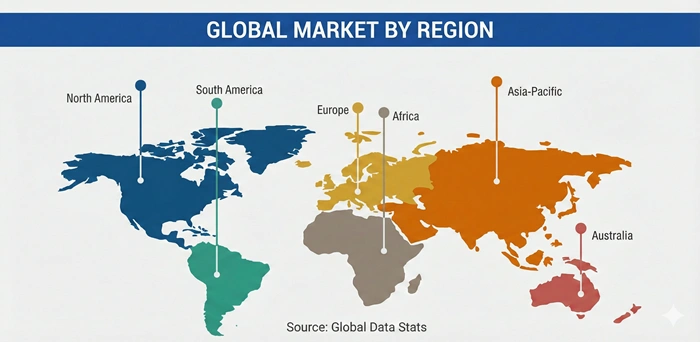
Regional Insights
North America's Commanding Technology Leadership and Asia Pacific's Infrastructure-Driven Growth Surge Define the Two Most Strategically Critical Geographies in the Global Field Programmable Gate Array Market
North America
North America's Concentration of Leading FPGA Vendors, Hyperscale Cloud Investment, and Defense Technology Procurement Programs Cement Its Position as the Global Leader in the Field Programmable Gate Array Market
North America holds the dominant position in the field programmable gate array market, accounting for approximately 37% of global revenue in 2025 and projected to grow at a CAGR of approximately 8.8% from 2026 to 2033. The region's leadership is structurally anchored by the headquarters and primary R&D operations of the world's two largest FPGA vendors — AMD (Xilinx) and Intel (Altera) — both based in the United States, which gives the region a first-mover advantage in next-generation FPGA architecture development and customer engagement. The U.S. data center ecosystem, home to the largest hyperscale cloud operators in the world, generates enormous FPGA procurement volumes as Microsoft, Amazon, and Google integrate programmable acceleration deeply into their cloud infrastructure stacks. Defense and aerospace agencies including the U.S. Department of Defense and NASA also represent significant and stable long-term FPGA procurement channels, preferring radiation-tolerant and space-grade programmable devices for mission-critical avionics and satellite systems.
Canada contributes a growing share of North American demand, particularly through its expanding AI research and cloud computing sector in Montreal, Toronto, and Vancouver, where AI startups and cloud service providers are adopting FPGA-based inference acceleration. Mexico's electronics manufacturing sector — serving as a nearshore production hub for U.S. technology brands — is also generating incremental FPGA demand through automotive electronics and IoT device manufacturing activities. Key players operating with significant North American market presence include AMD (Xilinx) (USA), Intel Corporation / Altera (USA), Lattice Semiconductor (USA), Achronix Semiconductor (USA), QuickLogic Corporation (USA), and Microchip Technology (USA), together accounting for the overwhelming majority of the region's FPGA revenue.
Asia Pacific
Asia Pacific's Explosive 5G Deployment, Dominant Semiconductor Manufacturing Infrastructure, and Rapidly Expanding Automotive Electronics Sector Are Driving the World's Fastest Regional Growth in the Field Programmable Gate Array Market
Asia Pacific is the fastest-growing region in the field programmable gate array market, expected to expand at a CAGR of approximately 11.2% from 2026 to 2033, significantly outpacing the global average, and projected to account for nearly 35% of global market share by 2033. China is the single largest country market in the region, fueled by massive 5G infrastructure investment, a rapidly expanding semiconductor design ecosystem, and active government policies promoting domestic development of advanced programmable logic devices as part of broader semiconductor self-sufficiency initiatives. Domestic Chinese FPGA vendors including GOWIN Semiconductor and Efinix are gaining ground in the mid-range and low-end segments as Chinese electronics manufacturers increasingly prefer domestically sourced components, adding a new competitive dimension to the regional market.
Japan and South Korea are significant contributors to regional FPGA demand through their leadership in automotive electronics, advanced manufacturing, and consumer electronics sectors. Toyota, Hyundai, and their respective Tier-1 supplier ecosystems represent growing FPGA consumers for ADAS and EV power management applications. Taiwan, home to TSMC — the world's leading FPGA wafer fabrication partner — plays a unique role in the regional ecosystem as the manufacturing backbone for AMD, Intel, and Lattice's most advanced-node devices. Key players with strong Asia Pacific operations include AMD (Xilinx) (USA), Intel / Altera (USA), GOWIN Semiconductor (China), Samsung Medison affiliates in embedded electronics (South Korea), Renesas Electronics (Japan), and Lattice Semiconductor (USA, with strong Asia design win activity).
Report Customization Available by Region and Country
This report is fully customizable to deliver targeted field programmable gate array market intelligence for specific regions, countries, and geographies, providing localized market sizing, competitive landscape analysis, technology adoption trends, regulatory environment insights, and growth opportunity assessments tailored to your exact geographic focus.
Customized versions of this report are available across all major global regions and their individual countries, ensuring that your strategic decisions are grounded in highly relevant, location-specific intelligence rather than broad global estimates. Whether you are evaluating a single country investment case or mapping a multi-region expansion strategy, the report can be configured to deliver the precise depth of analysis your business requires.
North America
-
United States — Largest single-country FPGA market, home to AMD (Xilinx), Intel (Altera), Lattice Semiconductor, and Achronix, with dominant data center, defense, and telecom demand
-
Canada — Growing AI and cloud computing sector driving FPGA adoption among startups and mid-market technology companies
-
Mexico — Expanding electronics manufacturing hub generating incremental FPGA demand through automotive and IoT production activities
Europe
-
United Kingdom — Active defense, telecommunications, and industrial automation FPGA market with strong presence of BAE Systems and major telecom equipment deployers
-
Germany — Leading European automotive electronics market with strong FPGA demand from BMW, Volkswagen, and their Tier-1 ADAS system suppliers
-
France — Growing FPGA adoption in aerospace and defense through Airbus and Thales, alongside expanding industrial automation sector
-
Italy — Growing industrial automation and automotive electronics FPGA market, supported by manufacturing sector digitalization initiatives
-
Rest of Europe — Includes the Netherlands, Sweden, and Finland as secondary markets with strong telecom and semiconductor industry presence
Asia Pacific
-
China — Largest regional FPGA market, with massive 5G investment and growing domestic programmable logic device development through GOWIN and Efinix
-
India — Rapidly growing semiconductor design and electronics manufacturing market with increasing FPGA design activity in Bangalore and Hyderabad tech corridors
-
Japan — Established FPGA market with strong automotive and industrial automation demand through Toyota, Renesas, and Murata ecosystems
-
South Korea — Key FPGA demand hub through Samsung, Hyundai, and LG electronics and automotive sectors
-
Australia — Growing defense and mining automation FPGA applications supported by government technology investment programs
-
Rest of Asia Pacific — Includes Taiwan as the critical manufacturing node, and Singapore, Vietnam, and Indonesia as expanding electronics production markets
Latin America
-
Brazil — Largest Latin American electronics market with growing FPGA adoption in telecommunications infrastructure and industrial automation
-
Argentina — Developing technology and electronics sector with increasing FPGA interest in research, defense, and industrial applications
-
Rest of Latin America — Includes Mexico (covered under North America), Colombia, and Chile as growing electronics and telecommunications markets
Middle East & Africa
-
UAE — Advanced technology adoption market with growing FPGA demand in defense, telecommunications, and smart city infrastructure programs
-
Saudi Arabia — Vision 2030-driven technology investment creating new opportunities for advanced semiconductor and FPGA applications in defense and industrial automation
-
Rest of MEA — Includes South Africa, Israel (strong defense and cybersecurity FPGA market), and Turkey as emerging programmable logic technology markets
Top Key Players
-
AMD Inc. / Xilinx (United States)
-
Intel Corporation / Altera (United States)
-
Lattice Semiconductor Corporation (United States)
-
Microchip Technology Inc. / Microsemi (United States)
-
Achronix Semiconductor Corporation (United States)
-
QuickLogic Corporation (United States)
-
GOWIN Semiconductor Corp. (China)
-
Efinix Inc. (United States)
-
Renesas Electronics Corporation (Japan)
-
Teledyne e2v (United Kingdom)
-
Flex Logix Technologies Inc. (United States)
-
Cologne Chip AG (Germany)
-
Anlogic Microelectronics (China)
-
Menta SAS (France)
-
Rapid Silicon Inc. (United States)
Recent Developments
-
In 2025, AMD (Xilinx) launched its next-generation Versal AI Edge Series adaptive SoC, integrating dedicated AI engine arrays with programmable logic fabric on a single device targeting autonomous vehicle, robotics, and industrial edge AI applications, significantly expanding its addressable market beyond traditional data center use cases
-
In 2024, Intel Corporation announced the spin-off of its Intel Foundry Services and a strategic restructuring of its Altera FPGA business unit into a standalone subsidiary, with plans for an independent IPO, enabling the Altera division to pursue partnerships and customer relationships with greater commercial flexibility
-
In 2025, Lattice Semiconductor released its Avant-G FPGA family optimized for low-power edge AI applications, alongside major enhancements to its Propel SDK software platform that significantly reduce the engineering time required to implement FPGA-based AI inference pipelines for industrial and IoT applications
-
In 2024, Microchip Technology expanded its PolarFire SoC FPGA portfolio with new automotive-grade AEC-Q100 qualified devices targeting ISO 26262 ASIL-B compliant ADAS applications, positioning itself as a key supplier to the rapidly growing automotive functional safety electronics market
-
In 2025, GOWIN Semiconductor secured a significant strategic partnership with a major Chinese telecommunications equipment manufacturer to supply high-volume FPGA devices for 5G small cell base station applications, marking a significant step in the company's expansion beyond consumer electronics into the high-performance communications infrastructure segment
Market Trends
AI-Native Adaptive SoC Architectures, SmartNIC Integration in Data Centers, and the Emergence of Domestic FPGA Vendors in Asia Are the Three Defining Technology and Competitive Trends Reshaping the Field Programmable Gate Array Market
The most consequential trend reshaping the field programmable gate array market is the architectural evolution toward adaptive System-on-Chip platforms that combine traditional FPGA programmable logic with hardened processor cores, dedicated AI acceleration engines, and high-speed interconnect fabrics on a single integrated device. AMD's Versal platform and Intel's Agilex series represent the current leading edge of this convergence, delivering dramatically improved performance-per-watt for AI inference, real-time signal processing, and data center networking workloads compared to standalone FPGAs. This architectural shift is expanding the market's addressable footprint by making FPGA-based solutions viable for a broader range of applications, particularly in edge AI and automotive electronics where the combination of programmability, performance, and energy efficiency is uniquely valuable.
A second significant trend is the rapid growth of SmartNIC and Data Processing Unit (DPU) deployments in hyperscale data centers, where FPGA-based network interface cards are used to offload networking, security, and storage functions from host CPU cores, significantly improving data center efficiency. As data center operators face escalating pressure to improve compute utilization and reduce total cost per workload, FPGA-based SmartNICs have emerged as a proven and scalable solution. Meanwhile, the emergence of domestic FPGA vendors — particularly in China with GOWIN and Efinix — is introducing meaningful new competition in mid-range and low-end device categories, challenging the long-standing duopoly of AMD and Intel and potentially reshaping competitive dynamics and pricing in the market's more cost-sensitive application segments over the 2026–2033 forecast period.
Segments Covered in the Report
-
By Device Type
-
SRAM-Based FPGA
-
Flash-Based FPGA
-
Antifuse-Based FPGA
-
-
By Technology Node
-
Below 28 nm
-
28–90 nm
-
Above 90 nm
-
-
By Configuration
-
High-End FPGA
-
Mid-Range FPGA
-
Low-End FPGA
-
-
By Application
-
Signal Processing
-
Data Center & Cloud Computing
-
Communications & Networking
-
Consumer Electronics
-
Automotive
-
Aerospace & Defense
-
Industrial Automation
-
Others
-
-
By End-User Industry
-
IT & Telecom
-
Automotive
-
Aerospace & Defense
-
Healthcare
-
Industrial
-
Consumer Electronics
-
Others
-
-
By Region
-
North America
-
U.S.
-
Canada
-
Mexico
-
-
Europe
-
U.K.
-
Germany
-
France
-
Italy
-
Rest of Europe
-
-
Asia Pacific
-
China
-
India
-
Japan
-
South Korea
-
Australia
-
Rest of Asia Pacific
-
-
Latin America
-
Brazil
-
Argentina
-
Rest of Latin America
-
-
Middle East & Africa
-
UAE
-
Saudi Arabia
-
Rest of MEA
-
-
❝ Built for Every Level — From Startups to Industry Giants ❞
Here Is Exactly How This Report Works for You
-
For tier-1 semiconductor companies, hyperscale technology investors, and executive leadership teams at FPGA vendors and their distribution partners, this report delivers precise market sizing, competitor revenue analysis, competitor revenue source breakdowns by application and region, technology node investment trends, and geopolitical risk assessments — including how U.S.-China semiconductor export controls and supply chain realignment are reshaping customer procurement patterns and vendor strategy in the global field programmable gate array market
-
For mid-market electronics manufacturers, automotive Tier-1 suppliers, and growing fabless semiconductor design firms, the report provides segment-level demand forecasts, supply-demand balance analysis, and top player technology roadmap intelligence — giving product strategists and procurement managers the data they need to identify which FPGA configurations are gaining fastest traction in target end-markets, how pricing dynamics are evolving across technology nodes, and which vendor partnerships offer the strongest competitive differentiation for specific application development programs
-
Startups developing FPGA-based AI acceleration platforms, edge computing solutions, or automotive electronics systems will find the report's design win data, customer adoption patterns, software toolchain competitive analysis, and emerging vendor landscape mapping invaluable for positioning their offerings, targeting the right customer segments, and making evidence-based technology partnership decisions that will define their competitive position as the field programmable gate array market continues its strong expansion through 2033
Frequently Asked Questions
Question 1: What is the projected size of the field programmable gate array market by 2033?
Answer: The field programmable gate array market is projected to reach approximately USD 26.06 billion by 2033. It is expected to grow from USD 13.51 billion in 2026 at a CAGR of 9.54% through 2033.
Question 2: Which device type dominates the field programmable gate array market?
Answer: SRAM-based FPGAs hold the dominant device type share in the field programmable gate array market, accounting for approximately 55% of global revenue in 2025. Their high logic density, fast reprogramming cycles, and broad toolchain compatibility make them the preferred choice across data center, telecom, and defense applications.
Question 3: Which region leads and which is growing fastest in the field programmable gate array market?
Answer: North America leads the field programmable gate array market with approximately 37% of global share in 2025, anchored by AMD, Intel, and the region's dominant hyperscale data center ecosystem. Asia Pacific is the fastest-growing region, expanding at a CAGR of approximately 11.2% driven by 5G infrastructure investment and automotive electronics growth.
Question 4: What are the key applications driving demand in the field programmable gate array market?
Answer: Data center and cloud computing is the leading application in the field programmable gate array market, contributing approximately 30% of market revenue in 2025. Communications and networking for 5G infrastructure is the second-largest application, while automotive ADAS and AI acceleration are the fastest-growing demand categories.
Question 5: Who are the leading companies in the field programmable gate array market?
Answer: The field programmable gate array market is dominated by AMD (Xilinx), Intel (Altera), Lattice Semiconductor, Microchip Technology, and Achronix Semiconductor. Emerging domestic players including GOWIN Semiconductor and Efinix in China are gaining market presence in the mid-range and low-end device segments.