
Fiber Optics Market Overview
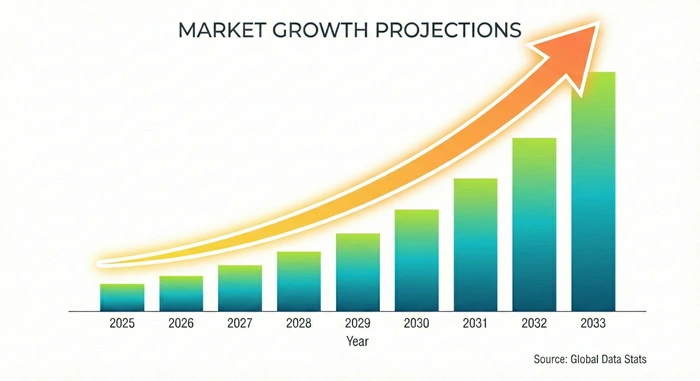
The global fiber optics market size is valued at USD 10.46 billion in 2025 and is predicted to increase from USD 11.18 billion in 2026 to approximately USD 17.65 billion by 2033, growing at a CAGR of 6.60% from 2026 to 2033.
The fiber optics market represents a critical infrastructure segment that enables high-speed data transmission through light pulses traveling within thin glass or plastic strands, supporting telecommunications networks, internet connectivity, cloud computing, healthcare diagnostics, and industrial monitoring systems worldwide. These advanced optical transmission systems deliver exceptional bandwidth capacity, minimal signal degradation over long distances, immunity to electromagnetic interference, and enhanced security compared to traditional copper-based networks. The market's impressive growth trajectory reflects accelerating demand for broadband connectivity, explosive expansion of 5G wireless infrastructure, surging data center capacity requirements, and strategic government investments to bridge digital divides across urban and rural communities.
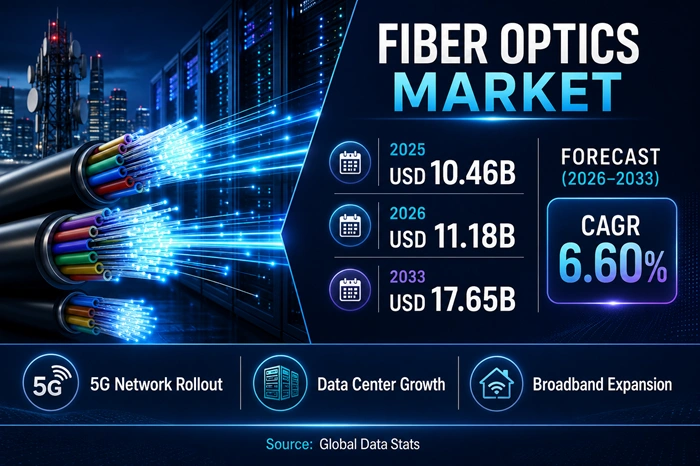
Illuminating the Digital Future Through Advanced Optical Communication Infrastructure
Organizations across every industry sector are recognizing fiber optic technology as the essential foundation for digital transformation initiatives that demand reliable, high-capacity connectivity. The proliferation of bandwidth-intensive applications including ultra-high-definition video streaming, artificial intelligence workloads, Internet of Things sensor networks, and augmented reality experiences is driving unprecedented data traffic growth that only fiber infrastructure can sustainably support. As nations prioritize technological competitiveness and economic development, substantial public and private capital continues flowing into fiber network deployments that connect homes, businesses, educational institutions, and healthcare facilities with next-generation communication capabilities.
AI Impact on the Fiber Optics Industry
Enhancing Network Performance Through Intelligent Monitoring and Predictive Maintenance Systems
Artificial intelligence is revolutionizing the fiber optics market by introducing sophisticated network management capabilities that optimize performance, reduce downtime, and extend infrastructure lifespan through predictive analytics. Machine learning algorithms continuously analyze vast datasets generated by optical monitoring systems to detect subtle signal degradation patterns that precede fiber breaks, connector failures, and equipment malfunctions before they impact service quality. These AI-powered platforms enable network operators to transition from reactive maintenance approaches toward proactive intervention strategies that schedule repairs during low-traffic periods, minimizing customer disruptions while reducing operational expenses. Leading telecommunications providers are deploying intelligent systems that automatically adjust optical amplifier settings, reroute traffic around congested network segments, and balance loads across fiber paths to maintain optimal throughput even during peak demand periods.
The integration of artificial intelligence extends beyond network operations to encompass comprehensive planning and design optimization for fiber infrastructure deployments. Advanced analytics platforms process geographic information, demographic data, building information models, and existing network topologies to identify optimal fiber routing paths that minimize installation costs while maximizing coverage and future capacity expansion options. AI-driven demand forecasting models predict bandwidth requirements years into the future, enabling network planners to design infrastructure with appropriate capacity buffers that avoid premature obsolescence while controlling capital expenditures. Additionally, machine learning systems are enhancing quality control during fiber manufacturing processes by analyzing production parameters in real-time to detect defects that could compromise optical performance, ensuring only the highest quality products reach customer networks. This comprehensive application of AI technology throughout the fiber optics value chain is creating unprecedented opportunities for efficiency improvements and innovation acceleration.
Growth Factors
5G Network Expansion and Cloud Computing Proliferation Driving Infrastructure Investments
The global deployment of fifth-generation wireless networks is creating extraordinary demand for fiber optic infrastructure that serves as the essential backbone connecting radio base stations to core network equipment. Unlike previous wireless generations that could partially rely on microwave backhaul links, 5G technology requires fiber connections to support the massive bandwidth, ultra-low latency, and network slicing capabilities that enable transformative applications including autonomous vehicles, remote surgery, and immersive extended reality experiences. Mobile network operators worldwide are investing hundreds of billions of dollars to densify their radio access networks with small cells that require fiber connections to every installation site. This 5G-driven fiber deployment extends far beyond urban centers into suburban and rural areas as carriers compete to deliver comprehensive coverage that meets customer expectations for consistent high-speed connectivity across all geographies.
The explosive growth of cloud computing services and hyperscale data centers represents another fundamental driver propelling the fiber optics market forward. Major technology companies are constructing enormous data center facilities that house hundreds of thousands of servers processing everything from email and video streaming to artificial intelligence model training and cryptocurrency mining. These massive computing complexes require ultra-high-capacity fiber connections to exchange data with users worldwide and synchronize operations across geographically distributed facilities. The transition of enterprise computing from on-premises infrastructure to cloud platforms is accelerating fiber network upgrades as organizations demand the bandwidth necessary to access applications and data hosted in remote data centers. Additionally, the proliferation of edge computing architectures that distribute processing closer to end users is driving fiber deployments to smaller regional data centers and telecommunication facilities, creating multi-tier network hierarchies that all depend on robust optical connectivity as their foundation.
Market Outlook
Robust Expansion Trajectory Supported by Digital Infrastructure Modernization Initiatives
The fiber optics market outlook remains exceptionally strong as governments worldwide implement ambitious broadband infrastructure programs designed to ensure all citizens and businesses have access to high-speed internet connectivity regardless of location. The United States has allocated tens of billions of dollars through programs including the Infrastructure Investment and Jobs Act to extend fiber networks into unserved and underserved communities, while the European Union's Connectivity Toolbox initiative aims to accelerate gigabit-capable network deployment across member states. Similar national broadband strategies in Asia, Latin America, and Africa are creating sustained demand for fiber equipment and installation services as countries recognize that digital connectivity has become as essential to economic development and social inclusion as roads, electricity, and water infrastructure. These policy-driven investment cycles provide multi-year visibility for fiber manufacturers and network operators planning capacity expansions and technology upgrade roadmaps.
Emerging applications in smart cities, industrial automation, and healthcare telemedicine are opening new growth avenues for fiber optic deployments beyond traditional telecommunications use cases. Municipal governments are installing fiber networks to support intelligent transportation systems, public safety surveillance, environmental monitoring, and energy-efficient street lighting that collectively enhance urban livability while reducing operational costs. Manufacturing facilities are adopting fiber connectivity for real-time machine monitoring, quality control systems, and robotic automation that enable flexible production configurations and predictive maintenance strategies. Healthcare providers are leveraging fiber infrastructure to conduct remote patient consultations, transmit high-resolution medical imaging, and coordinate care across distributed clinical networks, expanding access to specialized expertise while improving patient outcomes. This diversification of fiber applications across multiple sectors creates resilient demand patterns that reduce market sensitivity to cyclical fluctuations in any single industry.
Expert Speaks
-
Wendell Weeks, Chairman and CEO of Corning Incorporated, emphasized that the company is experiencing unprecedented demand for optical fiber and cable products driven by global investments in 5G networks, data center interconnections, and fiber-to-the-home deployments, with strong market fundamentals supporting sustained growth as digital transformation accelerates across all industry sectors and geographic regions.
-
Valerio Battista, CEO of Prysmian Group, stated that the telecommunications infrastructure market continues demonstrating robust momentum fueled by increasing bandwidth requirements, network modernization initiatives, and government-funded broadband expansion programs, with the company strategically positioned to capture opportunities through its comprehensive product portfolio and manufacturing footprint spanning key growth markets worldwide.
-
Anand Agarwal, CEO of Sterlite Technologies Limited, highlighted that the convergence of 5G wireless deployment with fiber-to-the-home adoption is creating exceptional growth opportunities particularly in emerging markets, with the company investing significantly in manufacturing capacity and technology innovation to serve telecommunications carriers, data center operators, and enterprise customers seeking high-performance optical connectivity solutions.
Key Report Takeaways
-
Asia Pacific dominates the fiber optics market with approximately 30.9% market share, driven by aggressive telecommunications infrastructure investments, massive 5G network rollouts, expanding internet penetration, and substantial government-backed digital transformation initiatives across China, India, Japan, South Korea, and Southeast Asian nations experiencing rapid urbanization and economic development.
-
North America represents the fastest-growing regional market with a projected CAGR of 7.1%, fueled by substantial federal broadband funding programs, telecommunications carrier network modernization projects, expanding data center capacity, and strategic initiatives to eliminate digital divides by extending high-speed fiber connectivity to underserved rural and tribal communities across the United States and Canada.
-
Multi-mode fiber type holds the largest product segment share accounting for approximately 53% of total market value, favored for cost-effective short-distance applications in enterprise data centers, local area networks, and campus environments where its higher bandwidth capacity at lower equipment costs compared to single-mode fiber delivers optimal performance for distances under several hundred meters.
-
Telecommunications applications contribute the most significant revenue representing roughly 42% of total market value, as service providers worldwide invest billions annually in fiber infrastructure to support mobile backhaul, broadband internet access, long-distance transmission, and network interconnections that collectively form the backbone of global communications infrastructure.
-
Plastic optical fiber segment is experiencing the fastest growth with a projected CAGR of 7.8%, gaining traction in automotive infotainment systems, home networking applications, industrial control systems, and consumer electronics where its flexibility, durability, ease of installation, and cost advantages outweigh the distance limitations compared to glass fiber alternatives.
-
Medical application segment will exhibit strong expansion trajectory expected to grow at a CAGR of 8.2% with expanding market share, driven by increasing adoption of fiber optic technology in endoscopic procedures, laser surgical systems, biomedical sensors, and diagnostic imaging equipment that enhance minimally invasive treatment capabilities while improving patient outcomes and reducing healthcare costs.
Market Scope
| Report Coverage | Details |
|---|---|
| Market Size by 2033 | USD 17.65 Billion |
| Market Size by 2025 | USD 10.46 Billion |
| Market Size by 2026 | USD 11.18 Billion |
| Market Growth Rate from 2026 to 2033 | CAGR of 6.60% |
| Dominating Region | Asia Pacific |
| Fastest Growing Region | North America |
| Base Year | 2025 |
| Forecast Period | 2026 to 2033 |
| Segments Covered | Type, Application, Region |
| Regions Covered | North America, Europe, Asia Pacific, Latin America, Middle East & Africa |
Market Dynamics
Drivers Impact Analysis
Accelerating 5G Deployment and Fiber-to-the-Home Expansion Propelling Market Growth
| Driver | (≈) % Impact on CAGR Forecast | Geographic Relevance | Impact Timeline |
|---|---|---|---|
| 5G wireless network infrastructure deployment and densification | +2.2% | Global | 2026-2033 |
| Broadband access expansion and fiber-to-the-home adoption | +1.9% | North America, Europe, Asia Pacific | 2026-2033 |
| Data center capacity expansion and cloud computing growth | +1.5% | Global | 2026-2030 |
The telecommunications industry's massive investment in fifth-generation wireless infrastructure is creating unprecedented demand for fiber optic connectivity as mobile network operators densify their radio access networks to deliver the coverage, capacity, and low latency that 5G applications require. Each 5G base station requires fiber backhaul connections capable of supporting multi-gigabit throughput, with urban deployments often placing small cells every few hundred meters to ensure consistent service quality. The fiber optics market is benefiting enormously from these deployment patterns, as carriers cannot leverage existing copper infrastructure or wireless alternatives to meet 5G performance requirements. Leading operators in markets including South Korea, China, and the United States have already deployed hundreds of thousands of 5G sites, with network expansion continuing for years as coverage extends into suburban and rural areas while urban networks add capacity layers to accommodate growing traffic demands from bandwidth-intensive applications.
The global push to extend high-speed broadband access through fiber-to-the-home and fiber-to-the-premises deployments represents another fundamental driver supporting sustained market expansion. Governments worldwide have recognized that ubiquitous access to gigabit-capable internet connectivity is essential for economic competitiveness, educational equity, healthcare access, and social inclusion in increasingly digital societies. Major funding programs in the United States including BEAD allocations, Europe's Recovery and Resilience Facility, and various Asian development initiatives are channeling tens of billions of dollars toward fiber network construction that will connect millions of homes and businesses currently relying on inferior copper-based or wireless connections. These policy-driven investment cycles provide exceptional visibility for fiber manufacturers and network construction companies, as project pipelines extend multiple years into the future with guaranteed funding mechanisms reducing execution risks. The fiber optics market is uniquely positioned to benefit from this structural shift toward fiber-based access networks that represent the most future-proof connectivity solution available.
Restraints Impact Analysis
High Installation Costs and Geographic Challenges Limiting Deployment Pace
| Restraint | (≈) % Impact on CAGR Forecast | Geographic Relevance | Impact Timeline |
|---|---|---|---|
| Substantial capital requirements and installation complexity | -1.1% | Rural Areas, Emerging Markets | 2026-2029 |
| Geographic obstacles and permitting difficulties | -0.8% | Mountainous Regions, Dense Urban Areas | 2026-2033 |
| Competition from wireless and satellite alternatives | -0.6% | Low-Density Markets | 2026-2028 |
The significant capital expenditures required for fiber network deployment represent a substantial barrier to market expansion, particularly in low-density rural areas and developing economies where project economics remain challenging despite technology advances. Comprehensive fiber-to-the-home buildouts require substantial upfront investments in fiber cable, distribution equipment, customer premises equipment, and extensive construction activities including trenching, aerial installation, or boring through obstacles. These costs must be recovered through subscriber revenues over extended periods, creating financial risks when customer adoption rates or average revenue per user fall below projections. Many telecommunications carriers serving rural communities struggle to justify fiber investments when potential subscriber bases remain limited and alternative wireless technologies offer adequate performance at lower deployment costs. This economic reality creates persistent coverage gaps that government subsidy programs attempt to address, though funding limitations and administrative complexities often slow project execution and limit geographic reach.
Geographic challenges and regulatory obstacles further complicate fiber network deployments across diverse terrain and jurisdictional boundaries. Rural areas frequently feature mountainous topography, river crossings, and dispersed populations that dramatically increase per-mile construction costs compared to urban environments with concentrated demand. Underground installation in rocky soil or densely developed urban corridors requires specialized boring equipment and skilled labor that may not be readily available in all markets. Obtaining necessary permits and rights-of-way from multiple property owners, municipal authorities, and utility companies introduces project delays and unpredictable costs that discourage fiber investments. Environmental regulations protecting wetlands, endangered species habitats, and historical sites can further restrict routing options or impose mitigation requirements that increase project complexity. These multifaceted deployment challenges collectively slow the pace of fiber network expansion and create persistent pockets of underserved communities despite strong policy support and technological readiness.
Opportunities Impact Analysis
Smart City Development and Industrial IoT Creating New Application Domains
| Opportunity | (≈) % Impact on CAGR Forecast | Geographic Relevance | Impact Timeline |
|---|---|---|---|
| Smart city infrastructure and intelligent transportation systems | +1.3% | Urban Centers Globally | 2027-2033 |
| Industrial automation and IoT sensor network deployment | +1.0% | Manufacturing Regions | 2026-2033 |
| Healthcare telemedicine and remote diagnostic expansion | +0.8% | Developed Markets | 2027-2033 |
Municipal governments worldwide are implementing ambitious smart city initiatives that leverage fiber optic infrastructure to support intelligent transportation systems, public safety networks, environmental monitoring, and efficient delivery of citizen services. Modern urban management requires comprehensive sensor networks collecting real-time data on traffic flows, air quality, energy consumption, and infrastructure conditions that enable responsive decision-making and proactive maintenance strategies. Fiber connectivity provides the bandwidth, reliability, and low latency necessary for these sophisticated applications that increasingly incorporate artificial intelligence and automated control systems. Cities are installing fiber networks to support adaptive traffic signals that reduce congestion, video surveillance systems that enhance public safety, smart lighting that minimizes energy waste, and integrated command centers that coordinate emergency response activities. These municipal fiber deployments create substantial market opportunities for equipment suppliers and installation contractors, while establishing robust infrastructure foundations that enable future smart city innovations as technologies continue evolving.
The manufacturing sector's digital transformation through industrial automation and Internet of Things technologies is driving significant fiber optic adoption in factory environments where traditional wireless solutions cannot deliver the reliability, determinism, and security that production systems require. Modern manufacturing facilities deploy thousands of sensors monitoring machine performance, product quality, energy consumption, and worker safety that generate continuous data streams requiring high-capacity network infrastructure. Fiber connections enable real-time control of robotic systems, predictive maintenance platforms that optimize equipment uptime, and flexible production configurations that rapidly adapt to changing market demands. The harsh electromagnetic environments common in industrial settings make fiber's immunity to electrical interference particularly valuable for ensuring consistent network performance. As manufacturers pursue Industry 4.0 visions of fully integrated digital factories where physical and cyber systems seamlessly interact, fiber optic infrastructure is becoming as essential as electrical power distribution, creating sustained demand that extends the market opportunity beyond traditional telecommunications applications into industrial networking domains.
Segment Analysis
Multi-Mode Fiber Type
Market Leadership Through Cost-Effective Performance for Enterprise and Data Center Applications
Multi-mode fiber dominates the fiber optics market with an impressive 53% revenue share, reflecting its widespread adoption across enterprise local area networks, data center interconnections, and campus environments where cost-effectiveness and performance optimally balance for short to medium distance applications typically under two kilometers. This fiber type utilizes larger core diameters compared to single-mode alternatives, allowing multiple light paths or modes to propagate simultaneously, which simplifies transceiver design and reduces equipment costs substantially. Organizations appreciate multi-mode fiber's ability to deliver high bandwidth capacity at distances sufficient for most building and campus connectivity requirements while avoiding the premium pricing associated with single-mode transceivers and laser light sources. The segment benefits particularly from explosive data center growth, as hyperscale facilities and enterprise computing environments deploy millions of multi-mode fiber connections annually to support server-to-switch, switch-to-switch, and inter-building communication requirements. Asia Pacific represents the strongest regional market for multi-mode fiber with approximately 54% of segment revenue, driven by massive data center construction in China, rapid enterprise digitalization across India, and sophisticated telecommunications infrastructure throughout Japan and South Korea. Leading fiber manufacturers including Corning Incorporated, Prysmian Group, and OFS Fitel continuously enhance multi-mode performance through innovations such as bend-insensitive designs and optimized refractive index profiles.
The multi-mode segment is projected to maintain steady growth with a CAGR of 6.4% through 2033 as data center operators and enterprise network managers pursue infrastructure upgrades supporting next-generation 100-gigabit and 400-gigabit Ethernet standards. Technology advances including OM5 wideband multi-mode fiber enable wavelength division multiplexing that dramatically increases transmission capacity over existing fiber installations, providing cost-effective upgrade paths without requiring complete cable replacement. The emergence of short-reach coherent optics technologies is extending multi-mode's viable distance range while maintaining its economic advantages for certain applications. North America exhibits particularly strong multi-mode adoption in enterprise and financial services sectors where trading systems, database servers, and backup storage arrays require ultra-low latency connectivity within data center facilities. European markets demonstrate solid demand from manufacturing and logistics operations deploying automated warehousing systems that rely on extensive sensor networks and real-time control systems. The segment's growth trajectory remains supported by continuous innovations improving bandwidth density, installation flexibility, and future-proofing characteristics that protect customer infrastructure investments against rapid technology obsolescence.
Telecommunications Application
Capturing Dominant Revenue Share Through Global Network Infrastructure Investments
The telecommunications application segment commands the largest market share at approximately 42% of total fiber optics market revenue, reflecting the essential role optical connectivity plays in supporting voice, data, and video services that billions of people and millions of organizations worldwide depend upon daily. Telecommunications carriers utilize fiber infrastructure for diverse purposes including long-haul transmission linking cities and countries, metro networks connecting neighborhoods and districts, mobile backhaul supporting wireless base stations, and residential access bringing broadband internet directly to homes and businesses. The segment's market dominance stems from massive ongoing investments by telecommunications operators modernizing legacy copper-based networks that cannot deliver the bandwidth necessary for contemporary applications including ultra-high-definition video streaming, cloud computing, and immersive virtual experiences. Asia Pacific leads telecommunications fiber adoption with over 44% of application segment revenue, driven by enormous subscriber bases in China and India combined with advanced fiber deployments throughout Japan, South Korea, and Southeast Asian nations experiencing rapid economic development. Major telecommunications companies including China Mobile, Verizon, AT&T, Deutsche Telekom, and NTT continuously expand and upgrade their fiber networks, generating sustained demand for optical cable, transmission equipment, and network construction services.
The telecommunications segment is experiencing robust growth with a projected CAGR of 6.9% through 2033 as mobile operators globally deploy 5G infrastructure requiring fiber connections to support network densification and capacity expansion. The transition from 4G to 5G technology fundamentally changes telecommunications network architectures, with distributed radio units, centralized baseband processing, and network slicing capabilities all demanding extensive fiber connectivity between components. Fixed broadband services continue driving substantial fiber deployments as competitive pressure compels providers to offer gigabit-speed internet access matching or exceeding cable and satellite alternatives. Government subsidy programs worldwide are accelerating telecommunications fiber expansion into previously uneconomic rural markets, creating new revenue opportunities for carriers and equipment suppliers. The segment benefits from ongoing technology migrations including coherent optical transmission systems that dramatically increase capacity on existing fiber routes and software-defined networking platforms that enable flexible service provisioning. North American telecommunications markets exhibit particularly strong fiber investment momentum supported by federal broadband funding and competitive dynamics among incumbent carriers, cable operators, and emerging fiber-focused competitors. The segment's growth trajectory remains fundamentally supported by insatiable consumer and business appetite for bandwidth that shows no signs of saturation despite decades of exponential traffic growth.
Regional Insights
Asia Pacific
Maintaining Market Leadership Through Massive Infrastructure Investments and Digital Economy Expansion
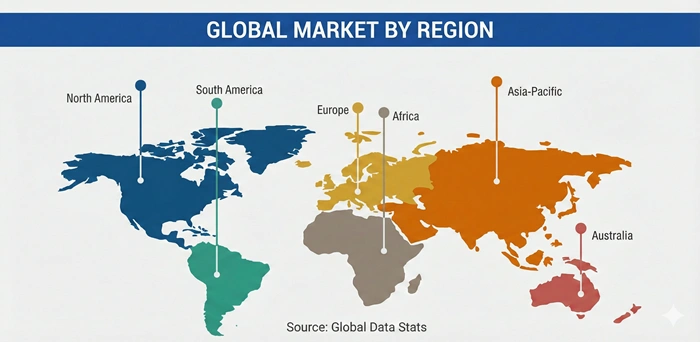
Asia Pacific commands the dominant position in the global fiber optics market with approximately 30.9% revenue share valued at around USD 3.45 billion in 2026, driven by the region's enormous population, rapid economic development, aggressive telecommunications infrastructure deployment, and strategic government initiatives promoting digital transformation. China represents the single largest country market within the region, accounting for over 48% of Asia Pacific demand through its extensive fiber-to-the-home networks serving hundreds of millions of subscribers, massive 5G infrastructure buildout encompassing millions of base stations, and enormous data center capacity supporting domestic cloud computing and internet services. India contributes substantial growth momentum as telecommunications operators race to connect the country's vast population with 4G and emerging 5G services while government programs aim to extend broadband access into rural communities. Japan and South Korea maintain sophisticated fiber infrastructure with near-universal high-speed connectivity supporting advanced applications including telemedicine, distance education, and smart city services. The region's fiber optics market is projected to grow at a robust CAGR of 6.8% through 2033 as urbanization continues, middle-class populations expand, and digital economy activities proliferate across diverse industry sectors.
The concentration of leading fiber manufacturers and telecommunications equipment suppliers throughout Asia Pacific creates distinct competitive advantages including proximity to major customers, extensive local engineering capabilities, and integrated supply chains supporting rapid deployment at competitive costs. Companies including Yangtze Optical Fiber and Cable Company, Furukawa Electric, Sumitomo Electric, and Sterlite Technologies operate substantial manufacturing facilities across the region producing fiber cable, optical components, and network equipment for domestic and export markets. The region benefits from abundant skilled technical workforces, strong engineering education systems, and supportive government policies encouraging technology industry development. Southeast Asian nations including Indonesia, Thailand, Vietnam, and the Philippines are experiencing accelerating fiber deployments as telecommunications operators extend coverage and governments implement broadband expansion programs. Australia maintains sophisticated fiber infrastructure through its National Broadband Network initiative while pursuing 5G deployments across major cities. The Asia Pacific market exhibits particularly strong adoption of advanced fiber technologies including high-density cable designs, bend-insensitive fibers, and integrated optical components that maximize network capacity while minimizing installation costs and physical footprints in space-constrained urban environments.
North America
Experiencing Fastest Growth Through Government Funding Programs and Network Modernization Initiatives
North America represents the fastest-growing regional market for fiber optics with a projected CAGR of 7.1% from 2026 to 2033, propelled by unprecedented government funding through programs including the Infrastructure Investment and Jobs Act, aggressive telecommunications carrier network upgrades, expanding hyperscale data center construction, and strategic initiatives to eliminate digital divides separating urban and rural communities. The United States accounts for approximately 84% of North American fiber demand, driven by federal broadband subsidies totaling over USD 65 billion allocated specifically for extending high-speed internet access to unserved and underserved areas, creating multi-year project pipelines for fiber network construction. Major telecommunications carriers including Verizon, AT&T, and Lumen Technologies are investing tens of billions of dollars to expand fiber footprints, upgrade network architectures, and compete with cable operators and emerging fiber-focused competitors for broadband market share. Canada contributes additional demand through its Universal Broadband Fund and private sector investments aimed at improving connectivity in rural and northern regions. The region currently captures approximately 23% of global market share valued near USD 2.57 billion in 2026, with growth acceleration expected as government funding programs transition from planning phases into active construction activities deploying fiber across millions of locations.
The presence of leading fiber manufacturers and technology innovators throughout North America creates ecosystem advantages including close collaboration between network operators and equipment suppliers during technology development, rapid deployment of engineering resources for customer support, and proximity to research institutions advancing optical communications science. Companies including Corning Incorporated, Prysmian Group's North American operations, OFS Fitel, and AFL operate extensive manufacturing, research, and service capabilities throughout the United States and Canada, continuously developing next-generation products including ultra-low-loss fiber, high-density cable designs, and integrated connectivity solutions. The region's fiber optics market benefits from mature telecommunications industry structures, well-established construction contractor ecosystems, and comprehensive permitting frameworks that facilitate network deployments despite occasional local obstacles. Major technology companies operating massive data center facilities throughout North America drive substantial fiber demand for inter-facility connections, cloud service delivery, and content distribution networks. The healthcare sector represents a growing fiber application area as telemedicine adoption accelerates and medical institutions upgrade network infrastructure to support electronic health records, diagnostic imaging systems, and remote consultation platforms. North American markets exhibit particularly strong preference for future-proof fiber deployments utilizing single-mode technology for access networks and highest-quality components that minimize maintenance requirements while supporting multi-decade operational lifetimes.
Top Key Players
-
Corning Incorporated (United States)
-
Prysmian Group (Italy)
-
Yangtze Optical Fiber and Cable Joint Stock Limited Company (China)
-
Sterlite Technologies Limited (India)
-
OFS Fitel LLC (United States)
-
Furukawa Electric Co. Ltd. (Japan)
-
Sumitomo Electric Industries Ltd. (Japan)
-
Finolex Cables Limited (India)
-
Birla Furukawa Fiber Optics Limited (India)
-
AFL (United States)
-
Fujikura Ltd. (Japan)
-
Nexans SA (France)
-
Optical Cable Corporation (United States)
-
Molex LLC (United States)
-
TE Connectivity Ltd. (Switzerland)
Recent Developments
-
Corning Incorporated (November 2025) secured multi-year supply agreements totaling over USD 100 million with major telecommunications operators for fiber optic cable deployments supporting rural broadband expansion projects across multiple U.S. states, demonstrating strong demand for optical connectivity solutions in underserved markets and reinforcing the company's leadership position in supporting government-funded infrastructure initiatives aimed at bridging digital divides.
-
Sterlite Technologies Limited (September 2025) launched an advanced unitube single jacket indoor fiber optic cable incorporating innovative 4-core multi-core fiber technology designed to enhance connectivity density while reducing installation complexity, targeting telecommunications carriers and enterprise customers seeking space-efficient solutions for high-density fiber deployments in data centers, office buildings, and multi-dwelling residential units.
-
Prysmian Group (April 2025) introduced next-generation high-density fiber optic cables featuring enhanced BendBrightXS 200µm fiber technology that delivers improved low-loss performance and superior bending resistance, enabling telecommunications operators to deploy more compact network infrastructure while maintaining exceptional signal quality for 5G wireless backhaul, IoT applications, and AI-driven communication services.
-
Coherent Corporation (October 2025) announced the commercial launch of advanced polarization-maintaining optical fiber specifically engineered for telecommunications applications requiring superior performance and reliability, incorporating innovations that minimize signal interference and power leakage while supporting emerging L-band and U-band transmission technologies that extend network capacity beyond traditional operating wavelengths.
-
Crown Fiber Optics (November 2025) secured over USD 100 million in multi-year fiber infrastructure construction contracts covering major broadband deployment projects throughout New Mexico and the Seattle metropolitan area plus additional rural broadband initiatives in Oregon, substantially increasing the company's project backlog and demonstrating robust market demand for fiber network construction services supporting both urban and rural connectivity expansion.
Market Trends
Integration of AI-Powered Network Management and Hollow-Core Fiber Innovation Reshaping Industry
The fiber optics market is experiencing a transformative shift as telecommunications operators and data center managers increasingly deploy artificial intelligence-powered network management systems that optimize traffic routing, predict maintenance requirements, and automatically resolve performance issues in real-time. These intelligent platforms continuously analyze optical signal parameters, network utilization patterns, and equipment health indicators to identify optimization opportunities and potential failures before they impact service quality. AI integration enables dynamic capacity allocation that directs traffic through optimal fiber paths based on current conditions, time-of-day patterns, and quality-of-service requirements, maximizing infrastructure utilization while maintaining performance guarantees. The technology facilitates proactive maintenance scheduling by predicting component failures based on subtle performance degradation trends, allowing operators to conduct repairs during planned maintenance windows rather than responding to emergency outages. This convergence of optical networking with artificial intelligence is fundamentally changing how fiber infrastructure is operated and managed, creating competitive advantages for organizations that successfully implement intelligent systems.
Breakthrough innovations in hollow-core fiber technology are generating significant industry excitement as these advanced optical transmission media promise to overcome fundamental performance limitations of conventional solid-core designs. Hollow-core fibers transmit light signals primarily through air-filled cores rather than glass, dramatically reducing signal latency by approximately 45% compared to traditional fibers while minimizing nonlinear optical effects that limit transmission capacity at high power levels. These performance characteristics make hollow-core technology particularly attractive for latency-sensitive applications including high-frequency trading networks, distributed cloud computing architectures, and precision timing distribution systems where microsecond-level delays carry significant economic or operational consequences. While hollow-core fibers currently remain more expensive and challenging to manufacture than conventional options, ongoing technology development is steadily improving performance characteristics and reducing costs toward commercial viability. Major telecommunications carriers and research institutions are actively evaluating hollow-core technology for next-generation network deployments, with initial installations likely targeting premium applications where superior performance justifies higher costs before broader market adoption occurs as manufacturing scales increase and pricing becomes competitive.
Segments Covered in the Report
By Type
-
Single-Mode Fiber
-
Multi-Mode Fiber
-
Plastic Optical Fiber
By Application
-
Telecommunications
-
Oil & Gas
-
Military & Aerospace
-
Banking Financial Services and Insurance
-
Medical
-
Railway
-
Others
By Region
-
North America (United States, Canada, Mexico)
-
Europe (United Kingdom, Germany, France, Italy, Spain, Rest of Europe)
-
Asia Pacific (China, Japan, India, South Korea, Australia, Southeast Asia, Rest of Asia Pacific)
-
Latin America (Brazil, Argentina, Rest of Latin America)
-
Middle East & Africa (Saudi Arabia, United Arab Emirates, South Africa, Rest of Middle East & Africa)
Frequently Asked Questions
Question 1: What is the expected fiber optics market size by 2033?
Answer: The global fiber optics market is projected to reach approximately USD 17.65 billion by 2033. This substantial growth from the 2026 baseline reflects accelerating demand driven by 5G network deployments, broadband infrastructure expansion, data center capacity increases, and government-funded digital connectivity initiatives worldwide.
Question 2: Which region currently dominates the fiber optics market?
Answer: Asia Pacific dominates the fiber optics market with approximately 30.9% market share. However, North America is experiencing the fastest growth rate with a CAGR of 7.1%, fueled by substantial government broadband funding programs and aggressive telecommunications infrastructure modernization initiatives.
Question 3: What are the primary applications driving fiber optics market growth?
Answer: Telecommunications applications represent the largest segment accounting for 42% of market revenue, serving mobile backhaul, broadband access, and long-distance transmission needs. The medical application segment is experiencing the fastest growth with a CAGR of 8.2%, driven by increasing adoption in endoscopy, surgical systems, and diagnostic equipment.
Question 4: How is 5G technology impacting the fiber optics market?
Answer: Fifth-generation wireless networks require extensive fiber infrastructure to connect radio base stations and support high-bandwidth, low-latency applications. Each 5G deployment necessitates fiber backhaul connections capable of multi-gigabit throughput, creating unprecedented demand as mobile operators densify networks and expand coverage globally.
Question 5: What factors are restraining fiber optics market expansion?
Answer: Substantial capital requirements for network deployment and complex installation processes in challenging terrain represent primary market constraints. Geographic obstacles including mountainous topography, permitting difficulties, and competition from wireless alternatives particularly impact rural and low-density areas where project economics remain challenging.