
Facial Palsy Market Overview
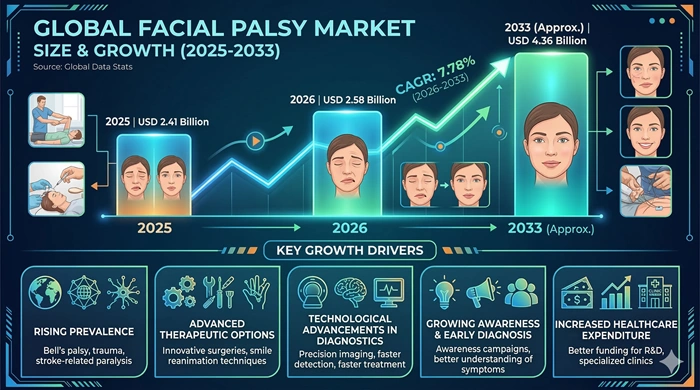
The global Facial Palsy market size is valued at USD 2.41 Billion in 2025 and is predicted to increase from USD 2.58 Billion in 2026 to approximately USD 4.36 Billion by 2033, growing at a CAGR of 7.78% from 2026 to 2033. The market is expanding steadily due to rising diagnosis rates, better access to neurological care, growing awareness of facial nerve disorders, and wider use of rehabilitation therapies, surgical procedures, and supportive treatment options. Related phrases such as facial paralysis treatment market and facial nerve disorder market also reflect the same broad business landscape.
A Broader Clinical and Commercial View of Facial Nerve Recovery Is Reshaping Demand Across Treatment Pathways
The Facial Palsy market includes products and services used to diagnose, manage, and improve weakness or paralysis of facial muscles caused by Bell’s palsy, trauma, infections, stroke, tumors, or congenital nerve damage. The market covers drug therapy, physical rehabilitation, electrical stimulation support, eye protection products, surgical repair, and follow-up monitoring. As healthcare systems place stronger focus on quality of life and functional recovery, demand is moving beyond emergency care toward long-term treatment pathways.
The market is also benefiting from better patient education and earlier intervention. Many patients now seek treatment sooner because facial asymmetry affects speech, blinking, eating, and emotional well-being. This has improved the uptake of steroid therapy in acute cases, nerve repair procedures in severe cases, and rehabilitative training in chronic conditions. Hospitals, specialty clinics, and outpatient rehabilitation centers all play an important role in market growth.
AI Impact on the Facial Palsy Industry
Artificial Intelligence Is Improving Diagnosis Support Patient Monitoring and Personalized Recovery Planning Across Facial Nerve Care
Artificial intelligence is starting to improve how clinicians assess facial palsy severity and recovery progress. AI-based image analysis tools can help measure facial symmetry, muscle movement, eyelid closure, and smile restoration with greater consistency. This supports more objective decision-making, especially in rehabilitation settings where progress tracking often depends on repeated visual evaluation.
AI is also helping telehealth platforms and digital therapy systems. Remote facial movement tracking can support home-based rehabilitation and improve patient adherence. In the coming years, AI may strengthen the Facial Palsy market by enabling earlier triage, customized therapy planning, and better treatment outcome prediction, especially in large hospitals and digital care networks.
Growth Factors
Rising Neurological Awareness Better Access to Specialty Care and Expanding Rehabilitation Pathways Are Supporting Market Expansion
One of the strongest growth factors in the Facial Palsy market is the increase in awareness around facial nerve dysfunction. Patients are more likely to recognize facial drooping and seek immediate care, which improves treatment rates. Public understanding has also improved because facial paralysis is frequently discussed in relation to stroke screening and post-viral complications. This has created stronger demand for both acute and supportive care.
Another growth factor is the expansion of multidisciplinary treatment models. Neurologists, ENT specialists, plastic surgeons, ophthalmologists, physiotherapists, and speech therapists increasingly work together in facial nerve care. This improves patient outcomes and creates more revenue channels across the market. As healthcare providers offer integrated treatment plans, the Facial Palsy market is becoming more organized and clinically specialized.
Market Outlook
Long Term Demand Will Be Driven by Better Recovery Protocols Higher Specialty Treatment Uptake and Broader Geographic Access
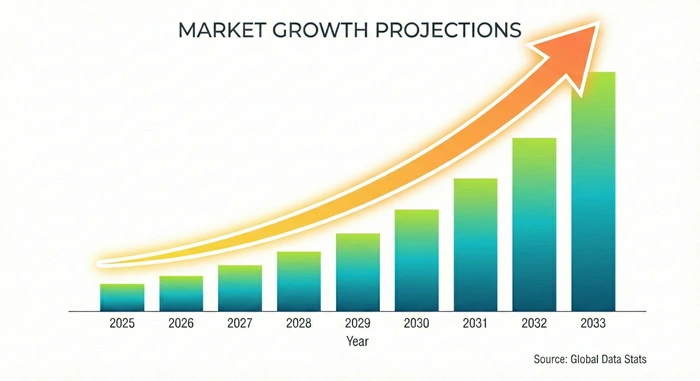
The market outlook remains positive as healthcare providers improve treatment pathways for both temporary and long-term facial paralysis. Drug therapy will continue to hold an important role in early-stage treatment, while physical rehabilitation and corrective procedures will gain traction in moderate to severe cases. Demand is expected to remain strong in developed healthcare systems and rise steadily in emerging economies where diagnosis and specialist access are improving.
Over the forecast period, the Facial Palsy market is likely to see stronger adoption of digital rehabilitation tools, refined microsurgical techniques, and patient-specific therapy programs. Investment in hospital infrastructure and facial nerve centers will support this trend. The market should also benefit from higher insurance coverage for neurological and reconstructive care in selected countries.
Expert Speaks
-
David Ricks (United States), CEO of Eli Lilly and Company, has emphasized the growing importance of neuroscience innovation and patient-centered treatment models, which supports broader investment interest in nerve-related disorders and recovery-focused care.
-
Joaquin Duato (United States), CEO of Johnson & Johnson, has repeatedly highlighted the value of integrated medtech and surgical innovation, a trend that aligns with procedural advances relevant to the Facial Palsy market.
-
Pascal Soriot (United Kingdom), CEO of AstraZeneca, has noted the need for earlier diagnosis and improved access to specialty care, both of which are important for better outcomes in facial paralysis management.
Key Report Takeaways
-
North America leads the Facial Palsy market with an estimated 38.4% share in 2026 due to stronger neurology care networks, higher treatment awareness, and wider access to surgical and rehabilitation services.
-
Asia Pacific is the fastest-growing region and is projected to expand at a CAGR of 9.41% from 2026 to 2033 because of improving hospital infrastructure, growing patient awareness, and rising healthcare spending.
-
Adult patients represent the largest customer group in the Facial Palsy market, accounting for nearly 72.6% of demand, mainly because Bell’s palsy, trauma-related nerve injury, and stroke-linked facial weakness are more common in adults.
-
Hospitals and specialty clinics contribute the highest application share at around 46.8%, supported by diagnosis, acute care, imaging access, surgery, and multidisciplinary treatment availability.
-
Physical rehabilitation and facial retraining remain the most widely used ongoing management approach, particularly for incomplete recovery cases and long-term nerve dysfunction.
-
Surgical intervention for complex and chronic facial paralysis is expected to grow quickly, with an estimated 18.9% share in 2026 and a projected CAGR of 8.96%, driven by better reconstructive techniques and specialist center expansion.
Market Scope
| Scope Item | Details |
|---|---|
| Market Size by 2033 | USD 4.36 Billion |
| Market Size by 2025 | USD 2.41 Billion |
| Market Size by 2026 | USD 2.58 Billion |
| Market Growth Rate from 2026 to 2033 | CAGR of 7.78% |
| Dominating Region | North America |
| Fastest Growing Region | Asia Pacific |
| Base Year | 2025 |
| Forecast Period | 2026 to 2033 |
| Segments Covered | By Treatment Type By End User By Patient Type By Severity By Region |
| Regions Covered | North America Europe Asia Pacific Latin America Middle East & Africa |
Market Dynamics
Drivers Impact Analysis
Improved Diagnosis Rising Patient Awareness and Expanding Multidisciplinary Treatment Models Are Increasing Facial Palsy Market Demand
| Driver | (≈) % Impact on CAGR Forecast | Geographic Relevance | Impact Timeline |
|---|---|---|---|
| Earlier diagnosis and treatment uptake | 1.9% | Global | Short to Medium Term |
| Growth in rehabilitation services | 1.6% | North America Europe Asia Pacific | Medium to Long Term |
| Advances in reconstructive and nerve repair procedures | 1.2% | North America Europe | Medium to Long Term |
The Facial Palsy market is being driven by rising awareness of facial asymmetry symptoms and faster referral patterns. Patients now reach healthcare systems earlier, which improves the use of steroid treatment, eye care support, and specialist assessment. This directly increases case capture across emergency departments, hospitals, and neurological clinics. As a result, the market is seeing broader treatment penetration.
A second important driver is the growth of rehabilitation and recovery-focused care. Facial retraining, speech support, and follow-up therapy are becoming standard parts of treatment in many countries. This expands the Facial Palsy market beyond short-term medication use and creates long-duration service revenue. Surgical innovation is also helping the market by offering better outcomes for chronic or severe cases.
Restraints Impact Analysis
Uneven Specialist Access Treatment Cost Barriers and Variable Recovery Outcomes Continue to Limit Faster Facial Palsy Market Expansion
| Restraint | (≈) % Impact on CAGR Forecast | Geographic Relevance | Impact Timeline |
|---|---|---|---|
| Limited access to facial nerve specialists | -1.4% | Emerging Markets | Short to Medium Term |
| High cost of advanced procedures | -1.1% | Global | Medium Term |
| Inconsistent long-term outcomes | -0.8% | Global | Long Term |
The Facial Palsy market still faces structural restraints in many healthcare systems. Not all patients can access neurologists, reconstructive surgeons, or rehabilitation experts quickly. Delays in care can reduce recovery quality and lower uptake of advanced treatments. This slows market growth in low-resource settings.
Cost is another significant challenge. Surgical correction, imaging, specialist follow-up, and long rehabilitation cycles may be expensive for patients without broad insurance support. In addition, not every patient responds the same way to therapy, and uncertainty around outcomes can delay treatment decisions. These factors create pressure on the market, especially in price-sensitive regions.
Opportunities Impact Analysis
Digital Rehabilitation Emerging Market Access and Better Long Term Care Models Are Creating New Revenue Pools in the Facial Palsy Market
| Opportunity | (≈) % Impact on CAGR Forecast | Geographic Relevance | Impact Timeline |
|---|---|---|---|
| Tele-rehabilitation and digital monitoring | 1.5% | Global | Medium Term |
| Expansion in Asia Pacific and Latin America | 1.7% | Asia Pacific Latin America | Medium to Long Term |
| Integrated facial nerve centers | 1.1% | North America Europe Asia Pacific | Long Term |
One of the best opportunities in the Facial Palsy market lies in digital rehabilitation. Home-based facial exercise programs supported by mobile apps and remote monitoring can improve treatment adherence. This is especially useful for patients who need repeated follow-up over several months. It can reduce travel burden and improve therapy continuity.
Another major opportunity is geographic expansion. Countries in Asia Pacific and Latin America are improving neurology care, surgery access, and rehabilitation services. As referral systems and hospital capabilities improve, the Facial Palsy market can gain from a larger treated patient base. Dedicated facial nerve centers may also become stronger commercial hubs for advanced treatment pathways.
Segment Analysis
By Treatment Type
Rehabilitation Focused Care Continues to Shape Demand While Surgical Therapies Gain Value in Complex Cases
The non-surgical treatment segment holds the largest share of the Facial Palsy market, accounting for about 61.7% in 2026. This segment includes corticosteroids, antiviral support in selected cases, lubricating eye care, physical therapy, and facial retraining. It remains dominant because many Bell’s palsy patients receive early medication and supportive rehabilitation rather than surgery. North America leads this segment due to stronger outpatient therapy systems and broad awareness of early intervention.
The segment is also growing in Europe and Asia Pacific as rehabilitation services become more accessible. Top providers in these regions benefit from larger neurology referral networks and better patient follow-up programs. Companies involved in eye protection products, neurorehabilitation support, and hospital treatment solutions continue to expand their presence. This part of the Facial Palsy market is projected to grow at a CAGR of 7.31% through 2033 because it serves a broad patient population and remains the first-line option in many cases.
By End User
Hospitals and Specialty Clinics Remain the Core Revenue Centers Because They Combine Acute Diagnosis Intervention and Long Term Management
The hospitals and specialty clinics segment represents the largest end-user share of the Facial Palsy market at nearly 46.8% in 2026. These facilities manage acute presentations, imaging, neurological examinations, surgical referrals, and multidisciplinary care. They also provide coordinated services across ENT, ophthalmology, physical therapy, and reconstructive surgery. North America and Europe continue to dominate this segment because of stronger specialty infrastructure and reimbursement systems.
This segment is also expected to post healthy long-term growth, with a projected CAGR of 8.04% from 2026 to 2033. Asia Pacific is emerging quickly due to hospital modernization and a rising number of specialty centers in China, India, Japan, and South Korea. Leading companies and care providers in these regions benefit from growing patient awareness and improving access to advanced treatment pathways. As the Facial Palsy market becomes more clinically specialized, hospitals and focused treatment centers will remain central to revenue generation.
Regional Insights
North America
High Awareness Advanced Treatment Access and Strong Specialist Networks Keep North America in the Leading Position
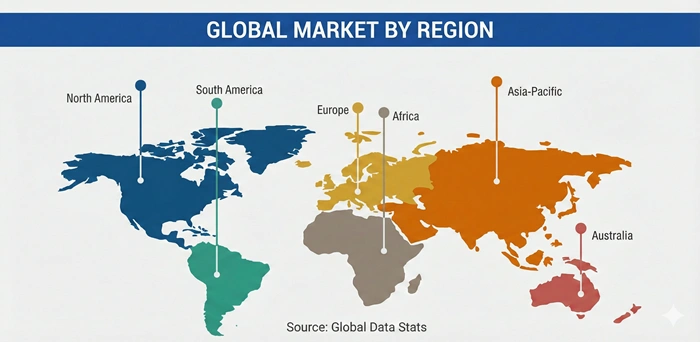
North America leads the Facial Palsy market with an estimated 38.4% share in 2026. The region benefits from early diagnosis, broad access to hospitals, and a strong base of neurologists, ENT specialists, and reconstructive surgeons. The United States remains the key revenue generator because patients are more likely to receive imaging, acute treatment, rehabilitation, and corrective procedures. Major healthcare and medtech companies also support the region’s leadership through hospital partnerships and product availability.
The regional market is expected to maintain stable expansion at a CAGR of 7.12% through 2033. Better use of digital assessment tools and tele-rehabilitation is supporting follow-up care across urban and suburban systems. Companies such as Johnson & Johnson, AbbVie, Pfizer, and Bausch + Lomb have strong relevance in adjacent treatment and care pathways. North America will likely remain the most mature Facial Palsy market during the forecast period.
Asia Pacific
Healthcare Expansion Rising Awareness and Growing Specialist Capacity Make Asia Pacific the Fastest Growing Regional Market
Asia Pacific is the fastest-growing region in the Facial Palsy market and is projected to register a CAGR of 9.41% from 2026 to 2033. The region is benefiting from rising healthcare expenditure, growing awareness of facial paralysis symptoms, and increasing availability of specialist treatment in large urban hospitals. China, Japan, India, and South Korea are central to this growth because of expanding patient pools and stronger hospital infrastructure.
Asia Pacific held an estimated 24.6% market share in 2026 and is expected to increase steadily over the forecast period. Regional growth is supported by better rehabilitation access, medical training, and expansion of ENT and neurology services. Large healthcare companies and device suppliers are also strengthening distribution and treatment support across the region. As access improves, the Facial Palsy market in Asia Pacific should become a major growth engine.
Top Key Players
-
AbbVie Inc. (United States)
-
Pfizer Inc. (United States)
-
Johnson & Johnson (United States)
-
Bausch + Lomb Corporation (Canada)
-
Stryker Corporation (United States)
-
Medtronic plc (Ireland)
-
Zimmer Biomet Holdings Inc. (United States)
-
3M Company (United States)
-
F. Hoffmann-La Roche Ltd. (Switzerland)
-
Sanofi S.A. (France)
-
Astellas Pharma Inc. (Japan)
-
Takeda Pharmaceutical Company Limited (Japan)
Recent Developments
-
2025: Johnson & Johnson continued expanding its surgical and specialist care ecosystem, strengthening support for hospitals involved in nerve repair and reconstructive intervention workflows.
-
2025: Medtronic advanced digital health and connected care initiatives that support broader remote monitoring trends relevant to rehabilitation-heavy segments of the Facial Palsy market.
-
2024: Stryker expanded innovation activity in procedural technologies and surgical training, which supports complex facial reconstruction and specialty operating room demand.
-
2024: Bausch + Lomb strengthened its eye care portfolio and commercial reach, which remains relevant for facial palsy patients requiring corneal protection and ocular surface management.
-
2024: Takeda and other large pharmaceutical companies continued investing in neurology and specialty care pipelines, helping maintain interest in nerve-related disorder treatment opportunities.
Market Trends
Digital Monitoring Better Functional Assessment and Patient Centered Recovery Models Are Becoming Core Themes Across the Market
A major trend in the Facial Palsy market is the shift toward functional outcome measurement rather than symptom-only treatment. Providers are paying more attention to smile recovery, blink restoration, speech comfort, and psychosocial well-being. This is increasing the value of structured rehabilitation and follow-up assessment. It also supports demand for digital tracking and telehealth-based care.
Another clear trend is the rise of personalized treatment planning. Patients with mild Bell’s palsy, chronic synkinesis, post-surgical weakness, or trauma-related paralysis do not follow the same recovery path. As a result, healthcare providers are using more tailored combinations of medication, therapy, eye care, and surgery. This trend will continue to shape the Facial Palsy market over the next several years.
Segments Covered in the Report
-
By Treatment Type: Non-surgical treatment, surgical treatment
-
By Drug and Supportive Care: Corticosteroids, antivirals, analgesics, lubricating eye drops, eye ointments
-
By Rehabilitation Type: Facial retraining, physiotherapy, speech therapy, electrical stimulation support
-
By End User: Hospitals, specialty clinics, rehabilitation centers, ambulatory surgical centers
-
By Patient Type: Adult, pediatric
-
By Severity: Mild, moderate, severe, chronic facial paralysis
-
By Cause: Bell’s palsy, trauma, infection, tumor-related, stroke-related, congenital causes
-
By Region: North America, Europe, Asia Pacific, Latin America, Middle East & Africa
Frequently Asked Questions
Question 1: What is the current size of the Facial Palsy market?
Answer: The Facial Palsy market is valued at USD 2.41 Billion in 2025. It is projected to reach USD 4.36 Billion by 2033 with steady growth.
Question 2: What is driving the Facial Palsy market growth?
Answer: The Facial Palsy market is growing because diagnosis rates are improving and more patients are receiving rehabilitation and specialist care. Better awareness and treatment access are also supporting demand.
Question 3: Which region dominates the Facial Palsy market?
Answer: North America currently leads the Facial Palsy market. The region has strong specialty care systems and high treatment awareness.
Question 4: Which region is growing fastest in the Facial Palsy market?
Answer: Asia Pacific is the fastest-growing region in the Facial Palsy market. Growth is supported by healthcare expansion and improving access to facial nerve treatment.
Question 5: What treatments are most common in the Facial Palsy market?
Answer: Non-surgical treatments are the most common in the Facial Palsy market. These include steroids, eye care, and facial rehabilitation therapies.