
Drone Services Market Overview
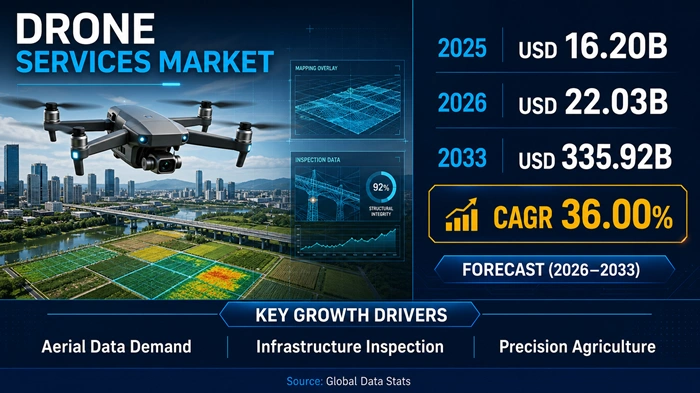
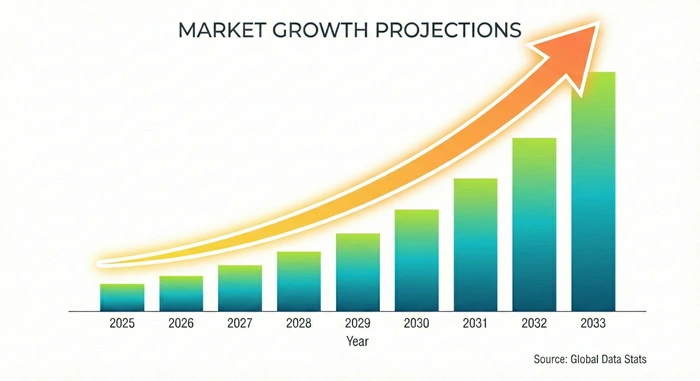
The global drone services market size is valued at USD 16.20 billion in 2025 and is predicted to increase from USD 22.03 billion in 2026 to approximately USD 335.92 billion by 2033, growing at a CAGR of 36.00% from 2026 to 2033. The drone services market encompasses professional services delivered using unmanned aerial vehicles including aerial photography, mapping and surveying, infrastructure inspection, data analysis, and delivery operations across diverse industries.
Rising adoption of drone technology for industrial applications, expanding regulatory approvals for beyond visual line of sight operations, and growing demand for cost-effective inspection solutions drive substantial market expansion worldwide. Organizations increasingly recognize that drone-based services deliver superior efficiency, safety improvements, and operational cost reductions compared to traditional methods requiring manned aircraft, scaffolding, or ground-based equipment. The market benefits from technological advancements including artificial intelligence integration, autonomous flight capabilities, advanced sensors, and real-time data analytics that transform drones from simple aerial platforms into intelligent service delivery systems.
AI Impact on the Drone Services Industry
Autonomous Navigation and Intelligent Data Processing Transform Service Capabilities
Artificial intelligence is fundamentally reshaping the drone services market by enabling autonomous navigation, intelligent obstacle avoidance, and automated data analysis that significantly enhance operational efficiency and service quality. AI-powered drones leverage computer vision algorithms, machine learning models, and real-time processing capabilities to navigate complex environments without human intervention, detecting and avoiding obstacles including power lines, buildings, trees, and other aircraft. Skydio leads autonomous drone development with AI-driven flight systems achieving unprecedented levels of self-navigation, enabling operations in GPS-denied environments, confined spaces, and challenging conditions where manual piloting proves difficult or impossible. Advanced AI systems process vast amounts of aerial imagery captured during inspections, automatically identifying defects, anomalies, and maintenance requirements through pattern recognition algorithms trained on millions of reference images.
The integration of AI with drone platforms enables predictive analytics transforming raw aerial data into actionable insights for decision-makers across agriculture, construction, energy, and infrastructure sectors. AI-powered image analysis automatically detects vegetation encroachment on power lines, identifies corrosion on pipelines, measures crop health variations across agricultural fields, and tracks construction progress against planned timelines. Machine learning models trained on historical inspection data predict equipment failures, prioritize maintenance schedules, and optimize resource allocation reducing downtime and preventing costly failures. Natural language processing capabilities enable automated report generation, translating complex aerial data into easy-to-understand summaries that non-technical stakeholders can quickly comprehend and act upon. Furthermore, AI-driven automation supports drone-in-a-box solutions enabling scheduled autonomous missions without human operators, allowing continuous monitoring of critical infrastructure, perimeter security, and environmental conditions.
Growth Factors
Regulatory Approvals and Cost Efficiency Drive Market Acceleration
The accelerating pace of regulatory approvals for beyond visual line of sight operations represents the primary driver propelling drone services market expansion as aviation authorities worldwide establish frameworks enabling extended-range commercial drone applications. The United States Federal Aviation Administration proposed groundbreaking rules in August 2025 normalizing BVLOS operations, removing requirements for individual waivers, and creating standardized pathways for routine low-altitude flights supporting logistics, agriculture, energy production, infrastructure inspection, and package delivery. BVLOS regulations unlock transformative applications including long-distance pipeline monitoring, transmission line inspection across remote terrain, agricultural surveying of expansive farms, and delivery services covering significant geographic areas previously restricted by visual line of sight limitations. European Union Aviation Safety Agency, Civil Aviation Administration of China, and regulatory bodies across developed nations implement similar frameworks recognizing that mature technology, proven safety records, and industry standardization support expanded operational permissions.
Exceptional cost efficiency and safety improvements compared to traditional inspection methods create compelling value propositions driving drone services market adoption across energy, utilities, construction, and infrastructure sectors. Electric utility companies deploying drones for transmission line inspection reduce costs by 30% to 50% compared to helicopter-based surveys while eliminating risks associated with manned aircraft operations in proximity to high-voltage infrastructure. Energy sector drone inspections of solar farms, wind turbines, and oil and gas facilities complete in fractions of the time required by manual approaches, acting as workforce multipliers allowing existing inspection crews to survey significantly more assets per day. Construction companies utilize drone mapping and progress monitoring services reducing surveying costs by 70% compared to traditional ground-based methods while providing more frequent updates enabling faster decision-making. Safety benefits prove particularly significant as drones eliminate requirements for workers to climb towers, enter confined spaces, or access hazardous environments, reducing workplace injuries and liability exposure. Additionally, enterprise digital transformation initiatives, smart city development programs, and precision agriculture adoption accelerate demand for data-driven decision-making that drone-captured aerial intelligence uniquely enables.
Market Outlook
Enterprise Adoption and Delivery Services Transform Industry Landscape
The drone services market outlook remains exceptionally positive as converging trends including enterprise-wide deployment standardization, autonomous delivery service commercialization, and artificial intelligence integration create opportunities for sophisticated aerial service offerings. The commercial drone services industry transitions from pilot programs to orchestrated deployments across energy utilities, agriculture, infrastructure inspection, and logistics sectors with automation, real-time data delivery, and expanding regulatory approvals accelerating service standardization and scale. Market participants invest heavily in developing turnkey service packages, subscription-based monitoring programs, and drone-as-a-service business models that reduce customer complexity while generating recurring revenue streams. Strategic partnerships between drone service providers, software analytics companies, and industry-specific solution integrators create comprehensive offerings addressing complete workflow needs rather than simply providing raw aerial data.
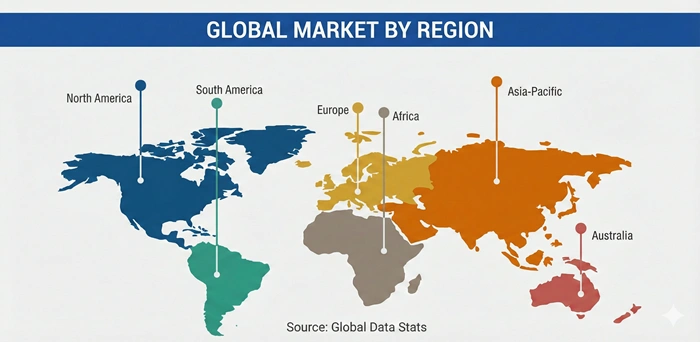
North America maintains market leadership with the United States drone services market valued at USD 8.15 billion in 2025 projected to reach substantial valuations by 2034 at exceptional CAGR exceeding 36% driven by favorable regulatory environment, robust enterprise adoption, and innovation ecosystem. The Infrastructure Investment and Jobs Act catalyzes pilot programs promoting widespread drone adoption for critical infrastructure inspections including bridges, roads, and utilities while federal spending supports deployment across government agencies. Zipline demonstrates delivery service viability crossing one million autonomous deliveries and forming United States partnerships with Panera Bread, Jet's Pizza, and Memorial Hermann healthcare system. The drone services market benefits from agricultural sector transformation as 54% of agriculture firms deploy drones for precision crop monitoring, variable rate application mapping, and yield prediction supporting sustainable farming practices. Asia Pacific demonstrates fastest regional growth at 24.0% CAGR driven by rapid urbanization, government smart city initiatives, agricultural modernization, and infrastructure development across China, India, Southeast Asia, and Japan. Industry analysts project logistics sector transformation as 68% of companies explore drone delivery adoption for last-mile delivery, medical supply transport, and remote area servicing.
Expert Speaks
-
Jeff Bezos, CEO of Amazon, revealed that Amazon is testing unmanned aerial vehicles for package delivery capable of transporting items weighing up to 2.3 kilograms to homes within 16 kilometers of distribution centers, with autonomous drones flying to programmed GPS coordinates potentially covering significant portions of urban populations within four to five years as regulations allow, emphasizing that these electric motors are very green and better than driving trucks around neighborhoods.
-
Jack Narcotta, Principal Industry Analyst at Strategy Analytics, emphasized that combining AI with advanced analytics makes drone operations more independent and efficient, noting that the integration of artificial intelligence technology with autonomous flight systems represents a fundamental transformation enabling drones to operate safely in complex environments while delivering unprecedented levels of service reliability and data quality.
-
Industry experts from commercial UAV sector, highlighted that of the many industries embracing drone technology in recent years, few have benefited more than Energy & Utilities and Civil Infrastructure, explaining that these industries turn to uncrewed vehicles because they can travel to hard-to-reach and dangerous places while capturing vast amounts of detailed, accurate, and actionable data enabling higher performance levels and improved return on investment.
Key Report Takeaways
-
North America leads the global drone services market with approximately 33.70% regional share in 2025, driven by favorable Federal Aviation Administration regulatory environment supporting BVLOS operations, robust enterprise adoption across energy and agriculture sectors, strong venture capital ecosystem, and the United States market valued at USD 8.15 billion in 2025 growing at 36.78% CAGR through 2034.
-
Asia Pacific represents the fastest-growing regional market, expected to expand at exceptional CAGR exceeding 24% through 2033, fueled by rapid urbanization, government smart city infrastructure initiatives, agricultural modernization programs, and massive construction activity across China, India, Southeast Asia, and Japan creating sustained demand for mapping, surveying, and inspection services.
-
Inspection and monitoring services dominate market demand, representing the largest service type segment as energy utilities, oil and gas operators, telecommunications providers, and infrastructure managers deploy drones for asset inspection reducing costs by 30% to 50% compared to traditional helicopter or manual inspection methods.
-
Agriculture applications demonstrate exceptional growth with 54% of farming operations adopting drone services for precision crop monitoring, variable rate application mapping, soil analysis, and yield prediction, enabling sustainable practices reducing input costs while improving productivity.
-
Delivery services emerge as transformative segment with 68% of logistics companies exploring drone delivery adoption, led by pioneering operations including Zipline surpassing one million autonomous deliveries and Amazon launching commercial services in Richardson, Texas, demonstrating viability for healthcare supplies, food delivery, and last-mile logistics.
-
Rotary-wing platforms maintain dominance capturing majority market share due to versatility supporting hovering, vertical takeoff and landing, close-range inspection, and operation in confined spaces, though fixed-wing drones gain traction for large-area mapping, long-distance pipeline monitoring, and agricultural surveying applications requiring extended flight times.
Market Scope
| Report Coverage Details | |
|---|---|
| Market Size by 2033 | USD 335.92 Billion |
| Market Size by 2025 | USD 16.20 Billion |
| Market Size by 2026 | USD 22.03 Billion |
| Market Growth Rate from 2026 to 2033 | CAGR of 36.00% |
| Dominating Region | North America |
| Fastest Growing Region | Asia Pacific |
| Base Year | 2025 |
| Forecast Period | 2026 to 2033 |
| Segments Covered | Service Type, Platform, End User, Region |
| Regions Covered | North America, Europe, Asia Pacific, Latin America, Middle East & Africa |
Market Dynamics
Drivers Impact Analysis
Beyond Visual Line of Sight Approvals and Industrial Digital Transformation Accelerate Adoption
| Factor | (≈) % Impact on CAGR Forecast | Geographic Relevance | Impact Timeline |
|---|---|---|---|
| BVLOS regulatory approvals | 12.5% | North America, Europe, Asia Pacific | Immediate to medium-term |
| Cost efficiency versus traditional methods | 10.8% | Global industrial sectors | Immediate and ongoing |
| Enterprise digital transformation | 8.2% | Developed markets | Ongoing |
| Safety improvement mandates | 4.5% | Energy, construction, utilities | Ongoing |
The accelerating pace of regulatory approvals for beyond visual line of sight operations represents the most significant driver propelling drone services market expansion as aviation authorities worldwide establish frameworks enabling extended-range commercial applications. The United States Federal Aviation Administration proposed transformative rules in August 2025 normalizing BVLOS operations, removing individual waiver requirements, and creating standardized pathways for routine low-altitude flights at 400 feet or less supporting logistics, agriculture, energy production, infrastructure inspection, and package delivery. BVLOS regulations unlock critical applications including long-distance pipeline monitoring across remote terrain, transmission line inspection spanning hundreds of miles, agricultural surveying of expansive farms, and delivery services covering significant geographic areas previously restricted by visual line of sight limitations requiring operators or observers maintaining direct visual contact. European Union Aviation Safety Agency implements similar frameworks while Civil Aviation Administration of China advances regulations supporting intelligent connected vehicle development and urban air mobility.
Exceptional cost efficiency compared to traditional inspection and surveying methods creates compelling value propositions driving drone services market adoption across energy, utilities, construction, and infrastructure sectors. Electric utility companies deploying drones for transmission line inspection reduce operational costs by 30% to 50% compared to helicopter-based surveys while eliminating safety risks associated with manned aircraft operations in proximity to high-voltage infrastructure. Energy sector drone inspections of solar farms, wind turbines, oil and gas pipelines, and refinery facilities complete in fractions of the time required by manual approaches involving trucks, helicopters, or scaffolding setups, acting as workforce multipliers allowing existing inspection crews to survey significantly more assets per day. Construction companies utilize drone mapping and progress monitoring services reducing surveying costs by 70% compared to traditional ground-based methods using total stations and GPS equipment while providing more frequent updates enabling faster decision-making. Enterprise digital transformation initiatives drive demand for data-driven operations management across industries, with aerial intelligence uniquely enabling insights impossible through ground-based observation. Additionally, workplace safety improvement mandates create regulatory and liability pressures as drones eliminate requirements for workers to climb towers, enter confined spaces, or access hazardous environments, reducing workplace injuries and associated costs.
Restraints Impact Analysis
Regulatory Complexity and Skilled Operator Shortages Create Adoption Barriers
| Factor | (≈) % Impact on CAGR Forecast | Geographic Relevance | Impact Timeline |
|---|---|---|---|
| Regulatory complexity and restrictions | -5.2% | Varies by jurisdiction | Ongoing to medium-term |
| Skilled operator shortage | -4.6% | Global markets | Ongoing |
| Privacy and security concerns | -3.8% | Urban and residential areas | Ongoing |
| Weather and environmental limitations | -2.9% | All regions | Ongoing |
Substantial regulatory complexity and operational restrictions create significant barriers to drone services market expansion, particularly in jurisdictions maintaining stringent requirements for commercial operations, airspace access, and pilot certification. Despite progress toward BVLOS approvals in leading markets, many countries maintain restrictive frameworks requiring expensive individual waivers, limiting operational areas to sparsely populated regions, mandating ground-based observers, and imposing altitude restrictions that constrain service delivery capabilities. Urban airspace congestion creates challenges as commercial drone operations must coordinate with manned aviation, maintain separation from airports and helipads, respect no-fly zones around government facilities and stadiums, and navigate complex local regulations varying by municipality. International operations face additional complexity as companies serving global clients encounter divergent regulatory frameworks requiring separate certifications, different operational protocols, and varying insurance requirements across countries.
Skilled operator shortages constrain drone services market growth as demand for certified pilots, data analysts, and maintenance technicians exceeds available talent pools. Commercial drone operations require FAA Part 107 certification in the United States or equivalent qualifications in other jurisdictions, involving examination, training, and ongoing proficiency requirements that limit labor supply. Advanced applications including infrastructure inspection, precision agriculture, and industrial surveying require specialized knowledge combining drone operation with domain expertise in civil engineering, agronomy, or energy systems that proves difficult to source. Data processing bottlenecks emerge as organizations collect vast quantities of aerial imagery and sensor data requiring specialized photogrammetry software skills, GIS expertise, and analytical capabilities to transform raw information into actionable insights. Privacy and security concerns create public opposition in some markets as citizens worry about surveillance, data collection, noise pollution, and potential accidents. Additionally, weather and environmental limitations constrain operations as wind, rain, snow, and extreme temperatures restrict safe flight conditions, while battery life limitations typically constraining flight times to 20 to 40 minutes require frequent recharging affecting productivity.
Opportunities Impact Analysis
Autonomous Delivery and Subscription Services Create Growth Prospects
| Factor | (≈) % Impact on CAGR Forecast | Geographic Relevance | Impact Timeline |
|---|---|---|---|
| Autonomous delivery service expansion | 9.2% | Urban markets, healthcare | Medium to long-term |
| Subscription-based service models | 7.8% | Enterprise and government | Medium-term |
| AI-powered data analytics | 6.5% | All commercial applications | Medium-term |
| Drone-in-a-box solutions | 5.3% | Infrastructure and security | Medium-term |
The rapid commercialization of autonomous delivery services creates exceptional opportunities within the drone services market as logistics companies, healthcare providers, and food service operators deploy unmanned aircraft for last-mile transportation. Zipline demonstrates delivery service viability operating at scale, surpassing one million autonomous deliveries and establishing United States partnerships with Panera Bread, Jet's Pizza, and Memorial Hermann healthcare system for medical supply transport. Amazon launched Prime Air commercial operations in Richardson, Texas, delivering packages weighing up to 2.3 kilograms within minutes, demonstrating that autonomous drones can safely navigate urban environments while providing convenient touchless delivery. Healthcare applications prove particularly compelling as drones transport blood, vaccines, laboratory samples, and emergency medications to remote clinics, disaster zones, and areas with poor road infrastructure, dramatically reducing delivery times from hours to minutes. Logistics sector transformation accelerates as 68% of companies explore drone adoption for warehouse-to-customer delivery, inventory transport between facilities, and servicing remote locations where ground transportation proves inefficient.
Subscription-based service models create substantial opportunities for drone services market vendors transitioning from project-based engagements to recurring revenue relationships. Drone-as-a-service offerings provide customers with scheduled monitoring, continuous data collection, and predictive analytics through monthly or annual subscriptions rather than one-time project fees. Infrastructure owners including utilities, pipeline operators, and transportation authorities particularly value subscription services providing regular inspection cycles, automated anomaly detection, and trend analysis identifying gradual deterioration requiring maintenance. Agriculture sector adoption accelerates through subscription packages delivering weekly or monthly crop health monitoring, variable rate application recommendations, and harvest readiness predictions supporting precision farming practices. AI-powered data analytics create differentiation opportunities as service providers offering automated defect detection, predictive maintenance algorithms, and decision support tools command premium pricing compared to basic imagery delivery. Additionally, drone-in-a-box solutions enabling fully autonomous operations without on-site pilots support security monitoring, perimeter surveillance, and continuous infrastructure observation generating recurring service revenue.
Segment Analysis
Inspection and Monitoring Services Dominance
Infrastructure Safety and Cost Efficiency Drive Segment Leadership
Inspection and monitoring services command the dominant position within the drone services market, representing the largest service type segment as energy utilities, oil and gas operators, telecommunications providers, and infrastructure managers deploy aerial platforms for asset inspection. Energy and utility sector applications prove particularly extensive with drones inspecting transmission lines spanning thousands of miles, identifying vegetation encroachment threatening power delivery, detecting equipment corrosion, and monitoring structural integrity of towers and substations. Traditional helicopter-based inspection methods cost USD 1,000 to USD 3,000 per hour while requiring pilots to operate dangerously close to high-voltage infrastructure, whereas drone inspections reduce costs by 30% to 50% while eliminating safety risks. Oil and gas pipeline operators utilize drone services for leak detection using thermal imaging, right-of-way monitoring identifying unauthorized encroachment, and corrosion assessment preventing environmental incidents. Telecommunications companies deploy drones for cell tower inspection, antenna alignment verification, and 5G infrastructure deployment planning reducing costs and deployment timelines.
North America demonstrates particularly strong inspection service adoption with United States utilities, energy companies, and infrastructure owners leading global deployment driven by aging infrastructure requiring increased monitoring, safety regulations mandating regular inspections, and workforce limitations necessitating productivity improvements. Major service providers including Cyberhawk, Measure, Sky-Futures, and Aerodyne operate extensive inspection service businesses serving Fortune 500 energy and utility clients across North America and Europe. The segment benefits from recurring revenue models as infrastructure owners contract for scheduled inspection programs, continuous monitoring services, and predictive maintenance analytics rather than one-time project engagements. Europe shows accelerating adoption driven by offshore wind farm expansion requiring underwater turbine foundation inspection and blade condition assessment that drones equipped with specialized sensors uniquely enable. Asia Pacific demonstrates rapid growth as China, India, and Southeast Asian nations invest heavily in power generation, transmission infrastructure, and smart city development creating sustained demand for efficient inspection solutions. The drone services market inspection segment particularly benefits from AI integration as automated defect detection algorithms analyze imagery identifying anomalies requiring attention, prioritizing maintenance activities, and tracking degradation trends over time.
Agriculture End-User Growth
Precision Farming and Sustainability Drive Sectoral Adoption
Agriculture represents a high-growth end-user segment within the drone services market, with 54% of farming operations adopting unmanned aerial systems for precision crop monitoring, variable rate application mapping, soil analysis, and yield prediction. Farmers utilize drone services for multispectral imaging assessing crop health through vegetation indices identifying stress, disease, or nutrient deficiencies invisible to human observation, enabling targeted interventions rather than blanket treatments across entire fields. Precision agriculture applications include irrigation management identifying areas requiring additional water, pest and disease detection enabling early treatment before widespread damage, weed mapping supporting herbicide application only where needed, and growth stage monitoring optimizing harvest timing. Variable rate application maps generated from drone imagery guide equipment applying fertilizers, pesticides, and water only where required, reducing input costs by 15% to 30% while improving yields and minimizing environmental impact. Large-scale farming operations particularly value efficiency gains as drones survey hundreds of acres in single flights providing complete field coverage impossible through ground-based scouting.
North America leads agricultural drone service adoption with United States and Canadian farms embracing precision agriculture technology driven by labor shortages, sustainability pressures, and economic incentives for input optimization. Service providers including PrecisionHawk, DroneDeploy, and Sentera offer comprehensive agriculture packages combining aerial data collection, AI-powered analytics, and agronomist consultation supporting data-driven farm management. The segment benefits from subscription-based pricing models as farmers contract for season-long monitoring services providing regular field assessments, trend analysis, and harvest predictions rather than one-time surveys. Asia Pacific demonstrates exceptional growth potential with India launching government programs supporting drone adoption for agricultural applications, while China invests heavily in rural modernization and precision farming technology deployment. The drone services market agriculture segment particularly advantages from affordable platforms as entry-level agricultural drones cost USD 1,000 to USD 5,000 making technology accessible to small and medium farms, while service providers offer pay-per-acre pricing lowering barriers to adoption. Africa and Latin America show emerging adoption as international development organizations promote drone technology for smallholder farmer support, crop insurance verification, and food security monitoring.
Regional Insights
North America Market Leadership
Regulatory Leadership and Enterprise Adoption Drive Regional Dominance
North America commands substantial leadership within the drone services market, maintaining approximately 33.70% regional share in 2025, driven by favorable Federal Aviation Administration regulatory environment, robust enterprise adoption, and the United States market valued at USD 8.15 billion in 2025 growing at 36.78% CAGR through 2034. The United States demonstrates particularly strong momentum with technology-forward enterprises across energy, agriculture, construction, and logistics sectors embracing drone services as productivity-enhancing tools delivering rapid return on investment. The Infrastructure Investment and Jobs Act catalyzes deployment through federal funding supporting bridge inspection programs, highway monitoring initiatives, and utility infrastructure assessment leveraging aerial technology. FAA regulatory leadership proposing groundbreaking BVLOS rules in August 2025 positions North America ahead of other regions in enabling advanced commercial applications including delivery services, extended-range inspection, and autonomous operations.
Major service providers including American-based Measure, Skyward, and DroneBase along with international operators including Cyberhawk and Aerodyne maintain strong North American operations serving Fortune 500 clients across multiple industries. Technology leaders including Skydio headquartered in San Mateo develop cutting-edge autonomous platforms specifically designed for enterprise and government applications where reliability, security, and American manufacturing prove essential. The region benefits from robust venture capital ecosystem with companies including Zipline, Skydio, and Shield AI raising hundreds of millions supporting technology development, market expansion, and service innovation. Canada demonstrates growing adoption driven by natural resource sector applications including mining site surveying, forestry management, and oil sands monitoring plus agricultural applications across prairie provinces. The drone services market in North America particularly advantages from defense sector spillover as military drone technology, autonomous systems, and sensor innovations transition to commercial applications.
Asia Pacific Fastest Growth
Urbanization and Infrastructure Investment Drive Regional Acceleration
Asia Pacific emerges as the fastest-growing regional drone services market, expected to expand at exceptional CAGR exceeding 24% through 2033, propelled by rapid urbanization, government smart city infrastructure initiatives, agricultural modernization programs, and massive construction activity creating sustained demand for aerial services. China represents the largest regional market with government policies actively promoting drone industry development, domestic manufacturers including DJI dominating global hardware production, and enterprises across agriculture, construction, and infrastructure sectors embracing technology. Smart city initiatives across Beijing, Shanghai, Shenzhen, and tier-two cities incorporate drone services for traffic monitoring, environmental assessment, infrastructure inspection, and emergency response supporting urban management. India demonstrates exceptional growth potential with government DroneShakti initiative promoting adoption across agriculture, mining, infrastructure, and law enforcement plus regulatory reforms simplifying commercial operations.
Southeast Asian nations including Singapore, Thailand, Malaysia, and Indonesia show accelerating adoption driven by infrastructure development projects, plantation agriculture monitoring across palm oil and rubber estates, and tourism industry aerial photography services. Japan leads precision agriculture deployment with aging farmer demographics driving automation adoption, while construction sector utilizes drones extensively for progress monitoring and earthwork volume calculation. Regional service providers including Terra Drone Corporation, Aerodyne Group, and Garuda Robotics operate across multiple countries offering localized services combined with advanced analytics platforms. The drone services market in Asia Pacific particularly benefits from manufacturing ecosystem concentration as component availability, technical expertise, and service infrastructure support rapid market development. Government initiatives including India's Production-Linked Incentive scheme for drone manufacturing and China's low-altitude economy development plans create favorable environments for service industry expansion.
Top Key Players
-
DJI Technology Co. Ltd. (China)
-
Zipline International Inc. (United States)
-
Skydio Inc. (United States)
-
AeroVironment Inc. (United States)
-
Terra Drone Corporation (Japan)
-
Aerodyne Group Limited (Malaysia)
-
Cyberhawk Innovations Limited (United Kingdom)
-
Measure (United States)
-
PrecisionHawk Inc. (United States)
-
DroneDeploy Inc. (United States)
-
Parrot Drones S.A. (France)
-
senseFly (Switzerland)
-
Yuneec International Co. Ltd. (China)
-
Delair Tech (France)
-
Flyability SA (Switzerland)
Recent Developments
-
Volatus Aerospace (May 2024): Volatus Aerospace, a Canada-based provider of drone solutions for civil, public safety, and defense sectors, merged with Drone Delivery Canada Corp. for an undisclosed amount, with the merger expected to bring significant benefits to both companies enhancing capabilities and expanding market presence particularly in drone delivery services within Canada and supporting broader North American expansion strategies.
-
Shield AI (2024): Shield AI completed acquisition of Sentient Vision Systems to enhance AI-driven intelligence, surveillance, and reconnaissance solutions, marking strategic consolidation within the defense-oriented drone services sector as the company expands autonomous aircraft capabilities supporting military and public safety applications through advanced computer vision and real-time target detection technologies.
-
Airbus Helicopters (2024): Airbus Helicopters acquired Aerovel expanding vertical takeoff and landing drone capabilities for commercial and defense applications, demonstrating major aerospace manufacturer commitment to unmanned systems market and reflecting industry consolidation trend as established aviation companies acquire drone technology specialists to complement existing product portfolios.
-
Robinson Helicopter (2024): Robinson Helicopter Company acquired Ascent AeroSystems marking the company's entry into unmanned aircraft systems market, signaling traditional rotorcraft manufacturer recognition of drone technology importance and creating opportunities for hybrid service offerings combining manned and unmanned aerial capabilities for commercial applications.
-
Zipline (2024): Zipline surpassed one million autonomous deliveries milestone and formed strategic United States partnerships with Panera Bread, Jet's Pizza, and Memorial Hermann healthcare system, demonstrating commercial viability of autonomous delivery services while expanding beyond international healthcare operations into American retail food service and medical logistics markets proving scalability and reliability.
Market Trends
Autonomous Operations and Drone-as-a-Service Transform Business Models
The rapid advancement of fully autonomous drone operations represents a transformative trend within the drone services market, fundamentally changing service delivery through drone-in-a-box solutions enabling scheduled missions without human operators. Autonomous systems leverage AI-powered navigation, automated battery charging stations, and cloud-based mission planning executing pre-programmed flight paths, capturing required data, and returning to base without intervention. Infrastructure monitoring applications particularly benefit from autonomous operations as utility companies deploy permanent drone stations along transmission corridors, pipeline routes, or facility perimeters conducting regular inspections according to scheduled intervals. Security and surveillance sectors utilize autonomous drones for perimeter monitoring, intrusion detection, and emergency response where rapid deployment proves essential. Weather monitoring, environmental sampling, and agricultural crop health assessment leverage scheduled autonomous flights providing consistent temporal data supporting trend analysis and predictive modeling. The drone services market shows growing emphasis on turnkey autonomous solutions reducing customer operational burden while enabling 24/7 monitoring capabilities impossible with manually piloted aircraft.
Drone-as-a-service business model adoption accelerates as service providers transition from project-based engagements to subscription relationships delivering recurring revenue and predictable cash flows. Enterprise customers increasingly prefer subscription packages bundling equipment, software, data processing, and analytics eliminating capital expenditure requirements, technical complexity, and staffing challenges associated with operating in-house drone programs. Energy and utility companies subscribe to continuous monitoring services providing regular infrastructure inspection, automated anomaly detection, maintenance prioritization, and compliance documentation rather than managing internal capabilities. Agricultural operations contract for season-long crop monitoring services delivering weekly field assessments, growth stage tracking, and harvest readiness predictions supporting precision farming decisions. Construction firms utilize subscription-based progress monitoring documenting site conditions, measuring earthwork volumes, and tracking completion against schedules through regular aerial surveys. Insurance companies, real estate developers, and government agencies increasingly adopt subscription models for disaster assessment, property documentation, and routine facility monitoring applications. Additionally, software platform integration creates ecosystems where drone service data flows directly into customer enterprise resource planning, computerized maintenance management, and geographic information systems enabling automated workflows and eliminating manual data transfer.
Segments Covered in the Report
By Service Type:
-
Aerial Photography and Videography
-
Real Estate Photography
-
Event Coverage
-
Wedding and Special Occasions
-
-
Mapping and Surveying
-
Topographic Mapping
-
Volumetric Measurements
-
3D Modeling
-
GIS Data Collection
-
-
Inspection and Monitoring
-
Infrastructure Inspection
-
Pipeline Monitoring
-
Power Line Inspection
-
Solar Panel Inspection
-
Wind Turbine Inspection
-
-
Data Analysis and Processing
-
Photogrammetry
-
Orthomosaic Generation
-
Point Cloud Processing
-
-
Delivery Services
-
Medical Supply Delivery
-
Package Delivery
-
Food Delivery
-
By Platform:
-
Fixed-Wing Drones
-
VTOL Fixed-Wing
-
Conventional Fixed-Wing
-
-
Rotary-Wing Drones
-
Quadcopters
-
Hexacopters
-
Octocopters
-
-
Hybrid Drones
-
Fixed-Wing VTOL Hybrids
-
By End User:
-
Agriculture
-
Crop Monitoring
-
Precision Agriculture
-
Livestock Management
-
-
Construction and Real Estate
-
Site Surveying
-
Progress Monitoring
-
Property Marketing
-
-
Energy and Utilities
-
Oil and Gas
-
Power Generation
-
Transmission and Distribution
-
-
Government and Defense
-
Law Enforcement
-
Border Patrol
-
Emergency Services
-
-
Media and Entertainment
-
Film Production
-
Broadcasting
-
Advertising
-
-
Mining and Quarrying
-
Telecommunications
-
Insurance
By Region:
-
North America
-
United States
-
Canada
-
Mexico
-
-
Europe
-
United Kingdom
-
Germany
-
France
-
Italy
-
Spain
-
Rest of Europe
-
-
Asia Pacific
-
China
-
India
-
Japan
-
South Korea
-
Southeast Asia
-
Australia
-
Rest of Asia Pacific
-
-
Latin America
-
Brazil
-
Argentina
-
Rest of Latin America
-
-
Middle East & Africa
-
United Arab Emirates
-
Saudi Arabia
-
South Africa
-
Rest of Middle East & Africa
-
Frequently Asked Questions
Question 1: What is the projected drone services market size by 2033?
Answer: The global drone services market is projected to reach USD 335.92 billion by 2033, growing from USD 22.03 billion in 2026 at a CAGR of 36.00%.
Question 2: Which region dominates the drone services market currently?
Answer: North America dominates the drone services market with approximately 33.70% regional share in 2025, driven by favorable regulatory environment and robust enterprise adoption.
Question 3: What are the key drivers of drone services market growth?
Answer: Key drivers include beyond visual line of sight regulatory approvals, exceptional cost efficiency versus traditional methods reducing inspection costs by 30% to 50%, enterprise digital transformation initiatives, and safety improvement mandates.
Question 4: Which application shows fastest growth in the drone services market?
Answer: Delivery services emerge as the fastest-growing application segment with 68% of logistics companies exploring adoption, led by Zipline surpassing one million deliveries and Amazon launching commercial operations.
Question 5: How is AI impacting the drone services market?
Answer: AI enables autonomous navigation, intelligent obstacle avoidance, and automated defect detection analyzing aerial imagery to identify maintenance requirements, while predictive analytics transform raw data into actionable insights across agriculture, construction, energy, and infrastructure sectors.