
Digitalization of Power Distribution Market Overview
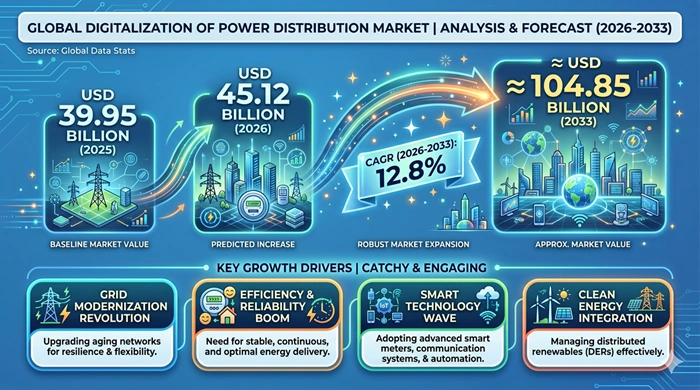
The global digitalization of power distribution market size is valued at USD 39.95 billion in 2025 and is predicted to increase from USD 45.12 billion in 2026 to approximately USD 104.85 billion by 2033, growing at a CAGR of 12.8% from 2026 to 2033.
The digitalization of power distribution is reshaping energy infrastructure across the globe, driven by the urgent need for smarter, more reliable, and more efficient grid systems. The integration of IoT, advanced metering infrastructure (AMI), grid automation, and cloud-based energy management platforms is enabling utilities, industries, and governments to optimize power flow, reduce losses, and accelerate the transition toward clean energy ecosystems.
AI Impact on the Digitalization of Power Distribution Industry
Artificial Intelligence Is Accelerating Smart Grid Transformation, Predictive Maintenance, and Real-Time Distribution Optimization Across the Global Power Infrastructure Landscape
Artificial intelligence is rapidly becoming one of the most impactful enabling forces across the digitalization of power distribution space. AI-driven analytics platforms are now being deployed to monitor distribution network performance in real time, detecting anomalies, predicting equipment failures, and automatically rerouting power flows to prevent outages. These capabilities are fundamentally changing how utilities manage complex grid systems — moving from reactive maintenance models to proactive, data-driven operational frameworks that significantly reduce downtime and operating costs.
Beyond grid management, AI is transforming demand forecasting and load balancing in distribution networks. Machine learning models can now analyze massive datasets from smart meters, weather sensors, and consumption patterns to predict demand fluctuations with high accuracy, enabling grid operators to optimize generation scheduling and distribution in advance. AI-powered digital twin technologies — which create virtual replicas of physical distribution assets — are also gaining traction, allowing utilities to simulate grid scenarios, test upgrades virtually, and make better-informed capital investment decisions without disrupting live operations.
Growth Factors
Accelerating Smart Grid Investments, Renewable Energy Integration Imperatives, and Stringent Energy Efficiency Regulations Are the Primary Forces Driving the Digitalization of Power Distribution Market
The most powerful growth catalyst for the digitalization of power distribution market is the global wave of smart grid investment being driven by both government mandates and utility modernization programs. Aging electrical infrastructure in North America, Europe, and parts of Asia is creating urgent demand for digital upgrades that improve grid reliability, reduce technical losses, and enable two-way communication between utilities and consumers. Governments across major economies are allocating substantial capital to grid modernization initiatives — including the US Infrastructure Investment and Jobs Act, the EU's smart energy systems framework, and China's State Grid digitalization programs — all of which are directly expanding the addressable market for digital power distribution solutions.
The accelerating global transition to renewable energy is equally critical as a growth driver. Solar, wind, and other variable renewable sources introduce new complexity into power distribution management, as grid operators must manage intermittent generation, bidirectional power flows from distributed energy resources (DERs), and increasing demand from electric vehicle charging infrastructure. Digital solutions — including distribution management systems (DMS), advanced SCADA platforms, and IoT-enabled sensors — are essential tools for managing this complexity and maintaining grid stability. As renewable energy penetration rates climb across all major markets, the demand for sophisticated digital power distribution technologies will continue to grow in parallel.

Market Outlook
The Digitalization of Power Distribution Market Is Poised for a Decade of High-Growth Expansion, Backed by Energy Transition Momentum, Digital Infrastructure Investment, and Emerging Market Electrification
Looking ahead through 2033, the digitalization of power distribution market is set to experience exceptionally strong and sustained expansion. The convergence of multiple structural tailwinds — including electrification of transport and industry, decentralized energy resource integration, and the global push toward net-zero carbon emissions — will continue to generate enormous demand for advanced digital solutions in power distribution. Companies that can deliver integrated platforms combining grid automation, real-time analytics, cybersecurity, and cloud-based asset management will capture the most significant market opportunities over the forecast period.
Emerging economies across Asia-Pacific, Africa, Latin America, and the Middle East are increasingly becoming important growth engines for this market. Rapid urbanization, industrial expansion, and the need to improve energy access in underserved regions are driving significant investment in greenfield digital distribution infrastructure — often bypassing older analog technologies altogether and deploying modern digital systems from the outset. This leapfrogging dynamic, combined with international development financing directed at energy infrastructure, positions emerging markets as key contributors to accelerated growth in the global digitalization of power distribution landscape through 2033.
Expert Speaks
-
Peter Weckesser, Chief Digital Officer, Schneider Electric — "The pace of digital transformation in power distribution has never been more urgent. Utilities are recognizing that intelligent, connected distribution systems are not a future aspiration — they are an immediate operational necessity as the energy landscape becomes increasingly distributed and complex."
-
Guido Jouret, Chief Digital Officer, ABB Ltd. — "We are at an inflection point where digitalization in power distribution is moving from incremental improvement to fundamental transformation. Our investments in AI-driven grid management tools and digital substations are directly aligned with where utilities and industrial customers need to go over the next decade."
-
Nathalie Marcotte, President, Siemens Digital Industries — "The integration of digital technologies across power distribution networks is accelerating globally, and Siemens is well-positioned to lead this evolution. Real-time visibility, predictive intelligence, and automated control are becoming the new baseline expectations for grid operators worldwide."
Key Report Takeaways
-
North America leads the digitalization of power distribution market, holding approximately 36% of global revenue in 2025, supported by large-scale government-backed grid modernization programs, high levels of utility digitalization investment, and early adoption of advanced metering infrastructure and smart distribution management systems
-
Asia-Pacific is the fastest-growing region, projected to expand at a CAGR of over 15.2% through 2033, driven by massive grid infrastructure investment in China and India, rapid urbanization, and strong government mandates for smart energy systems and renewable energy integration
-
Utilities represent the dominant end-user segment, accounting for approximately 48% of total end-user revenue in 2025, driven by their large-scale adoption of grid automation, advanced SCADA systems, distribution management software, and smart metering infrastructure to modernize aging distribution networks
-
Grid automation solutions are the leading solution segment, contributing the highest share of revenue within the digitalization of power distribution market in 2025, reflecting the widespread deployment of automated switching, fault detection, and self-healing grid technologies at utilities globally
-
Advanced Metering Infrastructure (AMI) and smart meters are the most widely adopted technology segment, reflecting their foundational role in enabling real-time consumption monitoring, demand response programs, and the two-way data communication essential for fully digital distribution networks
-
Cloud-based distribution management platforms represent the fastest-growing future technology segment, projected to grow at a CAGR of 17.3% through 2033 and reach approximately 18% market share by 2033, driven by scalability advantages, lower total cost of ownership, and the growing preference for software-as-a-service (SaaS) energy management solutions
Market Scope
| Report Coverage | Details |
|---|---|
| Market Size by 2033 | USD 104.85 Billion |
| Market Size by 2025 | USD 39.95 Billion |
| Market Size by 2026 | USD 45.12 Billion |
| Market Growth Rate (2026–2033) | CAGR of 12.8% |
| Dominating Region | North America |
| Fastest Growing Region | Asia-Pacific |
| Base Year | 2025 |
| Forecast Period | 2026 – 2033 |
| Segments Covered | Solution, Technology, End User, Deployment Mode |
| Regions Covered | North America, Europe, Asia-Pacific, Latin America, Middle East & Africa |
Market Dynamics
Drivers Impact Analysis
Massive Smart Grid Investment Programs, Renewable Energy Grid Integration Demands, and Accelerating Electrification of Transport Are the Core Forces Propelling the Digitalization of Power Distribution Market
| Driver | ≈ % Impact on CAGR Forecast | Geographic Relevance | Impact Timeline |
|---|---|---|---|
| Government-funded smart grid and grid modernization programs | ~32% | Global, especially North America, Europe, and China | Short to Long-term |
| Renewable energy integration requiring digital grid management | ~26% | Global | Medium to Long-term |
| Rising EV adoption increasing demand-side grid complexity | ~18% | North America, Europe, Asia-Pacific | Short to Medium-term |
| Aging power distribution infrastructure requiring digital upgrades | ~15% | North America, Europe | Short to Long-term |
| Growing industrial IoT adoption in energy management | ~9% | Asia-Pacific, North America, Europe | Medium to Long-term |
Government-driven investment is unquestionably the most significant and immediate driver for the digitalization of power distribution market. Legislative programs in major economies — from the United States' multi-billion-dollar grid modernization funding under federal infrastructure legislation to the European Union's smart energy system directives — are creating mandatory and commercially bankrolled demand for digital distribution solutions at a scale that private market forces alone could not generate. These programs fund the deployment of advanced metering infrastructure, automated substations, distribution management systems, and real-time grid monitoring platforms across millions of distribution nodes.
Renewable energy integration is the second structural driver with the deepest long-term implications. As solar and wind capacity continues to expand across all major energy markets, utilities are being forced to fundamentally rearchitect their distribution networks to handle variable generation, bidirectional power flows, and the management of millions of distributed energy resources. The complexity of coordinating this new generation landscape in real time is only manageable through sophisticated digital solutions, making the digitalization of power distribution a non-negotiable operational requirement for utilities pursuing their energy transition objectives.

Restraints Impact Analysis
High Implementation Costs, Cybersecurity Vulnerabilities in Connected Grid Systems, and Shortage of Digital Energy Workforce Are the Primary Factors Moderating Market Expansion
| Restraint | ≈ % Impact on CAGR Forecast | Geographic Relevance | Impact Timeline |
|---|---|---|---|
| High upfront capital cost for digital infrastructure deployment | ~30% | Emerging markets, smaller utilities | Short to Medium-term |
| Cybersecurity risks in internet-connected grid infrastructure | ~28% | Global | Ongoing |
| Shortage of skilled digital energy workforce | ~22% | Global, especially emerging markets | Medium to Long-term |
| Regulatory and interoperability challenges across jurisdictions | ~12% | Europe, Asia-Pacific | Medium-term |
| Legacy system integration complexity | ~8% | North America, Europe | Short to Medium-term |
The high capital cost associated with deploying digital power distribution infrastructure remains one of the most significant barriers, particularly for smaller utilities and governments in lower-income countries. Upgrading distribution networks to digital standards requires substantial investment in hardware — including smart meters, sensors, digital substations, and communication infrastructure — as well as software platforms, system integration, and staff training. For developing nations, these upfront costs can be prohibitive without substantial international financing or grant support.
Cybersecurity represents a growing and persistent restraint. As distribution networks become increasingly connected through IoT sensors, cloud platforms, and two-way communication systems, they also become more exposed to cyber threats. Ransomware attacks on energy infrastructure have demonstrated the potentially catastrophic consequences of security vulnerabilities in digitalized grid systems. Utilities and governments are now required to invest heavily in cybersecurity frameworks alongside their digital deployment programs — adding cost and complexity that can slow adoption, particularly in regions with less mature cybersecurity governance structures.
Opportunities Impact Analysis
EV Charging Infrastructure Expansion, Microgrid and DER Management Platforms, and Digital Twin Technology Adoption Present the Most Compelling Growth Opportunities Ahead
| Opportunity | ≈ % Impact on CAGR Forecast | Geographic Relevance | Impact Timeline |
|---|---|---|---|
| EV charging infrastructure and smart grid co-optimization | ~30% | North America, Europe, China | Short to Long-term |
| Microgrid and distributed energy resource management platforms | ~28% | Global | Medium to Long-term |
| Cloud-based distribution management SaaS expansion | ~22% | North America, Europe, Asia-Pacific | Short to Medium-term |
| Digital twin deployment for grid planning and optimization | ~12% | North America, Europe | Medium to Long-term |
| Greenfield digital grid deployment in emerging markets | ~8% | Africa, Southeast Asia, Latin America | Medium to Long-term |
The rapid proliferation of electric vehicles represents one of the most immediate and commercially significant opportunities in the digitalization of power distribution market. Managing EV charging loads — which can dramatically alter localized demand patterns — requires smart distribution systems capable of real-time demand response, load forecasting, and dynamic grid balancing. Technology companies and utilities that can deliver integrated EV-grid management platforms will be exceptionally well-positioned to capture revenue as EV penetration accelerates across North America, Europe, and China.
Emerging markets present a distinct but equally important opportunity category. Countries in Sub-Saharan Africa, Southeast Asia, and Latin America are deploying new electrical infrastructure to serve previously unelectrified populations — and increasingly choosing to deploy digital-native technologies from the outset rather than investing in legacy analog systems. This leapfrogging dynamic creates demand for cost-effective digital distribution solutions that can scale rapidly and operate reliably in environments with limited technical workforce, presenting unique market entry opportunities for agile solution providers.

Segment Analysis
By Solution
Grid Automation Solutions Lead the Digitalization of Power Distribution Market, Driven by Utilities' Urgent Need for Fault Detection, Self-Healing Capabilities, and Real-Time Network Control
Grid automation solutions represent the largest and most strategically important segment within the digitalization of power distribution market, accounting for approximately 42% of total solution-based revenue in 2025. This segment is projected to maintain a strong CAGR of 13.5% through 2033, fueled by the widespread deployment of automated switching systems, fault isolation and restoration (FDIR) technologies, and intelligent electronic devices (IEDs) across utility distribution networks. North America leads this segment with the largest regional revenue share, driven by the scale of utility grid modernization programs and the high concentration of major solution providers including Schneider Electric, Siemens AG, ABB Ltd., and General Electric Digital. These companies offer comprehensive grid automation platforms that integrate hardware, software, and advanced analytics into unified distribution management ecosystems.
Europe is the second-largest geography for grid automation adoption, with Germany, the United Kingdom, France, and the Netherlands all implementing large-scale distribution automation programs aligned with EU clean energy transition directives. Asia-Pacific is the fastest-growing region within this segment, where China's State Grid Corporation is deploying one of the world's most ambitious grid digitalization programs, investing tens of billions of dollars annually in automated substation, distribution management, and smart metering infrastructure. The segment is also gaining significant momentum in India, where the government's Revamped Distribution Sector Scheme (RDSS) is funding distribution automation deployments across dozens of state utilities. As self-healing and AI-enhanced grid automation technologies mature, this segment's share of the overall digitalization of power distribution market is expected to continue expanding throughout the forecast period.
By End User
Utilities Dominate the End-User Segment as the Primary Deployers of Digital Distribution Infrastructure, While Industrial Customers Emerge as the Fastest-Growing End User Category
The utilities segment accounts for the largest share of end-user revenue in the digitalization of power distribution market, contributing approximately 48% of total end-user revenue in 2025. Utilities are projected to sustain a CAGR of 12.1% through 2033, driven by their role as the primary deployers of grid-scale digital infrastructure including smart meters, advanced distribution management systems, digital substations, and real-time SCADA platforms. North America and Europe are the leading regions for utility-sector digitalization spending, where regulatory frameworks requiring grid reliability improvements and efficiency gains are directly compelling capital allocation toward digital technologies. Key companies serving this end-user segment include Schneider Electric, Siemens AG, ABB Ltd., Landis+Gyr, Eaton Corporation, and Honeywell, all of which offer utility-focused digital platform portfolios.
Industrial end users represent the fastest-growing customer category in the digitalization of power distribution market, with a projected CAGR of 15.8% through 2033, driven by the rapid adoption of industrial IoT, energy management systems, and microgrids in manufacturing, data center, and commercial building applications. Asia-Pacific leads industrial-sector demand growth, where manufacturing-intensive economies in China, South Korea, Japan, and India are investing heavily in digital energy management platforms to improve operational efficiency, reduce power costs, and meet increasingly stringent corporate sustainability targets. Companies like Eaton Corporation, Legrand, Honeywell International, and CHINT are particularly active in serving industrial customers across the region, offering digital power distribution solutions tailored for high-density, mission-critical operational environments.

Regional Insights
North America
North America Dominates the Digitalization of Power Distribution Market With the Highest Revenue Share, Driven by Large-Scale Grid Modernization Programs, Policy Support, and Deep Utility Technology Adoption
North America holds the leading position in the global digitalization of power distribution market, accounting for approximately 36% of total revenue in 2025 and projected to maintain a CAGR of 11.9% through 2033. The United States is the dominant national market, fueled by federal and state-level grid modernization funding, a highly advanced utility sector, and the presence of world-leading technology companies specializing in digital energy solutions. The country's aging distribution infrastructure — much of it built decades ago — is being comprehensively upgraded through programs funded under the Infrastructure Investment and Jobs Act and utility capital expenditure plans. Canada also contributes meaningfully to the regional market, with several provincial utilities implementing ambitious smart grid programs. Key companies shaping the North America digitalization of power distribution market include Schneider Electric, General Electric Digital, Eaton Corporation, Honeywell International, and Cisco Systems.
The region leads globally in the adoption of advanced metering infrastructure, with smart meter deployment rates exceeding 70% in the United States, enabling real-time two-way communication between utilities and consumers at scale. Regulatory pressure from bodies such as the Federal Energy Regulatory Commission (FERC) and state public utility commissions continues to mandate reliability and efficiency improvements that drive technology investment. The growing penetration of residential and commercial solar installations, combined with rapid EV adoption, is further accelerating demand for distribution-level digital management solutions across North America, making this region a persistent driver of global market growth throughout the forecast period.
Asia-Pacific
Asia-Pacific Is the Fastest-Growing Regional Market in the Digitalization of Power Distribution Space, Powered by China's Grid Modernization Scale, India's Distribution Reform Programs, and Southeast Asia's Rapid Energy Development
Asia-Pacific represents the most dynamic and high-growth regional market within the digitalization of power distribution landscape, projected to expand at a CAGR of 15.2% from 2026 to 2033 — by far the fastest growth rate of any global region. The region currently accounts for approximately 32% of global market share, with China, Japan, India, South Korea, and Australia emerging as the leading national markets. China alone is investing hundreds of billions of dollars in its power grid digitalization program, with the State Grid Corporation and China Southern Power Grid deploying smart meters, digital substations, and AI-powered distribution management systems across the country at an unparalleled scale. India is emerging as the second-largest growth driver, with its RDSS program targeting comprehensive distribution system upgrades across all state utilities. Key companies active across the Asia-Pacific market include Hitachi Energy, Siemens AG, ABB Ltd., CHINT Group, and MicroGRID Solutions, alongside a growing roster of regional players.
Government energy policy is the dominant force shaping market development across Asia-Pacific. China's carbon neutrality commitments, India's 24×7 power for all initiative, and national renewable energy targets across Southeast Asia are all creating strong policy tailwinds for digital grid investment. The rapidly expanding installed base of solar and wind capacity across the region is creating an urgent operational need for sophisticated distribution management solutions capable of handling intermittent generation and bidirectional power flows. With a combination of the largest greenfield investment pipeline globally, strong government policy direction, and a growing regional technology ecosystem, Asia-Pacific is positioned to be the most important single region for the digitalization of power distribution market throughout the entire 2026 to 2033 forecast period.
Top Key Players
-
Schneider Electric SE (France)
-
Siemens AG (Germany)
-
ABB Ltd. (Switzerland)
-
General Electric (GE) Digital (United States)
-
Eaton Corporation plc (Ireland)
-
Honeywell International Inc. (United States)
-
Cisco Systems Inc. (United States)
-
Oracle Corporation (United States)
-
IBM Corporation (United States)
-
Landis+Gyr Group AG (Switzerland)
-
Hitachi Energy Ltd. (Switzerland)
-
Legrand S.A. (France)
-
CHINT Group Co. Ltd. (China)
-
Itron Inc. (United States)
Recent Developments
-
Schneider Electric (2025) — Announced the global expansion of its EcoStruxure Grid platform with new AI-powered predictive maintenance modules for distribution networks, enabling utilities to detect equipment degradation up to 72 hours before failure and integrate seamlessly with existing SCADA infrastructure across their service territories
-
ABB Ltd. (2025) — Completed the strategic acquisition of a European digital substation software specialist, significantly strengthening ABB's portfolio of cloud-native distribution automation tools and accelerating its ability to deliver end-to-end digital grid transformation solutions to utility customers across the European Union
-
Siemens AG (2024) — Launched its next-generation SICAM distribution management system with enhanced AI-based fault location and service restoration capabilities, with initial commercial deployments announced across major utility customers in Germany, the United States, and Australia as part of multi-year grid modernization partnerships
-
Eaton Corporation (2025) — Expanded its digital power management product lineup with the introduction of a new series of intelligent low-voltage switchgear equipped with built-in IoT sensors and cloud connectivity, targeting industrial microgrid and commercial building digitalization applications across North American and European markets
-
Hitachi Energy (2024) — Signed a major multi-year agreement with a leading South Asian national utility for the deployment of an advanced distribution management system and smart metering platform covering millions of connection points, marking one of the largest individual digitalization of power distribution contracts executed in the Asia-Pacific region
Market Trends
Edge Computing Integration in Grid Management, Cybersecurity-First Digital Infrastructure Design, and Distributed Energy Resource Orchestration Are the Most Defining Emerging Trends in This Market
One of the most consequential trends reshaping the digitalization of power distribution market is the rapid integration of edge computing technologies into distribution grid management architectures. Rather than routing all data through centralized cloud platforms — which introduces latency challenges for real-time grid control — leading utilities and technology providers are deploying edge computing nodes closer to distribution assets, enabling sub-millisecond decision-making for automated switching, fault isolation, and local voltage regulation. This edge-cloud hybrid architecture is becoming the standard design paradigm for new digital grid deployments, with companies like Cisco, ABB, and Siemens offering edge-enabled platforms specifically engineered for utility-grade reliability and performance requirements.
The second major trend is the growing prioritization of cybersecurity as a foundational design principle — rather than an afterthought — in digital power distribution systems. High-profile cyberattacks on energy infrastructure in multiple countries have elevated grid cybersecurity from a compliance checkbox to a board-level strategic priority for utilities worldwide. This is driving strong demand for cybersecurity-integrated grid management platforms, real-time threat monitoring services, and zero-trust network architectures specifically designed for operational technology (OT) environments. Companies that can offer comprehensive, natively secure digital distribution solutions are increasingly winning large-scale utility contracts over competitors with less mature cybersecurity capabilities.
Segments Covered in the Report
By Solution:
-
Grid Automation Systems
-
Advanced Metering Infrastructure (AMI) and Smart Meters
-
Distribution Management Systems (DMS)
-
SCADA and Energy Management Systems
-
Cybersecurity Solutions for Grid Infrastructure
-
Others
By Technology:
-
IoT-Enabled Sensors and Devices
-
AI and Machine Learning Analytics Platforms
-
Cloud-Based Energy Management Software
-
Edge Computing Systems
-
Digital Twin Technology
-
Others
By End User:
-
Utilities
-
Industrial Customers
-
Commercial and Residential Buildings
-
Data Centers
-
Others
By Deployment Mode:
-
Cloud-Based Deployment
-
On-Premise Deployment
-
Hybrid Deployment
By Region:
-
North America (United States, Canada, Mexico)
-
Europe (Germany, United Kingdom, France, Italy, Netherlands, Rest of Europe)
-
Asia-Pacific (China, Japan, India, South Korea, Australia, Rest of Asia-Pacific)
-
Latin America (Brazil, Argentina, Rest of Latin America)
-
Middle East & Africa (UAE, Saudi Arabia, South Africa, Rest of MEA)
Frequently Asked Questions
Question 1: What is the current size of the global digitalization of power distribution market?
Answer: The global digitalization of power distribution market is valued at USD 39.95 billion in 2025 and is projected to reach USD 104.85 billion by 2033. It is growing at a CAGR of 12.8% from 2026 to 2033, driven by smart grid investment, renewable energy integration, and EV infrastructure expansion.
Question 2: Which region dominates the digitalization of power distribution market?
Answer: North America holds the leading position in the digitalization of power distribution market with approximately 36% of global revenue in 2025. Large-scale utility modernization programs, strong regulatory frameworks, and high smart meter penetration are the key factors behind this regional dominance.
Question 3: Which solution segment leads the digitalization of power distribution market?
Answer: Grid automation solutions are the leading segment in the digitalization of power distribution market, accounting for approximately 42% of solution-based revenue in 2025. Their leadership reflects the widespread utility deployment of automated switching, fault detection, and self-healing grid technologies globally.
Question 4: What are the main drivers of growth in the digitalization of power distribution market?
Answer: Government-funded smart grid programs and the need to integrate renewable energy sources are the primary drivers of the digitalization of power distribution market. Rising EV adoption, aging infrastructure replacement demand, and industrial IoT deployment are additional forces accelerating market expansion.
Question 5: What future technologies will shape the digitalization of power distribution market through 2033?
Answer: Cloud-based distribution management platforms and AI-powered predictive analytics are the most critical future technologies in the digitalization of power distribution market. Edge computing integration and digital twin adoption are also expected to significantly transform how utilities plan, operate, and optimize their distribution networks.