
Data Center Rack Market Overview
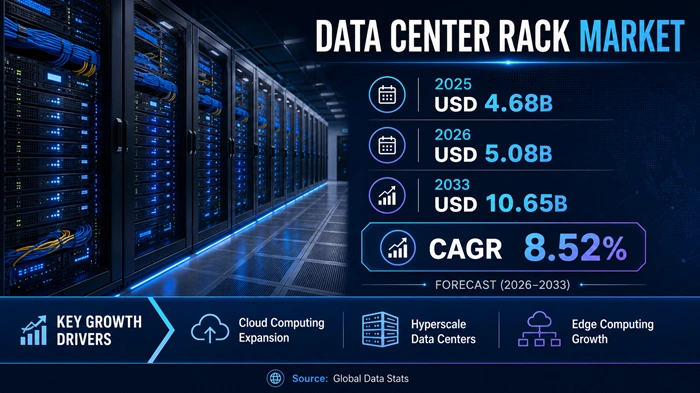
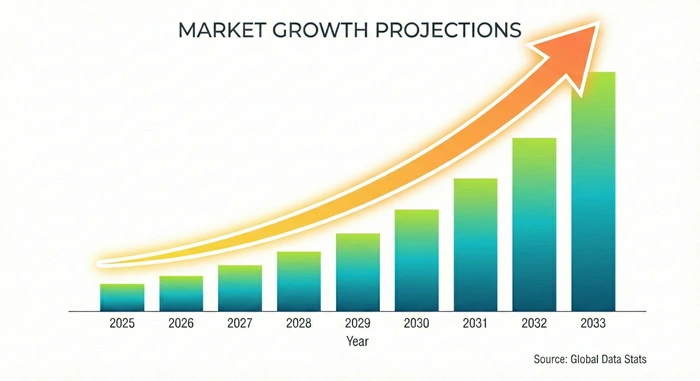
The global data center rack market size is valued at USD 4.68 billion in 2025 and is predicted to increase from USD 5.08 billion in 2026 to approximately USD 10.65 billion by 2033, growing at a CAGR of 8.52% from 2026 to 2033.
The data center rack market encompasses standardized frames and enclosures designed to mount, organize, and secure multiple electronic equipment modules including servers, storage systems, networking devices, and power distribution units within data center facilities.
Rising cloud computing adoption, accelerating hyperscale data center construction, and growing demand for high-density server deployments drive substantial market expansion worldwide. Organizations increasingly recognize that purpose-built rack solutions deliver superior space utilization, thermal management, and operational efficiency compared to improvised mounting approaches lacking standardization and optimization. The market benefits from technological advancements including intelligent power distribution, integrated cooling systems, modular designs, and remote monitoring capabilities that transform racks from passive infrastructure into active management platforms supporting digital transformation initiatives.
AI Impact on the Data Center Rack Industry
High-Density Computing and Thermal Challenges Transform Infrastructure Requirements
Artificial intelligence is fundamentally reshaping the data center rack market by creating unprecedented demand for high-density computing infrastructure capable of supporting GPU-intensive workloads that generate extreme heat loads exceeding 40 kilowatts per rack. AI training and inference operations require specialized server configurations with multiple high-performance GPUs, massive memory capacity, and high-speed interconnects that consume substantially more power and generate dramatically more heat than traditional computing workloads. Modern AI-optimized racks must accommodate power densities ranging from 30 to 200 kilowatts per rack, far exceeding conventional 5 to 15 kilowatt configurations, necessitating complete redesigns of rack architecture, power delivery, and cooling systems. Data center operators deploying AI infrastructure face critical decisions around liquid cooling integration, rear-door heat exchangers, and immersion cooling technologies that traditional air-cooled rack designs cannot adequately support.
The integration of AI and machine learning into data center operations drives demand for intelligent rack systems incorporating sensors, monitoring software, and automated management capabilities that optimize performance and prevent failures. AI-powered rack management platforms continuously monitor temperature, humidity, power consumption, and equipment health across distributed infrastructure, predicting maintenance needs, detecting anomalies, and recommending optimization strategies through predictive analytics. Smart rack systems leverage machine learning algorithms to analyze historical performance data, identify efficiency improvement opportunities, and automatically adjust cooling, power distribution, and equipment configurations maximizing resource utilization. Furthermore, AI workload deployment accelerates adoption of modular rack solutions supporting rapid capacity expansion, flexible configuration adjustments, and scalable infrastructure meeting unpredictable demand spikes associated with training large language models and processing massive datasets.
Growth Factors
Cloud Migration and Edge Computing Expansion Accelerate Infrastructure Deployment
The accelerating global migration toward cloud computing and hybrid IT architectures represents the primary driver propelling data center rack market expansion as enterprises shift workloads from on-premise servers to cloud service providers requiring massive hyperscale data center construction. Cloud computing growth fuels demand for standardized, high-density rack configurations supporting efficient equipment deployment, optimal space utilization, and consistent operational practices across geographically distributed facilities. Major cloud providers including Amazon Web Services, Microsoft Azure, Google Cloud, and emerging regional operators collectively invest hundreds of billions in data center infrastructure annually, driving sustained rack procurement across North America, Europe, and Asia Pacific. Organizations recognize that cloud adoption fundamentally transforms IT infrastructure requirements from scattered server rooms into concentrated mega-facilities where rack standardization, modularity, and efficiency determine competitive advantage.
The rapid proliferation of edge computing infrastructure creates substantial demand for data center rack market products as 5G networks, Internet of Things deployments, and low-latency applications necessitate distributed micro data centers positioned closer to end users. Edge computing architectures require compact, ruggedized rack solutions optimized for space-constrained environments including retail locations, cell towers, manufacturing facilities, and remote sites lacking traditional data center environmental controls. Telecommunications providers deploying 5G infrastructure install thousands of edge computing nodes requiring specialized rack enclosures protecting equipment from harsh conditions while maintaining accessibility for maintenance. The estimated rise of edge computing through 2030 and beyond creates sustained growth opportunities for rack vendors developing purpose-built solutions addressing unique edge requirements including smaller footprints, enhanced security, and simplified deployment. Additionally, increasing data center consolidation and modernization initiatives drive rack replacement cycles as organizations retire aging infrastructure in favor of high-density configurations supporting virtualization, containerization, and software-defined infrastructure maximizing hardware utilization.
Market Outlook
Sustainability Regulations and Liquid Cooling Integration Transform Industry Standards
The data center rack market outlook remains exceptionally positive as converging trends including AI workload growth, sustainability regulations, and cooling technology evolution create opportunities for innovative rack solutions addressing next-generation requirements. Energy efficiency regulations including ASHRAE guidelines and European Union directives mandate improved thermal management, driving demand for advanced rack designs incorporating hot aisle/cold aisle containment, intelligent airflow management, and integration with precision cooling systems. Market participants invest heavily in research and development to enhance rack capabilities through modular power distribution, built-in environmental monitoring, cable management innovations, and compatibility with liquid cooling infrastructure supporting extreme power densities. Strategic partnerships between rack manufacturers, cooling system providers, and data center operators accelerate technology adoption through integrated solutions, reference architectures, and validated designs reducing deployment risks.
North America maintains market leadership with the United States data center rack market projected to reach USD 3.60 billion by 2034 from USD 1.61 billion in 2025, growing at 9.37% CAGR driven by hyperscale expansion, colocation growth, and enterprise modernization. The transition toward liquid cooling represents a transformative shift affecting rack design as AI workloads, cryptocurrency mining, and high-performance computing applications exceed air cooling capabilities. Liquid cooling implementations including rear-door heat exchangers, direct-to-chip cooling, and immersion systems require rack modifications supporting coolant distribution, leak detection, and integration with facility-wide thermal management infrastructure. The data center rack market benefits from colocation facility expansion as enterprises increasingly prefer outsourcing infrastructure management while maintaining flexibility, with retail and wholesale colocation offerings requiring standardized rack configurations supporting multi-tenant deployments. Industry analysts project sustained growth through the forecast period with Asia Pacific demonstrating fastest expansion driven by digital transformation initiatives, cloud adoption acceleration, and massive data center investments across China, India, Singapore, and Indonesia.
Expert Speaks
-
John Freeman, CEO of Digital Edge, announced a landmark USD 4.5 billion investment to build CGK Campus, one of Indonesia's largest AI-ready hyperscale data center campuses in Bekasi with 500MW capacity, emphasizing that the CGK Campus represents a pivotal milestone in their Asia Pacific strategy and their largest infrastructure investment to date, positioning Digital Edge at the forefront of powering digital transformation across the region with sustainable, carrier-neutral infrastructure built for hyperscale and AI deployments.
-
Stephanus Oscar, CEO of Digital Edge Indonesia, highlighted that Indonesia's digital economy is expanding faster than infrastructure can keep up, explaining that the CGK Campus bridges that gap with 500MW of sustainable, carrier-neutral capacity built for hyperscale and AI deployments, while emphasizing that with AI shaping the future of enterprise and cloud services, Digital Edge is at the forefront of this transformation delivering high-performance, secure, and sustainable infrastructure solutions.
-
Industry analysts from ResearchAndMarkets, reported that with the global rise in colocation facilities and the growing demand for high-density server deployments, data centers are increasingly adopting taller, deeper, and wider rack configurations to optimize space and performance, noting that the orientation and structure of rack enclosures also significantly influence energy efficiency, making them a key factor in designing sustainable data center environments, creating growing opportunities for vendors to develop and offer rugged, advanced rack solutions tailored for demanding operating conditions.
Key Report Takeaways
-
North America leads the global data center rack market with approximately 35% to 40% regional share in 2024-2025, driven by extensive hyperscale data center presence, robust colocation industry, strong cloud service provider concentration, and the United States market projected to reach USD 3.60 billion by 2034 from USD 1.61 billion in 2025 at 9.37% CAGR.
-
Asia Pacific represents the fastest-growing regional market, expected to demonstrate exceptional expansion through 2033, fueled by massive digital infrastructure investments, government smart city initiatives, cloud adoption acceleration, and major data center construction across China, India, Singapore, and Indonesia with Digital Edge announcing USD 4.5 billion investment in Indonesia's largest AI-ready hyperscale campus.
-
Cabinet racks dominate market demand with over 55% share in 2025, significantly outperforming open frame alternatives as enterprises prioritize secure, enclosed configurations providing physical protection, organized cable management, airflow optimization, and high-density server housing particularly suitable for hyperscale and colocation facilities.
-
19-inch rack width maintains industry standard dominance projected to grow at 8.9% CAGR through 2030, driven by universal equipment compatibility, mature accessory ecosystems, space efficiency advantages, and decades of standardization enabling interoperability across vendors and simplified infrastructure planning.
-
IT & Telecom sector represents the largest end-user segment capturing approximately 38% market share in 2025, driven by proliferation of digital platforms, data-intensive applications, rapid 5G infrastructure deployment, and demand for highly scalable server rack enclosures supporting cloud computing, virtualization, and high-speed connectivity.
-
High-density deployments accelerate with power densities exceeding 40 kilowatts per rack becoming increasingly common, driven by AI workload adoption, GPU server configurations, and advanced computing applications necessitating liquid cooling integration, enhanced power distribution, and specialized thermal management solutions transforming traditional rack design paradigms.
Market Scope
| Report Coverage Details | |
|---|---|
| Market Size by 2033 | USD 10.65 Billion |
| Market Size by 2025 | USD 4.68 Billion |
| Market Size by 2026 | USD 5.08 Billion |
| Market Growth Rate from 2026 to 2033 | CAGR of 8.52% |
| Dominating Region | North America |
| Fastest Growing Region | Asia Pacific |
| Base Year | 2025 |
| Forecast Period | 2026 to 2033 |
| Segments Covered | Type, Rack Width, End User, Data Center Type, Region |
| Regions Covered | North America, Europe, Asia Pacific, Latin America, Middle East & Africa |
Market Dynamics
Drivers Impact Analysis
Hyperscale Expansion and Cloud Adoption Propel Infrastructure Demand
| Factor | (≈) % Impact on CAGR Forecast | Geographic Relevance | Impact Timeline |
|---|---|---|---|
| Hyperscale data center growth | 3.2% | North America, Asia Pacific | Immediate and ongoing |
| Cloud computing adoption | 2.8% | Global markets | Immediate and ongoing |
| High-density server deployment | 2.1% | North America, Europe, expanding Asia Pacific | Short-term |
| Edge computing proliferation | 1.9% | Global, urban metros | Long-term |
The explosive growth of hyperscale data centers represents the most significant driver propelling data center rack market expansion as major cloud service providers, social media platforms, and technology companies construct mega-facilities housing hundreds of thousands of servers requiring standardized, high-density rack configurations. Hyperscale operators including Amazon Web Services, Microsoft, Google, Meta, and Alibaba collectively manage thousands of data centers globally, continuously expanding capacity to meet soaring demand for cloud computing, streaming services, social networking, and artificial intelligence applications. These massive facilities prioritize operational efficiency, standardization, and scalability, driving preference for purpose-designed rack solutions optimizing space utilization, power distribution, and thermal management across uniform deployments. Hyperscale data center construction accelerates particularly across North America and Asia Pacific where land availability, power infrastructure, and network connectivity support large-scale development.
Cloud computing adoption fundamentally transforms enterprise IT infrastructure strategies, creating sustained demand for data center rack market products as organizations migrate workloads from on-premise servers to cloud environments or adopt hybrid architectures requiring colocation facilities. The shift toward cloud-based applications, software-as-a-service platforms, and infrastructure-as-a-service offerings drives massive investments in data center capacity supporting digital transformation initiatives across industries. Enterprises increasingly recognize that cloud adoption delivers advantages including reduced capital expenditure, improved scalability, enhanced disaster recovery, and access to advanced technologies without maintaining internal expertise. High-density server deployments exceeding 40 kilowatts per rack become increasingly common as AI workloads, GPU-intensive computing, and advanced analytics applications require specialized configurations generating extreme heat loads necessitating enhanced rack designs supporting liquid cooling integration and robust power delivery. Additionally, edge computing proliferation drives demand for specialized rack solutions as 5G networks, Internet of Things deployments, and low-latency applications require distributed micro data centers positioned closer to end users in retail locations, cell towers, manufacturing facilities, and remote sites.
Restraints Impact Analysis
High Upfront Costs and Space Constraints Create Adoption Barriers
| Factor | (≈) % Impact on CAGR Forecast | Geographic Relevance | Impact Timeline |
|---|---|---|---|
| High capital investment | -1.8% | Small and medium enterprises | Ongoing |
| Data center space limitations | -1.5% | Urban areas, high-cost markets | Medium-term |
| Thermal management complexity | -1.3% | High-density deployments | Ongoing |
| Standardization challenges | -0.9% | Mixed vendor environments | Medium-term |
Substantial capital investment requirements associated with comprehensive rack infrastructure implementations create significant barriers to data center rack market adoption, particularly for small and medium enterprises operating budget-constrained IT environments. Complete rack deployments encompass not only the physical rack enclosures but also integrated power distribution units, uninterruptible power supplies, cooling systems, cable management accessories, monitoring equipment, and professional installation services that collectively represent major expenditures. Small organizations managing limited server footprints struggle to justify investments in premium rack solutions offering advanced features including intelligent power distribution, environmental monitoring, and modular expansion capabilities when basic open-frame alternatives appear adequate for immediate needs. Budget constraints force compromises on rack quality, accessories, and future-proofing considerations that subsequently create operational inefficiencies, maintenance difficulties, and costly infrastructure redesigns when capacity expansion becomes necessary.
Data center space limitations in urban markets and established facilities create constraints affecting data center rack market growth as real estate costs, power availability, and cooling capacity restrictions limit infrastructure expansion options. Metropolitan areas offering optimal network connectivity, customer proximity, and talent availability face escalating land prices and power infrastructure constraints making new data center construction prohibitively expensive. Existing data centers built decades ago lack the floor loading capacity, power density support, and cooling infrastructure required for modern high-density rack deployments, necessitating costly retrofits or facility relocations. Organizations operating space-constrained facilities must balance competing demands for server density, accessibility, thermal management, and compliance with fire codes and safety regulations that limit maximum rack heights, aisle widths, and equipment concentrations. Thermal management complexity surrounding high-density rack deployments exceeding 20 kilowatts per rack creates technical challenges as traditional air cooling approaches prove inadequate for extreme heat loads generated by GPU servers, AI accelerators, and cryptocurrency mining equipment. Additionally, standardization challenges emerge in heterogeneous environments mixing equipment from multiple vendors with varying rack mounting requirements, depth specifications, and power connector configurations complicating infrastructure planning and reducing interoperability benefits.
Opportunities Impact Analysis
Liquid Cooling Integration and Modular Solutions Create Growth Prospects
| Factor | (≈) % Impact on CAGR Forecast | Geographic Relevance | Impact Timeline |
|---|---|---|---|
| Liquid cooling adoption | 2.6% | AI and HPC deployments globally | Medium to long-term |
| Modular data center growth | 2.3% | Edge computing, remote locations | Medium-term |
| Sustainability mandates | 2.0% | Europe, North America | Ongoing |
| Colocation expansion | 1.7% | Global enterprise segment | Medium-term |
The accelerating transition toward liquid cooling technologies creates exceptional opportunities within the data center rack market as AI workloads, high-performance computing, and extreme-density deployments exceed air cooling capabilities necessitating rack redesigns supporting coolant distribution infrastructure. Liquid cooling implementations including rear-door heat exchangers, direct-to-chip cooling systems, and immersion cooling require specialized rack configurations accommodating coolant lines, leak detection sensors, and integration with facility-wide thermal management systems. AI-optimized data centers deploying GPU servers with power densities ranging from 30 to 200 kilowatts per rack find liquid cooling essential for maintaining operational temperatures, reducing energy consumption, and improving power usage effectiveness metrics. Rack manufacturers developing liquid cooling-ready solutions with integrated coolant distribution manifolds, leak containment systems, and compatibility with multiple cooling architectures gain competitive advantages as hyperscale operators and enterprises increasingly adopt these technologies.
Modular data center solutions create substantial opportunities for data center rack market vendors as organizations seek rapid deployment options, scalable capacity expansion, and flexible infrastructure supporting edge computing, disaster recovery, and temporary installations. Prefabricated modular data centers incorporating pre-configured rack systems, integrated cooling, power distribution, and monitoring capabilities enable deployment timelines measured in weeks rather than months or years required for traditional construction. Edge computing architectures driving micro data centers into retail stores, cell towers, manufacturing facilities, and remote locations require compact, ruggedized rack solutions optimized for space-constrained environments lacking traditional data center environmental controls. Sustainability mandates and energy efficiency regulations including European Union directives and ASHRAE guidelines drive demand for advanced rack designs incorporating intelligent airflow management, hot aisle/cold aisle containment, and integration with precision cooling systems reducing power consumption and carbon footprints. Additionally, colocation facility expansion creates sustained growth opportunities as enterprises increasingly prefer outsourcing infrastructure management while maintaining flexibility, with retail and wholesale colocation providers requiring standardized rack configurations supporting multi-tenant deployments, flexible power allocations, and secure segregation.
Segment Analysis
Cabinet Racks Dominance
Enclosed Security and Thermal Management Drive Segment Leadership
Cabinet racks command the dominant position within the data center rack market, accounting for over 55% market share in 2025, significantly outperforming open frame alternatives as enterprises prioritize secure, enclosed configurations providing physical protection, organized cable management, airflow optimization, and high-density server housing. These fully enclosed rack systems feature lockable doors, removable side panels, integrated cable management systems, and optimized airflow paths supporting hot aisle/cold aisle containment strategies that improve cooling efficiency and reduce energy consumption. Modern cabinet racks accommodate standardized 19-inch equipment mounting while providing flexibility for various heights measured in rack units, with 42U cabinets representing popular configurations balancing capacity with accessibility. Organizations deploying cabinet racks benefit from enhanced security protecting expensive equipment from theft, tampering, and accidental damage while maintaining professional appearances in customer-facing colocation facilities and corporate data centers.
North America and Europe demonstrate particularly strong cabinet rack adoption with enterprises, colocation providers, and hyperscale operators implementing standardized enclosures across their facilities to ensure consistency, simplify management, and optimize thermal performance. Leading manufacturers including Schneider Electric with NetShelter series, Vertiv with VR Rack systems, Eaton with SmartRack solutions, Rittal with customizable enclosures, and HPE with enterprise-grade cabinets collectively command 45% to 55% market share through comprehensive product portfolios addressing diverse requirements. The segment benefits from modular accessory ecosystems providing cable management trays, blanking panels, power distribution units, environmental monitoring sensors, and cooling enhancements that organizations customize based on specific deployment needs. Asia Pacific shows accelerating cabinet rack adoption driven by rapid data center construction, growing awareness of thermal management benefits, and enterprise preferences for professional-grade infrastructure supporting mission-critical applications. The data center rack market cabinet segment particularly advantages from AI workload growth as high-density GPU server configurations require enclosed systems supporting liquid cooling integration, robust power delivery, and containment preventing hot air recirculation.
IT & Telecom End-User Leadership
Digital Transformation and 5G Deployment Drive Sectoral Dominance
IT & Telecommunications represents the largest end-user segment within the data center rack market, capturing approximately 38% share in 2025, driven by proliferation of digital platforms, data-intensive applications, rapid 5G infrastructure deployment, and demand for highly scalable server rack enclosures supporting cloud computing and high-speed connectivity. The sector encompasses cloud service providers operating massive hyperscale facilities, telecommunications carriers deploying network equipment, internet service providers managing content delivery networks, and technology companies supporting social media, search, and streaming services requiring enormous computing capacity. Digital transformation initiatives across industries drive exponential data generation, storage, and processing requirements that IT infrastructure must support through continuously expanding data center footprints. Telecommunications providers deploying 5G networks install thousands of edge computing nodes requiring specialized rack solutions positioned at cell towers, central offices, and aggregation points supporting low-latency applications including autonomous vehicles, augmented reality, and industrial automation.
North America demonstrates particularly strong IT & Telecom rack adoption with Silicon Valley technology giants, major cloud providers, and telecommunications carriers collectively operating thousands of data centers requiring millions of rack units. The United States data center rack market within IT & Telecom sector benefits from robust cloud computing growth at 9.3% CAGR from 2024 to 2030, driven by prevalent cloud services, data-driven enterprises, and adoption of AI and IoT technologies. Leading technology companies including Amazon Web Services, Microsoft, Google, Meta, and Oracle continuously expand data center capacity supporting global services, driving sustained rack procurement across North America, Europe, and Asia Pacific regions. Asia Pacific shows exceptional growth potential with telecommunications carriers deploying 5G infrastructure, cloud providers establishing regional presence, and technology companies serving massive user populations across China, India, Southeast Asia, and Indonesia. The segment benefits from standardization around 19-inch rack widths enabling interoperability, simplified equipment procurement, and consistent deployment practices across geographically distributed facilities. Hyperscale and colocation deployment models dominate IT & Telecom rack demand as organizations prefer purpose-built mega-facilities or outsourced infrastructure over distributed enterprise data centers.
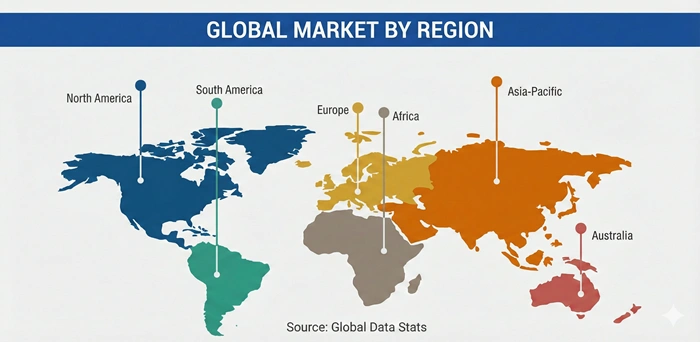
Regional Insights
North America Market Leadership
Hyperscale Concentration and Cloud Leadership Drive Regional Dominance
North America commands substantial leadership within the data center rack market, maintaining approximately 35% to 40% regional share in 2024-2025, driven by extensive hyperscale data center presence, robust colocation industry, strong cloud service provider concentration, and the United States market projected to reach USD 3.60 billion by 2034 from USD 1.61 billion in 2025 at 9.37% CAGR. The United States hosts the world's largest concentration of hyperscale data centers operated by Amazon Web Services, Microsoft Azure, Google Cloud, Meta, and other technology giants collectively managing thousands of facilities supporting global cloud services, social media, search, and streaming applications. Silicon Valley, Northern Virginia, Dallas, Chicago, and other major markets serve as data center hubs offering optimal network connectivity, power infrastructure, and proximity to major internet exchange points. Canada demonstrates growing data center activity with favorable climate conditions supporting natural cooling, renewable energy availability, and proximity to United States markets creating attractive development opportunities.
Major rack manufacturers including Schneider Electric, Vertiv headquartered in Ohio, Eaton, and HPE maintain strong North American presence through extensive distribution networks, local manufacturing, and established customer relationships with hyperscale operators, colocation providers, and enterprises. The region benefits from early technology adoption, mature data center industry, and sophisticated understanding of thermal management, power distribution, and infrastructure optimization driving preference for advanced rack solutions. Regulatory support including tax incentives for data center construction, streamlined permitting processes, and power infrastructure investments facilitate continued expansion despite space constraints and rising real estate costs in prime locations. The data center rack market in North America particularly advantages from AI workload deployment as United States companies lead artificial intelligence development, necessitating specialized high-density rack configurations supporting GPU servers and liquid cooling integration. Colocation industry maturity with established providers offering retail and wholesale services creates sustained rack demand as enterprises increasingly prefer outsourcing infrastructure management while maintaining flexibility.
Asia Pacific Fastest Growth
Digital Infrastructure Investment and Cloud Expansion Drive Regional Acceleration
Asia Pacific emerges as the fastest-growing regional data center rack market, expected to command estimated 40% share by 2025 with the highest CAGR through 2032, propelled by massive digital infrastructure investments, government smart city initiatives, cloud adoption acceleration, and major data center construction across China, India, Singapore, and Indonesia. China represents the largest regional market with domestic technology giants including Alibaba, Tencent, Baidu, and ByteDance operating extensive hyperscale facilities supporting cloud services, social media, e-commerce, and video streaming for populations exceeding 1.4 billion users. Government policies promoting digital economy development, smart city programs, and 5G network deployment create favorable environments for data center investment across tier-one and tier-two cities. India demonstrates exceptional growth potential with the software-defined vehicle market projected expansion reflecting broader digital transformation momentum, while data center construction accelerates supporting cloud adoption, digital payments, and government digitalization initiatives.
Singapore establishes itself as Southeast Asia's primary data center hub with Digital Edge and other operators investing billions in AI-ready hyperscale infrastructure serving regional cloud demand, financial services, and multinational corporations requiring secure, reliable facilities. Indonesia experiences transformative growth with Digital Edge announcing landmark USD 4.5 billion investment to build CGK Campus, one of the country's largest AI-ready hyperscale data center campuses with 500MW capacity in Bekasi, marking the company's largest infrastructure commitment powering digital transformation across Asia Pacific. The data center rack market in Asia Pacific particularly benefits from telecommunications carrier investments deploying 5G infrastructure requiring edge computing nodes positioned throughout urban areas supporting low-latency applications. Regional rack demand encompasses diverse requirements from hyperscale facilities requiring thousands of standardized cabinets to edge deployments needing ruggedized compact solutions supporting harsh environmental conditions. Government initiatives including Indonesia's digital economy expansion, India's Digital India program, and China's 14th Five-Year Plan supporting digital infrastructure create sustained investment momentum driving rack procurement through the forecast period.
Top Key Players
-
Schneider Electric SE (France)
-
Vertiv Group Corp. (United States)
-
Eaton Corporation plc (Ireland)
-
Rittal GmbH & Co. KG (Germany)
-
Hewlett Packard Enterprise Company (United States)
-
Dell Technologies Inc. (United States)
-
IBM Corporation (United States)
-
Fujitsu Limited (Japan)
-
Legrand SA (France)
-
Cisco Systems Inc. (United States)
-
Oracle Corporation (United States)
-
Panduit Corp. (United States)
-
Lenovo Group Limited (China)
-
CommScope Holding Company Inc. (United States)
-
Huawei Technologies Co. Ltd. (China)
Recent Developments
-
Vertiv Group Corp. (March 2025): Vertiv completed the acquisition of Emerson Network Power's Liebert business for approximately USD 3.7 billion, significantly expanding its data center offerings including a broad range of racks and power solutions while strengthening its market position in critical infrastructure serving enterprise, edge, and hyperscale environments with enhanced capabilities in power distribution particularly meeting demands of edge computing and AI workloads.
-
Digital Edge (January 2026): Digital Edge announced a landmark USD 4.5 billion investment to build CGK Campus, one of Indonesia's largest AI-ready hyperscale data center campuses in Bekasi with 500MW capacity, marking the company's largest infrastructure commitment to date and underscoring dedication to powering digital transformation in Asia Pacific with sustainable, carrier-neutral infrastructure built for hyperscale and AI deployments positioned less than 15 kilometers from major data center clusters.
-
BlackRock Global Infrastructure Partners (October 2025): BlackRock's Global Infrastructure Partners, along with UAE investment fund MGX and the AI Infrastructure Partnership consortium including Microsoft and Nvidia, moved forward with acquisition of Aligned Data Centers controlling more than 5 gigawatts of data center capacity across 50 campuses in the United States and Latin America, with transaction expected to close in first half of 2026 subject to regulatory approvals, reflecting unprecedented consolidation in data center infrastructure with transaction values reaching USD 73 billion in 2024 up from USD 26 billion in 2023.
-
IBM and Google Cloud (November 2024): IBM and Google Cloud entered into strategic partnership to accelerate adoption of hybrid multicloud solutions through joint go-to-market initiatives, technology integrations, and development of new offerings including integrated data center racks providing seamless connectivity between on-premises and cloud environments supporting enterprise digital transformation requirements.
-
Schneider Electric SE (2024-2025): Schneider Electric maintained market leadership position with advanced NetShelter rack solutions blending scalability and energy efficiency, emphasizing innovation through EcoStruxure platform enhancing real-time monitoring and power distribution capabilities while focusing on sustainability aligning with broader shift towards greener operations in data center industry serving enterprise, colocation, and edge data centers.
Market Trends
Liquid Cooling Integration and Modular Deployment Reshape Infrastructure Approaches
The accelerating adoption of liquid cooling technologies represents a transformative trend within the data center rack market, fundamentally changing thermal management approaches as AI workloads, high-performance computing, and extreme-density deployments exceed air cooling capabilities. Traditional air-cooled data centers supporting 5 to 15 kilowatt rack densities prove inadequate for modern GPU servers consuming 30 to 200 kilowatts per rack, necessitating liquid cooling implementations including rear-door heat exchangers, direct-to-chip cooling, and immersion systems. Rear-door heat exchangers retrofit onto existing cabinet racks, using chilled water circulating through radiator-like panels absorbing heat before it enters the data center environment, providing straightforward enhancement for air-cooled facilities without major infrastructure modifications. Direct-to-chip cooling transfers heat from processors to cold plates with liquid channels using single-phase water systems or two-phase fluorocarbon-based liquids offering 100 times better heat absorption through latent heat of evaporation, though requiring specialized rack plumbing and leak detection. Immersion cooling submerges entire servers in dielectric fluids eliminating traditional rack configurations but requiring purpose-built tanks and fluid management systems representing radical departures from conventional approaches.
Modular data center deployments demonstrate accelerating adoption as organizations seek rapid capacity expansion, flexible infrastructure supporting edge computing, and cost-effective solutions avoiding traditional construction timelines and expenses. Prefabricated modules incorporating pre-configured rack systems, integrated cooling, power distribution, fire suppression, and monitoring capabilities enable deployment measured in weeks with reduced complexity compared to conventional data center construction requiring months or years. The data center rack market benefits from modular approaches as vendors develop containerized solutions, micro data centers, and purpose-built edge computing enclosures supporting distributed architectures positioning computing resources closer to end users. Edge computing proliferation drives demand for ruggedized compact rack solutions deployable in retail stores, cell towers, manufacturing facilities, and outdoor environments lacking traditional data center environmental controls with features including enhanced sealing, temperature tolerance, and simplified serviceability. Additionally, sustainability focus intensifies as energy efficiency regulations, corporate carbon reduction commitments, and operational cost pressures motivate investments in intelligent rack systems optimizing airflow, supporting containment strategies, and integrating with facility-wide building management systems reducing power usage effectiveness.
Segments Covered in the Report
By Type:
-
Cabinet Racks
-
Standard Cabinet Racks
-
Seismic Cabinet Racks
-
Acoustic Cabinet Racks
-
-
Open Frame Racks
-
2-Post Open Frame Racks
-
4-Post Open Frame Racks
-
-
Wall-Mounted Racks
By Rack Width:
-
19-Inch Racks
-
23-Inch Racks
-
Other Rack Widths
By End User:
-
IT & Telecom
-
BFSI (Banking, Financial Services, Insurance)
-
Healthcare
-
Government
-
Retail
-
Education
-
Media & Entertainment
-
Manufacturing
By Data Center Type:
-
Hyperscale Data Centers
-
Colocation Facilities
-
Retail Colocation
-
Wholesale Colocation
-
-
Enterprise Data Centers
-
Edge Data Centers
By Region:
-
North America
-
United States
-
Canada
-
Mexico
-
-
Europe
-
Germany
-
United Kingdom
-
France
-
Italy
-
Spain
-
Rest of Europe
-
-
Asia Pacific
-
China
-
India
-
Japan
-
Singapore
-
Indonesia
-
Australia
-
Rest of Asia Pacific
-
-
Latin America
-
Brazil
-
Argentina
-
Rest of Latin America
-
-
Middle East & Africa
-
United Arab Emirates
-
Saudi Arabia
-
South Africa
-
Rest of Middle East & Africa
-
Frequently Asked Questions
Question 1: What is the projected data center rack market size by 2033?
Answer: The global data center rack market is projected to reach USD 10.65 billion by 2033, growing from USD 5.08 billion in 2026 at a CAGR of 8.52%.
Question 2: Which region dominates the data center rack market currently?
Answer: North America dominates the data center rack market with approximately 35% to 40% regional share in 2024-2025, driven by extensive hyperscale data center presence and robust cloud service provider concentration.
Question 3: What are the key drivers of data center rack market growth?
Answer: Key drivers include hyperscale data center expansion, cloud computing adoption acceleration, high-density server deployments exceeding 40 kilowatts per rack, and edge computing proliferation supporting 5G networks and IoT applications.
Question 4: Which rack type dominates the data center rack market?
Answer: Cabinet racks dominate with over 55% market share in 2025, outperforming open frame alternatives as enterprises prioritize secure enclosed configurations providing physical protection, cable management, and airflow optimization.
Question 5: How is liquid cooling impacting the data center rack market?
Answer: Liquid cooling adoption transforms rack design as AI workloads and GPU servers with 30 to 200 kilowatt densities exceed air cooling capabilities, necessitating specialized configurations supporting coolant distribution, leak detection, and integration with facility thermal management systems.