
Credit Default Swap (CDS) Market Overview
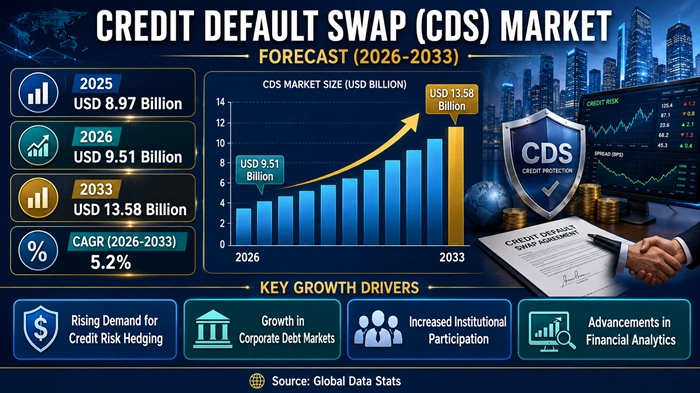
The global Credit Default Swap (CDS) market size is valued at USD 8.97 billion in 2025 and is predicted to increase from USD 9.51 billion in 2026 to approximately USD 13.58 billion by 2033, growing at a CAGR of 5.2% from 2026 to 2033. Credit default swaps are financial derivative instruments that allow one party to transfer credit risk associated with a borrower — typically a corporation or sovereign entity — to another party in exchange for periodic premium payments. As global financial markets grow more complex and interconnected, and as corporate debt volumes continue to rise, CDS instruments have become an indispensable tool for risk managers, institutional investors, hedge funds, and banks seeking to hedge credit exposure, discover pricing signals, and optimize portfolio-level capital efficiency.
AI Impact on the Credit Default Swap (CDS) Industry
Artificial Intelligence Is Transforming How Credit Risk Is Assessed, Priced, and Hedged — Giving CDS Market Participants a Significant Edge in an Increasingly Complex Global Credit Landscape
Artificial intelligence is fundamentally reshaping how participants in the credit default swap market analyze, price, and trade credit risk. Machine learning models are now capable of processing enormous volumes of macroeconomic data, corporate balance sheet indicators, news sentiment signals, and historical default patterns to generate real-time credit risk assessments that outperform traditional actuarial models. These AI-driven credit scoring systems allow banks, hedge funds, and asset managers to identify deteriorating credit conditions earlier, enabling more timely and cost-effective hedging through CDS instruments before spreads widen significantly. The speed and depth of AI-powered analysis is also improving execution quality in CDS trading, as algorithmic strategies increasingly dominate electronic trading platforms and centrally cleared market venues.
Beyond risk assessment, artificial intelligence is improving regulatory compliance and trade surveillance within the CDS ecosystem. Regulators in the U.S. and Europe now require detailed reporting of CDS trades, and AI tools are being deployed to automate compliance workflows, detect anomalous trading patterns, and flag potential market manipulation in real time. Natural language processing (NLP) models are analyzing earnings calls, regulatory filings, and geopolitical news to predict credit spread movements, while reinforcement learning systems are being piloted for dynamic portfolio hedging strategies. As electronic CDS trading platforms adopt AI-powered pricing engines, market participants will benefit from tighter bid-ask spreads, deeper liquidity, and more accurate valuations — collectively improving the overall efficiency of the credit default swap market.
Growth Factors
Surging Corporate Debt Issuance, Rising Geopolitical Uncertainty, and the Expanding Use of CDS for Portfolio Risk Management Are Driving Consistent Long-Term Market Growth
The single most powerful growth engine for the Credit Default Swap market is the dramatic expansion of global corporate and sovereign debt issuance. As governments and corporations continue to borrow heavily to finance infrastructure, technology investments, and post-pandemic recovery programs, the total outstanding stock of credit-sensitive instruments has reached historic highs. This creates proportional demand for credit risk hedging tools, and CDS contracts remain the most liquid, standardized, and effective mechanism available for transferring or managing that risk at scale. Central banks in major economies maintaining complex interest rate policies have also amplified credit spread volatility, making CDS pricing more dynamic and creating trading opportunities that attract increasing participation from hedge funds and proprietary trading desks.
Geopolitical risk — spanning trade tensions, regional conflicts, and sovereign fiscal pressures — has added another consistent demand driver for CDS instruments. Institutional investors managing cross-border credit portfolios increasingly rely on sovereign CDS to hedge against unexpected country-level credit events, while corporate credit default swap contracts are being used more aggressively by banks and asset managers to protect against sector-level stress in industries exposed to shifting trade policies. The growing sophistication of emerging market capital systems is also expanding the addressable universe of CDS contracts, as financial institutions in Asia Pacific, the Middle East, and Latin America develop the infrastructure and regulatory frameworks needed to actively participate in international credit derivative markets.

Market Outlook
Central Clearing Adoption, Evolving Regulatory Frameworks, and Growing Institutional Participation in Credit Derivatives Are Shaping a Resilient and Expanding CDS Market Through 2033
The medium-to-long-term outlook for the Credit Default Swap market remains constructive, supported by structural demand from large financial institutions managing complex credit portfolios and growing adoption of CDS among a broader range of market participants including insurance companies, pension funds, and institutional asset managers. The shift toward centrally cleared CDS transactions — driven by post-2008 regulatory reforms and reinforced by Dodd-Frank in the U.S. and EMIR in Europe — has significantly improved market transparency, reduced counterparty risk, and made CDS more accessible to participants who were previously deterred by bilateral exposure concerns. This structural improvement in market architecture is expected to support stable and growing transaction volumes through the forecast period.
Looking ahead to 2033, the rise of CDS index products as preferred instruments for portfolio-level credit hedging is expected to accelerate, as these indices offer greater liquidity, cost efficiency, and broader market exposure than single-name contracts. The expansion of the structured credit market — including collateralized loan obligations (CLOs) and synthetic CDOs — is also expected to sustain demand for CDS as a building block in structured product construction and hedging. Emerging market participants are gradually deepening their engagement with credit derivatives, and as domestic financial systems in countries like India, Brazil, and China become more sophisticated, new regional demand pools for CDS instruments are expected to develop. Combined with advancing electronic trading infrastructure and AI-powered pricing tools, these dynamics create a supportive environment for sustained market growth through 2033.
Expert Speaks
-
"The credit derivatives market continues to evolve as a cornerstone of global risk management — as corporate debt volumes grow and macroeconomic volatility persists, institutions that master credit risk tools like CDS will hold a clear advantage in building resilient, high-performing portfolios," — Jamie Dimon, Chairman & CEO, JPMorgan Chase & Co., highlighting the enduring strategic importance of credit risk management instruments in modern banking.
-
"We see growing demand from institutional clients for sophisticated credit hedging strategies, and the expansion of CDS index products alongside improvements in electronic trading infrastructure are making credit derivative markets more efficient and accessible than at any prior point in their history," — David Solomon, Chairman & CEO, Goldman Sachs Group, underscoring the evolution of the Credit Default Swap market toward greater transparency and participation.
-
"Central clearing and regulatory standardization have transformed how we operate in credit derivative markets — the combination of improved counterparty risk management and real-time trade reporting is creating a healthier, more liquid ecosystem that benefits all participants from large dealers to institutional end users," — James Gorman, Chairman, Morgan Stanley, emphasizing the structural improvements reshaping the CDS market's long-term trajectory.
Key Report Takeaways
-
North America leads the global Credit Default Swap market with a dominant share of approximately 44% in 2025, driven by the presence of the world's most active credit derivative dealers including JPMorgan Chase, Goldman Sachs, Bank of America, and Citigroup, combined with deep, liquid bond markets and a well-established regulatory framework under the Commodity Futures Trading Commission (CFTC)
-
Asia Pacific is the fastest-growing region, projected to expand at a CAGR of approximately 6.5% through 2033, as rapidly growing corporate debt markets, increasing capital market sophistication, and expanding institutional participation in credit derivatives across China, Japan, and India accelerate regional adoption of CDS instruments
-
Banks and financial institutions are the dominant end-user segment, commanding approximately 52% of the CDS market in 2025, as commercial and investment banks use credit default swaps extensively for balance sheet management, regulatory capital optimization, loan book hedging, and proprietary credit trading strategies
-
Corporate CDS contracts represent the largest reference entity segment, contributing approximately 46% of total market volume in 2025, driven by the enormous scale of global corporate bond markets and the widespread need among institutional investors to hedge company-specific default risk in high-yield and investment-grade credit portfolios
-
Over-the-Counter (OTC) trading remains the most common execution venue, holding a 58% platform share in 2025, though centrally cleared transactions are growing rapidly as regulatory mandates and risk management best practices push increasing volumes toward central counterparties
-
CDS Index products are the fastest-growing contract type, expected to grow at a CAGR of approximately 6.0% through 2033 with a current share of 38%, as institutional investors increasingly prefer index-based credit exposure for its superior liquidity, lower transaction costs, and more efficient broad-market hedging capabilities compared to single-name contracts
Market Scope
| Report Coverage | Details |
|---|---|
| Market Size by 2025 | USD 8.97 Billion |
| Market Size by 2026 | USD 9.51 Billion |
| Market Size by 2033 | USD 13.58 Billion |
| Market Growth Rate from 2026 to 2033 | CAGR of 5.2% |
| Dominating Region | North America |
| Fastest Growing Region | Asia Pacific |
| Base Year | 2025 |
| Forecast Period | 2026 to 2033 |
| Segments Covered | By Type, By Reference Entity, By End User, By Trading Platform, By Maturity, By Region |
| Regions Covered | North America, Europe, Asia Pacific, Latin America, Middle East & Africa |
Market Dynamics
Drivers Impact Analysis
Expanding Global Debt Markets and Rising Credit Risk Volatility Are Delivering Strong and Measurable Upward Pressure on the Credit Default Swap Market's Long-Term Growth Trajectory
| Driver | ≈ % Impact on CAGR Forecast | Geographic Relevance | Impact Timeline |
|---|---|---|---|
| Surging Corporate and Sovereign Debt Issuance | ~1.8% | Global, primarily North America & Europe | Near to Long Term |
| Rising Geopolitical Risk and Market Uncertainty | ~1.2% | Global | Near to Medium Term |
| Growing Institutional Demand for Credit Risk Hedging | ~1.0% | North America, Europe, Asia Pacific | Medium to Long Term |
| Expansion of Structured Credit Products (CLOs, CDOs) | ~0.7% | North America, Europe | Medium to Long Term |
| Adoption of Electronic CDS Trading Platforms | ~0.5% | North America, Europe | Near to Medium Term |
The extraordinary growth of global corporate and sovereign debt is the most significant structural driver for the Credit Default Swap market. As corporate balance sheets become more leveraged and government borrowing reaches record levels across major economies, the universe of credit instruments requiring risk management has expanded dramatically. Financial institutions, pension funds, and insurance companies managing large fixed-income portfolios need reliable, liquid mechanisms to hedge against potential default events — and CDS contracts remain the most direct and cost-effective instrument available for that purpose. The growing complexity of credit markets, including the proliferation of leveraged loans and high-yield bonds, further reinforces CDS demand as a portfolio stabilization tool.
Geopolitical instability and macroeconomic volatility continue to create persistent demand for credit protection instruments. Ongoing tensions between major trading powers, concerns about emerging market debt sustainability, and the unpredictable pace of central bank rate adjustments are all contributing to elevated credit risk perceptions across corporate and sovereign issuers. This environment encourages both defensive hedging by risk-averse institutions and speculative positioning by hedge funds and proprietary traders who use CDS spreads to express credit views with precision and leverage. The convergence of these forces is creating a consistently active CDS market with strong transaction volume growth across major dealing centers.

Restraints Impact Analysis
Regulatory Complexity, Counterparty Risk Concerns, and Market Opacity Challenges Continue to Create Meaningful Headwinds for Broader Participation in the CDS Market
| Restraint | ≈ % Impact on CAGR Forecast | Geographic Relevance | Impact Timeline |
|---|---|---|---|
| Stringent Post-Crisis Regulatory Requirements | ~-1.0% | North America, Europe | Near to Long Term |
| Systemic Risk and Counterparty Concentration Concerns | ~-0.8% | Global | Medium to Long Term |
| Limited Participation in Emerging Markets | ~-0.6% | Asia Pacific, MEA, Latin America | Near to Medium Term |
| Complexity and Opacity of CDS Pricing | ~-0.4% | Global | Medium Term |
Post-financial crisis regulatory frameworks represent the most significant restraint on CDS market growth, particularly in North America and Europe. Dodd-Frank in the U.S. and EMIR in Europe have imposed mandatory clearing, reporting, and margin requirements on standardized CDS contracts, significantly raising the operational and capital costs of participation for smaller financial institutions. While these regulations have improved systemic safety, they have also reduced market participation and, in some cases, diminished liquidity in certain contract segments — particularly single-name CDS on less frequently traded reference entities. Compliance costs associated with trade reporting, position limits, and variation margin requirements have deterred some buy-side participants from actively engaging in CDS markets.
Systemic and counterparty concentration risk remains a persistent concern that can periodically dampen market confidence. A significant share of global CDS trading is concentrated among a small number of large dealer banks — including JPMorgan Chase, Goldman Sachs, and Deutsche Bank — creating a level of interconnectedness that amplifies systemic risk in periods of acute market stress. The 2008 financial crisis demonstrated how concentrated counterparty exposure in CDS markets could rapidly escalate into a system-wide threat, and while central clearing has mitigated some of these risks, the structural concentration of dealer activity has not fundamentally changed. This concentration can reduce competitive pricing, widen bid-ask spreads during volatile periods, and create barriers to entry for non-dealer participants seeking tighter execution terms.
Opportunities Impact Analysis
The Rise of CDS Index Products, Growing Emerging Market Participation, and AI-Enabled Risk Analytics Are Creating Significant New Growth Opportunities for the Credit Default Swap Market
| Opportunity | ≈ % Impact on CAGR Forecast | Geographic Relevance | Impact Timeline |
|---|---|---|---|
| Expansion of CDS Index Products for Portfolio Hedging | ~+1.5% | North America, Europe | Near to Long Term |
| Growing Emerging Market Credit Derivative Adoption | ~+1.3% | Asia Pacific, Latin America, MEA | Medium to Long Term |
| AI-Powered Credit Risk Analytics and Pricing Tools | ~+1.0% | North America, Europe, Asia Pacific | Medium to Long Term |
| Rising Demand from Pension Funds & Insurance Companies | ~+0.8% | North America, Europe | Near to Medium Term |
CDS index products represent the most immediate and commercially significant growth opportunity in the credit default swap landscape. Indices such as CDX in North America and iTraxx in Europe have become the preferred instruments for portfolio-level credit risk management, offering superior liquidity, standardized contract terms, and broad market exposure at significantly lower transaction costs than single-name CDS. As more institutional investors seek efficient macro-level credit hedges and seek to express tactical views on credit market direction, CDS index volumes are growing at rates that outpace the broader market. The continued development of new index families covering emerging market credits, specific industry sectors, and sustainability-linked entities is expected to expand the universe of investable CDS index products significantly through 2033.
Emerging market financial systems offer a compelling long-term growth opportunity as domestic capital markets in Asia Pacific, Latin America, and the Middle East continue to mature. As these regions develop more sophisticated credit market infrastructure, regulatory frameworks, and institutional investor bases, demand for credit derivative instruments — including corporate and sovereign CDS — is expected to grow substantially. Countries like China, India, and Brazil are actively developing their domestic bond markets, creating the foundation for growing CDS market activity tied to local corporate and government debt. International banks and asset managers are simultaneously seeking efficient tools to manage the credit risk in their expanding emerging market portfolios, creating further demand from both domestic and cross-border market participants.

Segment Analysis
By Type
Single-Name CDS Contracts Lead in Market Share While CDS Index Products Dominate Growth — Reflecting a Market in Transition Toward More Liquid and Cost-Efficient Portfolio Hedging Instruments
The single-name CDS segment holds the largest share of the Credit Default Swap market, accounting for approximately 56% of total market volume in 2025 and generating roughly USD 5.02 billion in annualized fee and premium revenue. Single-name contracts allow investors to purchase or sell protection on the default risk of a specific corporate or sovereign reference entity, offering highly targeted hedging capability that is particularly valued by banks managing loan book exposures and asset managers holding concentrated positions in specific issuers. North America dominates single-name CDS trading, supported by the largest and most liquid corporate bond market in the world and the active involvement of major dealers such as JPMorgan Chase, Goldman Sachs, and Morgan Stanley who serve as primary market-makers in this segment. The single-name CDS segment is expected to grow at a CAGR of approximately 4.5% through 2033, maintaining its volume leadership while gradually ceding share to index products among buy-side participants seeking more diversified credit exposure.
CDS index contracts — including the CDX and iTraxx families — are the fastest-growing type segment with a current share of approximately 38% in 2025 and a projected CAGR of 6.0% through the forecast period. These standardized index products allow market participants to take efficient macro positions on broad credit markets or specific sub-sectors with a single trade, making them exceptionally popular among hedge funds, macro traders, and systematic investment strategies. Europe is a particularly active market for iTraxx index products, where banks and asset managers use these instruments to manage cross-border sovereign and corporate credit exposures. The growing availability of electronic trading and central clearing for CDS index contracts has dramatically improved execution efficiency and transparency, attracting a broader and more diverse range of market participants beyond the traditional dealer community. Barclays, Deutsche Bank, and BNP Paribas are among the most active market-makers in European index CDS, while CDX trading is dominated by U.S. primary dealers.
By End User
Banks and Financial Institutions Dominate CDS Market Participation While Hedge Funds Drive Innovation and Tactical Credit Trading Activity
Banks and financial institutions represent the dominant end-user category in the Credit Default Swap market, commanding approximately 52% of total market activity in 2025 and generating around USD 4.66 billion in associated revenue. Commercial and investment banks use credit default swaps across multiple strategic functions — including managing regulatory capital requirements under Basel III/IV, hedging loan portfolio credit risk, facilitating structured finance transactions, and acting as intermediary dealers for buy-side clients. The depth of bank participation in CDS markets reflects their dual role as both end-users seeking balance sheet protection and market-makers providing liquidity to other participants. North America holds the largest share of bank-driven CDS activity, with Citigroup, Bank of America, and Wells Fargo among the major institutions actively using CDS for credit risk transfer and capital optimization. This segment is expected to grow at a CAGR of approximately 4.8% through 2033.
Hedge funds represent the second-largest end-user category with approximately 22% market share in 2025 and the fastest CAGR among end-user segments at approximately 6.5% through 2033. Hedge funds use CDS instruments for a diverse range of strategies including directional credit bets, capital structure arbitrage, event-driven credit trading, and synthetic short exposure to specific issuers or broad credit markets. Their participation adds significant liquidity, price discovery value, and market efficiency to the credit default swap ecosystem. Europe is the fastest-growing region for hedge fund CDS activity, driven by the concentration of global macro and credit hedge funds in London and the growing access to centrally cleared iTraxx products. Companies like Citadel, Brevan Howard, and Millennium Management are among the most active hedge fund participants in the CDS market, executing strategies across single-name contracts, index products, and bespoke structured credit derivatives.

Regional Insights
North America
North America's Unmatched Financial Market Depth and the World's Most Active Credit Derivative Dealer Community Cement Its Dominant Position in the Global CDS Market
North America leads the global Credit Default Swap market with a 44% revenue share in 2025, generating approximately USD 3.95 billion, and is expected to grow at a CAGR of 4.5% through 2033. The United States is the undisputed center of global CDS activity, driven by the world's deepest corporate bond market, a highly active institutional investor base, and the presence of the largest and most sophisticated financial institutions in the world. The CFTC and SEC provide a well-defined regulatory framework under Dodd-Frank that, despite adding compliance costs, has improved market transparency and attracted long-term institutional confidence. Major dealer banks including JPMorgan Chase, Goldman Sachs, Morgan Stanley, Citigroup, and Bank of America collectively dominate global CDS market-making, providing the liquidity and pricing infrastructure that makes North American credit derivative markets function efficiently.
Canada contributes a smaller but meaningful share of North American CDS activity, primarily through the credit hedging programs of its large domestic banks — including Royal Bank of Canada and TD Bank — which use CDS instruments to manage corporate and government credit exposure within their sizable fixed-income portfolios. The integration of AI-powered credit analytics into major North American dealer operations is accelerating execution efficiency and expanding the client base for CDS products beyond traditional large institutional buyers. As U.S. corporate debt issuance remains elevated and interest rate policy continues to influence credit spread volatility, North America is expected to maintain its leadership position in the CDS market through the full forecast horizon, though its share may gradually compress as Asia Pacific and European activity grows.
Asia Pacific
Asia Pacific's Rapidly Deepening Credit Markets and Rising Institutional Sophistication Are Positioning It as the Most Dynamic Growth Region in the Global CDS Market Through 2033
Asia Pacific is the fastest-growing region in the Credit Default Swap market, holding approximately 18% market share in 2025 and projected to expand at the highest regional CAGR of approximately 6.5% through 2033. China is the primary growth driver, as its enormous and rapidly growing corporate bond market — now the second largest in the world — is generating increasing demand for credit risk management instruments among domestic banks, asset managers, and international investors holding Chinese credit exposure. Japan represents the most developed credit derivative market in the region, with active participation from major banks including Nomura Securities, Mitsubishi UFJ Financial Group, and Sumitomo Mitsui Financial Group, which use CDS instruments extensively for loan book hedging and structured credit programs. South Korea, Australia, and Singapore are also growing markets for credit derivatives, supported by expanding institutional investor bases and improving regulatory clarity around derivative use.
India is an emerging focus area for CDS market development in Asia Pacific, with the Reserve Bank of India actively working to develop a more robust domestic credit derivative framework that could unlock significant new market activity tied to India's growing corporate bond market. The expansion of international bank branches and asset management operations across Southeast Asia is creating new demand channels for CDS instruments, as regional financial institutions seek to hedge credit exposures in rapidly growing local markets. Regional participants are also increasingly using CDS indices — particularly iTraxx Asia — to manage macro credit exposures at the portfolio level, reflecting a growing sophistication that mirrors the evolution seen in North American and European markets over the past decade. These combined developments make Asia Pacific the most strategically important growth region for CDS market participants planning long-term investment and expansion strategies.
Report Customization: Region-Wise and Country-Wise Insights Available on Request
This Report Can Be Fully Customized for Every Region and Country — Delivering the Granular, Locally Relevant Credit Derivative Market Intelligence That Financial Institutions and Investors Need to Make High-Confidence Strategic Decisions
Customized versions of this report are available for all regions and countries listed below. Each customized report delivers in-depth market analysis, regulatory landscape assessment, local demand trends, competitive dynamics, key participant profiles, and forecasts specific to the selected geography and the Credit Default Swap market. Reports can be tailored for individual countries or multi-country combinations based on your firm's geographic focus and strategic priorities.
North America
-
U.S. — detailed analysis of Dodd-Frank regulatory impacts, major dealer market share, CDX index activity, and institutional end-user demand trends in the world's largest CDS market
-
Canada — domestic bank hedging strategies, regulatory environment under OSFI, and corporate CDS activity in the Canadian fixed-income market
-
Mexico — sovereign CDS market dynamics, emerging corporate credit derivative activity, and regulatory development trajectory
Europe
-
U.K. — post-Brexit regulatory framework implications, London's role as the global CDS trading hub, and iTraxx market activity analysis
-
Germany — major bank CDS activity, structured credit product linkages, and sovereign CDS market dynamics in Europe's largest economy
-
France — BNP Paribas and Société Générale CDS activity, regulatory environment under AMF/ESMA, and credit derivative market trends
-
Italy — sovereign CDS market sensitivity, domestic bank credit hedging activity, and corporate CDS trading patterns
-
Rest of Europe — cross-border CDS trading patterns, EMIR compliance dynamics, and emerging credit derivative market development in Eastern Europe
Asia Pacific
-
China — corporate bond market growth linkages, People's Bank of China credit derivative policy, and international investor hedging demand for Chinese credit
-
India — RBI credit derivative framework development, domestic institutional participation, and emerging CDS market opportunity analysis
-
Japan — bank CDS hedging programs, JGB sovereign CDS market, and structured credit activity by major Japanese financial institutions
-
South Korea — KRX credit derivative market development, domestic bank and asset manager CDS usage, and regulatory landscape
-
Australia — ASIC regulatory framework, major bank CDS activity, and corporate credit market hedging trends
-
Rest of Asia Pacific — Singapore, Hong Kong, and Southeast Asian credit derivative market developments and cross-border trading activity
Latin America
-
Brazil — sovereign and corporate CDS market activity, Banco Central regulatory landscape, and Brazilian real credit risk hedging demand
-
Argentina — sovereign CDS spread dynamics, default risk analysis, and international investor hedging patterns
-
Rest of Latin America — regional sovereign credit derivative markets and emerging corporate CDS activity across Chile, Colombia, and Mexico
Middle East & Africa
-
UAE — DIFC financial market CDS activity, sovereign wealth fund credit hedging strategies, and regional credit derivative market development
-
Saudi Arabia — Vision 2030-linked corporate bond market growth, SAMA regulatory framework, and emerging CDS market opportunity
-
Rest of MEA — sovereign CDS market dynamics, Africa-focused credit risk instruments, and GCC institutional credit derivative adoption trends
Top Key Players
-
JPMorgan Chase & Co. (United States)
-
Goldman Sachs Group Inc. (United States)
-
Morgan Stanley (United States)
-
Citigroup Inc. (United States)
-
Bank of America Corporation (United States)
-
Barclays PLC (United Kingdom)
-
Deutsche Bank AG (Germany)
-
BNP Paribas SA (France)
-
UBS Group AG (Switzerland)
-
HSBC Holdings PLC (United Kingdom)
-
Société Générale SA (France)
-
Nomura Holdings Inc. (Japan)
-
Wells Fargo & Company (United States)
-
Standard Chartered PLC (United Kingdom)
-
Credit Agricole CIB (France)
Recent Developments
-
In November 2025, FICO partnered with Plaid to launch the next generation of its UltraFICO Score — a major advancement combining the trusted reliability of the FICO Score with real-time cash-flow data from Plaid, giving lenders enhanced credit risk assessment capability that directly influences the quality of credit risk pricing reflected in CDS markets.
-
In October 2025, Barclays signed a new multi-year strategic agreement with SIX, the global financial data and market infrastructure provider, covering a broad scope of services including investment banking and corporate services — a collaboration expected to strengthen Barclays' data capabilities and competitive positioning in CDS pricing and execution.
-
In 2025, Deutsche Bank expanded its electronic CDS trading capabilities on LiquidityEdge and Bloomberg's SEF platform, improving execution quality for single-name and index CDS clients and reinforcing its position as a leading European credit derivative dealer serving global institutional clients.
-
In 2025, JPMorgan Chase continued advancing its AI-powered credit analytics platform, integrating real-time machine learning credit scoring models into its CDS pricing workflow — enabling faster, more accurate spread pricing for both standardized index contracts and bespoke single-name credit protection instruments.
-
In 2024, Goldman Sachs launched an enhanced credit derivatives research platform incorporating AI-driven macroeconomic scenario analysis, enabling institutional clients to better model CDS spread behavior under various geopolitical and interest rate stress scenarios and make more informed hedging decisions.
Market Trends
The Accelerating Shift from OTC to Centrally Cleared CDS and the Rise of AI-Integrated Electronic Trading Platforms Are Reshaping Market Structure and Competitive Dynamics Through 2033
One of the most consequential structural trends reshaping the Credit Default Swap market is the ongoing migration from bilateral over-the-counter trading toward centrally cleared execution venues. Driven by post-crisis regulatory mandates and the operational efficiency advantages of central counterparty (CCP) clearing — particularly through facilities like LCH and CME Clearing — the share of standardized CDS contracts being centrally cleared has grown consistently. Central clearing reduces counterparty risk, improves capital efficiency through multilateral netting, and enhances price transparency in ways that make CDS more accessible and cost-effective for a wider range of institutional participants. This structural shift is expected to continue accelerating through the forecast period, particularly as regulators in Asia Pacific and Latin America align their clearing mandates more closely with the frameworks already established in North America and Europe.
The second dominant trend is the expansion and diversification of CDS index product families. Index products like CDX IG, CDX HY, iTraxx Europe, and iTraxx Crossover are seeing record trading volumes, driven by institutional demand for efficient macro-level credit hedging and the growing use of indices in systematic and factor-based investment strategies. The development of new specialized indices — covering environmental, social, and governance (ESG) credit baskets, sector-specific exposures, and emerging market credits — is broadening the utility and appeal of CDS indices beyond traditional credit desk hedging applications. This trend toward index standardization and product diversification is expected to continue driving growth in CDS market volumes and participant diversity through 2033.
Segments Covered in the Report
By Type
-
Single-Name CDS
-
Investment-Grade Single-Name
-
High-Yield Single-Name
-
-
CDS Index Products
-
CDX (North America)
-
iTraxx (Europe & Asia Pacific)
-
-
Basket CDS
-
First-to-Default Baskets
-
Nth-to-Default Baskets
-
-
Structured CDS
By Reference Entity
-
Corporate CDS
-
Investment-Grade Corporate
-
High-Yield / Speculative-Grade Corporate
-
-
Sovereign CDS
-
Developed Market Sovereign
-
Emerging Market Sovereign
-
-
Financial Institution CDS
By End User
-
Banks & Financial Institutions
-
Hedge Funds
-
Asset Managers
-
Insurance Companies
-
Pension Funds
-
Others
By Trading Platform
-
Over-the-Counter (OTC) / Bilateral
-
Exchange-Traded / Centrally Cleared (via CCP)
-
Swap Execution Facilities (SEFs)
By Maturity
-
Less Than 1 Year
-
1 to 5 Years
-
5 to 10 Years
-
Above 10 Years
By Region
-
North America (U.S., Canada, Mexico)
-
Europe (U.K., Germany, France, Italy, Rest of Europe)
-
Asia Pacific (China, India, Japan, South Korea, Australia, Rest of Asia Pacific)
-
Latin America (Brazil, Argentina, Rest of Latin America)
-
Middle East & Africa (UAE, Saudi Arabia, Rest of MEA)
❝ Built for Every Level — From Startups to Industry Giants ❞
Here Is Exactly How This Report Works for You
-
For Tier 1 global banks, asset management firms, and institutional investors, this report delivers a granular competitor revenue and market share analysis — including dealer positioning, CDS desk revenue sources, and a structured analysis of how geopolitical developments such as U.S.-China trade tensions, European sovereign debt concerns, and emerging market currency pressures are directly influencing CDS spread behavior and trading volumes — enabling senior risk officers and portfolio managers to make data-driven hedging and investment decisions with full market context.
-
For Tier 2 and Tier 3 financial institutions, regional banks, insurance companies, and mid-level asset managers, this report maps the current supply-demand dynamics across CDS contract types, maturities, and geographies — identifying where market access is improving, which contract segments offer the most efficient hedging value, and how smaller participants can effectively engage with centrally cleared CDS markets without the infrastructure and capital burden historically associated with bilateral OTC trading.
-
For private equity investors, hedge fund managers, and strategic financial sector investors, this report provides a rigorous data-backed forecast with segment-level CAGR projections, analysis of key M&A and partnership activity across major CDS market participants, and a forward-looking assessment of how regulatory evolution, electronic trading platform growth, and AI-powered credit analytics are reshaping competitive positioning and creating new revenue opportunities in the global credit derivative ecosystem through 2033.
Frequently Asked Questions
Question 1: What is the current size of the Credit Default Swap (CDS) market and what is its projected growth?
Answer: The Credit Default Swap market is valued at USD 8.97 billion in 2025 and is projected to grow to approximately USD 13.58 billion by 2033. The market is expanding at a CAGR of 5.2% from 2026 to 2033, driven by rising corporate debt volumes and growing institutional demand for credit risk management tools.
Question 2: How does the Credit Default Swap market work and who are its main participants?
Answer: A credit default swap is a financial derivative in which one party pays periodic premiums to another in exchange for protection against a borrower's default event. The main participants in the CDS market include banks, hedge funds, asset managers, insurance companies, and pension funds who use these instruments for hedging, speculation, and portfolio risk management.
Question 3: Which region dominates the Credit Default Swap (CDS) market globally?
Answer: North America leads the Credit Default Swap market with approximately 44% of global market share in 2025, anchored by U.S.-based dealer banks such as JPMorgan Chase, Goldman Sachs, and Citigroup. The region benefits from the world's deepest corporate bond market and a well-established regulatory framework that supports active CDS trading and liquidity.
Question 4: What are the major growth drivers shaping the Credit Default Swap market through 2033?
Answer: The primary drivers of the Credit Default Swap market include rising global corporate and sovereign debt issuance, persistent geopolitical uncertainty driving demand for credit protection, and growing institutional adoption of CDS index products for portfolio-level hedging. The integration of AI-powered credit analytics and the expansion of centrally cleared CDS platforms are also contributing to broader market participation and volume growth.
Question 5: What risks and challenges could limit growth in the Credit Default Swap (CDS) market?
Answer: The most significant challenges include stringent regulatory requirements under Dodd-Frank and EMIR that increase the compliance costs of CDS participation, and the concentration of market-making activity among a small number of large global dealer banks that can reduce liquidity during periods of stress. The complexity of CDS pricing and the potential for systemic risk during financial market dislocations also remain ongoing concerns for regulators and market participants alike.