
Contract Packaging Market Overview
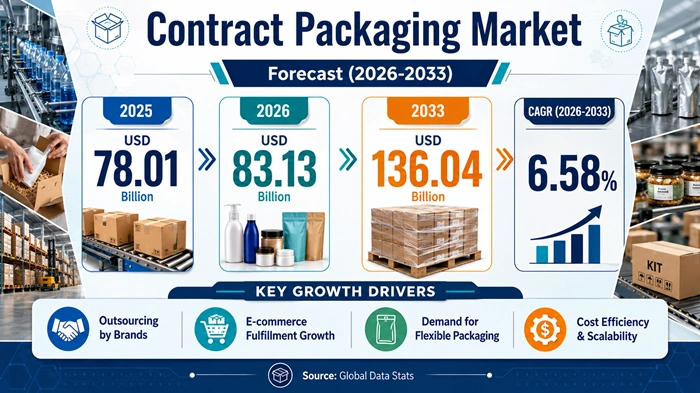
The global contract packaging market size is valued at USD 78.01 billion in 2025 and is predicted to increase from USD 83.13 billion in 2026 to approximately USD 136.04 billion by 2033, growing at a CAGR of 6.58% from 2026 to 2033.
The contract packaging market encompasses specialized third-party services that handle packaging operations for manufacturers across diverse industries who seek to outsource non-core functions. These dedicated packaging providers offer comprehensive solutions ranging from primary packaging that directly contacts products to secondary and tertiary packaging for distribution and retail presentation. Contract packagers deliver expertise, advanced equipment, and flexible capacity that enable brands to focus resources on core competencies including research and development, marketing, and customer relationship management while ensuring packaging quality and compliance with industry regulations.
Market growth is driven by increasing manufacturing complexity, rising demand for specialized packaging expertise, and the strategic shift toward asset-light business models among consumer goods companies. The outsourcing trend allows businesses to reduce capital expenditure on packaging infrastructure, access cutting-edge technologies without direct investment, and scale operations flexibly based on market demand fluctuations. Industries including pharmaceuticals, food and beverages, personal care, and consumer electronics increasingly rely on contract packaging partners to navigate evolving regulatory landscapes, implement sustainable materials, and deliver customized packaging solutions that enhance brand differentiation in competitive retail environments.
AI Impact on the Contract Packaging Industry
Transforming Operational Excellence Through Intelligent Automation and Predictive Analytics
Artificial intelligence is revolutionizing the contract packaging market by introducing advanced automation systems that optimize production workflows and enhance quality control standards across packaging facilities. Machine learning algorithms process real-time data from packaging lines to identify inefficiencies, predict equipment failures before they occur, and automatically adjust operational parameters for maximum throughput. AI-powered vision systems inspect products at speeds far exceeding human capabilities, detecting defects, verifying label placement, and ensuring compliance with specifications while reducing waste and rejection rates. These intelligent quality assurance mechanisms provide contract packagers with competitive advantages through consistent output quality that meets stringent client requirements across regulated industries like pharmaceuticals and food products.
Predictive analytics platforms powered by artificial intelligence are transforming demand forecasting and resource allocation in the contract packaging market. These systems analyze historical production patterns, seasonal variations, and market trends to anticipate capacity requirements and optimize inventory management for packaging materials. AI-driven scheduling algorithms coordinate complex multi-client operations, balancing production priorities to maximize equipment utilization while meeting delivery commitments. Smart robotics integrated with AI capabilities handle repetitive tasks including sorting, filling, and palletization with precision and consistency, reducing labor dependency while improving worker safety by removing humans from hazardous or physically demanding roles. This technological transformation enables contract packagers to offer faster turnaround times, higher accuracy, and more competitive pricing structures that attract brands seeking reliable outsourcing partners.
Growth Factors
Rising Outsourcing Trends Enabling Focus on Core Business Competencies
The accelerating trend toward outsourcing packaging operations reflects a fundamental strategic shift among manufacturers who recognize that packaging expertise and infrastructure represent non-core capabilities better handled by specialized partners. Companies across industries are redirecting capital and operational resources away from packaging facilities toward activities that directly drive competitive differentiation including product innovation, brand development, and customer experience enhancement. This reallocation enables businesses to achieve greater organizational efficiency while accessing specialized packaging knowledge and advanced equipment that contract packagers maintain through continuous investment. Research indicates that outsourcing packaging functions can reduce operational costs by six to eight percent through economies of scale and specialized process optimization that individual manufacturers cannot achieve independently.
The contract packaging market benefits from growing recognition that flexible capacity management represents a critical advantage in volatile market conditions. Seasonal demand fluctuations, promotional campaigns, and new product launches create packaging volume variability that challenges fixed in-house operations. Contract packagers absorb this variability across multiple clients, providing scalable capacity that expands during peak periods and contracts during slower seasons without forcing brands to maintain expensive idle infrastructure. This flexibility proves particularly valuable for small and medium-sized enterprises that lack resources for substantial capital investment in packaging equipment while requiring professional presentation standards to compete with established brands. The ability to test new products with limited initial production runs before committing to large-scale manufacturing further enhances the value proposition that contract packaging delivers to innovative companies navigating uncertain market reception.

Market Outlook
Sustainability Imperatives Driving Material Innovation and Circular Economy Solutions
The contract packaging market is experiencing profound transformation as sustainability considerations reshape material selection, process design, and end-of-life management across the industry. Consumer pressure and regulatory mandates are compelling brands to adopt environmentally responsible packaging that minimizes waste, incorporates recycled content, and facilitates recovery through existing recycling infrastructure. Contract packagers are responding by investing in sustainable materials expertise, establishing relationships with suppliers of bio-based and recycled packaging substrates, and developing processes that reduce material consumption without compromising protective performance. This sustainability transition creates competitive differentiation opportunities for forward-thinking contract packagers who position themselves as partners in helping brands achieve environmental commitments while maintaining cost structures that support business viability.
Technological integration and digital transformation are opening new frontiers in the contract packaging market through enhanced traceability, quality assurance, and customer engagement capabilities. Smart packaging incorporating QR codes, NFC chips, and printed electronics enables product authentication, supply chain visibility, and consumer interaction that extend value beyond traditional protective functions. Contract packagers investing in digital printing technologies, serialization systems, and track-and-trace capabilities position themselves to serve brands operating in highly regulated sectors or seeking enhanced consumer engagement through packaging. The convergence of packaging with digital technologies reflects broader industry evolution where packaging becomes an active participant in brand storytelling, product information delivery, and circular economy facilitation through capabilities that guide consumers in proper disposal and recovery of packaging materials after product consumption.
Expert Speaks
-
Peter Konieczny, CEO of Amcor, stated that with global reach, innovative capabilities, and exceptional talent, the company is transforming the industry and how the world sees packaging, emphasizing that enhanced innovation and research capabilities position them to revolutionize product development and meet evolving customer needs.
-
Stan Bikulege, Chairman and CEO of Novolex, commented that together they will continue to solidify their position and deliver in markets they serve by optimizing operations, accelerating product innovation, and driving commercial excellence while maintaining sustainable growth across the business.
-
Michael Doss, President and CEO of Graphic Packaging, expressed exceptional pride that the company has been recognized for dedication to providing essential, innovative, and circular packaging solutions for consumer brands worldwide, thanking employees for contributions to their thriving culture.
Key Report Takeaways
-
North America dominates the contract packaging market with the largest regional share accounting for approximately 37% of global market value in 2025, driven by robust manufacturing infrastructure, significant presence of pharmaceutical and food companies, and established outsourcing culture that prioritizes operational efficiency and specialized expertise.
-
Asia Pacific represents the fastest-growing regional market with projected CAGR of 9.0% during the forecast period from 2026 to 2033, fueled by rapid industrialization, expanding middle-class populations, growing pharmaceutical and electronics manufacturing, and increasing adoption of packaged consumer goods across major economies including China, India, and Southeast Asian nations.
-
Food and beverage segment commands the dominant end-use position representing approximately 72% of total market consumption in 2025, driven by extensive demand for packaging services across multiple product categories including convenience foods, ready-to-eat meals, beverages, and specialty food items requiring professional presentation and protective packaging.
-
Primary packaging services lead the packaging type segment holding around 56.89% market share in 2025, preferred for direct product contact applications requiring specialized expertise in contamination prevention, regulatory compliance, and materials compatibility across pharmaceutical, food, and personal care industries where product integrity represents paramount concern.
-
Bottling and filling operations dominate service categories accounting for approximately 29.2% of market share in 2025, serving liquid product manufacturers across beverages, pharmaceuticals, and personal care sectors that require specialized equipment and precision filling capabilities beyond typical in-house capabilities.
-
Blisters and clamshells segment positioned as fastest-growing packaging type with anticipated CAGR of 9.0% through 2033, driven by increasing adoption in pharmaceutical products, consumer electronics, and retail merchandise requiring tamper-evident properties, product visibility, and protection during distribution and display.
Market Scope
| Report Coverage | Details |
|---|---|
| Market Size by 2033 | USD 136.04 Billion |
| Market Size by 2025 | USD 78.01 Billion |
| Market Size by 2026 | USD 83.13 Billion |
| Market Growth Rate from 2026 to 2033 | CAGR of 6.58% |
| Dominating Region | North America |
| Fastest Growing Region | Asia Pacific |
| Base Year | 2025 |
| Forecast Period | 2026 to 2033 |
| Segments Covered | By Packaging Type, By Material, By Service, By End Use Industry, and By Region |
| Regions Covered | North America, Europe, Asia Pacific, Latin America, and Middle East & Africa |
Market Dynamics
Drivers Impact Analysis
E-Commerce Expansion Creating Unprecedented Demand for Specialized Packaging Solutions
| Factor | (≈) % Impact on CAGR Forecast | Geographic Relevance | Impact Timeline |
|---|---|---|---|
| E-commerce Growth | +1.2% | Global, strongest in North America and Asia Pacific | 2025-2033 |
| Outsourcing Trends | +1.1% | Global | 2026-2033 |
| Customization Demand | +0.8% | North America, Europe | 2026-2032 |
The explosive growth of e-commerce platforms and direct-to-consumer business models is fundamentally reshaping demand dynamics in the contract packaging market by creating new requirements for protective, attractive, and functional packaging. Online retail eliminates traditional in-store product handling advantages, making packaging the primary protective barrier during shipping while simultaneously serving as the first physical brand interaction for customers receiving deliveries. Global e-commerce sales in the retail sector reached approximately USD 6500 billion in 2023, with projections indicating growth to USD 9600 billion by 2027, representing a 47.6% increase that translates directly into expanded packaging requirements. This digital commerce revolution drives demand for specialized contract packaging services that understand the unique challenges of shipping packaging including cushioning requirements, dimensional optimization for freight efficiency, and unboxing experience design that creates memorable customer moments encouraging social sharing and brand loyalty.
Contract packagers serving e-commerce brands must deliver capabilities extending beyond traditional retail packaging including customization at scale, rapid turnaround for promotional campaigns, and integration with fulfillment logistics. The ability to handle small-batch personalized packaging alongside large-volume standard production enables brands to offer unique customer experiences that differentiate their offerings in crowded digital marketplaces. Advances in digital printing technologies allow contract packagers to produce variable designs economically, supporting personalization strategies that research indicates can increase revenue by 10-15% through enhanced customer engagement. The contract packaging market benefits from this e-commerce expansion as brands recognize that specialized packaging partners provide expertise, equipment, and flexibility that would require prohibitive capital investment to replicate internally, particularly for smaller digital-native brands focusing resources on marketing and product development rather than packaging operations.

Restraints Impact Analysis
Capital Investment Requirements and Quality Control Complexities Challenging Smaller Operators
| Factor | (≈) % Impact on CAGR Forecast | Geographic Relevance | Impact Timeline |
|---|---|---|---|
| Equipment Costs | -0.7% | Global | 2025-2033 |
| Quality Standards | -0.6% | North America, Europe | 2026-2033 |
| Client Dependency | -0.5% | Global | 2025-2030 |
The contract packaging market faces significant challenges from substantial capital requirements necessary to establish and maintain competitive operations equipped with modern packaging equipment. High-speed filling lines, automated inspection systems, serialization capabilities, and specialized packaging machinery for diverse product formats require multi-million-dollar investments that create barriers to entry for new market participants while forcing established operators to continuously upgrade capabilities. These capital demands become particularly burdensome when serving multiple industries with distinct equipment requirements, potentially limiting the ability of smaller contract packagers to compete for diversified client portfolios. The financial pressure intensifies when considering that clients increasingly expect contract packagers to absorb initial setup costs and tooling expenses, delaying return on investment and straining cash flows for operators without substantial financial reserves.
Quality control complexity and regulatory compliance requirements present ongoing operational challenges in the contract packaging market, particularly when serving highly regulated industries like pharmaceuticals and food products. Meeting stringent standards for cleanroom environments, validation protocols, and documentation systems requires specialized expertise and continuous investment in quality assurance personnel and systems. The risk of product recalls, contamination events, or compliance failures carries severe financial and reputational consequences that can threaten contract packagers' viability, creating inherent business volatility that complicates long-term planning. Additionally, client concentration risk affects many contract packagers who derive significant revenue from limited major customers, creating vulnerability when contracts terminate or clients decide to insource packaging operations after establishing market presence. This dependency dynamic requires contract packagers to continuously demonstrate value through innovation, cost efficiency, and service quality to retain relationships in competitive environments where clients possess significant negotiating leverage.
Opportunities Impact Analysis
Pharmaceutical Sector Expansion Creating High-Value Specialized Packaging Demands
| Factor | (≈) % Impact on CAGR Forecast | Geographic Relevance | Impact Timeline |
|---|---|---|---|
| Pharmaceutical Growth | +1.0% | North America, Europe, Asia Pacific | 2026-2033 |
| Sustainable Solutions | +0.9% | Europe, North America | 2026-2033 |
| Emerging Markets | +0.8% | Asia Pacific, Latin America | 2025-2032 |
The pharmaceutical industry's robust expansion presents substantial growth opportunities for the contract packaging market as drug manufacturers increasingly outsource packaging operations to focus on core competencies in research, development, and regulatory affairs. The United States pharmaceutical contract packaging market reached USD 5.9 billion in 2023 and is expected to reach USD 10.8 billion by 2032, growing at an annual rate of 6.98%, reflecting sustained demand driven by new drug approvals, biologics growth, and specialty pharmaceuticals requiring sophisticated packaging. The number of pharmaceutical manufacturing businesses operating in the United States increased 7.8% from 2022 to 2023, reaching 2325 facilities that represent approximately USD 2.3 billion in contract packaging opportunities. This pharmaceutical sector growth creates demand for specialized services including sterile packaging, serialization for anti-counterfeiting compliance, temperature-controlled handling, and unit-dose packaging formats requiring precision equipment and validated processes.
Sustainability initiatives and circular economy mandates are creating differentiation opportunities for contract packagers who invest in eco-friendly materials, energy-efficient processes, and recyclability optimization. Consumer pressure and regulatory requirements particularly in European markets are compelling brands to adopt sustainable packaging strategies that many lack internal expertise to implement effectively. Contract packagers positioning themselves as sustainability partners can capture premium pricing while helping clients achieve environmental goals including reduced material usage, increased recycled content, and improved end-of-life recovery. The development of expertise in emerging sustainable materials like bio-based plastics, compostable films, and fiber-based alternatives represents strategic investments that position forward-thinking contract packagers for long-term success as sustainability transitions from optional enhancement to mandatory requirement across consumer goods categories throughout the forecast period.

Segment Analysis
By Packaging Type
Primary Packaging Commanding Dominant Position Through Direct Product Contact Requirements
Primary packaging secured the leading position in the contract packaging market in 2025 with approximately 56.89% market share, growing at a projected CAGR of 8.96% through 2033. This segment's dominance stems from the specialized expertise and stringent compliance requirements associated with packaging materials that directly contact products, particularly in regulated industries like pharmaceuticals and food products where contamination prevention represents paramount concern. Primary packaging operations including filling, capping, blister forming, and tube filling require sophisticated equipment, cleanroom environments, and validated processes that most manufacturers prefer to outsource rather than maintain internally. The technical complexity of container-closure integrity testing, extractables and leachables analysis, and compatibility studies necessary for primary packaging materials creates barriers that favor specialized contract packagers with established capabilities and regulatory expertise.
North America and Europe represent the strongest regional markets for primary packaging services, driven by extensive pharmaceutical industries and stringent regulatory oversight from agencies including the FDA and EMA. Leading contract packagers serving these markets including Sharp Packaging, Silgan Holdings Inc., Aaron Thomas Company Inc., and AmeriPac Inc. maintain state-of-the-art facilities with specialized capabilities across diverse primary packaging formats. The pharmaceutical sector particularly drives primary packaging demand as drug manufacturers increasingly focus resources on therapeutic development while outsourcing packaging operations to partners who maintain current good manufacturing practices and adapt quickly to evolving serialization requirements. Rising demand for unit-dose packaging, child-resistant closures, and tamper-evident features across over-the-counter and prescription medications sustains robust growth trajectories. The segment benefits from high switching costs that create stable long-term client relationships, as validating new primary packaging suppliers requires extensive time and expense that discourages frequent changes once partnerships are established and regulatory approval is secured for specific product-package combinations.
Food and Beverage Segment Leading End-Use Categories Through Vast Market Scale
The food and beverage segment dominates end-use categories in the contract packaging market with approximately 72% market share in 2025, growing at a steady CAGR of 6.5% through 2033. This leadership reflects the enormous scale and diversity of food and beverage industries where packaging represents essential functions including product preservation, portion control, and brand differentiation across countless product variations serving global consumer markets. Rising demand for convenience foods, ready-to-eat meals, and single-serve beverage formats drives sustained packaging requirements as busy lifestyles increase consumer willingness to pay premiums for products saving preparation time. The segment encompasses diverse packaging operations including bottling for beverages and sauces, pouching for snacks and dried foods, cartoning for cereals and bakery products, and wrapping for fresh produce and prepared meals, creating opportunities for contract packagers offering comprehensive multi-format capabilities.
Regional growth patterns show particularly strong momentum in Asia Pacific markets where expanding middle-class populations, increasing disposable incomes, and growing retail infrastructure drive rapid adoption of packaged foods. There are approximately 445000 companies in Europe's Food & Drink Wholesaling industry, representing substantial contract packaging opportunities as these businesses seek efficient, scalable solutions for diverse product portfolios. Leading contract packagers serving food and beverage clients including Jones Packaging, Kelly Products Inc., Co-Pak Packaging Corporation, and Assemblies Unlimited Inc. provide specialized capabilities addressing unique sector requirements including food safety certifications, quick changeover between products, and seasonal capacity flexibility for products with variable demand patterns. The growing emphasis on sustainable packaging materials presents both challenges and opportunities as food brands respond to consumer environmental concerns by transitioning to recyclable, compostable, or reduced-material packaging options requiring specialized equipment and expertise that contract packagers can provide more efficiently than individual manufacturers developing in-house capabilities across their often-diverse product portfolios.

Regional Insights
North America
Regional Dominance Through Advanced Infrastructure and Established Outsourcing Culture
North America dominates the global contract packaging market with approximately 37% market share in 2025, growing at a projected CAGR of 6.4% through the forecast period. This leadership position reflects the region's sophisticated manufacturing infrastructure, significant concentration of pharmaceutical and food companies, and deeply established business culture that embraces outsourcing non-core functions to specialized service providers. The United States contract packaging market exhibits exceptional strength at USD 20.28 billion in 2025, projected to reach USD 37.92 billion by 2035, driven by mature industries recognizing operational and financial benefits of focusing internal resources on core competencies while leveraging contract packagers' specialized capabilities, equipment, and expertise.
Regional market strength is supported by continuous technological advancement and substantial capital investment by leading contract packaging companies headquartered in North America. Sealed Air Corporation, Berry Global Group Inc., Pactiv Evergreen, Graphic Packaging Holding Company, and Sonoco Products Company operate advanced facilities throughout the United States and Canada, providing comprehensive packaging services across primary, secondary, and tertiary formats serving diverse industries. The pharmaceutical sector represents particularly strong growth driver as drug manufacturers navigate complex regulatory requirements including serialization mandates, tamper-evident packaging, and child-resistant closures that specialized contract packagers manage more efficiently than in-house operations. E-commerce expansion throughout North America accelerates demand for protective packaging solutions optimized for direct-to-consumer shipping, with contract packagers providing expertise in dimensional optimization, cushioning design, and unboxing experiences that enhance brand perception. Market dynamics indicate sustained North American leadership through 2033, supported by favorable economic conditions, innovation-driven competitive culture, and growing recognition that strategic outsourcing partnerships deliver measurable advantages in operational flexibility, cost management, and access to cutting-edge packaging technologies.
Asia Pacific
Fastest Regional Growth Through Industrialization and Expanding Consumer Markets
Asia Pacific represents the fastest-growing regional market in the contract packaging sector with anticipated CAGR of 9.0% from 2026 through 2033, driven by rapid industrialization, expanding manufacturing capabilities, and rising consumer purchasing power across major economies. This exceptional growth rate reflects fundamental economic transformations throughout China, India, Southeast Asian nations, and developed markets like Japan and South Korea where increasing middle-class populations demand packaged consumer goods meeting international quality standards. The pharmaceutical and electronics industries particularly drive regional contract packaging adoption as manufacturers in these sectors recognize specialized packaging requirements exceeding typical in-house capabilities while facing pressure to reduce capital expenditure and improve operational flexibility in competitive global markets.
Regional growth dynamics show particularly robust momentum in India where approximately 63 million micro, small, and medium enterprises represent substantial contract packaging opportunities as these businesses scale operations and seek professional packaging solutions. China's booming industrial sector, technological modernization, and rising consumer incomes fuel exceptional demand for efficient contract packaging services supporting automated production environments and expanding e-commerce infrastructure requiring protective shipping packaging. Leading contract packagers operating in Asia Pacific including Rengo Co., Ltd. (Japan), Uflex Limited (India), Jindal Poly Films Limited (India), and Huhtamaki Oyj facilities throughout the region provide specialized capabilities addressing local market requirements while maintaining global quality standards. The region benefits from lower labor costs that enhance contract packaging economic advantages while growing environmental awareness drives adoption of sustainable materials and processes aligned with global trends. Market projections indicate continued Asia Pacific leadership in growth rates throughout the forecast period as economic development, retail infrastructure expansion, and increasing alignment with international packaging standards create favorable conditions for sustained contract packaging market expansion across diverse industrial and consumer product categories.
Top Key Players
-
Sealed Air Corporation (United States)
-
Berry Global Group, Inc. (United States)
-
Amcor plc (Australia)
-
Silgan Holdings Inc. (United States)
-
Sonoco Products Company (United States)
-
Pactiv Evergreen (United States)
-
Graphic Packaging Holding Company (United States)
-
Aaron Thomas Company, Inc. (United States)
-
AmeriPac Inc. (United States)
-
Co-Pak Packaging Corporation (United States)
-
Assemblies Unlimited, Inc. (United States)
-
Jones Packaging (Canada)
-
Rengo Co., Ltd. (Japan)
-
Uflex Limited (India)
-
Jindal Poly Films Limited (India)
Recent Developments
-
In July 2025, Kenco launched its Contract Packaging Division to enhance secondary packaging services, providing comprehensive solutions that simplify operations and reinforce the company's strategic role in supply chain management across diverse industries requiring specialized packaging expertise and flexible capacity.
-
In July 2025, Roquette introduced POLYOX Extended Stability packaging designed to enhance excipient stability, improve handling characteristics, and reduce environmental impact through innovative formulation and packaging integration serving pharmaceutical contract packaging clients seeking sustainable solutions.
-
In April 2025, Amcor completed its transformational all-stock combination with Berry Global ahead of schedule, creating a broader consumer and healthcare packaging leader with combined revenue exceeding USD 24 billion and anticipated synergy benefits of approximately USD 650 million by fiscal year 2028.
-
In February 2024, IPG launched its new American brand Plastic Sheeting available in Performance and Ultra films, designed to provide superior surface protection across various applications including food packaging and industrial uses requiring reliable barrier properties and durability.
-
In January 2024, MSI Express, supported by HCI Equity Partners, acquired Power Packaging to expand geographical reach, capabilities, and client connections while extending service offerings into additional food categories including powdered beverages, soups, baking mixes, and meal preparation products requiring specialized packaging solutions.
Market Trends
Digital Transformation Revolutionizing Operations Through Automation and Connected Systems
The contract packaging market is experiencing comprehensive digital transformation as operators integrate automation, robotics, and Internet of Things technologies to enhance operational efficiency and service quality. Advanced packaging lines equipped with smart sensors collect real-time production data enabling predictive maintenance that minimizes unplanned downtime while optimizing equipment utilization across multi-client facilities handling diverse product portfolios. Digital printing technologies allow contract packagers to offer variable data printing, personalization services, and small-batch customization that previously required prohibitive setup costs and minimum order quantities. This technological evolution positions contract packagers as strategic partners capable of supporting brands' marketing initiatives including limited-edition releases, regional variations, and promotional campaigns requiring rapid turnaround without compromising quality or efficiency standards.
Industry recognition is shifting from viewing contract packaging as transactional cost-saving to strategic partnerships enabling agile supply chains and value creation. Forward-thinking brands recognize that specialized packaging partners provide expertise extending beyond basic filling and labeling to encompass packaging design optimization, material selection, regulatory compliance navigation, and sustainability implementation. This partnership approach creates collaborative relationships where contract packagers contribute insights during product development phases, recommending packaging formats that balance brand presentation goals with production efficiency and cost management. The trend toward long-term strategic relationships rather than project-based engagements benefits both parties through improved planning visibility, shared investment in specialized capabilities, and continuous improvement initiatives that deliver measurable benefits in quality, cost, and speed to market throughout the product lifecycle.
Segments Covered in the Report
By Packaging Type
-
Primary
-
Secondary
-
Tertiary
By Material
-
Plastic
-
Metal
-
Glass
-
Paper and Paperboard
By Service
-
Bottling and Filling
-
Bagging/Pouching
-
Lot/Batch and Date Coding
-
Boxing and Cartoning
-
Wrapping and Bundling
-
Labelling
-
Clamshells and Blisters
-
Others
By End Use Industry
-
Food and Beverage
-
Pharmaceuticals
-
Electronics
-
Personal Care
-
Agriculture
-
Cosmetics
-
Others
By Region
-
North America
-
United States
-
Canada
-
Mexico
-
-
Europe
-
Germany
-
United Kingdom
-
France
-
Italy
-
Spain
-
Rest of Europe
-
-
Asia Pacific
-
China
-
India
-
Japan
-
South Korea
-
Australia
-
Southeast Asia
-
Rest of Asia Pacific
-
-
Latin America
-
Brazil
-
Argentina
-
Rest of Latin America
-
-
Middle East and Africa
-
GCC Countries
-
South Africa
-
Rest of Middle East and Africa
-
Frequently Asked Questions
Question 1: What is the projected size of the contract packaging market by 2033?
Answer: The global contract packaging market is projected to reach USD 136.04 billion by 2033, growing from USD 78.01 billion in 2025. This expansion reflects increasing outsourcing trends, e-commerce growth, and rising demand for specialized packaging expertise across diverse industries.
Question 2: Which region dominates the contract packaging market currently?
Answer: North America dominates the contract packaging market with approximately 37% market share in 2025, driven by advanced manufacturing infrastructure and established outsourcing culture. The region benefits from significant pharmaceutical and food company presence requiring specialized packaging services.
Question 3: What is the expected growth rate for the contract packaging market from 2026 to 2033?
Answer: The contract packaging market is anticipated to grow at a CAGR of 6.58% from 2026 to 2033. This growth is fueled by e-commerce expansion, sustainability initiatives, and increasing manufacturer focus on core competencies rather than packaging operations.
Question 4: Which end-use industry leads the contract packaging market consumption?
Answer: The food and beverage industry dominates the contract packaging market with approximately 72% of total consumption in 2025. This leadership stems from vast product diversity, convenience food demand, and extensive packaging requirements across numerous product categories.
Question 5: What are the primary growth drivers in the contract packaging market?
Answer: Key growth drivers in the contract packaging market include rising outsourcing trends, e-commerce expansion, pharmaceutical sector growth, and increasing demand for customization and sustainable packaging solutions. Cost efficiency and technological advancement also contribute significantly to market expansion.