
Contact Center as a Service Market Overview
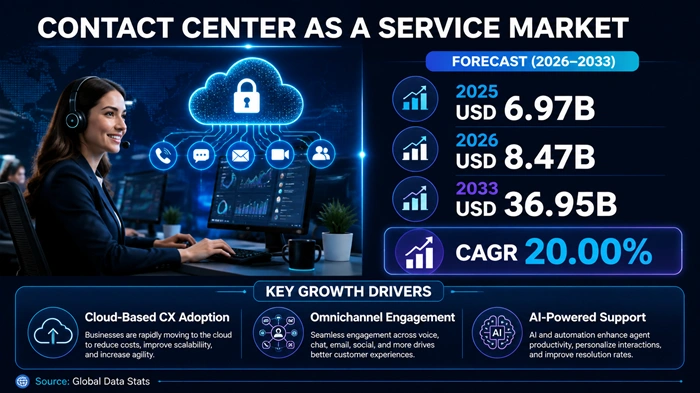
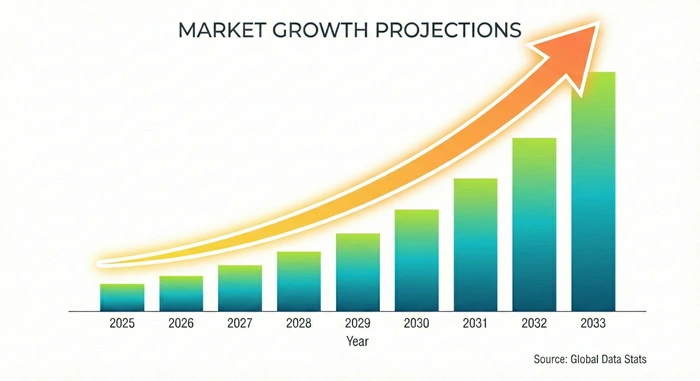
The global Contact Center as a Service market size is valued at USD 6.97 billion in 2025 and is predicted to increase from USD 8.47 billion in 2026 to approximately USD 36.95 billion by 2033, growing at a CAGR of 20.00% from 2026 to 2033.
Contact center as a service represents a cloud-based solution that enables organizations to outsource their customer contact center operations to third-party service providers without maintaining expensive on-premises infrastructure. These comprehensive platforms facilitate businesses in optimizing customer service operations, improving agent productivity, enhancing customer satisfaction scores, and gaining valuable insights through advanced analytics and reporting capabilities. Modern CCaaS solutions provide businesses with the ability to integrate omnichannel communications including voice, email, live chat, social media messaging, and SMS to deliver unified customer experiences across various channels.
The Contact Center as a Service market has experienced explosive growth as organizations increasingly recognize the strategic value of flexible, scalable customer engagement platforms that adapt to fluctuating business demands. Cloud-based contact center solutions eliminate the need for companies to build and maintain their own on-premises contact center infrastructure, significantly reducing capital expenditures and operational complexity. The accelerating shift toward remote work models combined with rising customer expectations for seamless omnichannel experiences has intensified demand for sophisticated CCaaS platforms that enable distributed agent workforces. Organizations across banking, telecommunications, healthcare, retail, and government sectors are implementing CCaaS solutions to transition their contact centers from traditional cost centers into strategic customer engagement hubs that generate valuable business intelligence. The integration of artificial intelligence, machine learning algorithms, natural language processing technologies, and robotic process automation within CCaaS platforms is revolutionizing how businesses understand customer needs, automate routine interactions, and optimize resource allocation.
AI Impact on the Contact Center as a Service Industry
Revolutionizing Customer Interactions Through Intelligent Automation and Predictive Insights
Artificial intelligence has fundamentally transformed the Contact Center as a Service market by introducing capabilities that dramatically enhance customer service effectiveness, operational efficiency, and agent productivity. AI-powered chatbots and virtual assistants now handle routine customer queries automatically, resolving common issues without human intervention while freeing agents to focus on complex problems requiring empathy and critical thinking. Natural language processing technologies enable advanced sentiment analysis of customer conversations across voice and text channels, allowing supervisors to identify frustrated customers in real-time and implement proactive intervention strategies. Intelligent routing systems leverage machine learning algorithms to analyze customer demographics, purchase history, previous interactions, and real-time behavioral signals to match inquiries with the most appropriate agents based on skill sets, past performance, and availability. Predictive analytics models process historical interaction data to forecast call volumes, optimal staffing levels, and potential service issues based on seasonal trends or marketing campaign timing, enabling more accurate resource planning.
AI-driven CCaaS solutions provide deeper insights into customer behavior patterns that were previously impossible to extract from massive volumes of interaction data. Automated quality management systems continuously monitor agent performance through speech analytics, identifying coaching opportunities, compliance violations, and best practices without relying on manual sampling methods. Real-time decision support tools provide agents with contextual information and recommended actions during live interactions, improving first-call resolution rates and reducing average handling times. Self-service capabilities powered by conversational AI enable customers to resolve issues independently through interactive voice response systems and knowledge bases, lowering operational costs while improving customer convenience. According to industry research, most contact centers now utilize AI technology to create more personalized communication solutions that bring unbelievable insights helping managers understand service performance and improve its quality. The continuous evolution of AI capabilities within CCaaS platforms is transforming customer service from reactive problem-solving to proactive engagement that anticipates customer needs and prevents issues before they escalate.
Growth Factors
Omnichannel Engagement Strategies and Remote Work Adoption Drive Market Expansion
The Contact Center as a Service market is experiencing accelerated growth as organizations embrace omnichannel customer engagement strategies that deliver consistent experiences across all touchpoints and communication channels. Modern consumers expect seamless interactions whether engaging through traditional voice calls, email, live chat, social media platforms, messaging applications, or self-service portals. An effective omnichannel contact strategy empowers businesses to offer customers multiple communication touchpoints including voice, email, chat, social media, and messaging apps, each with its particular characteristics and requirements. To deliver a seamless and frictionless consumer journey, businesses must unify all these channels into a single integrated platform that maintains context as customers switch between channels. This strategy proves beneficial in collecting feedback from customers and agents to refine and optimize engagement while providing agents with complete visibility into customer interaction histories regardless of channel.
The widespread adoption of remote working policies in businesses has emerged as a critical growth driver accelerating CCaaS implementation. Cloud-based contact center solutions enable businesses to establish global virtual contact centers with ease, allowing companies to set up distributed operations in different geographic locations and serve customers across various regions seamlessly. This global accessibility empowers businesses to expand their customer base, target new markets, and operate on a global scale without physical infrastructure constraints. CCaaS facilitates remote work by providing agents with the flexibility to work from anywhere with an internet connection, enhancing work-life balance for employees while enabling businesses to tap into a wider pool of talent regardless of geographical constraints. The COVID-19 pandemic accelerated this transformation as organizations were forced to rapidly transition to remote operations, with many discovering that distributed agent models delivered equivalent or superior performance compared to traditional centralized call centers. Natural disasters, power outages, and other disruptive events that cause significant downtime for traditional contact centers have minimal impact on cloud-based CCaaS platforms with built-in redundancy and failover mechanisms. This business continuity advantage makes CCaaS an attractive choice for organizations looking to ensure uninterrupted operations and mitigate risks associated with physical infrastructure dependencies.
Market Outlook
Emerging Technology Integration and SME Adoption Shape Future Trajectory
The Contact Center as a Service market outlook remains exceptionally positive as integration with emerging technologies including Internet of Things devices, blockchain applications, and advanced AI systems presents significant growth opportunities. This technological transformation empowers organizations to maximize data utilization and deliver hyper-personalized experiences at scale, aligning with the expectations of digital consumers who demand relevant, contextual interactions. By adopting a digital-first consumer engagement model, businesses not only evolve to meet consumer demands but also establish a distinct competitive edge in the marketplace through proactive service delivery and intelligent routing capabilities that were previously unattainable. The integration of robotic process automation in CCaaS automates data entry, updates to CRM systems, report generation, and other administrative tasks, improving efficiency and accuracy while reducing agent workload. Leading CCaaS providers are incorporating natural language processing, cloud computing, and voice biometrics technologies that facilitate more accurate speech recognition, sentiment analysis, and intelligent routing of customer inquiries while enhancing security and reducing authentication time.
Small and medium enterprises represent a massive underserved segment within the Contact Center as a Service market, projected to expand at a significant CAGR of 22.6% between 2025 and 2034. CCaaS platforms eliminate the need for significant upfront investments in hardware, software, and infrastructure that traditionally prevented SMEs from implementing professional contact center operations. These cloud-based solutions allow SMEs to start with small contact center deployments and easily scale up as their business grows, adding more agents, communication channels, and features without complex infrastructure upgrades. Since small and medium enterprises often face shortages of skilled customer service representatives, they need CCaaS solutions to enhance customer service quality through automated workflows, intelligent routing, and self-service capabilities. The democratization of advanced contact center capabilities through affordable subscription-based pricing models is enabling SMEs to compete with larger enterprises on customer experience quality. The consumer and retail segment is expected to expand at the highest CAGR of 26% during the upcoming period, driven by rising e-commerce adoption, increasing reliance on online shopping, and the need for seamless omnichannel support across digital and physical touchpoints. These dynamic trends position the Contact Center as a Service market for sustained expansion throughout the forecast period.
Expert Speaks
-
Satya Nadella, CEO of Microsoft emphasized in 2025 that "Cloud-based contact center solutions powered by artificial intelligence are transforming customer service from cost centers into strategic assets, enabling organizations to deliver personalized experiences at scale while generating valuable insights that inform business strategy and drive competitive advantage in increasingly digital markets."
-
Marc Benioff, CEO of Salesforce stated during a recent industry conference that "The future of customer engagement lies in unified platforms that break down silos and enable real-time personalization across every touchpoint, with AI serving as the connective tissue that transforms fragmented customer data into actionable intelligence and automated engagement workflows."
-
Jeff Bezos, Executive Chairman of Amazon noted in corporate communications that "Customer obsession requires investing in technologies that enable seamless, effortless interactions across channels, with cloud-based contact centers providing the scalability, flexibility, and innovation velocity necessary to continuously raise the bar on customer experience standards."
Key Report Takeaways
-
North America dominates the Contact Center as a Service market with commanding 35% revenue share in 2024, driven by robust technological infrastructure, widespread adoption of cloud-based solutions, presence of major CCaaS vendors including Salesforce, Sprinklr, Talkdesk, Twilio, Zoom, RingCentral, and Five9, and early technology adoption patterns
-
Asia-Pacific emerges as the fastest-growing region with exceptional projected CAGR of 23.5% throughout the forecast period, fueled by rapid digitization, integration of advanced technologies, product innovations, expansion of BFSI sector, rapid industrialization in India and China, and growing need to improve customer experience
-
Solutions segment captures dominant market position accounting for 67% revenue share in 2024, driven by increased need for outbound calls, strong focus on improving customer experience through call recording, reporting analytics, workforce optimization, and seamless integration of communication channels
-
Services segment demonstrates fastest growth trajectory projected to expand at double-digit CAGR of 22% in the coming years, as industries embrace CCaaS solutions and require integration deployment, support maintenance, training consulting, and managed services to seamlessly implement these platforms in existing systems
-
Large enterprises segment leads by organization size holding highest market share in 2024, as these organizations deal with significant customer bases spread worldwide requiring effective solutions to manage large volumes of queries and streamline contact center operations across multiple sites
-
BFSI segment dominates end-use applications representing the largest segment in 2024, as banking, financial services, and insurance institutes require effective solutions to build customer trust, enhance experience, handle huge volumes of customer inquiries regarding transactions, and provide real-time support
Market Scope
| Report Coverage | Details |
|---|---|
| Market Size by 2033 | USD 36.95 Billion |
| Market Size by 2025 | USD 6.97 Billion |
| Market Size by 2026 | USD 8.47 Billion |
| Market Growth Rate from 2026 to 2033 | CAGR of 20.00% |
| Dominating Region | North America |
| Fastest Growing Region | Asia-Pacific |
| Base Year | 2025 |
| Forecast Period | 2026 to 2033 |
| Segments Covered | Component, Enterprise Size, End-Use, Region |
| Regions Covered | North America, Europe, Asia-Pacific, Latin America, Middle East & Africa |
Market Dynamics
Driver Impact Analysis
Rising Customer Experience Focus and Personalization Demands
| Impact Factor | Details |
|---|---|
| ≈ Impact on CAGR Forecast | +4.5% to +6.2% |
| Geographic Relevance | Global, with strongest impact in North America, Europe, and Asia-Pacific |
| Impact Timeline | 2026-2033 |
The Contact Center as a Service market is expanding rapidly as organizations increasingly prioritize customer experience as the primary competitive differentiator in crowded marketplaces. The growing focus on enhancing customer satisfaction is boosting market growth as modern CCaaS platforms provide consumer-friendly interfaces and helpful training materials. The spontaneous interface and AI-powered features confirm rapid onboarding and equip agents to deliver excellent customer solutions that meet rising consumer expectations. Businesses recognize that product quality and pricing parity have made customer experience the critical factor influencing purchasing decisions, brand loyalty, and positive word-of-mouth recommendations. CCaaS solutions capture critical data from customers' and employees' interactions to improve customer experience through data-driven insights that identify pain points, optimize workflows, and personalize engagement strategies. Organizations implementing comprehensive CCaaS platforms report improved customer satisfaction scores, reduced churn rates, and increased customer lifetime value as they deliver more responsive, personalized service.
The rising demand for personalized solutions strongly supports Contact Center as a Service market growth as consumers expect relevant, contextual interactions that demonstrate understanding of their unique needs and preferences. Incorporating CCaaS with applications like CRM systems, e-commerce platforms, and marketing automation technologies allows businesses to create streamlined and connected consumer journeys by extracting data from several sources to offer efficient and personalized solutions. Advanced analytics capabilities within CCaaS platforms enable organizations to segment customers based on behavior patterns, purchase history, and demographic characteristics, tailoring communication strategies to specific audience segments. Real-time personalization engines adjust content, recommendations, and routing decisions dynamically based on current customer context and predicted intent, significantly improving conversion rates and customer satisfaction. Integration with customer data platforms provides agents with comprehensive 360-degree customer views during interactions, enabling informed conversations that reference previous interactions, preferences, and outstanding issues. The ability to deliver consistent, personalized experiences across all channels has become non-negotiable in industries including retail, banking, telecommunications, and healthcare where customer acquisition costs continue rising and loyalty proves increasingly difficult to maintain.
Restraints Impact Analysis
Integration Complexities and Data Security Concerns
| Impact Factor | Details |
|---|---|
| ≈ Impact on CAGR Forecast | -1.8% to -2.7% |
| Geographic Relevance | Global, particularly impactful in regions with legacy infrastructure |
| Impact Timeline | 2026-2030 |
The Contact Center as a Service market faces significant adoption barriers related to integration complexities when implementing CCaaS solutions with existing IT infrastructure and business applications. Representatives in most contact centers use various tools and traditional applications on separate screens to carry out their daily operations, creating complexities that complicate simple tasks and consume substantial time while negatively affecting consumer experience. This fragmented technology landscape increases screen toggling time for agents and waiting time for consumers, as agents rely on multiple applications to deliver single solutions. The complexity declines agents' productivity and efficiency, ultimately impacting the overall goals of the organization and customer satisfaction metrics. Organizations with substantial investments in legacy systems face difficult decisions regarding whether to replace existing infrastructure entirely or pursue complex integration projects that connect cloud-based CCaaS platforms with on-premises applications. Technical challenges related to data synchronization, API limitations, and incompatible data formats can extend implementation timelines and increase project costs beyond initial estimates.
Data security and privacy concerns represent critical restraints limiting Contact Center as a Service market expansion, particularly as contact centers store and process massive volumes of sensitive customer information. The increased use of cloud technologies brings heightened risks related to data security and privacy as organizations transmit confidential customer data including financial information, health records, and personal identification details to third-party cloud service providers. Regulatory compliance requirements including GDPR, HIPAA, PCI-DSS, and industry-specific data protection regulations create complex obligations that organizations must satisfy when implementing cloud-based contact center solutions. Organizations in highly regulated industries including banking, healthcare, and government often express hesitancy regarding cloud adoption due to concerns about data sovereignty, jurisdiction over stored information, and ability to demonstrate compliance during audits. The challenge of selecting reliable and security-compliant CCaaS providers adds complexity to procurement decisions, as organizations must thoroughly vet vendors' security practices, data handling procedures, certifications, and breach response protocols. High-profile data breaches affecting cloud service providers have heightened awareness of these vulnerabilities, causing some organizations to delay CCaaS implementations until robust security frameworks can be established. Addressing these technical, security, and compliance challenges requires ongoing vendor innovation and customer education to ensure the Contact Center as a Service market continues expanding sustainably.
Opportunities Impact Analysis
AI Integration and Global Market Expansion
| Impact Factor | Details |
|---|---|
| ≈ Impact on CAGR Forecast | +3.8% to +5.5% |
| Geographic Relevance | Strong opportunities in Asia-Pacific, Latin America, and developing markets |
| Impact Timeline | 2026-2033 |
The integration of CCaaS solutions with Internet of Things devices, blockchain applications, and AI technologies presents significant opportunities in the Contact Center as a Service market. This transformation empowers organizations to maximize data utilization and deliver hyper-personalized experiences at scale, aligning with the expectations of digital consumers who demand relevant, proactive engagement. By adopting a digital-first consumer engagement model, businesses not only evolve to meet consumer demands but also establish a distinct competitive edge in the marketplace through capabilities including proactive service delivery and intelligent routing that were previously unattainable. Advanced AI-powered features including conversational AI, predictive analytics, automated quality management, and intelligent virtual assistants are transitioning from premium differentiators to standard expectations as customers experience these capabilities through leading brands. Organizations implementing comprehensive AI-integrated CCaaS platforms report significant improvements in first-call resolution rates, agent productivity, customer satisfaction scores, and operational efficiency.
Emerging markets across Asia-Pacific, Latin America, Middle East, and Africa regions offer exceptional growth potential for the Contact Center as a Service market as digital transformation initiatives accelerate and customer service expectations rise. Rapid digitization, integration of advanced technologies, and product innovations are driving market expansion particularly in India, China, Southeast Asian countries, and Latin American nations. Government initiatives promoting digital infrastructure development, cloud adoption, and business process outsourcing industries are creating favorable regulatory environments and financial incentives for CCaaS investments in emerging markets. Organizations in these regions are leaping directly to modern cloud-based CCaaS platforms without legacy infrastructure constraints that burden enterprises in developed markets, potentially accelerating adoption rates. The growing middle class in emerging economies is driving consumer demand for quality customer service across retail, banking, telecommunications, and healthcare sectors, compelling local organizations to implement professional contact center operations supported by CCaaS capabilities. Lower implementation costs in emerging markets combined with availability of skilled agent workforces at competitive labor rates position these regions as attractive destinations for both domestic CCaaS adoption and international outsourcing activities. These converging opportunities establish emerging markets as critical growth engines for the global Contact Center as a Service market throughout the forecast period.
Segment Analysis
By Component: Solutions Segment
Comprehensive Toolsets and Omnichannel Integration Drive Segment Leadership
The solutions segment dominates the Contact Center as a Service market with commanding 67% revenue share in 2024, maintaining strong competitive positioning through comprehensive tool sets that manage customer interactions effectively. CCaaS solutions provide extensive capabilities including automatic call distribution, call recording, computer telephony integration, customer collaboration tools, dialers, interactive voice response systems, reporting analytics, and workforce optimization that collectively streamline contact center operations. These integrated platforms enable seamless integration of communication channels ensuring consistent and unified experiences across different platforms where customers can switch channels without losing context while agents maintain complete visibility into interaction histories. The demand for solutions like call recording, reporting analytics, and workforce optimization has increased due to strong focus of contact centers on improving customer experience and ensuring regulatory compliance. CCaaS solutions offer various communication channels including voice, email, live chat, social media, SMS messaging, and video that enable customers to reach out using their preferred method while providing agents with multiple options to engage with customers.
North America and Europe lead solutions adoption within the Contact Center as a Service market, driven by mature digital ecosystems, substantial enterprise investments in customer experience, and presence of leading solution providers. Asia-Pacific demonstrates the fastest regional growth with CAGR exceeding 23% through the forecast period, fueled by rapid industrialization, expanding BFSI sector, and growing recognition that effective customer engagement requires sophisticated technology platforms. Leading vendors including Genesys, NICE Systems, Avaya, Cisco Systems, Five9, and Microsoft have established strong market positions by offering comprehensive CCaaS solutions that integrate with existing business applications and support diverse industry-specific requirements. The segment benefits from continuous innovation including AI-powered analytics that provide actionable insights into contact center performance, agent productivity metrics, and customer interaction patterns. Workforce optimization capabilities help organizations forecast call volumes, schedule agents efficiently, and identify training opportunities through quality management monitoring. The increased need for outbound calls to reach out to customers for marketing campaigns, collections activities, and proactive service notifications drives demand for advanced dialer solutions and campaign management tools. These combined strengths ensure the solutions segment maintains market leadership throughout the forecast period as organizations continue investing in comprehensive platforms that deliver measurable ROI.
By Enterprise Size: Small & Medium Enterprises Segment
Affordable Cloud Models and Scalability Benefits Fuel Rapid Adoption
The small and medium enterprises segment is expected to grow at a significant CAGR of 22.6% between 2025 and 2034 within the Contact Center as a Service market, representing one of the fastest-growing segments. CCaaS platforms prove particularly suitable for small and medium enterprises as these solutions eliminate the need for significant upfront investments in hardware, software, and infrastructure that traditionally prevented SMEs from implementing professional contact center operations. Cloud-based subscription pricing models allow SMEs to access modern features at affordable prices with predictable monthly costs rather than substantial capital expenditures. These platforms enable small businesses to start with minimal contact center deployments and easily scale up as their business grows, adding more agents, communication channels, and advanced features without the need for complex infrastructure upgrades. The flexibility to adjust capacity dynamically based on seasonal demand fluctuations or business growth ensures SMEs only pay for resources they actually utilize.
North America demonstrates strong SME adoption as small businesses recognize that exceptional customer service provides competitive advantages against larger competitors with greater resources. Asia-Pacific exhibits the fastest SME segment growth driven by entrepreneurial ecosystems in India, Southeast Asia, and China where digital-native startups implement cloud-based contact centers from inception. Since small and medium enterprises often face shortages of skilled customer service representatives, they need CCaaS solutions to enhance customer service quality through automated workflows, intelligent call routing, self-service capabilities, and knowledge management systems that enable less experienced agents to handle complex inquiries. Leading CCaaS providers including Five9, RingCentral, Talkdesk, and Zendesk have developed SME-focused offerings with simplified interfaces, pre-built templates, and guided setup processes that reduce implementation complexity. The segment benefits from vendor strategies including freemium models, month-to-month contracts without long-term commitments, and packages bundling contact center capabilities with unified communications and collaboration tools. Integration with popular SME business applications including QuickBooks, Shopify, HubSpot, and Google Workspace enables seamless data flow without custom development. These accessibility improvements combined with demonstrated ROI through improved customer satisfaction and reduced operational costs position the SME segment for exceptional growth throughout the forecast period.
Regional Insights
North America
Technology Leadership and Cloud Adoption Drive Regional Dominance
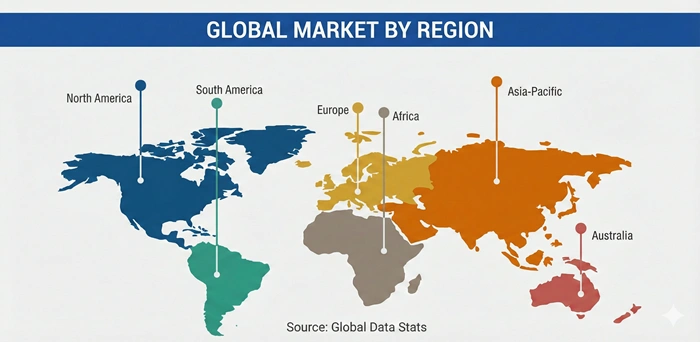
North America maintains its position as the dominant region in the Contact Center as a Service market, capturing commanding 35% revenue share in 2024 with the United States market valued at USD 1.96 billion in 2025 and projected to reach USD 10.80 billion by 2034 at CAGR of 20.81%. The region's market leadership stems from robust technological infrastructure enabling seamless deployment of CCaaS solutions, widespread high-speed internet availability, mature cloud computing ecosystems, and sophisticated digital capabilities across enterprises. North American organizations demonstrate early technology adoption patterns and substantial willingness to invest in innovative customer engagement solutions, creating favorable environments for CCaaS platform development and deployment. The United States serves as a major contributor to the North American Contact Center as a Service market as the country maintains position as an early adopter of cloud-based solutions across industries. The country is home to some of the major CCaaS vendors including Salesforce, Sprinklr, Talkdesk, Twilio, Zoom, RingCentral, and Five9 whose headquarters and development centers concentrate in technology hubs like San Francisco, Seattle, and Austin.
Businesses across North America are seeking solutions to enhance customer service and experience as competitive pressures intensify and customer expectations continue rising. Organizations are increasingly adopting Internet of Things devices and chatbots to enhance delivery of customer services, supporting regional market growth through technology integration. The availability of skilled workforce including customer service professionals, contact center managers, implementation specialists, and data analysts increases the deployment of CCaaS platforms while ensuring organizations can fully leverage advanced capabilities. Strong regulatory frameworks governing data privacy and consumer protection including state-level privacy laws create compliance-driven demand for CCaaS solutions that automatically monitor interactions and flag potential violations. Canada contributes meaningfully to regional growth with thriving technology sectors in Toronto, Vancouver, and Montreal developing innovative contact center solutions and providing attractive locations for bilingual customer service operations serving both English and French-speaking markets. The region's emphasis on measuring and optimizing customer experience through comprehensive analytics drives demand for CCaaS platforms with advanced reporting capabilities. North America is positioned to sustain its market leadership throughout the forecast period as organizations continue prioritizing digital transformation and customer-centric strategies.
Asia-Pacific
Rapid Digitization and BFSI Expansion Fuel Exceptional Regional Growth
The Asia-Pacific region is expected to experience the fastest growth in the upcoming period within the Contact Center as a Service market, projected to expand at exceptional CAGR of 23.5% throughout the forecast period. The growth of the market in the region can be attributed to rapid expansion of the BFSI sector which relies on efficient solutions like CCaaS to improve customer experience in highly competitive markets. CCaaS platforms provide detailed reporting and analytics tools that support BFSI firms to track employee performance, detect areas for improvement, and optimize workflow while ensuring regulatory compliance. Rapid digitization, integration of advanced technologies, and continuous product innovations drive market expansion particularly in China, India, Japan, South Korea, and Southeast Asian nations. Government initiatives supporting digital infrastructure development, smart city projects, and business process outsourcing industries create favorable regulatory environments that accelerate CCaaS adoption.
India is positioned to have a stronghold on the Contact Center as a Service market in Asia-Pacific, driven by rapid industrialization and growing need to improve customer experience across domestic and international businesses. Domestic market players are continuously launching new solutions to satisfy the need for effective platforms that can enhance customer experience while supporting the country's massive business process outsourcing industry serving global clients. In October 2023, Bharti Airtel, India's leading telecommunications solution provider, announced the launch of Airtel CCaaS, an industry-first omnichannel cloud platform that provides unified experience for all contact center solutions essential for enterprises. China represents the largest national market within Asia-Pacific with massive customer bases, expanding middle class, and aggressive e-commerce growth creating unprecedented demand for customer service capabilities. Japan contributes technological innovation and early adoption of emerging technologies including AI and robotics that push CCaaS capabilities forward. Leading global CCaaS vendors including Genesys, NICE Systems, Avaya, Cisco Systems, and Five9 have established substantial Asia-Pacific operations while regional providers including Alibaba Cloud, Tencent, and numerous specialized platforms serve domestic markets. Lower implementation costs compared to Western markets combined with competitive labor rates for skilled contact center agents position Asia-Pacific as attractive destination for both domestic adoption and international outsourcing activities. These converging factors establish Asia-Pacific as the primary growth engine for the global Contact Center as a Service market throughout the forecast period.
Top Key Players
-
Genesys (United States)
-
NICE Ltd. (Israel)
-
Avaya LLC (United States)
-
Cisco Systems Inc. (United States)
-
Five9 Inc. (United States)
-
Microsoft Corporation (United States)
-
8x8 Inc. (United States)
-
RingCentral Inc. (United States)
-
Talkdesk (United States)
-
Twilio Inc. (United States)
-
Zoom Video Communications Inc. (United States)
-
Amazon Web Services Inc. (United States)
-
SAP SE (Germany)
-
Salesforce Inc. (United States)
-
Enghouse Interactive Inc. (Canada)
-
Alcatel Lucent Enterprise (France)
-
Unify Inc. (United States)
-
Zendesk Inc. (United States)
-
Sprinklr Inc. (United States)
-
Oracle Corporation (United States)
Recent Developments
-
HCLTech announced expansion of its strategic partnership with Microsoft in January 2025 to transform customer service experiences with generative AI and cloud-based contact center solutions, combining HCLTech's industry expertise with Microsoft Azure AI capabilities to deliver next-generation customer engagement platforms for enterprise clients across industries
-
TransPerfect announced the acquisition of H2A in January 2025, a French leader in contact center customer experience and business process outsourcing solutions, strengthening TransPerfect's position as the world's largest provider of language and AI solutions for global business while expanding European market presence
-
NUSO announced the acquisition of T-Metrics in November 2024, a provider of advanced contact center solutions and communication tools for enterprise, US Federal, State, and Local government markets, solidifying NUSO's commitment to delivering resilient, scalable, and customizable communication solutions that empower organizations
-
SS&C Technologies Holdings Inc. announced its new Contact Center platform in July 2024 to help asset management, life and pensions, and retirement sectors modernize and elevate customer experience through comprehensive cloud-based solutions designed for financial services industry requirements
-
Accelecom announced the launch of its Contact Center as a Service offering in February 2024, a state-of-the-art solution designed to empower businesses with advanced tools and capabilities to enhance customer experience and streamline contact center operations through next-generation fiber and cloud-based communication technologies
Market Trends
Cloud Migration and AI-Powered Automation Reshape Industry Landscape
The Contact Center as a Service market is experiencing fundamental transformation through accelerating cloud migration as organizations shift away from traditional on-premises systems toward flexible, scalable cloud-based offerings. Companies are recognizing the benefits of cloud solutions including scalability that accommodates fluctuating demand, flexibility enabling rapid feature deployment, and cost savings eliminating capital expenditures for hardware and infrastructure. The transition from legacy systems to modern CCaaS platforms enables enterprises to implement advanced capabilities including omnichannel routing, workforce optimization, quality management, and analytics without substantial upfront investments. Cloud-native architectures provide automatic software updates, enhanced disaster recovery capabilities, and seamless support for distributed remote agent workforces that proved essential during pandemic-driven workplace transformations. Organizations that maintained on-premises contact centers faced significant challenges supporting remote work while cloud-based CCaaS platforms enabled business continuity with minimal disruption.
AI-powered automation represents another transformative trend within the Contact Center as a Service market as intelligent systems handle increasing percentages of customer interactions. Conversational AI and chatbots manage routine inquiries autonomously, resolving common issues without human intervention while freeing agents to focus on complex problems requiring critical thinking and empathy. Automated quality management systems continuously monitor agent performance through speech analytics, identifying coaching opportunities and compliance violations without relying on manual sampling methods that review only small percentages of interactions. Predictive analytics models analyze historical patterns to forecast call volumes, optimal staffing levels, and potential service issues, enabling proactive resource planning and issue prevention. Natural language processing technologies enable advanced sentiment analysis that identifies frustrated customers in real-time, triggering supervisor alerts and intervention protocols. These automation capabilities deliver measurable benefits including improved first-call resolution rates, reduced average handling times, enhanced agent productivity, and increased customer satisfaction scores. The convergence of cloud infrastructure and artificial intelligence continues reshaping the Contact Center as a Service market landscape throughout the forecast period.
Segments Covered in the Report
By Component
-
Solutions
-
Automatic Call Distribution
-
Call Recording
-
Computer Telephony Integration
-
Customer Collaboration
-
Dialer
-
Interactive Voice Response
-
Reporting & Analytics
-
Workforce Optimization
-
Others
-
-
Services
-
Integration & Deployment
-
Support & Maintenance
-
Training & Consulting
-
Managed Services
-
By Enterprise Size
-
Large Enterprises
-
Small & Medium Enterprises
By End-Use
-
BFSI (Banking, Financial Services, and Insurance)
-
IT & Telecommunications
-
Healthcare
-
Consumer Goods & Retail
-
Government
-
Travel & Hospitality
-
Media & Entertainment
-
Others
By Region
-
North America
-
United States
-
Canada
-
Mexico
-
-
Europe
-
Germany
-
France
-
United Kingdom
-
Italy
-
Spain
-
Rest of Europe
-
-
Asia-Pacific
-
China
-
Japan
-
India
-
South Korea
-
Australia
-
Indonesia
-
Rest of Asia-Pacific
-
-
Latin America
-
Brazil
-
Mexico
-
Rest of Latin America
-
-
Middle East & Africa
-
UAE
-
Saudi Arabia
-
South Africa
-
Rest of MEA
-
Frequently Asked Questions
Question 1: What is the projected Contact Center as a Service market size by 2033?
Answer: The global Contact Center as a Service market is projected to reach USD 36.95 billion by 2033, growing from USD 8.47 billion in 2026. The market is expanding at a CAGR of 20.00% during the 2026-2033 forecast period driven by omnichannel adoption, AI integration, and remote work trends.
Question 2: Which region dominates the Contact Center as a Service market currently?
Answer: North America dominates the Contact Center as a Service market with 35% revenue share in 2024, supported by robust technology infrastructure and early cloud adoption. However, Asia-Pacific is the fastest-growing region with CAGR of 23.5% from 2025 to 2034.
Question 3: What are the key components driving Contact Center as a Service market growth?
Answer: Solutions segment leads the Contact Center as a Service market with 67% revenue share in 2024, including call recording, analytics, and workforce optimization. Services segment demonstrates fastest growth at 22% CAGR through rising integration and deployment needs.
Question 4: How is artificial intelligence impacting the Contact Center as a Service market?
Answer: Artificial intelligence is transforming the Contact Center as a Service market through chatbots, predictive analytics, sentiment analysis, and automated quality management that improve efficiency. AI-driven CCaaS solutions provide deeper insights into customer behavior while automating routine tasks and optimizing agent performance.
Question 5: Which end-use segment leads the Contact Center as a Service market?
Answer: BFSI segment leads the Contact Center as a Service market in 2024, driven by need to build customer trust and handle large inquiry volumes. Consumer and retail segment demonstrates fastest growth at 26% CAGR fueled by e-commerce expansion and omnichannel support requirements.