
Conductive Ink Market Overview
Printed Electronics and Flexible Circuit Technologies Transform Manufacturing Across Consumer Electronics and Automotive Industries
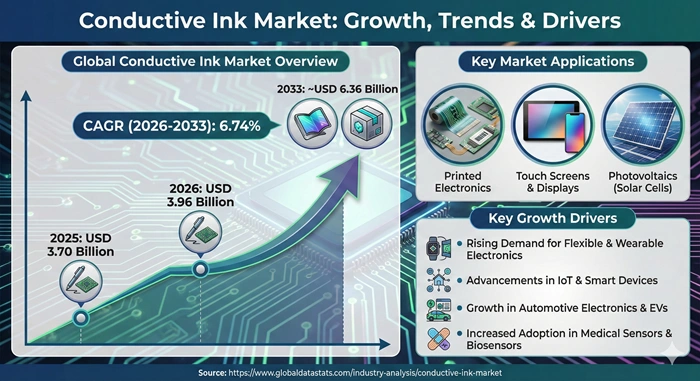
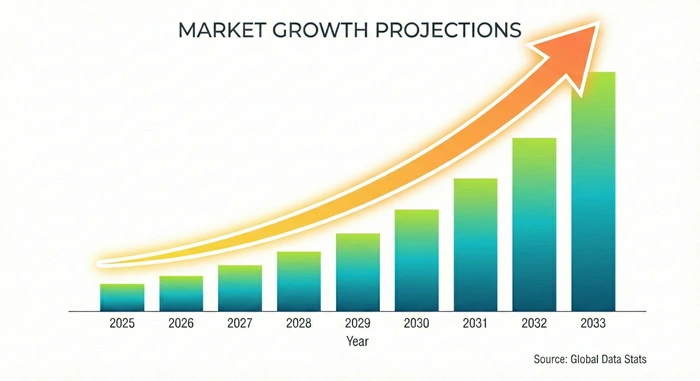
The global conductive ink market size is valued at USD 3.70 billion in 2025 and is predicted to increase from USD 3.96 billion in 2026 to approximately USD 6.36 billion by 2033, growing at a CAGR of 6.74% from 2026 to 2033. This specialized industry encompasses electrically conductive formulations containing metallic particles, carbon materials, or conductive polymers enabling printed electronic circuits, sensors, antennas, and electrodes across flexible substrates including plastics, paper, textiles, and ceramics. Conductive ink products deliver electrical conductivity through screen printing, inkjet printing, gravure, and flexographic processes replacing traditional circuit board etching and wire connections with cost-effective additive manufacturing techniques.
The conductive ink market addresses escalating demand for miniaturized electronics, flexible displays, wearable devices, and Internet of Things sensors where traditional rigid printed circuit boards cannot accommodate form factor requirements. These specialized formulations demonstrate exceptional electrical properties, adhesion characteristics, and mechanical flexibility enabling applications ranging from touchscreen displays and RFID tags to photovoltaic solar cells and automotive sensors. Major technology sectors including consumer electronics, automotive systems, healthcare devices, and renewable energy consume substantial conductive ink volumes as manufacturers pursue product differentiation through thinner designs, lighter weights, and enhanced functionality while reducing manufacturing costs and environmental impacts throughout product lifecycles.
AI Impact on the Conductive Ink Industry
Machine Learning and Process Optimization Revolutionize Formulation Development and Printing Quality Control
Artificial intelligence transforms the conductive ink market through computational modeling predicting electrical conductivity, adhesion strength, and curing behavior based on particle size distributions, binder chemistry, and substrate interactions before expensive pilot production runs. Machine learning algorithms analyze thousands of formulation variables including metal particle morphology, solvent compositions, dispersant concentrations, and rheology modifiers identifying optimal combinations achieving target sheet resistance below 0.1 ohms per square while maintaining stable dispersion preventing particle agglomeration during storage. These AI-powered systems enable virtual screening of novel conductive materials including graphene nanoplatelets, carbon nanotubes, and metal nanowires predicting performance characteristics and cost structures accelerating commercialization timelines from years to months. Deep learning models trained on high-resolution microscopy images perform automated defect detection identifying printing anomalies including line breaks, short circuits, and uneven thickness distributions at production speeds impossible through manual inspection.
Advanced AI applications extend beyond formulation optimization to revolutionize manufacturing process control within the conductive ink market landscape. Computer vision systems integrated with inline inspection equipment monitor printed circuit patterns in real-time detecting defects including bridging, open circuits, and dimensional variations triggering automatic adjustments to printing parameters including screen tension, squeegee pressure, and snap-off distance. Neural networks predict optimal curing profiles analyzing substrate thermal properties, ink thickness, and ambient conditions preventing over-sintering causing substrate damage or under-sintering leaving excessive resistivity. Predictive maintenance algorithms monitor printing equipment performance analyzing vibration signatures, temperature fluctuations, and consumable wear patterns scheduling maintenance interventions preventing costly downtime and quality issues. These AI-driven capabilities position manufacturers to achieve six-sigma quality levels while reducing scrap rates by 30-40% and improving overall equipment effectiveness throughout forecast period.
Growth Factors
Flexible Electronics Proliferation and Electric Vehicle Adoption Drive Unprecedented Conductive Ink Demand
The conductive ink market experiences robust growth propelled by flexible electronics revolution where foldable smartphones, rollable displays, and wearable health monitors require conductive circuits conforming to curved surfaces and withstanding repeated flexing cycles. Samsung, Huawei, and Motorola commercialize foldable smartphones incorporating flexible OLED displays with printed conductive traces enabling touchscreen functionality and interconnections surviving hundreds of thousands of fold cycles without electrical failure. Smartwatch manufacturers including Apple, Garmin, and Fitbit integrate flexible circuit boards and printed sensors enabling biometric monitoring, wireless charging, and compact form factors impossible with rigid conventional electronics. Medical wearables including continuous glucose monitors, ECG patches, and drug delivery systems utilize printed silver electrodes and conductive traces on flexible polymer substrates enabling comfortable long-term wear while maintaining reliable electrical performance across demanding healthcare applications.
Electric vehicle production expansion drives conductive ink market growth through specialized applications in battery heating systems, defrosting elements, electromagnetic interference shielding, and sensor networks requiring lightweight distributed heating and sensing capabilities. Battery thermal management systems incorporate printed resistive heating elements utilizing conductive silver or carbon inks maintaining optimal operating temperatures between 20-40 degrees Celsius across diverse climate conditions improving range and charging performance. Windshield and mirror defrosting applications deploy transparent conductive films incorporating silver nanowire or metal mesh patterns providing electrical heating while maintaining optical clarity exceeding 85% visible light transmission. In-cabin occupancy sensors, gesture recognition systems, and touch-sensitive control panels utilize printed capacitive electrodes and antenna structures enabling human-machine interfaces without mechanical switches or buttons. Global electric vehicle production projected to exceed 40 million units annually by 2030 with average conductive ink content valued 15-25 dollars per vehicle creates substantial market opportunity throughout forecast period.
Market Outlook
Sustainable Materials and Advanced Printing Technologies Position Industry for Sustained Long-Term Expansion
The conductive ink market outlook remains exceptionally positive as manufacturers invest substantially in copper-based alternatives to silver formulations addressing cost concerns while maintaining acceptable electrical performance for price-sensitive applications. Copper nanoparticle inks achieving conductivities exceeding 60% of bulk copper at prices 50-70% below silver equivalents enable mass-market printed electronics applications including RFID tags, membrane switches, and basic circuit patterns where ultra-high conductivity specifications unnecessary. Advanced surface protection technologies incorporating anti-oxidation coatings, protective overlayers, and hermetic encapsulation prevent copper oxidation maintaining electrical stability across environmental exposure and thermal cycling. Hybrid formulations combining silver-plated copper particles or silver-copper alloys balance performance against cost achieving conductivities approaching pure silver inks while reducing material expenses by 30-50% creating compelling value propositions for automotive and industrial applications.
Investment trends within the conductive ink market reflect growing confidence in long-term demand fundamentals as leading materials companies expand production capacity targeting photovoltaic, automotive, and IoT sensor applications. DuPont, Henkel, Sun Chemical, and Heraeus maintain robust research budgets advancing next-generation formulations including stretchable conductive inks for textile electronics, biocompatible inks for implantable medical devices, and high-temperature stable inks for automotive under-hood applications. Acquisition activity intensifies as materials suppliers pursue strategic combinations accessing complementary technologies, customer relationships, and geographic markets accelerating innovation cycles and market penetration. Asia Pacific capacity expansions particularly China, Japan, and South Korea target domestic electronics manufacturing while supporting emerging applications in printed sensors, smart packaging, and flexible photovoltaics. These favorable dynamics position the market for sustained expansion exceeding general electronics industry growth rates through 2033.
Expert Speaks
-
Lori Koch, Chief Executive Officer of DuPont, emphasized strategic priorities: "We delivered another quarter of year-over-year organic sales growth and solid margin expansion in both the ElectronicsCo and IndustrialsCo segments, as well as 15 percent adjusted EPS growth. Ongoing strength in electronics, healthcare and water end-markets demonstrates the value of our focused portfolio strategy and technical innovation capabilities".
-
Jon Kemp, President of DuPont Electronics & Industrial and future CEO of independent Electronics company, articulated vision: "For decades, our team has focused on driving innovations that advance the electronics industry. We are entering a pivotal time where advanced computing and connectivity will require new technologies and integrated solutions. As a leader in materials science and engineering, the future Electronics company will be a vital partner in advancing our customers' growth strategies".
-
Melbs LeMieux, Co-founder and President of Electroninks, highlighted partnership strategy: "Our partnership with LIG Nex1 will accelerate the commercialization of our conductive ink technology, serve as a key stepping stone for entering the Korean market, and further strengthen the Korea-US Defense cooperation. Next-generation particle-free inks using significantly less material compared to traditional formulations will contribute to lightweighting and cost reduction when applied to key components".
Key Report Takeaways
-
Asia Pacific dominates the conductive ink market with commanding share exceeding 45%, driven by concentrated electronics manufacturing across China, Japan, and South Korea where solar panel production, smartphone assembly, and display fabrication consume substantial silver-based and carbon-based conductive ink volumes supported by government renewable energy initiatives and consumer electronics exports.
-
North America emerges as the fastest-growing regional market with projected CAGR approaching 8.7% through 2034, propelled by electric vehicle adoption, flexible electronics innovation, renewable energy expansion, and defense applications requiring advanced conductive materials where established research ecosystems drive technology commercialization.
-
Silver-based conductive inks represent the dominant material segment accounting for approximately 42% market share due to superior electrical conductivity, oxidation resistance, and proven reliability across photovoltaic metallization, RFID antennas, and touch sensors where performance justifies premium pricing compared to copper or carbon alternatives.
-
Photovoltaic applications constitute the largest end-use segment capturing substantial market share driven by solar panel manufacturing requiring front-side and back-side metallization delivering efficient current collection where silver paste consumption exceeds 100 million ounces annually across global crystalline silicon solar cell production.
-
Screen printing technology maintains market leadership representing dominant process share due to proven reliability in high-volume production particularly solar panels and RFID tags where established manufacturing infrastructure, material compatibility, and cost-effectiveness support continued adoption despite emerging digital printing technologies.
-
Flexible electronics and wearables exhibit exceptional growth potential with anticipated CAGR exceeding 9.5% through 2033, attributed to smartwatch proliferation, medical device innovation, and textile-integrated electronics requiring stretchable conductive inks maintaining electrical performance through repeated mechanical deformation cycles.
Market Scope
| Report Coverage Details | |
|---|---|
| Market Size by 2033 | USD 6.36 Billion |
| Market Size by 2025 | USD 3.70 Billion |
| Market Size by 2026 | USD 3.96 Billion |
| Market Growth Rate from 2026 to 2033 | CAGR of 6.74% |
| Dominating Region | Asia Pacific |
| Fastest Growing Region | North America |
| Base Year | 2025 |
| Forecast Period | 2026 to 2033 |
| Segments Covered | Type, Application, Printing Technology, End-Use, Region |
| Regions Covered | North America, Europe, Asia Pacific, Latin America, Middle East & Africa |
Market Dynamics
Drivers Impact Analysis
Consumer Electronics Innovation and Renewable Energy Deployment Accelerate Conductive Ink Adoption Across Applications
| Impact Factor | (≈) % Impact on CAGR Forecast | Geographic Relevance | Impact Timeline |
|---|---|---|---|
| Flexible Electronics Growth | +2.3% | Global, Led by Asia Pacific | 2026-2033 |
| Solar Energy Expansion | +1.9% | Asia Pacific, Europe | 2026-2033 |
| Electric Vehicle Production | +1.5% | North America, Europe, Asia | 2026-2033 |
| IoT Sensor Proliferation | +1.1% | Global Markets | 2027-2033 |
The conductive ink market benefits substantially from flexible electronics revolution where manufacturers pursue form factor advantages and enhanced functionality impossible with rigid printed circuit boards. Foldable smartphone shipments projected to exceed 50 million units annually by 2028 consume specialized flexible printed circuits incorporating silver nanowire or carbon nanotube inks maintaining electrical conductivity through repeated folding cycles exceeding 200000 operations. Rollable display technology emerging in premium televisions and commercial signage utilizes transparent conductive films with metal mesh patterns achieving sheet resistance below 10 ohms per square while maintaining optical transparency above 90% enabling large-format flexible screens. Wearable health monitors including continuous glucose sensors, ECG patches, and sweat analysis devices deploy printed silver chloride electrodes and flexible interconnections enabling comfortable multi-day wear while maintaining biocompatibility and signal quality requirements for medical applications.
Solar energy deployment drives conductive ink market expansion through photovoltaic cell metallization where front-side and back-side silver paste consumption directly correlates with crystalline silicon solar panel production exceeding 300 gigawatts annually. Screen-printed silver electrodes collecting photogenerated current require optimized particle size distributions, glass frit formulations, and firing profiles achieving contact resistance below 1 milliohm-centimeter while minimizing silver consumption currently averaging 90-110 milligrams per watt. Passivated emitter rear contact solar cells incorporating selective emitter structures consume additional conductive ink volumes through multi-layer printing processes achieving conversion efficiencies exceeding 23% compared to 20-21% for conventional architectures. Bifacial solar modules capturing reflected light from ground and adjacent surfaces utilize specialized back-side metallization patterns with transparent conductive layers enabling light transmission while maintaining electrical collection efficiency. Global solar capacity additions projected to exceed 400 gigawatts annually by 2030 create sustained conductive ink demand throughout forecast period.
Restraints Impact Analysis
Material Costs and Performance Limitations Challenge Market Penetration Across Price-Sensitive Applications
| Restraint Factor | (≈) % Impact on CAGR Forecast | Geographic Relevance | Impact Timeline |
|---|---|---|---|
| High Silver Prices | -1.4% | Global Supply Chain | 2026-2033 |
| Conductivity vs. Flexibility Trade-offs | -1.0% | Emerging Applications | 2026-2031 |
| Substrate Compatibility Challenges | -0.8% | Diverse End-Uses | 2026-2033 |
| Manufacturing Process Complexity | -0.6% | Small-Scale Producers | 2026-2030 |
The conductive ink market faces growth constraints from substantial silver price volatility where spot market fluctuations between 15-30 dollars per troy ounce create quarterly cost uncertainty impacting profitability margins for formulation producers and end-use manufacturers. Silver-based conductive inks representing 40-50% of market volume by value experience direct material cost exposure where precious metal content comprises 60-80% of finished ink pricing. Photovoltaic manufacturers particularly sensitive to metallization costs pursue silver reduction strategies including narrower finger widths, optimized paste rheology, and partial silver substitution with copper or aluminum though technical challenges including oxidation susceptibility and contact resistance degradation limit adoption. Alternative conductive materials including copper nanoparticles, carbon nanotubes, and conductive polymers achieve 30-70% cost reductions compared to silver equivalents but suffer from inferior electrical conductivity, oxidation sensitivity, or mechanical property limitations restricting applications to less demanding use cases.
Performance trade-offs between electrical conductivity and mechanical flexibility constrain conductive ink market penetration across emerging wearable and stretchable electronics applications. Conventional silver flake inks achieving bulk conductivities exceeding 105 S/cm demonstrate brittle failure under tensile strains above 3-5% limiting utility for textile-integrated electronics and epidermal sensors requiring 50-100% elongation capabilities. Stretchable conductive ink formulations incorporating elastomeric binders, wavy microstructures, or percolating networks maintain electrical pathways during mechanical deformation but suffer from 10-100 times higher sheet resistance compared to conventional rigid formulations. Carbon-based alternatives including graphene and carbon nanotube inks demonstrate excellent flexibility and environmental stability but achieve maximum conductivities only 103-104 S/cm insufficient for high-frequency RF applications or low-resistance power distribution. These performance limitations restrict addressable market opportunities constraining growth across next-generation flexible and wearable device categories throughout forecast period.
Opportunities Impact Analysis
Printed Sensors and Smart Packaging Create Substantial Growth Avenues Beyond Traditional Electronics Applications
| Opportunity Factor | (≈) % Impact on CAGR Forecast | Geographic Relevance | Impact Timeline |
|---|---|---|---|
| Printed Sensor Networks | +1.7% | Global IoT Deployment | 2027-2033 |
| Smart Packaging Integration | +1.3% | Consumer Goods, Pharmaceuticals | 2026-2033 |
| Biomedical Electrodes | +1.0% | North America, Europe | 2027-2033 |
| Automotive Sensor Arrays | +0.8% | Electric Vehicle Platforms | 2026-2033 |
The conductive ink market stands to capture substantial value from printed sensor proliferation across Internet of Things applications where low-cost disposable or single-use sensors enable widespread environmental monitoring, structural health assessment, and supply chain tracking. Printed temperature sensors incorporating resistive or thermoelectric elements utilizing carbon or metal oxide inks achieve accuracy within 1-2 degrees Celsius at costs below 0.10 dollars per unit enabling cold chain monitoring for pharmaceutical distribution and food safety applications. Strain sensors fabricated through screen-printed piezoresistive inks detect structural deformation in bridges, buildings, and aircraft components providing early warning of fatigue damage or overload conditions at deployment costs orders of magnitude below conventional electronic strain gauges. Humidity sensors utilizing hygroscopic polymer composites with conductive particles demonstrate rapid response times below 10 seconds enabling HVAC control, agriculture monitoring, and manufacturing process optimization applications.
Smart packaging integration presents exceptional growth opportunities for the conductive ink market as consumer goods companies deploy interactive labels, authentication features, and freshness indicators addressing counterfeiting concerns and consumer engagement objectives. Near-field communication antennas printed with silver or copper inks enable smartphone-readable product information, authentication verification, and loyalty program integration at costs below 0.05 dollars per package compared to 0.15-0.25 dollars for conventional RFID tags. Time-temperature indicators incorporating printed electrochromic displays or LED arrays provide visual indication of cold chain excursions during pharmaceutical distribution or perishable food transport. Printed batteries and electrochemical sensors detecting spoilage markers including pH changes or volatile compound evolution enable intelligent expiration dating responding to actual storage conditions rather than conservative fixed dates reducing food waste. Leading pharmaceutical, consumer packaged goods, and logistics companies pilot smart packaging trials creating substantial market opportunity as costs decline and functionality improves throughout forecast period.
Segment Analysis
By Type: Silver-Based Conductive Inks
Superior Electrical Performance and Proven Reliability Sustain Silver Ink Segment Market Leadership Position
Silver-based conductive inks command the largest share within the conductive ink market, accounting for approximately 42% of global revenue with continued expansion projected at steady CAGR of 6.2% through 2033. This material category encompasses formulations containing silver flakes, silver nanoparticles, or silver nanowires suspended in organic solvents or aqueous carriers delivering electrical conductivities approaching 10-50% of bulk silver after curing or sintering processes. The conductive ink market benefits from silver's exceptional electrical properties, oxidation resistance, and compatibility with diverse substrates including plastics, ceramics, glass, and paper enabling applications ranging from photovoltaic metallization to flexible electronics interconnections. Particle size engineering from micron-scale flakes for screen printing to nanometer-scale particles for inkjet printing addresses diverse resolution requirements where fine-line circuitry demands particles below 100 nanometers while bulk current carrying applications utilize larger particles reducing material costs.
Asia Pacific leads silver-based conductive ink consumption within the market, driven by concentrated solar panel manufacturing across China accounting for 70% of global crystalline silicon cell production and smartphone assembly in China, Vietnam, and India. Leading regional producers including DuPont Microcircuit Materials, Heraeus Printed Electronics, and Sun Chemical Asia Pacific maintain technical centers and manufacturing facilities supporting photovoltaic customers requiring metallization pastes optimized for high-efficiency PERC and TOPCon cell architectures. Chinese solar manufacturers including Tongwei, LONGi, and JA Solar consume substantial silver paste volumes where metallization costs representing 8-12% of total cell manufacturing expenses drive continuous optimization efforts reducing silver consumption through narrower finger widths and improved paste transfer efficiency. Japanese electronics manufacturers including Sony, Panasonic, and Sharp specify premium silver nanowire inks for flexible OLED display production and touch sensor fabrication where transparency requirements exceed 85% while maintaining sheet resistance below 100 ohms per square. North American and European silver ink applications emphasize specialty segments including medical electrodes, aerospace sensors, and defense electronics where performance and reliability justify premium pricing throughout forecast period.
By Application: Photovoltaic Solar Cells
Renewable Energy Deployment and Efficiency Improvements Position Photovoltaics as Dominant Application Segment
Photovoltaic applications represent the largest segment within the conductive ink market, capturing substantial market share driven by crystalline silicon solar panel manufacturing requiring front-side and back-side metallization delivering efficient current collection. This sector encompasses screen-printed silver paste forming finger-busbar electrode patterns collecting photogenerated current and transporting electrons to external circuits with minimal resistive losses. The conductive ink market benefits from solar energy deployment momentum where annual installations exceeding 400 gigawatts projected by 2030 create sustained metallization paste demand despite ongoing silver reduction efforts through narrower line widths and alternative materials. High-efficiency cell architectures including PERC cells with passivated rear surfaces and TOPCon cells with tunneling oxide/polysilicon contacts require specialized paste formulations optimized for selective emitter structures, low contact resistance, and minimal surface recombination.
Asia Pacific and Europe lead photovoltaic conductive ink adoption within the market, driven by concentrated solar panel manufacturing in China and aggressive renewable energy targets across European Union member states. Chinese solar cell production exceeding 250 gigawatts annually consumes substantial silver paste volumes where leading paste suppliers including DuPont, Heraeus, Giga Solar, and Hunan LEED Electronic Ink maintain dedicated technical support teams optimizing formulations for diverse cell architectures and firing profiles. European solar manufacturers including Meyer Burger, REC Solar, and various integrated panel producers specify premium metallization pastes achieving conversion efficiencies exceeding 23% while meeting strict environmental regulations regarding lead content and volatile organic compound emissions. United States residential and utility-scale solar deployments create incremental paste demand though domestic cell manufacturing remains limited compared to Asian producers. Bifacial module adoption reaching 50% of global installations by 2027 drives specialized back-side paste formulations enabling light transmission while maintaining electrical performance. These dynamics position photovoltaic segment for continued market leadership despite competitive pressures from alternative metallization technologies including copper plating and seed-layer processes throughout forecast period.
Regional Insights
Asia Pacific
Electronics Manufacturing Dominance and Solar Production Leadership Establish Regional Market Leadership
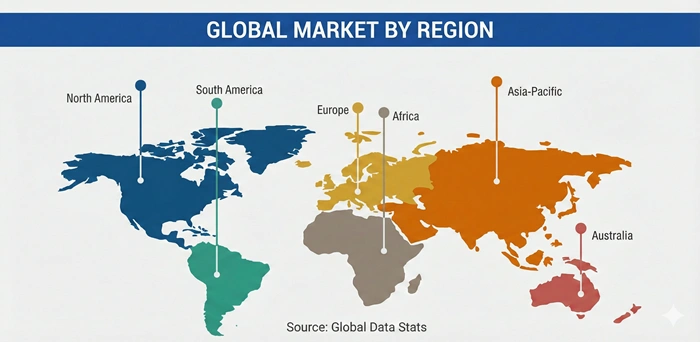
Asia Pacific commands the conductive ink market with dominant share exceeding 45%, driven by concentrated electronics manufacturing across China, Japan, and South Korea where consumer electronics assembly, display fabrication, and solar panel production consume substantial conductive ink volumes supporting domestic consumption and global exports. China alone accounts for over 70% of global solar cell manufacturing capacity, 50% of smartphone production, and 60% of flat panel display output creating diversified conductive ink demand across photovoltaic metallization, touch sensors, RFID tags, and flexible circuits. The region benefits from vertical integration spanning raw material production including silver powders and polymer binders through final device assembly with leading conductive ink suppliers maintaining local manufacturing operations reducing supply chain costs and delivery lead times. South Korea's Samsung and LG lead flexible OLED display commercialization incorporating printed transparent electrodes and touch sensors while Japanese companies including Sony, Panasonic, and Fujifilm pioneer advanced printing technologies and specialty ink formulations.
China represents fastest-growing market within Asia Pacific driven by domestic consumer electronics consumption, electric vehicle production expansion, and continued solar manufacturing capacity additions. Leading conductive ink suppliers including DuPont China, Henkel Electronics Asia, Heraeus Materials Technology Shanghai, and domestic producers including Hunan LEED Electronic Ink and Shanghai Daejoo Electronic Material operate regional technical centers supporting customers requiring application-specific formulation optimization and process integration assistance. Japanese electronics manufacturers maintain technological leadership in fine-line printing, flexible substrate bonding, and high-reliability applications where material purity and process control justify premium pricing. Southeast Asian nations including Vietnam, Thailand, and Malaysia develop electronics assembly capacity supporting smartphone production, automotive electronics manufacturing, and emerging IoT device fabrication. The region's market dominance continues strengthening through 2033 as domestic consumption growth, manufacturing capacity expansion, and technology innovation create self-reinforcing dynamics supporting continued leadership position.
North America
Innovation Ecosystem and Electric Vehicle Adoption Position Region as Fastest-Growing Geographic Market
North America emerges as the fastest-growing regional conductive ink market with projected CAGR of 8.7% through 2034, propelled by electric vehicle platform adoption, flexible electronics innovation, defense applications, and renewable energy expansion. The United States dominates regional market activity through established technology companies including Apple, Google, and Microsoft driving smartphone, wearable, and computing innovation requiring advanced flexible circuits and printed sensors. Electric vehicle production by Tesla, General Motors, Ford, and emerging manufacturers creates specialized demand for battery thermal management heaters, electromagnetic interference shielding, and distributed sensor networks utilizing printed conductive traces. Defense applications spanning radar systems, communication equipment, and soldier-worn electronics require high-reliability conductive inks meeting strict performance specifications and domestic content requirements creating opportunities for United States-based suppliers including Electroninks, Applied Ink Solutions, and Vorbeck Materials.
United States conductive ink market specifically benefits from robust research ecosystem connecting university laboratories, national research facilities, and industrial development programs advancing next-generation printed electronics technologies. Flexible hybrid electronics manufacturing innovation institutes, Department of Defense flexible electronics programs, and Department of Energy solar research initiatives provide funding and collaboration opportunities accelerating technology transfer from laboratory demonstrations to commercial production. Silicon Valley and Boston area technology clusters concentrate flexible electronics startups, wearable device developers, and advanced materials companies creating dense innovation networks. Canada contributes to North American growth through automotive electronics production concentrated in Ontario, telecommunications equipment manufacturing, and emerging printed sensor applications. Mexico represents substantial electronics manufacturing hub as automotive suppliers and consumer electronics contract manufacturers establish operations supporting North American supply chains. Leading conductive ink suppliers including DuPont, Henkel Electronics, Sun Chemical, and NovaCentrix maintain regional application development centers enabling close customer collaboration supporting formulation customization, process optimization, and qualification testing throughout forecast period.
Top Key Players
-
DuPont (United States)
-
Henkel AG & Co. KGaA (Germany)
-
Heraeus Holding GmbH (Germany)
-
Sun Chemical Corporation (United States)
-
NovaCentrix (United States)
-
Johnson Matthey (United Kingdom)
-
Poly-Ink (France)
-
Creative Materials Inc. (United States)
-
Applied Ink Solutions (United States)
-
Vorbeck Materials Corporation (United States)
-
Mitsubishi Chemical Corporation (Japan)
-
Sumitomo Corporation (Japan)
-
Electroninks (United States)
-
Cambrios Technologies (United States)
-
Nagase ChemteX Corporation (Japan)
Recent Developments
-
Henkel (2025): Launched novel industry-first silver inks and highly conductive silver inks based on recycled silver as raw material in February 2025, demonstrating commitment to sustainability while maintaining performance specifications for electronics applications, enabling customers to reduce environmental footprint of printed electronics manufacturing without compromising electrical conductivity or reliability requirements.
-
DuPont (2025): Announced acceleration of Electronics business separation targeting November 1 2025 completion creating independent publicly-traded company focused on semiconductor and electronics materials including conductive inks portfolio, appointing Jon Kemp as CEO to lead growth strategy capitalizing on advanced computing and connectivity market opportunities requiring innovative materials solutions.
-
DuPont (2025): Reported second quarter 2025 results demonstrating year-over-year organic sales growth and solid margin expansion in Electronics segment alongside 15 percent adjusted EPS growth, highlighting ongoing strength in electronics end-markets supporting conductive materials demand and validating strategic focus on high-value specialty materials applications.
-
LIG Nex1 and Electroninks (2024): Signed strategic cooperation memorandum in December 2024 for joint development of next-generation defense component materials based on particle-free conductive inks using Metal Organic Decomposition technology, aimed at reducing weight and cost of weapon systems while accelerating commercialization and establishing foothold in Korean market strengthening international collaboration.
-
Henkel (2025): Acquired CuInk Technologies in September 2025 to expand copper-based conductive inks portfolio for printed electronics applications, addressing market demand for cost-effective alternatives to silver formulations while maintaining acceptable electrical performance for price-sensitive consumer electronics and automotive applications requiring sustainable material solutions.
Market Trends
Copper-Based Alternatives and Additive Manufacturing Integration Reshape Industry Competitive Dynamics
The conductive ink market experiences transformative trends centered on copper-based formulation development as manufacturers pursue cost-effective alternatives to silver addressing material expense concerns while maintaining acceptable electrical performance. Copper nanoparticle inks achieving conductivities exceeding 60% of bulk copper at material costs 50-70% below silver equivalents enable mass-market printed electronics applications including RFID tags, membrane switches, and basic circuit patterns where ultra-high conductivity unnecessary. Advanced anti-oxidation technologies incorporating protective coatings, reducing atmosphere sintering, and rapid thermal processing prevent copper oxidation maintaining electrical stability across environmental exposure and thermal cycling requirements. Hybrid silver-copper formulations balance performance against cost combining silver-plated copper particles or silver-copper alloy nanoparticles achieving conductivities approaching pure silver while reducing precious metal content by 30-50% creating compelling value propositions for automotive and industrial applications throughout forecast period.
Additive manufacturing integration trends reshape the conductive ink market as 3D printing technologies incorporate multi-material capabilities enabling simultaneous deposition of conductive traces, dielectric insulators, and structural components within single fabrication process. Aerosol jet printing systems deposit conductive features with line widths below 10 micrometers on three-dimensional surfaces including curved substrates, vertical walls, and complex geometries impossible through conventional planar printing methods. Multi-nozzle inkjet systems co-deposit conductive silver inks with dielectric polymers and semiconductor materials fabricating complete transistors, capacitors, and integrated circuits through purely additive processes eliminating photolithography and etching steps. Hybrid manufacturing approaches combining traditional printed circuit board fabrication with printed conductive features enable rapid prototyping, design iteration, and low-volume customization reducing development timelines and tooling costs. These advanced manufacturing capabilities expand addressable markets enabling printed electronics adoption across aerospace conformal antennas, medical device integration, and custom sensor arrays throughout forecast period.
Segments Covered in the Report
By Type
-
Silver-Based Conductive Inks
-
Copper-Based Conductive Inks
-
Carbon/Graphene-Based Conductive Inks
-
Carbon Nanotube Conductive Inks
-
Conductive Polymer Inks
-
Others
By Application
-
Photovoltaic Solar Cells
-
RFID Tags and Smart Cards
-
Membrane Switches and Keyboards
-
Printed Circuit Boards
-
Touch Sensors and Displays
-
Automotive Sensors and Heaters
-
Others
By Printing Technology
-
Screen Printing
-
Inkjet Printing
-
Gravure Printing
-
Flexographic Printing
-
Others
By End-Use
-
Consumer Electronics
-
Automotive
-
Healthcare and Medical Devices
-
Renewable Energy
-
Aerospace and Defense
-
Industrial
-
Others
By Region
-
North America (United States, Canada, Mexico)
-
Europe (Germany, United Kingdom, France, Italy, Rest of Europe)
-
Asia Pacific (China, Japan, South Korea, India, Southeast Asia, Rest of Asia Pacific)
-
Latin America (Brazil, Argentina, Rest of Latin America)
-
Middle East & Africa (UAE, Saudi Arabia, South Africa, Rest of MEA)
Frequently Asked Questions
Question 1: What is the projected size of the conductive ink market by 2033?
Answer: The global conductive ink market is expected to reach approximately USD 6.36 billion by 2033, growing from USD 3.96 billion in 2026. This substantial expansion reflects increasing adoption across flexible electronics, photovoltaic solar cells, electric vehicle applications, and IoT sensor networks requiring printed conductive circuits.
Question 2: Which region dominates the conductive ink market currently?
Answer: Asia Pacific leads the conductive ink market with over 45% share, driven by concentrated electronics manufacturing and solar panel production in China, Japan, and South Korea. Leading suppliers including DuPont, Henkel, Heraeus, and Sun Chemical maintain dominant regional positions.
Question 3: What are the primary drivers of conductive ink market growth?
Answer: Key growth drivers include flexible electronics proliferation in foldable smartphones and wearables, solar energy deployment requiring photovoltaic metallization, electric vehicle production incorporating printed heaters and sensors, and IoT sensor expansion. These factors create sustained demand across diverse applications.
Question 4: Which material type holds the largest conductive ink market share?
Answer: Silver-based conductive inks dominate with approximately 42% market share due to superior electrical conductivity, oxidation resistance, and proven reliability across photovoltaic cells, RFID antennas, and touch sensors. Performance characteristics justify premium pricing compared to copper or carbon alternatives despite higher material costs.
Question 5: How do copper-based inks impact the conductive ink market?
Answer: Copper-based conductive inks offer 50-70% cost reduction compared to silver formulations while achieving acceptable conductivity for price-sensitive applications including RFID tags and membrane switches. Advanced anti-oxidation technologies prevent degradation enabling broader adoption where ultra-high conductivity unnecessary, expanding addressable market opportunities.