
Concierge Medicine Market Overview
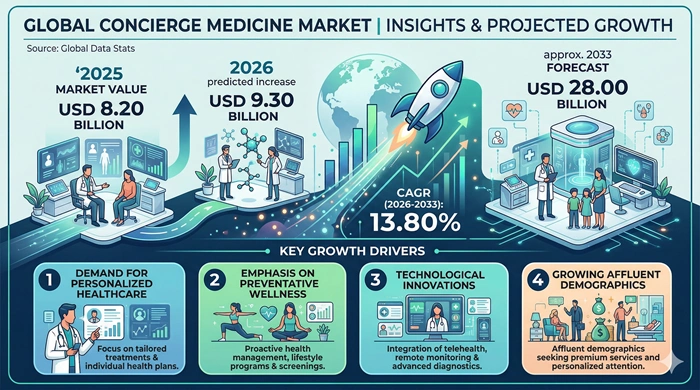
The global Concierge Medicine market size is valued at USD 8.20 billion in 2025 and is predicted to increase from USD 9.30 billion in 2026 to approximately USD 28.00 billion by 2033, growing at a CAGR of 13.80% from 2026 to 2033.
Concierge medicine — also widely referred to as direct primary care, membership medicine, or boutique healthcare — is a personalized healthcare delivery model in which patients pay a recurring membership fee directly to their physician or practice in exchange for enhanced access, longer appointment times, same-day or next-day visits, 24/7 physician availability via phone or telemedicine, comprehensive preventive health programs, and a fundamentally more attentive and relationship-centered standard of primary care than traditional insurance-based practices can deliver within their constrained per-visit reimbursement economics. This care model spans a spectrum from traditional high-end concierge practices serving affluent individual patients with premium annual membership fees of USD 1500 to USD 25000 per year, to more accessible direct primary care practices offering monthly memberships of USD 50 to USD 150 that deliberately serve broader middle-income patient populations seeking better primary care access without the administrative overhead of insurance billing. The Concierge Medicine market is experiencing strong and accelerating commercial growth driven by widespread dissatisfaction with the quality, accessibility, and personalization of conventional insurance-based primary care, growing physician burnout motivating primary care doctors to exit the traditional fee-for-service model, expanding corporate employer adoption of concierge medicine as a premium workforce benefit, and the growing clinical evidence that concierge and direct primary care models deliver better preventive health outcomes and lower total healthcare costs than traditional primary care.
AI Impact on the Concierge Medicine Industry
Artificial Intelligence Is Transforming Personalized Preventive Health Planning, Predictive Disease Risk Assessment, Virtual Care Delivery Quality, Administrative Efficiency, and Patient Engagement in Ways That Are Meaningfully Enhancing the Clinical Value and Commercial Scalability of Concierge Medicine Practices Globally*
Artificial intelligence is delivering commercially significant and clinically meaningful contributions to the Concierge Medicine market through AI-powered predictive health risk assessment platforms — where machine learning algorithms analyze individual patient genomic data, longitudinal laboratory biomarker trends, lifestyle and behavioral factors, family medical history, and wearable device physiological data to generate personalized disease risk profiles and preventive intervention priority recommendations that give concierge physicians a far more comprehensive and scientifically grounded foundation for proactive health management conversations than traditional episodic clinical assessment allows. Companies including Fountain Life, Lifeforce, and Human Longevity Inc. are embedding sophisticated AI-powered biomarker analysis and longevity risk prediction capabilities into their premium executive health and concierge wellness programs — enabling their physician teams to deliver genuinely personalized preventive medicine that identifies subclinical disease risk years before conventional screening approaches detect clinical manifestations — a capability that represents a powerful clinical value differentiator justifying the premium membership fees of high-end concierge programs and generating strong member retention among health-conscious high-value patients. The progressive integration of AI-powered virtual health assistant technology into concierge practice patient communication platforms — where AI chatbots triage incoming patient messages, synthesize relevant medical history before physician review, prioritize urgent communications for immediate physician attention, and handle administrative scheduling and prescription renewal requests autonomously — is simultaneously enabling concierge physicians to manage larger panel sizes without sacrificing the responsiveness and personalization quality that concierge membership fees promise, improving practice unit economics while maintaining the high-touch service standards that differentiate the concierge care experience.
AI is additionally transforming the administrative and operational efficiency of concierge medicine practice management — where machine learning-powered tools automate membership billing, predict membership churn risk enabling proactive retention interventions, optimize physician scheduling based on patient acuity and preference patterns, and generate personalized member health newsletters and annual health summary reports that reinforce the value of membership between direct physician interactions. The growing deployment of AI-powered remote patient monitoring integration within concierge practices — where continuous wearable biometric data from Apple Watch, Oura Ring, Withings, and Garmin devices feeds into AI analysis platforms that alert concierge physicians to physiologically significant changes requiring clinical attention — is progressively enabling concierge medicine practices to deliver genuinely continuous rather than episodically reactive healthcare that represents one of the most compelling clinical value propositions of the premium membership model for health-engaged patients. These AI operational and clinical capabilities are collectively enabling concierge medicine practices to improve both the quality of clinical service delivery and the economic sustainability of their operating models — accelerating commercial growth across the broader Concierge Medicine market through better member outcomes, stronger retention economics, and enhanced new member acquisition marketing through demonstrated outcome differentiation.
Growth Factors
Widespread Dissatisfaction with Conventional Primary Care Quality, Primary Care Physician Burnout Driving Practice Model Migration, Growing Corporate Employer Adoption as Workforce Benefit, and Expanding Direct Primary Care Accessibility Are the Core Drivers of the Concierge Medicine Market's Strong Commercial Growth*
The most structurally powerful and commercially consequential growth driver of the Concierge Medicine market is the deep and broadly experienced dissatisfaction with the quality, accessibility, and personalization of conventional insurance-based primary care — where the economics of fee-for-service primary care require physicians to see 20–30 patients per day in 10–15 minute appointments that allow minimal time for comprehensive health assessment, preventive counseling, chronic disease management, or the physician-patient relationship development that drives patient satisfaction, care continuity, and clinical outcome quality. Primary care patients in traditional practices face average appointment wait times of three to four weeks for non-urgent concerns, rushed encounters that frequently leave clinical questions unresolved, and difficulty reaching their physician between appointments — creating a persistent and deeply felt gap between the standard of primary care patients want and what the current healthcare system structure delivers. The growing awareness of the concierge medicine alternative — enabled by media coverage, employer program adoption, and direct-to-consumer marketing by growing concierge practice networks — is progressively converting this dissatisfaction into active membership growth across the concierge and direct primary care market as patients who can afford the membership cost increasingly choose the fundamentally better care access and quality experience that the model delivers.
The epidemic of primary care physician burnout — where studies consistently find that 60–70% of primary care physicians report symptoms of professional burnout driven by excessive administrative burden, unsustainable patient volume requirements, declining professional autonomy, and inadequate compensation relative to workload — is generating a steady stream of experienced primary care physicians who are leaving traditional fee-for-service practice to establish concierge or direct primary care practices that restore professional fulfillment through smaller, more manageable patient panels, direct financial relationships that eliminate insurance administrative burden, and the ability to practice the comprehensive, relationship-based primary care they trained to deliver. This physician migration from traditional to concierge practice models is simultaneously expanding the supply of concierge medicine practices available to patients and reducing the traditional primary care physician supply — creating a reinforcing demand pressure dynamic that progressively grows the Concierge Medicine market through both supply-side practice expansion and demand-side patient migration. The growing corporate employer adoption of concierge medicine and direct primary care as premium employee health benefits — where employers contract with concierge practice networks including Vera Whole Health, Marathon Health, and Crossover Health to provide on-site or near-site concierge primary care for their workforces — is simultaneously expanding the accessible addressable market beyond affluent individual consumers to include middle-income employed adults whose employers absorb the membership cost as a workforce wellbeing and productivity investment.

Market Outlook
With Direct Primary Care Accessibility Growing, Technology-Enhanced Concierge Practice Scalability Improving, Corporate Adoption Accelerating, and International Market Development Beginning, the Concierge Medicine Market Outlook Is Strongly Positive Through 2033*
The long-term outlook for the Concierge Medicine market is firmly positive and structurally well-supported — with a compelling combination of growing patient demand, physician supply migration, corporate employer adoption expansion, technology-enabled practice scalability improvement, and geographic market development collectively expected to sustain near double-digit to mid-teen revenue growth throughout the 2026–2033 forecast period. The most commercially significant structural market evolution within concierge medicine is the progressive democratization of the model beyond its traditional affluent individual patient base — where the rapid growth of direct primary care practices offering genuinely affordable monthly membership pricing is making the benefits of membership-based primary care accessible to middle-income households, self-employed individuals, and gig economy workers who lack comprehensive employer-provided health insurance and who represent an enormous underpenetrated addressable market for accessible direct primary care membership. This accessibility expansion is generating meaningfully larger addressable market scale for the concierge medicine model — growing the potential member population from the relatively small affluent demographic that traditional high-end concierge practices have historically served to a substantially broader working-age adult population segment that can afford USD 75–150 monthly direct primary care membership fees as a rational personal healthcare investment.
The progressive development of hybrid concierge medicine models — where practices combine in-person membership physician relationships with comprehensive virtual care capabilities including video consultations, asynchronous messaging, and remote monitoring — is expanding the geographic reach of concierge medicine beyond the urban and affluent suburban markets where traditional physical practices have concentrated into smaller cities, rural areas, and international markets where the concierge care access model has been previously unavailable. Technology platforms including Hint Health and Elation Health are enabling direct primary care practice management at scale — providing physicians with the electronic health record, billing, patient communication, and practice analytics tools required to operate membership practices efficiently — progressively lowering the operational barriers for new concierge practice formation and accelerating the pace of physician migration from traditional to membership-based practice models. The growing international interest in the Concierge Medicine market — particularly in the United Kingdom where NHS primary care access constraints are generating strong demand for private membership GP services, and in the Middle East and Asia Pacific where affluent patient populations seek premium healthcare access models — is beginning to generate meaningful international market development that will contribute growing revenue to the global market throughout the forecast period.
Expert Speaks
-
Andrew Witty, CEO, UnitedHealth Group (Optum Division) — "The structural challenges of conventional primary care — where physician time constraints, administrative burden, and reactive care orientation consistently fail to deliver the preventive, personalized healthcare experience that patients increasingly expect — are making alternative care delivery models including direct primary care and concierge medicine genuinely attractive to both patients seeking better care and physicians seeking more sustainable practice environments. We are actively studying and in some cases investing in advanced primary care delivery models that combine the physician relationship advantages of membership-based care with the data infrastructure and population health management capabilities of large integrated health systems — recognizing that the future of primary care likely incorporates elements of both approaches."
-
Gail Boudreaux, CEO, Elevance Health (Anthem) — "The employer market's growing investment in direct primary care and concierge medicine access as workforce health benefits reflects a rational economic calculation — where employers that provide their employees with meaningful primary care access achieve better preventive health outcomes, lower downstream emergency and specialist utilization costs, and meaningfully higher employee satisfaction and retention than those relying solely on traditional insurance plan coverage. Elevance Health is engaged in evaluating how direct primary care and advanced primary care model partnerships can complement our insurance products to deliver more comprehensive and cost-effective total health benefit value to our employer and individual market customers."
-
Bruce Broussard, CEO, Humana — "The concierge medicine model's emphasis on physician-patient relationship continuity, proactive preventive care, and genuinely personalized health management aligns closely with Humana's long-standing clinical philosophy that the most effective and cost-efficient healthcare is delivered through trusting, longitudinal physician relationships that enable truly preventive intervention rather than episodic reactive treatment. As we continue expanding Humana's primary care footprint through CenterWell — our senior-focused primary care platform — we see important lessons from the concierge medicine model's physician-patient relationship depth that we are actively incorporating into how we design our primary care delivery experiences for seniors who benefit most from comprehensive, relationship-centered healthcare."
Key Report Takeaways
-
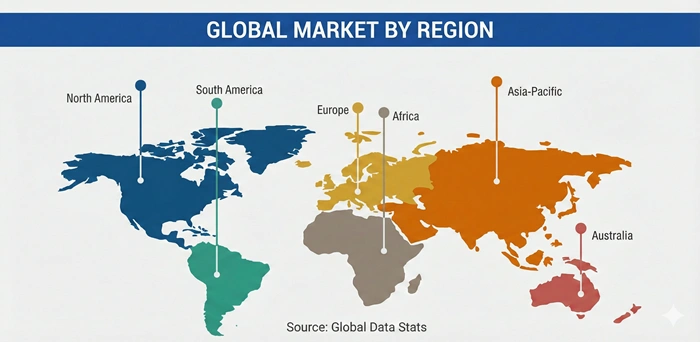
North America dominates the Concierge Medicine market, holding approximately 62.40% of global market share in 2025, driven by the United States' large affluent consumer population, the most acute primary care access dissatisfaction of any developed market, the highest primary care physician burnout rates driving practice model migration, the most developed direct primary care and concierge practice network infrastructure, and the strongest corporate employer adoption of direct primary care as an employee health benefit — with companies including Vera Whole Health, Marathon Health, and Crossover Health operating extensive employer-sponsored concierge primary care networks across the country.
-
Asia Pacific is the fastest-growing regional market for concierge medicine, projected to expand at a CAGR of approximately 16.20% from 2026 to 2033, driven by rapidly growing high-net-worth individual populations in China, India, Singapore, and the UAE seeking premium personalized healthcare experiences, rising awareness of preventive medicine and proactive health management, progressive development of private premium healthcare infrastructure, and growing corporate multinational employer demand for premium primary care access for expatriate and executive employee populations across major Asian business centers.
-
Direct Primary Care is the fastest-growing model type segment, expected to expand at a CAGR of approximately 17.40% through 2033, driven by its accessibility to middle-income patients at USD 50–150 monthly membership fees that dramatically expand the addressable population beyond traditional high-end concierge clientele, strong physician enthusiasm for the model's restoration of practice autonomy and patient relationship depth, growing employer direct primary care benefit adoption, and the progressive development of direct primary care practice management technology platforms that are making practice formation and operation more accessible to individual physicians.
-
Corporate and Group Membership is the fastest-growing membership type segment, projected to grow at a CAGR of approximately 18.60% through 2033, driven by accelerating Fortune 500 and mid-market employer adoption of direct primary care and concierge medicine workforce health programs — with the employer-sponsored segment representing a fundamentally different scale of addressable revenue per client than individual memberships and generating stronger practice revenue predictability through multi-year corporate benefit contracts.
-
Preventive Health and Wellness Services represent the most rapidly expanding service type, projected to grow at a CAGR of approximately 15.80% through 2033, driven by growing member demand for comprehensive executive health evaluations, advanced biomarker testing, genetic risk assessment, precision nutrition and lifestyle optimization programs, and AI-powered longevity medicine services that represent the highest-value and most differentiated clinical service offerings within the premium concierge medicine practice portfolio.
-
Solo and small group physician practices remain the dominant practice size segment, accounting for approximately 68.20% of total market revenue in 2025, reflecting the fundamentally relationship-centered nature of concierge medicine — where individual physician-patient relationships drive member loyalty and clinical outcome quality — with independent solo and small group concierge physicians collectively generating the majority of total market revenue through their large aggregate membership bases across thousands of individual practices nationwide.
Market Scope
| Report Coverage | Details |
|---|---|
| Market Size by 2033 | USD 28.00 Billion |
| Market Size by 2025 | USD 8.20 Billion |
| Market Size by 2026 | USD 9.30 Billion |
| Market Growth Rate (2026–2033) | CAGR of 13.80% |
| Dominating Region | North America |
| Fastest Growing Region | Asia Pacific |
| Base Year | 2025 |
| Forecast Period | 2026–2033 |
| Segments Covered | Model Type, Membership Type, Service Type, Practice Size, End User |
| Regions Covered | North America, Europe, Asia Pacific, Latin America, Middle East & Africa |
Market Dynamics
Drivers Impact Analysis
Primary Care System Failure Creating Strong Patient and Physician Demand for Better Models, Corporate Employer Adoption, DPC Accessibility Growth, and Physician Burnout Migration Are the Core Drivers of the Concierge Medicine Market*
| Driver | ≈ % Impact on CAGR Forecast | Geographic Relevance | Impact Timeline |
|---|---|---|---|
| Widespread dissatisfaction with conventional primary care quality and access creating patient demand | ~34% | North America, Europe | Short to Long-term |
| Primary care physician burnout driving migration to concierge and direct primary care models | ~27% | North America | Short to Long-term |
| Corporate employer adoption of direct primary care as workforce health and productivity benefit | ~24% | North America, Europe | Short to Medium-term |
| Direct primary care affordability expansion making membership medicine accessible to middle-income patients | ~15% | North America, Europe | Short to Long-term |
The most commercially durable and structurally significant growth driver of the Concierge Medicine market is the persistent and worsening quality gap between what patients experience in conventional insurance-based primary care and what they genuinely need and desire from their primary healthcare relationship — where the systemic economics of fee-for-service primary care force physicians to operate at patient volumes and appointment lengths that make truly comprehensive, preventive, and relationship-centered care delivery structurally impossible. The average primary care physician in a traditional practice manages a panel of 1500 to 2500 patients, delivers 10–15 minute appointments under relentless scheduling pressure, spends two hours on administrative documentation for every hour of direct patient care, and earns lower inflation-adjusted compensation than a decade ago — creating a professional environment that simultaneously produces burnout in physicians and dissatisfaction in patients who receive rushed, fragmented, and inadequately preventive primary care. Concierge and direct primary care practices that reduce physician panel sizes to 300–600 patients, eliminate insurance billing administrative burden, and generate direct membership revenue sufficient to sustain a satisfying professional and financial outcome for physicians simultaneously solve both the physician burnout and patient dissatisfaction problems — driving strong and mutually reinforcing demand from both sides of the physician-patient relationship that structurally grows the Concierge Medicine market from within the existing primary care workforce.
The accelerating corporate employer adoption of direct primary care and concierge medicine as employee health benefits — driven by compelling employer return-on-investment evidence showing reduced downstream healthcare utilization costs, improved employee health outcomes, and higher employee retention and satisfaction among employees with access to concierge primary care — is generating large and growing enterprise revenue streams for concierge practice networks that operate employer-sponsored programs. Vera Whole Health, Marathon Health, Crossover Health, and Amazon Care (prior to its closure) have collectively demonstrated the commercial viability and employer demand for near-site and on-site direct primary care delivery for large employer workforces — with published studies showing 20–30% reductions in emergency department visits, specialist referrals, and total healthcare costs among employee populations with direct primary care access compared to control groups. This employer adoption wave is progressively expanding the concierge medicine addressable market from individual consumer purchasing to large enterprise contract revenue — generating more predictable, higher-value, and more scalable revenue streams that support the commercial growth and investment attractiveness of the broader concierge medicine practice network sector.
Restraints Impact Analysis
High Membership Cost Barriers Limiting Mass Market Accessibility, Insurance Non-Coverage Creating Dual Expenditure Burden, Primary Care Physician Supply Constraints, and Equity Concerns Restraining the Concierge Medicine Market's Broader Penetration*
| Restraint | ≈ % Impact on CAGR Forecast | Geographic Relevance | Impact Timeline |
|---|---|---|---|
| High membership fee cost limiting accessibility to affluent demographics in traditional model | ~36% | Global | Short to Long-term |
| Insurance non-coverage requiring members to maintain separate insurance for specialist and hospital care | ~28% | North America, Europe | Short to Long-term |
| Limited primary care physician supply constraining new practice formation capacity | ~22% | North America | Short to Long-term |
| Regulatory uncertainty and state-level legislative variation for direct primary care model recognition | ~14% | United States, Emerging markets | Short to Medium-term |
The most broadly limiting commercial restraint on Concierge Medicine market growth is the fundamental cost barrier of traditional high-end concierge medicine membership fees — where annual fees of USD 1500 to USD 25000 effectively restrict the traditional concierge care model to the wealthiest 5–10% of the population, limiting addressable market scale and creating legitimate equity criticisms that constrain broader social acceptance and policy support for the model's expansion. While the growth of direct primary care has meaningfully extended membership medicine accessibility into middle-income demographics at USD 50–150 monthly price points, the additional reality that concierge and DPC memberships supplement rather than replace major medical insurance — requiring most members to simultaneously maintain comprehensive health insurance for specialist care, hospital services, and emergency treatment — creates a dual expenditure burden that remains financially challenging for households below median income levels even with affordable DPC pricing. This cost structure reality limits the theoretical addressable market for concierge medicine to households with sufficient discretionary income to afford both meaningful health insurance coverage and an additional monthly primary care membership — a population that represents a large but demographically bounded share of the total adult population.
The growing shortage of primary care physicians in the United States and internationally — driven by the combination of insufficient medical school and residency program training capacity, high rates of early career burnout and specialty migration, and an aging primary care physician workforce nearing retirement — is simultaneously constraining the supply of physicians available to transition into concierge or direct primary care practice models. Every physician who establishes a direct primary care practice with a 400-patient panel is simultaneously removing themselves from the conventional primary care system where they previously served 1500–2000 patients — creating a net reduction in conventional primary care access that generates social and policy criticism of the concierge medicine model as exacerbating rather than solving the primary care access problem. This public perception challenge creates a persistent reputational constraint on concierge medicine market expansion — particularly in countries with universal healthcare systems where the visible emergence of premium two-tier primary care access is politically sensitive and potentially subject to regulatory restriction.
Opportunities Impact Analysis
Direct Primary Care Employer Benefit Expansion, International Market Development, Technology-Enabled Virtual Concierge Model Scaling, Longevity Medicine Integration, and DPC Insurance Partnership Development Creating Significant Concierge Medicine Market Opportunities*
| Opportunity | ≈ % Impact on CAGR Forecast | Geographic Relevance | Impact Timeline |
|---|---|---|---|
| Employer direct primary care benefit program expansion to mid-market and small business clients | ~32% | North America, Europe | Short to Medium-term |
| Virtual and technology-enabled concierge model enabling geographic reach beyond physical practice locations | ~26% | Global | Short to Long-term |
| Longevity medicine and executive health program integration creating premium high-value service expansion | ~25% | North America, Asia Pacific, Europe | Short to Long-term |
| International market development in UK, Middle East, and Asia Pacific affluent healthcare markets | ~17% | Europe, Asia Pacific, MEA | Medium to Long-term |
The most commercially significant and near-term realizable opportunity within the Concierge Medicine market is the progressive expansion of employer-sponsored direct primary care benefit programs from the large enterprise segment — where Fortune 500 employers have led adoption — into the far more numerous mid-market and small business employer segment, where the same workforce productivity, health outcome, and cost reduction ROI arguments apply but where implementation and contracting barriers have historically been higher due to smaller employee populations and more limited HR benefit administration infrastructure. Technology platforms including Hint Health, Spruce Health, and dedicated DPC practice management software providers are progressively lowering the operational barriers for mid-market and small employer direct primary care program implementation — creating a large and currently underpenetrated employer contract opportunity that represents a meaningful revenue expansion pathway for direct primary care practice networks seeking to grow beyond the large-employer segment. The progressive development of direct primary care insurance partnerships — where health insurance carriers include DPC memberships as covered benefits within their commercial health plan products, effectively eliminating the dual expenditure concern for employees — represents another transformative market development opportunity that could meaningfully expand the accessible patient population for the concierge medicine model.
The rapidly growing interest in longevity medicine and executive health optimization — where affluent health-conscious individuals are seeking comprehensive biomarker assessment, genetic risk profiling, advanced imaging, precision nutrition analysis, and AI-powered personalized health optimization programs that represent the highest-value extension of the preventive medicine philosophy central to premium concierge practices — is creating a significant service expansion opportunity for high-end concierge medicine providers. Platforms including Fountain Life, Lifeforce, and Human Longevity Inc. are successfully monetizing this longevity medicine demand with comprehensive executive health programs priced at USD 5000–25000 annually — demonstrating the commercial viability of premium longevity-focused clinical services that complement and enhance the traditional primary care access membership value proposition of concierge programs. The enormous international market development opportunity — particularly in the United Kingdom where NHS primary care access has deteriorated to crisis levels, generating strong demand for private membership GP services; and in Gulf Cooperation Council countries and Singapore where affluent patient populations and international expatriate communities represent natural concierge medicine adopters — is beginning to generate meaningful international market revenue that will become progressively more commercially significant throughout the 2026–2033 forecast period.
Segment Analysis
By Model Type
Traditional Concierge Medicine Leads Revenue While Direct Primary Care Registers the Fastest Growth and Greatest Accessibility Expansion in the Concierge Medicine Market*
Traditional concierge medicine holds the dominant revenue position in the Concierge Medicine market, accounting for approximately 48.60% of total market revenue in 2025, driven by the high annual membership fees — ranging from USD 1500 to USD 25000 per patient annually — commanded by established concierge physician practices that serve affluent individual and family patients with highly personalized, comprehensive, and continuously available primary care services including same-day access, 24/7 physician availability, comprehensive preventive health evaluations, specialist coordination, and premium executive health program components. Concierge practice networks including MDVIP — the largest concierge medicine network in the United States operating more than 1100 affiliated physician practices — and Signature MD collectively represent the dominant traditional concierge segment commercial players, generating large aggregate membership revenue from their national networks of affiliated concierge physicians serving hundreds of thousands of members. North America generates the overwhelming majority of traditional concierge medicine segment revenue — driven by the United States' large affluent consumer base, the most mature concierge medicine market awareness and physician network infrastructure, and the highest per-capita healthcare expenditure that makes premium primary care membership fees financially accessible to a larger proportion of the population than in most other markets. Key companies maintaining strong positions in the traditional Concierge Medicine market segment include MDVIP, Signature MD, PartnerMD, and Castle Connolly Private Health Partners.
Direct primary care represents the fastest-growing model type segment in the concierge medicine market, projected to expand at a CAGR of approximately 17.40% through 2033 as its deliberately accessible pricing model — with monthly memberships typically ranging from USD 50 to USD 150 for adults — dramatically expands the addressable patient population beyond the affluent individual demographic that traditional concierge practices serve to encompass middle-income families, self-employed professionals, small business owners, and gig economy workers seeking affordable and high-quality primary care access. The direct primary care movement — encompassing more than 2500 individual DPC practices in the United States and growing — is generating strong physician interest as an escape from conventional practice burnout, with organizations including the Direct Primary Care Coalition and DPC Frontier actively supporting physician education, practice formation resources, and legislative advocacy that are progressively reducing barriers to DPC practice establishment. North America leads DPC segment revenue — driven by the largest and most rapidly growing DPC practice network density globally — while Europe is the fastest-growing DPC geographic region as the NHS primary care access crisis in the United Kingdom generates strong patient and physician interest in direct payment primary care alternatives. Key practice management technology companies including Hint Health and Elation Health serve the DPC segment by providing specialized billing, patient communication, and practice operations platforms that enable efficient DPC practice management.
By End User
Individual Patients Represent the Largest End User Segment While Corporate Clients Drive the Fastest Revenue Growth in the Concierge Medicine Market*
Individual patients represent the largest end user segment in the Concierge Medicine market, accounting for approximately 52.80% of total global market revenue in 2025, reflecting the large and growing base of health-engaged individuals and families who self-select into concierge and direct primary care membership programs through direct physician-patient marketing, practice referral networks, employer benefit recommendations, and progressive consumer awareness of the concierge medicine model as an alternative to the frustrating access and quality limitations of conventional primary care. The individual patient segment spans a wide socioeconomic spectrum — from high-net-worth patients in traditional high-fee concierge practices seeking the most premium personalized healthcare experience available, to middle-income adults and families in affordable DPC practices seeking fundamentally better primary care access at a monthly cost comparable to a gym membership. North America leads individual patient concierge medicine revenue — driven by the highest per-capita awareness of the concierge model, the largest existing concierge physician practice network, and the strongest cultural acceptance of direct payment healthcare relationships — while Asia Pacific is the fastest-growing individual patient region as affluent consumers in China, India, and Singapore progressively discover and adopt premium membership healthcare models. Key companies including MDVIP, Signature MD, and One Medical serve the individual patient concierge segment through their physician network and consumer-direct marketing programs.
Corporate clients and employers represent the fastest-growing end user segment in the Concierge Medicine market — projected to expand at a CAGR of approximately 18.60% through 2033 — as growing corporate evidence for direct primary care ROI, expanding availability of employer-focused concierge practice network platforms, and progressive HR benefit market adoption transforms employer-sponsored direct primary care from an innovative early-adopter benefit into a mainstream employee health offering across large and mid-market corporate employers. Vera Whole Health, Marathon Health, and Crossover Health collectively represent the largest employer-sponsored advanced primary care network companies in the United States — operating hundreds of employer-contracted near-site and on-site primary care clinics for corporate clients including Amazon, Boeing, and Toyota — and generating strong annual recurring contract revenue from multi-year employer partnerships that provide all enrolled employees unlimited primary care access for a per-employee-per-month contract fee. North America leads corporate client concierge medicine revenue — driven by the strongest corporate mental and physical health benefit investment culture and the largest enterprise HR benefit procurement infrastructure — while Europe is the fastest-growing corporate segment as UK and Nordic employer wellness program investment progressively incorporates advanced primary care access as a standard workforce health benefit component. The corporate client segment's combination of large contract values, multi-year duration, and predictable recurring revenue positions it as the most commercially attractive and strategically important end user segment within the overall concierge medicine market for organized practice network operators and investors.
Regional Insights
North America
North America Leads the Global Concierge Medicine Market at 62.40% Revenue Share, Driven by the World's Most Advanced Concierge Practice Network, Strongest Patient Demand, and Largest Corporate Employer Adoption Infrastructure*
North America holds the overwhelmingly dominant position in the global Concierge Medicine market, accounting for approximately 62.40% of total global market revenue in 2025, and is projected to sustain market leadership at a CAGR of approximately 13.20% from 2026 to 2033. The United States drives the vast majority of North American revenue — generating the world's largest concierge medicine and direct primary care practice ecosystem, with more than 12000 estimated concierge-model physician practices operating across the country serving an estimated 1–2 million members — supported by the acute primary care access and quality dissatisfaction that makes the concierge alternative compelling to American patients and physicians alike. Leading companies commanding the North American Concierge Medicine market include MDVIP, Signature MD, PartnerMD, One Medical (Amazon subsidiary), Vera Whole Health, Marathon Health, Crossover Health, Castle Connolly Private Health Partners, and a large independent solo and small group practice segment collectively representing the majority of national membership volume across thousands of individual practices.
Canada contributes meaningfully to North American concierge medicine revenue — through a growing private membership GP and family medicine market serving patients frustrated with public healthcare system wait times — while simultaneously experiencing strong DPC-adjacent model growth driven by the progressive private healthcare investment that Canada's single-payer public system gaps are generating. The United States legislative landscape for direct primary care — where 32 states have enacted DPC-specific legislation clarifying that membership fees do not constitute insurance and therefore do not require insurance licensing — is progressively removing the regulatory uncertainty that previously constrained DPC practice formation and is accelerating the pace of new practice establishment. North America's combination of massive patient demand, the world's largest existing concierge physician network, and the most developed employer benefit adoption infrastructure positions it to sustain clear concierge medicine market leadership through 2033.
Asia Pacific
Asia Pacific Is the Fastest-Growing Concierge Medicine Market at 16.20% CAGR, Driven by Affluent Patient Demand in China, India, and Singapore, Growing Preventive Health Awareness, and International Expatriate Healthcare Needs*
Asia Pacific is the fastest-growing regional segment in the Concierge Medicine market, projected to expand at a CAGR of approximately 16.20% from 2026 to 2033 — the highest regional growth rate globally. Singapore represents the most developed and commercially sophisticated Asia Pacific concierge medicine market — where a combination of a large affluent resident population, substantial international expatriate business community, excellent private healthcare infrastructure, and strong preventive health awareness creates ideal conditions for premium concierge medicine service adoption, with established international concierge healthcare service providers and local premium private GP networks serving growing membership patient populations. China's rapidly growing high-net-worth individual population — among the largest globally in absolute numbers — combined with rising awareness of preventive medicine and proactive health management, and significant frustration with the quality and personalization of both public hospital care and standard private clinic services, is generating growing demand for premium membership-based healthcare that is attracting both international concierge healthcare operators and domestic Chinese premium healthcare companies to develop concierge-model primary care offerings. Key companies serving the Asia Pacific Concierge Medicine market include International SOS (Singapore), Bumrungrad International Hospital Thailand Premium Service, Raffles Medical Group (Singapore), and growing domestic Chinese premium healthcare platforms developing concierge-adjacent private healthcare membership services.
India represents a rapidly developing Asia Pacific concierge medicine market — where the enormous private hospital sector, growing affluent and upper-middle-class patient population, and increasing awareness of global healthcare standards are generating demand for premium personalized primary care services that exceed the quality and access levels of standard private clinic care. The Gulf Cooperation Council market — particularly the UAE and Saudi Arabia — is also an important and rapidly growing component of the broader Middle East and Near-Asia premium healthcare ecosystem, where large international expatriate populations, high-income local patient populations, and strong government investment in premium healthcare infrastructure are creating strong demand for concierge medicine and executive health program services. The scale of Asia Pacific's growing high-net-worth and upper-middle-class patient populations, combined with their strong preventive health engagement and willingness to invest in premium healthcare experiences, positions Asia Pacific as the most commercially dynamic and fastest-growing Concierge Medicine market geography globally through 2033.
Top Key Players
-
MDVIP LLC (United States)
-
Signature MD Inc. (United States)
-
PartnerMD LLC (United States)
-
One Medical Inc. — Amazon Subsidiary (United States)
-
Vera Whole Health Inc. (United States)
-
Marathon Health Inc. (United States)
-
Crossover Health Inc. (United States)
-
Castle Connolly Private Health Partners LLC (United States)
-
International SOS (Singapore)
-
Raffles Medical Group (Singapore)
-
Sollis Health Inc. (United States)
-
Lifeforce Health Inc. (United States)
Recent Developments
-
One Medical — Amazon (2025) — Continued rapid expansion of its One Medical concierge-adjacent primary care network following Amazon's USD 3.9 billion acquisition completion — with Amazon Prime membership integration offering One Medical access as a Prime member benefit at reduced pricing representing a landmark democratization of concierge-adjacent primary care that is progressively growing One Medical's enrolled patient base well beyond its original affluent consumer demographic — while simultaneously advancing the integration of Amazon's Alexa and healthcare data capabilities into One Medical's patient engagement and care coordination platforms.
-
MDVIP (2025) — Reported continued growth in its national affiliated concierge physician network — surpassing 1100 affiliated physician practices across the United States serving more than 380000 members — while launching an enhanced member health portal integrating wearable device data monitoring, AI-powered health risk assessment tools, and expanded telehealth consultation capabilities designed to strengthen member engagement and clinical value between in-person physician visits and further differentiate the MDVIP member experience from standard primary care alternatives.
-
Vera Whole Health (2024) — Completed a strategic partnership expansion with a major national employer benefit consulting firm to accelerate distribution of its employer-sponsored advanced primary care clinic model to mid-market and regional employers — while reporting strong clinical outcome and cost reduction data from its existing employer client portfolio including meaningful reductions in emergency department visits and specialist referral rates among employer-enrolled patient populations that are reinforcing the business case for DPC model employer benefit adoption.
-
Marathon Health (2025) — Announced a significant expansion of its near-site employer health center network across multiple new geographic markets — adding more than 50 new employer-contracted clinic locations — while completing a strategic partnership with a behavioral health technology platform to integrate mental health and substance use disorder support services into its comprehensive employer primary care clinic service model — addressing growing employer recognition of the clinical and productivity impact of employee mental health alongside physical health.
-
Fountain Life (2024) — Launched two new flagship longevity medicine and executive health centers in major US metropolitan markets — offering comprehensive multi-day executive health evaluation programs combining advanced whole-body MRI scanning, liquid biopsy cancer detection testing, genomic risk profiling, microbiome analysis, AI-powered biomarker interpretation, and personalized longevity optimization programming — while reporting strong high-net-worth member acquisition and reporting outcomes from its initial member cohort demonstrating high rates of actionable health finding identification that justify the premium pricing of its comprehensive longevity medicine programs.
Market Trends
Longevity Medicine Integration Expanding Premium Service Scope, Technology-Enabled Virtual Concierge Models Reaching New Geographies, and Employer Direct Primary Care Mainstreaming Defining the Three Most Commercially Significant Trends in the Concierge Medicine Market Through 2033*
The most commercially transformative trend reshaping the Concierge Medicine market is the progressive integration of longevity medicine and advanced preventive health optimization services — encompassing comprehensive biomarker testing panels, whole-body advanced imaging, liquid biopsy cancer detection, genomic risk profiling, precision nutrition and lifestyle optimization, and AI-powered personalized health roadmapping — into the service portfolio of premium concierge medicine practices as a high-value upsell beyond standard primary care access membership. This longevity medicine integration trend reflects the growing demand among health-engaged affluent consumers for genuinely proactive and scientifically grounded health optimization — beyond reactive disease treatment and standard preventive screening — and is enabling premium concierge practices to generate substantially higher revenue per member through comprehensive executive health evaluation programs and ongoing personalized optimization services that justify premium fee structures and generate strong member retention through tangible health insight value. Companies including Fountain Life, Human Longevity Inc., and Lifeforce are leading this longevity medicine integration trend — establishing benchmark programs that traditional concierge networks including MDVIP and Signature MD are progressively incorporating into their own service portfolios to remain competitive at the premium end of the concierge medicine market.
The progressive development of virtual and technology-enabled concierge medicine models — where membership physicians deliver the majority of their care through asynchronous messaging, video consultations, AI-assisted monitoring, and remote diagnostics — is simultaneously expanding the geographic reach of concierge medicine practice models into markets, population demographics, and care settings that traditional physical concierge practices have not served. Virtual direct primary care platforms including Plume Health, Eden Health, and emerging telehealth-native DPC models are demonstrating that the core value propositions of concierge medicine — physician accessibility, care continuity, and personalized attention — can be delivered effectively through virtual care channels at pricing accessible to a broader patient population. This virtual model development is particularly commercially significant for rural and underserved geographic markets where physical concierge practice density is low, and for employer DPC program delivery across geographically distributed workforces where on-site clinic models are not operationally viable — collectively expanding the commercial addressable market for the concierge medicine model significantly beyond the boundaries of physical practice location density.
Segments Covered in the Report
By Model Type:
-
Traditional Concierge Medicine
-
Direct Primary Care
-
Hybrid Concierge Model
-
Corporate Concierge Medicine
By Membership Type:
-
Individual Membership
-
Family Membership
-
Corporate and Group Membership
By Service Type:
-
Primary Care Services
-
Preventive Health and Wellness Services
-
Chronic Disease Management
-
Mental Health and Behavioral Services
-
Specialist Coordination and Referral Services
-
Executive Health Programs
-
Others
By Practice Size:
-
Solo Physician Practices
-
Small Group Practices
-
Large Group Practices
-
Hospital-Affiliated Concierge Programs
By End User:
-
Individual Patients
-
Corporate Clients and Employers
-
High Net Worth Individuals
-
Government and Public Sector Employees
By Region:
-
North America
-
Europe
-
Asia Pacific
-
Latin America
-
Middle East & Africa
Frequently Asked Questions
Question 1: What is the current size of the Concierge Medicine market and what is its projected value by 2033?
Answer: The Concierge Medicine market was valued at USD 8.20 billion in 2025 and is projected to reach USD 28.00 billion by 2033, growing at a CAGR of 13.80% from 2026 to 2033. This strong growth is driven by widespread primary care access dissatisfaction, physician burnout migration to membership practice models, growing corporate employer adoption of direct primary care benefits, and the expanding accessibility of affordable direct primary care membership programs to middle-income patients.
Question 2: What is the difference between concierge medicine and direct primary care?
Answer: Concierge medicine and direct primary care are both membership-based primary care models where patients pay a recurring fee for enhanced physician access and personalized care — with traditional concierge medicine typically referring to higher-fee programs charging USD 1500–25000 annually that often serve affluent patient populations with comprehensive premium services, while direct primary care specifically refers to more accessible practices charging USD 50–150 monthly that deliberately serve broader demographics at lower price points while eliminating insurance billing. Both models within the Concierge Medicine market share the core principle of smaller patient panels enabling longer appointments, better access, and more personalized physician-patient relationships than conventional fee-for-service primary care delivers.
Question 3: Which region leads the Concierge Medicine market and which is growing the fastest?
Answer: North America leads the Concierge Medicine market with approximately 62.40% of global revenue in 2025 — driven by the United States' large and most developed concierge physician practice network with more than 12000 estimated practices, the strongest patient demand from primary care access dissatisfaction, and the largest corporate employer direct primary care benefit adoption infrastructure. Asia Pacific is the fastest-growing region at approximately 16.20% CAGR through 2033 — driven by affluent patient demand in China, Singapore, and India, growing preventive health awareness among younger wealthy demographics, and international expatriate corporate healthcare needs across major Asian business centers.
Question 4: Is concierge medicine covered by health insurance?
Answer: Traditional concierge medicine and direct primary care membership fees are generally not covered by health insurance — as membership fees cover primary care access and physician services directly, operating outside the insurance reimbursement system — meaning most members maintain separate health insurance coverage for specialist care, hospital services, medications, and emergency treatment alongside their concierge membership. However, the Concierge Medicine market is experiencing growing employer benefit adoption where corporations cover DPC membership fees as an employee benefit, and progressive health insurance carrier partnerships are beginning to emerge where DPC memberships are included within commercial health plan coverage structures — potentially eliminating the dual expenditure concern that represents the primary consumer adoption barrier.
Question 5: How is corporate employer adoption changing the Concierge Medicine market?
Answer: Corporate employer adoption is transforming the Concierge Medicine market from a primarily individual affluent consumer product into a mainstream employee health benefit — where Fortune 500 and mid-market employers contract with direct primary care and advanced primary care networks including Vera Whole Health, Marathon Health, and Crossover Health to provide workforce-wide primary care access programs that reduce downstream healthcare costs, improve employee productivity, and enhance recruitment and retention outcomes. The corporate end user segment is the fastest-growing revenue category in the market at approximately 18.60% CAGR through 2033 — with multi-year enterprise contracts generating large, predictable, and highly scalable recurring revenue streams that are driving significant investment in employer-focused concierge medicine network development and geographic expansion.