
Composites Market Overview
Advanced Lightweight Materials Transform Manufacturing Across Aerospace, Automotive, and Construction Industries
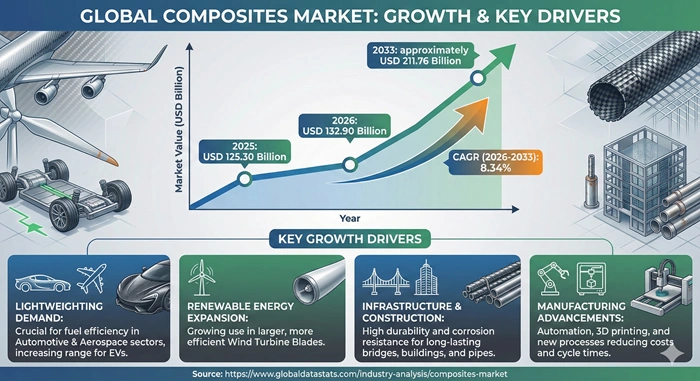
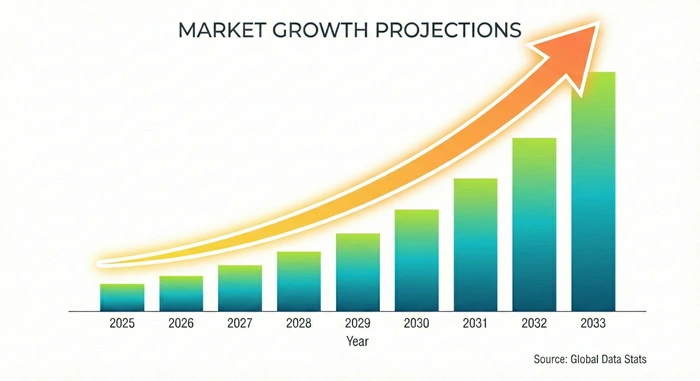
The global composites market size is valued at USD 125.30 billion in 2025 and is predicted to increase from USD 132.90 billion in 2026 to approximately USD 211.76 billion by 2033, growing at a CAGR of 8.34% from 2026 to 2033. This industry encompasses high-performance materials combining two or more constituent substances with different physical and chemical properties, resulting in superior strength-to-weight ratios, corrosion resistance, and design flexibility. Advanced composite materials enable manufacturers to create lighter, stronger, and more durable products across diverse applications, driving innovation in sectors demanding exceptional performance characteristics.
The composites market serves critical functions across aerospace, automotive, wind energy, and construction sectors where weight reduction directly impacts fuel efficiency, operational costs, and environmental performance. These materials typically consist of reinforcing fibers embedded in polymer matrix resins, creating structures that outperform traditional materials while reducing overall mass by 20-50%. Growing environmental regulations mandating emissions reductions, coupled with technological advancements enabling automated manufacturing processes, create sustained demand for composite solutions delivering measurable performance improvements and lifecycle cost advantages.
AI Impact on the Composites Industry
Machine Learning Optimization and Digital Manufacturing Transform Production Efficiency and Quality Control Across Composite Fabrication
Artificial intelligence revolutionizes the composites market through advanced process control systems that optimize manufacturing parameters in real-time, significantly reducing defect rates while improving production throughput. Machine learning algorithms analyze thousands of variables including resin viscosity, cure temperatures, fiber placement precision, and environmental conditions to identify optimal processing windows that maximize part quality. These AI-powered systems continuously learn from production data, automatically adjusting parameters to compensate for material batch variations, equipment drift, and ambient changes that human operators struggle to detect. Computer vision technology integrated into automated fiber placement equipment performs real-time inspection, identifying defects such as gaps, overlaps, and fiber waviness during layup rather than after cure, enabling immediate correction and eliminating costly rework.
Deep learning applications accelerate new material development and expand design possibilities within the composites market landscape. Computational modeling powered by artificial intelligence simulates mechanical properties of novel fiber-resin combinations, predicting strength, stiffness, and failure modes before expensive physical testing. Generative design algorithms create optimized part geometries that minimize weight while meeting structural requirements, exploring design spaces far beyond human intuition. Natural language processing extracts insights from decades of scientific literature and failure analysis reports, identifying patterns and correlations that inform material selection and process development. These AI-driven capabilities position advanced composite manufacturers to deliver systems that continuously improve performance through operational experience while reducing dependence on specialized engineering expertise.
Growth Factors
Lightweighting Imperatives and Regulatory Pressures Drive Unprecedented Composite Adoption Across Transportation Sectors
The composites market experiences robust growth propelled by stringent fuel efficiency regulations and emissions standards compelling automotive and aerospace manufacturers to adopt lightweight materials that reduce vehicle mass without compromising safety or performance. Automotive applications particularly drive demand as manufacturers pursue 50% weight reductions necessary to meet 2030 corporate average fuel economy targets that exceed 50 miles per gallon for passenger vehicles. Electric vehicle proliferation accelerates composite adoption as battery weight constraints make lightweighting even more critical for achieving competitive driving ranges. Carbon fiber reinforced composites replacing steel and aluminum in body panels, chassis components, and battery enclosures enable automakers to offset heavy battery packs while maintaining structural integrity and crashworthiness.
Renewable energy expansion drives composites market growth through escalating wind turbine blade dimensions that require materials delivering exceptional strength and fatigue resistance at minimal weight. Offshore wind installations now deploy turbines with rotor diameters exceeding 240 meters, requiring blades over 120 meters long that only advanced composites can economically manufacture while maintaining structural performance across 25-year operational lifespans. Wind energy capacity additions exceeding 100 gigawatts annually create sustained blade manufacturing demand that consumes over 20% of global composite production. Infrastructure development across emerging economies drives construction applications where composite rebar, bridge decking, and building panels offer superior corrosion resistance compared to steel reinforcement, eliminating costly maintenance while extending structure lifespans in harsh marine and industrial environments.
Market Outlook
Sustainability Initiatives and Advanced Manufacturing Technologies Position Industry for Continued Long-Term Expansion
The composites market outlook remains exceptionally favorable as sustainability imperatives drive development of bio-based resins, natural fiber reinforcements, and recycling technologies addressing end-of-life challenges historically limiting composite adoption. Manufacturers increasingly deploy plant-derived epoxy resins and thermoplastic matrices enabling mechanical recycling that recovers intact fibers for reuse in secondary applications. Flax, hemp, and basalt fiber composites gain traction in automotive interiors and consumer products where moderate performance requirements permit natural reinforcements offering carbon footprint reductions exceeding 40% compared to glass fiber equivalents. Regulatory frameworks emerging across Europe and North America mandate minimum recycled content percentages in manufactured goods, creating market pull for recycled composite materials and incentivizing investment in reclamation infrastructure.
Investment trends within the composites market reflect growing confidence in technology versatility and expanding application portfolios beyond traditional aerospace and automotive strongholds. Hydrogen storage tanks for fuel cell vehicles require high-pressure composite vessels combining carbon fiber reinforcement with specialized liner systems, creating high-value applications where composite performance advantages justify premium pricing. Urban air mobility vehicle development drives demand for certified aerospace-grade composites as numerous manufacturers pursue electric vertical takeoff and landing aircraft programs requiring lightweight airframes. The convergence of automated manufacturing technologies including automated fiber placement, resin transfer molding, and continuous fiber 3D printing enables high-rate production previously impossible with labor-intensive hand layup processes, expanding addressable markets into price-sensitive applications where composite economics now compete favorably against metallic alternatives.
Expert Speaks
-
Tom Gentile, Chairman, CEO and President of Hexcel Corporation, emphasized market fundamentals: "The underlying value proposition of Hexcel remains robust, driven by the demand for our innovative lightweight composites, which will generate strong cyclical and secular sales growth over time. Hexcel's value proposition is fortified by our extensive intellectual property, scale, and deep customer relationships globally".
-
Brian Chambers, Board Chair and Chief Executive Officer of Owens Corning, highlighted strategic expansion: "The addition of Masonite to Owens Corning marks a significant milestone for our company, as we further strengthen our position as a market leader in building and construction materials. Over the past several years, Owens Corning has been on a journey to transform and grow our company through strategic choices and strong execution".
-
Rob Blackburn, Head of Global Customer Engineering Aerospace and Defense at Solvay Materials, articulated innovation priorities: "Solvay's product development leadership and our best-in-class, UK-based Application Center will be key in contributing to the development of future-proofed, industrial-ready technologies in exciting cooperation with industry partners, accelerating composite fabrication, automation and assembly technologies".
Key Report Takeaways
-
Asia Pacific dominates the composites market with commanding market share of approximately 46%, driven by concentrated manufacturing capacity across China, India, and Japan where automotive, construction, and electronics industries consume substantial composite volumes supported by favorable raw material availability and cost-effective production capabilities.
-
North America emerges as the fastest-growing regional market with projected CAGR approaching 9% through 2033, propelled by aerospace sector recovery, automotive lightweighting initiatives, substantial wind energy capacity additions, and infrastructure modernization programs incorporating advanced composite materials into bridge rehabilitation and building retrofits.
-
Glass fiber composites maintain material leadership accounting for approximately 58% market share due to favorable cost-performance balance, established manufacturing infrastructure, and broad applicability across construction, automotive, and consumer goods sectors where performance requirements permit lower-cost reinforcement alternatives to carbon fiber.
-
Automotive and transportation applications represent the dominant end-use segment capturing over 35% market share, driven by stringent fuel efficiency regulations, electric vehicle production expansion, and lightweight component adoption across commercial vehicles reducing operational costs through improved payload capacity and reduced fuel consumption.
-
Thermoset composites dominate resin systems constituting approximately 65% of market volume, reflecting established cure processes, broad material compatibility, and superior elevated temperature performance critical for aerospace applications, though thermoplastic variants exhibit faster growth rates enabling rapid consolidation and recyclability advantages.
-
Carbon fiber composites emerge as fastest-growing reinforcement segment with anticipated CAGR exceeding 10% through 2033, attributed to expanding aerospace production rates, premium automotive applications, pressure vessel requirements for hydrogen storage, and wind turbine blade upsizing demanding exceptional stiffness-to-weight performance.
Market Scope
| Report Coverage Details | |
|---|---|
| Market Size by 2033 | USD 211.76 Billion |
| Market Size by 2025 | USD 125.30 Billion |
| Market Size by 2026 | USD 132.90 Billion |
| Market Growth Rate from 2026 to 2033 | CAGR of 8.34% |
| Dominating Region | Asia Pacific |
| Fastest Growing Region | North America |
| Base Year | 2025 |
| Forecast Period | 2026 to 2033 |
| Segments Covered | Fiber Type, Resin Type, Manufacturing Process, End-Use Industry, Region |
| Regions Covered | North America, Europe, Asia Pacific, Latin America, Middle East & Africa |
Market Dynamics
Drivers Impact Analysis
Regulatory Mandates and Performance Requirements Accelerate Composite Material Substitution Across Multiple Industries
| Impact Factor | (≈) % Impact on CAGR Forecast | Geographic Relevance | Impact Timeline |
|---|---|---|---|
| Automotive Lightweighting and CAFE Standards | +2.8% | North America, Europe, China | 2026-2033 |
| Commercial Aerospace Production Recovery | +2.3% | Global, Led by North America | 2026-2030 |
| Wind Energy Capacity Expansion | +1.9% | Europe, North America, Asia Pacific | 2026-2033 |
| Infrastructure Modernization Programs | +1.4% | North America, Europe | 2027-2033 |
The composites market benefits substantially from escalating regulatory requirements mandating corporate average fuel economy improvements and greenhouse gas emissions reductions that compel automotive manufacturers to pursue aggressive weight reduction strategies. Vehicle lightweighting delivers dual benefits of improved fuel efficiency and reduced tailpipe emissions, with every 10% mass reduction yielding approximately 6-8% fuel consumption improvement. Composite body panels, chassis components, and structural elements enable automakers to achieve weight savings exceeding 50% compared to steel equivalents while maintaining crashworthiness and durability requirements. Electric vehicle proliferation intensifies lightweighting imperatives as battery pack mass constraints make composite adoption essential for achieving competitive driving ranges exceeding 300 miles per charge that consumers demand.
Commercial aerospace recovery drives composites market expansion through production rate increases across narrow-body and wide-body aircraft programs that extensively incorporate carbon fiber reinforced structures. Boeing 787 and Airbus A350 programs utilize composite materials for approximately 50% of structural weight, demonstrating technology maturity and certification pathways for primary load-bearing applications. Next-generation aircraft development including Boeing 777X and potential new mid-market airplanes incorporate even higher composite content percentages, creating sustained demand for aerospace-grade prepreg materials and out-of-autoclave cure systems. Regional aircraft and business jet segments increasingly adopt composite fuselage and wing structures previously dominated by aluminum construction, expanding addressable markets as design confidence grows and manufacturing cost trajectories decline through automation and process refinement.
Restraints Impact Analysis
High Material Costs and Manufacturing Complexity Limit Market Penetration in Price-Sensitive Applications
| Restraint Factor | (≈) % Impact on CAGR Forecast | Geographic Relevance | Impact Timeline |
|---|---|---|---|
| Premium Material and Manufacturing Costs | -1.4% | Global, Particularly Emerging Markets | 2026-2030 |
| Recycling and End-of-Life Challenges | -1.1% | Europe, North America | 2026-2033 |
| Complex Manufacturing Processes | -0.9% | Global Supply Chain | 2026-2029 |
| Limited Repair and Damage Assessment Infrastructure | -0.7% | Emerging Markets | 2026-2031 |
The composites market faces growth constraints stemming from substantial material cost premiums compared to traditional metals that create barriers in price-sensitive applications where performance advantages cannot justify economic penalties. Carbon fiber reinforced composites command prices exceeding 20 dollars per pound compared to two dollars for aluminum and less than one dollar for steel, making direct material substitution economically challenging except where weight savings deliver measurable operational benefits. Manufacturing complexity requiring specialized equipment, controlled environments, and skilled labor further elevates production costs compared to established metallic fabrication processes. These economic barriers prove particularly problematic in commercial vehicle applications and price-competitive consumer goods where profit margins cannot absorb premium material costs without corresponding price increases that reduce market competitiveness.
End-of-life management challenges constrain composites market expansion as traditional thermoset materials resist recycling through chemical bonds that cannot be reversed without destroying fiber integrity. Composite waste generated during manufacturing and retired parts at end-of-service accumulates in landfills, creating environmental concerns and regulatory pressures for sustainable disposal solutions. Mechanical recycling processes that grind composite scrap into short fiber fillers provide limited value recovery compared to virgin material costs, failing to create economically viable circular supply chains. Chemical recycling technologies capable of recovering intact fibers remain commercially immature with capital costs and processing economics that cannot compete against virgin fiber production. European regulations mandating minimum recycled content and restricting landfill disposal create compliance challenges for manufacturers lacking viable reclamation pathways, potentially limiting market growth in sustainability-conscious regions.
Opportunities Impact Analysis
Emerging Applications and Technology Advances Create Substantial Growth Avenues Beyond Traditional Markets
| Opportunity Factor | (≈) % Impact on CAGR Forecast | Geographic Relevance | Impact Timeline |
|---|---|---|---|
| Hydrogen Storage and Clean Energy Infrastructure | +1.8% | Global, Led by Europe and Asia | 2027-2033 |
| Urban Air Mobility and Advanced Aviation | +1.5% | North America, Europe | 2028-2033 |
| Bio-Based and Sustainable Composites | +1.3% | Europe, North America | 2026-2033 |
| Continuous Fiber 3D Printing | +1.1% | Global Manufacturing Hubs | 2027-2033 |
The composites market stands to capture substantial value from hydrogen economy infrastructure development requiring high-pressure storage vessels where composite overwrap technology enables safe containment at 700 bar pressure. Hydrogen fuel cell vehicle commercialization depends on lightweight storage systems achieving gravimetric capacities exceeding 5% hydrogen-to-total-mass ratios that only carbon fiber composite pressure vessels can deliver. Stationary hydrogen storage for renewable energy buffering and industrial applications creates additional demand as utilities and chemical producers establish hydrogen infrastructure supporting decarbonization initiatives. Type IV pressure vessels combining polymer liners with carbon fiber overwrap represent multi-billion dollar market opportunity with composite content exceeding 60% of total vessel cost.
Urban air mobility vehicle development presents exceptional growth opportunities for the composites market as numerous manufacturers pursue electric vertical takeoff and landing aircraft certifications requiring lightweight airframes achieving power-to-weight ratios enabling vertical flight. Over 200 eVTOL development programs worldwide create near-term demand for certified aerospace composites as companies transition from prototype to production phases between 2026 and 2030. These aircraft require primary structures combining carbon fiber reinforcement with damage-tolerant design approaches meeting stringent aviation safety standards. Regional air mobility expansion into autonomous cargo delivery and air taxi services could consume composite volumes comparable to current business jet production, creating diversified revenue streams less dependent on cyclical commercial aerospace demand patterns while commanding aerospace-grade material pricing.
Segment Analysis
By Fiber Type: Glass Fiber Composites
Cost-Performance Balance and Established Infrastructure Sustain Glass Fiber Market Leadership Across Diverse Applications
Glass fiber composites command the largest share within the composites market, accounting for approximately 58% of global volume with continued expansion projected at steady CAGR of 7.8% through 2033. This reinforcement type provides optimal balance of mechanical properties, processability, and cost that enables broad adoption across construction, automotive, marine, and consumer goods applications where carbon fiber performance advantages cannot justify substantial cost premiums. The composites market benefits from mature glass fiber production infrastructure with annual capacity exceeding 6 million metric tons globally, supporting consistent material availability and competitive pricing through economies of scale. E-glass formulations dominate applications requiring basic mechanical properties and corrosion resistance, while S-glass and ECR-glass variants address specialized requirements for elevated strength and chemical resistance in demanding aerospace and infrastructure environments.
Asia Pacific leads glass fiber composite consumption within the composites market, driven by construction and automotive sectors across China, India, and Southeast Asian nations where rapid infrastructure development and vehicle production expansion create sustained demand. Leading manufacturers including Owens Corning, Jushi Group, CPIC, and Nippon Electric Glass maintain substantial regional production capacity serving local and export markets. North American glass fiber applications particularly emphasize wind turbine blades, where manufacturers including TPI Composites and LM Wind Power consume hundreds of thousands of tons annually producing blades for utility-scale installations. European automotive suppliers integrate glass fiber composites into underbody components, interior structures, and non-visible exterior panels where aesthetics permit lower surface finish compared to carbon fiber alternatives. The segment's market leadership continues strengthening as continuous strand mat and spray-up processes enable rapid manufacturing of large parts at costs unachievable with alternative reinforcement materials.
By End-Use Industry: Automotive and Transportation
Lightweighting Mandates and Electric Vehicle Proliferation Position Automotive Sector as Dominant Composite Consumer
Automotive and transportation applications represent the largest end-use segment within the composites market, accounting for approximately 35% of global consumption with robust expansion anticipated at CAGR of 9.2% through 2033. This sector encompasses passenger vehicles, commercial trucks, rail equipment, and marine craft where weight reduction directly impacts fuel efficiency, payload capacity, and operational economics. The composites market benefits from automotive industry transformation toward electrification requiring aggressive mass reduction to offset heavy battery packs while maintaining interior space and driving range competitiveness. Carbon fiber reinforced body panels, thermoplastic structural components, and glass fiber composite underbody systems enable automakers to achieve vehicle weight reductions exceeding 300 kilograms compared to conventional steel-intensive designs while preserving crashworthiness and durability.
North America and Europe lead automotive composite adoption within the market, driven by stringent CAFE standards and aggressive emissions reduction targets compelling manufacturers to deploy lightweight materials across vehicle portfolios. Premium automakers including BMW, Mercedes-Benz, and Audi extensively utilize carbon fiber reinforced plastics in vehicle architectures, with BMW i3 incorporating carbon fiber passenger cell manufactured through novel high-volume processes developed specifically for automotive cost targets. Volume manufacturers including Ford, General Motors, and Volkswagen integrate glass fiber composites into pickup truck beds, hoods, and tailgates where weight savings improve fuel economy ratings determining regulatory compliance and customer purchase decisions. Asian automotive composite demand exhibits fastest growth rates as Chinese electric vehicle manufacturers including BYD, NIO, and Xpeng adopt composite components pursuing range improvements and premium positioning. Leading composite suppliers including Teijin, Toray, SGL Carbon, and Hexcel compete intensively for automotive design wins, investing billions in automated manufacturing capacity supporting projected volume growth throughout the forecast period.
Regional Insights
Asia Pacific
Manufacturing Scale and Infrastructure Investment Establish Regional Dominance in Composite Production and Consumption
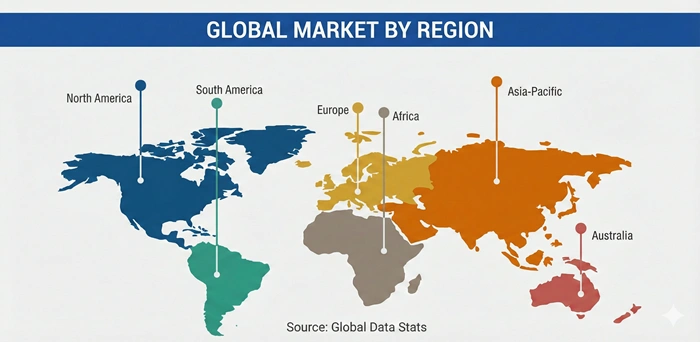
Asia Pacific commands the composites market with dominant share of approximately 46%, driven by concentrated manufacturing infrastructure across China, India, Japan, and Southeast Asian nations where automotive, construction, and wind energy sectors consume substantial composite volumes. China alone accounts for over 35% of global composite consumption, supported by integrated supply chains encompassing fiber production, resin manufacturing, and parts fabrication serving domestic and export markets. The region benefits from favorable raw material access including low-cost labor, established petrochemical industries supplying resin feedstocks, and government policies supporting advanced materials industries through subsidies and technology development programs. Automotive production exceeding 30 million vehicles annually across Asia Pacific creates massive composite demand as manufacturers pursue fuel efficiency improvements and electric vehicle development requiring lightweight structures.
Infrastructure development drives substantial composite adoption within Asia Pacific, particularly across rapidly developing economies undertaking transportation network expansion, urban construction programs, and renewable energy installations. China deploys composite rebar and bridge decking in coastal environments where conventional steel reinforcement suffers premature degradation from chloride exposure and industrial pollution. India pursues composite adoption in railway applications including passenger coaches and freight containers where weight reductions improve energy efficiency across extensive rail networks. Japan maintains technological leadership in carbon fiber production and advanced composite manufacturing, with Toray Industries, Teijin, and Mitsubishi Chemical dominating global supply chains for aerospace-grade prepreg materials. Wind energy expansion across China, India, and offshore installations surrounding Japan creates turbine blade demand consuming over 40% of regional glass fiber composite production, positioning Asia Pacific for continued market dominance throughout the forecast period.
North America
Aerospace Recovery and Automotive Transformation Drive Regional Market Emergence as Fastest-Growing Geography
North America emerges as the fastest-growing regional composites market with projected CAGR of 9% through 2033, propelled by commercial aerospace production recovery, automotive lightweighting initiatives, and substantial wind energy capacity additions supporting renewable energy targets. The United States dominates regional market activity with mature aerospace sector consuming high-value carbon fiber composites for commercial aircraft, military platforms, and space launch vehicles manufactured by Boeing, Lockheed Martin, Northrop Grumman, and SpaceX. Automotive composite adoption accelerates across North American manufacturers responding to corporate average fuel economy standards requiring fleet-average ratings exceeding 50 miles per gallon by 2030, compelling extensive lightweighting across vehicle portfolios.
The United States composites market specifically exhibits robust growth across multiple application segments, with wind energy representing particularly dynamic sector as utilities pursue renewable capacity additions exceeding 15 gigawatts annually. Offshore wind development along Atlantic coast creates demand for large turbine blades requiring advanced composites capable of withstanding harsh marine environments while minimizing maintenance requirements across 25-year operational periods. Infrastructure modernization programs including bridge rehabilitation and building retrofits increasingly specify composite materials offering superior durability and reduced lifecycle costs compared to conventional materials requiring frequent maintenance and replacement. Leading composite manufacturers including Hexcel, Owens Corning, Cytec (Solvay), and Toray Advanced Composites maintain substantial North American operations encompassing raw material production, prepreg manufacturing, and customer technical support capabilities positioning the region for continued market expansion through technological innovation and diversified end-market exposure.
Top Key Players
-
Hexcel Corporation (United States)
-
Toray Industries, Inc. (Japan)
-
Teijin Limited (Japan)
-
Owens Corning (United States)
-
Solvay S.A. (Belgium)
-
SGL Carbon SE (Germany)
-
Mitsubishi Chemical Group Corporation (Japan)
-
Gurit Holding AG (Switzerland)
-
Jushi Group Co., Ltd. (China)
-
PPG Industries, Inc. (United States)
-
3B-the fibreglass company (Belgium)
-
Axiom Materials, Inc. (United States)
-
Exel Composites Oyj (Finland)
-
Huntsman Corporation (United States)
-
Avient Corporation (United States)
Recent Developments
-
Owens Corning (2024): Completed strategic acquisition of Masonite International Corporation for approximately 3.9 billion dollars, significantly expanding presence in building and construction materials through addition of complementary interior and exterior doors portfolio, with expected run-rate cost synergies of 125 million dollars and ROIC exceeding cost of capital by Year 3 post-close.
-
Hexcel Corporation (2024): Finalized acquisition of Picosun, Finnish atomic layer deposition equipment specialist, strengthening low-temperature composite processing capabilities and expanding specialty materials portfolio addressing flexible composites, advanced packaging, and temperature-sensitive substrate applications requiring precise coating technologies.
-
Solvay and Spirit AeroSystems (2023): Established strategic collaboration through Spirit's Aerospace Innovation Centre in Prestwick, Scotland, focusing on development of advanced manufacturing concepts for composite aerostructures, accelerating composite fabrication, automation, and assembly technologies addressing future aircraft performance, cost, and production-rate requirements.
-
Toray Industries (2025): Advanced AP-G 2025 strategic plan emphasizing sustainable growth, ultimate value creation, and product excellence with ROIC target of 5%, driving business expansion in composites growth fields while implementing structural reforms in low-margin segments to enhance competitiveness.
-
Teijin and Partners (2025): Collaborated with Herone, Spiral RTC, and Collins Aerospace Almere in recycling A350 thermoplastic composite production waste into adjustable-length rods for Multifunctional Fuselage Demonstrator, demonstrating circular economy principles in aerospace composite manufacturing.
Market Trends
Thermoplastic Composites and Automated Manufacturing Transform Industry Production Economics and Design Flexibility
The composites market experiences transformative trends centered on thermoplastic matrix systems that enable rapid consolidation, forming, and joining processes impossible with conventional thermoset materials. Thermoplastic composites offer unlimited shelf life eliminating cold storage requirements, weldability enabling rapid assembly without mechanical fasteners or adhesive bonding, and potential for mechanical recycling recovering fiber and resin for reuse in secondary applications. These advantages prove particularly attractive for high-volume automotive applications where cycle time reductions and manufacturing flexibility justify material cost premiums and processing equipment investments. Automated tape laying and thermoplastic stamping processes achieve production rates exceeding thousands of parts annually, expanding economic viability beyond low-volume aerospace applications into price-competitive transportation markets. Major automotive suppliers increasingly qualify thermoplastic composite systems for structural components, signaling industry acceptance and creating market momentum throughout the forecast period.
Sustainability initiatives increasingly influence composites market development as manufacturers respond to regulatory pressures and customer demands for environmentally responsible materials and circular economy business models. Bio-based epoxy resins derived from plant oils and natural fiber reinforcements including flax, hemp, and basalt offer carbon footprint reductions exceeding 40% compared to conventional petroleum-based systems. Chemical recycling technologies under development promise fiber recovery from thermoset composites through processes breaking down polymer matrices while preserving reinforcement integrity for reuse in new parts. Several European automotive manufacturers committed to incorporating minimum recycled composite content percentages in vehicle structures, creating market pull for reclaimed materials and incentivizing investment in collection and reprocessing infrastructure. Industry consortiums including the Clean Sky initiative and Composites Recycling Europe coordinate research and demonstration projects validating technical feasibility and economic viability of circular composite supply chains supporting market transformation toward sustainable practices.
Segments Covered in the Report
By Fiber Type
-
Glass Fiber Composites
-
Carbon Fiber Composites
-
Natural Fiber Composites
-
Aramid Fiber Composites
-
Other Fiber Types
By Resin Type
-
Thermoset Composites (Epoxy, Polyester, Vinyl Ester, Others)
-
Thermoplastic Composites (Polypropylene, PEEK, Nylon, Others)
By Manufacturing Process
-
Layup Process
-
Resin Transfer Molding
-
Filament Winding
-
Pultrusion
-
Compression Molding
-
Injection Molding
-
Others
By End-Use Industry
-
Automotive and Transportation
-
Aerospace and Defense
-
Wind Energy
-
Construction and Infrastructure
-
Marine
-
Electrical and Electronics
-
Consumer Goods and Sports Equipment
-
Others
By Region
-
North America (United States, Canada, Mexico)
-
Europe (Germany, France, United Kingdom, Italy, Spain, Rest of Europe)
-
Asia Pacific (China, Japan, India, South Korea, Australia, Southeast Asia, Rest of Asia Pacific)
-
Latin America (Brazil, Argentina, Rest of Latin America)
-
Middle East & Africa (Saudi Arabia, UAE, South Africa, Rest of MEA)
Frequently Asked Questions
Question 1: What is the projected size of the composites market by 2033?
Answer: The global composites market is expected to reach approximately USD 211.76 billion by 2033, growing from USD 132.90 billion in 2026. This substantial expansion reflects increasing adoption across automotive lightweighting, aerospace production recovery, wind energy expansion, and infrastructure modernization applications worldwide.
Question 2: Which region dominates the composites market currently?
Answer: Asia Pacific leads the composites market with approximately 46% share, driven by concentrated manufacturing capacity in China, India, and Japan where automotive, construction, and wind energy sectors create sustained demand. Favorable raw material access, cost-effective production capabilities, and government support for advanced materials industries sustain regional dominance.
Question 3: What are the primary drivers of composites market growth?
Answer: Key growth drivers include automotive lightweighting mandates, commercial aerospace production recovery, wind energy capacity expansion, and infrastructure modernization programs incorporating advanced materials. Regulatory requirements for fuel efficiency improvements and emissions reductions compel manufacturers to adopt lightweight composite solutions across transportation applications.
Question 4: Which fiber type holds the largest composites market share?
Answer: Glass fiber composites dominate with approximately 58% market share due to optimal cost-performance balance, established manufacturing infrastructure, and broad applicability across construction, automotive, and marine sectors. Mature production capacity exceeding 6 million metric tons annually ensures consistent material availability at competitive pricing.
Question 5: How do recycling challenges impact composites market development?
Answer: End-of-life management limitations constrain market expansion as conventional thermoset composites resist economical recycling, creating environmental concerns and regulatory pressures. Chemical recycling technologies and thermoplastic matrix systems offer promising solutions enabling material recovery, though commercial viability requires further development and infrastructure investment throughout the forecast period.