
Combined Heat And Power Market Overview
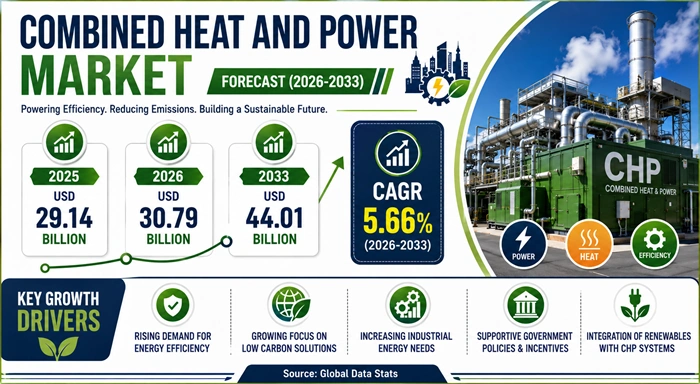
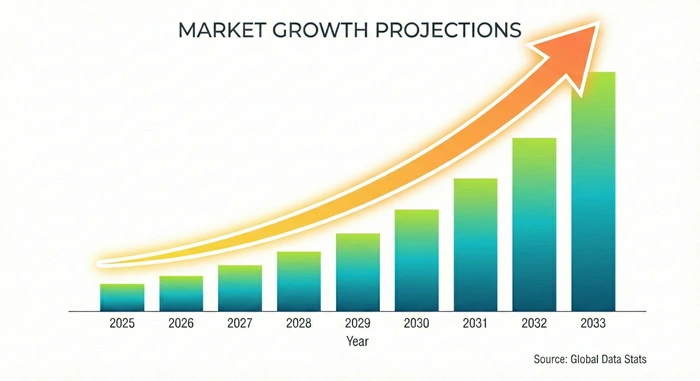
The global combined heat and power market size is valued at USD 29.14 billion in 2025 and is predicted to increase from USD 30.79 billion in 2026 to approximately USD 44.01 billion by 2033, growing at a CAGR of 5.66% from 2026 to 2033.
Combined heat and power systems, also known as cogeneration, simultaneously generate electricity and capture usable thermal energy from a single fuel source, achieving overall efficiency levels exceeding 80% compared to conventional separate generation systems reaching only 45-50% efficiency. These integrated energy solutions deliver electricity on-site while recovering waste heat for space heating, water heating, industrial processes, or district heating applications. The combined heat and power market encompasses diverse technologies including gas turbines, reciprocating engines, steam turbines, fuel cells, and microturbines serving industrial facilities, commercial buildings, district energy systems, and utility applications worldwide, delivering economic savings, energy security, and emissions reduction benefits.
AI Impact On The Combined Heat And Power Industry
Optimizing Operations And Predictive Maintenance Through Advanced Analytics
Artificial intelligence revolutionizes combined heat and power operations by enabling real-time optimization of system performance, fuel consumption, and heat-to-power ratios responding dynamically to changing demand patterns and energy pricing signals. Machine learning algorithms analyze operational data including fuel flow rates, exhaust temperatures, electrical loads, thermal demands, and equipment vibrations identifying optimal operating points maximizing efficiency across varying conditions. Predictive analytics forecast equipment maintenance requirements detecting early warning signs of component degradation including bearing wear, valve failures, and heat exchanger fouling before catastrophic failures occur. The combined heat and power market benefits from reduced unplanned downtime, extended equipment lifespans, and optimized maintenance scheduling as facility operators transition from reactive repairs toward proactive condition-based strategies minimizing operational disruptions while maximizing asset utilization throughout extended service periods.
Digital twin technology creates virtual replicas of physical CHP installations enabling engineers to simulate operational scenarios, validate control strategies, and optimize dispatch schedules without risking actual equipment or disrupting facility operations. AI-powered energy management systems coordinate CHP operation with utility grid connections, energy storage systems, and on-site renewable generation maximizing economic returns through intelligent load balancing and participation in demand response programs. The combined heat and power market witnesses enhanced performance as computer vision systems inspect equipment during maintenance outages detecting anomalies invisible to human inspection while natural language processing analyzes maintenance logs identifying recurring failure patterns informing design improvements. Automated fault detection and diagnosis systems respond to abnormal conditions within milliseconds implementing protective actions preventing cascading failures. Smart sensors continuously monitor critical parameters transmitting data to cloud-based analytics platforms providing facility managers real-time visibility into system performance, energy consumption patterns, and optimization opportunities enabling data-driven decision-making improving operational efficiency and financial performance.
Growth Factors
Energy Efficiency Imperatives And Decarbonization Commitments Driving Market Expansion
Government policies worldwide establish compelling frameworks promoting combined heat and power deployment through investment tax credits, accelerated depreciation, and streamlined interconnection standards. United States Investment Tax Credit provides 10-30% federal tax credit for qualifying CHP installations while state programs offer additional incentives including rebates, low-interest financing, and property tax exemptions. European Union energy efficiency directives establish binding targets requiring member states promote high-efficiency cogeneration while carbon pricing mechanisms create financial advantages for low-emission CHP systems over separate generation. The combined heat and power market expands rapidly as regulatory support addresses upfront cost barriers while environmental regulations favoring efficient, lower-emission technologies position CHP competitively versus conventional power generation and heating systems. Corporate sustainability commitments drive adoption as businesses pursue carbon reduction targets, energy cost management, and operational resilience through on-site generation capabilities.
Rising electricity costs create compelling economics for combined heat and power installations as facilities offset expensive grid purchases with self-generated power while utilizing waste heat eliminating separate boiler fuel consumption. Industrial facilities including manufacturing plants, chemical processors, refineries, and food production operations adopt CHP systems achieving 15-25% energy cost savings compared to purchasing electricity and operating separate heating equipment. The combined heat and power market benefits from improved equipment efficiency, reduced capital costs through standardized designs, and flexible fuel capabilities utilizing natural gas, biogas, biomass, or industrial waste gases. District energy systems serving hospitals, universities, airports, and urban developments adopt CHP technology providing reliable, cost-effective heating, cooling, and power to multiple buildings through centralized generation and thermal distribution networks. Grid resilience considerations motivate CHP adoption as facilities require reliable power for mission-critical operations including hospitals, data centers, emergency services, and manufacturing processes where outages create safety risks, financial losses, or operational disruptions justifying investment in on-site generation capabilities.
Market Outlook
Technology Innovation And Renewable Integration Shaping Industry Evolution
Advanced reciprocating engine and gas turbine designs achieve higher electrical efficiencies, lower emissions, and enhanced operational flexibility accommodating rapid load changes and frequent starts supporting integration with variable renewable energy sources. Fuel cell CHP systems commercialize delivering superior electrical efficiency exceeding 50% with near-zero criteria pollutant emissions, quiet operation, and modular scalability suitable for distributed applications including commercial buildings and microgrids. The combined heat and power market witnesses growing adoption of biomethane-fueled systems utilizing renewable natural gas from agricultural waste, landfills, and wastewater treatment converting waste streams into valuable energy resources while reducing greenhouse gas emissions. Hybrid configurations combining CHP with energy storage, electric heat pumps, and thermal storage optimize economics by time-shifting generation responding to dynamic electricity pricing and grid signals maximizing revenue opportunities.
Digital transformation enables remote monitoring, automated dispatch, and advanced controls improving operational performance across distributed CHP fleets. Internet of Things sensors, cloud computing, and mobile applications provide operators real-time visibility and control capabilities previously requiring on-site personnel. The combined heat and power market benefits from interoperability standards facilitating integration across multi-vendor equipment and enabling participation in wholesale electricity markets, capacity auctions, and ancillary service programs generating additional revenue streams beyond energy cost savings. Modular factory-assembled designs accelerate project deployment reducing on-site construction duration, improving quality control, and minimizing installation risks. Carbon capture integration creates low-carbon CHP as facilities capture CO2 emissions for utilization or permanent sequestration qualifying for environmental credits while demonstrating leadership addressing climate challenges. Technology convergence with hydrogen production, renewable fuels, and sustainable chemicals positions CHP facilities as multi-purpose energy hubs producing diverse outputs beyond electricity and heat maximizing asset utilization and economic returns.
Expert Speaks
-
Larry Culp, Chairman and CEO at General Electric, emphasized through recent communications that GE's advanced gas turbine and reciprocating engine technologies deliver superior efficiency, operational flexibility, and environmental performance positioning customers to achieve sustainability goals while improving operational economics, noting that cogeneration applications represent significant growth opportunity as industries and institutions pursue energy resilience and decarbonization objectives through distributed generation solutions.
-
Seifi Ghasemi, Chairman, President and CEO at Air Products and Chemicals, highlighted during investor presentations that energy efficiency and sustainability drive investment decisions across industrial sectors, emphasizing that combined heat and power systems delivering 20-30% energy cost savings with reduced emissions align with corporate environmental commitments while improving competitive positioning through lower operating costs and enhanced operational reliability.
-
Darren Woods, Chairman and CEO at ExxonMobil, noted through annual reports that cogeneration represents proven technology improving industrial energy efficiency and reducing emissions, stating that ExxonMobil's manufacturing facilities globally utilize CHP systems optimizing energy consumption while supporting the company's greenhouse gas reduction targets demonstrating how established technologies deliver immediate climate benefits at scale.
Key Report Takeaways
-
Europe dominates the combined heat and power market capturing approximately 38% regional share valued around USD 11.07 billion in 2025, driven by stringent environmental regulations, aggressive energy efficiency targets, extensive district heating networks, and substantial government incentives supporting CHP deployment across industrial, commercial, and residential applications.
-
Asia Pacific emerges as fastest-growing region with projected CAGR exceeding 6.2% through 2033, fueled by rapid industrialization, urbanization driving energy demand, government policies promoting energy efficiency, manufacturing sector expansion, and growing adoption of distributed generation addressing grid reliability challenges.
-
Natural gas represents the largest fuel type segment accounting for approximately 68% market share due to abundant supply, competitive pricing, superior environmental performance versus coal and oil, established infrastructure, and technology compatibility across gas turbines, reciprocating engines, and fuel cells.
-
Industrial applications contribute the most significant demand representing roughly 59% of total market as manufacturing facilities, chemical plants, refineries, food processors, and pulp and paper operations adopt CHP systems achieving substantial energy cost savings while meeting process heating, steam, and power requirements.
-
Combined cycle maintains dominant technology position commanding nearly 52% market share owing to superior electrical efficiency exceeding 50%, proven reliability, scalability from tens to hundreds of megawatts, and optimal economics for large industrial facilities and district energy systems.
-
Small-scale segment exhibits fastest capacity growth projected to expand at 6.8% CAGR through 2033 with market share reaching approximately 28%, driven by commercial building adoption, microgrid development, residential CHP systems in Europe and Japan, and declining equipment costs improving economic viability for distributed applications.
Market Scope
| Report Coverage | Details |
|---|---|
| Market Size by 2033 | USD 44.01 Billion |
| Market Size by 2025 | USD 29.14 Billion |
| Market Size by 2026 | USD 30.79 Billion |
| Market Growth Rate from 2026 to 2033 | CAGR of 5.66% |
| Dominating Region | Europe |
| Fastest Growing Region | Asia Pacific |
| Base Year | 2025 |
| Forecast Period | 2026 to 2033 |
| Segments Covered | Fuel Type, Technology, Capacity, Application, End-User, Region |
| Regions Covered | North America, Europe, Asia-Pacific, Latin America, Middle East and Africa |
Market Dynamics
Drivers Impact Analysis
Rising Energy Costs And Grid Reliability Concerns Accelerating Adoption
| Factor | (≈) % Impact on CAGR Forecast | Geographic Relevance | Impact Timeline |
|---|---|---|---|
| Energy cost reduction benefits | 21-27% | High electricity cost regions | 2026-2033 |
| Government incentive programs | 18-24% | Europe, North America, Asia Pacific | 2026-2033 |
| Grid resilience requirements | 15-21% | Urban centers, critical facilities | 2026-2033 |
Electricity price escalation creates compelling economics for combined heat and power installations as commercial and industrial energy consumers face rising utility costs driven by infrastructure investment requirements, carbon pricing, and renewable integration expenses. Facilities operating CHP systems reduce energy expenditures 15-30% compared to purchasing grid electricity and operating separate heating equipment. The combined heat and power market benefits from improved payback periods as fuel cost differentials favor natural gas, biogas, and waste fuels over grid electricity particularly in regions with high retail electricity rates or expensive heating fuels. Industrial facilities with consistent thermal and electrical demands achieve optimal CHP economics as systems operate continuously at high capacity factors maximizing energy savings and return on investment. Time-of-use electricity rates and demand charges create additional value as CHP systems offset expensive peak-period grid purchases.
Government support programs substantially improve project economics through direct rebates, investment tax credits, accelerated depreciation, and low-interest financing reducing upfront capital requirements. United States Department of Energy technical assistance programs help facilities assess CHP opportunities, navigate interconnection procedures, and optimize system designs. The combined heat and power market expands as European Union member states implement energy efficiency directives requiring member states promote high-efficiency cogeneration with preferential grid access and simplified permitting. State and local programs including California Self-Generation Incentive Program, New York State Clean Energy programs, and Connecticut CHP incentives provide substantial financial support. International development banks fund CHP projects in developing markets supporting industrial modernization and infrastructure development. Carbon pricing mechanisms including emissions trading systems and carbon taxes create financial advantages for low-carbon CHP systems qualifying for credits, exemptions, or reduced compliance obligations compared to conventional separate generation.
Restraints Impact Analysis
High Capital Costs And Natural Gas Price Volatility Limiting Adoption
| Factor | (≈) % Impact on CAGR Forecast | Geographic Relevance | Impact Timeline |
|---|---|---|---|
| Upfront capital investment | -13 to -18% | Capital-constrained markets | 2026-2033 |
| Fuel price volatility | -10 to -15% | Natural gas dependent regions | 2026-2033 |
| Interconnection complexity | -8 to -13% | Jurisdictions with restrictive policies | 2026-2033 |
Combined heat and power installations require substantial upfront investment with capital costs ranging from USD 1000-4000 per kilowatt depending on technology, capacity, and application creating financial barriers particularly for small and medium enterprises with limited access to capital. Project development involves significant engineering, permitting, and interconnection expenses before construction commences. The combined heat and power market faces adoption challenges as facilities prioritize lowest initial cost over lifecycle economics despite CHP delivering superior long-term value through energy savings. Financing complexity including coordination of multiple incentive programs, tax equity structures, and power purchase agreements requires sophisticated financial expertise and transaction costs discouraging potential adopters. Equipment lead times extending 12-24 months from order to commissioning create project risk and financial carrying costs.
Natural gas price volatility creates economic uncertainty as CHP economics depend on stable fuel cost assumptions with price spikes eroding savings relative to grid electricity particularly during winter heating periods or supply disruptions. Facilities lacking fuel supply diversity or hedging strategies face operational risk. The combined heat and power market confronts challenges in regions transitioning away from fossil fuels as policy uncertainty regarding future natural gas availability and carbon pricing affects long-term investment decisions. Electric grid interconnection requirements including technical standards, insurance, metering, and utility approval processes create delays, unexpected costs, and regulatory uncertainty. Some jurisdictions impose standby charges, exit fees, or restrictive net metering policies reducing CHP economic attractiveness. Lack of standardized interconnection agreements and inconsistent utility practices across jurisdictions complicate project development. Heat load variability creates operational challenges as CHP systems sized for peak thermal demands operate inefficiently during shoulder seasons or reduced production periods limiting overall system utilization and economic returns.
Opportunities Impact Analysis
Renewable Gas And Microgrid Applications Creating Growth Pathways
| Factor | (≈) % Impact on CAGR Forecast | Geographic Relevance | Impact Timeline |
|---|---|---|---|
| Renewable natural gas adoption | +16 to +22% | Regions with biogas resources | 2027-2033 |
| Microgrid development | +14 to +20% | Resilience-focused markets | 2027-2033 |
| Hydrogen blending potential | +12 to +17% | Decarbonization leaders | 2028-2033 |
Renewable natural gas production from agricultural waste, landfills, wastewater treatment, and food processing creates sustainable fuel supplies for combined heat and power systems achieving carbon-neutral or carbon-negative operation. Dairy digesters, swine operations, and food manufacturers adopt CHP fueled by biogas generated from organic waste streams providing dual benefits of waste management and energy generation. The combined heat and power market captures growing opportunity as renewable gas production incentives, renewable fuel standards, and carbon credit programs improve project economics. Pipeline injection of upgraded biogas creates fungible fuel supply supporting conventional CHP installations. Transportation fuel applications create premium markets for renewable natural gas driving production growth and improving availability for stationary applications including cogeneration systems across diverse end-user sectors.
Microgrid development accelerates as communities, campuses, military installations, and industrial parks adopt resilient energy systems maintaining power during grid outages. Combined heat and power systems serve as foundational microgrid assets providing dispatchable generation, grid-forming capabilities, and black-start capacity. The combined heat and power market benefits from federal resilience funding, state microgrid programs, and private investment supporting critical infrastructure protection. Hospital microgrids ensure uninterrupted medical services during emergencies while university campuses achieve sustainability goals and operational savings. Disaster-prone regions including hurricane zones, wildfire areas, and earthquake-vulnerable communities invest in resilient power infrastructure. Hydrogen blending opportunities emerge as equipment manufacturers develop natural gas turbines and engines capable of operating on hydrogen-natural gas mixtures supporting decarbonization pathways. Industrial facilities co-locating hydrogen production with CHP systems create integrated energy hubs producing multiple outputs optimizing asset utilization. Carbon capture integration creates low-carbon CHP qualifying for environmental credits while demonstrating climate leadership positioning technology supporting long-term energy transition.
Segment Analysis
By Fuel Type: Natural Gas
Abundant Supply And Environmental Performance Establishing Segment Dominance
Natural gas dominates the combined heat and power market capturing approximately 68% share valued around USD 19.82 billion in 2025 owing to abundant domestic production in North America, competitive pricing versus alternative fuels, superior environmental performance with 50% lower CO2 emissions versus coal, and compatibility with diverse CHP technologies. Shale gas development dramatically increased North American supply driving down prices and improving long-term availability creating favorable economics for natural gas-based cogeneration. Modern gas turbines and reciprocating engines achieve electrical efficiencies exceeding 40% with low emissions meeting stringent air quality standards without expensive pollution control equipment. The combined heat and power market benefits from established natural gas infrastructure including pipeline networks, distribution systems, and utility services supporting reliable fuel delivery across industrial, commercial, and institutional facilities.
North America and Europe lead natural gas CHP deployment with United States operating thousands of installations across industrial facilities, commercial buildings, and district energy systems. Asia Pacific adoption grows as LNG imports expand, pipeline networks develop, and environmental regulations favor cleaner fuels over coal and oil. The combined heat and power market sees this segment maintaining steady growth near 5.4% CAGR through 2033 despite emerging renewable gas and hydrogen opportunities. Leading equipment manufacturers including General Electric, Caterpillar, Wartsila, Siemens Energy, and Rolls-Royce offer comprehensive natural gas CHP solutions spanning 100-kilowatt microturbines through 300-megawatt combined cycle systems. Technology evolution focuses on increased efficiency, reduced emissions, operational flexibility supporting rapid load following, and fuel flexibility accommodating biogas, landfill gas, and future hydrogen blending. Dual-fuel capabilities enable backup operation on diesel during gas supply disruptions improving system reliability for critical applications.
By End-User: Industrial
Manufacturing Energy Intensity And Process Integration Driving Segment Leadership
Industrial applications represent the largest segment in the combined heat and power market commanding approximately 59% share valued around USD 17.19 billion in 2025, driven by manufacturing facilities, chemical plants, refineries, food processors, and pulp and paper operations adopting CHP systems delivering 20-35% energy cost savings while meeting simultaneous electricity and thermal requirements. Process industries with continuous high-temperature steam demands achieve optimal CHP economics as waste heat recovery supplies process requirements eliminating separate boiler fuel consumption. The combined heat and power market benefits from industrial energy intensity as large facilities consuming 50-500 million kWh annually achieve economies of scale justifying CHP investment. Manufacturing operations requiring reliable power for critical processes value on-site generation eliminating vulnerability to grid outages and voltage quality issues.
North America and Europe lead industrial CHP adoption with chemicals, refining, food and beverage, and primary metals sectors representing major applications. Asia Pacific industrial segment expands rapidly as manufacturing capacity grows across China, India, Southeast Asia, and emerging markets. The combined heat and power market witnesses this segment growing at steady 5.5% CAGR through 2033 as industrial decarbonization pressures, energy cost management priorities, and operational resilience requirements drive continued adoption. Leading industrial CHP operators include chemical manufacturers utilizing waste gases as fuel, refineries integrating cogeneration into hydrogen production facilities, food processors adopting biomass-fueled systems utilizing processing waste, and automotive manufacturers installing natural gas systems providing electricity and process heat. Technology preferences vary by application with large facilities favoring combined cycle gas turbines, medium industries adopting reciprocating engines, and specialized applications deploying steam turbines utilizing industrial waste heat. Performance contracting models eliminate upfront capital requirements as energy service companies finance, install, and operate systems sharing energy savings with host facilities.
Regional Insights
Europe
Stringent Regulations And District Heating Networks Cementing Regional Leadership
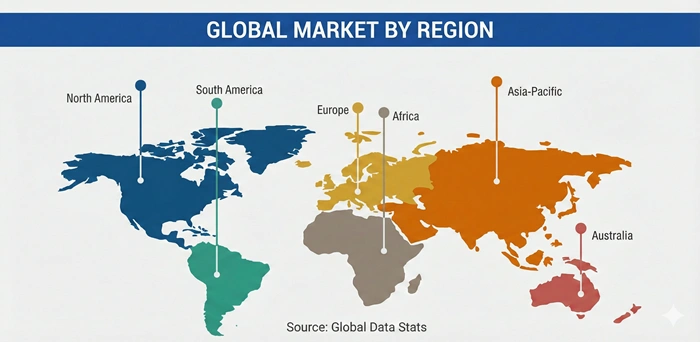
Europe dominates the combined heat and power market commanding approximately 38% global share valued at USD 11.07 billion in 2025, projected to reach USD 16.74 billion by 2033 growing at 5.3% CAGR. European Union energy efficiency directives establish binding targets requiring member states promote high-efficiency cogeneration with preferential grid access, simplified permitting, and financial incentives. Germany leads regional deployment through Energiewende policies supporting distributed generation, with thousands of CHP installations across industrial facilities, commercial buildings, and residential multi-family housing. The combined heat and power market benefits from extensive district heating networks serving major cities across Scandinavia, Germany, and Eastern Europe where CHP plants provide baseload heating and electricity generation. Denmark achieves world-leading CHP deployment with over 50% electricity generation from cogeneration supporting national energy independence and climate objectives.
United Kingdom promotes CHP through business rate exemptions, enhanced capital allowances, and Contracts for Difference supporting large installations. Netherlands, France, and Austria implement robust incentive programs encouraging industrial and commercial adoption. The combined heat and power market witnesses regional technological leadership as European manufacturers including Siemens Energy, MAN Energy Solutions, Wartsila, and Capstone Green Energy supply advanced equipment globally. Residential micro-CHP systems achieve significant penetration across Germany and United Kingdom providing household heating and electricity. Biomass-fueled CHP systems utilizing forestry residues and agricultural waste support renewable energy targets while providing firm capacity complementing variable wind and solar generation. Carbon pricing through EU Emissions Trading System creates financial advantages for efficient CHP systems versus separate generation. Regional policies, established infrastructure, environmental commitments, and technology leadership position Europe maintaining market dominance throughout forecast period.
Asia Pacific
Industrialization And Energy Demand Growth Driving Fastest Regional Expansion
Asia Pacific emerges as fastest-growing region in the combined heat and power market with CAGR exceeding 6.2% from 2026 to 2033, with market value expanding from approximately USD 8.16 billion in 2025 toward USD 12.90 billion by 2033. China leads regional expansion through manufacturing sector growth, industrial energy efficiency policies, and district heating expansion across northern cities addressing air quality concerns. National programs promote CHP adoption through subsidies, preferential electricity tariffs, and simplified approvals. India represents major opportunity as government initiatives including National Action Plan on Climate Change promote energy efficiency while industrial corridor development and smart city programs create substantial CHP demand. The combined heat and power market benefits from Japan's established residential micro-CHP market with millions of Ene-Farm fuel cell systems installed, supported by substantial government subsidies and utility programs.
South Korea implements renewable portfolio standards and emissions reduction targets driving industrial CHP adoption. Southeast Asian nations including Thailand, Vietnam, Indonesia, and Malaysia adopt cogeneration systems in manufacturing facilities, commercial developments, and agro-industrial operations utilizing biomass residues. The combined heat and power market witnesses growing investment as multinational manufacturers establish operations across region specifying energy-efficient facilities meeting corporate sustainability commitments. Leading regional players include domestic equipment manufacturers across China, Japan, and South Korea supplying local markets while international majors including GE, Siemens, and Mitsubishi establish regional manufacturing and service capabilities. Technology transfer initiatives, research collaboration, and workforce development programs advance regional capabilities. Energy security priorities, economic development objectives, environmental pressures, and cost competitiveness position Asia Pacific as primary growth engine for global combined heat and power expansion throughout forecast period.
Top Key Players
-
General Electric Company (United States)
-
Siemens Energy AG (Germany)
-
Caterpillar Inc. (United States)
-
Wärtsilä Corporation (Finland)
-
Mitsubishi Heavy Industries Ltd. (Japan)
-
Rolls-Royce Holdings plc (United Kingdom)
-
MAN Energy Solutions SE (Germany)
-
Capstone Green Energy Corporation (United States)
-
2G Energy AG (Germany)
-
Clarke Energy (United Kingdom)
-
FuelCell Energy, Inc. (United States)
-
BDR Thermea Group (Netherlands)
-
Kawasaki Heavy Industries, Ltd. (Japan)
-
Yanmar Holdings Co., Ltd. (Japan)
-
INNIO Group (Austria)
Recent Developments
-
General Electric (September 2024): Announced delivery of advanced HA-class gas turbine for combined cycle CHP application at major European industrial facility, providing 500 megawatts electrical capacity with waste heat recovery supplying district heating network serving 100000 homes, demonstrating technology leadership in large-scale high-efficiency cogeneration supporting European energy transition and decarbonization objectives.
-
Siemens Energy (July 2024): Secured contract supplying SGT-800 gas turbines for natural gas-fired CHP plant in Asia Pacific region, featuring advanced dry low emissions combustion technology meeting stringent environmental standards while delivering 60% overall system efficiency through integrated heat recovery, supporting regional industrial development and energy efficiency goals.
-
Caterpillar (October 2024): Launched next-generation reciprocating engine CHP packages rated 1-20 megawatts featuring improved electrical efficiency exceeding 44%, reduced emissions complying with Tier 4 standards, enhanced operational flexibility supporting rapid load following, and factory-integrated controls simplifying installation and commissioning for distributed generation applications across commercial and industrial sectors.
-
Wärtsilä (June 2024): Announced successful commissioning of biogas-fueled engine CHP plant at major wastewater treatment facility, utilizing anaerobic digestion gas providing 5 megawatts electricity and process heat with near-zero net greenhouse gas emissions, validating renewable gas pathway supporting circular economy principles and demonstrating technology viability for sustainable cogeneration applications.
-
FuelCell Energy (August 2024): Secured multiple orders for stationary fuel cell CHP systems totaling 20 megawatts capacity across commercial and industrial applications, featuring SureSource platforms delivering 50% electrical efficiency, 85% total system efficiency with heat recovery, and ultra-low emissions supporting customer sustainability commitments while improving energy cost competitiveness versus grid electricity and conventional generation alternatives.
Market Trends
Renewable Fuels And Digital Integration Reshaping Technology Development
Renewable natural gas integration accelerates as biogas production from agricultural operations, landfills, food processors, and wastewater treatment facilities creates sustainable fuel supplies for combined heat and power systems. Anaerobic digestion systems convert organic waste into methane-rich gas suitable for direct use in CHP equipment following cleaning and conditioning. The combined heat and power market witnesses growing adoption as production incentives including federal Renewable Fuel Standard credits, state renewable gas programs, and carbon offset revenues improve project economics. Pipeline injection of upgraded renewable gas creates fungible fuel supply accessible to conventional CHP installations. Transportation fuel demand creates premium markets for renewable natural gas motivating production expansion improving availability for stationary applications. Technology providers develop specialized fuel conditioning equipment, corrosion-resistant components, and flexible controls accommodating variable fuel composition characteristic of biogas sources. Emerging power-to-gas technologies converting renewable electricity into hydrogen or synthetic methane create additional pathways supporting CHP fuel supply decarbonization.
Digitalization transforms CHP operations as Internet of Things sensors, cloud computing, advanced analytics, and machine learning optimize performance, predict maintenance requirements, and enable remote fleet management. Digital platforms aggregate operational data across distributed installations providing owners visibility into system performance, energy consumption patterns, and optimization opportunities. The combined heat and power market benefits from automated dispatch algorithms coordinating CHP operation with utility grid signals, energy storage systems, and on-site renewable generation maximizing economic returns through intelligent load balancing. Cybersecurity solutions protect critical infrastructure from emerging threats as increasing connectivity creates potential vulnerabilities. Mobile applications provide operators real-time system status and remote control capabilities improving responsiveness and reducing staffing requirements. Performance-based maintenance contracts leverage continuous monitoring replacing scheduled interventions with condition-based strategies. Virtual power plant aggregations combine multiple distributed CHP systems creating dispatchable capacity participating in wholesale electricity markets, capacity auctions, and ancillary service programs generating additional revenue streams beyond energy cost savings positioning cogeneration as dynamic grid resource supporting renewable integration and system reliability.
Segments Covered In The Report
By Fuel Type
-
Natural Gas
-
Coal
-
Biomass
-
Oil
-
Others
By Technology
-
Gas Turbines
-
Steam Turbines
-
Reciprocating Engines
-
Fuel Cells
-
Microturbines
-
Others
By Capacity
-
Up to 10 MW
-
10 to 150 MW
-
151 to 300 MW
-
Above 300 MW
By Application
-
Combined Cycle
-
Single Cycle
By End-User
-
Utilities
-
Industrial (Manufacturing, Chemical, Refining, Food Processing, Pulp and Paper)
-
Commercial (Healthcare, Education, Hospitality, Data Centers)
-
Residential
By Region
-
North America (United States, Canada, Mexico)
-
Europe (Germany, United Kingdom, France, Italy, Spain, Netherlands, Denmark, Rest of Europe)
-
Asia-Pacific (China, India, Japan, South Korea, Thailand, Rest of Asia-Pacific)
-
Latin America (Brazil, Argentina, Rest of Latin America)
-
Middle East and Africa (Saudi Arabia, UAE, South Africa, Rest of MEA)
Frequently Asked Questions
Question 1: What is the expected size of the combined heat and power market by 2033?
Answer: The global combined heat and power market is projected to reach approximately USD 44.01 billion by 2033, expanding from USD 30.79 billion in 2026. This growth reflects increasing energy efficiency priorities, rising electricity costs creating favorable CHP economics, government incentive programs supporting deployment, and industrial facilities pursuing cost savings and operational resilience through on-site generation capabilities.
Question 2: Which region dominates the combined heat and power market currently?
Answer: Europe dominates the combined heat and power market with approximately 38% market share due to stringent energy efficiency regulations, extensive district heating networks, aggressive environmental targets, and substantial government incentives. The region benefits from established CHP infrastructure, supportive policies, carbon pricing mechanisms, and technology leadership supporting sustained adoption across industrial, commercial, and residential applications.
Question 3: What CAGR will the combined heat and power market experience from 2026 to 2033?
Answer: The combined heat and power market will grow at a compound annual growth rate of 5.66% from 2026 to 2033. This expansion reflects energy cost escalation motivating efficiency investments, government programs providing financial incentives, grid reliability concerns driving distributed generation, industrial decarbonization pressures, and technological improvements enhancing system performance and reducing capital costs.
Question 4: Which fuel type holds the largest share in the combined heat and power market?
Answer: Natural gas commands the largest fuel share at approximately 68% due to abundant supply particularly in North America, competitive pricing versus alternative fuels, superior environmental performance with lower emissions versus coal and oil, and compatibility with diverse CHP technologies. The combined heat and power market benefits from established natural gas infrastructure, proven equipment reliability, and favorable economics supporting continued dominance.
Question 5: What are the primary growth drivers for the combined heat and power market?
Answer: Primary drivers include rising electricity costs creating compelling CHP economics through energy bill reduction, government incentive programs providing tax credits and rebates, and grid reliability concerns motivating on-site generation. The combined heat and power market also benefits from industrial energy intensity supporting investment justification, environmental regulations favoring efficient technologies, renewable natural gas adoption enabling carbon-neutral operation, and microgrid development creating distributed generation opportunities supporting resilience and sustainability objectives.