
Cold Storage Market Overview
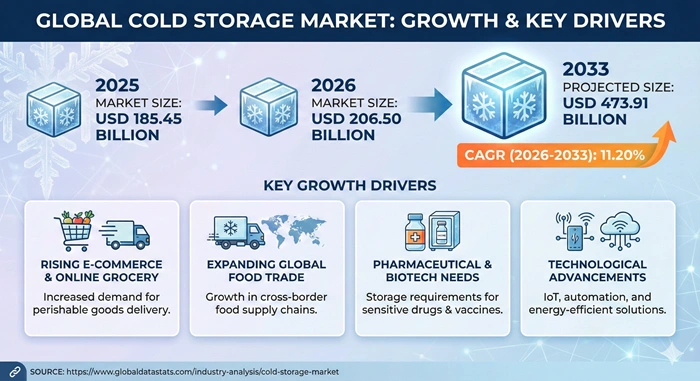
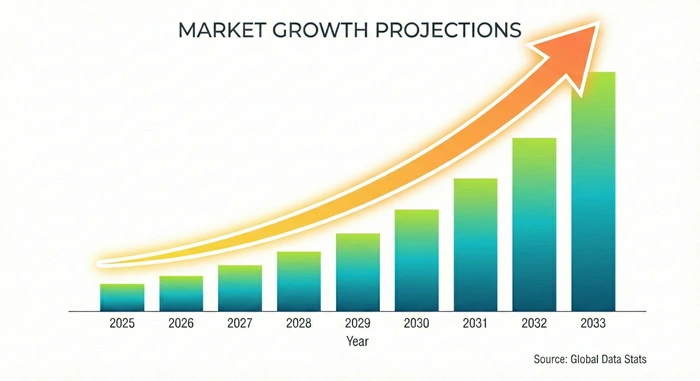
The global cold storage market size is valued at USD 185.45 billion in 2025 and is predicted to increase from USD 206.50 billion in 2026 to approximately USD 473.91 billion by 2033, growing at a CAGR of 11.20% from 2026 to 2033.
Cold storage facilities serve as critical infrastructure within modern supply chains, enabling the preservation of temperature-sensitive products across food, pharmaceutical, and chemical industries. These specialized warehouses maintain precise temperature controls ranging from chilled to deep-frozen conditions, preventing spoilage and extending product shelf life. Rising consumer demand for fresh produce, frozen foods, and temperature-controlled pharmaceuticals has transformed cold storage from a niche service into an essential component of global commerce.
AI Impact on the Cold Storage Industry
Transforming Operations Through Intelligent Technology and Predictive Analytics
Artificial intelligence is revolutionizing how cold storage facilities monitor and manage their operations. Companies now deploy AI-powered systems to track temperature fluctuations, humidity levels, and energy consumption patterns in real time. Machine learning algorithms identify potential equipment failures before they occur, such as compressor malfunctions or temperature drops, enabling preventive maintenance that protects valuable inventory. Lineage Logistics in the United States has successfully implemented AI solutions that reduced annual electricity consumption by 33 million kilowatt-hours, generating savings of approximately USD 4 million while maintaining strict temperature standards.
Automated warehousing systems enhanced by AI are optimizing storage space allocation and retrieval processes. These intelligent systems analyze historical data to determine optimal placement for fast-moving products, ensuring rapid fulfillment of customer orders. Robotics integrated with AI capabilities now handle product retrieval at speeds unmatched by manual operations, meeting tight delivery deadlines for perishable goods. Furthermore, AI assists in creating efficient shipping plans by analyzing traffic patterns and weather conditions, enabling better routing decisions for frozen and chilled products across local and interstate channels.
Growth Factors
Expanding Demand Across Multiple Industries Driving Market Acceleration
The cold storage market experiences significant growth driven by increasing global trade of perishable products. Health-conscious consumers are demanding more fresh dairy products, fruits, vegetables, meat, and seafood due to their high protein content and nutritional value. Cold storage infrastructure preserves these essential nutrients for extended periods, making it indispensable for modern food distribution networks. Globalization and free trade agreements have further amplified cross-border movement of temperature-sensitive goods, requiring robust cold chain facilities at strategic locations worldwide.
The rapid expansion of organized retail sectors, particularly in developing economies, creates substantial opportunities for cold storage operators. Retail giants such as Walmart, 7-Eleven, and Tesco require extensive cold storage networks to support their large transport fleets that distribute perishable goods. These retailers are increasingly penetrating emerging markets in India, Brazil, Argentina, UAE, and Saudi Arabia, where rising populations, improving infrastructure, growing food demand, and increasing disposable income generate exponential demand for cold storage solutions. Additionally, the surge in e-commerce and online grocery shopping has necessitated extensive last-mile cold chain logistics networks, as consumers expect fresh and frozen products delivered directly to their homes.
Market Outlook
Strategic Investments and Sustainability Initiatives Shaping Future Growth
The cold storage market demonstrates remarkable resilience and expansion potential across developed and emerging markets. Industry leaders are prioritizing sustainability through adoption of eco-friendly refrigerants, renewable energy sources, and energy-efficient equipment that reduces operational costs while minimizing greenhouse gas emissions. Low-carbon warehouse designs that incorporate intelligent automation and advanced control systems are becoming industry standards, enabling facilities to significantly decrease their carbon footprint while maintaining optimal temperature control.
Government initiatives worldwide are accelerating cold chain infrastructure development, particularly in Southeast Asia, Latin America, and Middle Eastern nations. Public investments and financial subsidies support the construction of modern temperature-controlled facilities that reduce post-harvest food loss and enable agricultural exports from developing countries. The pharmaceutical industry's growing dependence on cold storage for vaccines, biologics, and temperature-sensitive medications adds another dimension to market expansion. Technological innovations in warehouse management systems, IoT-enabled monitoring devices, and blockchain-based supply chain transparency solutions continue to enhance operational efficiency and regulatory compliance across the cold storage market.
Expert Speaks
-
Greg Lehmkuhl, CEO of Lineage Logistics Holding, LLC emphasized the company's commitment to leveraging automation and digital solutions to optimize cold chain operations and reduce costs while meeting increasing global demand for temperature-controlled logistics.
-
Fred Boehler, CEO of Americold Logistics, Inc. highlighted the strategic importance of expanding cold storage capacity through acquisitions and partnerships with food manufacturers, ensuring efficient supply chain management and customer service excellence.
-
Carlos Rodriguez, CEO of Constellation Cold Logistics expressed enthusiasm about implementing the company's 2030 strategic plan with enhanced accessibility and efficiency in supply chains, maintaining focus on responsiveness, customer service, and sustainability commitments toward net-zero emissions.
Key Report Takeaways
-
North America leads the cold storage market with a dominant revenue share of approximately 33.6%, driven by advanced logistics infrastructure, stringent food safety regulations, and strong presence of major industry players including Lineage Logistics and Americold
-
Asia Pacific represents the fastest-growing region with an anticipated CAGR of 10.46% between 2026 and 2035, fueled by rapid urbanization, rising disposable incomes, government subsidies for cold chain development, and expanding retail sectors in China and India
-
The frozen temperature segment dominates with over 63% market share in 2025, supported by increasing consumption of ready-to-cook meals and frozen foods in both developed and emerging markets
-
Food and beverages application accounts for more than 76% of the cold storage market, with fish, meat, and seafood holding the largest segment share at 31.69% due to global demand for protein-rich foods
-
Pharmaceutical applications are experiencing the fastest growth rate with a CAGR exceeding industry average, driven by strict regulations for vaccine storage and increasing demand for biologics requiring ultra-low temperature conditions
-
Private warehouse facilities hold the largest market share at 63.65% as businesses invest in customized cold storage solutions that ensure compliance with regulatory standards and provide operational flexibility
Market Scope
| Report Coverage | Details |
|---|---|
| Market Size by 2033 | USD 473.91 Billion |
| Market Size by 2025 | USD 185.45 Billion |
| Market Size by 2026 | USD 206.50 Billion |
| Market Growth Rate from 2026 to 2033 | CAGR of 11.20% |
| Dominating Region | North America |
| Fastest Growing Region | Asia Pacific |
| Base Year | 2025 |
| Forecast Period | 2026 to 2033 |
| Segments Covered | Storage Type, Temperature Range, Application, Warehouse Type, Construction Type, Region |
| Regions Covered | North America, Europe, Asia Pacific, Latin America, Middle East & Africa |
Market Dynamics
Drivers Impact Analysis
Accelerating Demand for Temperature-Controlled Infrastructure Across Global Supply Chains
| Impact Factor | ≈ % Impact on CAGR Forecast | Geographic Relevance | Impact Timeline |
|---|---|---|---|
| Rising global trade of perishables | 2.5-3.0% | Global, especially Asia Pacific and North America | 2026-2033 |
| E-commerce and online grocery expansion | 2.0-2.5% | North America, Europe, Asia Pacific | 2026-2033 |
| Organized retail sector growth | 1.5-2.0% | Emerging markets in Asia, Latin America, Middle East | 2026-2033 |
| Pharmaceutical cold chain requirements | 1.0-1.5% | Global, particularly developed markets | 2026-2033 |
The cold storage market experiences robust growth propelled by increasing international trade of temperature-sensitive products including dairy, meat, seafood, fruits, and vegetables. Consumers worldwide are prioritizing fresh and nutritious foods, creating sustained demand for cold chain infrastructure that maintains product quality throughout distribution networks. Rising health consciousness and preference for protein-rich diets have amplified consumption of perishable goods that require strict temperature control. The organized retail sector's rapid expansion, particularly supermarkets and hypermarkets in developing regions, necessitates extensive cold storage facilities to support inventory management and distribution operations. These retail chains require reliable temperature-controlled warehousing to prevent spoilage and maintain product freshness for discerning consumers.
The explosive growth of e-commerce platforms and online food delivery services has fundamentally transformed cold storage market dynamics. Online grocery shopping requires sophisticated cold chain logistics that maintain temperature integrity from warehouse to doorstep, driving substantial investments in last-mile delivery infrastructure. Companies are developing urban micro cold storage hubs near densely populated consumption centers to reduce delivery times and ensure product quality. The pharmaceutical industry's stringent requirements for vaccine storage and distribution have created additional demand for specialized cold storage facilities capable of maintaining ultra-low temperatures. Government agencies worldwide enforce strict food safety regulations that mandate proper temperature control throughout the supply chain, compelling businesses to invest in advanced cold storage solutions that ensure compliance and minimize product loss.
Restraints Impact Analysis
Infrastructure Costs and Energy Consumption Challenges Limiting Market Accessibility
| Impact Factor | ≈ % Impact on CAGR Forecast | Geographic Relevance | Impact Timeline |
|---|---|---|---|
| High initial infrastructure investment | -1.5 to -2.0% | Emerging markets, small enterprises | 2026-2033 |
| Energy consumption costs | -1.0 to -1.5% | Global, especially regions with high electricity rates | 2026-2033 |
| Skilled labor shortage | -0.5 to -1.0% | Developing countries | 2026-2033 |
The cold storage market faces significant barriers related to substantial capital requirements for facility establishment. Companies entering the market must invest heavily in specialized construction, advanced refrigeration systems, high-quality insulation materials, and continuous maintenance infrastructure. These financial demands create particular challenges for startups and small businesses that lack access to sufficient funding. Equipment costs for temperature monitoring systems, automated storage solutions, and backup power supplies add further complexity to initial investment calculations. Developing markets often struggle with limited access to financing options, slowing the pace of cold storage infrastructure development in regions where demand is rapidly growing.
Operational expenses represent another major challenge as cold storage facilities consume substantial amounts of electricity to maintain precise temperature conditions. Rising energy costs directly impact profitability, particularly for operators in regions with expensive or unreliable power supplies. Refrigeration equipment running continuously requires significant energy input, and older facilities with outdated technology face even higher operational costs. The industry's dependence on fossil fuel-based energy sources raises concerns about long-term sustainability and environmental impact. Additionally, shortage of skilled technicians capable of maintaining sophisticated refrigeration systems and automated warehouse equipment creates operational challenges, particularly in developing countries where technical training programs may be limited.
Opportunities Impact Analysis
Technological Innovation and Sustainable Solutions Creating New Growth Avenues
| Impact Factor | ≈ % Impact on CAGR Forecast | Geographic Relevance | Impact Timeline |
|---|---|---|---|
| Renewable energy integration | +1.5 to +2.0% | Global, particularly Europe and North America | 2026-2033 |
| Automation and AI adoption | +1.0 to +1.5% | Developed markets, expanding to emerging economies | 2026-2033 |
| Blockchain for supply chain transparency | +0.5 to +1.0% | Global, especially pharmaceutical applications | 2026-2033 |
The cold storage market presents substantial opportunities through adoption of renewable energy technologies and sustainable refrigeration solutions. Facilities implementing solar panels, wind energy, and other renewable power sources can significantly reduce operational costs while improving environmental credentials. Advanced insulation materials and energy-efficient compressor technologies enable operators to minimize electricity consumption without compromising temperature control standards. Development of eco-friendly refrigerants that comply with environmental regulations creates competitive advantages for forward-thinking companies. Green building certifications and sustainability initiatives attract environmentally conscious clients and may qualify facilities for government incentives and favorable financing terms.
Automation technologies combined with artificial intelligence offer transformative potential for cold storage operations. Robotic systems can optimize space utilization, accelerate order fulfillment, and reduce labor costs in markets facing workforce shortages. IoT-enabled sensors provide real-time monitoring capabilities that improve inventory management and prevent product spoilage through immediate alerts about temperature deviations. Blockchain technology introduces enhanced supply chain transparency, particularly valuable for pharmaceutical cold storage where regulatory compliance and product traceability are critical. Smart warehouse management systems integrate multiple technologies to create seamless operations that respond dynamically to changing demand patterns. Companies investing in these innovations position themselves to capture market share as customers increasingly prioritize efficiency, reliability, and technological sophistication in their cold storage partnerships.
Segment Analysis
Storage Type - Facilities and Services Segment
Comprehensive Warehousing Solutions Dominating Market Infrastructure and Revenue Generation
The facilities and services segment commands the cold storage market with an impressive 89.3% revenue share in 2025, reflecting its fundamental importance to temperature-controlled logistics. This segment encompasses refrigerated warehouses and cold rooms that form the backbone of modern supply chains for perishable goods. Public warehouses account for approximately 71% of gross refrigerated storage capacity in the United States, operating as independent businesses that offer transportation, storage, and handling services for variable or fixed fees. These facilities serve diverse client bases across food, pharmaceutical, and chemical industries, providing flexible storage solutions that accommodate seasonal demand fluctuations and varying product requirements. The segment benefits from increasing automation of warehouse operations, with companies investing in cloud technology, conveyor systems, robotic picking systems, and intelligent energy management platforms that enhance efficiency and reduce operational costs.
Private and semi-private refrigerated warehouses are experiencing rapid growth as businesses seek greater control over their cold chain operations. Companies with stringent regulatory requirements or specialized product needs increasingly invest in dedicated facilities designed to meet specific compliance standards. The flexibility to scale capacity based on demand patterns makes private warehouses particularly attractive for businesses with fluctuating storage needs, enabling precise capacity planning that optimizes costs. Major industry players including Lineage Logistics and Americold continue expanding their facility networks through strategic acquisitions and greenfield developments, with Lineage's recent USD 247 million acquisition of four Tyson Foods warehouses adding 49 million cubic feet of capacity. The segment's dominance reflects the essential nature of physical infrastructure in cold storage operations, where location, capacity, and technological sophistication directly determine service quality and operational efficiency.
Application - Food and Beverages Segment
Essential Preservation Infrastructure Supporting Global Food Security and Distribution Networks
The food and beverages application segment maintains commanding market leadership with over 76% revenue share in 2025, driven by fundamental consumer demand for fresh and preserved foods. Within this segment, fish, meat, and seafood products represent the largest category at 31.69% market share, reflecting global consumption patterns for protein-rich foods. Cold storage facilities protect these highly perishable products from bacterial growth and decomposition, enabling international trade and reducing food waste throughout supply chains. Rising protein consumption in emerging markets, particularly China and India, amplifies demand for refrigerated warehousing that can maintain product quality during extended distribution cycles. The segment's growth trajectory benefits from expanding retail chains and supermarkets that offer wide selections of fresh and frozen products, requiring sophisticated cold storage networks to support inventory management.
Dairy products constitute another critical category within the food and beverages segment, projected to grow at the fastest rate during the forecast period. Milk, cheese, yogurt, and ice cream require precise temperature control to prevent spoilage and maintain consumer safety standards. Cold storage extends shelf life for these products, reducing waste and improving economic efficiency throughout the supply chain. Consumer preferences for fresh dairy products and ready-to-eat meals drive continuous demand growth, particularly in regions with rising disposable incomes and changing dietary habits. The food and beverages segment's market dominance reflects cold storage's irreplaceable role in modern food systems, where temperature-controlled infrastructure enables diverse product availability, reduces seasonal limitations, and supports public health through proper preservation of perishable goods across North America, Europe, and rapidly developing markets in Asia Pacific.
Regional Insights
North America
Advanced Infrastructure and Regulatory Framework Establishing Regional Market Leadership
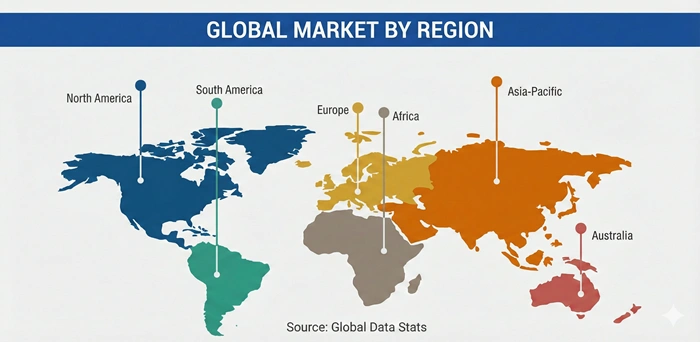
North America dominates the cold storage market with 33.6% revenue share in 2025, supported by sophisticated logistics networks and stringent food safety regulations. The United States leads regional growth with market size valued at USD 54.3 billion in 2025, projected to reach USD 126.23 billion by 2035 at a CAGR of 8.8%. The region benefits from presence of industry giants including Lineage Logistics Holding LLC, Americold Logistics Inc., United States Cold Storage, and Canadian operator Conestoga Cold Storage. According to the United States Department of Agriculture, gross refrigerated warehouse capacity exceeded 3.73 billion cubic feet in October 2021, reflecting massive infrastructure investment supporting food and pharmaceutical distribution. The region's robust economy, advanced infrastructure, and established regulatory frameworks create ideal conditions for cold storage market expansion.
Rising demand for online grocery shopping and fresh food products drives substantial investment in cold storage capacity across North America. E-commerce growth requires efficient last-mile delivery networks with strategically located temperature-controlled facilities near urban consumption centers. Americold's recent USD 127 million acquisition of a Houston facility adds 35,700 pallet positions to serve major retail contracts, demonstrating continued capacity expansion to meet market demand. The region's cold storage market benefits from technological leadership in automation and AI-powered warehouse management systems that optimize operations and reduce costs. Canada's cold storage sector grows alongside the United States, with companies expanding to serve both domestic markets and cross-border trade corridors. North America's market leadership position remains secure through 2033 as operators continue investing in sustainable technologies, expanded capacity, and enhanced service offerings that meet evolving customer requirements across food and pharmaceutical industries.
Asia Pacific
Explosive Growth Trajectory Fueled by Urbanization and Government Infrastructure Investments
Asia Pacific represents the fastest-growing cold storage market region with an anticipated CAGR of 10.46% between 2026 and 2035, driven by rapid urbanization and rising consumer affluence. The region's market dynamics reflect transformation in countries like China and India, where expanding middle classes demand higher-quality fresh and frozen foods. Government initiatives provide crucial support through subsidies and favorable policies that encourage cold chain infrastructure development, addressing historical gaps that contributed to significant post-harvest food losses. China's provincial governments offer financial incentives for energy-efficient warehouse construction, while India's public programs underwrite integrated networks connecting rural production areas to urban consumption centers. These strategic investments enable service providers to overcome transportation complexities and deliver innovative cold storage solutions across diverse markets.
Major industry players establish strong regional presence to capture growth opportunities in Asia Pacific markets. India-based Blue Star Limited and Japan-based Nichirei Corporation rank among leading regional operators, with Nichirei holding fifth position in temperature-controlled space operated among Global Cold Chain Alliance members as of March 2023. China's cold storage market experiences particularly rapid expansion driven by rising consumption of seafood, meat, and dairy products, coupled with explosive growth in online food shopping that requires extensive cold chain logistics. Port cities including Shanghai and Tianjin report near-capacity utilization of chilled storage facilities during peak seasons, highlighting strong demand that drives continued infrastructure investment. Southeast Asian nations like Singapore and Malaysia emerge as regional transshipment hubs for pharmaceuticals and seafood, developing temperature-controlled port facilities that enhance export efficiency and support regional trade growth through 2033.
Top Key Players
-
Americold Logistics, Inc. (United States)
-
Lineage Logistics Holding, LLC (United States)
-
United States Cold Storage (United States)
-
Burris Logistics (United States)
-
Nichirei Corporation (Japan)
-
Agro Merchants Group (United States)
-
Tippmann Group (United States)
-
NewCold (Netherlands)
-
Conestoga Cold Storage (Canada)
-
VersaCold Logistics Services (Canada)
-
Kloosterboer (Netherlands)
-
Confederation Freezers (Canada)
Recent Developments
-
2025 - Americold announced acquisition of a 10.7 million cubic foot cold storage facility in Houston, Texas for USD 127 million including expansion and equipment upgrades, adding approximately 35,700 pallet positions to support major grocery retail contracts and strengthen market position in high-turn retail cold storage segment
-
2025 - Lineage announced major expansion through acquisition of four cold storage warehouses from Tyson Foods for USD 247 million, adding 49 million cubic feet and 160,000 pallet positions while onboarding over 1,000 employees, plus commitment to build two fully automated warehouses adding 80 million cubic feet utilizing LinOS technology
-
2025 - DP World opened new temperature-controlled warehouse in Taloja, Navi Mumbai spanning 110,000 square feet with 11,000 pallet positions for dairy, frozen foods, seafood, pharmaceutical products featuring sustainable refrigerants and real-time environmental tracking
-
2025 - Americold submitted expansion plans for Melbourne, Australia facility responding to overwhelming demand for additional chilled and frozen food storage driven by rapidly growing population and e-commerce growth
-
2025 - Maersk launched new logistics center in Olmos, Peru supporting the country's thriving agro-export sector to ensure speed and freshness in Peru's fresh fruit exports to international markets
-
2024 - BGO and Yukon Real Estate Partners collaborated to build sustainable cold storage warehouse in New Century, Kansas spanning 291,000 square feet leased by CJ Logistics America featuring advanced refrigeration systems, rail service, and sustainable design to reduce environmental impact
-
2024 - EQT Infrastructure VI fund agreed to acquire Constellation Cold Logistics from Arcus Infrastructure Partners, with company operating 26 large cold storage facilities across seven countries in Western Europe and the Nordics, employing 700 people with expected revenues over EUR 150 million
Market Trends
Innovation and Sustainability Reshaping Industry Standards and Operational Practices
The cold storage market demonstrates accelerating adoption of smart monitoring systems and IoT-enabled technologies that transform operational capabilities. Cloud-based platforms integrated with wireless sensors provide real-time visibility into warehouse conditions, enabling immediate corrective actions when temperature deviations occur. These monitoring systems reduce product spoilage, optimize energy consumption, and enhance regulatory compliance through automated documentation of storage conditions. Urban micro cold storage facilities are proliferating near densely populated areas to support quick commerce platforms and online grocery delivery services, reducing delivery times and ensuring product freshness. This trend reflects changing consumer expectations for rapid delivery of fresh and frozen foods, requiring strategic positioning of smaller cold storage hubs that complement traditional large-scale warehouses.
Sustainability initiatives drive significant changes in cold storage market practices as operators seek to reduce environmental impact while controlling costs. Companies implement energy-efficient refrigeration equipment, improved insulation technologies, and low-energy compressors that substantially decrease electricity consumption. Renewable energy adoption accelerates with facilities installing solar panels and exploring wind power to offset operational expenses and reduce carbon footprints. Eco-friendly refrigerants replace traditional chemicals that contribute to greenhouse gas emissions, aligning operations with environmental regulations and corporate sustainability commitments. Blockchain technology gains traction for enhancing supply chain transparency, particularly in pharmaceutical applications where product traceability and regulatory compliance are critical. These technological and operational innovations position the cold storage market for continued growth while addressing environmental concerns and meeting evolving customer expectations for sustainable business practices through 2033.
Segments Covered in the Report
By Storage Type
-
Facilities/Services
-
Refrigerated Warehouse (Private & Semi-Private, Public)
-
Cold Room
-
-
Equipment
-
Blast Freezer
-
Walk-in Cooler and Freezer
-
Deep Freezer
-
Others
-
By Temperature Range
-
Chilled (0°C to 15°C)
-
Frozen (-18°C to -25°C)
-
Deep-Frozen (Below -25°C)
By Warehouse Type
-
Private
-
Public
By Construction Type
-
Bulk Storage
-
Production Stores
-
Ports
By Application
-
Food & Beverages
-
Fruits & Vegetables
-
Dairy Products (Milk, Butter, Cheese, Ice Cream)
-
Fish, Meat, and Seafood
-
Processed Food
-
Bakery & Confectionary
-
-
Pharmaceuticals
-
Vaccines
-
Blood Banking
-
Others
-
-
Others (Chemicals, Flowers, Plants)
By Region
-
North America (United States, Canada, Mexico)
-
Europe (Germany, United Kingdom, France, Spain, Italy, Norway, Netherlands, Switzerland, Russia)
-
Asia Pacific (China, Japan, India, Singapore, South Korea, Australia)
-
Latin America (Brazil, Argentina)
-
Middle East & Africa (UAE, Saudi Arabia, South Africa)
Frequently Asked Questions
Question 1: What is the expected cold storage market size by 2033?
Answer: The global cold storage market is projected to reach approximately USD 473.91 billion by 2033. This substantial growth reflects increasing demand for temperature-controlled logistics across food and pharmaceutical industries.
Question 2: Which region dominates the cold storage market currently?
Answer: North America leads the cold storage market with 33.6% revenue share in 2025. The region benefits from advanced infrastructure, stringent regulations, and presence of major industry players.
Question 3: What drives rapid growth in the cold storage market?
Answer: Key cold storage market drivers include rising global trade of perishables, e-commerce expansion, organized retail growth, and pharmaceutical industry requirements. Consumer demand for fresh foods and temperature-sensitive medications accelerates market expansion.
Question 4: Which application segment holds the largest cold storage market share?
Answer: The food and beverages application dominates with over 76% cold storage market share in 2025. Within this segment, fish, meat, and seafood products account for the largest category at 31.69%.
Question 5: What is the fastest-growing region in the cold storage market?
Answer: Asia Pacific represents the fastest-growing cold storage market region with CAGR of 10.46% between 2026 and 2035. Rapid urbanization, rising incomes, and government infrastructure investments drive exceptional growth.