
Cold Chain Logistics Market Overview
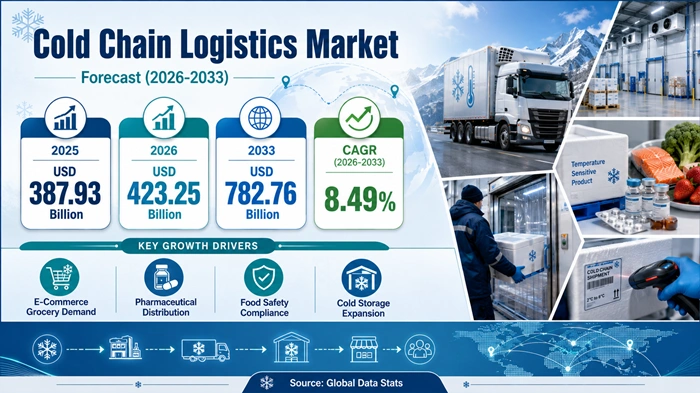
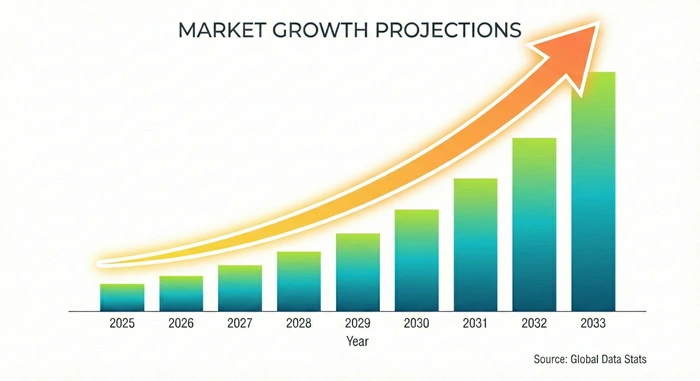
The global cold chain logistics market size is valued at USD 387.93 billion in 2025 and is predicted to increase from USD 423.25 billion in 2026 to approximately USD 782.76 billion by 2033, growing at a CAGR of 8.49% from 2026 to 2033.
This robust growth reflects the expanding global need for temperature-controlled transportation and storage that keeps pharmaceuticals, vaccines, and perishable foods safe as they move from manufacturers and farms to consumers worldwide. As online grocery delivery, biologics distribution, and cross-border food trade all continue accelerating, demand for reliable refrigerated warehousing and monitored transportation infrastructure keeps expanding across pharmaceutical, food and beverage, and chemical supply chains.
AI Impact on the Cold Chain Logistics Industry
Artificial Intelligence Is Enhancing Predictive Temperature Monitoring, Optimizing Refrigerated Route Planning, and Strengthening Demand Forecasting Across the Cold Chain Logistics Landscape — Fundamentally Changing How Perishable and Pharmaceutical Goods Move Through Global Supply Chains
Artificial intelligence has become an increasingly valuable tool for predictive temperature monitoring, with sensor-driven analytics now capable of detecting early signs of equipment malfunction or temperature drift inside refrigerated trucks and warehouses before spoilage actually occurs. This early warning capability matters considerably in a market where a single equipment failure can destroy an entire shipment of vaccines or fresh produce, and AI-assisted monitoring tools are helping logistics providers reduce costly product loss across their networks. Companies building predictive maintenance and monitoring directly into their cold storage operations are increasingly differentiating themselves through measurably lower spoilage rates and stronger client retention.
Beyond monitoring, AI is also improving refrigerated route planning, with optimization algorithms now able to analyze traffic patterns, fuel consumption, and delivery windows to select routes that minimize both energy use and transit time for temperature-sensitive cargo. This capability has proven valuable for logistics companies managing large refrigerated fleets, since better routing reduces fuel costs while also shortening the time perishable goods spend in transit. As these AI-driven monitoring and routing tools continue maturing, they are becoming an increasingly important factor shaping operational efficiency across the broader cold chain logistics market.
Growth Factors
Rising Demand for Perishable Foods and Expanding Pharmaceutical Cold Chain Needs Continue Driving Sustained Demand
The most significant growth factor supporting the cold chain logistics market is the steadily rising global demand for perishable food products, as consumers increasingly favor fresh produce, dairy, seafood, and frozen convenience foods over shelf-stable alternatives, requiring extensive refrigerated storage and transportation networks to maintain quality from farm to table. With online grocery and quick-commerce platforms expanding rapidly across both developed and emerging markets, this consumption-driven demand has become an increasingly important growth driver for providers offering both refrigerated warehousing and last-mile delivery capability.
A second important growth factor is the continued expansion of pharmaceutical and biologics distribution requiring strict temperature control, as vaccines, insulin, and increasingly complex biologic therapies demand rigorous cold chain handling throughout their entire journey from manufacturing facility to patient. This growing pharmaceutical demand, combined with rising cross-border food trade requiring compliant refrigerated shipping, has broadened the addressable market for cold chain logistics considerably. This combination of rising perishable food consumption and expanding pharmaceutical distribution needs continues to strengthen demand across the cold chain logistics market.
Market Outlook
IoT-Enabled Monitoring and Expanding Emerging Market Cold Storage Infrastructure Point Toward Sustained Growth Through 2033
Looking ahead through the forecast period, the cold chain logistics industry is expected to benefit substantially from continued investment in Internet of Things enabled monitoring systems, as shippers increasingly demand real-time visibility into temperature, humidity, and location data throughout the entire supply chain rather than relying on periodic manual checks. This visibility-focused shift is likely to reshape provider selection considerably as more companies prioritize transparency and accountability in their cold chain partnerships.
At the same time, expanding refrigerated warehousing and transportation infrastructure across emerging markets is expected to create substantial new demand, as growing urbanization and rising disposable incomes across Asia Pacific and Latin America increase consumption of frozen and refrigerated goods in regions with historically limited cold storage capacity. Companies that can deliver both proven reliability and cost-efficient scale are increasingly well positioned to capture this growth. Providers combining strong technology adoption with broad geographic network coverage are likely to lead growth within the broader cold chain logistics market through 2033.
Expert Speaks
-
"Our continued investment in automated cold storage and IoT monitoring reflects our commitment to helping customers protect product integrity across every mile of the supply chain." — CEO, Lineage Logistics
-
"As biologics and vaccine distribution needs grow more complex, our temperature-controlled network remains focused on delivering the reliability that healthcare systems and food producers depend on." — CEO, DHL Group
-
"We remain dedicated to advancing refrigerated transportation capacity and digital visibility tools that support both food security and pharmaceutical distribution worldwide." — CEO, Maersk
Key Report Takeaways
-
North America leads the global cold chain logistics market, holding approximately 34% market share in 2025, supported by extensive automation investment and well-established refrigerated transportation infrastructure
-
Asia Pacific is the fastest-growing region, projected to expand at a CAGR near 11.4% through 2033, driven by rising disposable incomes and rapidly expanding cold storage infrastructure across China and India
-
Pharmaceutical and healthcare customers use cold chain logistics the most intensively, accounting for roughly 34% share, given their strict temperature compliance requirements for vaccines and biologics
-
Refrigerated transportation contributes the most to overall demand, reflecting the continuous need for temperature-controlled shipping across both food and pharmaceutical supply chains
-
Refrigerated warehousing remains the most widely adopted storage process, valued for its ability to preserve product quality across extended holding periods
-
Frozen food application segments will grow the fastest among end-use categories, holding close to 27% market share with a CAGR near 12.3% through the forecast period, driven by rising demand for convenience and ready-to-eat frozen products
Market Scope
| Report Coverage | Details |
|---|---|
| Market Size by 2033 | USD 782.76 Billion |
| Market Size by 2025 | USD 387.93 Billion |
| Market Size by 2026 | USD 423.25 Billion |
| Market Growth Rate from 2026 to 2033 | CAGR of 8.49% |
| Dominating Region | North America |
| Fastest Growing Region | Asia Pacific |
| Base Year | 2025 |
| Forecast Period | 2026 to 2033 |
| Segments Covered | Service Type, Temperature Range, End User, Region |
| Regions Covered | North America, Europe, Asia Pacific, Latin America, Middle East & Africa |
Market Dynamics
Drivers Impact Analysis
Rising Perishable Food Consumption and Expanding Pharmaceutical Cold Chain Demand Remain the Two Strongest Forces Behind Market Momentum
| Driver | (≈) % Impact on CAGR Forecast | Geographic Relevance | Impact Timeline |
|---|---|---|---|
| Rising global consumption of perishable and frozen food products | ~33% | Global | Short to long-term |
| Expanding pharmaceutical and biologics distribution requiring strict temperature control | ~28% | North America, Europe | Medium to long-term |
| Rapid growth of online grocery and quick-commerce delivery models | ~25% | Global | Short to medium-term |
| Increasing cross-border food trade requiring compliant refrigerated shipping | ~14% | Asia Pacific, Latin America | Medium-term |
Rising global consumption of perishable and frozen food products continues to serve as the primary engine behind sustained growth in the cold chain logistics market, as consumers increasingly favor fresh and frozen convenience foods that require extensive refrigerated storage and transportation to maintain quality throughout the supply chain. This consumption-driven momentum has translated directly into rising investment in refrigerated warehousing and transportation capacity among logistics providers serving both retail and food service customers.
Expanding pharmaceutical and biologics distribution requiring strict temperature control represents the second major driver, as vaccines and increasingly complex biologic therapies demand rigorous cold chain handling from manufacturing through final delivery. This pharmaceutical-driven demand, combined with rapid growth of online grocery and quick-commerce delivery models, continues reinforcing steady momentum across the broader cold chain logistics market.
Restraints Impact Analysis
High Infrastructure Costs and Energy Consumption Concerns Continue to Moderate Broader Expansion
| Restraint | (≈) % Impact on CAGR Forecast | Geographic Relevance | Impact Timeline |
|---|---|---|---|
| High capital cost of building and maintaining refrigerated infrastructure | ~35% | Global, particularly emerging markets | Short to medium-term |
| Rising energy consumption and associated operational costs for cold storage | ~28% | Global | Medium-term |
| Fragmented supply chains and infrastructure deficits in developing regions | ~23% | Asia Pacific, Latin America, MEA | Medium to long-term |
| Regulatory variability across countries affecting cross-border operations | ~14% | Global | Short to medium-term |
The most persistent restraint facing the cold chain logistics market is the substantial capital cost associated with building and maintaining refrigerated warehouses and transportation fleets, which creates significant barriers for smaller logistics providers competing against established global carriers with greater infrastructure investment capacity. This cost sensitivity remains particularly pronounced in emerging markets where cold storage infrastructure development requires substantial upfront funding.
Rising energy consumption and associated operational costs represent a second significant restraint, since maintaining precise temperature control across large refrigerated networks demands continuous power usage that has grown more expensive amid volatile energy markets. Combined with fragmented supply chains and persistent infrastructure deficits across parts of Asia Pacific, Latin America, and the Middle East, these restraints continue moderating how quickly broader cold chain expansion occurs across the global cold chain logistics market.
Opportunities Impact Analysis
IoT Monitoring Adoption and Expanding Emerging Market Infrastructure Represent the Clearest Paths to Growth
| Opportunity | (≈) % Impact on CAGR Forecast | Geographic Relevance | Impact Timeline |
|---|---|---|---|
| Expanding adoption of IoT-enabled real-time temperature monitoring systems | ~37% | Global | Short to medium-term |
| Growing cold storage infrastructure investment across emerging markets | ~34% | Asia Pacific, Latin America | Medium to long-term |
| Rising demand for localized cold chain systems supporting quick-commerce | ~29% | North America, Asia Pacific | Short to medium-term |
Expanding adoption of IoT-enabled real-time temperature monitoring systems represents one of the most substantial opportunities within the cold chain logistics market, as shippers seeking greater transparency stand to benefit significantly from providers offering continuous location and condition data throughout the entire distribution journey. This monitoring-driven differentiation is expected to meaningfully reshape competitive positioning among leading logistics providers over the coming years.
Growing cold storage infrastructure investment across emerging markets presents a second substantial opportunity, as rising urbanization and disposable incomes across Asia Pacific and Latin America create demand for reliable refrigerated storage networks capable of serving rapidly expanding consumer bases. Rising demand for localized cold chain systems supporting quick-commerce delivery further broadens the opportunity landscape, particularly for providers able to establish smaller, strategically placed fulfillment centers. Companies pursuing these parallel opportunities are well positioned to capture meaningful growth within the broader cold chain logistics market through the forecast period.
Segment Analysis
By Service Type: Refrigerated Transportation
Refrigerated Transportation Continues to Anchor the Service Landscape, Reflecting Continuous Demand Across Food and Pharmaceutical Supply Chains
Refrigerated transportation holds the largest share within the service type segment of the cold chain logistics market, accounting for approximately 46% of total segment revenue in 2025. This dominance reflects the continuous need for temperature-controlled trucking, air, and ocean shipping to move perishable foods and pharmaceuticals safely across both domestic and international supply chains. In markets like the United States and Germany, shippers increasingly favor integrated providers offering combined long-haul refrigerated transport and last-mile delivery under a single monitored chain of custody. Leading suppliers such as Lineage Logistics, DHL, and Maersk continue to dominate this segment through expanded refrigerated fleet capacity and continuous monitoring technology improvements.
Growth within this segment remains particularly strong in North America, where extensive automation investment and well-established refrigerated transportation infrastructure continue generating sustained demand for reliable shipping services across thousands of delivery routes daily. The region's combination of dense retail distribution networks and mature logistics infrastructure has helped refrigerated transportation maintain its leading position despite growing interest in warehousing and value-added service alternatives. As perishable food consumption continues expanding, refrigerated transportation is expected to remain the dominant category within the broader cold chain logistics market throughout the forecast period.
By Application: Frozen Food
Frozen Food Applications Represent the Fastest-Growing Segment, Reflecting Rising Demand for Convenience and Ready-to-Eat Products
Frozen food applications represent the fastest-growing segment within the cold chain logistics market, holding close to 27% share in 2025 with a projected CAGR near 12.3% through the forecast period as consumers increasingly favor convenient, ready-to-eat frozen options over fresh alternatives requiring frequent shopping trips. Unlike traditional fresh produce logistics, frozen food distribution requires deep-freeze storage capability and specialized transportation equipment capable of maintaining sub-zero temperatures throughout extended holding and shipping periods. This specialized handling requirement has generated substantial interest among logistics providers investing heavily in deep-freeze capacity to serve growing frozen food manufacturer demand.
Growth in this segment remains especially strong in Asia Pacific, where rapidly expanding urban populations and rising disposable incomes across China and India continue driving strong demand for frozen convenience foods and the cold chain infrastructure needed to distribute them reliably. Companies like Nichirei and regional cold storage operators have expanded their deep-freeze warehousing capability significantly to serve this growing regional demand, often building localized distribution centers near major urban consumption hubs. As frozen food consumption continues expanding globally, this application segment is expected to remain the fastest-growing category within the broader cold chain logistics market.
Regional Insights
North America
Extensive Automation Investment and Mature Refrigerated Infrastructure Keep North America Firmly in the Lead
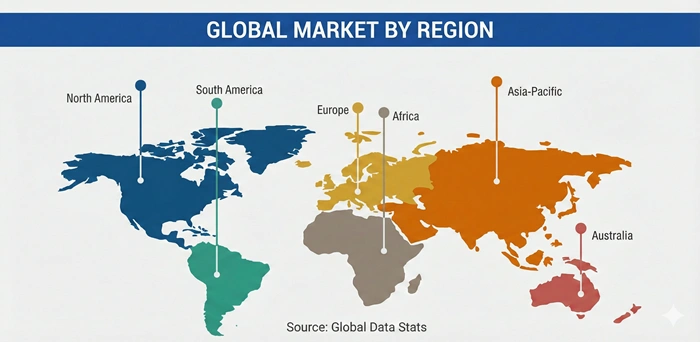
North America commands the leading position in the global cold chain logistics market, holding approximately 34% share in 2025, supported by extensive automation investment, well-established refrigerated transportation infrastructure, and a dense concentration of leading cold storage operators. The United States drives the overwhelming majority of regional demand, backed by substantial pharmaceutical and food distribution activity requiring reliable, monitored refrigerated networks across both retail and healthcare supply chains. Companies with strong regional presence include Lineage Logistics, Americold, DHL, and Burris Logistics, each maintaining deep relationships with major food and pharmaceutical manufacturers across the country.
Canada also contributes meaningfully to regional demand, supported by growing organic food consumption and expanding cold storage capacity serving both domestic and export markets. The region's combination of mature logistics infrastructure, strong automation adoption, and continuous IoT monitoring innovation ensures North America's leadership position within the cold chain logistics market remains firmly intact through the remainder of the forecast period.
Asia Pacific
Rising Disposable Incomes and Rapidly Expanding Cold Storage Infrastructure Position Asia Pacific as the Fastest-Growing Region
Asia Pacific is projected to register the fastest CAGR within the global cold chain logistics market through 2033, expanding at a rate near 11.4% as rising disposable incomes and rapidly expanding cold storage infrastructure create substantial new demand across the region. China and India lead much of this regional growth, supported by rapidly growing frozen and processed food consumption and expanding pharmaceutical distribution networks that require dependable refrigerated infrastructure reaching both urban and rural populations. Regional and international logistics providers alike have expanded their presence to serve this growing demand, often establishing local cold storage facilities to reduce dependence on longer international supply routes.
Japan and South Korea contribute further depth to regional growth, both bringing established processed food industries and growing pharmaceutical export activity requiring reliable temperature-controlled shipping networks. Growing government investment in cold storage infrastructure across several Asia Pacific markets continues to accelerate adoption among expanding food and pharmaceutical distribution networks alike. This combination of rising disposable incomes, expanding processed food consumption, and growing infrastructure investment positions Asia Pacific as the clear growth leader within the broader cold chain logistics market through the forecast period.
Customization Available for This Report
Region-Specific and Country-Specific Versions of This Report Are Available to Deliver a Sharper, More Localized View of Market Dynamics
This report can be tailored on a region-by-region and country-by-country basis, providing localized market sizing, competitive mapping, and cold storage infrastructure trend analysis that a global overview alone cannot fully capture.
Clients seeking a more focused breakdown can request a customized version covering any of the following regions and countries, complete with demand forecasting, competitor landscape review, and adoption trend analysis tied specifically to the cold chain logistics keyword focus:
North America
-
U.S. — Detailed review of automation investment and refrigerated infrastructure trends
-
Canada — Coverage of organic food consumption and cold storage capacity patterns
-
Mexico — Analysis of emerging cold chain logistics investment trends
Europe
-
U.K. — Review of cold chain regulation and refrigerated distribution trends
-
Germany — Coverage of logistics infrastructure investment among leading providers
-
France — Insights into refrigerated transport and warehousing adoption patterns
-
Italy — Analysis of regional cold chain logistics investment trends
-
Rest of Europe — Country-level view of emerging demand across Eastern Europe and the Nordics
Asia Pacific
-
China — Coverage of expanding frozen food consumption and cold storage deployment
-
India — Analysis of growing pharmaceutical distribution and infrastructure demand
-
Japan — Review of established processed food industry and export logistics trends
-
South Korea — Assessment of pharmaceutical export logistics investment and adoption
-
Australia — Insights into refrigerated distribution and cold chain adoption trends
-
Rest of Asia Pacific — Country-level breakdown covering Indonesia, Vietnam, and Malaysia
Latin America
-
Brazil — Coverage of expanding frozen food distribution access and cold chain adoption
-
Argentina — Analysis of early-stage cold chain logistics modernization trends
-
Rest of Latin America — Country-level sizing across Colombia, Peru, and Chile
Middle East & Africa
-
UAE — Review of cold chain logistics investment and storage adoption trends
-
Saudi Arabia — Coverage of expanding food distribution logistics modernization initiatives
-
Rest of MEA — Country-level view of African cold storage infrastructure expansion
Top Key Players
-
Lineage Logistics Holding LLC (United States)
-
Americold Logistics LLC (United States)
-
DHL Group (Germany)
-
Kuehne+Nagel International AG (Switzerland)
-
United Parcel Service Inc (United States)
-
FedEx Corporation (United States)
-
A.P. Moller-Maersk A/S (Denmark)
-
Burris Logistics (United States)
-
Nichirei Corporation (Japan)
-
NewCold Cooperatief U.A (Netherlands)
-
Kloosterboer Group B.V (Netherlands)
-
Snowman Logistics Ltd (India)
Recent Developments
-
In 2025, Lineage Logistics expanded its automated cold storage network with new facility openings targeting growing e-commerce and grocery distribution demand
-
In 2025, Americold strengthened its refrigerated warehousing capacity through continued investment in automation and energy-efficient cold storage technology
-
In 2026, DHL advanced its temperature-controlled transportation network with enhanced IoT monitoring capability across pharmaceutical distribution routes
-
In 2025, Maersk deepened its refrigerated container shipping partnerships to support expanding cross-border perishable food trade
-
In 2025, Kuehne+Nagel broadened its emerging market cold chain presence with new facility investments across Asia Pacific and Latin America
Market Trends
IoT Monitoring Expansion and Frozen Food Distribution Growth Are Reshaping Provider Priorities
One of the clearest trends shaping the cold chain logistics market is the accelerating adoption of IoT-enabled real-time monitoring platforms, as shippers increasingly demand continuous visibility into temperature, humidity, and location conditions throughout the entire distribution journey rather than relying on periodic manual checkpoints. Providers are investing heavily in sensor technology, recognizing that transparency has become an increasingly important competitive differentiator as customers prioritize supply chain accountability across both food and pharmaceutical categories.
A second significant trend is the growing specialization in localized cold chain fulfillment centers supporting quick-commerce and online grocery delivery, as consumers increasingly expect rapid delivery of frozen and refrigerated goods within hours rather than days. This trend toward decentralized, localized distribution is particularly meaningful for providers serving urban markets with dense delivery demand, continuing to support steady expansion across the broader cold chain logistics market as quick-commerce adoption continues increasing.
Segments Covered in the Report
By Service Type
-
Refrigerated Transportation
-
Refrigerated Warehousing
-
Value-Added Services
By Temperature Range
-
Frozen
-
Chilled
By End User
-
Pharmaceuticals and Healthcare
-
Food and Beverage
-
Chemicals
By Region
-
North America (U.S., Canada, Mexico)
-
Europe (U.K., Germany, France, Italy, Rest of Europe)
-
Asia Pacific (China, India, Japan, South Korea, Australia, Rest of Asia Pacific)
-
Latin America (Brazil, Argentina, Rest of Latin America)
-
Middle East & Africa (UAE, Saudi Arabia, Rest of MEA)
❝ Built for Every Level — From Startups to Industry Giants ❞
Here Is Exactly How This Report Works for You
-
For tier 1 companies, investors, and established market leaders, this report delivers detailed competitor revenue analysis, cold storage infrastructure trend mapping, and geopolitical risk context that support confident decisions around network expansion, pricing strategy, and long-term positioning within the cold chain logistics space
-
For tier 2 and tier 3 companies, startups, and mid-sized providers, this report highlights the most commercially promising service categories and underserved regional opportunities, giving you a practical framework to compete against larger established players without overextending limited resources
-
For every decision maker across the value chain, this report explains exactly how energy cost trends, regulatory compliance shifts, and competitor network expansions are shaping market direction through 2033, equipping you to plan investment and go-to-market decisions with genuine confidence
Frequently Asked Questions
Question 1: How large is the global cold chain logistics market expected to become by 2033?
Answer: The global cold chain logistics market was valued at USD 387.93 billion in 2025 and is projected to reach USD 782.76 billion by 2033. This growth is driven largely by rising perishable food consumption and expanding pharmaceutical cold chain needs.
Question 2: What is driving growth in the cold chain logistics market right now?
Answer: Growth in the cold chain logistics market is being driven by rising global consumption of frozen and perishable foods alongside expanding pharmaceutical distribution needs. Rapid growth of online grocery and quick-commerce delivery is further reinforcing this expansion.
Question 3: Which region currently dominates the cold chain logistics market?
Answer: North America currently leads the cold chain logistics market with roughly 34% share, supported by extensive automation investment. Asia Pacific is growing the fastest, driven by rising disposable incomes and expanding cold storage infrastructure.
Question 4: Which service segment generates the most revenue in the cold chain logistics market?
Answer: Refrigerated transportation generates the largest share of revenue in the cold chain logistics market, reflecting continuous demand across food and pharmaceutical supply chains. Frozen food applications remain the fastest-growing segment.
Question 5: Who are the leading companies competing in the cold chain logistics market?
Answer: Leading companies in the cold chain logistics market include Lineage Logistics, Americold, DHL, Kuehne+Nagel, and FedEx. These companies compete through continuous innovation in automation and IoT-based monitoring technology.