
Cloud Native Technologies Market Overview
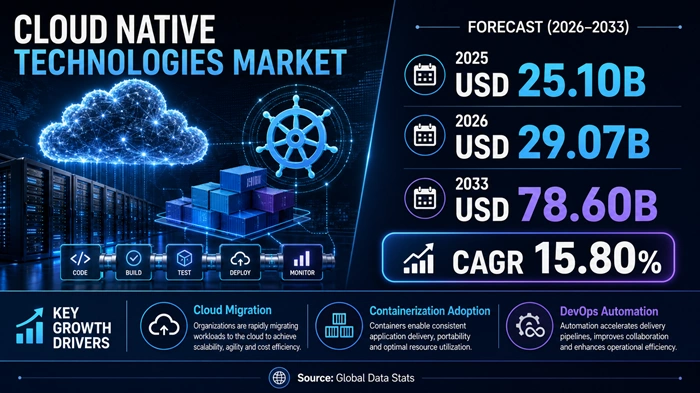
The global cloud native technologies market size is valued at USD 25.10 billion in 2025 and is predicted to increase from USD 29.07 billion in 2026 to approximately USD 78.60 billion by 2033, growing at a CAGR of 15.80% from 2026 to 2033. This remarkable expansion reflects the accelerating digital transformation initiatives across global enterprises, driven by the increasing demand for scalable, agile, and resilient application architectures that can adapt to rapidly changing business environments.
Organizations worldwide are migrating from traditional monolithic applications to modern cloud native architectures to achieve faster deployment cycles, improved resource utilization, and enhanced operational efficiency. The widespread adoption of containerization technologies, particularly Kubernetes as the de facto orchestration platform, has fundamentally transformed how businesses develop, deploy, and manage applications across distributed environments. This shift enables enterprises to leverage microservices architectures that promote modularity, allowing individual components to be updated, scaled, and maintained independently without disrupting entire systems.
AI Impact on the Cloud Native Technologies Industry
Revolutionizing Automation, Monitoring, and Intelligent Decision-Making Across the DevOps Lifecycle
Artificial intelligence is fundamentally reshaping the cloud native technologies landscape by introducing intelligent automation capabilities that significantly enhance development, deployment, and operational processes. AI-powered tools are streamlining routine DevOps tasks such as infrastructure provisioning, configuration management, and continuous integration and continuous deployment processes, reducing human error while accelerating release cycles and freeing engineering teams to focus on strategic innovation rather than repetitive maintenance activities. Machine learning algorithms analyze vast amounts of operational data from logs, metrics, and performance traces to detect anomalies and predict potential system failures before they impact end users, enabling proactive remediation that minimizes downtime and improves overall system reliability.
The integration of AI within cloud native ecosystems extends beyond operational automation to include intelligent resource optimization and enhanced security monitoring. AI systems forecast usage trends and dynamically scale infrastructure resources, optimizing both cost efficiency and performance across cloud environments, with major cloud platforms already incorporating AI-driven recommendations for autoscaling strategies. Natural language processing capabilities are enhancing collaboration by analyzing support tickets and code reviews to recommend fixes and auto-assign tasks, reducing communication lag and improving team productivity. The emergence of AI-driven observability platforms addresses the challenge of managing the exponential growth in data generated by distributed cloud native applications, providing cost-effective, comprehensive monitoring at scale that was previously prohibitively expensive. This AI transformation is creating intelligent, self-healing cloud native environments that can adapt to changing conditions with minimal human intervention, positioning organizations to handle increasingly complex workloads while maintaining high availability and performance standards.
Growth Factors
Digital Transformation Initiatives and Microservices Adoption Driving Unprecedented Market Expansion
The primary catalyst propelling the cloud native technologies market forward is the accelerating pace of digital transformation across virtually every industry sector, as organizations recognize that traditional IT infrastructures cannot support the agility, scalability, and innovation velocity required to remain competitive in today's rapidly evolving business landscape. Enterprises are embracing cloud native approaches to achieve faster time-to-market for new products and services, with microservices architectures enabling development teams to work independently on discrete application components, dramatically reducing deployment cycles and allowing businesses to respond quickly to changing market demands and customer expectations. The necessity for businesses to maintain competitive advantage through continuous innovation has made cloud native technologies essential rather than optional, with modern organizations demanding the resilience and scalability that monolithic applications simply cannot deliver.
The proliferation of containerization technologies, particularly Docker for packaging applications and Kubernetes for orchestration, has removed significant technical barriers that previously limited cloud native adoption. These technologies enable organizations to achieve consistency across different deployment environments, from development through testing to production, while facilitating portability across multiple cloud providers and preventing vendor lock-in. The shift toward multi-cloud and hybrid cloud strategies is further accelerating market growth, as enterprises seek to leverage the best services from different cloud providers while maintaining flexibility and optimizing costs. Additionally, the growing emphasis on DevOps practices and the integration of continuous integration and continuous deployment pipelines are driving demand for cloud native tools that support automated testing, deployment, and monitoring. The rising adoption of serverless computing frameworks is also contributing to market expansion by enabling organizations to focus on business logic rather than infrastructure management, reducing operational complexity and allowing small and medium-sized enterprises to access sophisticated capabilities previously available only to large organizations with extensive IT resources.
Market Outlook
Robust Growth Trajectory Supported by Technological Innovation and Enterprise Modernization Strategies
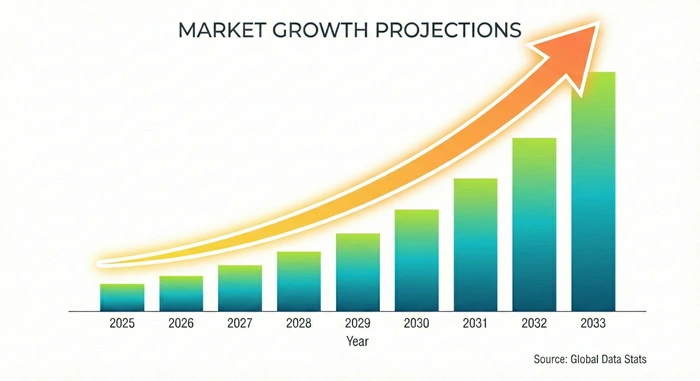
The cloud native technologies market is positioned for sustained robust growth throughout the forecast period, driven by continuous innovation in orchestration platforms, development tools, and security solutions that are making cloud native adoption more accessible and valuable across diverse industry verticals. The market trajectory reflects not only increasing adoption rates among early movers but also significant expansion into traditional industries that are beginning their digital transformation journeys, including healthcare, manufacturing, and government sectors where regulatory compliance and legacy system integration previously created adoption barriers. Organizations are recognizing that cloud native architectures provide compelling advantages beyond just technical efficiency, including enhanced business agility that enables rapid experimentation with new business models, improved customer experiences through faster feature delivery, and reduced total cost of ownership through optimized resource utilization.
The emergence of edge computing and the proliferation of Internet of Things devices are creating new opportunities for cloud native technologies, as organizations seek to process data closer to its source while maintaining centralized management and orchestration capabilities. The integration of artificial intelligence and machine learning workloads within cloud native environments is accelerating, with specialized tools and platforms being developed to support the unique requirements of AI training and inference at scale. The market is also benefiting from increased investment in cloud infrastructure globally, with governments promoting digital transformation initiatives and establishing regulatory frameworks that encourage cloud adoption while ensuring data sovereignty and security. Major technology vendors continue to expand their cloud native portfolios through strategic acquisitions and partnerships, consolidating the ecosystem while driving innovation in areas such as observability, security, and developer experience. The combination of technological maturation, expanding use cases, and strong enterprise demand positions the cloud native technologies market for sustained double-digit growth rates throughout the forecast period, with the potential for acceleration as new capabilities emerge and adoption barriers continue to diminish.
Expert Speaks
-
Satya Nadella, CEO of Microsoft Corporation, emphasized in 2025 that cloud native technologies are fundamental to every organization's digital transformation journey, enabling businesses to build intelligent applications that can scale dynamically and adapt to changing market conditions while maintaining security and compliance across hybrid environments.
-
Arvind Krishna, CEO of IBM Corporation, highlighted following IBM's HashiCorp acquisition that cloud native infrastructure automation is becoming critical for enterprises managing multi-cloud environments, with organizations increasingly seeking integrated platforms that can provision, secure, and manage infrastructure consistently across diverse cloud providers.
-
Thomas Kurian, CEO of Google Cloud, stated that the convergence of cloud native architectures and artificial intelligence represents the next major evolution in enterprise computing, with organizations leveraging containerized AI workloads to accelerate innovation while maintaining the flexibility to deploy across multiple cloud environments.
Key Report Takeaways
-
North America maintains market leadership with a dominant position accounting for approximately 40% market share in 2025, driven by early technology adoption, presence of major cloud service providers, and substantial investment in digital transformation initiatives across enterprises
-
Asia Pacific emerges as the fastest-growing region with an anticipated CAGR exceeding 20% during the forecast period, fueled by rapid digitalization, expanding cloud infrastructure, government-backed digital initiatives, and increasing adoption among small and medium-sized enterprises seeking competitive advantages
-
Large enterprises represent the dominant organizational segment accounting for more than 65% of market revenue in 2025, leveraging cloud native technologies to manage complex workloads, support global operations, and implement multi-cloud strategies that optimize service delivery
-
The IT and telecom vertical leads industry adoption capturing the largest market share due to inherent requirements for high-performance computing, scalable infrastructure, rapid application deployment, and continuous service availability that cloud native platforms uniquely deliver
-
Containers and microservices technology segment dominates the market with the highest revenue share, as organizations prioritize modular application architectures that enable independent development, deployment, and scaling of discrete application components
-
Hybrid and multi-cloud deployment models show the fastest growth trajectory with the highest CAGR projected at approximately 17%, as enterprises seek to avoid vendor lock-in, optimize costs, and leverage specialized services from multiple cloud providers
-
Application development and modernization applications contribute the largest revenue share, as organizations invest heavily in transforming legacy systems into cloud native architectures to improve agility, reduce technical debt, and accelerate innovation cycles
-
Data analytics and AI/ML workloads represent the fastest-growing application segment with projected CAGR exceeding 18%, driven by increasing demand for scalable platforms that can handle intensive computational requirements for training and deploying machine learning models
Market Scope
| Report Coverage | Details |
|---|---|
| Market Size by 2033 | USD 78.60 Billion |
| Market Size by 2025 | USD 25.10 Billion |
| Market Size by 2026 | USD 29.07 Billion |
| Market Growth Rate from 2026 to 2033 | CAGR of 15.80% |
| Dominating Region | North America |
| Fastest Growing Region | Asia Pacific |
| Base Year | 2025 |
| Forecast Period | 2026 to 2033 |
| Segments Covered | Technology, Deployment Model, Organization Size, Application Type, Industry Vertical |
| Regions Covered | North America, Europe, Asia Pacific, Latin America, Middle East and Africa |
Market Dynamics
Drivers Impact Analysis
Accelerating Digital Transformation and Microservices Architecture Adoption
| Factor | (≈) % Impact on CAGR Forecast | Geographic Relevance | Impact Timeline |
|---|---|---|---|
| Digital transformation initiatives | 35-40% | Global, particularly North America and Europe | 2026-2033 |
| Microservices adoption | 25-30% | Global, strongest in Asia Pacific | 2026-2033 |
| DevOps integration | 20-25% | North America, Europe, Asia Pacific | 2026-2030 |
The relentless drive toward digital transformation across global enterprises represents the most significant force propelling the cloud native technologies market, as organizations fundamentally restructure their IT infrastructures to support business models that demand unprecedented agility, scalability, and innovation velocity. Traditional monolithic applications have become strategic liabilities rather than assets, as they cannot accommodate the rapid deployment cycles, continuous updates, and elastic scaling that modern business operations require to respond to market disruptions and changing customer expectations. Cloud native technologies enable organizations to decompose complex applications into manageable microservices that can be developed, tested, deployed, and scaled independently, dramatically reducing the time required to bring new features and products to market while minimizing the risk of system-wide failures. This architectural transformation allows development teams to work in parallel on different application components, accelerating innovation while improving overall system resilience through isolation of failures and simplified troubleshooting.
The widespread adoption of containerization technologies, led by Docker and Kubernetes, has eliminated many technical barriers that previously limited cloud native implementation, providing developers with standardized packaging and orchestration tools that ensure consistency across development, testing, and production environments. Organizations are discovering that cloud native approaches deliver compelling business value beyond technical efficiency, including reduced infrastructure costs through improved resource utilization, enhanced security through isolation and granular access controls, and improved developer productivity through automation of repetitive deployment and management tasks. The COVID-19 pandemic accelerated digital transformation timelines by several years, forcing organizations to rapidly adopt cloud technologies to support remote work, online service delivery, and digital customer engagement, creating sustained momentum that continues driving cloud native adoption. The combination of business imperative, technical maturation, and proven success cases across diverse industries has created a self-reinforcing cycle where cloud native technologies transition from experimental to essential, driving sustained high growth rates throughout the forecast period.
Restraints Impact Analysis
Complexity, Skills Shortage, and Security Concerns
| Factor | (≈) % Impact on CAGR Forecast | Geographic Relevance | Impact Timeline |
|---|---|---|---|
| Implementation complexity | -15 to -20% | Global, particularly emerging markets | 2026-2029 |
| Skills shortage | -10 to -15% | Global, strongest impact in Asia Pacific and Latin America | 2026-2033 |
| Security and compliance concerns | -8 to -12% | Europe, North America (regulated industries) | 2026-2028 |
The inherent complexity of cloud native architectures presents a significant barrier to adoption, particularly for organizations with limited cloud expertise or those managing large portfolios of legacy applications that resist straightforward migration. Implementing cloud native technologies requires mastering multiple interconnected concepts including containerization, orchestration, service meshes, observability, and security frameworks, creating steep learning curves for development and operations teams accustomed to traditional deployment models. The distributed nature of microservices architectures introduces operational challenges around debugging, monitoring, and managing inter-service communication that can be substantially more complex than troubleshooting monolithic applications, requiring sophisticated observability tools and practices that many organizations struggle to implement effectively. Organizations often underestimate the cultural and organizational changes required to succeed with cloud native technologies, including the need to break down silos between development and operations teams, adopt continuous delivery practices, and establish governance frameworks for managing distributed systems.
The global shortage of professionals with expertise in cloud native technologies represents a persistent constraint on market growth, with demand for skilled practitioners far exceeding supply and creating competition for talent that drives up implementation costs and extends project timelines. Many enterprises face challenges recruiting and retaining engineers proficient in Kubernetes, containerization, microservices design patterns, and associated tools, forcing them to invest heavily in training programs or rely on external consultants that increase total cost of ownership. Security concerns around containerized applications and distributed architectures create hesitation among organizations in regulated industries, where compliance requirements demand rigorous controls over data access, encryption, and audit trails that can be challenging to implement consistently across dynamic, ephemeral container environments. Organizations worry about expanding attack surfaces as applications decompose into numerous microservices, each requiring secure configuration, vulnerability management, and access controls, while the rapid pace of change in cloud native tooling makes it difficult to establish standardized security practices. These restraints are gradually diminishing as the ecosystem matures, security tools improve, and more professionals gain cloud native expertise, but they continue to moderate adoption rates particularly among risk-averse enterprises and in regions with limited access to technical talent.
Opportunities Impact Analysis
Edge Computing, AI Integration, and Emerging Market Expansion
| Factor | (≈) % Impact on CAGR Forecast | Geographic Relevance | Impact Timeline |
|---|---|---|---|
| Edge computing integration | 20-25% | Global, particularly Asia Pacific and North America | 2027-2033 |
| AI/ML workload optimization | 25-30% | North America, Europe, Asia Pacific | 2026-2033 |
| Emerging market adoption | 15-20% | Asia Pacific, Latin America, Middle East and Africa | 2028-2033 |
The convergence of edge computing and cloud native technologies presents a substantial growth opportunity, as organizations seek to process data closer to its source while maintaining centralized orchestration and management capabilities across distributed infrastructure. Edge deployments require the portability, lightweight footprint, and automated management that containerized applications provide, enabling organizations to deploy consistent workloads across data centers, public clouds, and edge locations including retail stores, manufacturing facilities, and telecommunications network edges. The proliferation of Internet of Things devices generating massive data volumes that cannot be efficiently transmitted to centralized clouds is driving demand for edge computing solutions built on cloud native foundations, creating new use cases in autonomous vehicles, smart cities, industrial automation, and augmented reality applications. Cloud native architectures enable the distributed deployment models edge computing requires while providing the flexibility to move workloads between edge and cloud based on latency requirements, bandwidth constraints, and computational needs.
The optimization of artificial intelligence and machine learning workloads using cloud native technologies represents another high-growth opportunity, as organizations increasingly deploy AI models in production environments requiring the scalability, reliability, and efficient resource utilization that containerized platforms deliver. Cloud native environments provide the elastic infrastructure needed for training computationally intensive machine learning models while enabling efficient deployment and scaling of inference services that respond to variable demand. Specialized tools are emerging to support the unique requirements of AI/ML workloads including GPU scheduling, model versioning, experiment tracking, and automated retraining pipelines, all built on cloud native foundations that ensure portability and consistency. The rapid expansion of cloud infrastructure in emerging markets including Southeast Asia, India, Latin America, and Africa creates substantial opportunities for cloud native technology adoption, as organizations in these regions can leapfrog legacy infrastructure and adopt modern architectures from the outset. Government initiatives promoting digital transformation, improving internet connectivity, and establishing local cloud regions are reducing barriers to cloud adoption in emerging markets, while the economic advantages of cloud native approaches appeal particularly to resource-constrained small and medium-sized enterprises seeking to compete with larger rivals. These opportunities collectively position the cloud native technologies market for potential acceleration beyond baseline forecasts if adoption barriers continue declining and new use cases emerge as the technology ecosystem matures.
Segment Analysis
By Technology: Containers and Microservices
Foundational Architecture Enabling Modular Application Development and Deployment
The containers and microservices technology segment dominates the cloud native technologies market, capturing the largest revenue share of approximately 45% in 2025 with a projected CAGR of 14.5% during the forecast period. This segment's leadership reflects the fundamental role containerization plays in cloud native architectures, providing the standardized packaging and isolation mechanisms that enable applications to run consistently across diverse computing environments from developer laptops through testing systems to production clouds. Containers encapsulate application code along with all dependencies, libraries, and configuration files into lightweight, portable units that can be deployed and scaled independently, eliminating the "works on my machine" problem that plagued traditional deployment approaches and dramatically simplifying the path from development to production. The widespread adoption of Docker as the standard container runtime and Kubernetes as the dominant orchestration platform has created a mature ecosystem with extensive tooling, community support, and enterprise-grade management capabilities that reduce implementation risk and accelerate time-to-value. North America leads adoption in this segment, with major enterprises in technology, financial services, and retail sectors leveraging containers to modernize legacy applications and build cloud native platforms that support continuous delivery and rapid scaling in response to demand fluctuations. Leading companies including IBM Corporation, Red Hat, Microsoft Corporation, Amazon Web Services, and Google Cloud are continuously enhancing their container platforms with improved security, simplified networking, advanced scheduling, and integrated developer tools that make containerization more accessible to organizations across the technical maturity spectrum.
Microservices architecture complements containerization by providing the design pattern for decomposing monolithic applications into loosely coupled services that communicate through well-defined APIs, enabling organizations to develop, deploy, and scale individual application components independently without coordinating system-wide releases. This architectural approach allows development teams to work in parallel using different programming languages and frameworks best suited to specific service requirements, accelerating innovation while improving system resilience through failure isolation that prevents cascading outages. Organizations adopting microservices report significant improvements in deployment frequency, with many achieving daily or even hourly releases compared to quarterly or monthly cycles typical with monolithic applications, enabling rapid experimentation and faster response to customer feedback. The segment is experiencing particularly strong growth in Asia Pacific, where rapidly expanding digital economies and technology companies are building cloud native applications from inception rather than migrating legacy systems, allowing them to fully leverage microservices benefits without the constraints of existing architectures. Service mesh technologies including Istio and Linkerd are enhancing microservices capabilities by providing sophisticated traffic management, security, and observability features that operate transparently to application code, addressing operational complexity that previously limited adoption among organizations lacking deep technical expertise. The containers and microservices segment is expected to maintain its market leadership throughout the forecast period as these technologies become increasingly integrated into enterprise development practices and new capabilities emerge around security, networking, and developer experience.
By Deployment Model: Hybrid and Multi-Cloud
Strategic Flexibility Driving Fastest Growth Across Diverse Cloud Environments
The hybrid and multi-cloud deployment model segment is experiencing the fastest growth in the cloud native technologies market, with a projected CAGR exceeding 17% during the forecast period, reflecting enterprise strategies to avoid vendor lock-in, optimize costs, and leverage specialized capabilities from multiple cloud providers. Organizations are increasingly recognizing that no single cloud platform offers the optimal combination of services, pricing, geographic coverage, and compliance capabilities for all workloads, driving adoption of multi-cloud architectures that distribute applications across Amazon Web Services, Microsoft Azure, Google Cloud Platform, and specialized providers based on specific requirements. Hybrid cloud deployments combining on-premises infrastructure with public cloud services provide the flexibility to maintain sensitive workloads within corporate data centers while leveraging cloud scalability for variable or compute-intensive workloads, addressing regulatory constraints and data sovereignty requirements that prevent some organizations from adopting pure public cloud strategies. Cloud native technologies are fundamental enablers of hybrid and multi-cloud strategies, with containerization providing the portability needed to move workloads between environments while Kubernetes delivers consistent orchestration and management across disparate infrastructure.
North America demonstrates particularly strong adoption of hybrid and multi-cloud approaches, with large enterprises in regulated industries including healthcare, financial services, and government implementing sophisticated architectures that balance security, compliance, and flexibility requirements. The segment benefits from continued investment by major technology vendors in tools and services that simplify multi-cloud management, with offerings including centralized control planes, unified identity management, cross-cloud networking, and policy enforcement that reduce operational complexity previously associated with managing multiple environments. Leading companies driving innovation in this segment include IBM Corporation with its hybrid cloud platform built on Red Hat OpenShift, Microsoft Corporation through Azure Arc enabling consistent management across clouds, Google Cloud with Anthos for multi-cloud Kubernetes management, and VMware providing enterprise-grade tools for hybrid deployments. Europe shows increasing adoption of hybrid cloud approaches driven by data residency requirements under regulations including GDPR that mandate certain data remain within specific geographic boundaries, while enabling organizations to use public clouds for non-sensitive workloads. The emergence of distributed cloud models where public cloud providers deliver services through edge locations and customer data centers is further accelerating hybrid adoption by combining cloud advantages with local deployment benefits. Organizations pursuing hybrid and multi-cloud strategies report improved negotiating leverage with cloud providers, enhanced disaster recovery capabilities through geographic distribution, and flexibility to optimize workload placement based on performance and cost considerations that deliver measurable business value.
Regional Insights
North America
Market Leadership Through Technology Innovation and Enterprise Digital Transformation
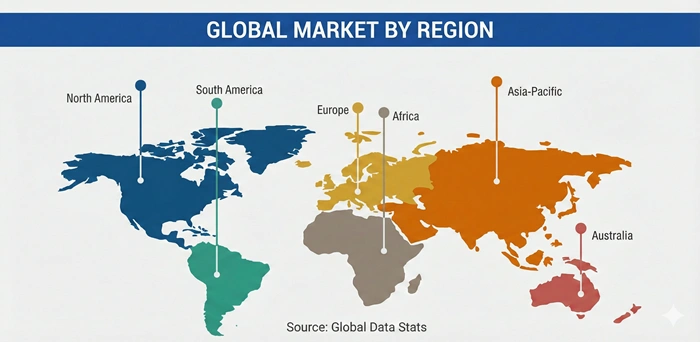
North America maintains its position as the dominant region in the cloud native technologies market, accounting for approximately 40% of global market share in 2025 with a market value exceeding USD 10 billion and projected CAGR of 14.8% during the forecast period. The region's leadership stems from multiple reinforcing factors including the concentration of major cloud service providers including Amazon Web Services, Microsoft Azure, Google Cloud Platform, and IBM Cloud that continuously innovate and expand their cloud native offerings, establishing technology standards and best practices that influence global adoption patterns. North American enterprises demonstrate high digital maturity and willingness to adopt emerging technologies, with organizations across technology, financial services, healthcare, retail, and manufacturing sectors investing heavily in cloud native platforms to modernize legacy applications, improve operational efficiency, and accelerate innovation cycles. The United States specifically accounts for the majority of North American market value, with the US cloud native technologies market valued at USD 15.14 billion in 2025 and projected to reach USD 52.89 billion by 2034, reflecting concentrated adoption among Fortune 500 companies and rapidly growing technology startups.
The region benefits from a mature ecosystem of technology vendors, system integrators, and specialized service providers offering implementation support, training, and managed services that reduce adoption barriers for organizations lacking internal cloud expertise. Leading companies headquartered in North America including Amazon Web Services, Microsoft Corporation, IBM Corporation, Google Cloud (Alphabet Inc.), Red Hat (IBM subsidiary), Oracle Corporation, VMware (Broadcom), and Salesforce dominate the global market while driving continuous innovation in container orchestration, serverless computing, security, and developer tools. Strong venture capital funding and corporate innovation programs support numerous startups developing specialized cloud native solutions around observability, security, networking, and application development that enhance the overall ecosystem. Canada demonstrates growing adoption particularly in financial services and government sectors, while Mexico shows increasing cloud native implementation as manufacturing and nearshoring activities expand. The region faces relatively minor constraints around skills shortage and implementation complexity, with abundant technical talent, educational programs, and professional training resources available to support adoption. North America is expected to maintain market leadership throughout the forecast period, though its share may gradually decline as other regions accelerate adoption and bridge the digital maturity gap.
Asia Pacific
Fastest Regional Growth Driven by Digital Economy Expansion and Cloud Infrastructure Investment
Asia Pacific emerges as the fastest-growing region in the cloud native technologies market, with a projected CAGR exceeding 20% during the forecast period, substantially outpacing global averages as rapidly expanding digital economies and government-backed initiatives accelerate technology adoption. The region's explosive growth reflects multiple converging trends including massive investments in cloud infrastructure by global providers and local champions establishing data centers across major markets, expanding internet connectivity reaching underserved populations, and digital transformation initiatives across industries from manufacturing to retail to financial services. China, India, Japan, South Korea, Southeast Asian nations including Singapore and Indonesia, and Australia each demonstrate unique adoption patterns and growth drivers, collectively creating a diverse and dynamic market landscape. The region benefits particularly from organizations building cloud native applications from inception rather than migrating legacy systems, allowing them to fully leverage modern architectural patterns without constraints of existing infrastructure or technical debt that slow adoption in more mature markets.
Small and medium-sized enterprises throughout Asia Pacific are embracing cloud native technologies at unprecedented rates, seeking competitive advantages through digital capabilities that previously required resources available only to large corporations, with cloud platforms democratizing access to sophisticated technologies including artificial intelligence, advanced analytics, and global-scale infrastructure. Government initiatives across multiple countries including India's Digital India program, China's push for indigenous cloud technology, Singapore's Smart Nation initiative, and Japan's Society 5.0 vision are providing policy support, infrastructure investment, and incentives that accelerate cloud adoption across public and private sectors. Leading companies driving growth in the region include Alibaba Cloud as the dominant Chinese provider with expanding international presence, Tencent Cloud serving Chinese enterprises, local providers including Tata Consultancy Services and Infosys in India, as well as major global vendors including Amazon Web Services, Microsoft Corporation, Google Cloud, and IBM Corporation establishing strong regional operations. The region faces challenges including variable regulatory environments across countries, skills shortages particularly acute in emerging markets, and infrastructure gaps in less developed areas, but these constraints are gradually diminishing as investment continues and educational programs expand. Manufacturing sector adoption is particularly strong in Asia Pacific as industries including automotive, electronics, and consumer goods implement Industry 4.0 initiatives built on cloud native foundations that enable IoT integration, predictive maintenance, and flexible production systems. The combination of favorable demographics with large populations of young, tech-savvy workers, rapid urbanization increasing demand for digital services, and strong economic growth supporting technology investment positions Asia Pacific for sustained high-growth rates throughout the forecast period, potentially capturing the largest market share by 2033.
Top Key Players
-
Amazon Web Services, Inc. (United States)
-
Microsoft Corporation (United States)
-
Google Cloud Platform - Alphabet Inc. (United States)
-
IBM Corporation (United States)
-
Red Hat, Inc. (United States)
-
Oracle Corporation (United States)
-
VMware, Inc. - Broadcom (United States)
-
Alibaba Cloud (China)
-
SAP SE (Germany)
-
Salesforce, Inc. (United States)
-
Cisco Systems, Inc. (United States)
-
Dell Technologies Inc. (United States)
-
Hewlett Packard Enterprise (United States)
-
Tencent Cloud (China)
-
Infosys Limited (India)
Recent Developments
-
Google Cloud (Alphabet Inc.) announced a definitive agreement in March 2025 to acquire Wiz, a leading cloud security startup, for USD 32 billion in an all-cash transaction representing Google's largest acquisition in company history, aimed at accelerating cloud security capabilities and multi-cloud architecture implementation for Google Cloud customers navigating increasingly complex security requirements in the AI era
-
IBM Corporation completed its USD 6.4 billion acquisition of HashiCorp in February 2025 after extended regulatory scrutiny, integrating the infrastructure automation provider's Terraform and Vault products into IBM's automation software portfolio and combining Vault with Red Hat OpenShift to enhance secrets management and security life-cycle management capabilities across hybrid multi-cloud environments
-
Palo Alto Networks reached an agreement in November 2025 to acquire observability platform provider Chronosphere for USD 3.35 billion, addressing major observability challenges arising from AI adoption growth and planning to combine Chronosphere's gigawatt-scale observability solution with its AgentiX platform for building and governing AI agents
-
Red Hat announced expanded partnerships in May 2025 with Oracle, Google Cloud, and Meta at Red Hat Summit, with Red Hat OpenShift now certified to run on Oracle Cloud Infrastructure including OCI Roving Edge Infrastructure, Oracle Compute Cloud@Customer, and Oracle Private Cloud Appliance, while extending Red Hat Enterprise Linux 10 across AWS, Google Cloud, and Microsoft Azure
-
Qualcomm announced in June 2025 a USD 2.4 billion acquisition of London-based chip designer Alphawave Semi to accelerate its expansion into the data center market particularly for AI inferencing tasks, supporting its Cloud AI 100 processors and wider server CPU ambitions for cloud native workloads
Market Trends
Serverless Computing, Platform Engineering, and Security-First Architectures Reshaping the Landscape
The cloud native technologies market is experiencing a significant shift toward serverless computing and Function-as-a-Service platforms that further abstract infrastructure management, allowing developers to focus exclusively on business logic while cloud providers handle scaling, availability, and resource provisioning automatically. Organizations are discovering that serverless architectures deliver substantial operational benefits including automatic scaling from zero to massive concurrency, pay-per-use pricing that eliminates costs for idle resources, and simplified deployment models that accelerate time-to-market for new features and applications. This trend is particularly pronounced among small and medium-sized enterprises that lack extensive DevOps teams, as serverless platforms reduce operational complexity and lower barriers to adopting sophisticated cloud native capabilities. Major cloud providers are expanding serverless offerings beyond simple functions to include containerized workloads, providing flexibility to run existing applications without modification while gaining serverless operational benefits.
Platform engineering is emerging as a critical trend, with organizations establishing dedicated teams to build internal developer platforms that provide self-service capabilities, standardized tooling, and automated workflows that improve developer productivity while maintaining security and compliance controls. These internal platforms abstract the complexity of underlying cloud native technologies including Kubernetes, service meshes, and observability tools, enabling application developers to deploy and manage services without requiring deep infrastructure expertise. Security-first architectures are becoming standard practice as organizations recognize that traditional perimeter-based security models are inadequate for distributed microservices environments, driving adoption of zero-trust principles, service mesh security features, policy-as-code approaches, and integrated security scanning throughout CI/CD pipelines. The convergence of FinOps practices with cloud native technologies is gaining momentum, as organizations seek to optimize cloud spending through better visibility into resource consumption, automated rightsizing recommendations, and allocation of costs to specific teams or projects. The rise of WebAssembly as a lightweight runtime environment is creating new possibilities for cloud native applications, offering near-native performance with smaller footprints than traditional containers and enabling new use cases at the edge and in browser environments. These trends collectively indicate that the cloud native technologies market is maturing beyond basic containerization and orchestration toward more sophisticated capabilities that address operational efficiency, developer experience, security, and cost optimization as organizations scale their cloud native initiatives.
Segments Covered in the Report
By Technology
-
Containers and Microservices
-
Serverless Computing
-
Cloud Native Security
-
Service Mesh
-
API Management
By Deployment Model
-
Public Cloud
-
Private Cloud
-
Hybrid and Multi-Cloud
By Organization Size
-
Large Enterprises
-
Small and Medium-Sized Enterprises
By Application Type
-
Application Development and Modernization
-
Data Analytics and AI/ML Workloads
-
DevOps and CI/CD Integration
-
Edge Computing
By Industry Vertical
-
IT and Telecom
-
BFSI
-
Healthcare
-
Retail and E-Commerce
-
Manufacturing
-
Government and Public Sector
By Region
-
North America
-
Europe
-
Asia Pacific
-
Latin America
-
Middle East and Africa
Frequently Asked Questions
Question 1: What is the projected size of the cloud native technologies market by 2033?
Answer: The global cloud native technologies market is projected to reach USD 78.60 billion by 2033, growing from USD 29.07 billion in 2026 at a CAGR of 15.80%. This substantial growth reflects accelerating enterprise digital transformation initiatives and widespread adoption of containerization and microservices architectures across diverse industries.
Question 2: Which region dominates the cloud native technologies market currently?
Answer: North America dominates the cloud native technologies market with approximately 40% market share in 2025, driven by major cloud service providers, high enterprise digital maturity, and substantial technology investment. However, Asia Pacific is the fastest-growing region with CAGR exceeding 20% during the forecast period.
Question 3: What are the key growth drivers for the cloud native technologies market?
Answer: The primary growth drivers include accelerating digital transformation initiatives, widespread microservices adoption, DevOps integration, increasing demand for application modernization, and rising AI and machine learning workload deployment. Organizations are embracing cloud native architectures to achieve greater agility, scalability, and operational efficiency compared to traditional monolithic applications.
Question 4: Which deployment model shows the fastest growth in the cloud native technologies market?
Answer: Hybrid and multi-cloud deployment models demonstrate the fastest growth with CAGR exceeding 17%, as enterprises seek to avoid vendor lock-in and optimize costs. Organizations are leveraging containerization and Kubernetes to achieve consistent orchestration across diverse cloud environments while maintaining flexibility to distribute workloads based on specific requirements.
Question 5: What role does AI play in the cloud native technologies market evolution?
Answer: AI is fundamentally transforming the cloud native technologies market by introducing intelligent automation for DevOps tasks, predictive anomaly detection, and dynamic resource optimization. Machine learning algorithms are enhancing observability platforms, enabling proactive system management and self-healing capabilities that improve reliability while reducing operational costs and manual intervention requirements.