
Clinical Workflow Solutions Market Overview
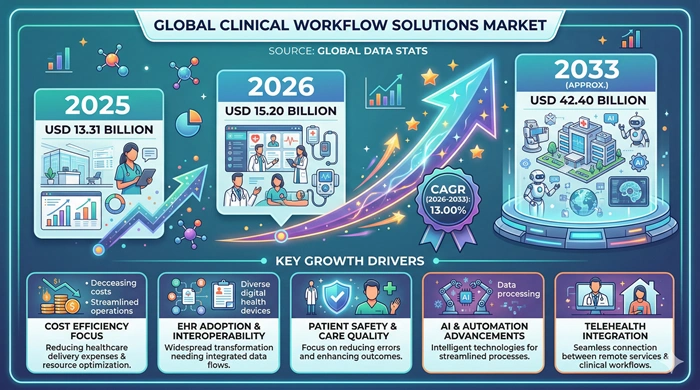
The global Clinical Workflow Solutions market size is valued at USD 13.31 billion in 2025 and is predicted to increase from USD 15.20 billion in 2026 to approximately USD 42.40 billion by 2033, growing at a CAGR of 13.00% from 2026 to 2033.
Clinical workflow solutions encompass a strategically critical category of digital health technologies — including real-time communication platforms, data integration systems, care collaboration tools, workflow automation software, and enterprise reporting and analytics solutions — that collectively streamline, automate, and intelligently optimize the complex sequence of clinical tasks, information exchanges, and care delivery processes that constitute modern patient care in hospital and ambulatory healthcare settings. These solutions directly address one of the most pressing operational challenges in contemporary healthcare — the growing complexity and fragmentation of clinical workflows that consumes excessive clinician time, generates costly inefficiencies, and contributes to care errors — by integrating digital tools that reduce administrative burden, improve care team communication, and deliver the right clinical information to the right care team member at the right moment. The Clinical Workflow Solutions market is experiencing strong and accelerating growth driven by the urgent need to address clinician burnout, the widespread adoption of electronic health records creating integration-ready infrastructure, growing regulatory requirements for clinical quality reporting, and the transformative application of artificial intelligence to healthcare workflow automation.
AI Impact on the Clinical Workflow Solutions Industry
Artificial Intelligence Is Transforming Clinical Documentation Automation, Intelligent Decision Support, Predictive Patient Flow Management, and NLP-Driven Care Coordination in Ways That Are Fundamentally Reshaping Healthcare Operational Efficiency and Clinician Experience*
Artificial intelligence is delivering its most immediate and commercially impactful contributions to the Clinical Workflow Solutions market through AI-powered clinical documentation assistance tools — most notably ambient clinical intelligence and natural language processing (NLP) platforms that automatically generate structured clinical notes, discharge summaries, and order sets from recorded physician-patient conversations. These tools dramatically reduce the documentation burden that consumes an estimated one to two hours of additional after-hours administrative time per physician per day and is widely identified as the leading contributor to physician burnout in modern healthcare systems. Companies such as Nuance Communications (Microsoft), Suki AI, Abridge, and Nabla are deploying generative AI and large language model technologies specifically optimized for clinical documentation workflows — with ambient AI documentation platforms achieving strong and rapidly growing adoption across physician practices, hospital medicine programs, and specialty care settings where documentation burden reduction is an urgent organizational priority. AI and machine learning models are also helping healthcare facilities predict patient admission rates, further optimizing hospital resource management and staff scheduling — capabilities that are becoming core differentiators of advanced clinical workflow platforms.
AI is also making increasingly meaningful contributions through predictive patient flow management, intelligent clinical decision support, and automated clinical task prioritization that collectively enable healthcare systems to operate more efficiently and safely even with constrained workforce resources. Machine learning models trained on historical patient flow data — including admission patterns, procedure scheduling, discharge timing, and bed management dynamics — are being deployed in hospital operations management platforms to predict patient census fluctuations, identify pending discharge readiness, optimize bed assignment decisions, and proactively alert care teams to patients at risk of deterioration before these situations become acute management crises. Advanced AI algorithms like NLP benefit clinical workflow solutions by assisting in clinical decision support, documentation automation, patient communication, and voice recognition — creating a comprehensive intelligent layer within the clinical workflow ecosystem that progressively improves care team productivity and patient safety outcomes simultaneously.
Growth Factors
Rising Demand for Big Data Analytics, Expanding EHR Adoption, Growing Need for Patient-Centered Care Delivery, and Rapid Healthcare Facility Expansion Are the Core Growth Drivers of the Clinical Workflow Solutions Market*
The most foundational and broadly applicable driver of the Clinical Workflow Solutions market is the rapidly growing demand for big data analytics in healthcare — where organizations managing exponentially growing volumes of clinical, operational, and administrative data are investing in integrated workflow solutions that can capture, process, and surface actionable insights from these data streams to improve care decisions and operational efficiency. As the patient base of healthcare organizations grows and they expand into new markets, the benefits of fully utilizing big data analytics through clinical workflow technologies — including predictive outcome modeling, population health management, and operational throughput optimization — are becoming increasingly recognized and actively pursued by healthcare leadership. The rising adoption of electronic health records has simultaneously created the digital data infrastructure that makes sophisticated clinical workflow solution deployment both technically feasible and operationally impactful — with EHR-integrated workflow tools deriving much of their value from deep integration with real-time clinical data streams that enable automated task triggers, decision support alerts, and care team communication workflows contextualized by current patient data.
The growing emphasis on patient-centered care delivery models — combined with the operational imperative to improve clinician productivity, reduce repetitive documentation tasks, and enhance interdepartmental communication — is creating sustained and structurally durable demand for clinical workflow solutions across hospitals and ambulatory care settings globally. Healthcare organizations are under simultaneous pressure from workforce retention challenges, quality reimbursement program performance requirements, patient satisfaction measurement programs, and competitive differentiation needs — all of which are meaningfully addressed by well-implemented clinical workflow solutions that improve care team communication, reduce administrative burden, and standardize evidence-based care delivery processes. The rapid expansion of healthcare facilities in emerging economies — particularly across Asia Pacific and Latin America — is simultaneously expanding the addressable market for clinical workflow solutions in new geographies where first-time digital health infrastructure investment is creating large cohorts of new technology adopters entering the market during the forecast period.
Market Outlook
With AI Documentation Assistance Achieving Mainstream Adoption, Cloud-Based Platform Migration Accelerating, Value-Based Care Models Expanding, and Healthcare Facility Digitization Growing Across Emerging Markets, the Clinical Workflow Solutions Market Outlook Is Exceptionally Strong Through 2033*
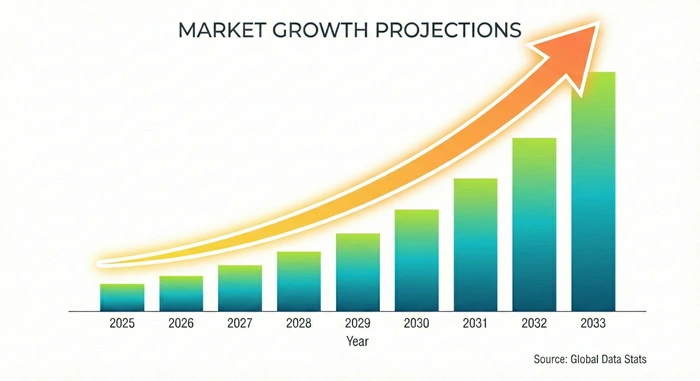
The long-term outlook for the Clinical Workflow Solutions market is firmly positive and supported by multiple converging structural, technological, and policy-driven growth catalysts expected to sustain strong double-digit revenue expansion throughout the 2026–2033 forecast period. The single most transformative commercial development reshaping the near-term market trajectory is the extraordinary speed and breadth of AI-powered clinical documentation assistance adoption — where the compelling physician time savings, documentation quality improvements, and burnout mitigation benefits demonstrated by ambient AI and natural language processing documentation platforms are driving adoption from early-innovator health systems into mainstream healthcare organizations at an exceptional pace. Investors are increasingly focused on clinical workflow platforms that show clear, measurable improvements in throughput, cost per case, and clinician time savings — with hot investment themes including interoperability middleware, AI-driven scheduling and capacity optimization, automation for prior authorizations, and clinical decision support that reduces unnecessary imaging and test ordering.
The sustainability dimension of clinical workflow investment is gaining increasing importance — with healthcare systems evaluating workflow technology investments not only on financial return metrics but also on workforce wellbeing, operational sustainability, and environmental impact criteria. Workflow digitization reduces paper use and unnecessary patient travel through telehealth integration — contributing to environmental sustainability goals — while workforce-focused workflow automation that eliminates low-value administrative tasks directly addresses the human sustainability concern of clinician burnout and turnover that represents one of the most costly operational challenges facing healthcare organizations today. The ongoing shift of clinical workflow solution deployment toward cloud-based and hybrid architectures is creating a favorable commercial trend — as cloud deployment enables lower upfront investment, faster deployment timelines, and access to continuous AI capability improvements through SaaS delivery models that are progressively becoming the preferred choice of healthcare IT decision makers globally.
Expert Speaks
-
Gianrico Farrugia, CEO, Mayo Clinic — "Intelligent clinical workflow technologies that reduce the administrative burden on our physicians and care teams — enabling them to spend more professional time on direct patient care and complex clinical problem-solving — are among the most strategically important investments Mayo Clinic is making in operational excellence and workforce wellbeing. The clinical productivity and care quality improvements that well-implemented workflow solutions deliver directly support our mission of providing the best care to every patient."
-
Kevin Tabb, CEO, Beth Israel Lahey Health — "We are seeing genuinely transformative results from our deployment of AI-powered clinical documentation and care coordination workflow solutions — with measurable reductions in physician documentation time, improved care team communication efficiency, and early positive indicators on physician satisfaction scores. The velocity of AI innovation in clinical workflow is accelerating faster than most health system leaders anticipated, and staying current with the best available tools is becoming a competitive imperative."
-
Marc Harrison, CEO, Intermountain Health — "Clinical workflow optimization through intelligent technology is not simply an operational efficiency initiative at Intermountain — it is a fundamental patient safety and care quality strategy, because fragmented and poorly designed clinical workflows are directly implicated in care errors and suboptimal patient outcomes. The investment case for comprehensive clinical workflow solution deployment has never been stronger, given the simultaneous pressure from workforce constraints, quality reporting requirements, and value-based care program performance expectations."
Key Report Takeaways
-
North America dominates the Clinical Workflow Solutions market, holding more than 41.55% of global revenue share in 2025, driven by near-universal EHR adoption providing the integration foundation for workflow solutions, the highest per-capita healthcare IT investment globally, the most urgent clinician burnout workforce crisis creating strong organizational demand for administrative burden reduction tools, and the concentration of leading clinical workflow solution vendors including Epic Systems, Oracle Health (Cerner), and Nuance Communications in the region.
-
Asia Pacific is the fastest-growing regional market, projected to expand at a CAGR of approximately 14.00% from 2026 to 2033, driven by rapidly expanding healthcare IT infrastructure investment across China, India, Japan, and South Korea, progressive government-mandated healthcare digitization programs, growing EHR adoption creating workflow solution integration foundations, and strong government support for medical tourism, e-health initiatives, and high-quality healthcare infrastructure development.
-
Data integration solutions are the dominant type segment, accounting for more than 26.40% of total market revenue in 2025, reflecting the critical healthcare need for integration systems that enable access to patient information across the care continuum — driven by regulatory reforms, interoperability requirements, rising EMR adoption, and the shift toward value-based care services that demand seamless cross-system data connectivity.
-
Hospitals represent the largest end-user segment, contributing approximately 46.00% of total market revenue in 2025, driven by the rising number of healthcare facilities requiring effective data management and privacy solutions, supportive government initiatives to enhance data handling in healthcare sectors, the trend toward connected hospital ecosystems, and the growing demand for unified critical clinical communications and streamlined call scheduling processes.
-
Care collaboration solutions are experiencing significant demand acceleration, driven by the increased emphasis on patient-centric services and the rising global patient population that is influencing market players to develop more effective and efficient workflow methodologies that improve patient care while saving both cost and time for healthcare organizations of all sizes.
-
Ambulatory care centers are the fastest-growing end-user segment, expected to register the highest growth through 2033, driven by a spike in outpatient admissions, the integration of IT-based solutions that notably reduce medical errors, and the enhanced communication these platforms enable among pharmacies, physicians, nursing staff, and patient families — making workflow solutions in ambulatory settings both clinically impactful and commercially compelling.
Market Scope
| Report Coverage | Details |
|---|---|
| Market Size by 2033 | USD 42.40 Billion |
| Market Size by 2025 | USD 13.31 Billion |
| Market Size by 2026 | USD 15.20 Billion |
| Market Growth Rate (2026–2033) | CAGR of 13.00% |
| Dominating Region | North America |
| Fastest Growing Region | Asia Pacific |
| Base Year | 2025 |
| Forecast Period | 2026–2033 |
| Segments Covered | Type, End User |
| Regions Covered | North America, Europe, Asia Pacific, Latin America, Middle East & Africa |
Market Dynamics
Drivers Impact Analysis
Surging Big Data Analytics Demand, Rising EHR Adoption, Patient-Centered Care Emphasis, and Rapid Expansion of Healthcare Facilities in Emerging Markets Are the Four Pillars Powering Clinical Workflow Solutions Market Growth*
| Driver | ≈ % Impact on CAGR Forecast | Geographic Relevance | Impact Timeline |
|---|---|---|---|
| Surge in demand for big data analytics in healthcare operations | ~34% | Global | Short to Long-term |
| Rising EHR adoption creating integration-ready workflow deployment foundations | ~28% | North America, Europe, Asia Pacific | Short to Long-term |
| Growing need to eliminate repetitive documentation tasks and improve clinician productivity | ~26% | North America, Europe | Short to Medium-term |
| Rapid expansion of healthcare facilities in emerging economies | ~12% | Asia Pacific, Latin America, MEA | Medium to Long-term |
The most enduring and commercially significant driver of the Clinical Workflow Solutions market is the rapidly growing organizational recognition that effective big data management — through integrated clinical workflow platforms — is a strategic operational necessity rather than an optional technology investment for healthcare organizations managing exponentially growing patient data volumes. As healthcare organizations grow their patient bases and expand into new markets, the challenge of integrating vast amounts of data from multiple internal and external sources to gain meaningful clinical and operational insights becomes progressively more acute — creating a powerful and self-reinforcing demand dynamic for clinical workflow solutions that can manage, process, and surface actionable intelligence from these complex data environments. The transition toward value-based care and quality-linked reimbursement frameworks further intensifies this data management imperative — as healthcare organizations must systematically capture, report, and act on clinical quality metrics that require the real-time data integration and workflow-embedded analytics capabilities that only well-implemented clinical workflow solutions can consistently deliver.
The elimination of repetitive administrative tasks — particularly the documentation burden that consumes an estimated one to two hours of physician time daily in EHR-heavy healthcare environments — represents one of the most practically impactful and organizationally prioritized drivers of clinical workflow solution adoption in North American and European healthcare markets. Healthcare organizations that have deployed comprehensive clinical workflow automation — including AI-powered documentation assistance, intelligent alert management, and automated administrative task processing — consistently report measurable improvements in clinician satisfaction, documentation quality, and workflow efficiency that build compelling return-on-investment evidence used to justify further technology investment across peer healthcare organizations. The growing body of real-world outcome data demonstrating the clinical and operational benefits of workflow solution deployment is accelerating adoption velocity in the Clinical Workflow Solutions market — creating a positive feedback loop between deployment evidence, organizational confidence, and investment commitment that is sustaining the market's strong double-digit growth trajectory.
Restraints Impact Analysis
Lack of Workforce Expertise, High Implementation Complexity, Interoperability Limitations, and Cybersecurity Compliance Burdens Are the Primary Restraints Limiting Faster Clinical Workflow Solutions Market Growth*
| Restraint | ≈ % Impact on CAGR Forecast | Geographic Relevance | Impact Timeline |
|---|---|---|---|
| Lack of expertise and trained professionals limiting effective technology adoption | ~35% | Global — developing markets especially | Short to Long-term |
| High implementation complexity and clinical change management challenges | ~27% | Global | Short to Long-term |
| Interoperability limitations restricting deep cross-system workflow integration | ~26% | Global | Short to Medium-term |
| Healthcare cybersecurity compliance requirements increasing IT cost and complexity | ~12% | North America, Europe | Short to Long-term |
The most broadly experienced and impactful restraint on the Clinical Workflow Solutions market is the critical shortage of qualified healthcare IT professionals capable of effectively implementing, configuring, and optimizing clinical workflow technology systems in active healthcare environments. The demand for healthcare IT specialists is significantly exceeding supply — not just in developing nations but also in developed markets including the United States and Europe — creating a persistent talent gap that slows deployment timelines, compromises implementation quality, and limits the operational benefits organizations can extract from their clinical workflow solution investments. Healthcare organizations and vendors are finding it increasingly challenging to attract and retain competent personnel as the number of healthcare IT initiatives grows — with this workforce shortage representing a structural market constraint that cannot be resolved quickly through traditional training and recruitment approaches alone.
The absence of skilled professionals is compounded by the inherent complexity of clinical workflow change management — where successful technology adoption requires not just effective software deployment but deep clinical process redesign, care team engagement, workflow configuration that accurately reflects actual clinical operations, and sustained post-implementation optimization support that many health system IT teams lack the internal capacity to provide independently. Many clinical workflow solution deployments fail to achieve their intended clinical productivity improvements not because of technology limitations but because of inadequate organizational change management investment — a pattern that generates cautionary narratives within the healthcare industry that can slow adoption among risk-averse healthcare leadership. Vendors and healthcare systems that invest seriously in implementation methodology, clinical champion engagement, and ongoing optimization support consistently achieve superior adoption outcomes — but building this implementation excellence capability across the broader market ecosystem remains a work in progress.
Opportunities Impact Analysis
Clinical Workflow Solution Benefits Expanding to New Use Cases, Cloud-First Platform Migration, Emerging Market Healthcare Digitization, and Sustainable Workflow Ecosystem Development Create Compelling Market Opportunities*
| Opportunity | ≈ % Impact on CAGR Forecast | Geographic Relevance | Impact Timeline |
|---|---|---|---|
| Expanding clinical workflow solution benefits driving new patient safety and care quality use cases | ~34% | North America, Europe | Short to Medium-term |
| Cloud-first workflow platform adoption enabling SaaS subscription revenue model transition | ~28% | Global | Short to Medium-term |
| Emerging market healthcare digitization creating large first-time adoption populations | ~26% | Asia Pacific, Latin America, MEA | Medium to Long-term |
| Sustainable workflow ecosystem development combining vendor platforms and hospital process teams | ~12% | Global | Medium to Long-term |
Healthcare businesses seeking impactful ways to improve patient outcomes and safety are increasingly turning to clinical workflow solutions — driven by the recognition that these platforms enable the continuous flow of real-time health data resulting in better-informed care decisions and meaningfully improved patient results. Clinical workflow solutions provide capabilities that enhance care quality, care coordination, and overall patient satisfaction while reducing medication errors and adverse drug events — and as real-world outcome evidence demonstrating these benefits accumulates and becomes more widely disseminated, the organizational adoption rationale becomes progressively stronger and more broadly compelling for healthcare leadership. This expanding evidence base is driving the Clinical Workflow Solutions market into new application areas — including perioperative workflow optimization, emergency department patient flow management, home care coordination, and virtual care integration — that extend the addressable market well beyond traditional inpatient hospital workflow management into the full continuum of healthcare delivery.
Sustainable clinical workflow ecosystems — combining vendor platforms, hospital process-improvement teams, clinician champions, and implementation partners — represent an increasingly important and commercially compelling model for ensuring that technology deployments generate durable operational improvements rather than one-time productivity gains that erode over time. Startups succeeding by solving single high-value pain points — such as OR turn-time optimization, e-prescription reconciliation, or discharge-planning automation — and then integrating into broader clinical workflow stacks are creating a rich and expanding innovation ecosystem that continuously generates new use case solutions and commercial market opportunities. Accelerators tied to health systems, outcome-based pilot funding, and shared testbeds are enabling workflow technology startups to validate clinical efficacy and commercial viability more efficiently — accelerating the pipeline of validated workflow innovations entering the broader market and sustaining the innovation diversity that keeps the clinical workflow solutions ecosystem commercially dynamic throughout the forecast period.
Segment Analysis
By Type
Data Integration Solutions Lead the Clinical Workflow Solutions Market by Type While Care Collaboration Solutions Register the Strongest Demand Growth Momentum*
Data integration solutions hold the dominant position within the type segment of the Clinical Workflow Solutions market, accounting for more than 26.40% of total global market revenue in 2025. Data integration systems are prominently preferred by healthcare service providers due to the critical need for integration solutions that curb rising costs while managing increasing clinical data volumes — with hospitals and caregivers actively adopting integrated systems that enable access to patient information throughout the entire course of care. Regulatory reforms and requirements, interoperability solutions, the raised adoption of electronic medical records, and the shifting focus toward value-based services have collectively propelled the growth of this segment to its dominant market position. North America leads data integration solution revenue globally — driven by the world's most advanced EHR ecosystem, the most demanding interoperability regulatory requirements including FHIR API mandates, and the highest concentration of multi-EHR health systems requiring sophisticated data integration infrastructure to achieve unified patient data views across their enterprise. Leading vendors dominating this segment include InterSystems Corporation, Epic Systems, Oracle Health, and Mirth Corporation — each offering specialized data integration middleware and EMR integration platforms with broad clinical customer adoption.
Care collaboration solutions have gained significant traction in the Clinical Workflow Solutions market in recent years and are expected to exhibit escalating demand throughout the forecast period. This growth is attributed to the increased emphasis on patient-centric services and the rising global patient population that is influencing market players to develop more effective workflow methodologies that improve both care quality and operational efficiency simultaneously. Care management solutions provide effective workflow methodologies that save both cost and time while meaningfully improving patient outcomes — with Asia Pacific emerging as the fastest-growing region for care collaboration solution adoption, driven by rapidly expanding patient populations in China and India that are making it challenging for healthcare facilities to manage care coordination efficiently without technology support. Companies including TigerConnect, PerfectServe, Vocera (Stryker), and Halo Health are leading care collaboration platform growth across North American and Asia Pacific markets — with their secure clinical communication and real-time care team coordination capabilities generating strong adoption momentum among hospitals seeking to address care fragmentation and communication inefficiency challenges.
By End User
Hospitals Dominate the Clinical Workflow Solutions Market End-User Revenue While Ambulatory Care Centers Register the Fastest Adoption Growth*
Hospitals occupy the maximum Clinical Workflow Solutions market value share of 46.00% in 2025, driven by the rising number of healthcare facilities with associated data management and privacy requirements that demand comprehensive workflow technology solutions. Supportive government initiatives undertaken across multiple regions to simplify and enhance data handling capacity in the healthcare sector are reinforcing hospital workflow solution adoption — with statistics indicating that more than 60% of hospitals have adopted EHR technology, creating the integration-ready infrastructure for advanced workflow solution deployment. The ongoing trend toward connected hospitals and effective management solutions — including unified critical clinical communications, integrated and collaborative care delivery, and streamlined processes for call scheduling — are key factors contributing to hospitals' dominant revenue share in the Clinical Workflow Solutions market. North America leads hospital-segment revenue globally — driven by the highest hospital technology investment levels, most advanced EHR integration infrastructure, and the most acute clinician burnout workforce urgency that is generating strong executive commitment to workflow automation investment — with leading health system customers of Epic, Oracle Health, and Vocera representing the most commercially significant hospital workflow solution accounts.
Ambulatory care centers are predicted to register the highest growth in the Clinical Workflow Solutions market over the forecast period — driven primarily by a significant spike in outpatient admissions in health centers that is creating acute workflow management challenges for ambulatory providers seeking to serve growing patient volumes efficiently with constrained clinical staff resources. Integration of IT-based workflow solutions in ambulatory care centers notably reduces medical errors and meaningfully enhances communication among pharmacies, physicians, nursing staff, and patient families — delivering clinical quality and patient safety benefits that are progressively well-documented and broadly recognized in the ambulatory care industry. Asia Pacific is the fastest-growing region for ambulatory care workflow solution adoption — driven by the rapid growth of outpatient care delivery infrastructure in China, India, and Southeast Asia, where government investment in expanding access to ambulatory healthcare services is simultaneously creating growing first-time adoption opportunities for workflow solution vendors. Companies including Allscripts, athenahealth (Athenahealth), and Greenway Health are among the leading vendors serving the ambulatory care workflow solution segment with purpose-built platforms optimized for outpatient clinical workflow management requirements.
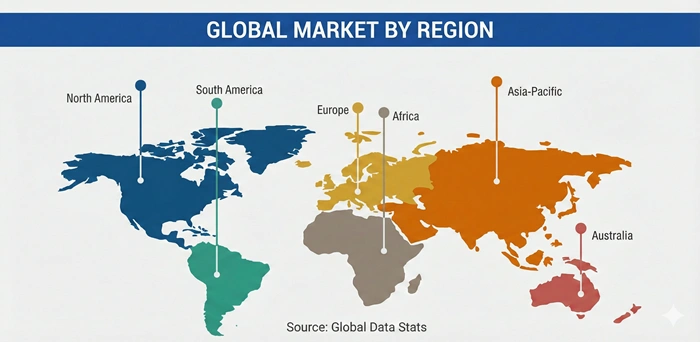
Regional Insights
North America
North America Leads the Global Clinical Workflow Solutions Market With Universal EHR Adoption, the Strongest Clinician Burnout Workforce Urgency, Highest Healthcare IT Investment, and the World's Most Advanced AI Documentation Tool Ecosystem*
North America holds the dominant position in the global Clinical Workflow Solutions market, accounting for more than 41.55% of total global market revenue in 2025, and is projected to maintain steady market leadership throughout the forecast period. The United States is the overwhelmingly primary commercial driver — where near-universal EHR adoption, the most acute and organizationally recognized clinician burnout workforce crisis, the highest per-capita healthcare IT investment globally, and the world's most commercially advanced AI clinical documentation platform ecosystem collectively create the most developed and commercially productive environment for clinical workflow solution adoption anywhere in the world. The increasing number of research and development activities on healthcare solutions — combined with the rising number of patient admissions in hospitals that continuously increases the volume of data generated — is expected to further impel market growth in this region throughout the forecast period. Leading companies dominating the North American Clinical Workflow Solutions market include Epic Systems, Oracle Health (Cerner), Nuance Communications (Microsoft), Cisco, Vocera Communications (Stryker), and Ascom — each maintaining strong installed base advantages among large U.S. health system customers.
Canada contributes meaningfully to North American market revenue through its provincial health system digital health modernization programs and growing clinical communication platform adoption — particularly as Canadian health systems address care coordination and physician documentation efficiency challenges that parallel those driving U.S. market demand. The rising number of trauma-related incidents leading to increased emergency ward patient volumes is boosting demand for care collaboration solutions in North America — while government policy support for clinical workflow solution adoption across healthcare facilities in both the United States and Canada continues to strengthen the regional market's commercial foundation. The North American Clinical Workflow Solutions market outlook through 2033 is strongly positive — reinforced by the AI documentation tool adoption wave, the cloud-based platform migration trend, and the expanding value-based care program ecosystem that consistently generates new workflow-integrated quality management tool requirements for healthcare organizations across the region.
Asia Pacific
Asia Pacific Is the Fastest-Growing Clinical Workflow Solutions Market, Driven by Rapid Healthcare IT Demand Growth, Government e-Health Investment, Medical Tourism Support Programs, and Expanding Healthcare Infrastructure Across China, India, Japan, and South Korea*
Asia Pacific is the fastest-growing regional segment in the Clinical Workflow Solutions market, projected to expand at a CAGR of approximately 14.00% from 2026 to 2033 — the highest of any region globally. The region registered a prominent surge in demand for healthcare IT solutions driven by government support for increasing medical tourism, implementing e-health initiatives, high demand for quality healthcare, and improving healthcare infrastructure that collectively create a large and rapidly growing addressable market for clinical workflow solutions across the region's diverse health systems. Rising consumer disposable income is increasing healthcare expenditure — and the rapidly growing patient populations in countries like India and China are significantly expanding the patient pool, making it increasingly challenging for healthcare facilities to manage care coordination efficiently without comprehensive workflow technology support. Key companies active in the Asia Pacific Clinical Workflow Solutions market include Philips Healthcare, Allscripts, Zebra Technologies, and rapidly growing domestic healthcare IT companies in China including Neusoft Corporation and Winning Health Technology Group — all of which are experiencing strong revenue growth as regional healthcare digitization investment accelerates.
Governments of Asian countries are investing heavily in expanding healthcare facilities in rural areas — and the increasing digitization across the region is driving high adoption of advanced technologies in the healthcare sector that is boosting clinical workflow solution market growth across both urban and emerging market segments. Japan and South Korea represent mature and technically sophisticated Asia Pacific clinical workflow markets — with advanced hospital information technology infrastructure, strong adoption of clinical communication tools, and growing healthcare system interest in AI-powered clinical documentation assistance platforms. Southeast Asian markets — including Singapore, Thailand, Malaysia, and Vietnam — are experiencing accelerating first-time clinical workflow solution adoption driven by progressive healthcare system digitization investment and the expansion of quality-accredited private hospital networks implementing international best-practice clinical information management standards. The breadth and demographic scale of Asia Pacific's healthcare digital transformation opportunity positions the region as the most commercially dynamic and fastest-expanding regional frontier in the global Clinical Workflow Solutions market through 2033.
Top Key Players
-
Epic Systems Corporation (United States)
-
Oracle Health — Cerner Corporation (United States)
-
Nuance Communications — Microsoft Corporation (United States)
-
Cisco Systems Inc. (United States)
-
Ascom Holding AG (Switzerland)
-
Vocera Communications — Stryker Corporation (United States)
-
Koninklijke Philips N.V. (Netherlands)
-
McKesson Corporation (United States)
-
Hill-Rom Services Inc. — Baxter International (United States)
-
Allscripts Healthcare Solutions Inc. (United States)
-
athenahealth Inc. (United States)
-
Stanly Healthcare (United States)
Recent Developments
-
Wipro GE Healthcare and AIIMS (December 2024) — The All India Institute of Medical Sciences (AIIMS) signed a Memorandum of Understanding with Wipro GE Healthcare — under which Wipro GE Healthcare will focus on the development of intelligent systems and clinical workflow solutions tailored to identified priority areas in healthcare — representing a significant strategic partnership milestone that reinforces the growing momentum of clinical workflow solution adoption in India's premier academic medical institutions and signals broader public health system commitment to healthcare digitization investment in Asia Pacific.
-
Royal Philips and Amazon Web Services (March 2024) — Royal Philips collaborated with Amazon Web Services (AWS) to address the growing need for secure and scalable digital pathology solutions in the cloud — building cloud-native enterprise pathology workflow solutions on AWS Health Imaging and Amazon Bedrock services — creating a powerful combined clinical workflow and cloud infrastructure offering that delivers both clinical workflow leadership and scalable cloud architecture to healthcare organizations seeking comprehensive digital pathology and workflow management capabilities.
-
Emtelligent Clinical Workflow Launch (October 2024) — Emtelligent, a leading company in clinical-grade medical AI software development, announced the launch of its emtelligent Clinical Workflow — an AI-driven clinical review tool that transforms the way healthcare professionals review medical records — combining advanced natural language processing with clinical workflow management capabilities to enable faster, more accurate, and more efficient medical record review that significantly reduces the time burden on clinical documentation review and compliance processes.
-
Epic Systems (2025) — Launched an enhanced AI-powered clinical workflow suite incorporating new generative AI capabilities across multiple workflow categories — including automated prior authorization letter drafting, AI-assisted after-visit summary generation, intelligent inbox message triage and response drafting for physician in-basket management, and predictive patient deterioration scoring integrated with real-time nursing workflow notification tools — extending Epic's dominant position as the most comprehensive integrated clinical workflow solution platform globally.
-
TigerConnect (2025) — Announced the strategic acquisition of a leading physician scheduling and care team management platform — adding automated on-call scheduling, role-based care team roster management, and intelligent call routing capabilities to TigerConnect's clinical communication platform — creating a significantly more comprehensive care coordination solution that addresses the full clinical communication lifecycle from team scheduling through secure messaging and patient status notification, meaningfully expanding TigerConnect's addressable market and deepening its competitive differentiation.
Market Trends
The AI-Powered Ambient Clinical Documentation Revolution and the Progressive Enterprise Consolidation of Clinical Workflow Point Solutions Into Integrated Intelligent Platform Architectures Are the Two Most Defining Trends Reshaping the Clinical Workflow Solutions Market*
The most immediately transformative and commercially significant trend reshaping the Clinical Workflow Solutions market is the rapid mainstream adoption of AI-powered ambient clinical documentation — where large language model and generative AI platforms automatically generate high-quality structured clinical notes from recorded physician-patient conversations, reducing documentation time by an estimated one to two hours per physician per day. The adoption velocity of these ambient documentation tools has exceeded most industry forecasts — driven by the exceptional clarity of the physician time savings and burnout reduction value proposition, the improving accuracy and specialty coverage of leading platforms from vendors including Nuance (Microsoft DAX), Suki, and Abridge, and the growing body of real-world deployment outcome evidence that clinical informatics leaders are using to build organizational investment approval cases. As ambient documentation AI achieves mainstream deployment across hospitals and physician practices, it is progressively becoming a foundational expectation of the clinical workflow solution stack — driving platform consolidation around vendors offering compelling AI documentation alongside broader care coordination, decision support, and workflow automation capabilities.
The second defining trend reshaping the clinical workflow solutions landscape is the progressive healthcare system preference for integrated enterprise clinical workflow platforms — delivered through cloud-based subscription architectures — over fragmented collections of disconnected point solutions that have historically characterized health IT environments. Healthcare IT leadership is increasingly recognizing that genuine workflow efficiency gains are achievable only when communication, documentation, decision support, and operational management tools are seamlessly connected within unified workflow architectures — rather than requiring care teams to navigate multiple disconnected systems with separate logins, interfaces, and notification streams that create their own workflow friction. This integration preference is driving health system procurement consolidation toward comprehensive platform vendors including Epic, Oracle Health, and integrated clinical communication platforms — while simultaneously creating pressure on standalone point solution vendors to demonstrate deep platform integration capabilities and clear workflow ecosystem fit that justify continued adoption alongside dominant EHR platform workflow modules in the rapidly maturing Clinical Workflow Solutions market.
Segments Covered in the Report
By Type:
-
Real-Time Communication Solutions
-
Unified Communication
-
Nurse Call Alert Systems
-
Data Integration Solutions
-
Medical Image Integration
-
EMR Integration
-
Workflow Automation Solutions
-
Nursing and Staff Scheduling Solutions
-
Patient Flow Management Solutions
-
Enterprise Reporting and Analytics Solutions
-
Care Collaboration Solutions
-
Rounding Solutions
-
Perinatal Care Management
-
Medication Administration
-
Other Care Collaboration Solutions
By End User:
-
Hospitals
-
Ambulatory Care Centers
-
Long-Term Care Facilities
By Region:
-
North America
-
U.S.
-
Canada
-
Europe
-
U.K.
-
Germany
-
France
-
Asia Pacific
-
China
-
India
-
Japan
-
South Korea
-
Latin America
-
Middle East & Africa
Frequently Asked Questions
Question 1: What is the current size of the Clinical Workflow Solutions market and what is its projected value by 2033?
Answer: The Clinical Workflow Solutions market was valued at USD 13.31 billion in 2025 and is projected to reach USD 42.40 billion by 2033. It is expected to grow at a CAGR of 13.00% from 2026 to 2033, driven by rising demand for big data analytics, EHR adoption expansion, growing need to eliminate repetitive clinical documentation tasks, and rapid healthcare facility expansion in emerging economies.
Question 2: Which type segment leads the Clinical Workflow Solutions market?
Answer: Data integration solutions dominate the Clinical Workflow Solutions market with more than 26.40% of total market revenue in 2025 — driven by the healthcare industry's critical need for integration systems that manage rising data volumes, support regulatory interoperability requirements, and enable seamless patient information access across the care continuum. Care collaboration solutions are the fastest-growing type segment, driven by increasing emphasis on patient-centric care delivery and the rising global patient population that is creating growing demand for effective care team coordination platforms.
Question 3: Which region dominates the Clinical Workflow Solutions market and which is the fastest growing?
Answer: North America dominates the Clinical Workflow Solutions market with more than 41.55% of global revenue in 2025, driven by near-universal EHR adoption, the most acute clinician burnout workforce urgency, the highest healthcare IT investment levels, and the world's most advanced AI clinical documentation platform ecosystem. Asia Pacific is the fastest-growing region at approximately 14.00% CAGR through 2033, driven by surging healthcare IT demand, government e-health and medical tourism support programs, rapidly expanding healthcare infrastructure, and rising patient populations in China and India.
Question 4: What are the key challenges affecting adoption in the Clinical Workflow Solutions market?
Answer: The most significant challenge in the Clinical Workflow Solutions market is the critical shortage of qualified healthcare IT professionals capable of effectively implementing and optimizing clinical workflow technology systems — with demand for healthcare IT specialists significantly exceeding supply in both developing and developed markets. High implementation complexity, clinical workflow change management demands, interoperability limitations between different health IT systems, and growing cybersecurity compliance requirements collectively create additional adoption barriers that are slowing the deployment pace of clinical workflow solutions relative to the demonstrated value these technologies can deliver.
Question 5: How are hospitals benefiting from clinical workflow solutions today?
Answer: Hospitals — the largest end-user segment with approximately 46.00% of the Clinical Workflow Solutions market revenue — are benefiting from unified critical clinical communications, integrated care delivery coordination, streamlined call scheduling processes, and comprehensive data management platforms that collectively reduce administrative burden, improve care team efficiency, and enhance patient safety outcomes. The rising adoption of connected hospital workflows and government initiatives supporting healthcare data management standardization are reinforcing hospital investment in clinical workflow solutions — creating a continuously expanding installed base that generates growing recurring software and services revenue for leading clinical workflow solution vendors globally.