
Chatbot Market Overview
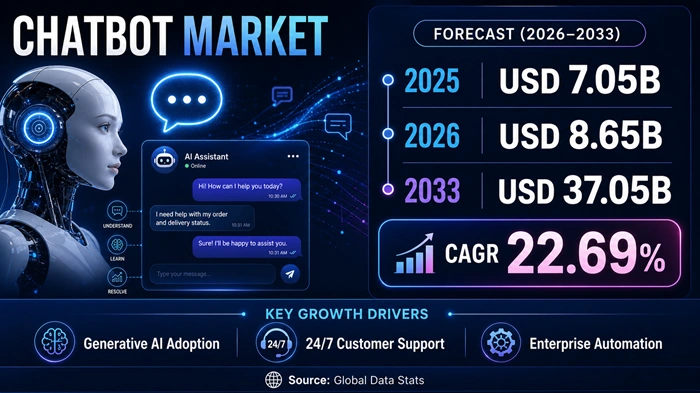
The global chatbot market size is valued at USD 7.05 billion in 2025 and is predicted to increase from USD 8.65 billion in 2026 to approximately USD 37.05 billion by 2033, growing at a CAGR of 22.69% from 2026 to 2033.
The chatbot market encompasses artificial intelligence-powered conversational interfaces and automated messaging systems designed to interact with users through natural language processing, providing customer support, sales assistance, information retrieval, and transaction processing across diverse industries.
Rising demand for 24/7 customer service availability, accelerating digital transformation initiatives, and growing adoption of artificial intelligence technologies drive substantial market expansion worldwide. Organizations increasingly recognize that chatbot solutions deliver superior cost savings, enhanced customer engagement, and improved operational efficiency compared to traditional human-only customer service models requiring extensive staffing. The market benefits from technological advancements including large language models, generative AI capabilities, multimodal interfaces, multilingual support, and seamless integration with enterprise systems that transform chatbots from simple query responders to intelligent business assistants.
AI Impact on the Chatbot Industry
Advanced Language Models and Generative AI Transform Conversational Capabilities
Artificial intelligence advancements, particularly large language models and generative AI technologies, are fundamentally revolutionizing the chatbot market by enabling human-like conversations, contextual understanding, and autonomous task execution that dramatically exceed capabilities of earlier rule-based systems. Modern AI-powered chatbots leverage natural language processing to comprehend user intent, maintain conversation context across multiple interactions, adapt communication tone automatically, and generate nuanced responses addressing complex queries without rigid pre-programmed scripts. ChatGPT's dominance with 48.36% market share and over 46.59 billion annual web visits demonstrates consumer and enterprise preference for advanced conversational AI delivering superior user experiences through intelligent, adaptive interactions. Machine learning algorithms continuously improve chatbot performance by analyzing interaction patterns, identifying successful conversation flows, detecting sentiment shifts, and optimizing responses based on user feedback and behavioral data.
The integration of generative AI transforms chatbots from reactive information providers into proactive business tools capable of creating content, summarizing documents, drafting communications, analyzing data, and making recommendations that augment human capabilities. Advanced chatbots in 2025 execute autonomous tasks including appointment booking, payment processing, account updates, ticket filing, and HR query management without human intervention, substantially reducing operational workload. Multimodal capabilities incorporating voice recognition, image understanding, and video interaction expand chatbot utility beyond text-based messaging into comprehensive omnichannel experiences. Furthermore, real-time personalization leveraging CRM integration, user history analysis, and behavioral insights enables chatbots to deliver tailored responses, product recommendations, and problem resolutions matching individual customer contexts and preferences.
Growth Factors
Customer Service Automation and Cost Reduction Drive Market Expansion
The urgent need for cost-effective customer service solutions delivering 24/7 availability represents the primary driver propelling chatbot market growth as businesses seek alternatives to expensive human agent staffing while meeting consumer expectations for instant support. Chatbot implementations reduce customer service costs by 30% to 70% compared to traditional call centers by automating routine inquiries, frequently asked questions, order tracking, and basic troubleshooting without requiring human intervention. Organizations project substantial savings with Juniper Research estimating that businesses could save more than USD 11 billion annually by 2025 through chatbot automation, while analysts predict 80% of customer interactions will be AI-handled by 2030. Small and medium enterprises particularly benefit from chatbot adoption as automated support eliminates the need for large customer service teams, enabling resource-constrained organizations to deliver professional customer experiences at affordable costs.
The explosive growth of messaging platforms, mobile commerce, and digital communication channels creates substantial demand for chatbot deployment where consumers already congregate. WhatsApp, Facebook Messenger, WeChat, and other messaging apps collectively serve billions of users worldwide, providing ready-made distribution channels for chatbot services reaching massive audiences without requiring separate application downloads. The chatbot market benefits from generational shifts as younger consumers demonstrate strong preferences for self-service digital interactions over traditional phone support, with surveys indicating increased comfort using chatbots for shopping, customer service, and information retrieval. E-commerce expansion drives chatbot adoption for applications including product recommendations, purchase assistance, order tracking, abandoned cart recovery, and personalized promotions that increase conversion rates and customer lifetime value. Additionally, digital transformation initiatives accelerate as 85% of customer service leaders plan to explore or pilot conversational generative AI solutions in 2025, reflecting mainstream recognition of chatbot value across industries.
Market Outlook
Enterprise Integration and Industry-Specific Solutions Sustain Growth Momentum
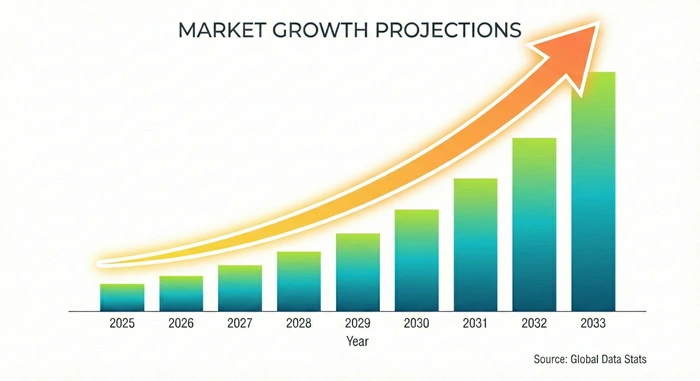
The chatbot market outlook remains exceptionally positive as converging trends including generative AI maturity, natural language processing advancement, cloud computing proliferation, and mobile device ubiquity create opportunities for sophisticated conversational applications. Market participants continue investing heavily in research and development to enhance chatbot capabilities through improved contextual understanding, expanded language support, voice interaction, visual recognition, and seamless integration with enterprise resource planning, customer relationship management, and business intelligence platforms. Strategic partnerships between chatbot providers, cloud infrastructure platforms, messaging applications, and industry solution vendors accelerate market penetration through combined offerings, complementary capabilities, and expanded distribution channels. Acquisitions including Laiye's purchase of Mindsay demonstrate industry consolidation as leading players acquire specialized technologies, expand geographic presence, and strengthen competitive positions.
Industry-specific chatbot development addressing vertical market requirements in healthcare, banking, retail, travel, and government creates substantial opportunities as specialized solutions deliver superior value compared to generic platforms. Healthcare chatbots provide symptom checking, appointment scheduling, medication reminders, and patient education addressing sector-specific workflows and regulatory requirements. Financial services institutions deploy chatbots for balance inquiries, transaction processing, fraud detection, investment guidance, and customer onboarding supporting banking operations while ensuring security and compliance. Retail and e-commerce chatbots deliver personalized shopping assistance, product discovery, purchase completion, and post-sale support driving revenue growth through enhanced customer experiences. Industry analysts project sustained market expansion throughout the forecast period with particularly robust growth anticipated in Asia Pacific where the region is expected to register 24.71% CAGR driven by large user bases, mobile commerce adoption, and government AI programs.
Expert Speaks
-
Gartner research senior principal Kim Hedlin emphasized that more than 75% of customer service and support leaders feel pressure from executive leadership to implement generative AI, noting that the customer service function has evolved from historically people-and-process driven into a technology-focused operation with growing influence over AI initiatives, as 47% of respondents indicate their organizations are primarily responsible for identifying new AI opportunities compared to just 19% viewing this as IT's role.
-
Industry analysts at Gartner reported that 85% of customer service and support leaders plan to explore or pilot conversational generative AI solutions in 2025, with 64% dedicating more time to learning about technology, reflecting mainstream recognition of AI chatbot value, though barriers remain as 61% of organizations report backlogs in editing knowledge articles and over one-third lack formal processes for revising outdated materials that may hinder smooth AI deployment.
-
Market research from conversational AI studies highlighted that chatbots in 2025 remember past interactions, adjust tone automatically, follow natural conversation flow, and execute autonomous tasks including booking appointments, processing payments, updating accounts, generating summaries, managing HR queries, and filing support tickets, delivering better customer satisfaction, lower costs, and scalable operations supporting the next phase of conversational AI becoming central to business operations.
Key Report Takeaways
-
North America leads the global chatbot market with more than 47% regional share, driven by robust technological infrastructure particularly in the United States with extensive network connectivity, widespread smartphone access, and strong adoption as surveys show 16% of North Americans use voice assistant platforms like Alexa or Google Home for shopping while 27% of adults have utilized AI conversation entities for purchasing.
-
Asia Pacific represents the fastest-growing regional market, expected to register exceptional CAGR of 24.71% through 2031, fueled by large user bases, mobile commerce adoption, government AI programs, and digital transformation initiatives across emerging economies.
-
AI-powered chatbots dominate market demand significantly outperforming rule-based alternatives as organizations recognize that natural language processing-enabled systems deliver superior customer experiences through contextual understanding, adaptive responses, and continuous learning capabilities compared to rigid pattern-matching approaches.
-
Customer service applications represent the largest use case segment, driving demand as organizations implement chatbots for 24/7 support availability, routine inquiry automation, first-contact resolution, and agent workload reduction delivering 30% to 70% cost savings compared to traditional human-only service models.
-
Cloud-based deployment maintains dominant position as subscription software-as-a-service models offer advantages including rapid deployment, automatic updates, elastic scalability, and lower upfront costs compared to on-premise installations requiring substantial infrastructure investments and internal IT resources.
-
The generative AI chatbot segment demonstrates explosive growth with market valuations reaching USD 9.9 billion in 2025 projected to expand to USD 113.35 billion by 2034, reflecting transformational impact of large language models enabling sophisticated conversational capabilities previously impossible with traditional approaches.
Market Scope
| Report Coverage Details | |
|---|---|
| Market Size by 2033 | USD 37.05 Billion |
| Market Size by 2025 | USD 7.05 Billion |
| Market Size by 2026 | USD 8.65 Billion |
| Market Growth Rate from 2026 to 2033 | CAGR of 22.69% |
| Dominating Region | North America |
| Fastest Growing Region | Asia Pacific |
| Base Year | 2025 |
| Forecast Period | 2026 to 2033 |
| Segments Covered | Type, Deployment Mode, Application, End User, Region |
| Regions Covered | North America, Europe, Asia Pacific, Latin America, Middle East & Africa |
Market Dynamics
Drivers Impact Analysis
24/7 Service Demands and Operational Cost Reduction Accelerate Adoption
| Factor | (≈) % Impact on CAGR Forecast | Geographic Relevance | Impact Timeline |
|---|---|---|---|
| Customer service automation | 8.5% | Global, particularly developed markets | Immediate and ongoing |
| Cost reduction initiatives | 6.2% | Global focus | Immediate to medium-term |
| Digital transformation programs | 4.8% | North America, Europe, Asia Pacific | Medium-term |
| Messaging platform proliferation | 3.9% | Asia Pacific, global markets | Ongoing |
The overwhelming consumer demand for instant, 24/7 customer service availability represents the most significant driver propelling chatbot market expansion as businesses recognize automated conversational interfaces uniquely deliver round-the-clock support without expensive night shift staffing. Modern consumers expect immediate responses to inquiries regardless of time zones, holidays, or business hours, with studies showing 51% of customers anticipate companies to be available 24/7 and 40% prefer self-service options over human contact. Traditional customer service models requiring extensive human agent teams prove prohibitively expensive for maintaining continuous availability, creating strong financial incentives for chatbot implementations automating routine interactions. Organizations deploying chatbots report substantial improvements in first-contact resolution rates, average handling times, and customer satisfaction scores while simultaneously reducing service delivery costs.
Cost reduction imperatives drive rapid chatbot market adoption as automation delivers 30% to 70% operational savings compared to human-only customer service by handling routine inquiries, frequently asked questions, order status checks, and basic troubleshooting without agent intervention. Juniper Research projections estimating businesses could save more than USD 11 billion annually by 2025 through chatbot automation create compelling business cases justifying implementation investments. Small and medium enterprises benefit disproportionately from chatbot economics as automated support eliminates needs for large service teams, enabling resource-constrained organizations to deliver professional customer experiences at affordable price points. The explosive growth of messaging platforms including WhatsApp, Facebook Messenger, and WeChat serving billions of users creates ready-made distribution channels for chatbot deployment reaching massive audiences where consumers already communicate. Additionally, generational preferences shift toward self-service digital interactions as younger consumers demonstrate strong comfort using chatbots for shopping, customer service, and information retrieval rather than traditional phone support.
Restraints Impact Analysis
Accuracy Limitations and Customer Trust Issues Create Adoption Barriers
| Factor | (≈) % Impact on CAGR Forecast | Geographic Relevance | Impact Timeline |
|---|---|---|---|
| Response accuracy concerns | -3.2% | Global, particularly complex queries | Ongoing |
| Customer trust and preference | -2.6% | Mature markets | Medium-term |
| Integration complexity | -2.1% | Enterprise deployments | Ongoing |
| Data privacy concerns | -1.8% | Europe, regulated industries | Ongoing |
Accuracy limitations and inappropriate responses from chatbots create significant barriers to chatbot market adoption as customers express frustration when automated systems misunderstand queries, provide irrelevant answers, or fail to resolve issues requiring escalation to human agents. Rule-based chatbots relying on pattern matching struggle with query variations, contextual nuances, and complex problems outside predefined scripts, delivering poor user experiences damaging brand perception. Even advanced AI-powered chatbots occasionally generate incorrect information, fabricate details, or misinterpret customer intent, creating reliability concerns particularly for sensitive applications in healthcare, financial services, and legal domains. Organizations report that 61% maintain backlogs editing knowledge articles feeding chatbot systems, while over one-third lack formal processes revising outdated content, undermining chatbot accuracy and effectiveness.
Customer trust and preference challenges hinder chatbot market penetration as many consumers remain skeptical about chatbot capabilities, preferring human interaction for complex problems, emotional support, or high-stakes decisions. Surveys indicate that while chatbot acceptance grows among younger demographics, significant customer segments still resist automated interactions viewing them as impersonal, inflexible, or inadequate for nuanced situations. Integration complexity surrounding chatbot connectivity with existing enterprise systems including customer relationship management platforms, knowledge bases, payment processors, and legacy applications creates implementation challenges requiring specialized technical expertise. The technical hurdles proving particularly pronounced for on-premise deployments and organizations with fragmented IT infrastructure lacking standardized APIs and data formats. Additionally, data privacy and security concerns create hesitation around chatbot adoption, particularly in Europe where GDPR mandates strict protection requirements, as organizations worry about sensitive customer information exposure, conversation logging, and potential breaches revealing confidential interactions.
Opportunities Impact Analysis
Generative AI and Industry-Specific Solutions Create Growth Prospects
| Factor | (≈) % Impact on CAGR Forecast | Geographic Relevance | Impact Timeline |
|---|---|---|---|
| Generative AI advancement | 7.4% | Global, particularly technology hubs | Medium to long-term |
| Industry-specific applications | 5.6% | Healthcare, BFSI, retail sectors | Medium-term |
| Voice and multimodal interfaces | 4.3% | Consumer applications globally | Medium-term |
| Emerging market expansion | 3.7% | Asia Pacific, Latin America, Middle East | Medium to long-term |
The revolutionary advancement of generative AI and large language models creates exceptional opportunities within the chatbot market as technologies like ChatGPT, Claude, and Gemini demonstrate unprecedented conversational capabilities transforming customer expectations and expanding viable use cases. Generative AI chatbots deliver human-like interactions understanding complex queries, maintaining context across extended conversations, generating creative content, and providing nuanced responses impossible with traditional rule-based or simple NLP approaches. Market projections showing generative AI chatbot segment growth from USD 9.9 billion in 2025 to USD 113.35 billion by 2034 reflect the transformational impact of these technologies on conversational AI applications. Organizations increasingly deploy generative AI chatbots for sophisticated applications including content creation, document summarization, data analysis, and decision support augmenting human capabilities beyond simple customer service automation.
Industry-specific chatbot development addressing vertical market requirements in healthcare, banking, retail, travel, and government creates substantial opportunities as specialized solutions deliver superior value compared to generic platforms. Healthcare chatbots provide symptom checking, appointment scheduling, medication reminders, patient education, and clinical decision support addressing sector-specific workflows, medical terminology, and regulatory compliance requirements. Financial services institutions deploy specialized chatbots for balance inquiries, transaction processing, fraud detection, investment guidance, loan applications, and customer onboarding supporting banking operations while ensuring security, privacy, and regulatory adherence. The chatbot market benefits from voice interface proliferation and multimodal capabilities as consumers increasingly interact with AI assistants through smart speakers, voice-enabled devices, and integrated experiences combining text, voice, images, and video. Emerging markets across Asia Pacific, Latin America, and Middle East present exceptional growth opportunities as smartphone penetration increases, internet connectivity improves, digital payment systems proliferate, and governments promote AI adoption through supportive policies and infrastructure investments.
Segment Analysis
AI-Powered Chatbots Dominance
Natural Language Processing and Learning Capabilities Drive Market Leadership
AI-powered chatbots command the dominant position within the chatbot market, significantly outperforming rule-based alternatives as organizations recognize that natural language processing-enabled systems deliver superior customer experiences through contextual understanding, adaptive responses, and continuous learning capabilities. These sophisticated chatbots leverage machine learning algorithms, neural networks, and large language models to comprehend user intent beyond exact keyword matches, maintain conversation context across multiple interactions, and generate relevant responses addressing complex queries without rigid pre-programmed scripts. AI chatbots continuously improve performance by analyzing interaction patterns, identifying successful conversation flows, detecting sentiment shifts, and optimizing responses based on feedback, delivering increasingly accurate and helpful assistance over time. Organizations value AI-powered solutions for handling unpredictable customer inquiries, supporting natural conversational flow, and scaling to accommodate diverse use cases without extensive manual programming for every possible query variation.
North America demonstrates particularly strong AI chatbot adoption with technology companies, e-commerce platforms, financial institutions, and healthcare organizations implementing advanced conversational AI from vendors including Google, Microsoft, IBM, OpenAI, and Amazon Web Services serving enterprise and consumer applications. Leading platforms including ChatGPT dominate with 48.36% market share and over 46.59 billion annual web visits, demonstrating consumer and business preference for generative AI capabilities delivering human-like interactions. The chatbot market AI segment benefits from rapid technological advancement as large language models enable sophisticated capabilities including multilingual support, sentiment analysis, personality adaptation, and autonomous task execution transforming chatbots from simple query responders into intelligent business assistants. Europe shows robust AI chatbot deployment with Microsoft, IBM, and Google maintaining strong regional presence through Azure AI, Watson Assistant, and Dialogflow platforms supporting enterprise integration, compliance requirements, and multilingual European language support. Cloud-based AI chatbot platforms deliver advantages including rapid deployment, automatic updates incorporating latest model improvements, elastic scalability handling traffic spikes, and subscription pricing eliminating large upfront infrastructure investments.
Customer Service Application Leadership
Support Automation and Cost Efficiency Drive Segment Dominance
Customer service applications represent the largest use case segment within the chatbot market, driving substantial demand as organizations implement conversational AI for 24/7 support availability, routine inquiry automation, first-contact resolution, and agent workload reduction delivering 30% to 70% cost savings compared to traditional human-only service models. Customer service chatbots handle diverse functions including frequently asked questions, account inquiries, order tracking, return processing, troubleshooting guidance, and escalation to human agents for complex issues requiring specialized expertise. Organizations report that 85% of customer service leaders plan to explore or pilot conversational generative AI solutions in 2025, reflecting mainstream recognition of chatbot value for support operations. Modern customer service chatbots remember past interactions, adjust communication tone automatically, follow natural conversation flow, and provide personalized responses leveraging CRM integration and user history analysis.
North America leads customer service chatbot deployment with retailers, telecommunications providers, technology companies, and financial institutions implementing conversational AI across web chat, mobile applications, messaging platforms, and voice channels. The segment benefits from documented success stories demonstrating measurable improvements including reduced average handling times, increased first-contact resolution rates, higher customer satisfaction scores, and substantial operational cost savings justifying continued investment. The chatbot market customer service segment particularly advantages from generative AI advancement enabling sophisticated problem-solving, empathetic responses, and complex query handling that earlier rule-based systems could not adequately address. Asia Pacific demonstrates accelerating customer service chatbot adoption as e-commerce growth, mobile commerce expansion, and large user bases across China, India, and Southeast Asia create enormous support requirements that automated solutions efficiently address. Strategic implementations including HotelPlanner.com's AI travel agents capable of handling inquiries, processing room reservations, communicating in multiple languages, and completing payment transactions demonstrate advanced capabilities expanding beyond traditional support into transactional functions.
Regional Insights
North America Market Leadership
Technology Infrastructure and Early Adoption Drive Regional Dominance
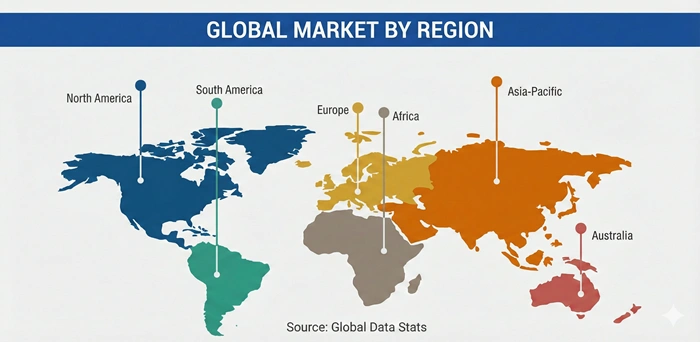
North America commands substantial leadership within the chatbot market, maintaining more than 47% regional share, driven by robust technological infrastructure particularly in the United States with extensive network connectivity, widespread smartphone access, high digital literacy, and strong technology adoption rates across enterprises and consumers. Major technology companies including Google, Microsoft, IBM, Amazon Web Services, and OpenAI headquarter operations in North America, creating regional advantages through innovation leadership, local presence, extensive research and development capabilities, and established customer relationships. The United States demonstrates particularly strong chatbot adoption with surveys showing 16% of North Americans use voice assistant platforms like Alexa or Google Home for shopping, while 27% of adults have utilized AI conversation entities for purchasing at least once, reflecting mainstream consumer acceptance.
Enterprise deployments across North American corporations, financial institutions, healthcare systems, and government agencies drive substantial chatbot market demand as organizations implement conversational AI for customer service, employee support, sales assistance, and operational automation. Microsoft, IBM, and Google dominate regional enterprise markets through comprehensive platforms including Azure AI, Watson Assistant, and Dialogflow offering robust ecosystem integration, responsible AI frameworks, and extensive developer support. The region benefits from favorable investment climates, venture capital funding, entrepreneurial ecosystems, and government policies supporting AI innovation that accelerate chatbot technology development and commercial deployment. Canada demonstrates growing chatbot adoption across banking, telecommunications, retail, and public sector applications as organizations recognize automation benefits for bilingual customer support serving English and French-speaking populations.
Asia Pacific Fastest Growth
Digital Transformation and Mobile Commerce Drive Exceptional Regional Expansion
Asia Pacific emerges as the fastest-growing regional chatbot market, expected to register exceptional CAGR of 24.71% through 2031, propelled by massive user bases, mobile commerce adoption, government AI programs, and digital transformation initiatives across emerging economies. The region encompasses the world's largest populations with billions of smartphone users, creating enormous addressable markets for chatbot applications across consumer and enterprise segments. China represents a major growth engine with widespread adoption of WeChat, Alipay, and other messaging platforms integrating chatbots for customer service, commerce, government services, and daily utilities reaching hundreds of millions of users. India demonstrates exceptional growth potential with expanding internet connectivity, smartphone penetration, digital payment adoption, and government digitalization programs creating favorable environments for chatbot deployment.
Southeast Asian nations including Indonesia, Thailand, Vietnam, and Philippines show accelerating chatbot adoption as economic development, e-commerce growth, and mobile-first consumer behaviors drive demand for automated customer engagement solutions. The chatbot market in Asia Pacific particularly benefits from multilingual requirements as diverse linguistic landscapes motivate investments in natural language processing supporting local languages, dialects, and cultural nuances. Regional technology companies and multinational corporations including Baidu, Alibaba, Tencent alongside Google, Microsoft, and IBM establish strong local presence serving domestic markets through culturally adapted solutions, local language support, and competitive pricing. Government initiatives promoting artificial intelligence development, smart city programs, and digital economy strategies create supportive regulatory environments and infrastructure investments accelerating chatbot technology adoption across public and private sectors.
Top Key Players
-
Google LLC (United States)
-
Microsoft Corporation (United States)
-
IBM Corporation (United States)
-
Amazon Web Services Inc. (United States)
-
OpenAI L.P. (United States)
-
Oracle Corporation (United States)
-
SAP SE (Germany)
-
Salesforce Inc. (United States)
-
Meta Platforms Inc. (United States)
-
Baidu Inc. (China)
-
ServiceNow Inc. (United States)
-
Artificial Solutions International AB (Sweden)
-
Nuance Communications Inc. (United States)
-
LivePerson Inc. (United States)
-
Zendesk Inc. (United States)
Recent Developments
-
Microsoft Corporation (2024): In January 2024, Microsoft announced comprehensive integration of its AI chatbot Microsoft Bot Framework with Teams and other Microsoft applications, expanding reach and enhancing user experience while strengthening the company's position in enterprise conversational AI supporting workplace productivity and collaboration.
-
IBM and Mastercard (2024): In March 2024, IBM and Mastercard formed a strategic partnership to develop AI chatbots specifically for the financial sector, aiming to improve customer service quality, streamline transaction processing, and enhance security in banking applications leveraging Watson Assistant capabilities and Mastercard's payment infrastructure.
-
Google (2025): In April 2025, Google secured a significant USD 250 million investment in its AI chatbot division DeepMind to advance conversational AI research, expand market presence, and develop next-generation natural language processing capabilities supporting enterprise and consumer applications across global markets.
-
Amazon Web Services (2025): In May 2025, Amazon Web Services launched Amazon Lex in Europe, marking strategic expansion into European markets providing localized conversational AI solutions and services to European businesses while ensuring compliance with regional data protection regulations and privacy requirements.
-
DRUID and ROBOYO Partnership (2023): In February 2023, DRUID, a Romania-based conversational AI platform, partnered with ROBOYO, a US-based hyperautomation professional services company, to deliver automation transformation projects leveraging DRUID's conversational AI technology layer combined with ROBOYO's comprehensive automation portfolio and consulting capabilities serving multiple industry sectors.
Market Trends
Generative AI Integration and Enterprise System Connectivity Transform Capabilities
The rapid integration of generative AI and large language models represents a transformative trend within the chatbot market, fundamentally changing conversational capabilities, user expectations, and viable applications across industries. ChatGPT's explosive growth achieving over 46.59 billion annual web visits and 48.36% market share demonstrates consumer and enterprise preference for advanced AI chatbots delivering human-like interactions, contextual understanding, creative content generation, and sophisticated problem-solving capabilities. Organizations increasingly deploy generative AI chatbots for applications extending beyond traditional customer service into content creation, document summarization, data analysis, research assistance, and decision support augmenting human capabilities. The technology enables chatbots to handle complex, unpredictable queries requiring nuanced understanding and creative responses impossible with earlier rule-based or simple NLP approaches. Market projections showing generative AI chatbot segment expansion from USD 9.9 billion in 2025 to USD 113.35 billion by 2034 reflect the revolutionary impact of these technologies reshaping conversational AI landscapes.
Enterprise system integration and omnichannel deployment demonstrate accelerating adoption as organizations implement chatbots connecting with customer relationship management platforms, enterprise resource planning systems, knowledge bases, payment processors, and business intelligence tools creating comprehensive business automation. Modern chatbots execute autonomous tasks including appointment booking, payment processing, account updates, ticket filing, and HR query management without human intervention, substantially reducing operational workloads. The chatbot market shows growing emphasis on multimodal interfaces combining text, voice, images, and video interaction supporting diverse user preferences and expanding accessibility. Voice-enabled chatbots integrate with smart speakers, automotive systems, and mobile devices enabling hands-free interaction while visual capabilities support product selection, document verification, and troubleshooting through image recognition. Additionally, real-time personalization leveraging CRM data, user history, sentiment analysis, and behavioral patterns enables chatbots to deliver tailored responses, product recommendations, and problem resolutions matching individual customer contexts, preferences, and communication styles.
Segments Covered in the Report
By Type:
-
AI-Powered Chatbots
-
Machine Learning Chatbots
-
NLP Chatbots
-
Generative AI Chatbots
-
-
Rule-Based Chatbots
-
Pattern Matching Chatbots
-
Decision Tree Chatbots
-
-
Hybrid Chatbots
By Deployment Mode:
-
Cloud-Based
-
Public Cloud
-
Private Cloud
-
-
On-Premise
-
Hybrid Deployment
By Application:
-
Customer Service
-
Query Resolution
-
Technical Support
-
-
Sales & Marketing
-
Lead Generation
-
Product Recommendations
-
-
E-Commerce
-
Shopping Assistance
-
Order Tracking
-
-
Healthcare
-
Symptom Checking
-
Appointment Scheduling
-
-
BFSI (Banking, Financial Services, Insurance)
-
Account Management
-
Transaction Processing
-
-
Travel & Hospitality
-
Booking Assistance
-
Customer Support
-
By End User:
-
Retail
-
Healthcare
-
Banking & Finance
-
IT & Telecom
-
Government
-
Education
-
Real Estate
-
Automotive
By Region:
-
North America
-
United States
-
Canada
-
Mexico
-
-
Europe
-
Germany
-
United Kingdom
-
France
-
Italy
-
Spain
-
Rest of Europe
-
-
Asia Pacific
-
China
-
India
-
Japan
-
South Korea
-
Southeast Asia
-
Australia
-
Rest of Asia Pacific
-
-
Latin America
-
Brazil
-
Argentina
-
Rest of Latin America
-
-
Middle East & Africa
-
United Arab Emirates
-
Saudi Arabia
-
South Africa
-
Rest of Middle East & Africa
-
Frequently Asked Questions
Question 1: What is the projected chatbot market size by 2033?
Answer: The global chatbot market is projected to reach USD 37.05 billion by 2033, growing from USD 8.65 billion in 2026 at a CAGR of 22.69%.
Question 2: Which region dominates the chatbot market currently?
Answer: North America dominates the chatbot market with more than 47% regional share, driven by robust technology infrastructure and high adoption rates across enterprises and consumers.
Question 3: What are the key drivers of chatbot market growth?
Answer: Key drivers include 24/7 customer service demands, operational cost reduction achieving 30% to 70% savings, digital transformation programs, messaging platform proliferation, and generative AI advancement.
Question 4: How is generative AI impacting the chatbot market?
Answer: Generative AI revolutionizes chatbot capabilities through human-like conversations, contextual understanding, creative content generation, and autonomous task execution, with the segment projected to grow from USD 9.9 billion in 2025 to USD 113.35 billion by 2034.
Question 5: Which application segment leads the chatbot market?
Answer: Customer service represents the largest application segment, driven by 24/7 support automation, routine inquiry handling, and 30% to 70% cost savings compared to traditional human-only service models.