
Bulk Explosives Market Overview
Mining Expansion and Infrastructure Investment Transform Large-Scale Blasting Solutions Across Resource Extraction, Construction, and Quarrying Operations Worldwide
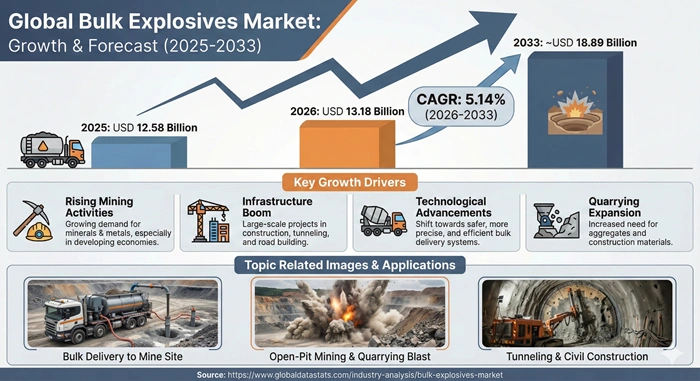
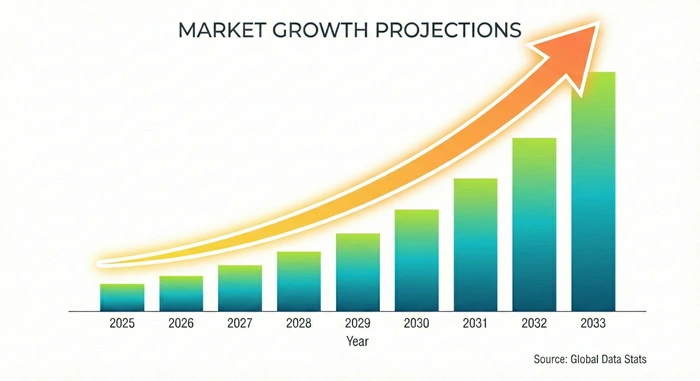
The global bulk explosives market size is valued at USD 12.58 billion in 2025 and is predicted to increase from USD 13.18 billion in 2026 to approximately USD 18.89 billion by 2033, growing at a CAGR of 5.14% from 2026 to 2033. This specialized industrial sector encompasses production, distribution, and application of large-volume explosive materials delivered in bulk form—primarily ammonium nitrate fuel oil (ANFO), emulsion explosives, and water gel formulations—serving critical blasting operations across mining, quarrying, construction, and infrastructure development requiring cost-effective rock fragmentation solutions. Bulk explosives deliver essential performance benefits including high energy output, controlled detonation characteristics, operational cost efficiency, and on-site mixing capabilities supporting diverse applications across surface mining, underground extraction, tunneling projects, and quarry operations demanding reliable blasting technology and technical expertise.
The bulk explosives market addresses escalating demand for resource extraction and infrastructure development where mining activity expansion, urbanization acceleration, aggregate consumption growth, and construction project scaling drive explosive consumption across developed and emerging economies. This essential industrial material supplied through specialized delivery systems including bulk trucks, mobile manufacturing units, and on-site mixing equipment enables efficient rock breaking, ore extraction, and excavation operations delivering productivity improvements and operational cost reductions across extractive industries. Major sectors including coal mining, metal ore extraction, construction aggregates, infrastructure tunneling, and quarrying operations consume substantial bulk explosive volumes as companies pursue enhanced blasting efficiency, improved fragmentation quality, and operational safety throughout production cycles requiring proven explosive technology and application support capabilities.
AI Impact on the Bulk Explosives Industry
Digital Optimization and Automated Systems Revolutionize Blasting Precision and Operational Safety Standards
Artificial intelligence transforms the bulk explosives market through advanced blast design optimization systems analyzing geological data, fragmentation requirements, and environmental constraints identifying optimal explosive loading patterns, timing sequences, and detonation parameters maximizing productivity while minimizing vibration and flyrock risks. Machine learning algorithms process thousands of blast performance datasets including rock fragmentation analysis, vibration monitoring records, and production throughput metrics predicting optimal powder factors, hole patterns, and timing designs achieving target fragmentation specifications. These AI-powered platforms enable real-time adjustments incorporating weather conditions, geological variations, and operational constraints preventing suboptimal blasts, reducing secondary breaking requirements, and improving downstream processing efficiency particularly critical given high-value ore recovery and crushing plant optimization needs. Predictive analytics correlating blast parameters with fragmentation outcomes enable proactive design modifications maintaining consistent production rates and minimizing operational disruptions throughout mining cycles.
Advanced AI applications extend beyond blast design to revolutionize automated charging systems and safety monitoring within the bulk explosives market landscape. Robotic charging technologies incorporating computer vision, precision positioning, and automated loading sequences eliminate human presence during explosive placement reducing accident risks and enabling continuous operations. ABB Robot Charger systems detecting drilled holes and installing explosive charges autonomously demonstrate technology advancement improving worker safety and operational efficiency. Real-time blast monitoring incorporating AI-powered sensors tracking ground vibrations, air overpressure, and structural impacts enables immediate response protocols protecting nearby infrastructure and communities. Predictive maintenance algorithms monitoring bulk delivery equipment, mixing systems, and detonation devices identify potential failures before breakdowns occur preventing production delays and safety incidents. These AI-driven capabilities position operators to achieve superior blasting efficiency while reducing operational costs by 15-25% and improving safety performance throughout forecast period.
Growth Factors
Mining Industry Expansion and Infrastructure Investment Drive Unprecedented Bulk Explosives Demand
The bulk explosives market experiences robust growth propelled by mining industry expansion where commodity demand growth, exploration activity acceleration, and production capacity additions drive blasting operations requiring substantial explosive consumption. Global mining sector producing essential materials for energy transition, infrastructure development, and industrial manufacturing creates sustained bulk explosive demand. Coal mining operations particularly thermal coal for power generation and metallurgical coal for steel production consume substantial ANFO and emulsion explosive volumes. Metal mining expansion particularly copper extraction supporting renewable energy infrastructure, gold production meeting investment demand, and iron ore mining supplying steel manufacturing drives specialized explosive formulations. Mining companies including BHP, Rio Tinto, Glencore, and regional operators expanding production capacities across Australia, Chile, Peru, and Africa create concentrated explosive demand. Underground mining operations requiring precise blasting control utilize emulsion explosives delivering enhanced safety and performance characteristics. These diverse mining applications create sustained baseline demand supporting market growth throughout forecast period.
Infrastructure development accelerates bulk explosives market expansion as urbanization, transportation network modernization, and construction activity growth require extensive tunneling, excavation, and site preparation operations consuming specialized blasting solutions. Developing nations particularly India implementing infrastructure master plans including metro rail systems, highways, and hydropower projects create substantial explosive demand for tunneling and rock excavation. China pursuing Belt and Road Initiative infrastructure investments across Asia, Africa, and Latin America drives construction blasting consumption. Middle Eastern countries developing transportation networks, urban centers, and economic zones require quarrying and construction explosives. Dam construction, canal development, and water infrastructure projects utilize controlled blasting techniques achieving precise excavation specifications. Building foundation preparation, underground parking construction, and basement excavation in urban areas demand vibration-controlled explosive formulations. These infrastructure applications demonstrate exceptional growth supporting sustained consumption throughout forecast period.
Market Outlook
Sustainable Formulations and Automated Delivery Systems Position Industry for Technology-Driven Transformation
The bulk explosives market outlook remains exceptionally positive as manufacturers invest substantially in sustainable explosive formulations addressing environmental concerns, reducing carbon emissions, and minimizing water contamination from nitrate-based products. Next-generation explosive technologies including hydrogen peroxide emulsion (HPE) explosives eliminating ammonium nitrate eliminate nitrate water contamination, reduce greenhouse gas emissions, and improve ventilation times in underground mining operations. Swedish company Hypex pioneering nitrate-free explosive formulations demonstrates commercial viability with proven performance matching conventional products while delivering sustainability benefits. Orica collaborating with Fertiberia developing low-carbon explosive alternatives addresses mining industry decarbonization commitments. Reduced-emission formulations minimizing toxic gas production improve underground air quality enabling faster re-entry times and productivity improvements. Bio-based explosive ingredients derived from renewable feedstocks create opportunities for environmentally responsible formulations. These sustainability innovations create competitive advantages as mining companies, construction contractors, and regulatory agencies increasingly prioritize suppliers demonstrating environmental stewardship and worker health protection throughout forecast period.
Investment trends within the bulk explosives market reflect growing confidence in long-term demand fundamentals as explosives manufacturers, mining services companies, and technology providers expand capacity, upgrade delivery systems, and develop advanced application solutions. Leading manufacturers including Orica, Dyno Nobel, AEL Mining Services, MAXAM, and Solar Industries maintain capital expenditure programs modernizing production facilities, implementing automated mixing systems, and developing digital blasting solutions. Acquisition activity intensifies as explosives companies pursue geographic expansion, technology platforms, and customer base consolidation through strategic acquisitions. Vertical integration strategies connecting explosive manufacturing with blasting services, equipment provision, and technical support create comprehensive solution offerings. On-site mixing unit deployment enabling just-in-time explosive production improves safety, reduces transportation risks, and enhances operational flexibility. Research collaborations advancing automated charging robotics, wireless initiation systems, and AI-powered blast optimization support market evolution balancing productivity requirements with safety imperatives through 2033.
Expert Speaks
-
Sanjeev Gandhi, Managing Director Orica Limited, emphasized technology leadership: "Our vision is to become the world's leading mining and infrastructure solutions company. More materials, metals, and minerals will be required to help the global economy grow and transition to net zero emissions. Our priority is to help mobilize those resources, utilizing advanced technology and innovation from mine to mill to accelerate global decarbonization efforts through sustainable blasting solutions".
-
ABB Mining Innovation Leadership, highlighted automation advancement: "The robotic blasting system not only improves safety but contributes to the increased sustainability of mining operations. Its precise technology results in more controlled blasts and increased efficiency in the use of explosive materials, minimizing environmental impact on the surrounding area and generating better rock fragmentation leading to lower energy usage throughout the value chain".
-
Mining3 Alternative Explosives Program, articulated sustainability imperative: "Conventional explosives have long been associated with detrimental effects on the environment including air pollution, water contamination, and ecological disruption. Our Alternative Explosives aim to minimize or even eliminate these adverse consequences, signaling a new era of sustainable mining practices enabling companies to align with stringent regulations and demonstrate commitment to decarbonization".
Key Report Takeaways
-
Asia Pacific dominates the bulk explosives market with commanding share exceeding 50%, driven by extensive mining operations, infrastructure investments, and mineral resource extraction across China, India, and Australia where coal production, metal mining, and construction activities consume substantial explosive volumes supporting regional industrial development.
-
Africa and Latin America emerge as fastest-growing regional markets with projected CAGR approaching 6.5% through 2033, propelled by metal mining expansion, foreign direct investment inflows, and untapped mineral resources where copper, gold, and rare earth exploration activities create concentrated blasting operations demand.
-
Mining applications represent dominant end-use segment accounting for approximately 55% market share due to coal extraction, metal ore mining, and mineral production demonstrating sustained consumption across surface mining operations, underground extraction, and ore body development requiring reliable bulk explosive solutions.
-
ANFO maintains largest product segment share representing approximately 45% of market driven by cost-effectiveness, proven performance, and widespread application across surface coal mining, quarrying operations, and construction blasting where simplicity and reliability support consistent adoption.
-
Emulsion explosives exhibit fastest product growth with anticipated CAGR exceeding 6% through 2033, attributed to superior water resistance, enhanced safety characteristics, and controlled energy delivery where underground mining, wet conditions, and precise fragmentation requirements drive adoption.
-
Construction and infrastructure segment demonstrates exceptional growth potential with projected CAGR of 6.8% through 2033, driven by urbanization, tunneling projects, and infrastructure modernization where controlled blasting techniques, vibration management, and precision excavation create specialized explosive demand.
Market Scope
| Report Coverage Details | |
|---|---|
| Market Size by 2033 | USD 18.89 Billion |
| Market Size by 2025 | USD 12.58 Billion |
| Market Size by 2026 | USD 13.18 Billion |
| Market Growth Rate from 2026 to 2033 | CAGR of 5.14% |
| Dominating Region | Asia Pacific |
| Fastest Growing Region | Africa & Latin America |
| Base Year | 2025 |
| Forecast Period | 2026 to 2033 |
| Segments Covered | Product Type, Application, End-Use Industry, Delivery Method, Region |
| Regions Covered | North America, Europe, Asia Pacific, Latin America, Middle East & Africa |
Market Dynamics
Drivers Impact Analysis
Resource Extraction Growth and Construction Activity Acceleration Propel Bulk Explosives Adoption
| Impact Factor | (≈) % Impact on CAGR Forecast | Geographic Relevance | Impact Timeline |
|---|---|---|---|
| Mining Industry Expansion | +2.8% | Asia Pacific, Latin America | 2026-2033 |
| Infrastructure Investment | +2.2% | Emerging Markets | 2026-2033 |
| Aggregate Demand Growth | +1.6% | Global Markets | 2026-2033 |
| Technology Advancement | +1.4% | Developed Regions | 2027-2033 |
The bulk explosives market benefits substantially from mining industry expansion where global commodity demand, exploration investment, and production capacity additions drive blasting operations requiring substantial explosive consumption across diverse mineral extraction activities. Coal mining sector particularly Asian thermal coal demand for power generation and steel industry metallurgical coal requirements consume massive ANFO volumes. Metal mining expansion particularly copper extraction supporting electric vehicle production, battery manufacturing, and renewable energy infrastructure creates concentrated explosive demand across Chile, Peru, Democratic Republic of Congo, and Zambia. Gold mining operations serving investment demand, jewelry manufacturing, and industrial applications utilize specialized emulsion explosives delivering precise fragmentation control. Iron ore production supplying steel manufacturing consumes bulk explosives across Australian, Brazilian, and Indian mining operations. Rare earth element extraction supporting technology manufacturing, defense applications, and clean energy technologies drives specialized blasting requirements. These mining applications create sustained baseline demand supporting market growth throughout forecast period.
Infrastructure development accelerates bulk explosives market adoption as government investment programs, urbanization trends, and transportation network modernization require extensive tunneling, excavation, and site preparation consuming controlled blasting solutions. Indian government implementing National Infrastructure Pipeline investing over 1 trillion dollars in infrastructure projects creates substantial explosive demand for metro rail tunnels, highway construction, and dam development. Chinese urban development programs, high-speed rail expansion, and hydropower projects maintain consistent blasting consumption. Middle Eastern nations developing transportation infrastructure, urban centers, and economic diversification projects require quarrying and construction explosives. African infrastructure modernization including road networks, mining access routes, and port facilities drives explosive demand. Tunneling operations for subways, road systems, and utility corridors utilize precisely engineered explosive formulations achieving controlled excavation profiles. Foundation blasting for high-rise buildings, bridge construction, and industrial facility development consumes specialized products. These infrastructure applications demonstrate exceptional growth supporting sustained consumption throughout forecast period.
Restraints Impact Analysis
Environmental Regulations and Safety Requirements Challenge Traditional Explosive Applications
| Restraint Factor | (≈) % Impact on CAGR Forecast | Geographic Relevance | Impact Timeline |
|---|---|---|---|
| Environmental Compliance | -1.8% | Developed Markets | 2026-2033 |
| Safety Regulations | -1.4% | Global Operations | 2026-2031 |
| Transportation Restrictions | -1.2% | Urban Areas | 2026-2030 |
| Ammonium Nitrate Concerns | -0.9% | Security-Sensitive Regions | 2026-2033 |
The bulk explosives market faces growth constraints from environmental regulations where emission controls, blast vibration limits, and water contamination restrictions impose compliance costs and operational limitations particularly developed markets implementing stricter environmental standards. Ammonium nitrate-based explosives generating toxic nitrogen oxide (NOx) fumes require extensive ventilation periods in underground operations reducing productivity and increasing operational costs. Nitrate contamination of groundwater from undetonated explosive residues creates environmental liabilities and remediation expenses. European Union implementing greenhouse gas reduction targets pressures mining operations to reduce carbon emissions including explosive-related contributions. Blast-induced ground vibration restrictions protecting nearby infrastructure, residential areas, and sensitive structures limit explosive quantities and timing designs constraining production rates. Flyrock prevention requirements mandating protective measures, restricted blast zones, and monitoring systems add operational complexity. These environmental pressures create compliance burdens constraining market expansion particularly operations near populated areas or environmentally sensitive zones throughout forecast period.
Safety regulations constrain bulk explosives market development where storage requirements, transportation controls, and handling protocols impose infrastructure investments and operational procedures limiting deployment flexibility and increasing costs. Explosive storage facilities requiring secure magazines, separation distances, and inventory controls create capital investment barriers particularly smaller contractors and remote operations. Transportation regulations mandating specialized vehicles, route restrictions, and escort requirements increase logistics complexity and delivery costs. Ammonium nitrate security concerns following terrorist incidents drive stringent tracking, documentation, and access control requirements. Explosive handling certifications requiring trained personnel, safety procedures, and emergency response capabilities limit workforce availability. Detonator regulations particularly electronic initiation systems facing export controls and security protocols constrain technology adoption. Weather restrictions preventing blasting during adverse conditions create operational delays and scheduling challenges. These safety requirements favor established manufacturers and large contractors with proven compliance capabilities while constraining market entry for smaller participants throughout forecast period.
Opportunities Impact Analysis
Sustainable Formulations and Automation Technologies Create Substantial Growth Avenues Beyond Traditional Applications
| Opportunity Factor | (≈) % Impact on CAGR Forecast | Geographic Relevance | Impact Timeline |
|---|---|---|---|
| Nitrate-Free Explosives | +2.0% | Environmental Markets | 2027-2033 |
| Automated Charging Systems | +1.8% | Advanced Mining | 2027-2033 |
| On-Site Mixing Units | +1.4% | Remote Operations | 2026-2033 |
| Digital Blast Optimization | +1.2% | Technology Adoption | 2027-2033 |
The bulk explosives market stands to capture substantial value from nitrate-free explosive formulations where hydrogen peroxide emulsion (HPE) technologies eliminate ammonium nitrate addressing environmental concerns, reducing emissions, and improving underground air quality. Hypex pioneering commercial-scale nitrate-free explosives demonstrates proven performance matching conventional products while eliminating nitrate water contamination and reducing carbon footprint. Mining companies pursuing decarbonization commitments and environmental, social, and governance (ESG) targets prioritize sustainable explosive alternatives. Reduced toxic gas emissions enable faster ventilation times in underground operations improving productivity and worker exposure reduction. Water contamination elimination removes groundwater remediation costs and environmental liabilities. Bio-based explosive ingredients derived from renewable resources create opportunities for circular economy integration. Premium pricing for sustainable formulations justified by environmental benefits, operational advantages, and regulatory compliance supports market value growth. These sustainable innovations command higher margins and demonstrate exceptional growth supporting market diversification throughout forecast period.
Automated charging systems present exceptional growth opportunities as robotic technologies, remote-controlled equipment, and autonomous operations eliminate human presence during explosive loading improving safety and enabling continuous operations. ABB Robot Charger demonstrating autonomous hole detection and explosive installation capabilities showcases technology advancement. Orica WebGen wireless electronic initiation system eliminating physical detonation circuits enables remote blasting from secure locations. Underground mining automation incorporating tele-remote equipment, automated drilling rigs, and robotic charging systems drives technology adoption. Internet of Things (IoT) sensors monitoring blast conditions, explosive performance, and safety parameters enable real-time optimization and predictive analytics. Digital twin technologies simulating blast outcomes, fragmentation predictions, and optimization scenarios reduce trial-and-error approaches. Mobile manufacturing units providing on-site explosive production, customized formulations, and just-in-time delivery improve safety, reduce transportation risks, and enhance operational flexibility. These advanced technologies command premium pricing supporting market value expansion throughout forecast period.
Segment Analysis
By Product Type: ANFO
Cost-Effectiveness and Proven Performance Sustain ANFO Market Leadership Across Surface Mining Operations
Ammonium nitrate fuel oil (ANFO) commands the largest share within the bulk explosives market, accounting for approximately 45% of global consumption with continued expansion projected at steady CAGR of 4.8% through 2033. This product category encompasses standard ANFO blends combining 94% ammonium nitrate prills with 6% fuel oil delivering cost-effective blasting solutions across surface mining, quarrying, and construction applications where dry hole conditions and proven performance support widespread adoption. The bulk explosives market benefits from ANFO advantages including lowest cost per unit energy, simple mixing requirements, established application track records, and broad compatibility across diverse rock types and mining conditions. Coal mining operations particularly surface mines and open-pit operations consume massive ANFO volumes supporting overburden removal and coal extraction. Quarrying applications producing aggregates, dimension stone, and industrial minerals utilize ANFO delivering reliable fragmentation at economical costs. Construction blasting for site preparation, road cuts, and foundation excavation demonstrates consistent ANFO consumption.
Asia Pacific and North America lead ANFO consumption within the market, driven by extensive coal mining operations, quarrying activities, and favorable geological conditions enabling dry hole blasting applications. Australian coal mining industry producing thermal and metallurgical coal for export and domestic markets consumes substantial ANFO volumes across Queensland and New South Wales operations. Indonesian coal production supporting power generation and cement manufacturing utilizes ANFO across Kalimantan mining regions. Indian coal mining particularly Coal India Limited operations and captive mine development consume growing ANFO volumes. United States surface mining operations particularly Wyoming Powder River Basin coal production and Southwestern copper mining utilize ANFO extensively. Canadian oil sands mining and mineral extraction operations demonstrate consistent ANFO demand. Leading explosive manufacturers including Orica, Dyno Nobel, and MAXAM supply ANFO through bulk delivery trucks and on-site mixing facilities serving mining customers. Technology improvements including heavy ANFO formulations, emulsion-ANFO blends, and packaged ANFO products expand application versatility. Price competitiveness supporting ANFO preferences over premium explosive formulations maintains segment dominance throughout forecast period.
By Application: Mining
Resource Extraction Growth and Commodity Demand Position Mining Segment for Sustained Market Dominance
Mining applications represent dominant segment within the bulk explosives market, accounting for approximately 55% of total consumption with continued expansion projected at robust CAGR of 5.4% through 2033. This application category encompasses coal mining, metal ore extraction, mineral production, and underground development utilizing bulk explosives delivering essential rock fragmentation enabling resource extraction across surface and underground operations. The bulk explosives market benefits from mining advantages including consistent high-volume consumption, established supply relationships, technical support requirements, and long-term contract opportunities supporting stable business foundations. Coal mining particularly thermal coal for power generation and metallurgical coal for steel production represents largest mining explosive consumer. Metal mining including copper, gold, iron ore, and base metals drives specialized explosive formulations. Rare earth mining supporting technology manufacturing creates growing opportunities. Underground mine development including shaft sinking, drift advancement, and stope preparation consumes emulsion explosives and ANFO blends.
Latin America and Africa lead mining-related bulk explosive consumption growth within the market, driven by metal mining expansion, exploration investment, and untapped mineral resources attracting international mining companies. Chilean copper mining producing approximately 30% of global copper supply consumes substantial emulsion explosives across Escondida, Collahuasi, and Los Pelambres operations. Peruvian copper and gold mining expansion particularly Antamina, Cerro Verde, and Las Bambas mines creates concentrated explosive demand. Democratic Republic of Congo cobalt and copper production supporting electric vehicle battery manufacturing drives explosive consumption. Zambian copper belt mining operations demonstrate consistent demand. Leading mining companies including BHP, Rio Tinto, Glencore, and regional producers maintain long-term supply agreements with explosive manufacturers including Orica, AEL Mining Services, and MAXAM. Underground mining growth particularly block caving operations, sublevel stoping, and narrow vein mining requires specialized emulsion explosives delivering water resistance and precise energy control. Automated charging systems, wireless initiation technologies, and digital blast optimization enhance mining productivity supporting continued segment leadership throughout forecast period.
Regional Insights
Asia Pacific
Mining Concentration and Infrastructure Investment Establish Regional Dominance in Bulk Explosive Consumption
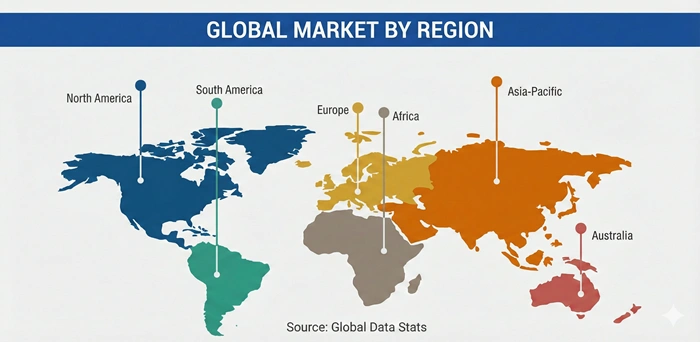
Asia Pacific commands the bulk explosives market with dominant share exceeding 50%, driven by extensive coal mining operations, metal ore extraction, and massive infrastructure development across China, India, Australia, and Indonesia where resource-dependent economies and construction activity consume substantial explosive volumes. China alone accounts for approximately 45% of Asia Pacific market share with coal production exceeding 4 billion tonnes annually supporting thermal power generation and steel manufacturing requiring massive ANFO and emulsion explosive consumption. Indian coal mining particularly Coal India Limited operating largest coal producer globally consumes substantial explosive volumes across surface and underground operations. Australian mining industry including iron ore, coal, and gold production demonstrates consistent bulk explosive demand across Western Australia, Queensland, and New South Wales operations. Indonesian coal mining and nickel extraction serving export and domestic markets creates growing consumption. Regional infrastructure development including metro rail systems, highway networks, and urban development drives construction blasting demand.
Regional industrial policies strengthen Asia Pacific's market position through mining promotion, infrastructure investment, and economic development strategies supporting resource extraction and construction activities. Chinese economic development requiring steel production, power generation, and construction materials maintains substantial coal and metal mining activity. Indian government implementing Production Linked Incentive schemes, National Infrastructure Pipeline, and mining reform initiatives supports domestic explosive consumption growth. Australian mining sector benefiting from strong commodity prices, established infrastructure, and technical expertise maintains leading explosive consumption. Leading explosive manufacturers including Orica maintaining largest Asia Pacific presence, Solar Industries serving Indian market, and MAXAM operating regional facilities supply bulk explosives through delivery trucks, on-site mixing units, and technical services. The region's market dominance continues through 2033 as mining expansion, infrastructure development, and economic growth create sustained demand supporting continued leadership throughout forecast period.
Africa & Latin America
Metal Mining Expansion and Resource Development Drive Fastest Regional Market Growth
Africa and Latin America emerge as fastest-growing regional bulk explosives markets with projected CAGR of 6.5% through 2033, propelled by metal mining expansion, foreign direct investment, and untapped mineral resources attracting global mining companies pursuing copper, gold, and critical mineral production. Latin America particularly Chile, Peru, and Brazil dominates regional explosive consumption with copper mining representing primary demand driver. Chilean copper production exceeding 5 million tonnes annually requires substantial emulsion explosive consumption across large-scale open-pit operations. Peruvian mining sector expanding production capacity through new projects including Quellaveco copper mine and Mina Justa operation creates concentrated explosive demand. Brazilian iron ore mining, gold production, and nickel extraction demonstrate growing consumption. African mining development particularly Democratic Republic of Congo cobalt production, Zambian copper mining, and West African gold extraction drives explosive demand growth. South African platinum and gold mining maintains established consumption patterns.
Regional investment trends strengthen Africa and Latin America market growth through exploration activities, production expansion projects, and infrastructure development supporting mining logistics. Foreign mining companies including BHP, Rio Tinto, Glencore, and Anglo American investing billions in regional mining projects create long-term explosive supply opportunities. Chinese mining companies pursuing copper, cobalt, and rare earth resources across Africa and Latin America expand regional consumption. Leading explosive suppliers including Orica, AEL Mining Services operating extensive African presence, MAXAM serving Latin American markets, and regional manufacturers expanding delivery infrastructure through bulk trucks, emulsion plants, and technical support services. On-site mixing unit deployment enabling remote operation support and just-in-time production improves safety and operational efficiency. Government mining promotion policies, foreign investment incentives, and infrastructure development supporting mining access strengthen regional market fundamentals. The region's exceptional growth continues through 2033 as metal mining expansion, exploration success, and production capacity additions create favorable dynamics supporting sustained market expansion throughout forecast period.
Top Key Players
-
Orica Limited (Australia)
-
Dyno Nobel (United States)
-
AEL Mining Services (South Africa)
-
MAXAM Corp (Spain)
-
Solar Industries India Limited (India)
-
Austin Powder Company (United States)
-
Enaex S.A. (Chile)
-
Sasol Limited (South Africa)
-
Yara International ASA (Norway)
-
Incitec Pivot Limited (Australia)
-
EPC Groupe (France)
-
Hanwha Corporation (South Korea)
-
Nelson Brothers LLC (United States)
-
BME (Bulk Mining Explosives) (South Africa)
Recent Developments
-
Orica Limited (2023-2025): Expanded WebGen wireless initiation system deployment across underground mining operations globally achieving over 500 installation sites, demonstrating technology leadership enabling remote blasting, improved safety, and operational efficiency while recording underlying EBIT from continuing operations increasing 24% to 698 million dollars with ammonium nitrate and emulsion volumes reaching 2972000 tonnes supporting mining customers across Asia Pacific, North America, and Latin America.
-
Solar Industries India Limited (2024-2025): Commissioned new bulk explosive manufacturing facilities in Madhya Pradesh and Telangana expanding production capacity by 30% addressing growing domestic mining demand and export opportunities, implementing automated mixing systems and quality control technologies while securing long-term supply contracts with Coal India Limited subsidiaries and private mining companies supporting Indian infrastructure development and mineral extraction growth.
-
AEL Mining Services (2024-2025): Expanded African operations establishing new emulsion explosive plants in Zambia and Democratic Republic of Congo serving copper belt mining expansion projects, deploying mobile manufacturing units enabling remote mine support and just-in-time explosive delivery while advancing digital blast optimization technologies and automated charging systems improving customer productivity and operational safety across underground and surface mining applications.
-
MAXAM Corporation (2023-2024): Completed strategic acquisition of regional explosive distributors in Peru and Colombia strengthening Latin American market position, investing in sustainable explosive formulation development including reduced-emission products and bio-based ingredients while expanding technical services capabilities providing blast design optimization, fragmentation analysis, and digital monitoring solutions supporting mining customers pursuing productivity improvements and environmental compliance.
-
Dyno Nobel (2023-2025): Advanced DigiShot Plus electronic initiation system deployment incorporating wireless connectivity, programmable timing precision, and integrated blast monitoring enabling real-time parameter adjustments, expanding North American bulk delivery infrastructure through mobile manufacturing unit acquisitions and on-site mixing equipment upgrades while developing sustainable explosive formulations reducing carbon footprint and improving underground ventilation characteristics.
Market Trends
Sustainable Formulations and Digital Technologies Reshape Industry Competitive Dynamics
The bulk explosives market experiences transformative trends centered on sustainable explosive formulations as environmental regulations, mining company decarbonization commitments, and worker health concerns drive innovation toward nitrate-free alternatives and reduced-emission products. Manufacturers develop hydrogen peroxide emulsion (HPE) explosives eliminating ammonium nitrate completely removing nitrate water contamination risks, reducing greenhouse gas emissions, and improving underground air quality enabling faster re-entry times. Hypex commercializing nitrate-free explosive technology demonstrates proven performance matching conventional products while delivering sustainability benefits attracting mining companies pursuing environmental, social, and governance (ESG) targets. Orica collaborating with fertilizer producers developing low-carbon ammonium nitrate alternatives reducing production energy consumption and emissions. Bio-based explosive ingredients incorporating renewable feedstocks, recycled materials, and waste valorization create circular economy opportunities. Reduced-toxicity formulations minimizing nitrogen oxide emissions improve underground ventilation requirements and worker exposure levels. Life cycle assessment quantifying environmental impacts, carbon footprints, and sustainability metrics supports customer decision-making and regulatory compliance. These sustainability initiatives create competitive advantages as mining companies, regulatory agencies, and investment communities increasingly prioritize suppliers demonstrating environmental stewardship throughout forecast period.
Automation and digital technology integration trends reshape the bulk explosives market as manufacturers adopt Industry 4.0 principles including robotics, artificial intelligence, and connectivity optimizing blasting operations and safety performance. Automated charging systems incorporating robotic equipment eliminate human presence during explosive loading reducing accident risks and enabling continuous operations. Wireless initiation technologies including Orica WebGen removing physical detonation circuits enable remote blasting from secure locations improving safety. AI-powered blast design optimization analyzing geological data, fragmentation requirements, and environmental constraints identifies optimal explosive loading, timing sequences, and detonation parameters maximizing productivity. Digital twin simulations predicting blast outcomes, fragmentation distributions, and vibration impacts reduce trial-and-error approaches accelerating optimization. Real-time blast monitoring incorporating IoT sensors tracking ground vibrations, air overpressure, and flyrock trajectories enables immediate response protocols and data-driven improvements. Mobile applications providing explosive inventory management, delivery tracking, and technical support improve customer experience and operational efficiency. These digital innovations expand beyond operational benefits to enable predictive analytics, remote support, and data-driven decision-making supporting competitive differentiation throughout forecast period.
Segments Covered in the Report
By Product Type
-
Ammonium Nitrate Fuel Oil (ANFO) (Standard ANFO, Heavy ANFO, Packaged ANFO)
-
Emulsion Explosives (Bulk Emulsion, Packaged Emulsion, Cartridge Emulsion)
-
Water Gel Explosives (Slurry Explosives, Site-Mixed Formulations)
-
Blends and Hybrids (ANFO-Emulsion Blends, Heavy ANFO Mixtures)
By Application
-
Mining (Surface Mining, Underground Mining, Mine Development)
-
Construction & Infrastructure (Tunneling, Excavation, Site Preparation)
-
Quarrying (Aggregate Production, Dimension Stone, Industrial Minerals)
-
Others (Demolition, Seismic Exploration)
By End-Use Industry
-
Mining & Minerals Coal (Thermal Coal, Metallurgical Coal)
-
Metal Mining (Copper, Gold, Iron Ore, Base Metals)
-
Construction & Civil Engineering (Infrastructure Projects, Urban Development)
-
Quarrying & Aggregates (Crushed Stone, Sand, Gravel)
-
Others (Oil & Gas, Geotechnical Applications)
By Delivery Method
-
Bulk Trucks & Mobile Manufacturing Units (MMUs) (Pneumatic Loading, Pump Systems)
-
On-Site Mixing Systems (Stationary Plants, Portable Equipment)
-
Pre-Packaged Products (Cartridges, Bags, Containers)
By Region
-
North America (United States, Canada, Mexico)
-
Europe (Russia, Germany, United Kingdom, Rest of Europe)
-
Asia Pacific (China, India, Australia, Indonesia, Rest of Asia Pacific)
-
Latin America (Chile, Peru, Brazil, Rest of Latin America)
-
Middle East & Africa (South Africa, Democratic Republic of Congo, Rest of MEA)
Frequently Asked Questions
Question 1: What is the projected size of the bulk explosives market by 2033?
Answer: The global bulk explosives market is expected to reach approximately USD 18.89 billion by 2033, growing from USD 13.18 billion in 2026. This substantial expansion reflects mining industry growth, infrastructure investment acceleration, construction activity increases, and technological advancement across blasting operations worldwide.
Question 2: Which region dominates the bulk explosives market currently?
Answer: Asia Pacific leads the bulk explosives market with over 50% share, driven by extensive coal mining operations, metal ore extraction, and infrastructure development across China, India, Australia, and Indonesia. Leading manufacturers including Orica, Solar Industries, and regional producers maintain dominant positions serving mining and construction sectors.
Question 3: What are the primary drivers of bulk explosives market growth?
Answer: Key growth drivers include mining industry expansion requiring resource extraction, infrastructure investment demanding tunneling and excavation, aggregate consumption growth supporting construction materials, and technology advancement enabling automated blasting systems. Metal mining growth particularly copper and gold production creates concentrated demand supporting sustained market expansion throughout forecast period.
Question 4: Which product type holds the largest bulk explosives market share?
Answer: Ammonium nitrate fuel oil (ANFO) dominates the bulk explosives market with approximately 45% share due to cost-effectiveness, proven performance, and widespread application across surface mining, quarrying, and construction. Coal mining operations and aggregate production drive consistent ANFO demand supporting market leadership position.
Question 5: How do environmental concerns impact the bulk explosives market?
Answer: Environmental concerns drive sustainable explosive development including nitrate-free formulations, reduced-emission products, and bio-based ingredients addressing water contamination, greenhouse gas emissions, and air quality issues. Mining companies pursuing decarbonization targets and ESG commitments increasingly prioritize sustainable explosives. These environmental initiatives create opportunities for innovative manufacturers while constraining traditional ammonium nitrate-based products supporting market transformation throughout forecast period.