
Brain Computer Interface Market Overview
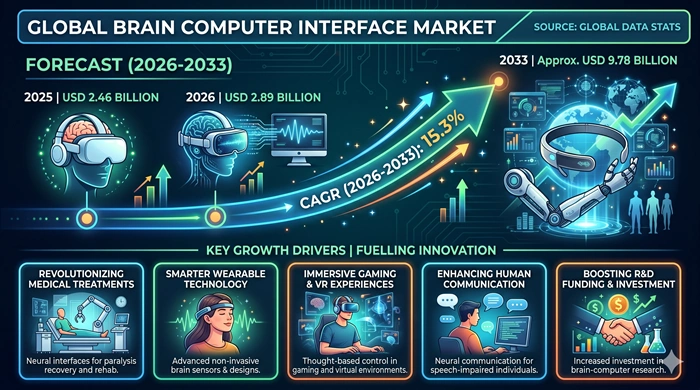
The global brain computer interface market size is valued at USD 2.46 billion in 2025 and is predicted to increase from USD 2.89 billion in 2026 to approximately USD 9.78 billion by 2033, growing at a CAGR of 15.3% from 2026 to 2033.
A brain computer interface (BCI) is a technology system that establishes a direct communication pathway between the human brain and external devices — bypassing the normal neuromuscular channels of communication and enabling individuals to control computers, prosthetics, communication aids, and other digital systems using neural signals alone. The market is witnessing accelerating growth driven by rising neurological disorder prevalence, rapid advances in neural signal processing, growing investment from both private technology companies and government research programs, and the expanding application scope of BCI technology beyond medical rehabilitation into gaming, education, mental health monitoring, and human performance enhancement. The transition from primarily research-stage technology toward early commercial deployment across medical and consumer applications is defining the current phase of the brain computer interface market's development globally.
AI Impact on the Brain Computer Interface Industry
Artificial Intelligence Is Transforming the Brain Computer Interface Industry Through Advanced Neural Signal Decoding Algorithms, Adaptive Real-Time Signal Processing, AI-Powered Neuroprosthetic Control, and Deep Learning-Enabled Brain Activity Pattern Recognition
Artificial intelligence is the single most transformative technical force advancing the capability, precision, and clinical utility of brain computer interface systems today. The fundamental challenge of BCI technology — translating the complex, noisy, and highly variable electrical signals generated by billions of neurons into reliable, precise control commands — is being addressed with unprecedented effectiveness by deep learning and AI signal processing algorithms that can identify meaningful neural activity patterns from raw electrophysiological data with a speed and accuracy that classical signal processing approaches cannot match. AI-powered BCI systems are enabling significantly faster motor imagery decoding for paralyzed patients controlling robotic prosthetics, more accurate speech synthesis from neural signals for communication-impaired individuals, and real-time adaptive recalibration of signal interpretation models that account for the natural drift in neural signal characteristics over time — solving longstanding reliability problems that previously prevented BCI systems from achieving practical clinical deployment outside controlled research settings.
Beyond signal decoding, AI is creating new possibilities in the brain computer interface market through generative AI models that predict intended neural outputs — effectively filling gaps in incomplete or ambiguous neural signal data to provide smoother, more responsive control for BCI users. The integration of large language model AI with neural speech BCI systems is enabling paralyzed patients to compose text and synthesize speech at conversational rates by predicting intended word sequences from partial neural data — a capability that is dramatically expanding the real-world communication utility of speech BCI systems for patients with ALS, locked-in syndrome, and severe dysarthria. These AI-BCI integrations are attracting significant research investment from both the academic neuroscience community and commercial technology companies, and represent the most commercially compelling technology development track within the brain computer interface market heading into the 2033 forecast horizon.
Growth Factors
Rising Global Neurological Disorder Burden Driving Medical BCI Adoption, Rapid Advances in Neural Signal Processing Technology, Growing Government and Private Investment in Neurotechnology Research, and Expanding Non-Medical Consumer BCI Applications Are the Core Market Growth Drivers
The escalating global burden of neurological disorders — including stroke, spinal cord injury, ALS, Parkinson's disease, epilepsy, and traumatic brain injury — is providing the clinical demand foundation that is driving investment in and adoption of medical BCI systems. Approximately 15 million people suffer strokes globally each year, and hundreds of thousands more live with severe motor and communication impairments from neurodegenerative diseases and traumatic injuries that leave conventional rehabilitation approaches insufficient for restoring meaningful functional independence. BCI technology offers these patients a pathway to restored communication, computer control, and motorized prosthetic operation that is otherwise unavailable — creating a strong and growing clinical demand for both invasive high-channel BCI implants for severely paralyzed patients and non-invasive BCI systems for broader rehabilitation and assistive technology applications. This medical demand base provides the primary commercial revenue foundation for the brain computer interface market today and is expected to support sustained above-average growth throughout the forecast period.
The growing commitment of both government agencies and private technology companies to neurotechnology research investment is dramatically accelerating the pace of BCI development across the full product development spectrum from basic research to clinical commercialization. US government programs including DARPA's neural interface research investments, NIH's BRAIN Initiative, and the National Science Foundation's neurotechnology grants are funding foundational research that is progressively solving the core technical challenges of BCI — including biocompatibility of implanted electrodes, long-term signal stability, wireless data transmission from implanted devices, and miniaturization of neural recording electronics. Simultaneously, private investment in the brain computer interface market has surged — with companies like Neuralink, Synchron, and BrainGate attracting hundreds of millions in venture capital funding for first-generation commercial BCI device development — creating a competitive commercial development landscape that is compressing the timeline from laboratory research to clinical deployment.

Market Outlook
The Brain Computer Interface Market Is Approaching a Critical Commercial Inflection Point Through 2033, Driven by First-Generation Commercial BCI Device Approvals, Expanding Non-Invasive Consumer Applications, and the Progressive Integration of AI-Powered Neural Interface Technology Across Medical and Performance Enhancement Domains
The commercial outlook for the brain computer interface market through 2033 is characterized by a progressive transition from primarily research-stage technologies toward early commercial deployment — with medical BCI applications including neural prosthetics, epilepsy management implants, and communication BCI for locked-in patients expected to achieve first-wave commercial approvals and reimbursement establishment during the forecast period. The FDA's Breakthrough Device Designation for multiple BCI systems — including Synchron's Stentrode and BrainGate-derived systems — is accelerating the regulatory pathway for medical BCIs and creating a more predictable approval timeline that is encouraging commercial investment and clinical adoption planning. As first-generation commercial medical BCI products gain regulatory clearance and insurance reimbursement coverage, they will establish the clinical infrastructure, trained neurosurgical implant specialist network, and healthcare system familiarity that will support progressively broader adoption of second and third-generation BCI systems with expanded functionality.
Non-invasive consumer BCI applications — including EEG-based neurofeedback for mental health and cognitive enhancement, emotion detection and affective computing platforms, BCI-enhanced gaming and virtual reality experiences, and workplace attention monitoring tools — represent a parallel and increasingly commercially significant growth driver for the brain computer interface market that complements the medical device trajectory. Consumer electronics companies, gaming hardware developers, mental wellness platforms, and enterprise productivity software providers are all exploring BCI integration opportunities that could create mass-market demand volumes well beyond what medical device markets can support. While consumer BCI products currently deliver far less neural signal resolution than invasive medical BCIs, the combination of improving non-invasive sensor technology, AI-powered signal processing, and declining device costs is progressively closing the performance gap and expanding what non-invasive consumer BCIs can meaningfully enable.
Expert Speaks
-
Elon Musk, CEO, Neuralink / Tesla — "The potential of brain computer interface technology to restore independence and quality of life for people with severe neurological conditions is extraordinary, and Neuralink's first-in-human clinical results have demonstrated that high-bandwidth neural interfaces can be safely implanted and reliably operated for extended periods — validating the path from experimental research to genuine clinical utility. We believe the brain computer interface market is entering a transformational decade where BCI technology will progress from helping paralyzed patients to enabling new forms of human-computer interaction that will benefit people across all ability levels globally."
-
Tom Oxley, CEO, Synchron — "The brain computer interface market is reaching the early commercialization phase that the field has been working toward for decades — and the combination of minimally invasive implant approaches, AI-powered signal decoding, and cloud-connected device management is creating BCI systems that can genuinely integrate into patients' daily lives rather than requiring laboratory infrastructure to operate. Synchron's Stentrode approach demonstrates that BCI technology does not require open-brain surgery to achieve meaningful clinical outcomes, and we believe this reduced invasiveness will be critical for driving broader clinical adoption of implantable BCI systems as the market matures."
-
Brian Johnson, Founder, Kernel — "The democratization of neurotechnology — making high-quality brain monitoring accessible outside research laboratories through portable, non-invasive devices — is one of the most commercially important trends driving the brain computer interface market forward. When clinicians, researchers, and ultimately consumers can access reliable, high-resolution neural data through non-invasive wearable platforms, the number of applications that become commercially viable expands dramatically — from mental health monitoring and cognitive performance optimization to AI-brain integration tools that augment human decision-making in demanding professional environments."
Key Report Takeaways
-
North America leads the brain computer interface market, holding approximately 48.1% of global revenue in 2025, driven by the world's highest concentration of BCI research institutions and clinical trial activity, substantial federal government funding through DARPA and NIH, the strongest private venture capital investment in neurotechnology startups, and the headquarters presence of leading global BCI companies including Neuralink, Synchron, Natus Medical, and Blackrock Neurotech
-
Asia-Pacific is the fastest-growing regional market, projected to expand at a CAGR of over 16.8% through 2033, driven by rapidly increasing neurological disorder prevalence, growing government investment in neurotechnology research programs in China, Japan, South Korea, and India, expanding clinical trial activity, and the progressive establishment of neurotechnology startup ecosystems in major Asian technology hubs
-
Non-invasive BCIs hold the dominant product segment, accounting for approximately 56.8% of total product revenue in 2025, reflecting the broader clinical and commercial accessibility of EEG-based, fNIRS-based, and other non-invasive neural monitoring approaches that can be applied without surgical procedures — serving both medical rehabilitation applications and expanding consumer wellness and performance enhancement use cases
-
Healthcare is the dominant application segment, contributing approximately 58.5% of total application revenue in 2025, encompassing motor neuroprosthetics for paralyzed patients, neural communication devices for locked-in patients, epilepsy detection and management systems, pain management BCIs, and neural rehabilitation tools — representing the most clinically developed and commercially established application domain in the brain computer interface market
-
Invasive BCIs represent the highest-value product segment, commanding premium pricing driven by the sophistication of implanted microelectrode array technology, the specialized neurosurgical implantation requirements, and the high-channel neural recording capability that only direct cortical contact can deliver — with companies including Neuralink, Blackrock Neurotech, and Synchron competing in this technically demanding but highest-performance segment of the market
-
Consumer and gaming BCI applications are the fastest-growing end-use segment in the brain computer interface market, projected to grow at a CAGR of approximately 17.6% through 2033 and expected to account for approximately 22% of total application market share by 2033, driven by growing interest in EEG-based neurofeedback gaming peripherals, VR neural interface integration, and mental wellness monitoring applications from major consumer technology companies exploring the BCI design space
Market Scope
| Report Coverage | Details |
|---|---|
| Market Size by 2033 | USD 9.78 Billion |
| Market Size by 2025 | USD 2.46 Billion |
| Market Size by 2026 | USD 2.89 Billion |
| Market Growth Rate (2026–2033) | CAGR of 15.3% |
| Dominating Region | North America |
| Fastest Growing Region | Asia-Pacific |
| Base Year | 2025 |
| Forecast Period | 2026 – 2033 |
| Segments Covered | Product, Application, Component, End User, Technology |
| Regions Covered | North America, Europe, Asia-Pacific, Latin America, Middle East & Africa |
Market Dynamics
Drivers Impact Analysis
Rising Neurological Disorder Prevalence Expanding the BCI Patient Population, AI-Powered Neural Signal Decoding Advancing System Performance, Government and Private Neurotechnology Research Investment, and Non-Invasive BCI Consumer Application Growth Are the Core Drivers of the Brain Computer Interface Market
| Driver | ≈ % Impact on CAGR Forecast | Geographic Relevance | Impact Timeline |
|---|---|---|---|
| Rising neurological disorder prevalence expanding medical BCI patient demand | ~29% | Global | Short to Long-term |
| AI and deep learning advances improving neural signal decoding accuracy and speed | ~25% | North America, Europe | Short to Long-term |
| Government and private investment in neurotechnology research and clinical trials | ~22% | North America, Europe, Asia-Pacific | Short to Long-term |
| Expanding non-invasive BCI consumer and wellness application development | ~15% | North America, Europe, Asia-Pacific | Short to Medium-term |
| Growing clinical evidence and regulatory approval momentum for medical BCIs | ~9% | North America, Europe | Short to Long-term |
The growing global neurological disease burden — and the profound disability it creates for tens of millions of patients who currently have no effective therapy for restoring motor function or communication — is the most fundamental driver of sustained investment and development activity in the brain computer interface market. For patients with ALS, severe stroke, spinal cord injury, or brainstem stroke resulting in locked-in syndrome, BCI technology represents the only credible pathway to restored communication, computer access, and environmental control — a clinical necessity that translates into strong demand and willingness-to-pay from healthcare systems, patients, and families. The aging of global populations is progressively expanding the pool of patients with neurological disorders relevant to BCI therapy, ensuring a growing medical demand base that will support the brain computer interface market throughout the 2033 forecast period and well beyond.
The convergence of several enabling technology trends — miniaturized wireless neural recording electronics, long-life rechargeable implant batteries, biocompatible flexible electrode arrays with reduced inflammatory tissue response, cloud-based neural signal processing infrastructure, and AI-powered real-time decoding algorithms — is collectively reaching a maturity level that makes commercial BCI system development achievable for the first time. Each of these enabling technologies is improving on its own trajectory while also creating synergistic benefits when combined — allowing BCI system designers to create implanted devices that are smaller, safer, longer-lasting, more capable, and easier to use than previous generation systems. This multi-dimensional technological convergence is dramatically improving the risk-benefit profile of medical BCI implants and creating the foundation for the first wave of regulatory-approved commercial BCI systems that the brain computer interface market is expected to see during the forecast period.

Restraints Impact Analysis
High Surgical Risk and Invasiveness of Implanted BCI Systems, Limited Long-Term Signal Stability, High Development and Regulatory Approval Costs, Skilled Neurosurgeon Availability Constraints, and Data Privacy Concerns Are the Primary Restraints on the Brain Computer Interface Market
| Restraint | ≈ % Impact on CAGR Forecast | Geographic Relevance | Impact Timeline |
|---|---|---|---|
| High surgical risk and invasiveness of implanted BCI devices limiting patient acceptance | ~33% | Global | Ongoing |
| Long-term neural signal stability challenges in chronically implanted electrodes | ~27% | Global | Ongoing |
| High R&D, manufacturing, and regulatory approval costs creating commercial barriers | ~21% | Emerging markets, startup companies | Ongoing |
| Limited availability of specialized neurosurgeons trained in BCI implant procedures | ~12% | Emerging markets, rural regions | Ongoing |
| Neural data privacy and ethical concerns surrounding brain signal monitoring | ~7% | Global | Short to Medium-term |
The invasiveness of high-performance implanted BCI systems — requiring craniotomy procedures, microelectrode array placement on or within cortical tissue, and ongoing management of implanted hardware — creates a significant patient acceptance and clinical adoption barrier that limits the addressable population for invasive BCIs to patients with severe neurological impairment where the clinical benefit is sufficient to justify the surgical risk. Even with advances in minimally invasive implant approaches — such as Synchron's endovascular Stentrode that is placed through a blood vessel rather than requiring open-brain surgery — the residual procedural risks and the lifelong device management requirements of implanted BCI systems make many patients and clinicians hesitant to pursue BCI therapy except in cases of severe functional impairment. This inherent invasiveness constraint is one of the reasons why the non-invasive BCI segment is expected to capture a growing share of the brain computer interface market over time — despite its lower neural signal resolution — by offering a risk-free path to BCI-enabled functionality for patients, consumers, and researchers.
The long-term signal stability problem — where chronically implanted microelectrodes progressively lose recording quality due to glial cell encapsulation, electrode corrosion, and the micro-motion of electrode arrays relative to adjacent neural tissue — remains one of the most significant technical challenges facing invasive BCI systems and a meaningful commercial restraint on the brain computer interface market. Implanted BCI systems that experience signal degradation over months to years require recalibration procedures, potential surgical revision, or replacement — creating ongoing clinical management burden, cost, and patient risk that complicates the health economic case for BCI adoption. The development of flexible, soft electrode materials that better match the mechanical properties of brain tissue, and the application of AI-based adaptive signal processing algorithms that compensate for gradual signal change without requiring hardware intervention, are the primary technical approaches being pursued to address this challenge within the brain computer interface market.
Opportunities Impact Analysis
First Commercial Implantable BCI System Market Launches, Wireless Fully Implanted Next-Generation BCI Development, Mental Health and Cognitive Enhancement Non-Invasive Application Expansion, and Defense and Industrial Human Performance BCI Applications Are the Most Compelling Growth Opportunities
| Opportunity | ≈ % Impact on CAGR Forecast | Geographic Relevance | Impact Timeline |
|---|---|---|---|
| First commercial implantable BCI regulatory approvals and clinical market launches | ~32% | North America, Europe | Short to Long-term |
| Wireless fully implanted next-generation BCI platform development | ~26% | North America, Europe | Medium to Long-term |
| Non-invasive consumer mental health and cognitive enhancement BCI application growth | ~22% | North America, Europe, Asia-Pacific | Short to Medium-term |
| Defense, aerospace, and industrial human performance BCI application development | ~13% | North America | Medium to Long-term |
| Emerging market neurology clinical infrastructure buildout creating new BCI demand | ~7% | Asia-Pacific, Latin America | Medium to Long-term |
The imminent commercialization of first-generation FDA-cleared implantable BCI systems represents the single most transformative near-term opportunity in the brain computer interface market — establishing the clinical precedent, neurosurgical expertise network, and healthcare system familiarity that will accelerate adoption of second and third-generation BCI systems with progressively expanding capabilities. As Neuralink advances its N1 implant toward broader clinical deployment, Synchron expands US and international commercialization of its Stentrode, and BrainGate consortium-derived technologies transition toward commercial licensing, the brain computer interface market will establish its first commercially structured medical device revenue base — creating a foundation for sustained market growth driven by clinical reimbursement establishment, post-market registry data accumulation, and expanding clinical guidelines that endorse BCI therapy for specific neurological patient populations.
The application of non-invasive BCI technology in mental health monitoring, emotional wellness, and cognitive performance enhancement represents an enormous addressable market opportunity that is beginning to generate commercially viable consumer product revenue within the brain computer interface market ecosystem. Neurofeedback-based attention and stress management applications — delivered through consumer-grade EEG headsets with AI-powered adaptive training protocols — are attracting growing consumer adoption as mental wellness awareness rises globally. The integration of non-invasive BCI sensors with consumer electronics platforms from major technology companies could dramatically accelerate adoption of brain-sensing technology beyond the niche markets currently served, creating potential for mass-market scale that would fundamentally transform the size and commercial dynamics of the brain computer interface market over the medium-to-long term.

Segment Analysis
By Product
Non-Invasive BCIs Lead the Brain Computer Interface Market as the Most Broadly Accessible Product Category While Invasive BCIs Drive the Highest Per-Unit Revenue and Most Advanced Neural Interface Capability
Non-invasive BCIs are the dominant product segment in the brain computer interface market, accounting for approximately 56.8% of total product revenue in 2025 and projected to grow at a CAGR of 14.9% through 2033. This segment encompasses EEG headsets, fNIRS neural monitoring platforms, MEG systems, and dry-electrode wearable BCI devices that enable neural signal monitoring without any surgical procedure — making them clinically accessible for rehabilitation, neurofeedback therapy, consumer wellness, research, and pilot consumer entertainment applications. North America is the largest regional market for non-invasive BCIs, where companies including Emotiv, Neurosky, InteraXon (Muse), Natus Medical, and Kernel are commercializing EEG-based and fNIRS-based BCI platforms for clinical and consumer applications. Europe is the second-largest market, with strong academic and clinical non-invasive BCI research and commercial product activity in Germany, the Netherlands, and the United Kingdom.
Asia-Pacific is the fastest-growing region for non-invasive BCI products within the brain computer interface market, driven by growing consumer electronics market adoption in China, Japan, and South Korea, where BCI-enabled gaming peripherals and focus enhancement devices are finding early consumer market traction. Invasive BCIs — comprising intracortical microelectrode arrays, electrocorticography grids, and minimally invasive endovascular approaches — command the market's highest per-unit revenue and represent the frontier of BCI clinical capability, with companies including Neuralink (United States), Blackrock Neurotech (United States), Precision Neuroscience (United States), and Synchron (United States/Australia) leading development and early commercial deployment of high-channel implanted BCI platforms.
By Application
Healthcare Dominates Application Revenue in the Brain Computer Interface Market While Gaming and Entertainment Emerges as the Most Rapidly Expanding Application Segment Driven by Consumer Technology Integration
Healthcare is the dominant application segment in the brain computer interface market, accounting for approximately 58.5% of total application revenue in 2025 and projected to grow at a CAGR of 14.7% through 2033. This segment encompasses motor neuroprosthetics enabling paralyzed patients to control robotic arms and computer cursors, neural communication systems for locked-in patients, epilepsy detection and neurostimulation management devices, deep brain stimulation platforms for Parkinson's disease, and BCI-enhanced neurofeedback rehabilitation for stroke recovery patients. North America leads the healthcare application segment, where the combination of well-funded academic medical BCI research centers, active FDA regulatory engagement, and growing venture capital investment in clinical BCI companies is creating the most advanced and commercially active healthcare BCI development ecosystem globally. Key companies active in the healthcare segment of the brain computer interface market include Medtronic, Abbott, LivaNova, Synchron, Neuralink, Blackrock Neurotech, and Natus Medical.
Gaming and entertainment is the fastest-growing application in the brain computer interface market, projected to grow at a CAGR of approximately 17.6% through 2033, driven by growing consumer interest in EEG-enhanced immersive gaming experiences, neuro-adaptive virtual reality content that responds to player emotional and cognitive states, and esports performance enhancement through real-time attentional state monitoring. Asia-Pacific is the fastest-growing region for gaming BCI applications, where the world's largest consumer gaming markets in China, South Korea, and Japan are creating commercial opportunities for EEG-enhanced gaming peripherals at scale. Companies including Emotiv, Valve (Steam), Sony Interactive Entertainment, and specialized BCI gaming startups are actively exploring neural interface integration with gaming platforms — with the potential for mass-market BCI gaming accessories that could generate consumer revenue volumes significantly exceeding the medical BCI market's near-term scale.

Regional Insights
North America
North America Leads the Global Brain Computer Interface Market With the Dominant Revenue Share, the World's Most Concentrated BCI Research and Clinical Trial Activity, Largest Private Neurotechnology Investment, and Headquarters of the Leading Global BCI Companies
North America holds the dominant position in the global brain computer interface market, accounting for approximately 48.1% of total global revenue in 2025 and projected to maintain a CAGR of 14.8% through 2033. The United States is the overwhelmingly primary national market — home to the world's most active neurotechnology research ecosystem, the largest concentration of BCI clinical trials, and the headquarters of the most commercially advanced BCI companies globally including Neuralink, Synchron, Blackrock Neurotech, Precision Neuroscience, Emotiv, and Natus Medical. Federal funding from DARPA's neural interface programs and the NIH BRAIN Initiative has provided billions of dollars in foundational research investment that has created the basic scientific infrastructure underlying commercial BCI development. The US FDA's Breakthrough Device Designation process is providing an accelerated regulatory pathway for multiple BCI devices that is expected to result in first commercial approvals during the forecast period — establishing North America as the first major market to create a commercially structured regulatory framework for medical BCI devices.
The North American brain computer interface market is also benefiting from the world's most active venture capital and private equity investment in neurotechnology — with Neuralink's cumulative funding exceeding USD 700 million, Synchron's Series D round raising USD 200 million in 2025, and dozens of BCI and neurotechnology startups collectively attracting record capital flows driven by investor interest in the intersection of AI, neuroscience, and medical technology. This private investment is funding rapid product development cycles and clinical trial programs that are progressively closing the gap between laboratory proof-of-concept and commercial readiness across multiple BCI technology platforms within the brain computer interface market.
Asia-Pacific
Asia-Pacific Is the Fastest-Growing Regional Market for Brain Computer Interfaces, Driven by Government Neurotechnology Investment, Rapidly Growing Neurological Disease Burden, Expanding Consumer Electronics BCI Adoption, and Active Clinical Research Infrastructure Development
Asia-Pacific is the most rapidly expanding regional market in the global brain computer interface landscape, projected to grow at a CAGR of 16.8% from 2026 to 2033. The region currently accounts for approximately 21.5% of global brain computer interface market revenue in 2025, with China, Japan, South Korea, Australia, and India as the primary national markets. China is the largest and fastest-growing national market within Asia-Pacific, driven by the Chinese government's active investment in brain science research through the China Brain Project — a major national neuroscience initiative that is funding BCI research at leading Chinese universities and research institutes — combined with a large and growing neurological disease burden, rapidly expanding private healthcare investment, and the world's largest consumer electronics market creating commercial opportunities for consumer BCI products at scale. Japan has the most mature clinical neurotechnology infrastructure in Asia-Pacific, with established neural prosthetics research programs at institutions including RIKEN and the University of Tokyo, and growing clinical trial activity for medical BCI applications. Key companies active in the Asia-Pacific brain computer interface market include BrainCo (China), NeuroSky, and the regional operations of global players including Medtronic and Natus Medical.
Australia is an important contributor to the Asia-Pacific brain computer interface market through its world-class neurotechnology research sector — with the University of Melbourne's Graeme Clark Institute and related academic spinouts including Synchron (which was founded in Melbourne before expanding to the United States) representing globally recognized centers of BCI innovation. South Korea's active medical device industry and strong semiconductor and electronics manufacturing capabilities are creating growing capacity for domestic BCI hardware development, and government programs supporting brain research are attracting increasing investment into the South Korean neurotechnology startup ecosystem within the brain computer interface market.
Top Key Players
-
Neuralink Corporation (United States)
-
Synchron Inc. (United States / Australia)
-
Blackrock Neurotech (United States)
-
Precision Neuroscience (United States)
-
Medtronic plc (Ireland / United States)
-
Abbott Laboratories (United States)
-
LivaNova plc (United Kingdom)
-
Natus Medical Inc. (United States)
-
Emotiv Inc. (United States)
-
Kernel Co. (United States)
-
BrainCo Inc. (United States / China)
-
Nihon Kohden Corporation (Japan)
Recent Developments
-
Neuralink (2025) — Continued enrollment in its first-in-human PRIME Study clinical trial for its N1 implantable BCI device, reporting successful long-term neural signal recording and reliable computer cursor control by participants with quadriplegia — and announced plans to expand clinical trial enrollment to additional patients in the United States and Canada, advancing the device toward potential FDA Breakthrough Device application and commercial pre-market approval submission within the study's planned timeline
-
Synchron (2025) — Raised USD 200 million in a Series D financing round to accelerate commercialization of its Stentrode minimally invasive BCI and fund development of a next-generation whole-brain neural interface with significantly expanded recording channel count — building on demonstrated clinical outcomes showing reliable computer and smartphone control by patients with ALS and other severe motor neuron diseases across multiple sites in the United States and Australia within the brain computer interface market
-
Precision Neuroscience (2025) — Completed successful temporary cortical recording demonstrations in awake neurosurgical patients using its Layer 7 Cortical Interface — an ultra-thin flexible electrode array designed for subdural placement with a minimally invasive delivery mechanism — and reported series financing to fund pivotal clinical studies targeting permanent implant indication FDA submission, positioning Precision Neuroscience as a strong commercial competitor in the high-channel implantable segment of the brain computer interface market
-
Medtronic (2025) — Advanced its deep brain stimulation portfolio with new AI-powered adaptive stimulation algorithms in its Percept RC and Percept PC systems that use neural sensing data to automatically adjust stimulation parameters in response to detected brain activity patterns — representing an AI-enhanced closed-loop neurostimulation approach that applies core BCI neural decoding principles to improve DBS therapy outcomes for Parkinson's disease, essential tremor, and obsessive-compulsive disorder patients
-
Abbott Laboratories (2025) — Announced expanded clinical data demonstrating the efficacy of its Proclaim XR rechargeable spinal cord stimulation platform — with neural sensing capabilities that position it as a peripheral neural interface product adjacent to the brain computer interface market — and advanced research collaborations exploring closed-loop neural feedback-driven pain management stimulation algorithms that represent the next frontier of smart implantable neural device development within Abbott's neurostimulation portfolio
Market Trends
The Accelerating Race Toward Fully Wireless High-Bandwidth Implanted BCI Systems and the Emergence of AI-Powered Neural Speech and Communication BCIs as the Most Clinically Impactful Near-Term Application Are the Two Defining Commercial Trends in the Brain Computer Interface Market
The most consequential technology development race in the brain computer interface market is the competition to achieve fully wireless, high-bandwidth neural data transmission from implanted devices — eliminating the transcutaneous wires, percutaneous connectors, and external computing hardware requirements that have defined first-generation BCI systems and created significant infection risk, cosmetic concerns, and practical lifestyle limitations for implant recipients. Companies including Neuralink, Precision Neuroscience, and Blackrock Neurotech are investing heavily in miniaturized neural recording ASIC development, implanted signal processing to reduce wireless transmission data rate requirements, and high-efficiency wireless power transmission systems that enable fully hermetic neural implants with no external physical connections. Achievement of fully wireless high-bandwidth implanted BCI is widely regarded as the technological milestone that will make implanted BCI practical and acceptable for a significantly larger patient population — enabling commercial market expansion well beyond the severe paralysis patient population that currently represents the primary clinical target.
AI-powered neural speech decoding is emerging as arguably the most commercially compelling near-term clinical application in the brain computer interface market — with multiple research groups demonstrating the ability to reconstruct intelligible spoken and attempted speech from neural signals at rates approaching or exceeding natural speaking speed in paralyzed patients. The combination of neural microelectrode array recordings from speech motor cortex, AI acoustic model decoding, and large language model-based sequence prediction is enabling BCI users to produce synthesized speech and text output at rates that were simply not achievable with earlier generation neural communication systems. As clinical trials accumulate performance and safety data for neural speech BCI systems, and as AI decoding models improve with larger training datasets, neural speech communication is expected to be one of the earliest high-impact medical BCI applications to achieve regulatory approval and clinical adoption scale — establishing a foundational revenue stream for the brain computer interface market's medical device commercial infrastructure during the forecast period.
Segments Covered in the Report
By Product:
-
Non-Invasive BCIs (EEG-Based Systems, fNIRS Platforms, MEG Systems, Dry-Electrode Wearable Devices)
-
Partially Invasive BCIs (Electrocorticography [ECoG] Systems, Endovascular BCIs)
-
Invasive BCIs (Intracortical Microelectrode Arrays, Utah Arrays, Flexible Cortical Implants)
By Application:
-
Healthcare (Motor Neuroprosthetics, Neural Communication Devices, Epilepsy Management, Deep Brain Stimulation, Neurofeedback Rehabilitation)
-
Gaming and Entertainment (EEG Gaming Peripherals, Neuro-Adaptive VR, Esports Performance Tools)
-
Communication and Control (Augmentative and Alternative Communication, Smart Home BCI Control)
-
Defense and Security (Cognitive Performance Monitoring, Warfighter Neural Interfaces)
-
Others
By Component:
-
Hardware (Electrodes, Amplifiers, Signal Processors, Stimulators)
-
Software (Signal Processing Software, AI Decoding Platforms, BCI Analytics Tools)
By End User:
-
Medical/Healthcare (Hospitals, Neurology Centers, Rehabilitation Clinics)
-
Research and Academic Institutions
-
Military and Defense
-
Consumer and Commercial
By Technology:
-
Electroencephalography (EEG)
-
Electrocorticography (ECoG)
-
Functional Near-Infrared Spectroscopy (fNIRS)
-
Magnetoencephalography (MEG)
-
Others
By Region:
-
North America (United States, Canada, Mexico)
-
Europe (Germany, United Kingdom, France, Netherlands, Rest of Europe)
-
Asia-Pacific (China, Japan, South Korea, India, Australia, Rest of Asia-Pacific)
-
Latin America (Brazil, Argentina, Rest of Latin America)
-
Middle East & Africa (UAE, Saudi Arabia, South Africa, Rest of MEA)
Frequently Asked Questions
Question 1: What is the current size of the global brain computer interface market?
Answer: The global brain computer interface market is valued at USD 2.46 billion in 2025 and is projected to reach USD 9.78 billion by 2033. The market is growing at a CAGR of 15.3% from 2026 to 2033, driven by rising neurological disorder prevalence, AI-powered neural signal decoding advances, growing government and private neurotechnology investment, and expanding non-invasive BCI consumer application development.
Question 2: What are the main types of brain computer interface devices?
Answer: Brain computer interface devices are categorized into three main types: non-invasive BCIs — including EEG headsets and fNIRS systems — that operate without surgery; partially invasive BCIs such as electrocorticography grids placed on the brain surface; and fully invasive BCIs including intracortical microelectrode arrays implanted directly into brain tissue for the highest-resolution neural recording. The brain computer interface market is currently dominated by non-invasive systems in terms of unit volume, while invasive BCIs command the highest per-device revenue and clinical performance capability.
Question 3: Which application dominates the brain computer interface market?
Answer: Healthcare is the dominant application in the brain computer interface market, accounting for approximately 58.5% of total application revenue in 2025, driven by strong clinical demand for motor neuroprosthetics, neural communication devices for locked-in patients, epilepsy management systems, and BCI-enhanced neurological rehabilitation. Gaming and entertainment is the fastest-growing application, projected to grow at a CAGR of approximately 17.6% through 2033, driven by expanding consumer interest in EEG-enhanced immersive gaming experiences and neuro-adaptive virtual reality content.
Question 4: Which companies are leading the brain computer interface market?
Answer: The brain computer interface market is led by a combination of established medical device companies and innovative neurotechnology startups — with Medtronic and Abbott holding strong positions in the implantable neurostimulation segment, while Neuralink, Synchron, Blackrock Neurotech, and Precision Neuroscience are the most commercially advanced companies in the high-channel implantable BCI development space. Emotiv, Kernel, and Natus Medical are prominent in the non-invasive BCI segment serving clinical, research, and consumer market applications.
Question 5: What role does AI play in advancing the brain computer interface market?
Answer: Artificial intelligence is transforming the brain computer interface market by enabling significantly more accurate and faster decoding of neural signals into control commands — allowing BCI users to control devices, communicate, and interact with digital environments with greater precision and reliability than was achievable with earlier statistical signal processing approaches. AI-powered large language model integration with neural speech BCIs is enabling paralyzed patients to produce synthesized speech at near-conversational rates from cortical neural signals, representing one of the most clinically impactful near-term application areas within the brain computer interface market.