
Blockchain in Energy Market Overview
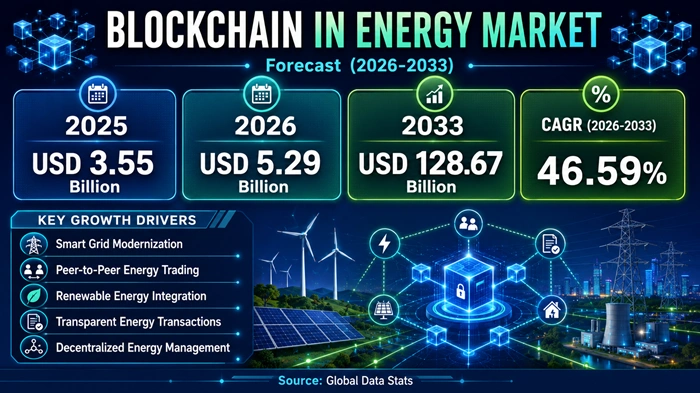
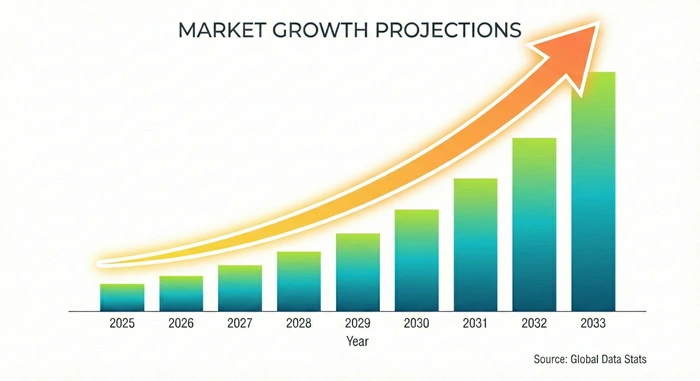
The global blockchain in energy market size is valued at USD 3.55 billion in 2025 and is predicted to increase from USD 5.29 billion in 2026 to approximately USD 128.67 billion by 2033, growing at a CAGR of 46.59% from 2026 to 2033. This extraordinary growth is driven by the rapid expansion of decentralized renewable energy systems, the surging global adoption of peer-to-peer energy trading platforms, increasing government and corporate investment in carbon credit and renewable energy certificate tracking, and the growing recognition across utilities and energy producers that blockchain's transparency, immutability, and programmability can fundamentally address the trust, security, and efficiency challenges of modern energy grid management.
Blockchain technology is increasingly being applied across the energy sector's most critical pain points — from enabling transparent energy transactions and automating billing through smart contracts to facilitating cross-border carbon trading and securing real-time grid data — making it one of the most strategically important emerging technologies in the global energy transition.
AI Impact on the Blockchain in Energy Industry
The Convergence of Artificial Intelligence and Blockchain Is Creating a New Generation of Autonomous, Self-Optimizing Energy Networks That Can Trade Energy, Balance Grids, and Track Sustainability Credentials With Minimal Human Intervention and Near-Zero Settlement Latency
Artificial intelligence is amplifying the commercial value and operational capabilities of blockchain applications in the energy sector by solving the intelligent decision-making problem that distributed blockchain energy networks cannot address on their own. Blockchain excels at recording, verifying, and executing transactions in a tamper-resistant, decentralized manner — but it does not inherently possess the ability to analyze real-time energy consumption patterns, predict grid demand fluctuations, or optimize the routing of distributed renewable energy flows across complex network topologies. AI fills precisely this gap, enabling blockchain-based energy platforms to move beyond passive transaction recording toward active, predictive grid intelligence. Companies building AI-blockchain hybrid platforms for the blockchain in energy market — including IBM, Siemens Energy, and Grid Singularity — are demonstrating that AI-powered demand forecasting combined with blockchain smart contract execution can automate complex multi-party energy dispatch decisions at speeds and scales that no centralized control system could match.
The combination of machine learning and blockchain is also transforming the carbon and renewable energy certificate (REC) market by enabling real-time, data-driven verification of renewable energy generation claims at the source. AI models can analyze IoT sensor data from solar panels, wind turbines, and smart meters — validating generation volumes, device performance, and energy delivery — while blockchain provides the immutable audit trail that regulators, corporate sustainability teams, and voluntary carbon market participants require to trust the integrity of the environmental attribute claims being made. This AI-verified, blockchain-anchored approach to sustainability credential management is increasingly important as corporate net-zero commitments multiply and the scrutiny applied to greenwashing claims intensifies, creating growing institutional demand for the kind of digitally verifiable, AI-backed energy provenance systems that the blockchain in energy market is uniquely positioned to supply.
Growth Factors
Decentralized Renewable Energy Adoption, Regulatory Mandates for Energy Market Transparency, and the Global Carbon Market Expansion Are the Three Most Powerful Structural Forces Driving Explosive Growth in the Blockchain in Energy Market
The transition to decentralized, renewable energy systems is creating a structural need for new transaction infrastructure that legacy energy markets were never designed to support. Traditional electricity markets were built around centralized generation, one-way power flows, and utility-controlled metering — a model that is increasingly incompatible with the realities of modern energy systems, where millions of rooftop solar panels, battery storage units, electric vehicles, and community wind projects are simultaneously generating, storing, and consuming electricity across complex multi-directional grids. The blockchain in energy market is growing because peer-to-peer energy trading platforms — which allow prosumers (simultaneous energy producers and consumers) to sell excess renewable generation directly to neighbors or grid participants without routing transactions through a central utility — require exactly the kind of decentralized, trustless transaction settlement that blockchain technology enables. Projects including LO3 Energy's Brooklyn Microgrid in New York, Powerledger in Australia and the United States, and various European Enerchain participants have demonstrated that blockchain-based P2P energy trading is technically viable and commercially attractive — creating proof points that are accelerating broader investment and deployment globally.
Government regulatory initiatives and corporate sustainability mandates are adding a second powerful demand driver by requiring verifiable, auditable energy data that manually managed or centrally controlled systems cannot reliably provide. The European Union's Green Deal, Renewable Energy Directive (RED III), and Corporate Sustainability Reporting Directive (CSRD) all create specific requirements for energy provenance documentation, renewable attribute verification, and carbon footprint reporting that blockchain's immutable, real-time transaction ledger is uniquely suited to satisfy. In parallel, major corporations with science-based emissions reduction targets — including Microsoft, Google, Amazon, and Shell — are investing in blockchain-based energy attribute certificate systems to ensure that their renewable energy procurement claims are verifiable and defensible under the emerging global standards for corporate decarbonization reporting. These regulatory and corporate demand vectors are creating large, well-funded institutional buyers for blockchain energy platforms that are driving significant commercial market growth.
Market Outlook
The Maturing of Smart Grid Infrastructure, the Expansion of Cross-Border Carbon Trading Programs, and Growing Utility Adoption of Consortium Blockchain Platforms Are Establishing the Conditions for Sustained Hypergrowth in the Blockchain in Energy Market Through 2033
The medium and long-term commercial outlook for the blockchain in energy market is exceptionally strong, anchored by the convergence of energy infrastructure modernization investment, global decarbonization policy commitments, and the ongoing cost reduction and performance improvement of blockchain platforms. Smart grid infrastructure is being deployed at massive scale globally — with the International Energy Agency estimating that over $1 trillion will be invested in electricity grid modernization between 2023 and 2030 — creating a vast new digital energy data infrastructure that generates the real-time generation, consumption, and distribution data that blockchain applications require to function effectively. As smart meters, grid sensors, IoT devices, and distributed energy resource management systems become ubiquitous components of modern energy infrastructure, the data pipelines that blockchain platforms need to operate are being built at public utility investment scale — dramatically lowering the deployment friction for commercial blockchain energy applications.
The emerging global voluntary and compliance carbon market is another powerful long-term demand driver that is still in its early stages of blockchain integration. Carbon credit markets are notoriously vulnerable to double-counting, fraudulent claims, and lack of traceability — problems that blockchain technology can structurally solve by creating a single, immutable record of each carbon credit's creation, ownership transfer, and retirement. As the Article 6 mechanisms of the Paris Agreement create new international carbon trading frameworks and as the voluntary carbon market scales toward projected values of several hundred billion dollars annually by the mid-2030s, the demand for blockchain-based registry and trading infrastructure will grow proportionally. Consortiums including the Energy Web Foundation, B4E (Blockchain for Energy), and various utility-backed industry groups are already building the shared blockchain infrastructure that is expected to serve as the foundation for global energy and carbon market digitization — positioning the blockchain in energy ecosystem for a sustained multi-decade growth trajectory.
Expert Speaks
-
"At IBM, we have been deeply engaged in applying blockchain to energy system challenges for several years, and the use cases continue to multiply. The ability to create a trusted, shared record of energy transactions — whether for renewable energy certificates, carbon credits, or peer-to-peer power trading — is driving significant commercial adoption across utilities, grid operators, and corporate energy buyers who need verifiable sustainability data." — CEO, IBM Corporation
-
"Siemens Energy is committed to building the digital infrastructure of the energy transition, and blockchain plays a key role in enabling the transparent, automated, and decentralized energy systems that our customers are building. The combination of smart contracts and distributed ledger technology is making it possible to manage complex multi-party energy transactions with a level of speed, accuracy, and auditability that was simply not achievable before." — CEO, Siemens Energy AG
-
"Shell has been exploring blockchain technology in energy for several years because we recognize that the complexity of modern energy markets — spanning electrons, molecules, carbon credits, and renewable attributes across dozens of jurisdictions — requires a new kind of transaction infrastructure. Blockchain's ability to provide a single source of truth for complex multi-party energy deals is genuinely transformative for how energy markets will function in the future." — CEO, Shell plc
Key Report Takeaways
-
North America leads the blockchain in energy market with approximately 35% of global revenue share in 2025, driven by strong utility investment in smart grid technologies, growing peer-to-peer energy trading pilot programs, significant corporate renewable energy procurement activity requiring REC verification, and the presence of leading blockchain energy companies including LO3 Energy, IBM, and ConsenSys
-
Asia Pacific is the fastest-growing region, projected to expand at a CAGR of approximately 52% from 2026 to 2033, driven by rapid renewable energy capacity expansion in China and India, growing government digitalization investment in energy infrastructure, strong utility modernization programs in Japan and South Korea, and increasing corporate sustainability reporting requirements driving blockchain REC adoption
-
Power utilities and grid operators are the dominant end-user segment, accounting for approximately 38% of market revenue in 2025, as established utility companies invest in blockchain platforms to improve grid data management, enable prosumer energy trading programs, automate billing through smart contracts, and comply with increasing regulatory requirements for transparent, auditable energy transaction records
-
Energy trading and peer-to-peer trading is the leading application segment, contributing approximately 32% of total blockchain in energy market revenue in 2025, driven by the rapid global growth of P2P energy trading platforms that enable prosumers to sell excess renewable electricity directly to local buyers without centralized intermediary settlement infrastructure
-
Consortium/hybrid blockchain is the most widely deployed platform type, holding approximately 45% of market share in 2025, as utility companies, energy grid operators, and regulatory bodies prefer permissioned consortium frameworks that balance the transparency and immutability benefits of blockchain with the privacy, governance, and performance requirements of enterprise energy market applications
-
Carbon credit management and REC tracking is the fastest-growing application segment, projected at a CAGR of approximately 58% through 2033, as corporate net-zero commitments multiply globally and the Article 6 Paris Agreement carbon trading mechanisms create new compliance-grade demand for blockchain-verified environmental attribute registration and trading infrastructure
Market Scope
Market Dynamics
Drivers Impact Analysis
Decentralized Renewable Energy Growth, Corporate Net-Zero Commitments, and Regulatory Mandates for Energy Data Transparency Are the Three Dominant Forces Accelerating Adoption of Blockchain Applications Across the Global Energy Sector
| Driver | ≈ % Impact on CAGR Forecast | Geographic Relevance | Impact Timeline |
|---|---|---|---|
| Expansion of decentralized renewable energy and prosumer P2P trading | ~28% | Global, strongest in Europe, North America | Short to Long Term |
| Corporate sustainability mandates and REC verification demand | ~24% | North America, Europe, Asia Pacific | Short to Long Term |
| Government smart grid modernization and energy digitalization investment | ~22% | Asia Pacific, North America, Europe | Medium to Long Term |
| Carbon credit market growth and Article 6 compliance mechanisms | ~16% | Global | Medium to Long Term |
| Energy sector cybersecurity and data integrity requirements | ~10% | Global | Short to Medium Term |
The blockchain in energy market is being propelled by a uniquely powerful combination of market pull and regulatory push that is accelerating commercial adoption far beyond typical enterprise technology adoption timelines. The market pull is driven by the commercial opportunity that peer-to-peer energy trading creates for prosumers — particularly small and medium-scale solar energy producers who currently receive below-market feed-in tariff rates from utilities when they export excess generation, but who could realize significantly higher revenue by trading directly with local buyers through blockchain platforms. As rooftop solar installation volumes grow globally and battery storage costs continue to fall, the number of prosumers capable of and motivated to participate in P2P energy markets is growing rapidly — creating an expanding addressable user base for blockchain energy trading platforms in every major electricity market.
The regulatory push is equally powerful, with energy regulators in the EU, UK, Australia, and several U.S. states all actively developing frameworks that require digital, auditable, and interoperable energy data management systems — requirements that legacy centralized utility data management approaches cannot efficiently satisfy. The EU's REDIII directive requires member states to enable prosumer energy communities and P2P trading, effectively mandating the operational conditions under which blockchain energy platforms thrive. Australia's Energy Security Board has developed specific regulatory frameworks for distributed energy resource management that envision blockchain-based virtual power plant and peer-to-peer trading coordination. These regulatory frameworks are transforming blockchain from an experimental technology into a preferred compliance-ready infrastructure solution for the evolving energy market — accelerating the transition from pilot programs to commercially deployed platforms across the blockchain in energy market.
Restraints Impact Analysis
Blockchain Scalability Limitations for High-Frequency Energy Transactions, Regulatory Fragmentation Across Energy Markets, and the High Cost and Complexity of Legacy System Integration Are the Primary Factors Limiting Faster Mainstream Adoption in the Blockchain in Energy Market
| Restraint | ≈ % Impact on CAGR Forecast | Geographic Relevance | Impact Timeline |
|---|---|---|---|
| Scalability and throughput limitations for real-time energy transaction volumes | ~-28% | Global | Ongoing |
| Regulatory fragmentation and lack of interoperability standards | ~-24% | Global | Medium to Long Term |
| High integration cost with existing legacy energy management systems | ~-20% | North America, Europe | Ongoing |
| Energy consumption of proof-of-work blockchain platforms | ~-16% | Global | Medium Term |
| Limited technical expertise and awareness in traditional utility sectors | ~-12% | Emerging markets, traditional utilities | Ongoing |
The scalability challenge remains the most technically significant constraint on broader blockchain deployment in energy markets. Real-time electricity grid management involves millions of simultaneous transactions per second — metering reads, frequency regulation signals, dispatch instructions, and settlement confirmations — that exceed the transaction throughput capabilities of current public and most enterprise blockchain platforms. Bitcoin processes approximately 7 transactions per second, and even more advanced platforms like Ethereum process only hundreds of transactions per second under optimal conditions, far short of what large-scale energy market clearing requires. While layer-2 scaling solutions, state channel architectures, and purpose-built energy blockchain platforms like the Energy Web Chain are specifically designed to address these throughput limitations, the technology is still maturing — and most current commercial blockchain energy deployments operate on relatively small-scale P2P trading or REC tracking applications rather than the full-scale, real-time grid management use cases that would represent the technology's maximum commercial potential.
Regulatory fragmentation across energy markets creates a second major adoption barrier that is particularly challenging for companies attempting to build cross-border blockchain energy trading platforms. Electricity market regulation varies enormously across jurisdictions — with differences in market structure (regulated vs. deregulated), metering standards, grid code requirements, consumer protection rules, and data privacy laws creating a complex patchwork of compliance requirements that blockchain energy platforms must navigate simultaneously. The EU's relatively harmonized regulatory environment has enabled more rapid progress in cross-border energy blockchain pilots — particularly the ENTSO-E coordinated Enerchain project — than has been possible in more fragmented markets like the United States, where state-level electricity regulation creates significant inconsistencies in the commercial conditions for P2P energy trading program deployment.
Opportunities Impact Analysis
Virtual Power Plants, Cross-Border Carbon Trading Platforms, and EV Grid Integration Through Vehicle-to-Grid Blockchain Systems Represent the Three Highest-Value Emerging Opportunities in the Blockchain in Energy Market
| Opportunity | ≈ % Impact on CAGR Forecast | Geographic Relevance | Impact Timeline |
|---|---|---|---|
| Virtual power plant coordination and DER aggregation | ~+32% | North America, Europe, Asia Pacific | Short to Medium Term |
| Cross-border carbon credit and REC blockchain trading | ~+26% | Global | Medium to Long Term |
| Vehicle-to-grid (V2G) blockchain integration | ~+20% | North America, Europe, Asia Pacific | Medium to Long Term |
| Emerging market off-grid and microgrid energy access | ~+14% | Africa, South Asia, Latin America | Medium to Long Term |
| Utility tokenization and decentralized finance (DeFi) energy financing | ~+8% | Global | Long Term |
Virtual power plant (VPP) coordination represents one of the most commercially immediate and scalable opportunities in the blockchain in energy market. VPPs aggregate the controllable load, generation, and storage capacity of thousands of distributed energy resources — rooftop solar panels, home battery systems, smart thermostats, and electric vehicles — into a single dispatchable resource that can provide grid services including frequency regulation, demand response, and reserve capacity that were previously only available from large centralized power plants. Blockchain platforms enable VPP coordination by providing the secure, automated, and transparent transaction infrastructure needed to manage real-time energy dispatch instructions, settle participant payments, and maintain auditable records of grid service delivery — all without requiring a trusted central operator to manage the millions of individual device-level interactions that VPP operation involves. Companies including AGL Energy (Australia), Sonnen (Germany), and OhmConnect (USA) are actively developing VPP programs that incorporate blockchain elements, and the commercial opportunity is growing rapidly as electricity grid operators offer increasing compensation for demand flexibility services.
The intersection of electric vehicle growth and blockchain-enabled vehicle-to-grid (V2G) technology represents a transformative long-term opportunity that is only beginning to emerge commercially. V2G technology enables EV batteries to discharge stored electricity back to the grid during peak demand periods, providing valuable grid balancing services while generating revenue for EV owners. The complexity of managing millions of individual V2G transactions — each involving dynamic pricing, real-time grid signal response, battery state of charge management, and automated payment settlement — creates exactly the type of high-volume, multi-party coordination challenge that blockchain smart contracts are designed to solve efficiently. As EV penetration rates grow toward projected levels of 40–60% of new vehicle sales in major markets by the early 2030s, the scale of the V2G opportunity — and the blockchain infrastructure needed to manage it — will grow proportionally, creating a significant new commercial frontier within the blockchain in energy market.
Segment Analysis
By Application
Energy Trading and Peer-to-Peer Platforms Dominate Application Revenue Today While Carbon Credit and REC Tracking Is Emerging as the Fastest-Growing Blockchain Application Across the Energy Sector
Energy trading and peer-to-peer (P2P) trading applications hold approximately 32% of total blockchain in energy market revenue in 2025 and are growing at a CAGR of approximately 44% through 2033, driven by the rapidly growing global prosumer population and the increasing regulatory support for decentralized energy market participation. P2P energy trading platforms built on blockchain — including Powerledger (Australia/USA), LO3 Energy (USA), and WePower (Europe) — allow residential and commercial solar energy producers to sell excess generation directly to nearby buyers at negotiated prices, with blockchain handling transaction verification, metering data recording, smart contract-based settlement, and regulatory compliance documentation automatically and transparently. North America and Europe are the most commercially developed regions for blockchain P2P energy trading, benefiting from deregulated electricity market structures, progressive utility commission frameworks, and strong prosumer solar penetration that together create the market conditions for commercial P2P trading program viability; key companies active in North America include LO3 Energy, ConsenSys, and several utility innovation programs run by Exelon and Duke Energy.
Carbon credit management and renewable energy certificate (REC) tracking is the fastest-growing application within the blockchain in energy market, projected to expand at a CAGR of approximately 58% from 2026 to 2033 as the global corporate net-zero movement creates massive new institutional demand for verifiable, blockchain-anchored sustainability credentials. Large corporations with SEC-regulated or CSRD-mandated climate disclosure obligations need to demonstrate that their renewable energy procurement is genuine, additional, and not double-counted — a standard of proof that manual or centralized certificate registry systems cannot reliably provide. The Energy Web Foundation's EW-DOS platform, IBM's Environmental Intelligence Suite, and Gold Standard's blockchain-based carbon registry are among the platforms building the digital infrastructure for next-generation carbon and REC markets; Asia Pacific is the fastest-growing regional market for blockchain carbon and REC applications, driven by China's Emissions Trading Scheme expansion, India's growing renewable energy certificate market, and Singapore's role as a regional hub for voluntary carbon market trading and financial services related to energy transition.
By Type
Consortium Blockchain Leads Deployment Share as Enterprises Prefer Permissioned Architectures While Public Blockchain Platforms Power the Consumer-Facing P2P Energy Trading Ecosystem
Consortium/hybrid blockchain platforms account for approximately 45% of the blockchain in energy market's total revenue in 2025 and are growing at a CAGR of approximately 42% through 2033, as established utility companies, grid operators, and energy regulators favor permissioned, governance-controlled blockchain architectures that provide the transparency and immutability benefits of distributed ledger technology while maintaining the access controls, transaction privacy, and performance characteristics required in regulated energy market environments. The Energy Web Chain — a purpose-built, proof-of-authority blockchain co-developed by the Rocky Mountain Institute and Grid Singularity — exemplifies this model, providing a shared enterprise-grade blockchain infrastructure that dozens of utilities and energy technology companies have adopted for applications including renewable energy tracking, EV charging management, and distributed energy resource coordination. European utility consortia including ENTSO-E's Enerchain project and the German utility-backed Powerpeers program are further examples of consortium models that are building real commercial transaction volumes on shared permissioned blockchain infrastructure; leading companies in this space include IBM (USA), Siemens Energy (Germany), Energy Web Foundation (Switzerland), and Shell New Energies (Netherlands/UK).
Private blockchain platforms hold approximately 25% of market share in 2025 and are growing strongly among large oil and gas companies and integrated energy majors that are using internal blockchain deployments for specific operational use cases including supply chain provenance tracking, contractual settlement automation, and internal carbon accounting. Companies including BP, TotalEnergies, and Chevron have developed private blockchain systems to manage specific high-value transaction types within their own ecosystems — using the technology's smart contract capabilities to automate complex commodity trading settlement processes that previously required significant manual reconciliation effort. Public blockchain platforms — including Ethereum-based applications developed by startups targeting the consumer P2P energy market and decentralized energy finance use cases — account for approximately 30% of the market and are growing at the highest rate within the type segment as the developer ecosystem, consumer applications, and DeFi energy financing use cases built on public chains continue to expand.
Regional Insights
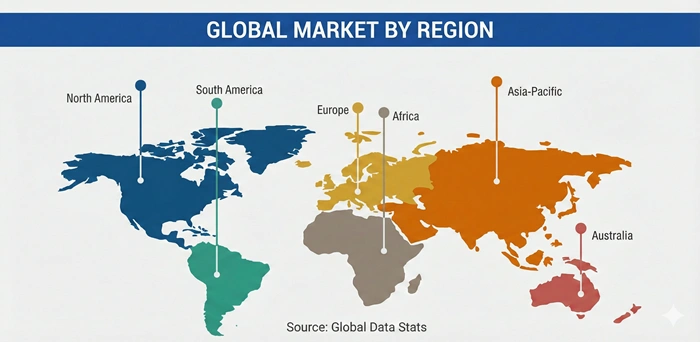
North America's Deregulated Market Leadership and Asia Pacific's Massive Renewable Energy Deployment Scale Define the Two Most Commercially Critical Regions in the Global Blockchain in Energy Market
North America
North America's Deregulated Electricity Markets, Strong Utility Innovation Investment, and Corporate Renewable Energy Procurement Activity Establish It as the Leading Revenue Region in the Blockchain in Energy Market
North America leads the blockchain in energy market with approximately 35% of global revenue in 2025 and a regional CAGR of approximately 43% from 2026 to 2033. The United States drives the majority of regional activity, supported by its large deregulated electricity market — particularly in states including Texas, California, New York, and Pennsylvania — where competitive market structures create the commercial conditions for P2P energy trading, virtual power plant coordination, and blockchain-based settlement innovation. The presence of dominant technology and blockchain platform companies including IBM (USA), ConsenSys (USA), and LO3 Energy (USA) creates a strong innovation cluster that is both advancing the technology and building commercial deployments at scale within the regional energy market.
Canada contributes actively through its provincial clean energy transition programs — particularly in British Columbia, Ontario, and Alberta, where renewable energy expansion programs, carbon pricing mechanisms, and growing corporate green energy procurement are creating demand for blockchain-based REC verification and carbon tracking platforms. The regional market is further strengthened by active investment from major U.S. utilities including Duke Energy, Exelon, and NextEra Energy in blockchain proof-of-concept and pilot programs, and by the U.S. Department of Energy's continuing funding of blockchain energy research through its ARPA-E and Office of Electricity programs.
Asia Pacific
Asia Pacific's Unprecedented Renewable Energy Build-Out, China's Expanding Emissions Trading Scheme, and Strong Government Digital Energy Infrastructure Investment Are Driving the Fastest Regional Growth in the Blockchain in Energy Market
Asia Pacific is the fastest-growing region in the blockchain in energy market, projected to expand at a CAGR of approximately 52% from 2026 to 2033, driven by the extraordinary scale of renewable energy capacity being deployed across the region and the growing institutional recognition that blockchain technology is essential infrastructure for managing the transparency, verification, and trading requirements of complex distributed energy systems. China's National Carbon Market — the world's largest by covered emissions — is increasingly exploring blockchain integration for carbon credit issuance, verification, and trading, while the government's ambitious 1,200 GW renewable energy installation target by 2030 is creating massive new demand for REC tracking and clean energy attribute verification infrastructure that blockchain platforms are uniquely suited to provide. Key companies active in the Asia Pacific blockchain energy space include Power Ledger (Australia), Tokyo Electric Power Company (Japan), and State Grid Corporation of China (China).
Australia has emerged as one of the world's most advanced markets for commercial blockchain P2P energy trading, with Powerledger operating multiple live commercial programs including P2P solar energy trading projects in Perth and several international markets, and the Australian Energy Market Commission actively developing regulatory frameworks that support distributed energy trading program expansion. India is a rapidly growing blockchain energy market, with the government's Smart Grid Mission and Renewable Energy Certificate market creating regulatory infrastructure that is increasingly amenable to blockchain integration; Indian energy blockchain startups and global technology companies are beginning to develop platforms targeting the country's large and growing distributed solar energy market. Japan and South Korea are investing heavily in smart grid modernization and VPP development programs that are creating natural deployment environments for blockchain energy coordination platforms within their tightly managed grid environments.
Report Customization Available by Region and Country
This report is fully customizable to deliver targeted blockchain in energy market intelligence for specific regions, countries, and geographies, providing localized market sizing, regulatory environment assessments, technology adoption landscape analysis, competitive positioning data, and strategic growth opportunity maps tailored to your precise geographic focus area.
Customized versions of this report are available for every major global region and their constituent countries, ensuring that energy sector investment, market entry, and product development decisions are grounded in granular, locally validated intelligence specific to the blockchain and energy ecosystem in each target geography.
North America
-
United States — World's largest blockchain in energy market driven by deregulated electricity markets, P2P trading pilots, corporate REC procurement, and leading blockchain companies including IBM and ConsenSys
-
Canada — Growing blockchain energy market with provincial clean energy programs, carbon pricing mechanisms, and increasing utility investment in blockchain innovation
-
Mexico — Developing market with growing renewable energy capacity and increasing government interest in digital energy infrastructure modernization
Europe
-
United Kingdom — Active blockchain energy market with Ofgem-supported innovation programs, growing P2P trading regulation, and strong corporate sustainability-driven REC verification demand
-
Germany — Europe's largest blockchain energy market with utility-backed consortium projects, leading renewable energy prosumer population, and Enerchain cross-border trading initiative
-
France — Growing market with EDF's blockchain energy pilot programs, growing corporate PPA activity, and national clean energy transition investment driving REC platform adoption
-
Italy — Developing blockchain energy market with increasing distributed solar adoption and growing utility digital transformation investment
-
Rest of Europe — Includes Netherlands, Belgium, and Switzerland as active markets for cross-border blockchain energy trading, REC platforms, and green energy certificate systems
Asia Pacific
-
China — Largest Asia Pacific blockchain energy market driven by national carbon market, massive renewable energy deployment, and State Grid Corporation digital energy program
-
India — Fast-growing market with Smart Grid Mission, REC market expansion, and growing distributed solar energy requiring blockchain-based trading infrastructure
-
Japan — Advanced smart grid market with VPP development programs, blockchain energy coordination pilots, and major utility digital transformation investment
-
South Korea — Active blockchain energy market with strong government renewable energy target programs and growing prosumer community energy trading development
-
Australia — Global leader in commercial P2P blockchain energy trading through Powerledger's live programs and progressive market regulatory frameworks
-
Rest of Asia Pacific — Includes Singapore, Thailand, and New Zealand as growing markets with increasing blockchain energy innovation investment and regulatory support
Latin America
-
Brazil — Largest Latin American energy market with significant renewable energy capacity and growing digital energy infrastructure investment driving blockchain adoption
-
Argentina — Developing blockchain energy market with expanding renewable energy programs and increasing corporate sustainability reporting requirements
-
Rest of Latin America — Includes Chile, Colombia, and Costa Rica as growing markets with strong renewable energy sectors creating demand for blockchain-based REC and carbon tracking
Middle East & Africa
-
UAE — Advanced digital energy market with Dubai Blockchain Strategy, smart city energy infrastructure investment, and growing renewable energy project development requiring blockchain transparency
-
Saudi Arabia — Expanding blockchain energy market driven by Vision 2030 renewable energy programs, NEOM smart city development, and growing corporate sustainability credential requirements
-
Rest of MEA — Includes South Africa, Kenya, and Nigeria as markets with significant off-grid and microgrid energy access programs where blockchain can enable trusted community energy trading
Top Key Players
-
IBM Corporation (United States)
-
Siemens Energy AG (Germany)
-
Powerledger Pty Ltd (Australia)
-
LO3 Energy Inc. (United States)
-
ConsenSys Inc. (United States)
-
Energy Web Foundation (Switzerland)
-
Shell plc / Shell New Energies (United Kingdom / Netherlands)
-
Power Ledger / WePower (Australia / Europe)
-
Grid Singularity GmbH (Austria)
-
Electron (United Kingdom)
-
Enerchain / Ponton GmbH (Germany)
-
BTL Group Ltd (Canada)
-
Verv Energy Ltd (United Kingdom)
-
Share&Charge Foundation (Germany)
-
TotalEnergies SE (France)
Recent Developments
-
In 2025, Energy Web Foundation announced a major upgrade to the Energy Web Chain infrastructure, incorporating new layer-2 scaling capabilities specifically designed to support high-frequency distributed energy resource (DER) coordination transactions at the volumes required by large-scale virtual power plant and V2G applications — directly addressing the scalability constraints that have limited real-time grid management blockchain deployment
-
In 2025, IBM expanded its Environmental Intelligence Suite to include blockchain-verified renewable energy procurement analytics for large enterprise corporate clients, enabling automated, audit-ready REC tracking and Scope 2 emissions reporting that satisfies SEC climate disclosure and EU CSRD regulatory requirements within a single integrated platform
-
In 2024, Powerledger secured multiple new international partnership agreements for commercial P2P energy trading program deployments in Southeast Asian markets including Thailand and the Philippines, expanding its commercial footprint beyond its established Australian and U.S. programs and establishing a significant presence in the rapidly growing Asia Pacific blockchain in energy market
-
In 2025, Shell New Energies deepened its blockchain energy investment portfolio by participating in a consortium blockchain platform for cross-border liquefied natural gas (LNG) cargo tracking and automated settlement, applying distributed ledger technology to reduce the complex multi-party documentation and reconciliation processes associated with international energy commodity trades
-
In 2024, Siemens Energy launched a pilot program for blockchain-based virtual power plant coordination in Germany in partnership with regional distribution network operators, demonstrating real-time automated demand response settlement for aggregated residential battery storage and smart thermostat loads using smart contracts deployed on the Energy Web Chain platform
Market Trends
The Tokenization of Energy Assets, the Mainstreaming of Blockchain-Verified Corporate Green Energy Procurement, and the Rise of Decentralized Energy Finance Are the Three Most Transformative Trends Reshaping the Blockchain in Energy Market Landscape
The tokenization of energy assets — representing renewable energy generation capacity, battery storage units, or long-term power purchase agreements as blockchain-based digital tokens that can be fractionalized, traded, and used as collateral in decentralized finance applications — is emerging as one of the most innovative and commercially significant new frontiers within the blockchain in energy market. Tokenization enables small investors to participate in renewable energy project financing through fractional ownership of blockchain-registered clean energy infrastructure, dramatically expanding the capital available for solar, wind, and storage project development beyond the institutional investor market that has historically dominated clean energy investment. Companies including WePower, LiquidPower, and several DeFi energy startups are pioneering energy asset tokenization platforms that are attracting growing interest from both renewable energy developers seeking new financing channels and retail investors seeking sustainable investment products with real energy sector yield backing.
The mainstreaming of blockchain verification in corporate renewable energy procurement is simultaneously driving significant near-term commercial growth. As the Securities and Exchange Commission's climate disclosure rules and Europe's CSRD create legal obligations for large companies to report verified Scope 2 emissions and renewable energy procurement data, the demand for blockchain-anchored energy attribute certificates that cannot be double-counted or fabricated is transitioning from a voluntary best practice to a compliance requirement. This compliance-driven demand is creating large, predictable institutional revenue streams for blockchain REC platforms — transforming what was previously a niche sustainability technology market into a mainstream enterprise software category with well-defined regulatory use cases, clear commercial buyers, and growing certification infrastructure that will support sustained market growth throughout the forecast period.
Segments Covered in the Report
-
By Type
-
Public Blockchain
-
Private Blockchain
-
Consortium/Hybrid Blockchain
-
-
By Application
-
Grid Management & Smart Grid
-
Energy Trading & Peer-to-Peer Trading
-
Carbon Credit Management
-
Renewable Energy Certificate (REC) Tracking
-
Supply Chain Management
-
Payment & Billing Automation
-
Others
-
-
By End User
-
Power Generation Companies
-
Utilities & Grid Operators
-
Oil & Gas Companies
-
Renewable Energy Producers
-
Government & Regulatory Bodies
-
Industrial & Commercial Energy Users
-
Others
-
-
By Region
-
North America (U.S., Canada, Mexico)
-
Europe (U.K., Germany, France, Italy, Rest of Europe)
-
Asia Pacific (China, India, Japan, South Korea, Australia, Rest of Asia Pacific)
-
Latin America (Brazil, Argentina, Rest of Latin America)
-
Middle East & Africa (UAE, Saudi Arabia, Rest of MEA)
-
❝ Built for Every Level — From Startups to Industry Giants ❞
Here Is Exactly How This Report Works for You
-
For global energy companies, utility corporations, and institutional investors evaluating the blockchain energy technology landscape, this report delivers precise market sizing by application, platform type, and geography, competitor revenue and technology roadmap intelligence, P2P trading regulatory environment assessments, and geopolitical risk analysis — including how U.S.-China clean energy policy competition, EU carbon border adjustment mechanisms, and national grid data sovereignty regulations are creating both barriers and strategic acceleration opportunities for blockchain energy platform deployment across different regional markets
-
For mid-market blockchain technology companies, energy software developers, and digital energy platform startups, the report provides segment-level demand forecasts, end-user adoption driver benchmarking, competitive landscape analysis, and technology white-space mapping — enabling sales and product teams to identify which application areas — carbon credit platforms, VPP coordination, V2G integration — are generating the fastest institutional investment, how pricing models are evolving for enterprise blockchain energy solutions, and which geographic markets offer the most commercially favorable conditions for rapid revenue growth in the expanding blockchain in energy ecosystem
-
Startups developing novel decentralized energy trading protocols, tokenized clean energy asset platforms, or AI-blockchain hybrid grid management systems will find the report's investment landscape analysis, corporate procurement trend forecasting, partnership opportunity mapping, and regulatory readiness scoring by market indispensable for prioritizing product development, building investor narratives anchored in verified market sizing data, and making confident go-to-market decisions in the rapidly expanding and high-CAGR blockchain in energy market
Frequently Asked Questions
Question 1: What is the projected size of the blockchain in energy market by 2033?
Answer: The blockchain in energy market is projected to reach approximately USD 128.67 billion by 2033, growing from USD 5.29 billion in 2026 at a CAGR of 46.59%. This extraordinary growth is driven by decentralized renewable energy adoption, P2P energy trading expansion, and growing corporate demand for blockchain-verified sustainability credentials.
Question 2: What are the key applications driving the blockchain in energy market?
Answer: The primary applications driving the blockchain in energy market include peer-to-peer energy trading, carbon credit management, renewable energy certificate tracking, smart grid management, and automated billing through smart contracts. Carbon credit and REC tracking is the fastest-growing application, projected to expand at approximately 58% CAGR through 2033 as corporate net-zero reporting obligations multiply globally.
Question 3: Which region leads the blockchain in energy market?
Answer: North America leads the blockchain in energy market with approximately 35% of global revenue share in 2025, supported by deregulated electricity market structures, strong corporate renewable energy procurement activity, and the presence of leading blockchain energy companies including IBM, ConsenSys, and LO3 Energy. Asia Pacific is the fastest-growing region, expanding at approximately 52% CAGR from 2026 to 2033.
Question 4: How is AI improving blockchain applications in the energy sector?
Answer: AI is enhancing the blockchain in energy market by enabling intelligent, automated energy dispatch decisions and predictive grid management capabilities that blockchain alone cannot provide — creating AI-blockchain hybrid systems that can autonomously optimize distributed energy resource coordination, carbon credit verification, and P2P trading price discovery. AI-powered IoT data validation combined with blockchain's immutable audit trail is also transforming REC and carbon credit verification into a digitally verifiable, near-real-time process.
Question 5: What are the main challenges facing the blockchain in energy market?
Answer: The primary challenges facing the blockchain in energy market include the scalability limitations of current blockchain platforms for high-frequency real-time energy transaction volumes, the high integration costs associated with connecting blockchain systems to legacy energy management infrastructure, and the fragmented regulatory landscape across different electricity market jurisdictions that complicates cross-border blockchain energy trading platform deployment. Addressing these challenges through purpose-built energy blockchain platforms, layer-2 scaling solutions, and progressive regulatory harmonization is expected to unlock significantly faster commercial adoption through 2033.