
BioSignal Serums Market Overview
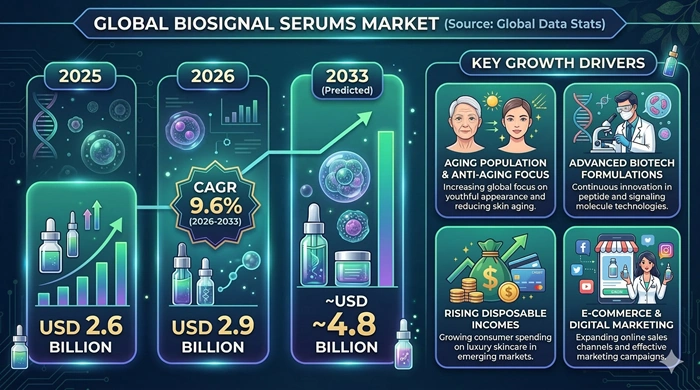
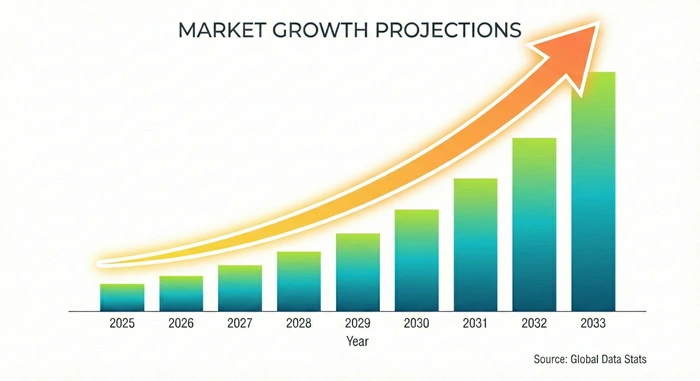
The global BioSignal serums market size is valued at USD 2.6 billion in 2025 and is predicted to increase from USD 2.9 billion in 2026 to approximately USD 4.8 billion by 2033, growing at a CAGR of 9.6% from 2026 to 2033.
BioSignal serums represent an advanced category of bioactive skincare formulations that work by mimicking or modulating the body's natural cellular communication processes. These serums use signal peptides, growth factors, exosomes, and cytokine-based compounds to trigger specific biological responses within skin cells — such as collagen synthesis, cell renewal, and barrier restoration. Growing consumer sophistication, the rise of science-backed cosmeceuticals, and increasing clinical validation of bioactive skincare compounds are collectively driving strong and sustained market expansion across key global regions.
AI Impact on the BioSignal Serums Industry
Artificial Intelligence Is Transforming Ingredient Discovery, Consumer Personalization, and Formulation Efficiency Across the Bioactive Signal Serum Landscape
Artificial intelligence is reshaping how BioSignal serum formulations are developed, tested, and brought to market. AI-driven molecular simulation tools are enabling cosmetic chemists to model how specific peptide sequences interact with skin cell receptors, helping identify high-efficacy signal compounds with greater precision and significantly shorter development timelines. This capability is accelerating the creation of next-generation bioactive serums that deliver measurable, clinically verifiable outcomes rather than relying on general ingredient claims.
On the consumer-facing side, AI-powered skin diagnostics are transforming how BioSignal serums are recommended and personalized. Apps and devices that analyze skin texture, pigmentation, hydration levels, and aging markers through smartphone cameras or wearable sensors are enabling brands to offer customized serum regimens tailored to each individual's biological skin profile. This level of personalization was previously available only through expensive dermatological consultations, but AI is now making it scalable, accessible, and commercially compelling — creating a new growth engine for premium bioactive serum brands.
Growth Factors
Rising Consumer Demand for Clinically Validated Skincare, Growing Cosmeceutical Sophistication, and the Premiumization of the Skincare Industry Are the Core Drivers Powering Market Expansion
The most significant driver behind the BioSignal serums market is the rapidly evolving consumer preference for skincare products grounded in biological science rather than marketing narratives. Today's skincare consumer, particularly in the premium and luxury segments, actively researches ingredient efficacy, seeks clinical study references, and gravitates toward formulations that interact meaningfully with skin biology. Signal peptides, growth factors, and exosome-based actives are gaining strong credibility in this context because their mechanisms of action are well-documented in dermatological and pharmacological literature, giving them a legitimate scientific foundation that resonates with educated consumers.
The broader premiumization trend in the global beauty and personal care industry is another powerful growth catalyst. Consumers are increasingly willing to invest in fewer, higher-quality skincare products that deliver visible results, replacing large multi-step routines with targeted high-potency serums. This behavioral shift has created a premium sub-category within skincare — sometimes referred to as cosmeceuticals or biotech beauty — where BioSignal serums are prominently positioned. E-commerce and direct-to-consumer brand models have further accelerated growth by allowing specialized bioactive serum brands to reach global audiences without requiring traditional retail distribution, reducing market entry barriers and enabling niche innovation to thrive.
Market Outlook
With a Deep Pipeline of Bioactive Ingredients, Expanding Clinical Skincare Channels, and Growing Consumer Trust in Science-Backed Formulations, the BioSignal Serums Market Is Positioned for Strong Double-Digit Growth Through 2033
The medium-to-long-term outlook for the BioSignal serums market is strongly positive, supported by continuous ingredient innovation and growing convergence between dermatology and cosmetic skincare. The exosome-based serum segment, in particular, is expected to be a major market catalyst over the next several years as clinical evidence supporting exosome-driven cellular regeneration accumulates and regulatory agencies develop clearer frameworks for these formulations. As dermatology clinics and medical spas increasingly incorporate bioactive serums into post-procedure recovery protocols, the professional channel will add a significant new revenue layer to overall market growth.
From a regional perspective, North America will continue to hold the largest market share driven by premium consumer spending and a well-developed dermocosmetics retail ecosystem. Asia Pacific, however, is expected to post the highest growth rate due to the strong skincare culture in South Korea, China, and Japan, where bioactive and technology-driven beauty products have a deeply engaged and rapidly growing consumer base. As more clinical skincare brands enter the BioSignal serum space with evidence-backed formulations and the professional aesthetic channel expands globally, this market is well-positioned to sustain robust growth well into the next decade.
Expert Speaks
-
Françoise Bettencourt Meyers (representing L'Oréal leadership through Group Executive Committee) — "Bioactive and signal-peptide-driven skincare represents the most exciting frontier in beauty science today. The convergence of dermatology, biotechnology, and personalized beauty is creating a new standard for what consumers expect from premium skincare, and we are accelerating our investment in this space to meet that demand."
-
Alan Jope (former CEO, Unilever, representing ongoing strategic direction) — "The shift toward science-backed, ingredient-transparent skincare is permanent and structural. Consumers want to understand what their products are doing at a cellular level, and brands that can communicate bioactive efficacy with credibility will be the long-term winners in the prestige skincare segment."
-
Fabrizio Freda, CEO, Estée Lauder Companies — "We are witnessing an extraordinary transformation in the prestige skincare consumer. They are better informed, more ingredient-aware, and more demanding of clinical proof than ever before. Our investment in growth factor and peptide-based serum technologies reflects our conviction that bioactive skincare is not a trend — it is the future of the category."
Key Report Takeaways
-
North America dominates the BioSignal serums market with approximately 36% of global revenue in 2026, supported by high consumer spending on premium skincare, a robust dermocosmetics retail infrastructure, and strong clinical skincare channel adoption in the U.S. and Canada
-
Asia Pacific is the fastest-growing region, projected to expand at a CAGR of approximately 12.4% through 2033, driven by the deeply embedded skincare culture in South Korea, China, and Japan, where biotech beauty and science-backed actives have enthusiastic and rapidly growing consumer followings
-
Individual consumers represent the largest end-user segment, accounting for nearly 58% of total market revenue in 2026, as direct-to-consumer e-commerce and social media-driven brand discovery continue to fuel premium serum purchases among self-directed skincare enthusiasts
-
Anti-aging and wrinkle reduction is the dominant application segment, holding approximately 40% of market share in 2026, as signal peptides and growth factor compounds are most prominently marketed and clinically validated for their collagen-stimulating and skin-firming properties
-
Signal peptide serums hold the highest product type share at approximately 42% in 2026, led by neuropeptide and carrier peptide formulations from established cosmeceutical brands targeting the premium anti-aging consumer segment
-
Exosome-infused serums are the fastest-growing product sub-segment with a projected CAGR of approximately 14.2% through 2033, reflecting strong clinical interest in extracellular vesicle-based skin regeneration and growing adoption in medical spas and post-aesthetic procedure recovery protocols
Market Scope
| Report Coverage | Details |
|---|---|
| Market Size by 2033 | USD 4.8 Billion |
| Market Size by 2025 | USD 2.6 Billion |
| Market Size by 2026 | USD 2.9 Billion |
| Market Growth Rate (2026–2033) | CAGR of 9.6% |
| Dominating Region | North America |
| Fastest Growing Region | Asia Pacific |
| Base Year | 2025 |
| Forecast Period | 2026 – 2033 |
| Segments Covered | Product Type, Application, Distribution Channel, End User |
| Regions Covered | North America, Europe, Asia Pacific, Latin America, Middle East & Africa |
Market Dynamics
Drivers Impact Analysis
Growing Skincare Science Literacy, Clinical Validation of Bioactive Actives, and Rising Premium Beauty Spending Are the Three Core Forces Accelerating BioSignal Serum Adoption Globally
| Driver | ≈ % Impact on CAGR Forecast | Geographic Relevance | Impact Timeline |
|---|---|---|---|
| Rising consumer demand for clinically backed bioactive skincare | ~32% | Global, especially North America & Asia Pacific | Near to Long Term |
| Premiumization of skincare and cosmeceutical growth | ~27% | North America, Europe, Asia Pacific | Near to Mid Term |
| Expanding clinical and professional skincare channels | ~24% | North America, Europe | Mid to Long Term |
| Growth of e-commerce and DTC bioactive skincare brands | ~17% | Global | Near Term |
The BioSignal serums market is fundamentally driven by a generational shift in how consumers approach skincare. The rise of ingredient-aware beauty culture — fueled by social media platforms, beauty science content creators, and accessible dermatological resources online — has created a large and growing segment of consumers who evaluate skincare products based on scientific merit. Signal peptides, growth factors, and exosome actives fit perfectly into this paradigm because they have credible peer-reviewed research supporting their skin benefits, which differentiates them from purely marketing-driven cosmetic claims.
The professional aesthetic channel is playing an increasingly important role in driving market growth from a clinical direction. Dermatologists, plastic surgeons, and aesthetic medicine practitioners are incorporating bioactive serums as essential components of pre- and post-procedure skincare protocols, particularly after laser treatments, microneedling, and chemical peels. This clinical endorsement creates a powerful halo effect for BioSignal serum brands, building trust among consumers who look to dermatologist recommendations as the gold standard of skincare guidance. As more clinical skincare lines introduce signal peptide and growth factor serums into their professional and retail offerings, market penetration will continue to deepen across all consumer segments.
Restraints Impact Analysis
High Product Costs, Ingredient Stability Challenges, and Regulatory Ambiguity for Advanced Bioactive Compounds Are Limiting Broader Market Accessibility and Growth
| Restraint | ≈ % Impact on CAGR Forecast | Geographic Relevance | Impact Timeline |
|---|---|---|---|
| High cost of premium bioactive ingredients and formulation | ~31% | Emerging markets, price-sensitive consumer segments | Near to Long Term |
| Ingredient stability and shelf-life challenges for peptide serums | ~28% | Global | Near to Mid Term |
| Regulatory ambiguity for growth factor and exosome-based products | ~25% | Global, especially Europe & Asia Pacific | Mid Term |
| Consumer skepticism and difficulty verifying clinical claims | ~16% | Global | Near Term |
Despite strong growth momentum, the BioSignal serums market faces meaningful challenges related to the cost and complexity of bioactive ingredient sourcing. Signal peptides, growth factors, and especially exosome extracts are expensive to produce at commercial scale with consistent bioactivity and purity, which results in high retail price points that limit accessibility to premium consumer segments. In emerging markets where disposable income for luxury skincare remains constrained, this affordability gap significantly reduces the addressable market and slows broader adoption.
Regulatory frameworks for advanced bioactive skincare compounds remain inconsistent across major markets. In the European Union, certain growth factor and exosome-based serum ingredients fall into regulatory gray areas between cosmetics and borderline medicinal products, creating compliance uncertainty for brands seeking pan-European distribution. The U.S. FDA has also begun scrutinizing the efficacy claims made by bioactive serum brands, particularly those referencing cellular regeneration or tissue repair mechanisms. Navigating these regulatory complexities requires significant legal and scientific investment, which can disadvantage smaller innovative brands that lack the resources of established cosmetics companies.
Opportunities Impact Analysis
Exosome Innovation, Personalized Bioactive Formulations, and Penetration of the Medical Spa and Aesthetic Clinic Channel Offer Significant New Revenue Streams for Market Participants
| Opportunity | ≈ % Impact on CAGR Forecast | Geographic Relevance | Impact Timeline |
|---|---|---|---|
| Exosome and stem cell-derived serum innovation | ~34% | North America, Asia Pacific, Europe | Mid to Long Term |
| AI-powered personalized bioactive serum formulation | ~27% | North America, Europe, Asia Pacific | Near to Mid Term |
| Medical spa and aesthetic clinic channel expansion | ~24% | Global | Mid to Long Term |
| Affordable mid-market bioactive serum development | ~15% | Asia Pacific, Latin America, MEA | Mid Term |
The exosome-based serum sub-segment represents one of the most commercially exciting frontier opportunities within the BioSignal serums market. Exosomes — nano-sized extracellular vesicles released by stem cells — carry biologically active cargo including growth factors, microRNA, and signaling proteins that can meaningfully influence cellular behavior in recipient skin cells. Clinical studies emerging from dermatology and regenerative medicine are generating compelling efficacy data for exosome serums, and brands that can commercialize these formulations with rigorous quality controls and regulatory-compliant claims will capture significant first-mover advantage in this premium sub-segment.
Personalization represents another major opportunity that is still in its early stages of commercial realization. Several startups are developing AI-and biomarker-driven platforms that analyze individual skin biology and recommend or even custom-formulate BioSignal serums matched to a person's specific cellular skin profile. This subscription-based personalization model commands premium pricing, builds deep customer loyalty, and generates a recurring revenue stream that is far more sustainable than one-time cosmetic product purchases. As the technology matures and consumer trust in personalized skincare grows, this model has the potential to fundamentally reshape how bioactive serums are sold and experienced.
Segment Analysis
By Product Type
Signal Peptide Serums Lead the Product Type Segment With the Highest Revenue Share, While Exosome-Infused Serums Emerge as the Fastest-Growing Category Driven by Clinical Skincare Adoption
Signal peptide serums hold the dominant position within the BioSignal serums market, accounting for approximately 42% of total market revenue in 2026 and growing at a CAGR of around 8.7% through 2033. These serums work by delivering specific amino acid sequences that signal skin cells to increase collagen production, improve elastin synthesis, or reduce the appearance of expression lines by modulating neuromuscular signals at the skin surface. North America leads this sub-segment in revenue contribution, driven by high consumer familiarity with flagship signal peptide ingredients like Argireline, Matrixyl, and Leuphasyl, which have been extensively marketed by brands such as The Ordinary, SkinMedica, and Revision Skincare. The sub-segment benefits from a strong clinical endorsement culture in the U.S. dermatology community, where peptide serums are frequently recommended alongside prescription retinoids and professional treatments.
Growth factor serums represent the second largest product type category, holding approximately 24% of market share in 2026 and growing at a CAGR of about 10.2% through 2033. These formulations, which typically contain epidermal growth factor (EGF), fibroblast growth factor (FGF), or transforming growth factor (TGF-beta), are particularly valued in clinical and post-procedure skincare contexts due to their potent cellular regeneration properties. Europe is a significant market for growth factor serums, particularly in Germany, France, and the UK, where the intersection of dermatology and luxury skincare has created strong demand for evidence-based bioactive formulations. Companies including BENEV Company Inc., Noveome Biotherapeutics, and TNS Essential Serum by SkinMedica are key players driving growth factor serum adoption across North American and European clinical skincare channels.
By Application
Anti-Aging and Wrinkle Reduction Dominates Application Revenues, While Post-Procedure Skin Recovery Emerges as a High-Value Fast-Growing Application Segment
The anti-aging and wrinkle reduction application segment commands the largest share within the BioSignal serums market, accounting for approximately 40% of market revenue in 2026 and growing at a CAGR of around 8.4% through 2033. Signal peptides and growth factors have their most robust clinical backing in the context of skin aging — specifically for stimulating collagen and elastin production, reducing the depth of expression lines, and improving overall skin density and firmness. North America and Europe together account for the majority of revenue in this application segment, where the premium anti-aging skincare category is well-established and consumers have demonstrated consistent willingness to pay for high-efficacy, science-backed products. Leading brands including Estée Lauder, L'Oréal's SkinCeuticals, and La Mer are core market participants in this application category.
Post-procedure skin recovery is emerging as the fastest-growing application sub-segment, projected at a CAGR of approximately 13.1% through 2033, driven by the rapid expansion of aesthetic medicine procedures globally. After treatments such as laser resurfacing, microneedling, chemical peels, and injectables, skin is in a heightened state of cellular activity and receptivity, making it particularly responsive to bioactive signal compounds. Aesthetic clinics and medical spas are increasingly building customized post-procedure serum protocols around growth factor and exosome-infused products, creating a high-value B2B channel for BioSignal serum manufacturers. Asia Pacific, particularly South Korea and Japan, is leading this application segment's growth, where the medical aesthetic procedure market is among the most advanced and consumer-accepted in the world.
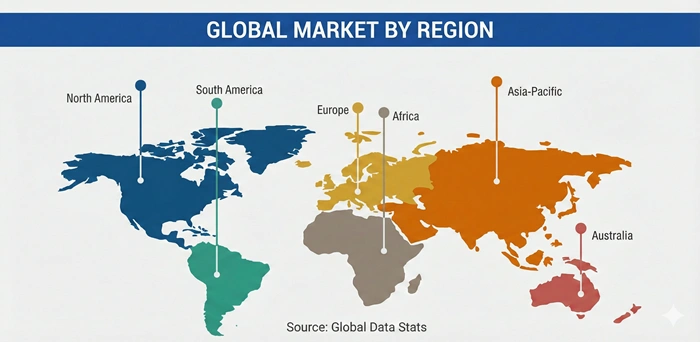
Regional Insights
North America
North America Leads the BioSignal Serums Market With the Highest Revenue Share, Supported by Premium Skincare Spending, Clinical Channel Strength, and Ingredient-Educated Consumers
North America holds the dominant position in the BioSignal serums market, accounting for approximately 36% of global revenue in 2026 and growing at a CAGR of around 8.9% through 2033. The United States is the single largest national market, driven by a highly developed prestige skincare retail ecosystem, a large and growing medical spa industry, and a deeply ingredient-literate consumer base that actively seeks out clinically validated bioactive actives. Key companies driving North America's market leadership include SkinMedica (Allergan Aesthetics), Revision Skincare, SkinCeuticals (L'Oréal), BENEV Company Inc., and Obagi Medical. The region benefits from a well-established dermocosmetics distribution infrastructure that spans luxury department stores, specialty beauty retailers, dermatology clinics, and a rapidly expanding online DTC channel.
Canada contributes meaningfully to regional revenue, with a growing medical aesthetic sector and increasing consumer adoption of clinical skincare brands offering bioactive serum formulations. The U.S. market in particular benefits from strong celebrity and influencer endorsement of premium peptide and growth factor serums, which accelerates mainstream consumer awareness and adoption well beyond the traditional luxury beauty shopper. North America is expected to maintain its global revenue leadership through 2033, supported by continued clinical research, new ingredient approvals, and the ongoing expansion of the medical spa and aesthetic clinic distribution channel.
Asia Pacific
Asia Pacific Is the Fastest-Growing Regional Market for BioSignal Serums, Powered by Skincare-First Consumer Culture, K-Beauty Innovation, and Rapid Medical Aesthetic Sector Expansion
Asia Pacific is the fastest-growing regional market, estimated to hold approximately 28% of global market share in 2026 and projected to expand at a CAGR of approximately 12.4% through 2033. South Korea is the most dynamic national market within the region, where the K-beauty industry has long been at the forefront of bioactive skincare innovation and consumer adoption of science-forward serum formulations is deeply embedded in daily skincare culture. Key companies shaping the Asia Pacific BioSignal serum landscape include Amorepacific Corporation (South Korea), LG H&H (South Korea), Shiseido Company (Japan), Proya Cosmetics (China), and a growing ecosystem of biotech-skincare startups across Shenzhen and Seoul developing proprietary signal peptide and exosome serum formulations.
China represents the most significant growth opportunity within Asia Pacific, with a rapidly expanding middle class, soaring demand for premium skincare products, and a government-supported cosmetics innovation ecosystem that is actively fostering domestic bioactive ingredient development. The Chinese skincare consumer is increasingly sophisticated and drawn to science-backed formulations, making the BioSignal serums market particularly well-positioned for expansion as ingredient education improves and clinical skincare distribution channels mature. Japan's well-established cosmeceutical culture and strong dermatology-linked retail channels also contribute meaningfully to the regional market, with brands like Albion Co. and Kanebo Cosmetics maintaining strong positions in the premium bioactive serum space.
Top Key Players
-
L'Oréal S.A. – SkinCeuticals Division (France)
-
Estée Lauder Companies Inc. (United States)
-
Allergan Aesthetics – SkinMedica (United States / Ireland)
-
Amorepacific Corporation (South Korea)
-
Shiseido Company, Ltd. (Japan)
-
Revision Skincare (United States)
-
BENEV Company Inc. (United States)
-
Obagi Medical Products Inc. (United States)
-
LG H&H Co., Ltd. (South Korea)
-
Proya Cosmetics Co., Ltd. (China)
-
Noveome Biotherapeutics Inc. (United States)
-
Genosys Co., Ltd. (South Korea)
Recent Developments
-
L'Oréal – SkinCeuticals (2025): Launched a new growth factor serum line incorporating proprietary recombinant EGF technology developed through its in-house biotech research division, targeting the professional dermatology channel in the U.S. and Western Europe and positioning SkinCeuticals as a clinical-grade bioactive serum leader.
-
Estée Lauder Companies (2024): Expanded its Advanced Night Repair serum line with a new signal peptide-infused variant clinically tested to reduce multiple visible signs of aging in 28 days, backed by a major clinical study involving 1200 participants across four continents, reinforcing its dominant position in the premium bioactive serum market.
-
Allergan Aesthetics – SkinMedica (2025): Received expanded clinical study validation for its TNS Advanced+ Serum, a growth factor-rich formulation derived from human fibroblast conditioned media, with new data demonstrating significant improvements in skin texture and firmness, strengthening its position as the leading post-procedure recovery serum recommended by aesthetic physicians.
-
Amorepacific Corporation (2024): Launched a new exosome-infused serum line under its premium Sulwhasoo brand, marking the company's formal entry into the extracellular vesicle skincare space and reinforcing South Korea's position as a global hub for next-generation bioactive beauty innovation.
-
Genosys Co., Ltd. (2025): Entered into a distribution partnership with a leading European medical spa network to supply its professional-grade growth factor and peptide serum portfolio across 14 European markets, significantly expanding its geographic footprint beyond its established base in South Korea and Southeast Asia.
Market Trends
The Rise of Exosome-Based Serums and the Convergence of Aesthetic Medicine With Retail Skincare Are the Two Most Defining Trends Reshaping the BioSignal Serums Landscape
Exosome-based serums are rapidly transitioning from a niche clinical curiosity into a mainstream premium skincare category, and this shift is one of the most consequential trends in the BioSignal serums market today. Exosome formulations derived from human adipose stem cells, plant-derived sources, or marine organisms are entering the market with increasingly sophisticated delivery systems that improve cellular uptake and extend bioactive stability. As more peer-reviewed clinical studies confirm their regenerative skin benefits and brands develop better methods for communicating this science to consumers, the exosome serum sub-segment is expected to drive meaningful market growth over the next five to seven years.
The second defining trend is the blurring boundary between aesthetic medicine and retail skincare. Procedures like microneedling with growth factor serums, mesotherapy with bioactive peptide cocktails, and post-laser exosome serum applications have normalized the idea of prescription-strength bioactive ingredients in the consumer skincare context. This convergence is creating a "clinical consumer" archetype — a shopper who routinely combines in-clinic aesthetic treatments with at-home bioactive serum maintenance routines, and who demands the same level of scientific rigor from their retail products as they receive in a clinical setting. Brands that successfully bridge both the professional and retail channels with consistent bioactive serum portfolios will be the long-term beneficiaries of this structural market shift.
Segments Covered in the Report
By Product Type
-
Signal Peptide Serums
-
Neuropeptide Serums
-
Carrier Peptide Serums
-
Enzyme Inhibitor Peptide Serums
-
-
Growth Factor Serums
-
EGF-Based Serums
-
FGF-Based Serums
-
-
Cellular Communication Serums
-
Exosome-Infused Serums
-
Cytokine-Based Serums
-
-
Hybrid Bioactive Serums
By Application
-
Anti-Aging & Wrinkle Reduction
-
Skin Brightening & Tone Correction
-
Hydration & Barrier Repair
-
Acne & Blemish Control
-
Post-Procedure Skin Recovery
By Distribution Channel
-
Specialty Beauty Retailers
-
Online Platforms & E-Commerce
-
Dermatology Clinics & Medical Spas
-
Luxury Department Stores
-
Pharmacy & Drugstores
By End User
-
Individual Consumers
-
Dermatology & Aesthetic Clinics
-
Spa & Wellness Centers
-
Professional Skincare Practitioners
By Region
-
North America
-
Europe
-
Asia Pacific
-
Latin America
-
Middle East & Africa
Frequently Asked Questions
Question 1: What is the current market size of the BioSignal serums market and what growth is projected through 2033?
Answer: The BioSignal serums market was valued at USD 2.6 billion in 2025 and is projected to reach approximately USD 4.8 billion by 2033, growing at a CAGR of 9.6% from 2026 to 2033. This growth is driven by rising consumer demand for scientifically validated bioactive skincare and expanding clinical channel adoption of signal peptide and growth factor formulations.
Question 2: Which product type dominates the BioSignal serums market and why?
Answer: Signal peptide serums currently hold the largest share in the BioSignal serums market at approximately 42% of total revenue in 2026, supported by strong clinical evidence and broad consumer familiarity with peptide-based anti-aging formulations. Their well-established prescribing history in dermatology and wide availability across premium retail channels continue to sustain their market leadership.
Question 3: Which region leads the BioSignal serums market and which is the fastest growing?
Answer: North America leads the BioSignal serums market with approximately 36% of global revenue in 2026, while Asia Pacific is the fastest-growing region at a CAGR of 12.4% through 2033. Asia Pacific's growth is powered by the deeply embedded skincare culture in South Korea, China, and Japan, and the rapid expansion of the medical aesthetic sector in these markets.
Question 4: What are the biggest challenges facing the BioSignal serums market?
Answer: The primary challenges in the BioSignal serums market include the high cost of bioactive ingredient sourcing, ingredient stability and shelf-life complexities for peptide and growth factor formulations, and regulatory ambiguity for advanced actives like exosomes and growth factors across major markets. Consumer skepticism about verifying clinical efficacy claims also remains a barrier to broader mainstream adoption outside the core premium skincare segment.
Question 5: What is the fastest-growing product segment in the BioSignal serums market?
Answer: Exosome-infused serums are the fastest-growing product sub-segment in the BioSignal serums market, projected at a CAGR of approximately 14.2% through 2033. Their growing clinical validation in skin regeneration and increasing adoption in medical spa post-procedure protocols are driving rapid commercial expansion in both North America and Asia Pacific.