
Biopsy Bag Market Overview
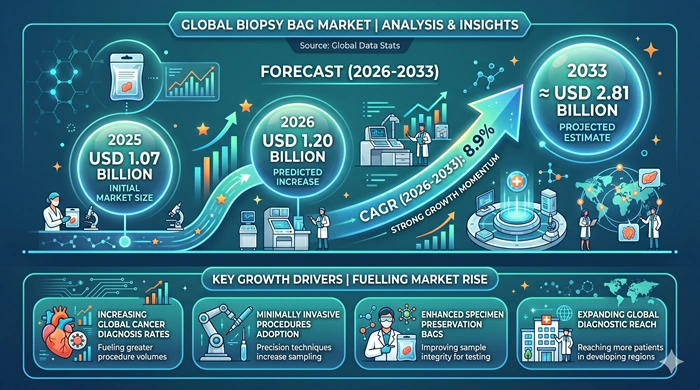
The global biopsy bag market size is valued at USD 1.07 billion in 2025 and is predicted to increase from USD 1.20 billion in 2026 to approximately USD 2.81 billion by 2033, growing at a CAGR of 8.9% from 2026 to 2033.
The biopsy bag market is positioned at the intersection of rising cancer diagnoses, expanding surgical volumes, and the growing global demand for safe, contamination-free tissue specimen handling. Biopsy bags — used to collect, preserve, and transport tissue samples removed during endoscopic, laparoscopic, and open surgical procedures — play a critical and non-negotiable role in accurate pathological diagnosis. As minimally invasive surgical techniques become standard practice across hospitals worldwide, the demand for high-quality specimen retrieval and containment solutions continues to grow steadily.
AI Impact on the Biopsy Bag Industry
Artificial Intelligence Is Transforming Biopsy Procedure Planning, Specimen Tracking, and Pathology Laboratory Workflows in Ways That Directly Strengthen Demand for Advanced Biopsy Bag Solutions
Artificial intelligence is increasingly influencing the clinical and operational environment in which biopsy bags are used. AI-powered imaging platforms — including ultrasound, MRI, and endoscopic systems — are improving biopsy targeting precision, reducing the number of sampling passes required per procedure, and guiding physicians toward the most diagnostically relevant tissue areas. This improvement in procedural efficiency is directly expanding the volume of tissue samples collected and processed globally, driving consistent growth in demand for reliable specimen containment products throughout the diagnostic pathway.
On the laboratory side, AI-driven pathology workflow management systems are improving how specimens are tracked from the point of collection through fixation, processing, and histological analysis. Digital chain-of-custody platforms are being integrated with specimen labeling and bag identification systems to reduce transcription errors, improve traceability, and ensure regulatory compliance across pathology departments. These operational improvements are creating a stronger institutional preference for biopsy bag products with integrated identification features — such as pre-labeled pouches, barcode-compatible packaging, and tamper-evident closures — that are compatible with modern laboratory information management systems.
Growth Factors
Rising Global Cancer Incidence, Expanding Minimally Invasive Surgical Volumes, and Strengthening Pathology Infrastructure in Emerging Markets Are the Primary Drivers of Biopsy Bag Market Growth
The most fundamental growth driver for the biopsy bag market is the sustained increase in global cancer incidence. Cancer remains one of the leading causes of mortality worldwide, and early detection through biopsy remains the gold standard for definitive tissue diagnosis across virtually all cancer types — including breast, colorectal, prostate, lung, and cervical cancers. As global cancer screening programs expand, populations age, and awareness of early detection benefits grows, the total annual volume of biopsy procedures performed worldwide continues to rise. Each biopsy procedure requires appropriate tissue containment, making this volume growth directly and proportionally translatable into increased demand for biopsy bag products.
The accelerating global adoption of minimally invasive surgical and endoscopic techniques is the second major growth catalyst. Laparoscopic and robotic-assisted procedures have become the preferred approach for a wide range of surgical interventions, and specimen retrieval bags are an essential component of these procedures — preventing tissue fragmentation, containing potentially malignant cells, and facilitating safe extraction of resected tissue from the body cavity. As hospitals in emerging markets invest in laparoscopic equipment and train surgical teams in minimally invasive techniques, the adoption of biopsy and specimen bag products in these regions is expanding rapidly, adding significant new demand to the global market.
Market Outlook
The Biopsy Bag Market Is Poised for Consistent Growth Through 2033, Backed by Oncology Expansion, Surgical Technology Adoption, and Growing Quality Standards in Specimen Handling
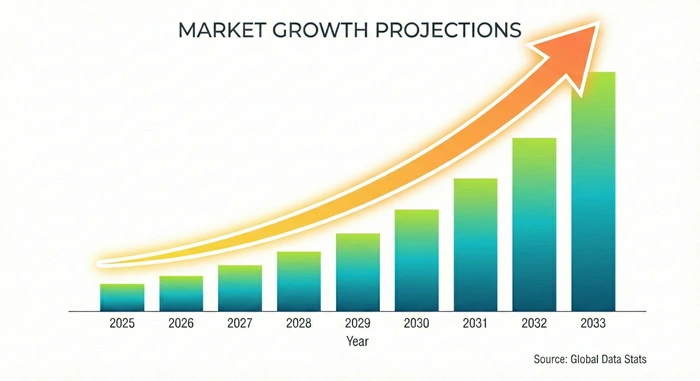
The outlook for the biopsy bag market through 2033 is positive and supported by strong structural tailwinds across global healthcare systems. The continued expansion of oncology services — including the buildout of cancer centers, pathology laboratories, and surgical suites in Asia, Latin America, and the Middle East — is creating substantial new demand for specimen handling consumables, including high-quality biopsy containment products. Healthcare infrastructure investment in these regions is being driven by both government health programs and private hospital group expansion, creating durable demand growth that supplements already strong markets in North America and Europe.
Increasing quality and safety standards in pathology and surgical practice are also shaping the long-term market outlook in a meaningful way. Regulatory bodies, hospital accreditation organizations, and professional surgical associations are setting increasingly rigorous expectations for specimen integrity, contamination prevention, and chain-of-custody documentation. These standards are compelling healthcare facilities to move away from basic, low-specification containment products toward purpose-designed, validated biopsy bags that meet stringent quality benchmarks. This quality-driven upgrade cycle is expected to generate both volume growth and favorable pricing dynamics for premium biopsy bag manufacturers throughout the forecast period.
Expert Speaks
-
Joaquin Duato, Chairman & CEO, Johnson & Johnson — "The demand for high-quality surgical and diagnostic consumables continues to grow as healthcare systems worldwide expand their oncology and minimally invasive surgery capabilities. Products that support specimen integrity and safety throughout the diagnostic chain are increasingly recognized as essential — not optional — components of quality cancer care."
-
Robert Ford, President & CEO, Abbott Laboratories — "As diagnostic precision improves and the volume of tissue-based cancer diagnoses grows globally, the importance of reliable specimen containment and handling solutions becomes even more critical. We see sustained long-term investment across healthcare systems in the tools and consumables that support accurate, reproducible pathological diagnosis."
-
Peter Arduini, President & CEO, GE HealthCare — "The integration of AI-guided biopsy targeting with better specimen handling protocols is transforming how tissue samples are obtained and processed in clinical practice. The tools used to contain and transport biopsy specimens safely are a critical but sometimes overlooked link in the overall chain of diagnostic excellence."
Key Report Takeaways
-
North America dominates the biopsy bag market, accounting for approximately 38% of global revenue in 2025, driven by the highest per-capita cancer screening rates globally, advanced surgical infrastructure, strong adoption of minimally invasive procedures, and the presence of leading medical device and pathology consumable manufacturers
-
Asia-Pacific is the fastest-growing regional market, projected to expand at a CAGR of over 11.4% through 2033, driven by expanding cancer center infrastructure, rapidly growing biopsy procedure volumes in China, India, Japan, and South Korea, and increasing adoption of laparoscopic and endoscopic surgical techniques in major emerging economies
-
Hospitals and surgical centers are the dominant end-user segment, accounting for the largest share of biopsy bag consumption globally in 2025, reflecting the high volume of inpatient and outpatient biopsy and minimally invasive surgical procedures performed in tertiary care settings that depend on specimen bags for safe tissue collection
-
Nylon biopsy bags hold the leading material segment share, contributing approximately 45% of material-based revenue in 2025, driven by their superior tensile strength, biocompatibility, puncture resistance, and ability to withstand fixation reagents without degrading specimen integrity during transport and processing
-
Laparoscopic and minimally invasive surgical applications are the most dominant use category, reflecting the critical role of specimen retrieval bags in laparoscopic oncological resections and the mandatory use of contained extraction protocols to prevent cell spillage during minimally invasive tumor removal procedures
-
Biodegradable and sustainable biopsy bag materials represent the fastest-growing future segment, projected to grow at a CAGR of 13.2% through 2033 and reach approximately 16% of total material-based market share by 2033, driven by increasing regulatory focus on medical device sustainability and growing hospital procurement policies favoring environmentally responsible single-use products
Market Scope
| Report Coverage | Details |
|---|---|
| Market Size by 2033 | USD 2.81 Billion |
| Market Size by 2025 | USD 1.07 Billion |
| Market Size by 2026 | USD 1.20 Billion |
| Market Growth Rate (2026–2033) | CAGR of 8.9% |
| Dominating Region | North America |
| Fastest Growing Region | Asia-Pacific |
| Base Year | 2025 |
| Forecast Period | 2026 – 2033 |
| Segments Covered | Material Type, Product Type, Application, End User |
| Regions Covered | North America, Europe, Asia-Pacific, Latin America, Middle East & Africa |
Market Dynamics
Drivers Impact Analysis
Escalating Global Cancer Burden, Widespread Adoption of Laparoscopic Surgical Techniques, and Expanding Pathology Laboratory Networks Are the Core Forces Driving the Biopsy Bag Market Forward
| Driver | ≈ % Impact on CAGR Forecast | Geographic Relevance | Impact Timeline |
|---|---|---|---|
| Rising global cancer incidence driving biopsy procedure volumes | ~33% | Global, especially North America, Europe, and Asia-Pacific | Short to Long-term |
| Growing adoption of minimally invasive and laparoscopic surgeries | ~27% | Global | Short to Medium-term |
| Expansion of cancer screening programs in emerging economies | ~20% | Asia-Pacific, Latin America, MEA | Medium to Long-term |
| Increasing quality and safety standards for specimen handling | ~13% | Global, especially North America and Europe | Short to Medium-term |
| Aging global population driving higher cancer and chronic disease rates | ~7% | North America, Europe, Asia-Pacific | Medium to Long-term |
The sustained global rise in cancer incidence is the most consistent and powerful demand driver underpinning the biopsy bag market. With approximately 20 million new cancer cases diagnosed globally each year and rising, the volume of diagnostic biopsies performed — including image-guided, endoscopic, and surgical biopsies — continues to grow at a meaningful pace. Each tissue sample requires appropriate containment, fixation compatibility, and secure transport to the pathology laboratory, making biopsy bags a non-discretionary consumable that grows proportionally with diagnostic activity.
The parallel expansion of minimally invasive surgical capabilities across global healthcare systems amplifies this demand. Laparoscopic cholecystectomy, prostatectomy, colectomy, and gynecological resections all rely on specimen retrieval bags as a standard component of the procedure. As hospitals in emerging markets acquire laparoscopic equipment and train surgical staff, they simultaneously create new demand for the consumables that support these procedures — including specimen containment products. This expansion of the surgical technology adoption curve in Asia-Pacific, Latin America, and the Middle East is expected to drive biopsy bag market volume growth at an above-average pace in these regions through 2033.
Restraints Impact Analysis
Stringent Regulatory Requirements for Medical Device Validation, Competitive Pricing Pressure From Low-Cost Manufacturers, and Limited Awareness in Underdeveloped Healthcare Markets Are Moderating Growth
| Restraint | ≈ % Impact on CAGR Forecast | Geographic Relevance | Impact Timeline |
|---|---|---|---|
| Rigorous regulatory requirements for medical-grade specimen containment products | ~28% | Global, especially USA and EU | Ongoing |
| Intense price competition from low-cost regional manufacturers | ~26% | Emerging markets, Europe | Short to Medium-term |
| Limited healthcare infrastructure and specimen handling protocols in low-income markets | ~22% | Sub-Saharan Africa, parts of South Asia | Medium to Long-term |
| Supply chain disruptions affecting raw material availability for medical consumables | ~15% | Global | Short to Medium-term |
| Risk of specimen contamination or failure due to substandard products | ~9% | Global | Ongoing |
Regulatory compliance is one of the most significant structural challenges for manufacturers operating in the biopsy bag market. Medical-grade specimen containment products must meet strict material safety, biocompatibility, and sterility standards as defined by the FDA in the United States and the CE marking framework in Europe. The cost and timeline associated with product validation, clinical testing, and regulatory submission for new biopsy bag designs can be substantial — creating barriers for smaller manufacturers attempting to introduce innovative products and slowing the pace at which new materials and design improvements can be commercialized globally.
The competitive pricing environment in many emerging market regions creates margin pressure for established premium product manufacturers. Local manufacturers in China, India, and other developing markets often produce low-cost nylon and polyester biopsy bags at prices that are difficult for international brands to match without compromising on quality standards. While premium product manufacturers can differentiate on performance, regulatory compliance documentation, and institutional procurement processes, the price gap can be challenging in government hospital procurement contexts where cost is the primary selection criterion.
Opportunities Impact Analysis
Smart Specimen Identification Integration, Growth of Single-Port and Robotic Surgery, and Sustainability-Driven Material Innovation Are the Most Compelling Opportunities in the Biopsy Bag Market
| Opportunity | ≈ % Impact on CAGR Forecast | Geographic Relevance | Impact Timeline |
|---|---|---|---|
| Integration of RFID and barcode identification in biopsy bag products | ~30% | North America, Europe | Short to Medium-term |
| Robotic and single-port surgery adoption creating demand for advanced retrieval bags | ~28% | North America, Europe, Japan | Short to Long-term |
| Biodegradable and sustainable material development for eco-conscious procurement | ~22% | North America, Europe | Medium to Long-term |
| Expansion of point-of-care biopsy in outpatient and community health settings | ~12% | Asia-Pacific, Latin America | Medium to Long-term |
| Rising adoption of personalized oncology protocols increasing repeat biopsy frequency | ~8% | North America, Europe | Short to Long-term |
The integration of digital identification technologies — including QR codes, barcodes, and RFID tags — directly into biopsy bag designs represents a high-impact commercial opportunity. Pathology departments globally are investing in laboratory information management systems (LIMS) that require accurate, automated specimen tracking from collection through analysis. Biopsy bags that are pre-labeled with scannable identifiers compatible with hospital LIS systems reduce transcription errors, improve chain-of-custody compliance, and simplify regulatory documentation — creating a compelling upgrade pathway from standard commodity bags to value-added smart specimen products.
The rapid expansion of robotic surgical systems — including the da Vinci platform and newer competitive robotic systems — is creating new demand for specialized retrieval bags designed for robotic-assisted laparoscopic procedures. As robotic surgery platforms expand beyond major academic medical centers into community hospitals and ambulatory surgical centers, the volume of procedures utilizing specimen retrieval bags in robotic settings is growing significantly. Manufacturers that develop biopsy and specimen bag products specifically optimized for robotic and narrow-port extraction techniques will be well-positioned to capture this growing and premium-priced market segment.
Segment Analysis
By Material Type
Nylon Biopsy Bags Lead the Material Segment Due to Superior Puncture Resistance, Biocompatibility, and Chemical Stability in Fixation Reagent Environments Across Global Pathology Settings
Nylon biopsy bags are the dominant material type in the biopsy bag market, accounting for approximately 45% of total material-based revenue in 2025. This segment is projected to maintain a CAGR of 8.5% through 2033, driven by nylon's well-established combination of mechanical strength, biocompatibility, and chemical resistance that makes it the preferred material for high-volume surgical specimen containment. North America holds the largest regional share of nylon biopsy bag consumption, supported by the strong purchasing preferences of US hospital systems and ambulatory surgical centers that prioritize validated, ISO-compliant products from established suppliers. Key companies dominating this segment in North America include Thermo Scientific (Thermo Fisher Scientific), Sakura Finetek, and Electron Microscopy Sciences, all of which maintain comprehensive nylon biopsy bag product lines with multiple size formats and closure configurations to serve diverse procedural requirements.
Europe represents the second-largest geography for nylon biopsy bag adoption, where Germany, France, and the United Kingdom are the most significant national markets. Asia-Pacific is the fastest-growing region within the nylon segment, where expanding hospital surgical departments in China, India, and Japan are adopting nylon biopsy bags at a rapidly increasing pace as laparoscopic surgical volumes climb. Mortech Manufacturing (US) and CellPath (UK) are also notable regional suppliers with strong institutional relationships. As nylon remains the material of choice for both standard and high-complexity specimen retrieval procedures, this segment will continue to anchor the overall biopsy bag market throughout the forecast period.
By Application
Laparoscopic and Minimally Invasive Surgical Applications Represent the Largest and Most Clinically Critical Use Segment Within the Biopsy Bag Market
The laparoscopic and minimally invasive surgical application segment is the largest revenue contributor within the biopsy bag market, accounting for approximately 52% of total application-based revenue in 2025. This segment is projected to grow at a CAGR of 9.3% through 2033, driven by the universal adoption of laparoscopic techniques for oncological and general surgical resections globally. Specimen retrieval bags are a mandatory component of laparoscopic procedures involving potentially malignant tissue, where containment is required to prevent cell spillage and contamination of the abdominal cavity — a clinical standard enforced by surgical societies in North America, Europe, and increasingly in Asia-Pacific. North America leads this application segment, with major contributing companies including Applied Medical (US), Medtronic (Ireland), and Stryker Corporation (US) offering integrated specimen retrieval systems combining bag, closure, and extraction mechanisms.
The endoscopic biopsy application segment is the second-largest and is growing at a CAGR of 9.7% through 2033, driven by the rapid global expansion of gastrointestinal endoscopy volumes and the increasing use of endoscopic mucosal resection and endoscopic submucosal dissection techniques in colorectal cancer screening programs. Asia-Pacific is the fastest-growing region for the endoscopic application segment, where high colorectal and gastric cancer incidence rates in China, Japan, and South Korea are driving extraordinary endoscopy procedure volumes. Companies like Olympus Corporation (Japan) and CONMED Corporation (US) are key players in supplying endoscopic specimen collection and containment products to this rapidly growing segment of the global biopsy bag market.
Regional Insights
North America
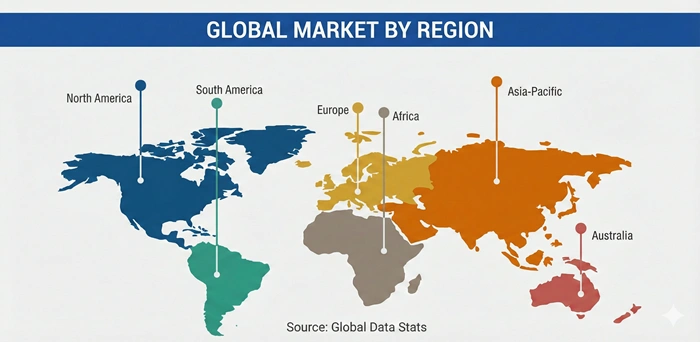
North America Leads the Global Biopsy Bag Market With the Largest Revenue Share, Driven by High Surgical Volumes, Advanced Cancer Screening Infrastructure, and Rigorous Specimen Safety Standards
North America holds the dominant position in the biopsy bag market, accounting for approximately 38% of total global revenue in 2025 and projected to maintain a CAGR of 8.3% through 2033. The United States is the primary national market, supported by the world's highest per-capita rate of cancer screening procedures, a large and technologically advanced surgical infrastructure, and comprehensive institutional protocols mandating appropriate specimen containment across oncological procedures. The depth of the US pathology laboratory network — including both hospital-based and independent reference laboratories — creates consistent high-volume demand for quality-assured biopsy bag products throughout the diagnostic workflow. Leading companies shaping the North American biopsy bag market include Thermo Fisher Scientific, Sakura Finetek USA, Mortech Manufacturing, Electron Microscopy Sciences, Applied Medical, and CONMED Corporation.
Canada contributes meaningfully to regional demand through its publicly funded healthcare system, which performs significant annual volumes of cancer-related biopsies and endoscopic resections through provincial cancer agencies. The strong regulatory environment maintained by the FDA ensures that specimen containment products sold in the United States meet rigorous safety and performance standards, which simultaneously encourages product quality investment and maintains premium pricing power for compliant manufacturers. The growing adoption of robotic surgery in North American hospitals, combined with expanding outpatient surgical center infrastructure, is expected to sustain strong volume growth in the biopsy bag market across the region throughout the forecast period.
Asia-Pacific
Asia-Pacific Is the Fastest-Growing Region in the Biopsy Bag Market, Fueled by Rising Cancer Incidence, Rapid Expansion of Surgical Infrastructure, and Growing Endoscopy Procedure Volumes
Asia-Pacific is the most dynamic regional market in the global biopsy bag landscape, projected to expand at a CAGR of 11.4% from 2026 to 2033 — the highest growth rate of any region globally. The region accounts for approximately 26% of total market revenue in 2025, with China, Japan, India, South Korea, and Australia representing the largest national markets. China is the dominant national market within the region, where the government's ongoing expansion of cancer screening programs, massive hospital construction activity, and rapidly growing volumes of both laparoscopic and endoscopic procedures are driving exceptional demand growth for surgical consumables including specimen retrieval bags. Japan contributes significantly due to its world-leading endoscopy procedure volumes and sophisticated pathology laboratory network, with companies like Olympus Corporation and Nissei Plastic Industrial playing important roles in the domestic supply chain. Key international players active across Asia-Pacific include Thermo Fisher Scientific, Sakura Finetek, and Medtronic.
India is emerging as a particularly high-growth market within Asia-Pacific, where the expansion of private hospital groups, the growing availability of laparoscopic surgical training programs, and government initiatives to improve cancer detection rates are collectively driving a sustained increase in biopsy procedure volumes. The Indian domestic medical device manufacturing sector is also developing local production capabilities for basic biopsy bag formats, contributing to market accessibility and affordability in lower-income healthcare settings. Southeast Asian markets including Indonesia, Thailand, Vietnam, and Malaysia are also contributing to regional growth as healthcare infrastructure investments and growing middle-class health awareness expand the addressable patient base for cancer diagnostics throughout the Asia-Pacific biopsy bag market.
Top Key Players
-
Thermo Fisher Scientific Inc. (United States)
-
Sakura Finetek USA Inc. (United States)
-
Mortech Manufacturing Inc. (United States)
-
Electron Microscopy Sciences (United States)
-
CellPath Ltd. (United Kingdom)
-
Simport Scientific (Canada)
-
Citotest Labware Manufacturing Co. Ltd. (China)
-
Saati S.p.A. (Italy)
-
Cancer Diagnostics Inc. (United States)
-
Applied Medical Resources Corporation (United States)
-
CONMED Corporation (United States)
-
Medtronic plc (Ireland)
-
Olympus Corporation (Japan)
Recent Developments
-
Thermo Fisher Scientific (2025) — Expanded its pathology consumables portfolio with the introduction of a new line of color-coded, pre-labeled biopsy bags featuring integrated QR-code identification compatible with major laboratory information management systems, targeting high-volume hospital pathology departments seeking to improve specimen tracking accuracy and reduce transcription errors
-
Sakura Finetek (2025) — Launched an updated range of tissue cassette-compatible biopsy collection bags with enhanced formalin-resistant sealing for improved specimen fixation quality, with the product line receiving FDA 510(k) clearance and initial commercial distribution through major US hospital group procurement channels
-
Applied Medical (2024) — Introduced the next generation of its Alexis specimen retrieval bag system featuring an expanded size range and redesigned closure mechanism optimized for robotic-assisted laparoscopic surgical procedures, with commercial launch at the Society of American Gastrointestinal and Endoscopic Surgeons (SAGES) annual meeting
-
Medtronic plc (2025) — Completed a strategic supply agreement with a leading group purchasing organization in North America to expand hospital-tier access to its specimen retrieval bag portfolio, securing preferred vendor status across hundreds of acute care facilities and significantly expanding its distribution reach in the US surgical consumables market
-
CellPath Ltd. (2024) — Invested in new manufacturing capacity at its UK facility to meet growing demand for premium histology and biopsy containment consumables from European hospital and reference laboratory customers, while also expanding its export distribution agreements to cover new markets in the Middle East and Asia-Pacific regions
Market Trends
Smart Specimen Identification Integration, Eco-Friendly Material Innovation, and the Shift Toward Procedure-Specific Bag Design Are the Most Defining Trends Shaping the Biopsy Bag Market
One of the most significant trends reshaping the biopsy bag market is the growing integration of digital identification and tracking technology directly into specimen containment products. As hospital pathology departments implement laboratory information management systems and digital chain-of-custody workflows, there is increasing demand for biopsy bags that arrive pre-labeled with unique identifiers — QR codes, barcodes, or RFID tags — that can be scanned at each stage of the specimen processing workflow. This trend is elevating the value proposition of premium biopsy bag manufacturers who can offer customized labeling and system-compatible identification features, creating a meaningful differentiation layer above basic commodity bag products.
The second important trend is the growing institutional focus on sustainability in medical device procurement. Single-use plastic medical consumables — including standard nylon and polyester biopsy bags — are coming under increasing scrutiny from hospital sustainability officers and environmental regulations in Europe and North America. Manufacturers that can demonstrate a credible pathway toward reduced environmental impact — through recyclable materials, reduced packaging, or certified biodegradable bag options — are gaining competitive advantages in institutional procurement processes. This sustainability trend is expected to accelerate through 2033, driving meaningful product reformulation investment across the biopsy bag market's leading manufacturers.
Segments Covered in the Report
By Material Type:
-
Nylon Biopsy Bags
-
Polyester Biopsy Bags
-
Paper Biopsy Bags
-
Biodegradable Material Bags
-
Others
By Product Type:
-
Standard Biopsy Bags
-
Specimen Retrieval Bags (Laparoscopic)
-
Endoscopic Biopsy Collection Bags
-
Pre-labeled and Identification-Integrated Bags
-
Others
By Application:
-
Laparoscopic and Minimally Invasive Surgery
-
Endoscopic Procedures
-
Open Surgical Biopsies
-
Core Needle and Image-Guided Biopsies
-
Others
By End User:
-
Hospitals and Surgical Centers
-
Ambulatory Surgical Centers
-
Pathology Laboratories
-
Diagnostic and Research Centers
-
Others
By Region:
-
North America (United States, Canada, Mexico)
-
Europe (Germany, United Kingdom, France, Italy, Spain, Rest of Europe)
-
Asia-Pacific (China, Japan, India, South Korea, Australia, Rest of Asia-Pacific)
-
Latin America (Brazil, Argentina, Rest of Latin America)
-
Middle East & Africa (UAE, Saudi Arabia, South Africa, Rest of MEA)
Frequently Asked Questions
Question 1: What is the current size of the global biopsy bag market?
Answer: The global biopsy bag market is valued at USD 1.07 billion in 2025 and is projected to reach USD 2.81 billion by 2033. The market is growing at a CAGR of 8.9% from 2026 to 2033, driven by rising cancer incidence, expanding minimally invasive surgical volumes, and growing quality standards in specimen handling.
Question 2: Which region dominates the biopsy bag market globally?
Answer: North America leads the biopsy bag market with approximately 38% of global revenue in 2025, driven by high cancer screening rates, advanced surgical infrastructure, and rigorous specimen safety protocols. The United States represents the largest single national market, supported by FDA regulatory standards and leading medical device manufacturers.
Question 3: What are the key growth drivers in the biopsy bag market?
Answer: The primary growth drivers for the biopsy bag market are the rising global cancer burden increasing biopsy procedure volumes and the widespread adoption of laparoscopic and minimally invasive surgical techniques. Expanding cancer screening programs in emerging economies and stricter quality standards for pathological specimen handling are also contributing significantly to market expansion.
Question 4: Which material type dominates the biopsy bag market?
Answer: Nylon biopsy bags hold the leading material segment share in the biopsy bag market, accounting for approximately 45% of material-based revenue in 2025. Nylon's superior puncture resistance, biocompatibility, and chemical stability in formalin fixation environments make it the preferred choice for surgical and pathology applications globally.
Question 5: What future trends are expected to shape the biopsy bag market through 2033?
Answer: The integration of digital specimen identification technologies such as QR codes and RFID into biopsy bag products is one of the most impactful future trends expected to reshape the biopsy bag market. The development of sustainable, biodegradable material alternatives and the growing demand for procedure-specific retrieval bag designs optimized for robotic surgery are also expected to define competitive dynamics through 2033.