
Biomass Briquette Market Overview
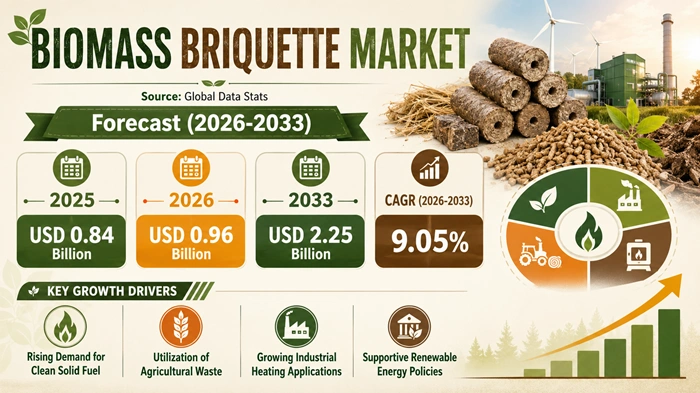
The global biomass briquette market size is valued at USD 0.84 billion in 2025 and is predicted to increase from USD 0.96 billion in 2026 to approximately USD 2.25 billion by 2033, growing at a CAGR of 9.05% from 2026 to 2033.
The biomass briquette market represents a vital segment within renewable energy solutions worldwide. These compressed blocks are manufactured from agricultural residues, wood waste, forestry by-products, and other organic materials. Industries and households increasingly turn to these sustainable alternatives because they deliver high energy output while minimizing carbon footprints compared to traditional fossil fuels.
AI Impact On The Biomass Briquette Industry
Revolutionizing Production Efficiency Through Smart Automation And Predictive Analytics
Artificial intelligence is transforming how biomass briquette manufacturers operate their production facilities today. Smart sensors combined with machine learning algorithms continuously monitor moisture content, compression pressure, and temperature levels during the briquetting process. These AI-powered systems automatically adjust machinery parameters to maintain optimal quality standards while reducing material waste and energy consumption. Predictive maintenance powered by AI helps prevent unexpected equipment failures by analyzing vibration patterns and performance data from briquetting machines.
Digital transformation through AI extends beyond production floors into supply chain management and market forecasting for biomass briquette operations. Advanced algorithms analyze weather patterns to predict agricultural residue availability across different seasons and regions. Machine learning models process historical sales data alongside economic indicators to forecast demand fluctuations in various end-user segments. Companies deploying AI-driven quality control systems achieve more consistent briquette density and calorific values, which strengthens their competitive position in industrial applications where fuel performance specifications are critical.
Growth Factors
Accelerating Demand Driven By Environmental Regulations And Renewable Energy Transition
Government policies worldwide are creating powerful incentives for industries to switch from coal and conventional fuels to biomass alternatives. Carbon pricing mechanisms, co-firing mandates for thermal power plants, and renewable energy targets are making biomass briquettes economically attractive across multiple sectors. Many countries now offer financial subsidies, tax benefits, and carbon credits to businesses that adopt these sustainable fuel sources. The biomass briquette market benefits tremendously as industrial boilers, cement kilns, and manufacturing facilities seek compliance with increasingly stringent emission standards while maintaining cost-effective operations.
Agricultural waste management challenges are pushing farmers and rural communities toward briquette production as a viable revenue stream. Millions of tons of crop residues that previously caused air pollution through open burning now serve as valuable feedstock for the biomass briquette market. Rising fossil fuel prices combined with energy security concerns in developing nations accelerate adoption rates among small and medium enterprises. Technology improvements in briquetting machinery have reduced capital investment requirements while increasing production efficiency, making entry into this market more accessible for entrepreneurs across Asia, Africa, and Latin America.
Market Outlook
Expanding Applications And Regional Growth Creating Robust Long-Term Prospects
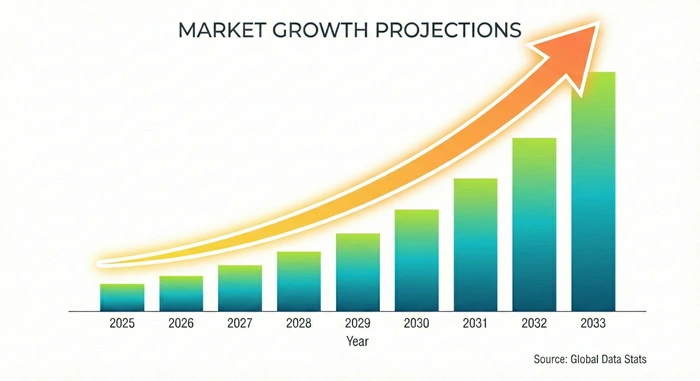
The biomass briquette market stands at an inflection point where multiple growth drivers converge to create sustained momentum through the forecast period. Industrial decarbonization efforts are driving bulk procurement contracts from cement manufacturers, textile mills, and food processing units seeking to reduce their carbon intensity. Residential heating markets in cold climate regions are experiencing renewed interest in biomass briquettes as consumers look for cost-effective alternatives to propane and heating oil. District heating systems in European cities are integrating biomass fuel supplies into their infrastructure planning.
Emerging markets in South Asia and Southeast Asia present particularly strong growth opportunities due to abundant agricultural residue availability and supportive government policies. Investment in densification technology and logistics infrastructure continues to expand production capacity while improving the economics of biomass briquette distribution. Export markets are developing as energy-hungry nations seek reliable renewable fuel sources to diversify their energy portfolios. The biomass briquette market also benefits from growing corporate sustainability commitments where multinational companies mandate cleaner fuel usage across their supplier networks and owned facilities.
Expert Speaks
-
Enviva's leadership team recently highlighted how global thermal energy demand is increasingly being met through sustainable biomass solutions, noting that industries across multiple continents are transitioning away from coal-fired systems toward renewable alternatives that deliver comparable performance with significantly reduced emissions.
-
Pacific BioEnergy executives emphasized their observations regarding accelerating institutional adoption of densified biomass fuels, particularly noting how public-private partnerships in North America are successfully demonstrating the economic viability of replacing fossil fuels in industrial heating applications.
-
Drax Group representatives shared insights about how co-firing strategies in existing power generation infrastructure create immediate opportunities for biomass integration, allowing utilities to reduce carbon intensity without requiring complete facility overhauls or extended downtime.
Key Report Takeaways
-
Asia Pacific dominates the biomass briquette market with approximately 40% regional market share due to abundant agricultural residue availability, large rural energy demand, and progressive government policies supporting decentralized renewable energy production.
-
North America emerges as the fastest-growing region with strong CAGR driven by substantial public investment in forest-based biomass innovations, conversion of wood residues into commercial supplies, and growing industrial adoption for distributed heating applications.
-
Agricultural waste feedstock accounts for the largest segment with over 41% market share as farmers increasingly monetize crop residues like rice husks, corn stalks, and wheat straw through briquette production rather than burning them.
-
Heating applications contribute the most significant demand representing 42% of total consumption as industrial facilities, commercial buildings, and residential users adopt biomass briquettes for thermal energy generation.
-
Wood briquettes represent the most popular type capturing nearly 40% market share owing to superior energy density, consistent combustion characteristics, and versatility across multiple industrial and residential applications.
-
The power generation segment shows fastest future growth potential expected to expand at 7.3% CAGR through 2033 with market share reaching approximately 28% as utilities implement co-firing strategies and biomass-dedicated power plants come online.
Market Scope
| Report Coverage | Details |
|---|---|
| Market Size by 2033 | USD 2.25 Billion |
| Market Size by 2025 | USD 0.84 Billion |
| Market Size by 2026 | USD 0.96 Billion |
| Market Growth Rate from 2026 to 2033 | CAGR of 9.05% |
| Dominating Region | Asia Pacific |
| Fastest Growing Region | North America |
| Base Year | 2025 |
| Forecast Period | 2026 to 2033 |
| Segments Covered | Feedstock Type, Type, Form, Application, End-User Industry, Region |
| Regions Covered | North America, Europe, Asia-Pacific, Latin America, Middle East and Africa |
Market Dynamics
Drivers Impact Analysis
Stringent Environmental Regulations And Carbon Reduction Mandates Propelling Market Expansion
| Factor | (≈) % Impact on CAGR Forecast | Geographic Relevance | Impact Timeline |
|---|---|---|---|
| Government co-firing mandates | 15-20% | Global (strongest in EU, North America, India) | 2026-2033 |
| Carbon pricing mechanisms | 10-15% | Europe, North America, select Asian markets | 2026-2033 |
| Renewable energy subsidies | 12-18% | Asia Pacific, Latin America | 2026-2033 |
Regulatory frameworks worldwide are fundamentally reshaping energy consumption patterns across industrial and commercial sectors. National governments implement increasingly aggressive carbon reduction targets that directly benefit the biomass briquette market through mandated fuel substitution requirements. Coal-fired power plants face regulatory pressure to blend biomass at percentages ranging from 5% to 20%, creating immediate demand for millions of tons of densified biomass fuel annually. Industries producing cement, steel, textiles, and chemicals receive financial penalties for excessive emissions while simultaneously gaining access to carbon credit programs when they switch to renewable alternatives like biomass briquettes.
Environmental compliance costs for conventional fossil fuels continue rising as monitoring systems become more sophisticated and enforcement mechanisms strengthen across developed and emerging economies. The biomass briquette market captures market share from coal suppliers as industrial buyers calculate total cost of ownership including carbon taxes, emission control equipment, and regulatory compliance overhead. Clean air policies in major metropolitan areas restrict high-sulfur fuel usage, pushing commercial heating operations toward biomass alternatives. Financial institutions increasingly factor environmental performance into lending decisions, creating additional market pull for sustainable fuel options among businesses seeking capital for expansion or equipment upgrades.
Restraints Impact Analysis
Supply Chain Challenges And Quality Inconsistencies Limiting Broader Market Penetration
| Factor | (≈) % Impact on CAGR Forecast | Geographic Relevance | Impact Timeline |
|---|---|---|---|
| Seasonal feedstock availability | -8 to -12% | Agricultural regions globally | 2026-2033 |
| Transportation cost burden | -6 to -10% | Regions with poor infrastructure | 2026-2033 |
| Quality standardization gaps | -5 to -8% | Emerging markets (Africa, Southeast Asia) | 2026-2030 |
Feedstock seasonality creates significant operational challenges for biomass briquette manufacturers who struggle to maintain consistent production throughout the year. Agricultural residues become abundant immediately after harvest seasons but face severe shortages during off-harvest months when farmers have already cleared their fields. Storage infrastructure for raw biomass materials remains inadequate in many producing regions, leading to degradation of feedstock quality through moisture absorption and biological decomposition. The biomass briquette market faces margin pressure when producers must pay premium prices for feedstock during shortage periods or idle expensive briquetting equipment when raw materials become unavailable.
Transportation economics present another substantial barrier limiting market expansion into regions distant from feedstock sources. Bulk density of raw agricultural waste remains relatively low until compression, requiring significant trucking capacity to move materials from dispersed collection points to centralized production facilities. Rural road infrastructure in many developing countries cannot support heavy commercial vehicles year-round, particularly during monsoon seasons when unpaved roads become impassable. Quality inconsistency across different batches of biomass briquettes creates hesitation among industrial buyers who require predictable calorific values and combustion characteristics for their boiler operations. Lack of industry-wide certification standards makes it difficult for end-users to differentiate between high-quality and substandard products in the biomass briquette market.
Opportunities Impact Analysis
Emerging Market Development And Technology Innovation Opening New Revenue Channels
| Factor | (≈) % Impact on CAGR Forecast | Geographic Relevance | Impact Timeline |
|---|---|---|---|
| Torrefied briquette premium segment | +10 to +15% | Europe, North America, Japan | 2027-2033 |
| Export market development | +8 to +12% | Southeast Asia to EU/Japan corridors | 2026-2033 |
| Agricultural waste monetization | +12 to +18% | India, China, Brazil, Sub-Saharan Africa | 2026-2033 |
Advanced processing technologies are creating premium product categories within the biomass briquette market that command significantly higher prices from specialized industrial applications. Torrefied briquettes undergo thermal treatment that increases energy density while improving hydrophobic properties and storage stability. These enhanced characteristics make torrefied products particularly attractive for long-distance shipping and utility-scale power generation where handling efficiency and consistent combustion performance justify premium pricing. The biomass briquette market sees growing investment in torrefaction facilities as producers seek to capture higher margins and access export markets previously dominated by coal suppliers.
International trade corridors are developing between biomass-rich agricultural regions and energy-importing industrial economies. Southeast Asian nations export increasing volumes of palm kernel shell briquettes and rice husk briquettes to energy-hungry markets in Japan and South Korea. European biomass traders establish sourcing partnerships with African agricultural cooperatives to secure sustainable supplies meeting strict EU sustainability criteria. Vertical integration models are emerging where agricultural processing companies install on-site briquetting equipment to convert their own waste streams into marketable energy products, simultaneously solving waste disposal challenges while generating new revenue streams that improve overall business economics.
Segment Analysis
By Feedstock Type: Agricultural Waste
Abundant Supply And Cost Advantages Driving Dominant Market Position
Agricultural waste establishes itself as the leading feedstock category within the biomass briquette market, capturing over 41% market share throughout the forecast period. Rice husks, wheat straw, corn stalks, sugarcane bagasse, and cotton stalks represent readily available residues generated in massive quantities across global farming operations. Farmers previously burned these materials in open fields, creating severe air pollution problems and wasting valuable energy resources. Government interventions now restrict agricultural burning while simultaneously promoting briquette production as an economically viable alternative that generates income for farming communities. The biomass briquette market leverages these policy shifts by establishing collection networks that aggregate dispersed residues and transport them to centralized processing facilities where modern briquetting equipment transforms low-value waste into premium solid fuel products.
Processing technologies specifically designed for agricultural residues have matured significantly over recent years, addressing earlier challenges related to high silica content and variable moisture levels. Manufacturing facilities in major agricultural states of India, China's grain-producing provinces, and Brazil's sugarcane regions operate at substantial scale with throughput capacities exceeding 10 tons per hour. The biomass briquette market sees Asia Pacific dominating agricultural waste processing due to intensive farming practices generating enormous residue volumes annually. Leading companies like ECOSTAN Biofuel in India and Gattuwala Energy have established extensive supply chains connecting thousands of farming villages to their production networks, ensuring year-round feedstock availability through strategic storage and diversified crop residue sourcing across multiple harvest seasons.
By Type: Wood Briquettes
Superior Energy Characteristics And Industrial Acceptance Maintaining Market Leadership
Wood briquettes command approximately 40% market share within the biomass briquette market owing to their exceptional energy density, minimal ash content, and consistent combustion performance. Sawdust, wood chips, and forestry residues from lumber mills, furniture manufacturing, and sustainable forest management operations provide abundant raw material for this segment. Industrial boiler operators prefer wood briquettes because their uniform composition allows precise control of combustion temperatures and heat output, which proves critical for manufacturing processes requiring stable thermal conditions. The biomass briquette market benefits from established logistics infrastructure serving forestry industries, making wood-based products readily available across major industrial regions.
Europe leads wood briquette consumption with countries like Austria, Germany, and Sweden maintaining sophisticated supply chains connecting sustainable forestry operations to district heating networks and industrial facilities. North American markets show accelerating adoption rates as sawmills convert their waste streams into value-added briquette products rather than paying disposal fees for wood residues. Companies including Pacific BioEnergy Corporation and Pinnacle Renewable Energy operate large-scale wood pellet and briquette facilities throughout British Columbia and Alberta, supplying both domestic industrial users and export markets across the Pacific. The biomass briquette market sees this segment maintaining strong CAGR above 6.5% through 2033 as wood processing industries increasingly integrate briquetting operations into their core business models to improve profitability and environmental performance simultaneously.
Regional Insights
Asia Pacific
Agricultural Abundance And Policy Support Cementing Regional Market Dominance
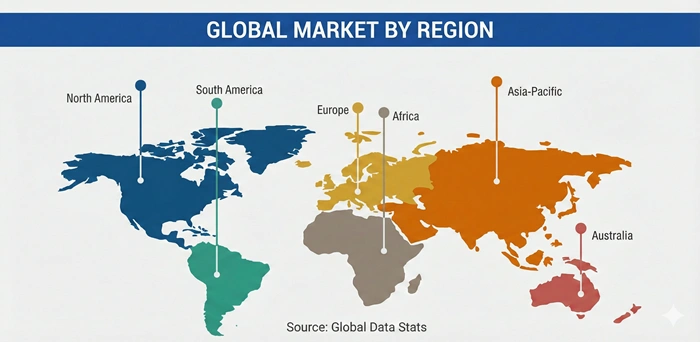
Asia Pacific commands the biomass briquette market with approximately 40% global market share valued at around USD 0.34 billion in 2025 and projected to exceed USD 0.90 billion by 2033. Massive agricultural operations across India, China, Thailand, Vietnam, and Indonesia generate hundreds of millions of tons of crop residues annually that serve as low-cost feedstock for briquette manufacturing. Rural electrification challenges and expensive LPG distribution in remote villages create strong demand for affordable solid fuels among residential users. The biomass briquette market thrives in this environment where both supply-side availability and demand-side economics align favorably for industry growth.
Government programs specifically targeting agricultural waste valorization accelerate market development across the region. India's National Bio-Energy Programme provides capital subsidies of up to USD 50000 per briquetting unit while mandating biomass co-firing percentages for coal power plants operated by NTPC and other major utilities. China implements strict agricultural burning prohibitions in provinces surrounding Beijing and Shanghai, effectively forcing farmers to sell their residues to biomass processors or face substantial fines. The biomass briquette market benefits from these regulatory frameworks that simultaneously restrict alternative disposal methods while incentivizing commercial briquette production. Leading regional players include ECOSTAN Biofuel, Gattuwala Energy, Radhe Industrial Corporation, and hundreds of smaller manufacturers operating in agricultural belts where feedstock logistics remain economically viable throughout most of the calendar year.
North America
Technology Innovation And Sustainability Mandates Driving Fastest Regional Growth
North America emerges as the fastest-growing region in the biomass briquette market with CAGR exceeding 9.5% from 2026 to 2033 as public and private sectors invest heavily in renewable heating infrastructure. United States forestry operations generate enormous volumes of wood residues from sustainable timber harvesting, land clearing, and sawmill operations. Canadian provinces with extensive forest resources actively promote biomass utilization as both an economic development strategy for rural communities and a carbon reduction mechanism supporting national climate commitments. The biomass briquette market captures this momentum through projects converting previously underutilized forest by-products into commercial energy supplies serving industrial and institutional customers.
Federal and state-level incentive programs accelerate biomass infrastructure development across the region. Production capacity reached 13.04 million tons annually in the United States by May 2025, with 75 active manufacturing facilities employing approximately 2417 workers in full-time positions. The biomass briquette market sees strong demand from industrial operations seeking to reduce fossil fuel dependency while meeting corporate sustainability targets that increasingly influence procurement decisions. Major companies like Enviva, Pinnacle Renewable Energy Group, Pacific BioEnergy Corporation, and Drax Biomass operate large-scale facilities throughout the Pacific Northwest, southeastern states, and Canadian provinces, supplying both domestic industrial users and export markets in Europe and Asia where premium wood briquettes command favorable pricing in international trade.
Top Key Players
-
Enviva (United States)
-
Pinnacle Renewable Energy Group (Canada)
-
Pacific BioEnergy Corporation (Canada)
-
German Pellets (Germany)
-
RWE Innogy (Germany)
-
Pfeifer Group (Austria)
-
Drax Biomass (United Kingdom)
-
Graanul Invest Group (Estonia)
-
General Biofuels (Australia)
-
Biomass Secure Power Inc. (United States)
-
Viridis Energy (Canada)
-
Westervelt (United States)
-
Lignetics (United States)
-
ECOSTAN Biofuel (India)
-
Gattuwala Energy (India)
-
Premium Pellet Ltd. (Canada)
Recent Developments
-
Enviva (2024): Completed expansion of its Hamlet, North Carolina production facility, increasing annual wood pellet and briquette capacity by 115000 tons to meet growing European and Asian export demand for sustainable biomass fuel alternatives.
-
Pacific BioEnergy Corporation (2024): Announced a strategic partnership with British Columbia forestry operators to secure long-term wood residue supply agreements totaling 250000 tons annually, strengthening feedstock security for their Prince George manufacturing operations.
-
EKI Energy Services (February 2024): Established a new biomass briquette manufacturing plant in Maharashtra, India, with initial production capacity of 800 metric tonnes per month expandable to 1200 metric tonnes, targeting industrial customers transitioning from coal to sustainable alternatives.
-
Madhya Pradesh Government (April 2025): Launched the Scheme for Implementation of Biofuel Projects under its Renewable Energy Policy 2025, offering financial incentives to boost bio-CNG, briquettes, and pellets production while creating rural employment opportunities across the state.
-
Bhopal Municipal Corporation (June 2025): Initiated construction of Madhya Pradesh's first green-waste processing plant under a public-private partnership model with an investment of approximately USD 1 million, designed to convert urban woody and leafy waste into commercial biomass briquettes for local industrial consumption.
Market Trends
Integration Of Circular Economy Principles And Decentralized Production Models
The biomass briquette market increasingly embraces circular economy frameworks where agricultural processors, forestry operations, and food manufacturers integrate briquetting units directly into their existing facilities. This vertical integration eliminates separate waste disposal costs while generating new revenue streams from energy products sold to nearby industrial users. Coffee processing plants convert their husks into briquettes immediately after bean extraction. Rice mills install on-site densification equipment that transforms hull waste into marketable solid fuel within hours of grain processing. The biomass briquette market benefits from these distributed production models that reduce transportation costs, improve feedstock quality through immediate processing, and strengthen local energy security in rural regions where grid electricity remains unreliable or expensive.
Corporate sustainability reporting requirements drive institutional procurement of certified sustainable biomass fuels meeting internationally recognized environmental standards. Multinational corporations with net-zero carbon commitments mandate that their manufacturing facilities and supply chain partners transition away from coal and fuel oil toward renewable alternatives with verified carbon reduction credentials. The biomass briquette market responds by developing traceability systems and third-party certification programs that document sustainable sourcing practices throughout the supply chain from agricultural fields through final industrial combustion. Premium pricing develops for certified products meeting strict European Union sustainability criteria or Japanese industrial standards, creating market differentiation opportunities for producers investing in quality assurance systems and transparent supply chain documentation.
Segments Covered In The Report
By Feedstock Type
-
Agricultural Waste
-
Forestry Residues
-
Industrial Biomass Waste
-
Urban Solid Waste
By Type
-
Wood Briquettes
-
Charcoal Briquettes
-
Sawdust Briquettes
-
Agro Waste Briquettes
By Form
-
Cylindrical Briquettes
-
Cubical Briquettes
-
Hexagonal Briquettes
-
Pellet Briquettes
By Application
-
Heating
-
Power Generation
-
Cooking Fuel
-
Industrial Fuel
By End-User Industry
-
Power Plants
-
Residential
-
Industrial
-
Commercial
By Region
-
North America (United States, Canada, Mexico)
-
Europe (Germany, United Kingdom, France, Austria, Poland, Rest of Europe)
-
Asia-Pacific (China, India, Japan, Thailand, Vietnam, Indonesia, Rest of Asia-Pacific)
-
Latin America (Brazil, Argentina, Rest of Latin America)
-
Middle East and Africa (UAE, South Africa, Rest of MEA)
Frequently Asked Questions
Question 1: What is the expected size of the global biomass briquette market by 2033?
Answer: The global biomass briquette market is projected to reach approximately USD 2.25 billion by 2033, expanding from USD 0.96 billion in 2026. This growth trajectory reflects increasing industrial adoption of renewable fuel alternatives driven by environmental regulations and carbon reduction mandates across major economies worldwide.
Question 2: Which region dominates the biomass briquette market currently?
Answer: Asia Pacific dominates the biomass briquette market with approximately 40% market share due to abundant agricultural residue availability and supportive government policies. Countries including India, China, Thailand, and Indonesia lead regional production through extensive farming operations generating massive volumes of crop residues suitable for briquetting applications.
Question 3: What CAGR will the biomass briquette market experience from 2026 to 2033?
Answer: The biomass briquette market will grow at a compound annual growth rate of 9.05% from 2026 to 2033. This robust expansion reflects accelerating demand from industrial heating applications, power generation co-firing requirements, and residential users seeking cost-effective renewable energy alternatives to conventional fossil fuels.
Question 4: Which feedstock type holds the largest share in the biomass briquette market?
Answer: Agricultural waste feedstock dominates the biomass briquette market with over 41% market share including rice husks, wheat straw, and corn stalks. These materials provide cost-effective raw inputs available in massive quantities across global farming regions where government policies increasingly restrict open burning while promoting commercial biomass processing.
Question 5: What are the primary growth drivers for the biomass briquette market?
Answer: Primary growth drivers include stringent environmental regulations mandating carbon reduction, government co-firing policies requiring biomass blending in coal power plants, and rising fossil fuel costs. The biomass briquette market also benefits from improved processing technologies, agricultural waste monetization opportunities, and corporate sustainability commitments driving industrial procurement of renewable fuel alternatives.