
Bioethanol Market Overview
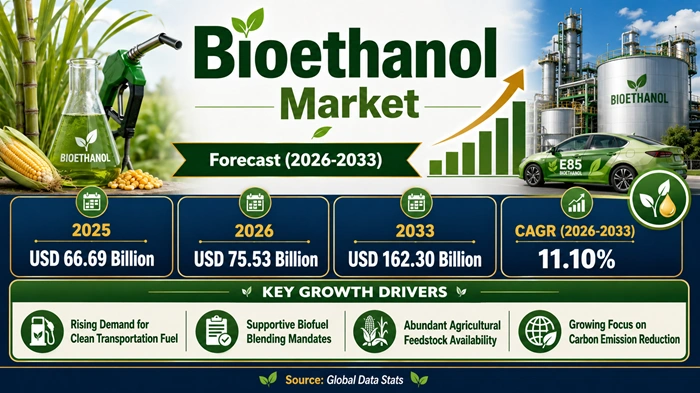
The global bioethanol market size is valued at USD 66.69 billion in 2025 and is predicted to increase from USD 75.53 billion in 2026 to approximately USD 162.30 billion by 2033, growing at a CAGR of 11.10% from 2026 to 2033.
Bioethanol represents renewable liquid fuel produced through fermentation of sugar, starch, and cellulosic materials derived from agricultural crops, forest residues, and dedicated energy feedstocks. This sustainable energy alternative delivers high octane ratings, reduces greenhouse gas emissions, and blends seamlessly with conventional gasoline supporting existing vehicle engines without modification. The bioethanol market encompasses diverse production technologies including first-generation processes utilizing corn and sugarcane, advanced second-generation methods converting agricultural waste into fuel, and emerging third-generation pathways leveraging algae biomass addressing global energy security while supporting agricultural economies worldwide.
AI Impact On The Bioethanol Industry
Transforming Production Efficiency And Feedstock Optimization Through Intelligent Systems
Artificial intelligence revolutionizes bioethanol production by optimizing fermentation processes, predicting equipment maintenance requirements, and identifying ideal feedstock combinations maximizing yield while minimizing costs. Machine learning algorithms analyze thousands of variables including temperature, pH levels, yeast strain performance, and substrate composition to determine optimal processing conditions producing higher ethanol concentrations with reduced energy consumption. Computer vision systems monitor fermentation tanks in real-time detecting contamination risks, yeast health indicators, and conversion efficiency metrics enabling immediate corrective actions preventing batch failures. The bioethanol market benefits from AI-driven process control reducing production costs by 12-18% while improving output consistency and quality meeting stringent fuel specifications demanded by regulatory standards and commercial buyers.
Predictive analytics transform supply chain management as AI systems forecast feedstock availability, optimize inventory levels, and schedule production runs aligning with market demand patterns and seasonal harvest cycles. Digital twins create virtual replicas of entire bioethanol facilities enabling engineers to simulate process modifications, test new feedstock combinations, and validate equipment upgrades without disrupting actual operations. The bioethanol market witnesses accelerated innovation as AI compresses development timelines for advanced cellulosic technologies, identifying optimal enzyme combinations and pretreatment methods converting woody biomass and agricultural residues into fermentable sugars. Smart logistics platforms powered by machine learning optimize transportation routes, blending terminal operations, and distribution scheduling reducing delivery costs while ensuring timely fuel availability across retail networks maximizing operational efficiency throughout entire value chains.
Growth Factors
Government Mandates And Decarbonization Commitments Driving Robust Market Expansion
Renewable fuel standards established globally create compelling demand drivers as nations mandate minimum bioethanol blending percentages in transportation fuel addressing climate commitments and energy security objectives. United States Renewable Fuel Standard requires refiners blend specified volumes of renewable fuels including bioethanol into gasoline supplies with enforcement mechanisms penalizing non-compliance. European Union Renewable Energy Directive establishes binding renewable energy targets across member states while India's Ethanol Blending Program targets 20% ethanol in gasoline by 2025. The bioethanol market expands rapidly as regulatory frameworks provide demand certainty supporting long-term investment decisions in production capacity, feedstock cultivation, and distribution infrastructure. Carbon pricing mechanisms including cap-and-trade systems and fuel carbon intensity regulations create financial advantages for low-carbon bioethanol compared to fossil gasoline, with advanced cellulosic ethanol qualifying for premium carbon credits enhancing economic viability.
Agricultural sector integration delivers substantial benefits as bioethanol production creates consistent demand for corn, sugarcane, wheat, and dedicated energy crops supporting farm economies and rural development. Farmers gain access to stable markets with predictable pricing reducing commodity price volatility while byproducts including distillers grains provide high-value animal feed supplementing farm revenues. The bioethanol market benefits from technological improvements in crop genetics producing higher-starch corn varieties and enhanced sugarcane cultivars increasing ethanol yields per hectare. Manufacturing cost reductions emerge through economies of scale as larger production facilities achieve superior operational efficiency while process innovations including advanced fermentation techniques, energy recovery systems, and waste valorization reduce production expenses enabling competitive pricing versus petroleum gasoline. Growing corporate sustainability commitments drive demand as major fuel retailers, fleet operators, and automotive manufacturers pursue carbon reduction targets positioning bioethanol blends as immediate solutions reducing transportation emissions without requiring vehicle fleet replacement.

Market Outlook
Advanced Technologies And Feedstock Diversification Creating Robust Long-Term Growth Trajectory
Cellulosic ethanol commercialization progresses as second-generation technologies utilizing agricultural residues, forestry waste, and dedicated energy crops approach cost parity with conventional corn-based production. Engineering breakthroughs in enzymatic hydrolysis, thermochemical pretreatment, and consolidated bioprocessing convert recalcitrant lignocellulosic materials into fermentable sugars overcoming technical barriers limiting earlier commercialization attempts. The bioethanol market witnesses growing investment in demonstration-scale cellulosic facilities validating integrated production systems while establishing supply chains for non-food feedstocks addressing food-versus-fuel concerns associated with first-generation technologies. Government support programs including production tax credits, loan guarantees, and research funding accelerate cellulosic deployment with multiple facilities achieving sustained commercial operations demonstrating technical feasibility and improving economics through operational experience.
Infrastructure development expands bioethanol distribution capabilities as pipeline operators, fuel terminals, and retail stations upgrade facilities handling higher ethanol blends including E15 and E85 formulations. Flex-fuel vehicle populations grow across United States, Brazil, and European markets capable of operating on gasoline blends containing up to 85% ethanol expanding addressable market beyond conventional E10 blends dominating current consumption. The bioethanol market benefits from international trade growth as production-surplus nations including United States and Brazil export to deficit markets in Europe and Asia Pacific creating global supply chains balancing regional production capacity with consumption demand. Technology convergence with carbon capture creates negative-emission bioethanol as facilities integrate CO2 capture systems sequestering fermentation emissions producing carbon-negative fuels qualifying for premium environmental credits while establishing bioethanol as climate solution addressing hard-to-decarbonize transportation sectors including aviation and maritime shipping through sustainable aviation fuel pathways.
Expert Speaks
-
Juan Luciano, CEO at Archer Daniels Midland Company, emphasized through recent earnings communications that ADM's position as leading global bioethanol producer positions the company to capitalize on accelerating renewable fuel demand driven by government decarbonization mandates, noting that strategic investments in carbon capture technology and advanced feedstock processing create competitive advantages delivering premium-priced low-carbon intensity ethanol qualifying for enhanced environmental credits.
-
Jeff Broin, Executive Chairman at POET LLC, highlighted during industry presentations that America's bioethanol sector delivers proven climate benefits reducing transportation emissions while supporting rural economies through sustained agricultural demand, emphasizing that continued policy support and infrastructure investment enable bioethanol serving as cornerstone of national decarbonization strategy delivering immediate emissions reductions at scale.
-
Todd Becker, CEO at Green Plains Inc., noted through investor communications that Green Plains' transformation from commodity ethanol producer toward sustainable ingredients and renewable fuels company reflects evolving market dynamics where bioethanol facilities serve as biorefinery platforms producing diverse high-value products beyond fuel ethanol, positioning the company capturing growth opportunities across multiple end markets driven by sustainability trends.
Key Report Takeaways
-
North America dominates the bioethanol market capturing approximately 36% regional share valued around USD 24.01 billion in 2025, driven by extensive corn production infrastructure, Renewable Fuel Standard mandates requiring bioethanol blending, advanced ethanol production technology, and established distribution networks supporting widespread E10 fuel availability.
-
Asia Pacific emerges as fastest-growing region with projected CAGR exceeding 12.2% through 2033, fueled by massive energy demand growth, government biofuel mandates in India and China, agricultural modernization supporting feedstock availability, and policy initiatives targeting reduced petroleum imports through domestic renewable fuel production.
-
Starch-based feedstock represents the largest segment accounting for approximately 52% market share due to abundant corn and wheat supplies, mature production technologies delivering proven reliability, existing agricultural infrastructure, and cost-effectiveness compared to cellulosic alternatives establishing dominance across major producing regions.
-
Transportation applications contribute the most significant demand representing roughly 68% of total market as automotive fuel represents primary bioethanol use case, driven by government blending mandates, octane enhancement benefits, emissions reduction advantages, and compatibility with existing gasoline engine designs requiring minimal vehicle modifications.
-
E10 blend maintains dominant position commanding nearly 63% market share owing to widespread regulatory mandates across multiple countries, compatibility with conventional vehicle engines without modification, proven performance characteristics, and established infrastructure supporting production, distribution, and retail availability globally.
-
Second-generation fuel exhibits fastest growth trajectory projected to expand at 13.8% CAGR through 2033 with market share reaching approximately 31%, driven by cellulosic technology commercialization, premium pricing for low-carbon intensity fuels, government incentives supporting advanced biofuel deployment, and feedstock diversification addressing sustainability concerns.
Market Scope
| Report Coverage | Details |
|---|---|
| Market Size by 2033 | USD 162.30 Billion |
| Market Size by 2025 | USD 66.69 Billion |
| Market Size by 2026 | USD 75.53 Billion |
| Market Growth Rate from 2026 to 2033 | CAGR of 11.10% |
| Dominating Region | North America |
| Fastest Growing Region | Asia Pacific |
| Base Year | 2025 |
| Forecast Period | 2026 to 2033 |
| Segments Covered | Feedstock, Fuel Generation, Blend, Application, End-User, Region |
| Regions Covered | North America, Europe, Asia-Pacific, Latin America, Middle East and Africa |
Market Dynamics
Drivers Impact Analysis
Renewable Fuel Standards And Carbon Reduction Mandates Accelerating Market Adoption
| Factor | (≈) % Impact on CAGR Forecast | Geographic Relevance | Impact Timeline |
|---|---|---|---|
| Government blending mandates | 22-28% | North America, Europe, Asia Pacific | 2026-2033 |
| Carbon pricing mechanisms | 18-24% | Europe, North America, select Asian markets | 2026-2033 |
| Agricultural sector support | 15-21% | Major crop-producing regions globally | 2026-2033 |
Government policies establishing mandatory bioethanol blending requirements create sustained demand growth across major fuel markets worldwide. United States Renewable Fuel Standard mandates increasing volumes of renewable fuel blended into transportation fuel with compliance enforced through tradeable credit systems. European Union member states implement national biofuel obligations ranging from 5-10% renewable content in gasoline driving consistent bioethanol consumption. The bioethanol market benefits from regulatory stability providing long-term demand visibility supporting capital investment in production capacity expansion, feedstock development, and infrastructure improvements. India's ambitious ethanol blending program targets 20% ethanol in gasoline creating substantial incremental demand requiring billions of liters annual production capacity additions supporting domestic agricultural sectors while reducing costly petroleum imports.
Carbon reduction commitments under Paris Agreement drive nations toward decarbonization pathways where bioethanol delivers immediate transportation emissions reductions utilizing existing vehicle fleets and fuel infrastructure. Lifecycle assessments demonstrate corn-based ethanol reduces greenhouse gas emissions 40-50% compared to gasoline while advanced cellulosic technologies achieve 90% reductions qualifying for premium environmental credits. The bioethanol market expands as carbon pricing mechanisms including California Low Carbon Fuel Standard and European Union Emissions Trading System create financial incentives favoring low-carbon biofuels over fossil alternatives. Corporate sustainability commitments from major fuel retailers, automotive manufacturers, and transportation companies establish voluntary procurement targets for renewable fuels supporting bioethanol demand beyond regulatory requirements. Agricultural sector benefits accrue as bioethanol production creates stable markets for corn, wheat, sugarcane, and emerging energy crops supporting farm incomes, rural employment, and agricultural infrastructure investment across producing regions worldwide.

Restraints Impact Analysis
Food Security Concerns And Electric Vehicle Competition Constraining Growth Potential
| Factor | (≈) % Impact on CAGR Forecast | Geographic Relevance | Impact Timeline |
|---|---|---|---|
| Food-versus-fuel debate | -12 to -17% | Global food-deficit regions | 2026-2030 |
| Electric vehicle market growth | -10 to -15% | Developed automotive markets | 2028-2033 |
| Production cost pressures | -8 to -13% | High feedstock cost regions | 2026-2033 |
Food security considerations create political opposition to bioethanol production as critics argue diverting food crops toward fuel production increases agricultural commodity prices affecting food affordability for vulnerable populations. Corn, wheat, and sugarcane utilized in first-generation bioethanol compete directly with food and feed applications creating ethical debates particularly during agricultural commodity price spikes or regional harvest failures. The bioethanol market faces policy uncertainty as some governments reconsider biofuel mandates responding to public concerns regarding food price inflation and agricultural land use priorities. Environmental advocacy groups challenge conventional bioethanol sustainability credentials citing indirect land-use change emissions, water consumption, and agrochemical usage associated with intensive feedstock cultivation potentially offsetting carbon reduction benefits claimed by industry.
Electric vehicle market penetration threatens long-term bioethanol demand growth as battery-electric powertrains gain consumer acceptance across major automotive markets. Global electric vehicle sales exceed 10 million units annually with projections indicating EVs capturing 30-50% new vehicle sales by 2030 particularly concentrated in developed markets including Europe, China, and North America. The bioethanol market confronts structural demand headwinds as transportation electrification reduces gasoline consumption and associated bioethanol blending opportunities. Production economics face challenges as feedstock costs represent 60-75% of bioethanol manufacturing expenses creating vulnerability to agricultural commodity price volatility affecting profitability margins. Capital-intensive cellulosic technologies require substantial upfront investment with uncertain returns as demonstration facilities struggle achieving cost competitiveness versus conventional corn-based production. Infrastructure limitations constrain higher-blend adoption as gasoline stations lack equipment handling E15 and E85 fuels while non-flex-fuel vehicle warranties restrict usage above E10 blends limiting market growth potential.
Opportunities Impact Analysis
Sustainable Aviation Fuel And Export Markets Creating Revenue Diversification
| Factor | (≈) % Impact on CAGR Forecast | Geographic Relevance | Impact Timeline |
|---|---|---|---|
| Sustainable aviation fuel pathways | +16 to +22% | Aviation hubs globally | 2027-2033 |
| International trade expansion | +14 to +19% | Export-oriented production regions | 2026-2033 |
| Carbon capture integration | +12 to +17% | Large-scale production facilities | 2026-2033 |
Sustainable aviation fuel emerges as high-value opportunity as aviation sector pursues decarbonization pathways where bioethanol serves as feedstock for alcohol-to-jet fuel production technologies. Commercial airlines establish ambitious carbon reduction targets requiring sustainable aviation fuel representing 10-30% of jet fuel consumption by 2030-2040. The bioethanol market captures growing demand as ethanol-to-SAF conversion technologies achieve commercial readiness with multiple facilities announced across North America and Europe. Premium pricing for sustainable aviation fuel delivers superior margins compared to transportation ethanol as airlines pay significant premiums for SAF qualifying for carbon credit generation and corporate sustainability reporting. Policy support including production tax credits, blending mandates, and procurement commitments from government and military aviation accelerates SAF market development creating substantial growth opportunities for bioethanol producers.
International trade expansion diversifies revenue streams as production-surplus regions export bioethanol to deficit markets balancing regional supply-demand dynamics. United States emerges as major bioethanol exporter serving European Union, Canada, and Asian markets where domestic production proves insufficient meeting regulatory blending requirements. The bioethanol market benefits from trade agreements reducing tariffs and establishing equivalency frameworks recognizing sustainability certifications facilitating cross-border commerce. Brazil leverages competitive sugarcane-based production costs capturing export opportunities as global demand exceeds local production capacity. Carbon capture technology integration creates premium low-carbon bioethanol commanding enhanced pricing as facilities capture fermentation CO2 for sequestration or utilization qualifying for carbon-negative fuel classifications under California Low Carbon Fuel Standard and similar programs. Industrial applications diversify end markets as bioethanol serves chemical manufacturing, pharmaceutical production, and personal care formulations providing non-fuel revenue opportunities reducing exposure to transportation fuel market volatility while improving overall facility economics.

Segment Analysis
By Feedstock: Starch-Based
Manufacturing Infrastructure And Feedstock Abundance Establishing Segment Dominance
Starch-based feedstock commands the largest share within the bioethanol market at approximately 52%, valued around USD 34.68 billion in 2025 owing to abundant corn, wheat, and grain sorghum supplies across major producing regions and mature production technologies delivering proven reliability and cost-effectiveness. Corn dominates North American bioethanol production leveraging extensive cultivation infrastructure, high-starch content varieties optimized for ethanol yields, and established agricultural supply chains. Enzymatic conversion processes efficiently break down starch molecules into fermentable sugars achieving high conversion efficiencies exceeding 90% while co-producing valuable distillers grains serving livestock feed markets. The bioethanol market benefits from continuous crop improvement through conventional breeding and biotechnology developing higher-yielding varieties with enhanced starch content and improved drought tolerance reducing production costs while increasing sustainability metrics.
North America leads starch-based bioethanol production with United States operating over 200 ethanol facilities concentrated across Corn Belt states including Iowa, Nebraska, and Illinois. Asia Pacific represents growing market as China and India expand corn and wheat-based ethanol production addressing energy security priorities and agricultural surplus management. The bioethanol market witnesses this segment maintaining steady growth near 10.8% CAGR through 2033 despite emerging cellulosic competition as starch-based production delivers proven economics, reliable performance, and established market acceptance. Leading regional producers including POET LLC, Archer Daniels Midland, Green Plains Inc., and Valero Energy operate large-scale facilities leveraging economies of scale, advanced fermentation technologies, and integrated energy systems optimizing operational efficiency. Technology evolution focuses on energy efficiency improvements, water consumption reduction, and carbon intensity minimization through renewable natural gas utilization, carbon capture implementation, and process optimization enhancing environmental performance while maintaining cost competitiveness.
By Application: Transportation
Fuel Blending Mandates And Emissions Reduction Benefits Driving Segment Leadership
Transportation applications represent the largest and fastest-growing segment in the bioethanol market commanding approximately 68% share valued around USD 45.35 billion in 2025, driven by government blending mandates requiring renewable fuel content in gasoline and automotive industry adoption supporting vehicle compatibility across conventional and flex-fuel designs. Bioethanol serves as octane enhancer replacing toxic additives in gasoline formulations while delivering superior combustion characteristics reducing carbon monoxide, particulate matter, and hydrocarbon emissions compared to pure gasoline. Fleet operators including government agencies, transportation companies, and corporate vehicle programs adopt higher ethanol blends reducing operational carbon footprints while achieving cost savings compared to premium gasoline. The bioethanol market benefits from established retail infrastructure as E10 fuels achieve near-universal availability across United States, Brazil, and European markets with growing E15 and E85 station networks expanding consumer access to higher blends.
Global automotive manufacturers design vehicles accommodating ethanol blends as standard fuel with flex-fuel engines capable of operating on gasoline-ethanol mixtures up to E85 concentration. North America leads transportation bioethanol consumption with over 140 billion liters annual usage blended into gasoline supplies. Brazil maintains mandatory ethanol blending ranging from 18-27% depending on sugarcane harvest conditions and price dynamics. The bioethanol market sees this segment expanding at robust 11.5% CAGR through 2033 driven by tightening fuel carbon intensity regulations, expanding biofuel mandates across emerging markets including India and China, and growing corporate sustainability commitments from major fuel retailers and transportation companies. Performance advantages including higher octane ratings enabling advanced engine designs, superior cold-start characteristics, and compatibility with modern fuel injection systems position ethanol-blended fuels as preferred gasoline formulations. Racing applications validate ethanol performance as NASCAR, IndyCar, and other motorsports series mandate E15 and E85 fuels demonstrating reliability, safety, and performance benefits under extreme operating conditions.

Regional Insights
North America
Corn Infrastructure And Renewable Fuel Standards Cementing Regional Market Leadership
North America dominates the bioethanol market commanding approximately 36% global share valued at USD 24.01 billion in 2025, projected to reach USD 58.44 billion by 2033 growing at 10.9% CAGR. United States establishes overwhelming regional leadership operating world's largest bioethanol industry with annual production capacity exceeding 15 billion gallons supported by extensive corn cultivation across Midwest states. Renewable Fuel Standard provides demand certainty mandating renewable fuel blending volumes creating stable market for bioethanol producers while Low Carbon Fuel Standard programs in California and other states reward low-carbon intensity ethanol with premium pricing. The bioethanol market benefits from North America's integrated agricultural and energy infrastructure including dedicated ethanol pipeline networks, blending terminals, and retail distribution systems supporting widespread E10 fuel availability with growing E15 adoption.
Canada contributes regional growth through wheat and corn-based ethanol production supported by federal Clean Fuel Regulations establishing carbon intensity reduction requirements for transportation fuels. Provincial programs in Ontario and Manitoba provide additional policy support through renewable content mandates and production incentives. Mexico represents growing demand market consuming domestic production and United States exports supporting regional trade flows. The bioethanol market witnesses technological leadership as North American producers invest in carbon capture technology, advanced fermentation systems, and energy efficiency improvements reducing production carbon intensity qualifying for enhanced environmental credit values. Leading regional players include POET LLC operating over 30 facilities across Corn Belt, Archer Daniels Midland leveraging global agribusiness infrastructure, Green Plains Inc. transitioning toward integrated biorefinery model, Valero Energy expanding renewable fuels portfolio, and Flint Hills Resources applying process optimization expertise. Policy stability, agricultural abundance, technological innovation, and infrastructure advantages position North America maintaining market leadership throughout forecast period.
Asia Pacific
Energy Security Priorities And Agricultural Modernization Driving Fastest Regional Growth
Asia Pacific emerges as the fastest-growing region in the bioethanol market with CAGR exceeding 12.2% from 2026 to 2033, with market value expanding from approximately USD 17.34 billion in 2025 toward USD 44.52 billion by 2033. China leads regional expansion pursuing energy security and agricultural surplus management through ethanol production utilizing corn, cassava, and sweet sorghum feedstocks. Government policies including E10 mandate implementation across multiple provinces create substantial domestic demand supporting production capacity additions. India represents major growth opportunity as Ethanol Blending Program targets 20% ethanol in gasoline by 2025 requiring billions of liters annual production capacity utilizing sugarcane molasses, grains, and emerging cellulosic feedstocks. The bioethanol market benefits from agricultural modernization improving crop yields and expanding feedstock availability supporting sustainable production growth.
Southeast Asian nations including Thailand, Philippines, and Indonesia implement biofuel policies promoting domestic ethanol production from sugar, cassava, and palm-based feedstocks addressing petroleum import dependency. Regional governments provide production incentives, blending mandates, and infrastructure support accelerating market development. Japan and South Korea remain import-dependent markets creating trade opportunities for regional producers. The bioethanol market witnesses manufacturing investment as domestic and international companies establish production facilities across multiple countries. Leading regional players include state-owned enterprises in China and India, agricultural conglomerates including CP Group in Thailand, and international majors including ADM establishing regional operations. Technology transfer initiatives, research collaboration, and academic partnerships advance production capabilities while policy coordination through ASEAN frameworks promotes regional market integration. Energy security priorities, urbanization trends increasing fuel demand, and policy support position Asia Pacific as primary growth engine for global bioethanol expansion throughout forecast period.
Top Key Players
-
Archer Daniels Midland Company (United States)
-
POET LLC (United States)
-
Green Plains Inc. (United States)
-
Valero Energy Corporation (United States)
-
Flint Hills Resources (United States)
-
Raízen S.A. (Brazil)
-
Tereos Group (France)
-
Alto Ingredients Inc. (United States)
-
The Andersons Inc. (United States)
-
Pacific Ethanol Inc. (United States)
-
Sekab Biofuels & Chemicals AB (Sweden)
-
BlueFire Ethanol Fuels Inc. (United States)
-
BASF SE (Germany)
-
Lummus Technology (United States)
-
Pannonia Bio Zrt (Hungary)
Recent Developments
-
Archer Daniels Midland (October 2024): Announced completion of carbon capture and sequestration project at Decatur Illinois ethanol facility permanently storing over 5 million tons of CO2, establishing ADM as leader in low-carbon intensity ethanol production qualifying for premium environmental credits under Low Carbon Fuel Standard programs while demonstrating commercial viability of carbon capture technology integrated with bioethanol manufacturing.
-
POET LLC (August 2024): Launched commercial production at first large-scale cellulosic ethanol facility utilizing corn kernel fiber and crop residues converting agricultural waste streams into renewable fuel, achieving production capacity of 20 million gallons annually demonstrating technical and economic viability of second-generation bioethanol technologies advancing industry toward sustainable feedstock diversification.
-
Green Plains Inc. (June 2024): Completed strategic transformation repositioning company as sustainable ingredients and renewable fuels producer, announcing partnerships converting bioethanol production byproducts into high-value protein ingredients for human consumption and animal nutrition markets, diversifying revenue streams beyond commodity ethanol toward premium products commanding superior margins.
-
Lummus Technology (September 2024): Announced commercial launch of ethanol-to-sustainable aviation fuel process technology offering aviation industry commercially demonstrated pathway producing SAF from bioethanol feedstocks, targeting large-scale deployment supporting airline decarbonization commitments and government sustainable aviation fuel blending mandates across North America and Europe.
-
BASF (May 2024): Introduced Spartec brand to North American bioethanol market offering advanced enzyme formulations, fermentation additives, and process optimization technologies improving ethanol yields, reducing energy consumption, and lowering production costs, supporting industry competitiveness through continuous innovation in bioprocessing technologies and operational efficiency improvements.
Market Trends
Carbon Capture Integration And Cellulosic Technology Commercialization Reshaping Industry
Carbon capture and sequestration technology transforms bioethanol industry economics as facilities capture fermentation CO2 for permanent geologic storage or commercial utilization producing low and negative carbon intensity ethanol. Multiple United States facilities implement carbon capture systems leveraging federal 45Q tax credits providing USD 85 per ton for permanently sequestered CO2 dramatically improving project economics. The bioethanol market witnesses captured CO2 transported through dedicated pipeline networks to sequestration sites or sold to industrial customers for enhanced oil recovery, greenhouse operations, and food-grade applications. Low-carbon ethanol commands premium pricing under California Low Carbon Fuel Standard, Oregon Clean Fuels Program, and similar mechanisms where carbon intensity scores determine credit values. Facilities achieving negative carbon scores through carbon capture generate maximum credit values delivering superior profitability compared to conventional production. Technology costs decline as deployment scales with multiple carbon capture projects announced across Corn Belt ethanol facilities.
Cellulosic ethanol commercialization progresses as second-generation facilities achieve sustained operations converting agricultural residues, forest biomass, and dedicated energy crops into renewable fuel. Engineering improvements reduce capital costs while operational experience optimizes biological and thermochemical conversion processes improving yields and reducing production expenses. The bioethanol market benefits from cellulosic technology delivering enhanced sustainability metrics achieving 90% greenhouse gas reduction versus gasoline qualifying for premium Renewable Fuel Standard credits and environmental attribute pricing. Feedstock supply chains mature as agricultural service providers establish collection systems aggregating corn stover, wheat straw, and energy crop biomass supporting consistent facility operations. Integrated biorefinery concepts emerge producing multiple revenue streams including cellulosic ethanol, renewable natural gas from organic waste, biochar for soil amendment, and high-value biochemicals maximizing biomass utilization economics. Policy support continues through production tax credits, loan guarantees, and research funding accelerating technology deployment while industry consolidation positions surviving facilities for long-term commercial success serving growing advanced biofuel market demand.
Segments Covered In The Report
By Feedstock
-
Starch-Based (Corn, Wheat, Grain Sorghum)
-
Sugar-Based (Sugarcane, Sugar Beet, Molasses)
-
Cellulose-Based (Agricultural Residues, Forest Biomass, Energy Crops)
By Fuel Generation
-
First Generation
-
Second Generation
-
Third Generation
By Blend
-
E5
-
E10
-
E15 to E70
-
E75 and E85
-
Others
By Application
-
Transportation
-
Alcoholic Beverages
-
Cosmetics
-
Pharmaceuticals
-
Others (Chemical, Paint and Coatings)
By End-User
-
Automotive
-
Industrial
-
Chemical
-
Food and Beverage
-
Others
By Region
-
North America (United States, Canada, Mexico)
-
Europe (Germany, France, United Kingdom, Spain, Italy, Sweden, Rest of Europe)
-
Asia-Pacific (China, India, Japan, South Korea, Thailand, Philippines, Rest of Asia-Pacific)
-
Latin America (Brazil, Argentina, Rest of Latin America)
-
Middle East and Africa (Saudi Arabia, UAE, South Africa, Rest of MEA)
Frequently Asked Questions
Question 1: What is the expected size of the bioethanol market by 2033?
Answer: The global bioethanol market is projected to reach approximately USD 162.30 billion by 2033, expanding from USD 75.53 billion in 2026. This growth reflects increasing government renewable fuel mandates, transportation sector decarbonization initiatives, agricultural sector support, and technological advancements in cellulosic ethanol production improving sustainability performance.
Question 2: Which region dominates the bioethanol market currently?
Answer: North America dominates the bioethanol market with approximately 36% market share due to extensive corn production infrastructure, Renewable Fuel Standard mandates requiring bioethanol blending, advanced production technology, and established distribution networks. The region benefits from policy stability, agricultural abundance, and technological leadership supporting sustained market dominance.
Question 3: What CAGR will the bioethanol market experience from 2026 to 2033?
Answer: The bioethanol market will grow at a compound annual growth rate of 11.10% from 2026 to 2033. This expansion reflects strengthening government blending mandates, carbon reduction commitments requiring renewable transportation fuels, cellulosic technology commercialization, and agricultural sector support driving production capacity additions globally.
Question 4: Which feedstock type holds the largest share in the bioethanol market?
Answer: Starch-based feedstock commands the largest market share at approximately 52% due to abundant corn and wheat supplies across major producing regions, mature production technologies delivering proven reliability, existing agricultural infrastructure, and cost-effectiveness. The bioethanol market benefits from continuous crop improvement enhancing starch content and ethanol yields.
Question 5: What are the primary growth drivers for the bioethanol market?
Answer: Primary drivers include government blending mandates establishing renewable fuel requirements, carbon pricing mechanisms rewarding low-carbon biofuels, and agricultural sector support creating stable feedstock markets. The bioethanol market also benefits from transportation emissions reduction benefits, sustainable aviation fuel opportunities, carbon capture technology integration, and international trade expansion diversifying revenue streams.