
Biochar Gasification Market Overview
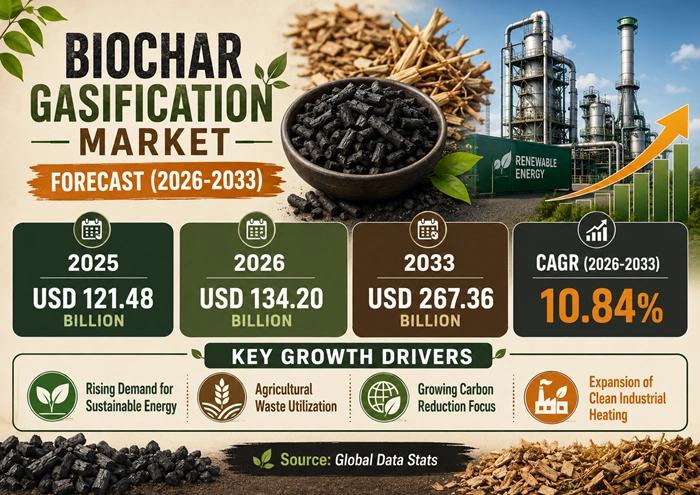
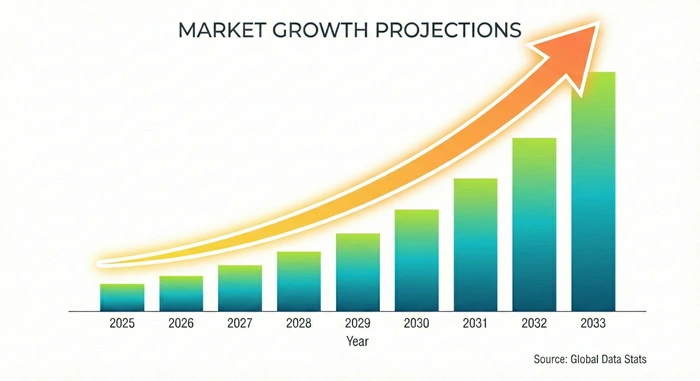
The global biochar gasification market size is valued at USD 121.48 billion in 2025 and is predicted to increase from USD 134.20 billion in 2026 to approximately USD 267.36 billion by 2033, growing at a CAGR of 10.84% from 2026 to 2033.
Biochar gasification involves a thermochemical conversion process transforming biomass materials into combustible syngas and carbon-rich biochar under controlled high-temperature, oxygen-limited conditions. This dual-output technology delivers renewable energy generation capabilities while producing stable biochar suitable for agricultural soil enhancement and long-term carbon sequestration. The process converts agricultural residues, forestry waste, and organic materials into valuable products supporting circular economy principles and climate change mitigation strategies.
AI Impact On The Biochar Gasification Industry
Enhancing Process Efficiency And Quality Control Through Intelligent Automation Systems
Artificial intelligence revolutionizes biochar gasification operations by enabling real-time optimization of complex thermochemical processes previously requiring extensive manual oversight. Machine learning algorithms continuously analyze operational parameters including temperature profiles, feedstock characteristics, oxygen ratios, and residence times to maximize biochar yield while maintaining consistent quality standards. Smart sensor networks integrated with AI systems detect subtle variations in biomass moisture content, particle size distribution, and ash composition, automatically adjusting reactor conditions to compensate for feedstock variability. The biochar gasification market benefits from these intelligent systems reducing operational costs through minimized energy consumption, decreased downtime from predictive maintenance capabilities, and improved product consistency meeting stringent agricultural certification requirements.
Digital transformation extends throughout supply chains as AI-powered logistics platforms optimize biomass collection routes, inventory management, and distribution networks connecting rural feedstock sources with production facilities. Advanced analytics predict seasonal availability patterns for different agricultural residues, enabling producers to diversify feedstock portfolios and maintain year-round operations despite harvest cycle variations. The biochar gasification market witnesses accelerated commercialization as AI-driven carbon monitoring systems provide precise measurement and verification documentation supporting carbon credit certifications. Blockchain integration with AI platforms creates transparent traceability from feedstock origin through biochar application, satisfying increasingly rigorous sustainability standards demanded by corporate purchasers and regulatory frameworks governing carbon offset markets worldwide.
Growth Factors
Rising Demand For Sustainable Agriculture And Carbon Credit Monetization Driving Adoption
Agricultural sector transformation toward regenerative practices creates substantial demand for biochar as farmers recognize soil health improvements, water retention benefits, and reduced fertilizer requirements. Scientific evidence demonstrates biochar applications increase crop yields ranging from 10% to 40% across diverse soil types while simultaneously sequestering atmospheric carbon for centuries. Climate-smart agriculture initiatives supported by governmental programs incentivize biochar adoption through subsidies, technical assistance, and carbon farming programs. The biochar gasification market expands rapidly as agricultural cooperatives, large-scale farming operations, and specialty crop producers integrate biochar into soil management protocols addressing degradation challenges threatening long-term productivity.
Carbon credit markets provide compelling economic drivers as biochar projects qualify for premium pricing under voluntary and compliance frameworks recognizing permanent carbon removal. Major corporations including Microsoft, Google, and technology leaders commit to multi-year, high-volume carbon removal credit purchases from biochar producers, providing revenue certainty supporting infrastructure investments. The biochar gasification market benefits from carbon prices approaching USD 200 per tonne for high-quality, well-documented removal credits, creating profitable business models even before considering biochar sales revenue. Government incentives for renewable energy generation from syngas co-products further improve project economics, with combined heat and power applications delivering additional revenue streams diversifying risk and accelerating return on investment timelines attractive to infrastructure investors and project developers.
Market Outlook
Accelerating Commercialization And Policy Support Positioning Sector For Sustained Expansion
Investment momentum builds significantly as biochar gasification transitions from pilot demonstrations toward commercial-scale deployment across multiple continents. Production capacity additions accelerate with facilities ranging from modular, decentralized units serving local agricultural communities to industrial-scale plants processing hundreds of thousands of tonnes annually. Technology maturation addresses earlier challenges related to tar formation, feedstock flexibility, and operational reliability, with second and third-generation reactor designs achieving continuous operation exceeding 8000 hours annually. The biochar gasification market attracts diverse investor categories including agricultural equipment manufacturers, waste management companies, energy developers, and carbon credit aggregators recognizing multiple value propositions supporting robust project economics.
Policy frameworks evolve rapidly supporting biochar industry development through renewable energy mandates, circular economy regulations, and carbon removal targets. European Union carbon removal certification frameworks establish standardized methodologies enabling biochar projects to generate tradeable credits integrating with emissions trading systems. United States Department of Agriculture allocates substantial funding supporting biochar production infrastructure across rural regions while state-level programs provide additional incentives. The biochar gasification market witnesses regulatory clarity improving as testing protocols, quality standards, and application guidelines mature through industry collaboration with agricultural authorities, environmental agencies, and international standards organizations establishing biochar as recognized climate solution within IPCC mitigation pathways and national decarbonization strategies.
Expert Speaks
-
Philippe Haffner, Co-founder and CEO at Haffner Energy, emphasized during fiscal 2024-2025 results presentation that the company continues executing its strategic roadmap expanding addressable markets beyond hydrogen production while achieving significant project portfolio growth, positioning gasification technology platforms to serve diverse energy and environmental applications across industrial sectors pursuing decarbonization objectives.
-
Rajiv Mangal, Vice President of Safety, Health and Sustainability at Tata Steel, highlighted pioneering biochar introduction as partial fossil fuel replacement in steelmaking processes, noting this advancement opens doors for greater alternative fuel reliance across Indian steel industry while demonstrating commitment to responsible production practices building sustainable manufacturing sector benchmarks for emerging economy industrial operations.
-
Jean-Louis Chaussade, former CEO of SUEZ and strategic advisor to Carbonity joint venture, noted through company announcements that biochar production represents concrete climate solution aligned with circular economy principles, emphasizing partnerships with Airex Energy demonstrate how industrial collaboration leverages complementary expertise converting forestry and agricultural waste into valuable soil amendments while achieving permanent carbon removal.
Key Report Takeaways
-
Asia Pacific dominates the biochar gasification market capturing approximately 40% regional share valued around USD 48.70 billion in 2025, driven by abundant agricultural waste availability from rice, wheat, and corn production, substantial government support for biomass energy programs, large farming populations requiring soil enhancement solutions, and expanding carbon market infrastructure.
-
North America emerges as fastest-growing region with projected CAGR exceeding 11.2% through 2033, fueled by federal and state renewable energy incentives, corporate carbon removal credit commitments, agricultural sector interest in regenerative practices, and substantial venture capital investments supporting technology commercialization and production capacity expansion.
-
Agricultural waste represents the largest feedstock segment accounting for approximately 49% market share due to abundant availability from crop residues including corn stalks, wheat straw, rice husks, and sugarcane bagasse, cost-effectiveness compared to other biomass sources, and alignment with sustainable waste management solving agricultural burning pollution problems.
-
Energy production applications contribute the most significant demand representing roughly 45% of total market as syngas generation for power and heat captures revenue from renewable energy mandates while biochar co-product supports carbon credit monetization creating diversified income streams improving overall project economics.
-
Fixed bed gasification maintains dominant technology position commanding nearly 50% market share owing to simplicity, lower capital costs suitable for small to medium-scale operations, proven reliability with specific biomass types, and natural biochar production characteristics meeting agricultural quality specifications.
-
Two-stage gasifier segment exhibits fastest future growth projected to expand at 11.1% CAGR through 2033 with market share reaching approximately 42%, driven by superior syngas quality with minimal tar content, enhanced operational reliability reducing maintenance requirements, and flexibility enabling optimization for either energy production or premium biochar output depending on market conditions.
Market Scope
| Report Coverage | Details |
|---|---|
| Market Size by 2033 | USD 267.36 Billion |
| Market Size by 2025 | USD 121.48 Billion |
| Market Size by 2026 | USD 134.20 Billion |
| Market Growth Rate from 2026 to 2033 | CAGR of 10.84% |
| Dominating Region | Asia Pacific |
| Fastest Growing Region | North America |
| Base Year | 2025 |
| Forecast Period | 2026 to 2033 |
| Segments Covered | Feedstock Type, Gasification Technology, Reactor Type, Application, End-User Industry, Region |
| Regions Covered | North America, Europe, Asia-Pacific, Latin America, Middle East and Africa |
Market Dynamics
Drivers Impact Analysis
Government Carbon Sequestration Incentives And Regenerative Agriculture Momentum Propelling Market Growth
| Factor | (≈) % Impact on CAGR Forecast | Geographic Relevance | Impact Timeline |
|---|---|---|---|
| Carbon credit revenue opportunities | 20-26% | Global (strongest in North America, Europe) | 2026-2033 |
| Agricultural soil health demand | 17-23% | Asia Pacific, North America, Latin America | 2026-2033 |
| Renewable energy mandates | 14-19% | Europe, Asia Pacific, select US states | 2026-2033 |
Carbon credit markets create unprecedented economic opportunities for biochar gasification projects as permanent carbon removal credits command premium pricing substantially exceeding temporary offset mechanisms. Corporate commitments to carbon neutrality drive long-term offtake agreements with biochar producers, providing revenue predictability supporting project financing from commercial lenders and infrastructure funds. The biochar gasification market benefits from carbon credit prices escalating as compliance markets tighten emission caps while voluntary markets mature with improved verification standards eliminating lower-quality offsets. Integration with bioenergy carbon capture and storage frameworks enables projects to claim both biochar sequestration credits and avoided emissions from renewable energy displacement of fossil fuels.
Soil degradation concerns intensify across major agricultural regions as decades of intensive farming practices deplete organic matter, reduce water retention capacity, and diminish nutrient availability threatening food security. Farmers experiencing declining yields invest in soil restoration strategies with biochar delivering proven benefits including improved soil structure, enhanced microbial activity, and reduced nutrient leaching. The biochar gasification market expands as agricultural extension services, cooperative purchasing programs, and government subsidy schemes facilitate biochar adoption among farming communities. Scientific research validates biochar effectiveness across diverse soil types and climatic conditions, building confidence among agricultural stakeholders while refining application guidelines optimizing performance for specific crop systems, creating sustained demand growth throughout the forecast period.
Restraints Impact Analysis
Feedstock Supply Variability And Production Standardization Gaps Challenging Market Scaling
| Factor | (≈) % Impact on CAGR Forecast | Geographic Relevance | Impact Timeline |
|---|---|---|---|
| Feedstock seasonality and logistics | -11 to -16% | Agricultural regions globally | 2026-2033 |
| Quality standardization absence | -8 to -13% | Emerging markets | 2026-2029 |
| High initial capital requirements | -7 to -10% | Developing economies | 2026-2030 |
Biomass feedstock availability fluctuates dramatically across agricultural seasons creating operational challenges for gasification facilities requiring consistent material inputs maintaining year-round production schedules. Harvest concentrates biomass availability into narrow time windows necessitating substantial storage infrastructure investment while risking quality degradation from moisture absorption and biological decomposition during extended storage periods. The biochar gasification market faces logistics complexity coordinating collection from dispersed agricultural locations, requiring extensive transportation networks increasing costs and carbon footprints partially offsetting environmental benefits. Competition for biomass feedstock intensifies as multiple industries including biofuels, pellet production, and animal bedding compete for limited supplies, driving prices upward during shortage periods and squeezing project margins.
Standardization deficits hinder market development as biochar properties vary substantially depending on feedstock characteristics, gasification parameters, and post-processing treatments. Agricultural customers require consistent product specifications ensuring predictable soil amendment performance, yet variability across producers creates uncertainty limiting broader adoption. The biochar gasification market lacks universally accepted testing protocols and certification programs comparable to fertilizer industry standards, complicating quality assurance and creating barriers for biochar inclusion in agricultural input supply chains. Regulatory uncertainty persists across jurisdictions regarding biochar classification, application limits, and safety requirements, with some regions treating biochar as waste product while others recognize it as valuable agricultural amendment. Limited long-term field trial data across diverse soil types and climatic zones constrains farmer confidence despite laboratory evidence supporting biochar benefits.
Opportunities Impact Analysis
Waste-to-Value Integration And Industrial Carbon Removal Contracts Creating Revenue Diversification
| Factor | (≈) % Impact on CAGR Forecast | Geographic Relevance | Impact Timeline |
|---|---|---|---|
| Municipal waste processing integration | +15 to +21% | Urban regions globally | 2027-2033 |
| Corporate carbon removal offtakes | +14 to +19% | North America, Europe, Asia Pacific | 2026-2033 |
| Industrial process integration | +11 to +16% | Manufacturing hubs | 2027-2033 |
Municipal solid waste management challenges create opportunities for biochar gasification systems processing organic fractions including food waste, yard trimmings, and paper products. Urban areas struggling with landfill capacity constraints and waste-to-energy requirements increasingly consider gasification technologies delivering renewable energy while producing biochar suitable for urban agriculture, landscaping, and soil remediation applications. The biochar gasification market benefits from gate fees collected for waste processing services creating additional revenue streams beyond energy and biochar sales. Public-private partnerships emerge as municipalities contract with technology providers installing gasification infrastructure addressing waste management mandates while generating renewable electricity for municipal operations or grid export.
Corporate sustainability commitments drive unprecedented demand for verified carbon removal credits with biochar emerging as preferred permanent sequestration solution. Technology companies, financial institutions, and multinational corporations announce multi-million dollar carbon removal purchasing commitments specifically targeting biochar projects offering traceability, verification, and permanence characteristics. The biochar gasification market witnesses offtake agreements extending 5 to 10 years providing revenue certainty supporting project financing from commercial lenders previously hesitant funding early-stage carbon credit ventures. Industrial sectors including steel manufacturing, cement production, and chemical processing explore biochar integration as both carbon management strategy and potential feedstock substitute, creating specialized application markets commanding premium pricing for biochar meeting stringent technical specifications required by industrial processes seeking decarbonization pathways.
Segment Analysis
By Feedstock Type: Agricultural Waste
Abundant Availability And Waste Management Synergies Establishing Segment Dominance
Agricultural waste commands the largest share within the biochar gasification market at approximately 49%, valued around USD 59.63 billion in 2025 due to massive generation volumes from global crop production systems. Rice husks from Asian paddy cultivation, corn stalks from North American grain production, wheat straw from European farming operations, and sugarcane bagasse from tropical agriculture provide readily accessible, low-cost biomass feedstock. Farmers historically burned crop residues in fields creating severe air pollution episodes prompting government restrictions, while gasification offers profitable alternative converting waste into valuable biochar and energy products. The biochar gasification market benefits from dual value proposition addressing environmental problems while generating income for rural agricultural communities.
Asia Pacific dominates agricultural waste biochar gasification with China and India leading development owing to enormous crop residue volumes exceeding 500 million tonnes annually in each country. Government programs including China's biomass energy initiatives and India's waste management policies actively promote gasification infrastructure through subsidies, technical support, and favorable electricity purchase agreements. Companies including Airex Energy expand operations across agricultural regions installing modular gasification systems at cooperative facilities, sugar mills, and rice processing centers. The biochar gasification market sees this segment maintaining robust CAGR near 10.3% through 2033 as technology improvements increase feedstock flexibility processing diverse agricultural residues within single systems, reducing dependence on specific crop types and enabling year-round operations through seasonal feedstock rotation strategies balancing availability across different harvest periods.
By Application: Energy Production
Syngas Revenue Generation And Renewable Energy Mandates Driving Application Leadership
Energy production represents the dominant application segment in the biochar gasification market capturing approximately 45% share valued near USD 54.58 billion in 2025 as syngas generation for electricity and heat delivers immediate revenue supporting overall project economics. Gasification converts biomass into combustible gas mixture primarily containing hydrogen, carbon monoxide, and methane suitable for combustion in internal combustion engines, gas turbines, or boilers generating electrical power or thermal energy. Renewable energy mandates, feed-in tariffs, and renewable energy certificate programs provide guaranteed revenue streams making energy applications financially attractive. The biochar gasification market benefits from combined heat and power configurations maximizing efficiency through simultaneous electricity generation and thermal energy utilization in industrial facilities, agricultural processing operations, and district heating systems.
Europe leads energy application development driven by renewable energy targets requiring substantial biomass energy contributions meeting 2030 climate goals. Germany's renewable energy policies incentivize biomass gasification through favorable electricity prices while countries including Austria and Nordic nations integrate systems into district heating networks. North American industrial facilities install gasification systems generating on-site renewable power reducing electricity costs and improving energy security. The biochar gasification market witnesses this segment expanding at strong 10.7% CAGR through 2033 as technology advances improve syngas cleaning systems, increase electrical efficiency, and enable flexible operation matching variable renewable energy integration requirements. Grid operators increasingly value dispatchable renewable generation capabilities biochar gasification provides, offering backup power during solar and wind generation gaps while producing valuable biochar co-product creating diversified revenue streams attractive to energy project developers and agricultural sector investors.
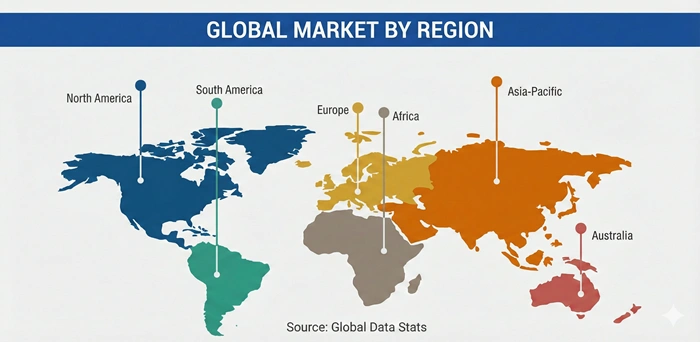
Regional Insights
Asia Pacific
Agricultural Scale And Government Support Cementing Regional Market Leadership
Asia Pacific dominates the biochar gasification market commanding approximately 40% global share valued at USD 48.70 billion in 2025, projected to reach USD 118.52 billion by 2033 growing at 10.45% CAGR. China leads regional development with massive agricultural waste volumes from rice, corn, and wheat production combined with government policies promoting biomass energy and restricting agricultural burning practices. Provincial incentive programs support gasification facility construction while carbon market development enables biochar projects to generate tradeable emission reduction credits. The biochar gasification market benefits from China's manufacturing capabilities producing gasification equipment at competitive costs facilitating rapid capacity expansion across rural regions.
India emerges as critical growth market leveraging abundant agricultural residues from farming operations supporting over 140 million households. Government initiatives including biomass energy programs, carbon sequestration incentives, and soil health schemes actively promote biochar adoption addressing dual challenges of waste management and agricultural productivity. The biochar gasification market witnesses growing startup ecosystem with companies developing appropriate technology solutions tailored for smallholder farming contexts, decentralized village-scale operations, and agricultural cooperative models. Leading regional players include Pacific Biochar, local manufacturers producing modular gasification systems, and agricultural input companies integrating biochar into soil amendment product portfolios. Southeast Asian nations including Thailand, Vietnam, and Indonesia expand biochar production utilizing palm oil residues, rice husks, and plantation waste, positioning Asia Pacific as dominant force throughout forecast period.
North America
Corporate Commitments And Technology Innovation Fueling Fastest Regional Growth
North America emerges as the fastest-growing region in the biochar gasification market with CAGR exceeding 11.2% from 2026 to 2033, with market value expanding from approximately USD 33.21 billion in 2025 toward USD 74.38 billion by 2033. United States leads regional expansion through substantial corporate carbon removal commitments creating guaranteed demand for high-quality biochar credits. Technology companies including Microsoft, Google, and others announce multi-year purchasing agreements totaling hundreds of thousands of tonnes of carbon removal credits specifically from biochar projects. The biochar gasification market captures momentum from these offtake commitments providing revenue certainty supporting project financing from commercial banks, infrastructure funds, and green bond issuances.
Federal and state government support accelerates through USDA funding programs, renewable energy tax credits, and environmental grant initiatives. Department of Agriculture allocated over USD 20 million to Myno Carbon supporting large-scale biochar facility construction in Washington state, demonstrating policy commitment to technology commercialization. Agricultural sector interest grows as regenerative agriculture practices gain traction among organic producers, specialty crop growers, and livestock operations seeking soil health improvements. The biochar gasification market benefits from North America's established agricultural input distribution networks facilitating biochar market access while research institutions including universities and agricultural extension services validate application benefits building farmer confidence. Leading regional players include Airex Energy operating Canada's largest biochar facility, Pacific Biochar, Aries Clean Technologies, and emerging companies including Myno Carbon and Charm Industrial developing innovative production systems and carbon removal verification methodologies positioning North America as technology and business model innovation leader.
Top Key Players
-
Airex Energy (Canada)
-
Pacific Biochar (United States)
-
Aries Clean Technologies (United States)
-
SUEZ (France)
-
Haffner Energy (France)
-
Myno Carbon (United States)
-
Charm Industrial (United States)
-
Carbonauten (Germany)
-
BioMaCon (Germany)
-
Swiss Biochar (Switzerland)
-
Carbo Culture (Finland)
-
Vega Biofuels (United States)
-
CharGrow USA (United States)
-
Diacarbon Energy (Canada)
-
Warmheart Worldwide (Thailand)
Recent Developments
-
Airex Energy, Groupe Rémabec, and SUEZ (May 2025): Inaugurated Carbonity, Canada's first industrial-scale biochar plant in Port-Cartier, Quebec, with initial production capacity of 10000 tonnes per year expected to triple by 2026, becoming North America's largest biochar facility utilizing proprietary DryFX and CarbonFX technologies converting forestry and agricultural biomass into premium biochar for carbon sequestration and soil health applications.
-
Myno Carbon (November 2024): Received USD 20.4 million funding from USDA to construct large-scale biochar carbon removal facility in Port Angeles, Washington, designed to convert sustainably sourced biomass into 20000 dry tonnes of renewable carbon products annually for agricultural applications improving crop yields while promoting climate-smart farming practices across Pacific Northwest region.
-
Google (January 2025): Signed carbon removal agreements with Varaha and Charm Industrial for purchase of 200000 tons of biochar-based carbon removal credits by 2030, representing largest biochar offtake deals concluded to date, aimed at scaling climate solution while supporting company's net-zero emissions target through verified permanent carbon sequestration.
-
Tata Steel (November 2024): Became first Indian steel manufacturer introducing biochar as partial replacement for fossil fuel in Jamshedpur blast furnace operations, successfully replacing approximately 30000 tonnes of coal with biochar since January 2023 trials, demonstrating potential to reduce over 50000 tonnes of carbon dioxide emissions annually while improving energy efficiency.
-
Airex Energy and SUEZ Partnership (July 2023): Formed Carbonity joint venture with Groupe Rémabec to build Canada's first biochar production plant in Port-Cartier, Quebec, utilizing forestry and agricultural biomass to produce biochar recognized by IPCC as top-five negative-emission solution, supporting carbon sequestration, improved soil health, and sustainable land use management objectives.
Market Trends
Modular Decentralized Systems And Carbon Credit Integration Reshaping Industry Business Models
Distributed production models gain momentum as manufacturers develop containerized, modular gasification systems deployable at agricultural cooperatives, food processing facilities, and rural energy centers. These compact units process local biomass waste eliminating long-distance transportation costs while generating electricity for on-site consumption and producing biochar for nearby farming operations. The biochar gasification market witnesses technology democratization as smaller-scale systems become economically viable for community-owned projects, agricultural partnerships, and distributed energy developers. Plug-and-play designs simplify installation and operation, reducing technical expertise requirements previously limiting adoption among agricultural sector participants lacking industrial process experience.
Carbon credit market integration accelerates as biochar projects develop sophisticated monitoring, reporting, and verification systems satisfying stringent certification standards. Blockchain-based tracking platforms document feedstock origins, production parameters, and biochar application locations providing transparent audit trails supporting carbon credit validation. The biochar gasification market benefits from standardization efforts establishing testing protocols, permanence assessments, and life cycle analysis methodologies enabling biochar credits to compete with other carbon removal pathways. Corporate buyers increasingly specify biochar credits in purchasing portfolios valuing permanence characteristics, co-benefits for agricultural productivity, and alignment with circular economy principles. Premium pricing develops for projects demonstrating social benefits including rural income generation, air quality improvements from avoided agricultural burning, and food security contributions through enhanced soil fertility.
Segments Covered In The Report
By Feedstock Type
-
Agricultural Waste
-
Forestry Waste
-
Animal Manure
-
Urban Biomass
-
Industrial Biomass Residues
By Gasification Technology
-
Fixed Bed Gasification
-
Fluidized Bed Gasification
-
Entrained Flow Gasification
-
Downdraft Gasification
By Reactor Type
-
Single-Stage Gasifiers
-
Two-Stage Gasifiers
By Application
-
Energy Production
-
Soil Amendment
-
Waste Management
-
Carbon Sequestration
-
Industrial Processing
By End-User Industry
-
Agriculture
-
Power and Energy
-
Waste Management Companies
-
Chemical Industry
-
Construction and Cement
By Region
-
North America (United States, Canada, Mexico)
-
Europe (Germany, United Kingdom, France, Spain, Italy, Rest of Europe)
-
Asia-Pacific (China, India, Japan, South Korea, Australia, Southeast Asia, Rest of Asia-Pacific)
-
Latin America (Brazil, Argentina, Rest of Latin America)
-
Middle East and Africa (Saudi Arabia, UAE, South Africa, Rest of MEA)
Frequently Asked Questions
Question 1: What is the expected size of the biochar gasification market by 2033?
Answer: The global biochar gasification market is projected to reach approximately USD 267.36 billion by 2033, expanding from USD 134.20 billion in 2026. This growth reflects increasing adoption across agricultural applications, expanding carbon credit opportunities, renewable energy integration, and supportive government policies promoting sustainable waste management and climate change mitigation strategies.
Question 2: Which region dominates the biochar gasification market currently?
Answer: Asia Pacific dominates the biochar gasification market with approximately 40% market share due to abundant agricultural waste availability from rice, wheat, and corn production systems. The region benefits from large farming populations requiring soil enhancement solutions, substantial government support for biomass energy programs, and expanding carbon market infrastructure supporting biochar project development.
Question 3: What CAGR will the biochar gasification market experience from 2026 to 2033?
Answer: The biochar gasification market will grow at a compound annual growth rate of 10.84% from 2026 to 2033. This expansion reflects growing agricultural demand for soil amendments, carbon credit monetization opportunities, renewable energy mandates supporting syngas utilization, and technology improvements enhancing operational reliability and feedstock flexibility.
Question 4: Which feedstock type holds the largest share in the biochar gasification market?
Answer: Agricultural waste feedstock dominates the biochar gasification market with approximately 49% market share including crop residues like corn stalks, wheat straw, rice husks, and sugarcane bagasse. These materials provide abundant, cost-effective biomass resources while addressing environmental challenges associated with agricultural residue burning and waste management concerns.
Question 5: What are the primary growth drivers for the biochar gasification market?
Answer: Primary drivers include carbon credit revenue opportunities enabling biochar projects to generate permanent carbon removal credits, agricultural soil health demand addressing degradation challenges, and renewable energy mandates supporting syngas utilization. The biochar gasification market also benefits from corporate sustainability commitments, government incentive programs, and circular economy policies promoting organic waste valorization.