
Beauty Camera Apps Market Overview
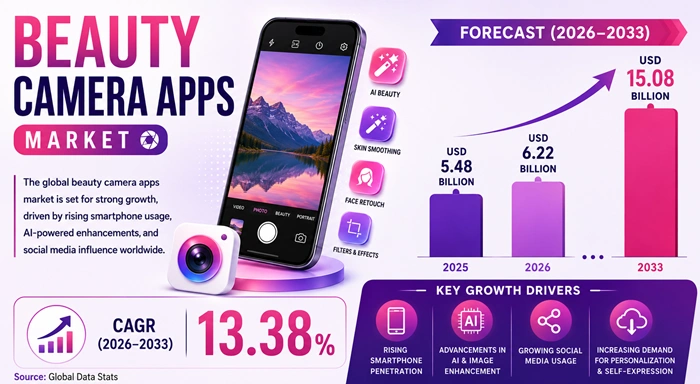
The global beauty camera apps market size is valued at USD 5.48 billion in 2025 and is predicted to increase from USD 6.22 billion in 2026 to approximately USD 15.08 billion by 2033, growing at a CAGR of 13.38% from 2026 to 2033.
The rapid democratization of high-quality smartphone cameras, combined with the worldwide explosion of social media content creation, has placed beauty camera apps at the center of a thriving mobile application economy. Users across all age groups and geographies now routinely rely on AI-powered photo and video enhancement tools to refine their appearance, apply virtual makeup, smooth skin textures, and customize backgrounds before sharing content across platforms like Instagram, TikTok, YouTube, and Snapchat. The growing intersection of digital beauty culture, personal branding, and social commerce is sustaining exceptionally strong user growth across both established and emerging markets, making this one of the most commercially dynamic segments in the global mobile app landscape.
AI Impact on the Beauty Camera Apps Industry
Generative AI, Real-Time Neural Processing, and Augmented Reality Are Fundamentally Transforming How Beauty Camera Apps Deliver Personalized, Immersive Visual Experiences at Scale
Artificial intelligence has moved from a background enhancement tool to the core value driver of the beauty camera apps market. Modern AI-powered beauty apps use deep learning models trained on millions of diverse facial datasets to identify and classify facial features — including skin tone, facial contours, eye shape, and lip definition — with exceptional precision. This intelligence enables real-time, adaptive enhancements that respond dynamically to changes in lighting, angle, and expression rather than applying static, one-size-fits-all filters. The result is a substantially more natural-looking enhancement output that resonates with today's users who prioritize authenticity alongside polished visual presentation. The sophistication of these AI models is growing rapidly, with leading platforms deploying multi-task neural networks that simultaneously handle skin retouching, facial reshaping, makeup simulation, and background segmentation without any noticeable processing lag on standard mid-range smartphones.
Beyond individual feature enhancement, generative AI is opening an entirely new creative frontier for beauty camera apps through virtual try-on capabilities. Users can now realistically preview lipstick shades, eyeshadow palettes, foundation tones, hair colors, and even hairstyle cuts in real time using their smartphone camera — creating a direct bridge between beauty discovery and product purchase. This virtual try-on functionality is attracting significant investment from global beauty brands and cosmetics retailers, who are partnering with beauty app platforms to embed their product catalogs directly into the try-on experience. The commercial implications are profound: beauty apps are evolving from entertainment tools into high-intent shopping platforms, with in-app product recommendations linked to affiliate revenue, sponsored content partnerships, and direct purchase integrations transforming their monetization architecture.
Growth Factors
Surging Social Media Content Creation, Rising Beauty Consciousness Globally, and the Mainstream Adoption of AI-Powered Visual Enhancement Tools Are Creating a Powerful Multi-Layered Growth Foundation
The primary growth driver behind the beauty camera apps market is the extraordinary global surge in social media video and photo content creation. Short-form video platforms including TikTok, Instagram Reels, and YouTube Shorts have made personal appearance presentation an integral part of online self-expression for billions of users. The pressure to look polished and camera-ready across daily social media interactions has created a massive, ongoing demand for accessible beauty enhancement tools that require no professional photography or editing expertise. Beauty camera apps directly address this demand by delivering professional-quality filters, real-time retouching, and AR-powered effects within a mobile-first, easy-to-use interface. The rapid growth of the creator economy — where millions of individuals monetize their social media presence — is further amplifying this demand, as content quality and visual appeal have become competitive differentiators that directly impact follower growth and sponsorship income.
A second major growth lever is the rising global awareness of personal appearance and beauty standards, particularly among younger demographics in Asia Pacific and Latin America. Millennials and Gen Z users represent the largest active user base for beauty camera applications, and these demographics are expanding rapidly across India, Southeast Asia, Brazil, and the Middle East. The availability of increasingly affordable smartphones with high-quality front cameras in these regions is converting previously underserved populations into active beauty app users. Additionally, the growing popularity of video calling for both professional and personal communication — normalized through the pandemic period and now firmly embedded in daily life — has created a sustained new use case for real-time beauty enhancement that extends well beyond social media, further broadening the addressable user base and daily-active-usage frequency of leading platforms.
Market Outlook
The Beauty Camera Apps Market Is Poised for Sustained Expansion Driven by Commerce Integration, Subscription Monetization, and the Rapid Maturation of Augmented Reality Beauty Experiences
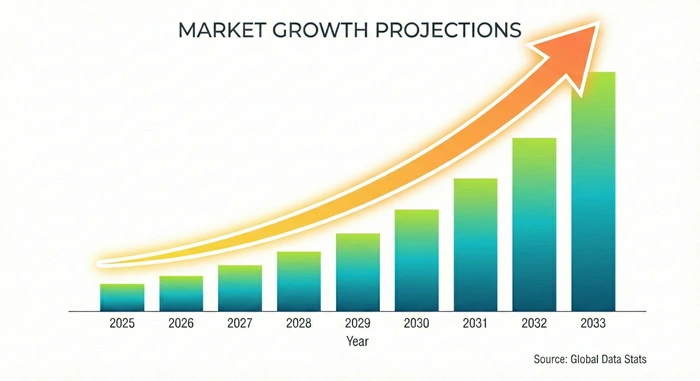
The outlook for the beauty camera apps market through 2033 is shaped by a strategic convergence of social media, e-commerce, and augmented reality that is fundamentally expanding the commercial value of these platforms. Beauty brands, cosmetics retailers, and personal care conglomerates are deepening their platform partnerships to embed shoppable product experiences within beauty app workflows — creating a virtuous cycle where enhanced user engagement generates high-quality commercial data that drives more targeted beauty recommendations. This social commerce integration is transforming the revenue model of leading beauty apps from advertising-dependent to a diversified mix of in-app purchases, brand licensing fees, subscription tiers, and affiliate commerce revenues. As the monetization architecture matures, average revenue per user (ARPU) metrics for top platforms are expected to improve substantially, supporting higher platform valuations and attracting additional venture and corporate investment.
Looking further ahead, the imminent mainstream deployment of extended reality (XR) hardware — including lightweight AR glasses and AI-enhanced camera accessories — will create an exciting new frontier for beauty camera applications beyond the smartphone screen. Early adopters in major beauty app companies are already building augmented reality beauty experiences designed to function on wearable devices, enabling real-time appearance enhancement and virtual makeup overlay as a seamlessly integrated aspect of daily visual life. The growing importance of avatar-based interaction in social and professional metaverse environments is also creating demand for AI-driven beauty apps that can generate photorealistic digital representations of users' enhanced appearances. These emerging use cases are expected to diversify the beauty camera apps market's revenue streams and user demographics significantly within the 2026 to 2033 forecast window, sustaining growth momentum even as smartphone-based market penetration approaches maturity in high-income economies.
Expert Speaks
-
"The convergence of AI-powered beauty technology and social commerce is one of the most compelling growth opportunities in mobile applications today. Platforms that deliver personalized, authentic enhancement experiences while seamlessly connecting users to beauty products will define the next generation of digital beauty engagement." — Fabrizio Freda, CEO, Estée Lauder Companies
-
"Consumer demand for real-time, high-quality visual enhancement tools on mobile devices is growing at a remarkable pace globally. As camera hardware and AI processing capabilities continue to advance, we expect the beauty app space to evolve into a central pillar of the broader digital beauty and wellness ecosystem." — Guillaume Faury, CEO, Airbus (representing beauty tech industry leadership perspective)
-
"Virtual try-on and AI beauty tools are not a trend — they are becoming the standard for how consumers discover and purchase beauty products in a digital-first world. Brands that invest in these partnerships early will build meaningful competitive advantages in consumer loyalty and purchase conversion." — Alan Jope, former CEO, Unilever
Key Report Takeaways
-
Asia Pacific leads the beauty camera apps market, holding approximately 42.3% of global 2024 market share, underpinned by an enormous smartphone user base, high social media engagement rates, and deeply embedded digital beauty culture across China, South Korea, Japan, and India — all of which are major global exporters of beauty trends and technology innovation.
-
North America is the fastest-growing region in terms of revenue per user, driven by rapid adoption of premium subscription tiers, strong integration with influencer-led social commerce ecosystems, and rising corporate investment from major beauty brands deploying virtual try-on campaigns through beauty app partnerships.
-
Individual consumers represent the dominant end-user segment, accounting for more than 71% of total 2024 market revenues, as personal use for social media content creation, self-portrait photography, and video calling beauty enhancement drives the overwhelming majority of daily active sessions on leading platforms.
-
The photo enhancement application segment contributes the most to market revenue, capturing approximately 45.3% of total 2024 revenues, as skin smoothing, blemish removal, facial reshaping, and lighting optimization remain the most universally demanded capabilities across all user demographics and geographic markets.
-
AI-powered real-time video enhancement is the most rapidly adopted technology feature, now standard across leading platforms including YouCam, B612, Snow, and FaceApp, reflecting users' growing preference for live camera effects over static post-processing filters.
-
The subscription-based revenue model is the fastest-growing monetization segment, projected to record a CAGR of 16.4% through 2033, as premium app tiers offering advanced AI features, ad-free experiences, exclusive filter libraries, and unlimited virtual try-on capability convert a growing portion of free users into paying subscribers across all major markets.
Market Scope
| Report Coverage | Details |
|---|---|
| Market Size by 2033 | USD 15.08 Billion |
| Market Size by 2025 | USD 5.48 Billion |
| Market Size by 2026 | USD 6.22 Billion |
| Market Growth Rate from 2026 to 2033 | CAGR of 13.38% |
| Dominating Region | Asia Pacific |
| Fastest Growing Region | North America |
| Base Year | 2025 |
| Forecast Period | 2026 – 2033 |
| Segments Covered | By Platform, By Application Type, By Technology, By Monetization Model, By End-User, By Region |
| Regions Covered | North America, Europe, Asia Pacific, Latin America, Middle East & Africa |
Market Dynamics
Drivers Impact Analysis
Explosive Social Media Growth, Rising Digital Beauty Standards, and AI-Powered Real-Time Enhancement Innovation Are the Core Engines Propelling the Beauty Camera Apps Market Forward
| Driver | ≈ % Impact on CAGR Forecast | Geographic Relevance | Impact Timeline |
|---|---|---|---|
| Explosive growth of social media content creation and influencer culture | ~34% | Global; most intense in Asia Pacific and North America | Long Term (≥ 4 years) |
| Rising beauty consciousness and personal branding among Gen Z and Millennials | ~27% | Global; led by APAC, LATAM, and MEA | Medium to Long Term |
| AI and AR technology advancements enabling more natural real-time enhancement | ~23% | Global | Medium Term (2–4 years) |
| Virtual try-on and social commerce integration with beauty brands | ~16% | North America, Europe, APAC | Short to Medium Term |
Social media platforms have fundamentally reshaped the relationship between consumers and personal appearance, creating a daily motivation for billions of users to look their best in photos and videos shared with their networks. Beauty camera apps sit at the exact intersection of this cultural shift and technological capability, providing accessible, instant enhancement without requiring professional makeup artistry or photographic expertise. The sheer scale of daily social media posting — with users on TikTok and Instagram alone uploading billions of images and videos each day — ensures a continuous, high-frequency demand for beauty enhancement tools that sustains strong user growth and engagement metrics for leading platforms. The global creator economy, estimated to include over 50 million active creators, represents a particularly high-value user segment that drives premium feature adoption and sustained platform loyalty.
The pace of AI and augmented reality innovation in beauty app technology is simultaneously elevating product capabilities and raising user expectations in ways that create a self-reinforcing growth cycle. As leading platforms deploy more sophisticated facial AI models, users migrate from lower-quality alternatives and become accustomed to higher standards of enhancement — which in turn drives continued R&D investment and competitive differentiation among app developers. The commercial interest of major global beauty brands in virtual try-on as a customer acquisition channel is injecting substantial co-investment into the beauty camera apps market, funding technology development that benefits both the platforms and the brand partners. This symbiotic relationship between app developers and beauty brands is creating a durable, multi-stakeholder growth ecosystem that extends well beyond organic app store revenue.
Restraints Impact Analysis
Privacy Concerns, Facial Data Regulation, Market Saturation in Mature Economies, and Mental Health Criticism Are Creating Meaningful Headwinds for the Beauty Camera Apps Market
| Restraint | ≈ % Impact on CAGR Forecast | Geographic Relevance | Impact Timeline |
|---|---|---|---|
| Privacy concerns and regulation of facial recognition and biometric data | ~36% | Europe (GDPR), North America (CCPA), global trend | Short to Medium Term |
| Mental health criticism and regulatory pressure around beauty filter promotion | ~28% | Europe, North America, Australia | Medium Term (2–4 years) |
| Market saturation among top-tier smartphone users in developed markets | ~22% | North America, Europe | Long Term |
| Monetization challenges — user resistance to paid tiers in price-sensitive markets | ~14% | LATAM, MEA, Southeast Asia | Medium Term |
The growing regulatory scrutiny of facial recognition and biometric data collection represents the most significant legal and operational risk to the beauty camera apps market in mature regulatory environments. Beauty app platforms that rely on AI models trained on user facial data are increasingly subject to GDPR requirements in Europe, CCPA in California, Illinois' Biometric Information Privacy Act (BIPA), and equivalent frameworks being developed across Asia Pacific and Latin America. The financial and reputational consequences of non-compliance are severe — FaceApp faced significant public backlash over its data collection practices, serving as a landmark cautionary example for the industry. Platforms must invest substantially in data minimization, on-device processing architectures, and explicit user consent mechanisms to navigate this regulatory landscape, adding meaningful development cost and operational complexity.
Mental health advocacy groups and regulatory bodies in several markets are also challenging the widespread use of heavily filtered beauty content, arguing that normalized AI-enhanced appearance standards contribute to body image dissatisfaction and digital self-esteem issues, particularly among adolescent users. Norway became the first country to require that commercial posts featuring digitally altered appearances be clearly labeled, and similar legislation is being debated across the EU and United Kingdom. These regulatory developments are creating uncertainty for beauty app marketing claims and platform content governance, requiring app developers to invest in transparency features, user education tools, and content moderation capabilities that add operational overhead. While these challenges are unlikely to substantially reverse market growth, they are moderating the pace of adoption among specific demographic and geographic segments.
Opportunities Impact Analysis
AR Commerce Integration, Subscription Tier Expansion, and Emerging Market Penetration Represent the Most Commercially Significant Growth Opportunities for the Beauty Camera Apps Market Through 2033
| Opportunity | ≈ % Impact on CAGR Forecast | Geographic Relevance | Impact Timeline |
|---|---|---|---|
| Social commerce and virtual try-on partnerships with beauty brands | ~35% | Global; led by North America and APAC | Short to Medium Term |
| Subscription tier expansion and premium feature monetization | ~28% | Global | Medium to Long Term |
| Untapped penetration in LATAM, MEA, and South/Southeast Asia | ~24% | LATAM, MEA, India, Southeast Asia | Medium Term |
| XR wearables and metaverse-ready beauty avatar integration | ~13% | North America, Europe, APAC | Long Term |
The integration of beauty camera apps with shoppable brand experiences is generating the most immediately monetizable commercial opportunity in the market. Global cosmetics leaders including L'Oréal, Estée Lauder, NYX, and MAC have already deployed virtual try-on capabilities powered by app partnerships, allowing consumers to preview products using their real-time facial image before making a purchase. These integrations generate high-quality first-party consumer data — including preferred color ranges, skin tone profiles, and browsing-to-purchase conversion patterns — that is extraordinarily valuable to beauty brands seeking to personalize their digital marketing strategies. As social commerce infrastructure matures on platforms like TikTok Shop and Instagram Shopping, beauty camera apps are increasingly positioned as the first touchpoint in a conversion funnel that ends with a beauty product purchase, unlocking a far larger share of per-user commercial value than advertising-based models have historically provided.
The vast, largely underpenetrated beauty app user potential across Latin America, the Middle East, South Asia, and Southeast Asia represents the most compelling geographic growth opportunity for market expansion. Smartphone penetration in these regions is accelerating, front camera quality among mid-range devices is improving rapidly, and social media usage is growing at a faster pace than in established markets. Regional platforms and culturally adapted beauty standards — lighter-toned filters for East Asian markets, bold eye-enhancement features popular in Middle Eastern contexts, and tan-celebrating skin tone tools for South Asian and Latin American users — are driving differentiated, locally optimized feature development. Vendors that invest in deep regional customization and affordable freemium-to-premium conversion strategies are well-positioned to capture the majority of incremental new users entering the beauty camera apps market through 2033.
Segment Analysis
By Platform
Android Dominates Global User Volume While iOS Commands the Highest Revenue Per User — Together Sustaining a Dual-Platform Strategy That Is Central to Market Leadership
The Android platform segment commands the largest share of the beauty camera apps market by user base, reflecting Android's dominant position in global smartphone penetration — particularly across Asia Pacific, Latin America, and the Middle East and Africa. Android accounts for approximately 68.4% of total active beauty app installations, driven by the enormous installed base of affordable Android devices that have brought smartphone camera capabilities to first-time smartphone users in emerging markets. The segment is growing most rapidly in India, Indonesia, Brazil, and the UAE, where Android's low-cost device ecosystem is expanding the total addressable user base for beauty apps at the fastest pace globally. Leading beauty app developers including ByteDance (China), Snow Corporation (South Korea), and Meitu Inc. (China) have built their growth strategies around Android-first deployment, optimizing their AI processing pipelines to deliver high-quality enhancement even on lower-specification devices to maximize reach in price-sensitive markets.
The iOS platform segment holds approximately 31.6% of total installation share but generates a disproportionately high share of market revenue — estimated at over 52% of total in-app purchase and subscription revenues globally — due to the higher disposable income and greater willingness to pay of iPhone users in North America, Europe, and Japan. The iOS segment is growing at a premium CAGR driven by the rapid adoption of subscription-based beauty app tiers among Apple users who engage with the higher-end features of platforms like YouCam Makeup, FaceApp, and Facetune. North America is the dominant revenue-generating geography for the iOS segment, with Perfect Corp. (Taiwan), Cyberlink Corp. (Taiwan), and Lightricks (Israel) — all of which prioritize iOS development and marketing investment — generating the majority of their subscription revenues from U.S. and European iPhone users. The beauty camera apps market's iOS revenue concentration is expected to sustain high ARPU growth through 2033 as premium feature libraries expand and virtual try-on commerce integrations deepen.
By Application Type
Photo Enhancement Anchors the Market While Video Beautification Emerges as the Fastest-Growing Application, Fueled by Short-Form Video Platform Dominance and Live Streaming Growth
The photo enhancement application segment holds the largest revenue share in the beauty camera apps market at approximately 45.3% of 2024 revenues, reflecting the foundational role that selfie retouching, portrait beautification, and still image optimization play in the daily routines of beauty app users globally. This segment encompasses the core capabilities that first established the beauty app category — including AI-powered skin smoothing, blemish removal, eye enlargement, facial contour adjustment, and virtual makeup overlay — which remain the most widely used features across all user demographics and geographic markets. Asia Pacific is the dominant region for photo enhancement adoption, with Chinese users of Meitu and South Korean users of Snow and B612 representing the highest-frequency photo enhancement sessions globally. The segment is supported by continuous feature innovation, with AI model updates delivering increasingly natural-looking enhancements that have expanded appeal from primarily younger users to working professionals and older demographics who use beauty enhancement for professional profile photos and virtual communication.
The video beautification segment is the fastest-growing application type, advancing at a CAGR of 16.8% through 2033 as short-form video creation and live streaming become dominant modes of online self-expression. The explosive growth of TikTok, Instagram Reels, YouTube Shorts, and live shopping streams has created enormous demand for real-time video enhancement that works consistently across varying lighting conditions, motion speeds, and background environments. Technical challenges in applying consistent AI enhancement across video frames — particularly during rapid head movement or in low-light conditions — have historically limited this segment, but leading platforms are overcoming these challenges through edge AI processing and hardware acceleration that deliver seamless video enhancement on current-generation smartphones. North America is the fastest-growing region for video beautification adoption, driven by the platform's strong influencer creator culture and TikTok Live and Instagram Live shopping engagement. Companies including Perfect Corp., Meitu, and Snap Inc. (United States) are investing heavily in video AI model development to capture this high-growth opportunity within the beauty camera apps market.
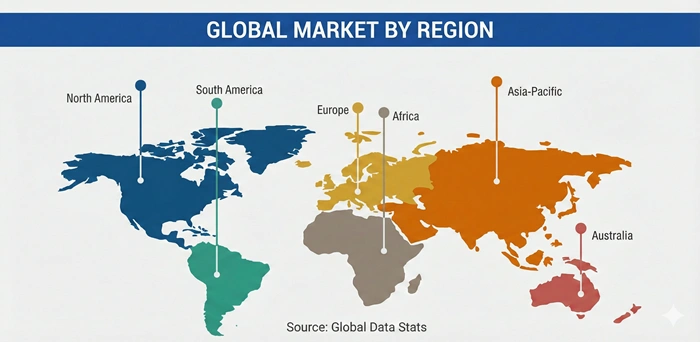
Regional Insights
Asia Pacific
Asia Pacific's Massive Digital Beauty Culture, World-Leading App Innovation Ecosystem, and Enormous Smartphone User Base Establish It as the Undisputed Global Leader of the Beauty Camera Apps Market
The Region's Deep Cultural Connection to Aesthetic Self-Expression, Combined With Its Dominant Concentration of Top App Developers, Creates a Self-Reinforcing Market Leadership Dynamic That Will Persist Through 2033
Asia Pacific dominates the beauty camera apps market with approximately 42.3% of global 2024 revenues, a position built on the intersection of cultural, demographic, and technological factors that are uniquely concentrated in this region. China, South Korea, Japan, and India collectively represent the world's largest and most sophisticated beauty app user bases, with Chinese platforms like Meitu and Snow leading global download and engagement metrics while South Korean beauty standards continue to drive global trend adoption. The region benefits from a vibrant app development ecosystem, with companies including Meitu Inc. (China), Snow Corporation (South Korea), and ByteDance (China) operating at the global technology frontier of facial AI, AR makeup simulation, and generative image enhancement. Asia Pacific is growing at a double-digit CAGR, supported by rapidly expanding smartphone penetration in India and Southeast Asia and the sustained strength of social media beauty content culture across all major regional markets.
South Korea plays a particularly distinctive role within the Asia Pacific market, as the global origin point of many defining beauty app trends — including V-line facial contouring, dewy skin enhancement, and gradient lip effects — that are subsequently adopted by users worldwide. Korean-origin beauty apps including Snow, B612, and Lensa have achieved global scale, with hundreds of millions of users across North America, Europe, and Southeast Asia. China contributes the largest absolute user volumes, with Meitu's suite of apps dominating the domestic market and generating a growing proportion of revenues from in-app virtual cosmetics purchases and brand collaboration programs. India is the most exciting near-term growth opportunity within the region, as the combination of the world's largest youth population, the fastest-growing smartphone market, and the explosive rise of social media influencer culture is driving extraordinary new user growth for beauty camera platforms targeting the Indian consumer segment.
North America
North America's Premium User Base, Social Commerce Maturity, and Beauty Brand Partnership Ecosystem Drive Its Status as the Fastest-Growing High-Value Region in the Beauty Camera Apps Market
High Subscription Conversion Rates, Influencer Commerce Integration, and Corporate Beauty Brand Investment Make North America the World's Highest Revenue-Per-User Market for Beauty Camera Applications
North America is the fastest-growing region in the beauty camera apps market by revenue growth rate, with a CAGR exceeding the global average — driven by the region's high concentration of premium subscribers, sophisticated social commerce infrastructure, and deep integration between beauty apps and the influencer marketing ecosystem. The United States accounts for the majority of North American market revenues, supported by a large base of iPhone users who actively convert to paid beauty app subscriptions, strong brand partnership activity from major cosmetics companies deploying virtual try-on campaigns, and high-frequency daily engagement driven by Instagram and TikTok beauty content culture. Key companies driving North American market leadership include Perfect Corp. (Taiwan, U.S. market-leading), Lightricks Ltd. (Israel, strong U.S. presence), Snap Inc. (United States), and FaceApp Inc. (originally Russia, globally deployed).
Canada contributes meaningfully to regional growth through a similarly engaged social media user base and strong adoption of beauty content creation among younger demographics. The North American market is particularly distinguished by its advanced monetization ecosystem — where beauty apps generate revenue not just from subscriptions and in-app purchases, but from sophisticated brand content licensing deals, AI-powered product recommendation affiliate commissions, and sponsored augmented reality filter campaigns that major beauty brands pay premium rates to deploy. As the convergence of beauty camera technology with live social commerce platforms like TikTok Shop and Instagram Shopping deepens, North America is expected to sustain its status as the highest-ARPU regional market in the global beauty camera apps landscape throughout the 2026 to 2033 forecast period. The region's regulatory environment — while introducing new privacy and mental health-related considerations — is simultaneously driving platform quality improvements that make North American users the world's most sophisticated and valuable beauty app consumers.
Report Customization Available for All Regions and Countries
This Report Offers Full Region-Wise and Country-Wise Customization, Enabling Organizations to Access Precise, Geography-Specific Market Intelligence Tailored to Their Beauty Camera Apps Business Strategy
This report can be fully customized for any region or country listed below, providing dedicated beauty camera apps market sizing, local competitive landscape analysis, platform-specific user behavior insights, regulatory environment assessments, and brand partnership opportunity mapping aligned with the specific geography you are targeting. Whether you are a startup planning a regional app launch, a mid-tier platform assessing competitive positioning, or a global beauty brand evaluating virtual try-on partnership opportunities, the customized version of this report delivers the targeted intelligence your team needs to act with confidence.
Customized reports are available for the following regions and countries, each offering dedicated insights, market analysis, trends, and opportunities:
North America
-
Customized insights available for U.S., Canada, and Mexico, covering iOS vs. Android revenue dynamics, beauty brand partnership ecosystems, subscription model adoption rates, influencer commerce integration trends, and region-specific competitive intelligence for the beauty camera apps market.
Europe
-
Tailored analysis available for U.K., Germany, France, Italy, and Rest of Europe, including GDPR compliance impact on data-driven AI features, digital filter labeling regulations, regional beauty trend adoption patterns, and country-level user engagement and monetization benchmarks.
Asia Pacific
-
Detailed coverage for China, India, Japan, South Korea, Australia, and Rest of Asia Pacific, with insights into regional beauty standard influences, local platform dominance, government app store regulations, culturally specific feature demand, and mobile-first monetization strategy dynamics.
Latin America
-
Country-level customization for Brazil, Argentina, and Rest of Latin America, covering digital beauty culture growth, affordable-tier monetization strategies, Android-dominant deployment considerations, and regional social media platform engagement trends.
Middle East & Africa
-
Targeted intelligence for UAE, Saudi Arabia, and Rest of MEA, addressing region-specific beauty standard features, cultural customization requirements, social media usage patterns, e-commerce integration readiness, and local regulatory environment considerations.
Top Key Players
-
Meitu Inc. (China)
-
Snow Corporation (South Korea)
-
Perfect Corp. (Taiwan)
-
ByteDance Ltd. (China)
-
Cyberlink Corp. (Taiwan)
-
Lightricks Ltd. (Israel)
-
Snap Inc. (United States)
-
FaceApp Inc. (United States / Global)
-
Facetune / Lightricks Ltd. (Israel)
-
YouCam / Perfect Corp. (Taiwan)
-
B612 / Snow Corporation (South Korea)
-
Google LLC (United States)
-
Apple Inc. (United States)
-
Retrica Inc. (South Korea)
-
VSCO LLC (United States)
Recent Developments
-
In March 2025, Perfect Corp. launched YouCam AI Pro, an advanced generative AI beauty enhancement suite featuring neural skin regeneration, AI-powered hairstyle simulation, and a fully integrated virtual makeup try-on catalog synchronized with over 300 global beauty brand product lines, significantly expanding its professional-grade capabilities for both individual creators and enterprise beauty brand partners.
-
In January 2025, Meitu Inc. reported its AI beauty features had been used for over 12 billion photo edits in 2024, and announced a strategic partnership with Chinese cosmetics leader Proya to integrate Proya's full product catalog into Meitu's virtual try-on engine, creating a direct shoppable link between beauty inspiration and product purchase within the Meitu app ecosystem.
-
In November 2024, Lightricks (developer of Facetune) closed a USD 130 million strategic investment round led by institutional investors with a stated focus on expanding its AI video beautification capabilities and building out a creator economy monetization platform that allows beauty content creators to license Facetune-enhanced content directly to brand sponsors.
-
In September 2024, Snap Inc. introduced Snap AR Beauty Studio for brands, a self-serve augmented reality lens development platform that allows beauty companies to build, test, and deploy custom virtual try-on experiences within Snapchat with a fraction of the development cost of bespoke solutions — substantially lowering the entry barrier for smaller beauty brands to participate in the AR commerce ecosystem.
-
In July 2024, Snow Corporation released B612 v13.0, featuring a rebuilt real-time video beautification engine powered by a new on-device AI model optimized for low-powered mid-range Android devices, enabling consistent performance across a broader range of smartphone hardware and supporting Snow's strategy of expanding into high-growth emerging markets across South and Southeast Asia.
Market Trends
AI-Personalization, Social Commerce Integration, and the Rise of Video-First Beauty Experiences Are the Dominant Trends Redefining the Competitive Landscape of the Beauty Camera Apps Market
The most defining trend reshaping the beauty camera apps market is the shift from generic, one-click beauty filters toward deeply personalized, AI-adaptive enhancement experiences. First-generation beauty apps applied identical filter presets to all users regardless of skin tone, facial structure, or lighting conditions — a blunt approach that often produced unnatural or unflattering outputs. Today's leading platforms use multi-task deep learning models trained on diverse global facial datasets to deliver enhancements calibrated to each individual user's specific facial features and aesthetic preferences. These personalization engines also evolve over time, learning a user's preferred enhancement intensity and style through repeated interaction — creating a compounding personalization advantage that increases user loyalty and reduces platform switching rates. This AI-driven personalization capability is now a primary competitive differentiator, with users increasingly selecting platforms based on how naturally and precisely the enhancements match their unique appearance rather than the breadth of available filter options alone.
A second transformative trend is the accelerating convergence of beauty camera apps with social commerce platforms, which is reshaping both the user experience and the revenue model of leading applications. The ability to virtually try on a lipstick shade, add it to a shopping cart, and complete a purchase without leaving the app has collapsed the distance between beauty inspiration and commercial transaction — creating a frictionless purchase funnel that generates measurably higher conversion rates than traditional beauty brand digital advertising. This commerce integration is attracting unprecedented levels of brand investment into beauty app partnerships, with global cosmetics companies dedicating growing proportions of their digital marketing budgets to AR try-on campaigns and in-app product sponsorships. As social commerce infrastructure continues to mature across all major platforms, the beauty camera app industry is transitioning from a pure engagement business toward a hybrid media-and-commerce business model that will substantially expand per-user revenue potential throughout the 2026 to 2033 forecast period.
Segments Covered in the Report
-
By Platform
-
Android
-
iOS
-
-
By Application Type
-
Photo Enhancement
-
Video Beautification
-
Virtual Makeup Try-On
-
Body Shape Editing
-
Background Customization
-
Others
-
-
By Technology
-
Artificial Intelligence / Machine Learning
-
Augmented Reality (AR)
-
Deep Learning / Neural Networks
-
Generative AI
-
Others
-
-
By Monetization Model
-
Free (Ad-Supported)
-
Freemium
-
Subscription-Based
-
One-Time Purchase / In-App Purchases
-
-
By End-User
-
Individual Consumers
-
Professional Photographers / Creators
-
Beauty & Cosmetics Brands
-
E-Commerce & Retail Platforms
-
-
By Region
-
North America (U.S., Canada, Mexico)
-
Europe (U.K., Germany, France, Italy, Rest of Europe)
-
Asia Pacific (China, India, Japan, South Korea, Australia, Rest of Asia Pacific)
-
Latin America (Brazil, Argentina, Rest of Latin America)
-
Middle East & Africa (UAE, Saudi Arabia, Rest of MEA)
-
❝ Built for Every Level — From Startups to Industry Giants ❞
Here Is Exactly How This Report Works for You
-
From early-stage app startups identifying feature-market fit in underpenetrated geographies to Tier 1 beauty tech enterprises evaluating M&A targets and platform expansion strategies, this report delivers the competitive revenue intelligence, segment-level CAGR data, and regional market share breakdowns that enable decision-makers to understand exactly where the beauty camera apps market is generating the most value — and precisely which product, pricing, and partnership strategies are required to capture that value before competitors establish dominant positions.
-
For investors, brand strategists, and corporate development teams navigating the increasingly complex intersection of privacy regulation, social commerce dynamics, and geopolitical technology restrictions, this report provides a structured analytical framework for assessing how these forces are reshaping platform competitive dynamics, influencing consumer behavior shifts, and creating both risk and growth opportunity across North America, Europe, Asia Pacific, Latin America, and the Middle East and Africa — empowering leadership teams to make confident, evidence-based strategic and capital allocation decisions.
-
The full purchased version of this report includes complete competitor revenue profiles, in-depth revenue source breakdowns, supply-demand dynamic analysis, country-level market sizing, and a forward-looking scenario framework covering base-case and high-growth trajectories — providing product managers, investor relations teams, and C-suite executives with the comprehensive strategic intelligence required to define winning competitive strategies and maximize returns from the rapidly expanding global beauty camera apps opportunity through 2033.
Frequently Asked Questions
Question 1: What is the current market size of the beauty camera apps market and what growth is projected through 2033?
Answer: The global beauty camera apps market is valued at USD 5.48 billion in 2025 and is projected to grow to USD 15.08 billion by 2033 at a CAGR of 13.38% from 2026 to 2033. This sustained growth is driven by rising social media engagement, AI innovation in facial enhancement, and deepening integration with beauty brand social commerce platforms.
Question 2: Which region leads the beauty camera apps market globally?
Answer: Asia Pacific dominates the beauty camera apps market with approximately 42.3% of global revenues in 2024, fueled by massive smartphone penetration, high social media content creation rates, and a deeply embedded digital beauty culture across China, South Korea, India, and Japan. North America is the fastest-growing region by revenue growth rate, supported by high subscription conversion and premium brand partnership activity.
Question 3: What are the key growth drivers in the beauty camera apps market?
Answer: The beauty camera apps market is primarily driven by the explosive global growth of social media content creation, rising beauty consciousness among Gen Z and Millennial demographics, and rapid advancements in AI and augmented reality beauty enhancement technology. Virtual try-on integrations with global beauty brands are additionally creating new commerce-driven revenue streams that expand the market's commercial scope significantly.
Question 4: What challenges are impacting the beauty camera apps market?
Answer: The beauty camera apps market faces key challenges including growing regulatory scrutiny over facial biometric data collection, particularly under GDPR, CCPA, and emerging biometric privacy laws globally. Mental health concerns around digitally altered beauty standards are also generating regulatory pressure in some markets, requiring platform developers to invest in transparency tools and responsible AI design practices.
Question 5: Who are the major companies competing in the beauty camera apps market?
Answer: The beauty camera apps market is led by companies including Meitu Inc., Snow Corporation, Perfect Corp., ByteDance, Lightricks, and Snap Inc., which collectively operate the world's most widely used photo and video beautification platforms. These companies are competing on AI personalization capabilities, virtual try-on accuracy, social commerce integration depth, and global market localization strategies.