
Automotive Logistics Market Overview
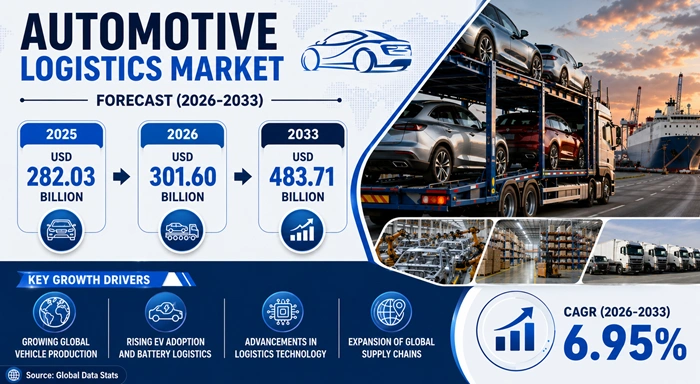
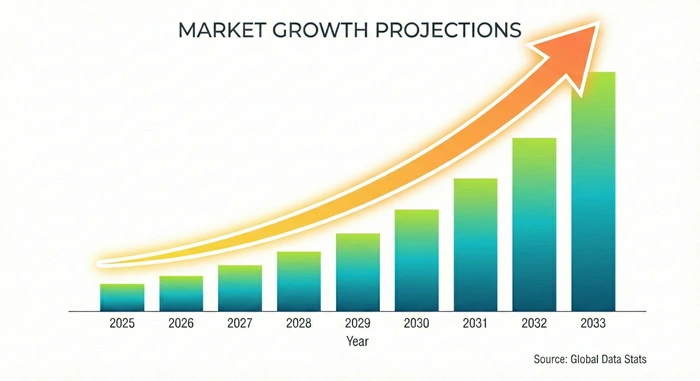
The global automotive logistics market size is valued at USD 282.03 billion in 2025 and is predicted to increase from USD 301.60 billion in 2026 to approximately USD 483.71 billion by 2033, growing at a CAGR of 6.95% from 2026 to 2033.
This steady growth reflects the auto industry's expanding need for efficient inbound parts delivery, finished vehicle transportation, and after-sales spare parts distribution as manufacturing networks grow more globally interconnected and complex. As electric vehicle production ramps up and just-in-time manufacturing practices demand tighter supply chain coordination, demand for specialized logistics services continues expanding across original equipment manufacturers, dealerships, and aftermarket parts suppliers worldwide.
AI Impact on the Automotive Logistics Industry
Artificial Intelligence Is Optimizing Vehicle Transport Scheduling, Enhancing Inbound Parts Delivery Precision, and Strengthening Supply Chain Risk Forecasting Across the Automotive Logistics Landscape — Fundamentally Changing How Vehicles and Components Move From Factory to Showroom
Artificial intelligence has become an increasingly valuable tool for optimizing vehicle transport scheduling, with routing algorithms now capable of analyzing carrier capacity, dealer demand patterns, and port congestion data to determine the most efficient path for moving finished vehicles from assembly plants to dealerships nationwide. This precision matters considerably in an industry where holding costs and depreciation accumulate quickly while vehicles sit idle, and AI-assisted scheduling tools are helping logistics providers reduce both transit time and unnecessary storage expenses. Companies building AI-driven transport optimization directly into their logistics platforms are increasingly differentiating themselves through measurably faster vehicle delivery cycles.
Beyond vehicle transport, AI is also improving inbound parts delivery precision, with demand forecasting models now able to analyze production schedules and historical supplier performance to time component deliveries with far greater accuracy than manual planning ever achieved. This capability has proven valuable for manufacturers operating tightly synchronized just-in-time assembly lines, since precise parts timing reduces both costly production delays and excess warehouse inventory. As these AI-driven scheduling and forecasting tools continue maturing, they are becoming an increasingly important factor shaping operational efficiency across the broader automotive logistics market.
Growth Factors
Rising Electric Vehicle Production and Growing Just-in-Time Manufacturing Adoption Continue Driving Sustained Demand
The most significant growth factor supporting the automotive logistics market is the rapid global expansion of electric vehicle production, as battery packs and specialized EV components require distinct handling, hazardous material compliance, and dedicated transport equipment that differs meaningfully from traditional internal combustion vehicle logistics. With automakers building new EV-focused assembly plants across multiple continents, this production-driven demand has become an increasingly important growth driver for logistics providers investing in specialized EV transport capability.
A second important growth factor is the continued adoption of just-in-time and just-in-sequence manufacturing practices across the auto industry, as manufacturers increasingly rely on precisely timed component deliveries to minimize warehouse space and reduce inventory carrying costs on the factory floor. This growing coordination demand, combined with expanding aftermarket parts distribution supporting an aging global vehicle fleet, has broadened the addressable market for automotive logistics considerably. This combination of rising EV production and growing just-in-time manufacturing adoption continues to strengthen demand across the automotive logistics market.
Market Outlook
Digital Supply Chain Visibility and Expanding Emerging Market Manufacturing Point Toward Sustained Growth Through 2033
Looking ahead through the forecast period, the automotive logistics industry is expected to benefit substantially from continued investment in digital supply chain visibility platforms, as automakers increasingly demand real-time tracking of both inbound components and outbound finished vehicles to respond quickly to disruptions like port delays or supplier shortages. This visibility-focused shift is likely to reshape logistics provider selection considerably as more manufacturers prioritize transparency and rapid disruption response over simple cost minimization.
At the same time, expanding vehicle manufacturing capacity across emerging markets is expected to create substantial new demand, as automakers continue shifting production toward regions offering lower labor costs and growing domestic consumer demand across Asia Pacific and Latin America. Companies that can deliver both proven reliability and cost-efficient regional network coverage are increasingly well positioned to capture this growth. Providers combining strong technology adoption with broad multimodal transport capability are likely to lead growth within the broader automotive logistics market through 2033.
Expert Speaks
-
"Our continued investment in dedicated EV logistics infrastructure reflects our commitment to helping automakers move battery-powered vehicles safely and efficiently through the supply chain." — CEO, DHL Group
-
"As automotive supply chains grow more complex, our multimodal transport network remains focused on delivering the reliability manufacturers need to keep assembly lines running smoothly." — CEO, Kuehne+Nagel International
-
"We remain dedicated to advancing digital visibility and specialized vehicle transport solutions that support both traditional and electric vehicle production worldwide." — CEO, CEVA Logistics
Key Report Takeaways
-
Europe leads the global automotive logistics market, holding approximately 32% market share in 2025, supported by dense automotive manufacturing clusters and well-established cross-border transport networks
-
Asia Pacific is the fastest-growing region, projected to expand at a CAGR near 9.8% through 2033, driven by rapidly expanding vehicle manufacturing capacity and rising domestic vehicle demand across China and India
-
Original equipment manufacturers represent the dominant customer segment, accounting for roughly 46% share, given their extensive inbound parts and outbound finished vehicle transportation needs
-
Finished vehicle transportation contributes the most to overall demand, reflecting the continuous need to move completed vehicles from assembly plants to dealership networks worldwide
-
Road transport remains the most widely used logistics process, valued for its flexibility in reaching both manufacturing facilities and dealership locations
-
Electric vehicle logistics segments will grow the fastest among application categories, holding close to 24% market share with a CAGR near 13.1% through the forecast period, driven by rising demand for specialized battery and component handling
Market Scope
| Report Coverage | Details |
|---|---|
| Market Size by 2033 | USD 483.71 Billion |
| Market Size by 2025 | USD 282.03 Billion |
| Market Size by 2026 | USD 301.60 Billion |
| Market Growth Rate from 2026 to 2033 | CAGR of 6.95% |
| Dominating Region | Europe |
| Fastest Growing Region | Asia Pacific |
| Base Year | 2025 |
| Forecast Period | 2026 to 2033 |
| Segments Covered | Activity, Mode of Transport, End User, Region |
| Regions Covered | North America, Europe, Asia Pacific, Latin America, Middle East & Africa |
Market Dynamics
Drivers Impact Analysis
Rising Electric Vehicle Production and Growing Just-in-Time Manufacturing Coordination Remain the Two Strongest Forces Behind Market Momentum
| Driver | (≈) % Impact on CAGR Forecast | Geographic Relevance | Impact Timeline |
|---|---|---|---|
| Rapid global expansion of electric vehicle production and battery logistics | ~34% | Asia Pacific, Europe | Medium to long-term |
| Growing adoption of just-in-time and just-in-sequence manufacturing practices | ~27% | Global | Short to medium-term |
| Expanding aftermarket parts distribution supporting an aging global vehicle fleet | ~25% | Global | Medium-term |
| Rising cross-border vehicle trade requiring compliant transport documentation | ~14% | Europe, North America | Short to medium-term |
Rapid global expansion of electric vehicle production continues to serve as the primary engine behind sustained growth in the automotive logistics market, as battery packs and specialized EV components require distinct handling and hazardous material compliance that differs meaningfully from conventional vehicle logistics. This production-driven momentum has translated directly into rising investment in dedicated EV transport capability among logistics providers serving major automakers.
Growing adoption of just-in-time and just-in-sequence manufacturing practices represents the second major driver, as manufacturers increasingly rely on precisely timed component deliveries to minimize factory floor inventory and reduce carrying costs. This coordination-driven demand, combined with expanding aftermarket parts distribution supporting an aging global vehicle fleet, continues reinforcing steady momentum across the broader automotive logistics market.
Restraints Impact Analysis
Rising Fuel Costs and Supply Chain Disruption Risks Continue to Moderate Broader Expansion
| Restraint | (≈) % Impact on CAGR Forecast | Geographic Relevance | Impact Timeline |
|---|---|---|---|
| Rising fuel and transportation costs affecting overall logistics expenses | ~35% | Global | Short to medium-term |
| Persistent supply chain disruption risks from semiconductor and component shortages | ~28% | Global | Medium-term |
| Complex customs and regulatory compliance requirements across international borders | ~23% | Europe, Asia Pacific | Medium to long-term |
| Port congestion and capacity constraints affecting vehicle export schedules | ~14% | Asia Pacific, North America | Short to medium-term |
The most persistent restraint facing the automotive logistics market is the ongoing rise in fuel and transportation costs, which continues squeezing margins for logistics providers operating large vehicle carrier fleets and long-haul trucking networks across international supply routes. This cost pressure remains particularly pronounced for providers managing cross-continental finished vehicle shipments where fuel represents a substantial share of total operating expenses.
Persistent supply chain disruption risks stemming from semiconductor and component shortages represent a second significant restraint, since unpredictable parts availability continues to complicate logistics planning and force manufacturers to adjust shipping schedules with limited advance notice. Combined with complex customs and regulatory compliance requirements that vary considerably across international borders, these restraints continue moderating how quickly broader logistics expansion occurs across the global automotive logistics market.
Opportunities Impact Analysis
Digital Visibility Platform Adoption and Expanding Emerging Market Manufacturing Represent the Clearest Paths to Growth
| Opportunity | (≈) % Impact on CAGR Forecast | Geographic Relevance | Impact Timeline |
|---|---|---|---|
| Expanding adoption of end-to-end digital supply chain visibility platforms | ~37% | Global | Short to medium-term |
| Growing vehicle manufacturing capacity investment across emerging markets | ~34% | Asia Pacific, Latin America | Medium to long-term |
| Rising demand for specialized electric vehicle and battery logistics capability | ~29% | Asia Pacific, Europe | Medium-term |
Expanding adoption of end-to-end digital supply chain visibility platforms represents one of the most substantial opportunities within the automotive logistics market, as manufacturers seeking greater transparency stand to benefit significantly from providers offering real-time tracking of both inbound components and outbound finished vehicles. This visibility-driven differentiation is expected to meaningfully reshape competitive positioning among leading logistics providers over the coming years.
Growing vehicle manufacturing capacity investment across emerging markets presents a second substantial opportunity, as automakers continue shifting production toward Asia Pacific and Latin America where lower labor costs and growing domestic demand create favorable conditions for new assembly plants. Rising demand for specialized electric vehicle and battery logistics capability further broadens the opportunity landscape, particularly for providers able to handle hazardous material compliance reliably. Companies pursuing these parallel opportunities are well positioned to capture meaningful growth within the broader automotive logistics market through the forecast period.
Segment Analysis
By Activity: Finished Vehicle Transportation
Finished Vehicle Transportation Continues to Anchor the Activity Landscape, Reflecting Continuous Demand From Plant to Dealership
Finished vehicle transportation holds the largest share within the activity segment of the automotive logistics market, accounting for approximately 44% of total segment revenue in 2025. This dominance reflects the continuous need to move completed vehicles from assembly plants to regional distribution centers and dealership networks through specialized car carrier trucks, rail, and roll-on roll-off ocean vessels. In markets like Germany and the United States, automakers increasingly favor integrated providers offering combined multimodal transport under a single tracked chain of custody to minimize handling damage and delivery delays. Leading suppliers such as DHL, CEVA Logistics, and Kuehne+Nagel continue to dominate this segment through expanded carrier fleet capacity and continuous tracking technology improvements.
Growth within this segment remains particularly strong in Europe, where dense automotive manufacturing clusters and well-established cross-border transport networks continue generating sustained demand for reliable finished vehicle shipping across thousands of delivery routes daily. The region's combination of concentrated production facilities and mature rail and road infrastructure has helped finished vehicle transportation maintain its leading position despite growing interest in inbound parts logistics alternatives. As global vehicle production continues expanding, finished vehicle transportation is expected to remain the dominant category within the broader automotive logistics market throughout the forecast period.
By Application: Electric Vehicle Logistics
Electric Vehicle Logistics Represent the Fastest-Growing Application Segment, Reflecting Rising Demand for Specialized Battery Handling
Electric vehicle logistics represent the fastest-growing application segment within the automotive logistics market, holding close to 24% share in 2025 with a projected CAGR near 13.1% through the forecast period as automakers increasingly require specialized handling for battery packs and other EV-specific components that differ substantially from conventional vehicle logistics requirements. Unlike traditional internal combustion vehicle transport, EV logistics often involve strict hazardous material compliance, temperature-sensitive battery storage, and specialized carrier equipment designed to prevent damage to sensitive electrical components during transit. This specialized handling requirement has generated substantial interest among logistics providers investing heavily in dedicated EV transport capability to serve rapidly expanding automaker demand.
Growth in this segment remains especially strong in Asia Pacific, where a dense concentration of battery manufacturers and rapidly expanding EV assembly plants across China and South Korea continue driving strong demand for providers capable of managing these specialized, high-value shipments reliably. Companies like DHL and regional logistics specialists have expanded their battery logistics and hazardous material handling capability significantly to serve this growing demand, often partnering directly with battery manufacturers on dedicated transport protocols. As global EV adoption continues expanding, this application segment is expected to remain the fastest-growing category within the broader automotive logistics market.
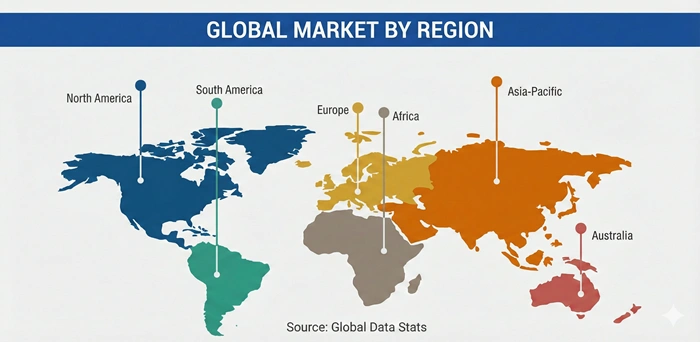
Regional Insights
Europe
Dense Manufacturing Clusters and Mature Cross-Border Transport Infrastructure Keep Europe Firmly in the Lead
Europe commands the leading position in the global automotive logistics market, holding approximately 32% share in 2025, supported by dense automotive manufacturing clusters, well-established cross-border transport networks, and a strong concentration of leading logistics providers. Germany drives a substantial share of regional demand, backed by major automaker production facilities and extensive rail and road infrastructure connecting manufacturing hubs across neighboring countries efficiently. Companies with strong regional presence include DHL, Kuehne+Nagel, CEVA Logistics, and BLG Logistics, each maintaining deep relationships with major European automakers.
France and Italy also contribute meaningfully to regional demand, supported by established vehicle assembly operations and expanding aftermarket parts distribution networks serving both domestic and export markets. The region's combination of mature cross-border transport infrastructure, deep manufacturing concentration, and continuous logistics innovation ensures Europe's leadership position within the automotive logistics market remains firmly intact through the remainder of the forecast period.
Asia Pacific
Rapidly Expanding Vehicle Manufacturing Capacity and Rising Domestic Demand Position Asia Pacific as the Fastest-Growing Region
Asia Pacific is projected to register the fastest CAGR within the global automotive logistics market through 2033, expanding at a rate near 9.8% as rapidly expanding vehicle manufacturing capacity and rising domestic vehicle demand create substantial new demand across the region. China and India lead much of this regional growth, supported by rapidly growing electric vehicle production and expanding domestic consumer demand that require dependable inbound and outbound logistics networks reaching both urban and rural dealership locations. Regional and international logistics providers alike have expanded their presence to serve this growing demand, often establishing local distribution hubs to reduce dependence on longer international shipping routes.
Japan and South Korea contribute further depth to regional growth, both bringing established automotive manufacturing infrastructure and growing battery production capacity requiring reliable specialized transport networks. Growing government investment in EV manufacturing infrastructure across several Asia Pacific markets continues to accelerate logistics adoption among expanding vehicle distribution networks alike. This combination of rapidly expanding manufacturing capacity, rising domestic demand, and growing EV infrastructure investment positions Asia Pacific as the clear growth leader within the broader automotive logistics market through the forecast period.
Customization Available for This Report
Region-Specific and Country-Specific Versions of This Report Are Available to Deliver a Sharper, More Localized View of Market Dynamics
This report can be tailored on a region-by-region and country-by-country basis, providing localized market sizing, competitive mapping, and manufacturing logistics trend analysis that a global overview alone cannot fully capture.
Clients seeking a more focused breakdown can request a customized version covering any of the following regions and countries, complete with demand forecasting, competitor landscape review, and adoption trend analysis tied specifically to the automotive logistics keyword focus:
North America
-
U.S. — Detailed review of vehicle distribution networks and logistics infrastructure trends
-
Canada — Coverage of automotive manufacturing and cross-border shipping patterns
-
Mexico — Analysis of expanding assembly plant logistics investment trends
Europe
-
U.K. — Review of vehicle distribution and cross-border transport trends
-
Germany — Coverage of manufacturing cluster logistics investment among leading providers
-
France — Insights into finished vehicle transport and warehousing adoption patterns
-
Italy — Analysis of regional automotive logistics investment trends
-
Rest of Europe — Country-level view of emerging demand across Eastern Europe and the Nordics
Asia Pacific
-
China — Coverage of expanding EV manufacturing and logistics network deployment
-
India — Analysis of growing domestic vehicle demand and infrastructure investment
-
Japan — Review of established automotive manufacturing and export logistics trends
-
South Korea — Assessment of battery and EV logistics investment and adoption
-
Australia — Insights into vehicle distribution and logistics adoption trends
-
Rest of Asia Pacific — Country-level breakdown covering Thailand, Vietnam, and Indonesia
Latin America
-
Brazil — Coverage of expanding vehicle assembly logistics access and adoption
-
Argentina — Analysis of early-stage automotive logistics modernization trends
-
Rest of Latin America — Country-level sizing across Colombia, Peru, and Chile
Middle East & Africa
-
UAE — Review of automotive logistics investment and distribution adoption trends
-
Saudi Arabia — Coverage of expanding vehicle import logistics modernization initiatives
-
Rest of MEA — Country-level view of African automotive distribution infrastructure expansion
Top Key Players
-
DHL Group (Germany)
-
Kuehne+Nagel International AG (Switzerland)
-
CEVA Logistics (France)
-
BLG Logistics Group AG & Co KG (Germany)
-
Hellmann Worldwide Logistics (Germany)
-
APL Logistics Ltd (Singapore)
-
DB Schenker (Germany)
-
Ryder System Inc (United States)
-
Nippon Express Co Ltd (Japan)
-
Gefco SA (France)
-
ArcBest Corporation (United States)
-
Wallenius Wilhelmsen ASA (Norway)
Recent Developments
-
In 2025, DHL expanded its EV and battery logistics network with new dedicated facilities to support growing electric vehicle production demand
-
In 2025, Kuehne+Nagel strengthened its multimodal transport capacity through continued investment in digital visibility tools for automotive supply chains
-
In 2026, CEVA Logistics advanced its finished vehicle distribution network with enhanced tracking capability across major European manufacturing corridors
-
In 2025, BLG Logistics deepened its automotive terminal operations to support expanding cross-border vehicle transport requirements
-
In 2025, Gefco broadened its emerging market logistics presence with new facility investments across Asia Pacific and Latin America
Market Trends
Digital Visibility Expansion and Electric Vehicle Logistics Growth Are Reshaping Provider Priorities
One of the clearest trends shaping the automotive logistics market is the accelerating adoption of end-to-end digital supply chain visibility platforms, as automakers increasingly demand real-time tracking of both inbound components and outbound finished vehicles to respond quickly to disruptions like port delays or supplier shortages. Providers are investing heavily in tracking technology, recognizing that transparency has become an increasingly important competitive differentiator as manufacturers prioritize supply chain resilience amid ongoing global disruption risks.
A second significant trend is the growing specialization in electric vehicle and battery logistics capability, as automakers ramping up EV production increasingly require dedicated hazardous material compliance and specialized carrier equipment that differs from conventional vehicle transport. This trend toward specialized EV logistics is particularly meaningful for providers serving battery manufacturers and EV assembly plants, continuing to support steady expansion across the broader automotive logistics market as global EV adoption continues increasing.
Segments Covered in the Report
By Activity
-
Inbound Logistics
-
Outbound Logistics
-
Aftermarket Parts Distribution
By Mode of Transport
-
Roadways
-
Railways
-
Maritime
By End User
-
Original Equipment Manufacturers
-
Dealerships
-
Aftermarket Parts Suppliers
By Region
-
North America (U.S., Canada, Mexico)
-
Europe (U.K., Germany, France, Italy, Rest of Europe)
-
Asia Pacific (China, India, Japan, South Korea, Australia, Rest of Asia Pacific)
-
Latin America (Brazil, Argentina, Rest of Latin America)
-
Middle East & Africa (UAE, Saudi Arabia, Rest of MEA)
❝ Built for Every Level — From Startups to Industry Giants ❞
Here Is Exactly How This Report Works for You
-
For tier 1 companies, investors, and established market leaders, this report delivers detailed competitor revenue analysis, manufacturing logistics trend mapping, and geopolitical risk context that support confident decisions around network expansion, pricing strategy, and long-term positioning within the automotive logistics space
-
For tier 2 and tier 3 companies, startups, and mid-sized providers, this report highlights the most commercially promising activity categories and underserved regional opportunities, giving you a practical framework to compete against larger established players without overextending limited resources
-
For every decision maker across the value chain, this report explains exactly how fuel cost trends, semiconductor supply risks, and competitor network expansions are shaping market direction through 2033, equipping you to plan investment and go-to-market decisions with genuine confidence
Frequently Asked Questions
Question 1: How large is the global automotive logistics market expected to become by 2033?
Answer: The global automotive logistics market was valued at USD 282.03 billion in 2025 and is projected to reach USD 483.71 billion by 2033. This growth is driven largely by rising electric vehicle production and growing just-in-time manufacturing coordination.
Question 2: What is driving growth in the automotive logistics market right now?
Answer: Growth in the automotive logistics market is being driven by rapid electric vehicle production expansion alongside growing just-in-time manufacturing adoption. Expanding aftermarket parts distribution is further reinforcing this growth.
Question 3: Which region currently dominates the automotive logistics market?
Answer: Europe currently leads the automotive logistics market with roughly 32% share, supported by dense manufacturing clusters. Asia Pacific is growing the fastest, driven by rapidly expanding vehicle manufacturing capacity and rising domestic demand.
Question 4: Which activity segment generates the most revenue in the automotive logistics market?
Answer: Finished vehicle transportation generates the largest share of revenue in the automotive logistics market, reflecting continuous demand from plant to dealership. Electric vehicle logistics remain the fastest-growing application segment.
Question 5: Who are the leading companies competing in the automotive logistics market?
Answer: Leading companies in the automotive logistics market include DHL, Kuehne+Nagel, CEVA Logistics, BLG Logistics, and Hellmann Worldwide Logistics. These companies compete through continuous innovation in digital tracking and specialized EV transport capability.