
Automated Truck Loading System Market Overview
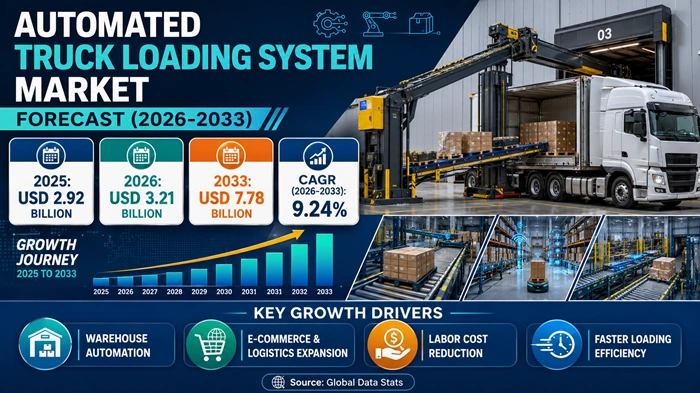
The global automated truck loading system market size is valued at USD 2.92 billion in 2025 and is predicted to increase from USD 3.21 billion in 2026 to approximately USD 7.78 billion by 2033, growing at a CAGR of 9.24% from 2026 to 2033.
The industry supplies advanced mechanical and robotic equipment designed to streamline cargo loading and unloading operations at distribution centers, warehouses, and manufacturing facilities. These sophisticated systems utilize conveyor belts, roller tracks, automated guided vehicles, and intelligent control software reducing manual labor requirements while improving safety and throughput. Manufacturing facilities worldwide produce thousands of units annually serving logistics operations across e-commerce, retail, manufacturing, and third-party logistics sectors.
The sector has become critical infrastructure supporting modern supply chain efficiency objectives and labor optimization strategies. Rising e-commerce volumes and persistent warehouse labor shortages drive steady demand for automated loading solutions. Distribution centers invest substantially in these technologies achieving faster truck turnaround times, reducing worker injury risks, and maintaining competitive operational costs.
AI Impact on the Automated Truck Loading System Industry
Intelligent Load Planning and Predictive Maintenance Revolutionizing Operations
Artificial intelligence has begun transforming how automated truck loading systems optimize cargo placement, predict equipment failures, and coordinate with broader warehouse management operations. Modern AI systems analyze package dimensions, weight distributions, delivery routes, and trailer configurations to calculate optimal loading sequences maximizing space utilization while ensuring proper weight balance. These intelligent platforms help logistics managers improve trailer cube utilization by 15-25% compared to manual loading approaches through sophisticated algorithms considering countless loading permutations identifying most efficient arrangements. Machine learning models process historical loading data identifying patterns that minimize damage risks, optimize unloading sequences at destination facilities, and reduce total transportation costs through better space utilization.
Predictive maintenance powered by AI enables facilities to forecast equipment failures, schedule proactive maintenance interventions, and minimize costly downtime disrupting loading operations. Sensor networks throughout conveyor systems, hydraulic components, and control mechanisms feed real-time performance data into neural networks detecting subtle vibration changes, temperature anomalies, and performance degradation patterns indicating impending failures. These systems alert maintenance teams days or weeks before critical breakdowns occur enabling scheduled repairs during planned downtime windows rather than emergency shutdowns during peak operating periods. Computer vision technologies inspect packages identifying damage, verifying proper orientation, and ensuring loading quality standards throughout automated processes reducing human error and improving overall system reliability.
Growth Factors
E-Commerce Expansion and Labor Challenges Accelerating Automation Adoption
The explosive growth of e-commerce creates fundamental demand for the automated truck loading system market as fulfillment centers process dramatically increased package volumes requiring faster truck turnaround times supporting same-day and next-day delivery promises. Online retail sales continuing to capture greater market share from traditional retail channels drive warehouse throughput requirements far exceeding capabilities of manual loading operations. Peak shopping seasons including holidays and promotional events create surges in shipping volumes that manual operations cannot accommodate without extensive temporary labor recruitment and training. Automated loading systems enable facilities to handle variable demand patterns maintaining consistent performance during peaks while optimizing labor deployment across other value-adding warehouse activities.
Chronic warehouse labor shortages and rising wage costs accelerate automation investments as logistics operators struggle recruiting and retaining workers for physically demanding loading tasks. The logistics sector faces persistent labor challenges with turnover rates often exceeding 40-50% annually in warehouse positions involving heavy lifting and repetitive motions. Worker compensation claims from loading-related injuries including back strains, crush injuries, and falls from elevated surfaces create substantial direct costs and regulatory compliance risks. Automated systems eliminate these hazards removing humans from dangerous positions while enabling remaining workforce to focus on higher-skilled activities including quality control, equipment operation, and exception handling requiring human judgment.

Market Outlook
Regional Adoption Patterns and Technology Evolution Shaping Industry Trajectory
North America maintains its market leadership position as the region's massive e-commerce infrastructure, advanced logistics networks, and early automation adoption drive substantial installations across distribution centers and manufacturing facilities. The United States represents the world's largest market with extensive warehouse portfolios operated by Amazon, Walmart, Target, and major third-party logistics providers implementing automation strategies improving operational efficiency. Labor cost pressures and difficulty recruiting warehouse workers in competitive employment markets accelerate ROI justification for automated loading investments. Canada shows growing adoption particularly in major logistics hubs around Toronto, Montreal, and Vancouver supporting cross-border trade flows and domestic distribution networks.
Technology advancement focuses on fully autonomous systems integrating robotic arms, automated guided vehicles, and advanced sensors enabling lights-out loading operations requiring minimal human supervision. Next-generation systems incorporate collaborative robots safely working alongside human operators during transition periods or handling exceptions automated equipment cannot process. Modular system designs enable scalable implementations allowing facilities to start with semi-automated configurations and progressively upgrade to full automation as volumes grow and ROI justifies additional investment. Integration with warehouse management systems, transportation management platforms, and enterprise resource planning software creates seamless data flows optimizing loading decisions based on real-time inventory positions, carrier schedules, and delivery requirements.
Expert Speaks
-
Andy Jassy, CEO of Amazon – "Automation technologies including advanced loading systems remain central to our logistics network strategy enabling us to meet customer delivery expectations while maintaining cost efficiency. Continued investments in warehouse automation help us manage peak demand periods and address ongoing labor market challenges while improving safety across our fulfillment operations."
-
Brian Cornell, CEO of Target – "As we expand our same-day fulfillment capabilities and optimize supply chain operations, automated loading solutions play important roles improving throughput at our distribution centers. These technologies enable faster truck turnaround supporting our stores-as-hubs strategy while reducing physical demands on our warehouse team members."
-
Jim Vena, CEO of Union Pacific Railroad – "While railroads focus on intermodal transportation, we recognize how automated loading technologies at customer facilities improve overall supply chain velocity and reliability. Partnerships with logistics providers implementing advanced loading systems help optimize equipment utilization and reduce dwell times throughout transportation networks."
Key Report Takeaways
-
North America dominates the global automated truck loading system market with approximately 38% market share, powered by massive e-commerce infrastructure, advanced logistics networks, and early automation adoption across distribution centers operated by major retailers and third-party logistics providers
-
Asia Pacific represents the fastest-growing region with projected CAGR exceeding 10.5% through 2033, driven by rapid logistics infrastructure development, expanding e-commerce markets, manufacturing sector automation, and growing third-party logistics industry throughout China, India, and Southeast Asia
-
Belt conveyor systems lead product categories capturing roughly 32% market share as proven technology offering reliability, cost-effectiveness, and well-established maintenance expertise serving diverse warehouse applications from small facilities to mega distribution centers
-
E-commerce and retail sectors dominate end-user segments accounting for approximately 42% of market consumption as online retailers and omnichannel operators invest heavily in automation supporting rapid order fulfillment and delivery commitments
-
Fully automated systems show strongest growth trajectory among automation levels with highest projected CAGR approaching 11.2% as facilities pursue lights-out operations, address labor shortages, and maximize throughput through complete automation from trailer docking through final loading
-
Third-party logistics providers demonstrate robust adoption as contract logistics operators serving multiple clients justify automation investments through improved asset utilization, expanded service offerings, and enhanced competitiveness in tight logistics markets
Market Scope
| Report Coverage | Details |
|---|---|
| Market Size by 2033 | USD 7.78 Billion |
| Market Size by 2025 | USD 2.92 Billion |
| Market Size by 2026 | USD 3.21 Billion |
| Market Growth Rate from 2026 to 2033 | CAGR of 9.24% |
| Dominating Region | North America |
| Fastest Growing Region | Asia Pacific |
| Base Year | 2025 |
| Forecast Period | 2026 to 2033 |
| Segments Covered | System Type, Automation Level, Load Capacity, End-User Industry, Component, Region |
| Regions Covered | North America, Europe, Asia Pacific, Latin America, Middle East & Africa |
Market Dynamics
Drivers Impact Analysis
Multiple Operational and Economic Factors Propelling Market Expansion
| Driver | Impact on CAGR Forecast | Geographic Relevance | Impact Timeline |
|---|---|---|---|
| E-commerce growth and rapid fulfillment requirements | ≈ 3.2% positive impact | Global, strongest in developed markets | Immediate and long-term |
| Labor shortages and rising warehouse wage costs | ≈ 2.8% positive impact | North America, Europe, developed Asia | Immediate and long-term |
| Safety improvements and injury reduction benefits | ≈ 1.6% positive impact | Global | Immediate |
| Integration with warehouse management systems | ≈ 1.5% positive impact | Developed markets initially | Medium to long-term |
E-commerce expansion creates sustained demand for the automated truck loading system market as online retailers require dramatically increased warehouse throughput supporting same-day and next-day delivery commitments. Amazon's fulfillment network alone processes billions of packages annually with individual facilities shipping hundreds of thousands of items daily during peak periods. This volume intensity demands automated loading systems capable of processing 30-50+ trailers per facility daily maintaining consistent cycle times regardless of labor availability fluctuations. Automated systems enable facilities to achieve 10-15 minute loading cycles compared to 30-60 minutes for manual operations dramatically improving asset utilization for trucks, trailers, and dock doors representing substantial capital investments.
Warehouse labor challenges accelerate automation adoption as logistics operators face persistent difficulties recruiting and retaining workers for physically demanding loading positions. Turnover rates in warehouse environments often exceed 40-50% annually creating constant recruitment and training burdens while disrupting operational consistency. Starting wages for warehouse positions have increased 25-35% over recent years yet many facilities still struggle maintaining adequate staffing particularly during peak seasons. Automated loading systems reduce labor requirements by 60-80% for loading operations allowing facilities to deploy workers in higher-value activities including quality control, returns processing, and customer service functions requiring human judgment and interaction.

Restraints Impact Analysis
Implementation Challenges and Economic Barriers Affecting Adoption Rates
| Restraint | Impact on CAGR Forecast | Geographic Relevance | Impact Timeline |
|---|---|---|---|
| High upfront capital investment requirements | ≈ 1.9% negative impact | Price-sensitive markets, SMEs | Immediate and medium-term |
| Existing facility infrastructure limitations | ≈ 1.4% negative impact | Older warehouses globally | Immediate |
| Integration complexity with legacy systems | ≈ 1.1% negative impact | Established facilities | Short to medium-term |
| Skilled maintenance workforce availability | ≈ 0.8% negative impact | Emerging markets | Medium-term |
Capital cost considerations create significant barriers for the automated truck loading system market particularly among small and mid-sized logistics operators and facilities with uncertain volume projections. Complete automated loading installations cost USD 200,000-500,000+ per loading bay depending on system complexity, integration requirements, and facility modifications needed. These investments require 3-5 year payback horizons through labor savings and throughput improvements which many operators struggle justifying particularly in uncertain economic environments or facilities experiencing variable throughput. Financing options remain underdeveloped in many markets limiting access to capital for automation projects competing against other warehouse technology investments including automated storage and retrieval systems, sortation equipment, and robotics.
Existing facility constraints limit retrofit opportunities as many older warehouses lack adequate ceiling heights, floor load capacities, electrical infrastructure, and dock configurations supporting automated loading equipment. Legacy facilities designed around manual operations feature narrow dock approaches, limited trailer maneuvering space, and dock door spacing incompatible with automated system footprints. Structural modifications required for automation installations including reinforced floors, expanded electrical capacity, and reconfigured dock layouts often cost as much as equipment itself making automation economically unviable in older buildings. These limitations particularly affect urban warehouses occupying premium real estate where facility replacement or expansion proves cost-prohibitive despite operational inefficiencies.
Opportunities Impact Analysis
Emerging Applications and Technology Evolution Creating Growth Avenues
| Opportunity | Impact on CAGR Forecast | Geographic Relevance | Impact Timeline |
|---|---|---|---|
| Emerging market logistics infrastructure development | ≈ 2.4% positive impact | Asia Pacific, Latin America, Middle East | Immediate and long-term |
| Cold chain and temperature-controlled applications | ≈ 1.7% positive impact | Global, food & pharma sectors | Medium to long-term |
| Retrofit solutions for existing warehouse facilities | ≈ 1.5% positive impact | Developed markets | Medium-term |
| Modular and scalable system offerings | ≈ 1.3% positive impact | SME logistics operators | Medium-term |
Emerging market logistics infrastructure development presents substantial opportunities for the automated truck loading system market as countries throughout Asia Pacific, Latin America, and Middle East build modern warehouse facilities incorporating automation from initial design stages. China's logistics real estate market adds 50+ million square meters of modern warehouse space annually with significant portions featuring automation-ready designs. India's logistics sector undergoes transformation as government infrastructure initiatives, GST implementation streamlining interstate commerce, and e-commerce growth drive demand for sophisticated distribution facilities. Southeast Asian countries including Vietnam, Indonesia, and Thailand attract manufacturing relocations and e-commerce investments requiring advanced logistics infrastructure supporting regional and export markets.
Cold chain applications create premium market segments as temperature-controlled warehouses and distribution centers handling pharmaceuticals, fresh food, and frozen products adopt automation addressing unique operational challenges. Cold storage facilities face even more acute labor recruitment difficulties as workers resist prolonged exposure to freezing temperatures despite protective equipment and scheduled breaks. Automated loading systems enable facilities to minimize worker time in temperature-controlled environments while maintaining throughput and product integrity. Pharmaceutical logistics particularly demand automation as regulatory requirements for temperature monitoring, chain-of-custody documentation, and contamination prevention favor automated systems providing complete traceability and environmental control throughout loading processes.

Segment Analysis
Belt Conveyor Systems
Dominant Technology Platform Delivering Proven Performance Across Applications
Belt conveyor systems represent the largest segment capturing approximately 32% of the automated truck loading system market share in 2025, expanding at 8.8% CAGR through the forecast period. This category encompasses powered belt conveyors with telescoping or extendable sections reaching into trailers for automated loading and unloading operations. North America dominates belt conveyor adoption as the region's established logistics infrastructure, early automation investments, and large-scale distribution centers favor proven conveyor technology offering reliability and scalability. These systems handle diverse package sizes and weights through adjustable speeds, multiple belt widths, and sophisticated control systems coordinating with upstream warehouse conveyors and sortation equipment. Integration with warehouse management systems enables automated routing decisions directing packages to appropriate loading positions based on delivery routes, carrier assignments, and trailer loading priorities.
Major equipment manufacturers including Honeywell Intelligrated, Dematic, Vanderlande Industries, and Bastian Solutions operate global operations supplying belt conveyor loading systems serving diverse industries from e-commerce through manufacturing. These companies offer modular designs enabling configurations from single loading positions through complex multi-door installations handling dozens of simultaneous loading operations. Advanced features including vision systems for package tracking, automatic height adjustment for different trailer types, and collision avoidance sensors enhance operational reliability and safety. E-commerce fulfillment centers represent the largest application as facilities shipping thousands of parcels daily require high-speed loading systems maintaining consistent throughput during peak periods. Food and beverage distribution also shows strong adoption as case-handling operations benefit from belt systems accommodating palletized and floor-loaded configurations.
Fully Automated Systems
Fastest Growing Segment Enabling Lights-Out Operations and Maximum Efficiency
Fully automated systems demonstrate the strongest growth trajectory expanding at approximately 11.2% CAGR as facilities pursue complete automation from trailer positioning through final loading eliminating manual intervention. This advanced segment integrates automated docking systems, robotic loading arms, vision-guided package placement, and sophisticated control software coordinating entire loading sequences without human operators. Asia Pacific shows particularly robust growth as new logistics facilities throughout China, Japan, and South Korea incorporate full automation from initial construction supporting 24/7 operations and addressing acute labor shortages. These systems utilize artificial intelligence optimizing loading sequences, machine learning algorithms improving performance over time, and predictive analytics forecasting maintenance requirements minimizing downtime disrupting operations.
Leading technology providers including Knapp AG, Swisslog, TGW Logistics, and Daifuku develop integrated solutions combining mechanical handling equipment, robotics, and intelligent software creating seamless automated loading operations. These vendors serve premium market segments including automotive parts distribution, pharmaceutical logistics, and high-volume e-commerce operations justifying substantial capital investments through labor elimination and throughput maximization. Pharmaceutical cold chain logistics particularly favors full automation as regulatory requirements, temperature control needs, and contamination risks demand lights-out operations minimizing human contact with products. Manufacturing facilities shipping finished goods also adopt fully automated loading supporting lean production systems and just-in-time delivery schedules requiring precise loading timing and reliability.

Regional Insights
North America
Market Leadership Through Mature Logistics Infrastructure and Early Automation Adoption
North America dominates with approximately 38% of the global automated truck loading system market share, valued at over USD 1.1 billion in 2025 and growing at 8.6% CAGR through 2033. The region benefits from massive e-commerce infrastructure, sophisticated logistics networks, chronic warehouse labor shortages, and favorable economic conditions supporting automation investments. United States represents the world's largest national market as major retailers including Amazon, Walmart, and Target operate hundreds of distribution centers with many implementing automated loading technologies improving operational efficiency. Third-party logistics providers including XPO Logistics, DHL Supply Chain, and FedEx Supply Chain invest substantially in warehouse automation serving diverse clients requiring advanced logistics capabilities. Labor challenges particularly acute in major logistics markets including Southern California, Dallas-Fort Worth, and Pennsylvania/New Jersey regions accelerate automation adoption as facilities struggle recruiting adequate workers despite significant wage increases.
Major regional installations by Honeywell Intelligrated, Dematic, Bastian Solutions, and Daifuku Webb demonstrate technology leadership and market maturity with sophisticated systems handling complex loading requirements. These providers maintain extensive service networks supporting installed equipment base ensuring operational reliability critical for high-throughput facilities. Canada shows growing adoption particularly around major population centers and border crossings supporting cross-border trade flows and domestic distribution networks. Government initiatives supporting advanced manufacturing and supply chain resilience following pandemic disruptions provide favorable conditions for automation investments. The region's emphasis on worker safety and ergonomics also drives adoption as automated systems eliminate loading-related injuries reducing workers' compensation costs and regulatory compliance risks.
Asia Pacific
Fastest Growing Region Through Infrastructure Development and Manufacturing Automation
Asia Pacific emerges as the fastest-growing regional market expanding at approximately 10.5% CAGR as logistics infrastructure development, expanding e-commerce, manufacturing sector automation, and growing third-party logistics industry drive installations throughout China, India, Japan, and Southeast Asia. China dominates regional consumption as the country's massive e-commerce market, extensive manufacturing base, and modern logistics facility construction create enormous demand for automated loading solutions. Major Chinese e-commerce operators including Alibaba, JD.com, and Pinduoduo build sophisticated fulfillment networks incorporating advanced automation technologies achieving industry-leading efficiency and delivery speeds. Government policies supporting logistics industry modernization, smart warehouse development, and manufacturing automation provide favorable regulatory environment for technology adoption.
Leading regional and global suppliers including Daifuku, Murata Machinery, Dematic operations, Vanderlande installations, and emerging Chinese automation providers establish substantial market presence serving diverse customer segments. These companies adapt technologies for regional requirements including integration with local warehouse management systems, compliance with regional safety standards, and customization for specific industry needs. India represents high-growth opportunity as logistics sector modernization, e-commerce expansion, and manufacturing growth drive demand for automated solutions. Government initiatives including Make in India, Digital India, and logistics infrastructure development support market expansion. Japan and South Korea maintain mature markets with advanced automation adoption across automotive, electronics, and consumer goods logistics supporting efficient manufacturing supply chains and urban distribution networks.
Top Key Players
-
Honeywell Intelligrated (United States)
-
Dematic (Kion Group) (United States/Germany)
-
Vanderlande Industries (Netherlands)
-
Bastian Solutions (Toyota Advanced Logistics) (United States/Japan)
-
Daifuku Co., Ltd. (Japan)
-
Swisslog (Kuka Group) (Switzerland/Germany)
-
TGW Logistics Group (Austria)
-
Knapp AG (Austria)
-
Beumer Group (Germany)
-
Hytrol Conveyor Company (United States)
-
Interroll Group (Switzerland)
-
SSI Schaefer (Germany)
-
Joloda Hydraroll (United Kingdom)
-
Ancra Systems (United States)
Recent Developments
-
Honeywell Intelligrated (2024) – Launched next-generation telescopic belt conveyor system featuring AI-powered load optimization reducing loading times by 30% while improving trailer cube utilization through intelligent package sequencing and placement algorithms supporting high-volume e-commerce fulfillment operations
-
Dematic (2025) – Completed major installation at leading automotive parts distributor in Germany implementing fully automated loading system handling 12 simultaneous trailer loading operations achieving 24/7 lights-out capability reducing labor requirements by 75% while improving throughput and worker safety
-
Vanderlande (2024) – Acquired regional warehouse automation specialist expanding service capabilities in Asia Pacific market strengthening position serving growing e-commerce and third-party logistics sectors throughout China, Southeast Asia, and India with localized support infrastructure
-
Bastian Solutions (2025) – Announced strategic partnership with major grocery retailer implementing automated loading systems across 25 distribution centers supporting omnichannel fulfillment strategy and fresh food distribution requiring precise temperature control and rapid throughput
-
Daifuku (2024) – Invested USD 150 million expanding manufacturing capacity in Japan and China increasing production of automated loading systems and warehouse automation equipment by 40% supporting growing demand throughout Asia Pacific automotive, e-commerce, and manufacturing sectors
Market Trends
Integration and Intelligence Driving System Evolution
The automated truck loading system market experiences fundamental transformation toward intelligent integrated solutions as vendors develop platforms seamlessly connecting with broader warehouse management ecosystems, transportation management systems, and enterprise software. Modern systems incorporate IoT sensors throughout equipment providing real-time performance monitoring, predictive maintenance alerts, and operational analytics enabling continuous optimization. Cloud-based control platforms enable remote monitoring and management allowing logistics operators to oversee multiple facilities from centralized operations centers responding quickly to issues and coordinating resources across warehouse networks. API-based integrations with carrier systems, yard management platforms, and dock scheduling software create seamless information flows optimizing trailer assignments, coordinating driver arrivals, and minimizing dock door idle time.
Modular and scalable designs emerge as dominant product development direction as vendors recognize diverse customer needs spanning small regional warehouses through mega distribution centers. Entry-level semi-automated systems provide cost-effective automation introducing basic conveyor-assisted loading while preserving manual oversight for complex situations or exception handling. Progressive upgrade paths enable facilities to add capabilities incrementally as volumes grow and ROI justifies additional investment avoiding large upfront commitments while building automation maturity. Vendors develop standardized modules that can be configured for specific facility requirements reducing engineering costs, shortening installation timelines, and improving equipment reliability through proven component designs tested across numerous installations.
Segments Covered in the Report
By System Type
-
Belt Conveyor Systems
-
Roller Track Systems
-
Chain Conveyor Systems
-
Skate Wheel Systems
By Automation Level
-
Semi-Automated Systems
-
Fully Automated Systems
By Load Capacity
-
Light Duty (< 15 tons)
-
Medium Duty (15-30 tons)
-
Heavy Duty (> 30 tons)
By End-User Industry
-
E-Commerce & Retail
-
Food & Beverage
-
Automotive
-
Pharmaceutical
-
Manufacturing
-
Third-Party Logistics (3PL)
-
Others
By Component
-
Hardware (Conveyors, Sensors, Control Systems)
-
Software (WMS Integration, Control Software)
-
Services (Installation, Maintenance, Training)
By Region
-
North America
-
Europe
-
Asia Pacific
-
Latin America
-
Middle East & Africa
Frequently Asked Questions
Question 1: What drives growth in the automated truck loading system market globally?
Answer: The automated truck loading system market experiences robust growth from expanding e-commerce fulfillment requirements demanding faster truck turnaround times and persistent warehouse labor shortages increasing automation adoption. Rising operational costs and workplace safety concerns also contribute significantly to market expansion across logistics sectors.
Question 2: Which region leads the automated truck loading system market currently?
Answer: North America dominates the automated truck loading system market with approximately 38% share backed by massive e-commerce infrastructure and advanced logistics networks. The region benefits from early automation adoption among major retailers and third-party logistics providers addressing chronic warehouse labor challenges.
Question 3: How does AI impact the automated truck loading system market?
Answer: Artificial intelligence significantly influences the automated truck loading system market through intelligent load optimization algorithms and predictive maintenance capabilities. These technologies improve trailer space utilization by 15-25% while reducing equipment downtime through proactive maintenance scheduling based on sensor data analysis.
Question 4: What applications drive the automated truck loading system market consumption?
Answer: E-commerce and retail sectors lead the automated truck loading system market representing approximately 42% of consumption. These segments prioritize automation supporting rapid order fulfillment, same-day delivery commitments, and high-volume package processing during peak shopping periods.
Question 5: Which segment shows fastest growth in the automated truck loading system market?
Answer: Fully automated systems demonstrate the strongest growth trajectory in the automated truck loading system market with projected CAGR approaching 11.2%. This segment attracts investment from facilities pursuing lights-out operations, complete labor elimination, and maximum throughput through integrated robotic loading solutions.