
Automated Mining Equipment Market Overview
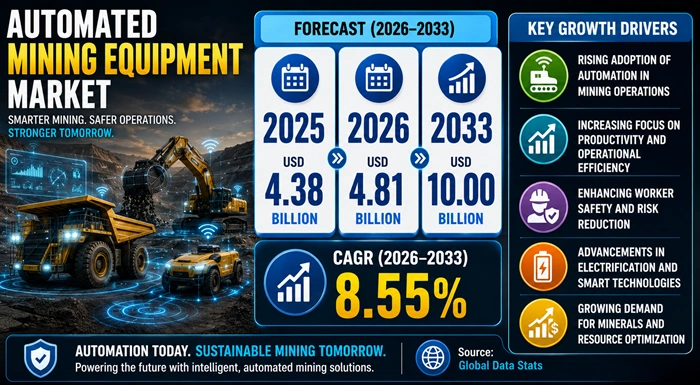
The global automated mining equipment market size is valued at USD 4.38 billion in 2025 and is predicted to increase from USD 4.81 billion in 2026 to approximately USD 10.00 billion by 2033, growing at a CAGR of 8.55% from 2026 to 2033. This remarkable growth trajectory reflects the mining industry's accelerating transformation toward intelligent, connected, and autonomous operations that dramatically improve worker safety, operational efficiency, and productivity while reducing environmental impact. Automated mining equipment encompasses sophisticated machinery and systems capable of performing critical mining operations with minimal or no human intervention, utilizing advanced technologies including artificial intelligence, machine learning, Internet of Things sensors, GPS navigation, and real-time data analytics.
The automated mining equipment market represents a fundamental shift from traditional manual operations toward technology-driven mining processes where autonomous haul trucks transport materials without drivers, robotic drilling rigs execute precise drilling patterns without human operators, and automated loading equipment operates continuously in hazardous environments where human presence poses unacceptable safety risks. These advanced systems integrate multiple sensors, cameras, radar systems, and communication networks that enable machines to perceive their surroundings, make intelligent decisions, coordinate with other equipment, and execute complex tasks with precision exceeding human capabilities. The growing emphasis on reducing workplace injuries, addressing skilled labor shortages, optimizing ore extraction, and meeting stringent environmental regulations is driving substantial investment in automated mining technologies across coal, metal, and mineral operations worldwide.
AI Impact on the Automated Mining Equipment Industry
Revolutionizing Mining Operations Through Intelligent Decision-Making and Predictive Capabilities
Artificial intelligence is fundamentally transforming the automated mining equipment market by enabling unprecedented levels of operational intelligence, predictive maintenance, and autonomous decision-making that maximize productivity while minimizing safety risks and equipment downtime. AI-powered systems continuously analyze massive datasets collected from sensors throughout mining operations, including equipment performance metrics, geological conditions, operational parameters, and environmental factors to generate real-time recommendations optimizing mining processes. Machine learning algorithms process historical performance data alongside current operational information to predict equipment failures before they occur, enabling proactive maintenance interventions that prevent costly breakdowns and extend machinery lifespan. Computer vision technologies integrated with autonomous mining vehicles detect obstacles, identify hazards, recognize traffic patterns, and navigate complex mining environments with precision that surpasses human operators while eliminating accidents caused by fatigue, distraction, or impaired judgment.
The integration of AI extends throughout the entire automated mining ecosystem from exploration and planning through extraction and transportation, creating comprehensive intelligent operations that optimize resource allocation and maximize return on investment. Neural networks analyze geological survey data to identify optimal drilling locations, predict ore quality distributions, and recommend extraction strategies that maximize resource recovery while minimizing waste generation. Predictive analytics models forecast equipment energy consumption patterns, maintenance requirements, and operational bottlenecks, enabling mining companies to optimize scheduling, reduce operating costs, and improve overall equipment effectiveness. AI-driven coordination systems manage complex interactions between multiple autonomous vehicles operating simultaneously in confined spaces, optimizing traffic flow, preventing collisions, and maximizing throughput while ensuring safety protocols are maintained. This technological transformation is democratizing access to sophisticated mining optimization capabilities that were previously available only to the largest mining corporations with extensive engineering resources.
Growth Factors
Escalating Safety Requirements and Labor Shortage Challenges Drive Automation Adoption
The mining industry's paramount focus on improving worker safety and reducing fatalities represents the most powerful driver propelling automated mining equipment market expansion across all major mining regions globally. Mining operations inherently involve numerous hazards including equipment collisions, rockfalls, exposure to harmful dust and chemicals, extreme temperatures, and risks associated with explosive materials that historically resulted in unacceptable injury and death rates. Automated systems eliminate or dramatically reduce human exposure to these dangerous conditions by enabling operations in hazardous zones without requiring worker presence, with autonomous haul trucks transporting materials through active mining areas, robotic drilling rigs operating in unstable ground conditions, and remote-controlled equipment functioning in areas where toxic gases or extreme heat would endanger human operators. International safety regulations and corporate responsibility commitments are creating powerful incentives for mining companies to invest in automation technologies that demonstrably improve safety records and reduce liability exposures.
The accelerating global shortage of skilled mining workers, particularly equipment operators with specialized training and experience, is creating urgent demand for automated solutions that can maintain or increase production levels despite declining workforce availability. Aging demographics in traditional mining regions including North America, Europe, and Australia are creating situations where experienced operators retire faster than new workers enter the industry, with many young workers preferring careers in less physically demanding and safer industries. Automated mining equipment addresses this challenge by reducing dependence on human operators while enabling fewer workers to oversee larger operations through remote monitoring and control systems. The automated mining equipment market benefits from improving economic justification as automation technologies reduce per-unit production costs through continuous operation uninterrupted by shift changes, breaks, or fatigue, higher precision reducing waste and improving ore recovery rates, and lower labor expenses offsetting initial capital investments. Mining companies document operational cost reductions of twenty to thirty percent following automation implementation, with some operations reporting payback periods as short as three to five years for major autonomous system investments.
Market Outlook
Technological Maturation and Mining Industry Digital Transformation Shape Robust Growth Trajectory
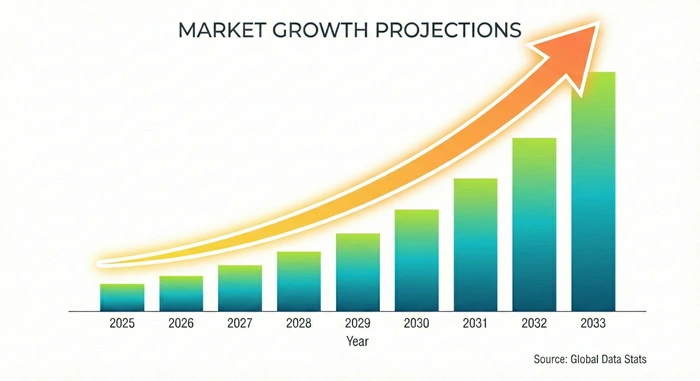
The automated mining equipment market outlook through 2033 remains exceptionally positive as technological maturation, declining implementation costs, and expanding proven track records drive mainstream adoption beyond early-adopter mining operations into conventional facilities worldwide. Integration of 5G communication networks at mining sites is eliminating connectivity limitations that historically constrained real-time control and coordination of autonomous systems, enabling reliable high-bandwidth data transmission supporting advanced applications including remote operation centers located hundreds of kilometers from actual mining sites. Development of interoperable systems and industry standardization efforts are reducing vendor lock-in concerns and simplifying integration of equipment from multiple manufacturers, making automation investments more attractive to mining companies concerned about technological obsolescence and upgrade pathways. Growing availability of financing specifically structured for automation projects, including equipment leasing arrangements and performance-based contracts where technology providers share operational risk, is improving accessibility for mid-sized mining operations previously deterred by substantial upfront capital requirements.
Looking toward the forecast period conclusion in 2033, market dynamics will be increasingly influenced by sustainability imperatives as mining operations face intensifying pressure to reduce carbon emissions, minimize environmental footprints, and demonstrate responsible resource stewardship. Automated systems contribute directly to sustainability goals by optimizing fuel consumption through efficient route planning and reduced idling, minimizing waste through precise extraction and processing, and enabling mining companies to meet increasingly stringent environmental regulations. The automated mining equipment market evolution encompasses expanding applications beyond traditional surface mining into underground operations where autonomous systems address unique challenges including limited space, communication constraints, and heightened safety risks. Emerging opportunities in deep-sea mining, asteroid mining research, and extraction of critical minerals for clean energy technologies will create new application areas where automation is essential rather than optional due to extreme operating environments exceeding human capabilities. This market diversification across multiple mining applications and commodity types creates robust growth momentum that will sustain expansion throughout the forecast period.
Expert Speaks
-
Joseph Creed, CEO of Caterpillar Inc, emphasized following his appointment in May 2025 that Caterpillar is positioned to benefit substantially from infrastructure spending and the global energy transition, with autonomous mining fleets gaining significant traction among mining customers due to proven productivity improvements, enhanced safety features, and compelling cost-efficiency benefits that deliver strong return on investment for operations worldwide.
-
Takuya Imayoshi, President and CEO of Komatsu Ltd, outlined in the Komatsu Report 2025 the company's strategic growth priorities including advancing automation technologies, expanding equipment offerings, and enhancing sales and service distribution networks globally, with particular emphasis on electric equipment development and innovative solutions that support mining customers' sustainability objectives while improving operational performance.
-
Aidan Knight, Associate Analyst at GlobalData, noted in research on the future of work in mining that industrial automation including autonomous haulage systems and process automation could dramatically reduce workers' exposure to dangerous mining conditions, while wearable technology enables real-time health and fatigue monitoring, with the mining industry achieving notable safety improvements over recent decades but recognizing that automation technologies represent essential next steps for further risk reduction.
Key Report Takeaways
-
Asia-Pacific dominates the global automated mining equipment market with approximately 41% market share driven by massive coal and metal mining operations in China, India, and Australia, substantial government support for mining modernization programs, rapid adoption of advanced technologies in Australian iron ore operations, and growing emphasis on worker safety improvements addressing historically high mining accident rates across the region.
-
Middle East and Africa emerges as the fastest-growing regional market with projected CAGR exceeding 9.8% through 2033, fueled by expanding mining activities in countries including South Africa, Saudi Arabia, and UAE, substantial investments in mining infrastructure supporting economic diversification strategies, growing adoption of advanced technologies to address skilled labor shortages, and increasing emphasis on operational efficiency in resource extraction industries.
-
Autonomous haul trucks segment leads equipment type categorization accounting for approximately 38.6% of global automated mining equipment market revenue as these massive vehicles represent the highest-value automation investments, deliver most immediate productivity and safety benefits in surface mining operations, and have the longest proven track record supporting rapid adoption by major mining companies worldwide seeking competitive advantages.
-
Surface mining applications dominate market consumption representing around 65.4% of total automated mining equipment deployments as open-pit operations provide more straightforward environments for autonomous system implementation compared to underground mining, with larger working spaces, better GPS and communication coverage, and fewer technical constraints enabling faster automation adoption rates and larger-scale autonomous fleet operations.
-
Fully autonomous technology segment exhibits highest growth potential expected to expand at CAGR exceeding 10.2% through 2033 as mining companies transition from semi-autonomous systems requiring human supervision toward fully autonomous operations delivering maximum safety and efficiency benefits, with advancing technologies, improving regulatory frameworks, and proven operational successes building confidence in completely unmanned mining operations.
-
The underground mining segment demonstrates accelerating adoption momentum driven by technological advances addressing unique challenges including limited space for equipment maneuvering, communication system constraints, and extreme safety concerns, with autonomous load-haul-dump systems and remote-controlled drilling rigs increasingly deployed in underground operations where automation delivers particularly compelling safety benefits by eliminating worker exposure to highest-risk environments.
Market Scope
| Report Coverage Details | |
|---|---|
| Market Size by 2033 | USD 10.00 Billion |
| Market Size by 2025 | USD 4.38 Billion |
| Market Size by 2026 | USD 4.81 Billion |
| Market Growth Rate from 2026 to 2033 | CAGR of 8.55% |
| Dominating Region | Asia-Pacific |
| Fastest Growing Region | Middle East and Africa |
| Base Year | 2025 |
| Forecast Period | 2026 to 2033 |
| Segments Covered | Equipment Type, Technology, Application, Region |
| Regions Covered | North America, Europe, Asia-Pacific, Latin America, Middle East and Africa |
Market Dynamics
Drivers Impact Analysis
Imperative to Enhance Mining Safety Standards and Eliminate Workplace Fatalities
| Factor | Details |
|---|---|
| ≈ % Impact on CAGR Forecast | +3.1% to +3.8% |
| Geographic Relevance | Global, particularly acute in developed mining regions |
| Impact Timeline | Immediate to Long-term (2026-2033) |
The mining industry's unwavering commitment to eliminating workplace fatalities and reducing injury rates represents the fundamental driver propelling automated mining equipment market growth as regulatory requirements, corporate responsibility mandates, and social license pressures demand continuous safety improvements. Mining consistently ranks among the world's most hazardous occupations with workers facing daily risks from equipment collisions, falling rocks, ground collapses, explosive accidents, and exposure to harmful substances that historically resulted in thousands of deaths and injuries annually across global mining operations. Automated systems address these challenges directly by removing human workers from immediate danger zones, with autonomous haul trucks eliminating risks associated with driver errors and fatigue-related accidents, robotic drilling equipment operating in unstable ground conditions without endangering operators, and remote-controlled systems enabling personnel to maintain safe distances from blasting zones and rockfall areas while continuing productive operations.
Regulatory frameworks in major mining jurisdictions increasingly mandate implementation of technologies demonstrably reducing worker exposure to hazardous conditions, with regulatory bodies in Australia, Canada, United States, and European Union establishing specific requirements for risk mitigation measures that automated systems satisfy. Mining companies face substantial financial liabilities from workplace accidents including compensation claims, legal penalties, operational disruptions, and reputational damage affecting their ability to obtain operating licenses, secure financing, and attract quality workers. The automated mining equipment market benefits from compelling safety statistics documented at operations utilizing autonomous systems, with studies showing seventy to eighty percent reductions in vehicle-related incidents, fifty percent decreases in operator injuries, and elimination of fatalities in high-risk operations following automation implementation. Mining industry associations and safety organizations actively promote automation adoption through case studies, best practice guidelines, and recognition programs celebrating safety achievements, creating positive industry momentum supporting continued market expansion. Insurance companies increasingly offer premium reductions and favorable coverage terms for mining operations implementing automation technologies, recognizing demonstrated risk reduction and encouraging broader adoption through economic incentives beyond regulatory compliance.
Restraints Impact Analysis
Substantial Capital Investment Requirements and Technical Integration Complexities
| Factor | Details |
|---|---|
| ≈ % Impact on CAGR Forecast | -1.4% to -1.9% |
| Geographic Relevance | Developing mining regions, smaller operations globally |
| Impact Timeline | Short to Medium-term (2026-2029) |
The automated mining equipment market faces significant adoption barriers related to enormous upfront capital investments required for purchasing autonomous equipment, installing supporting infrastructure, and integrating systems into existing mining operations. Complete autonomous haulage systems for large-scale surface mining operations can require investments exceeding one hundred million dollars including autonomous trucks costing millions per unit, communication networks, GPS base stations, remote operation centers, and extensive software systems coordinating fleet operations. These capital requirements far exceed investments needed for conventional mining equipment, creating financial hurdles particularly challenging for small to medium-sized mining companies, operations in developing regions with limited access to capital, and mining ventures extracting lower-value commodities where profit margins cannot support premium equipment investments. Access to specialized financing for automation projects remains limited compared to conventional mining equipment loans, with many traditional mining lenders lacking familiarity with automation technologies and hesitant to extend credit for projects they perceive as higher risk.
Technical integration challenges associated with retrofitting autonomous systems into existing mining operations create additional barriers requiring specialized engineering expertise, extensive testing periods, and operational disruptions during implementation phases. Mining sites typically include legacy equipment from multiple manufacturers operating on different communication protocols, control systems incompatible with modern automation platforms, and infrastructure inadequate for supporting autonomous operations including insufficient GPS coverage, unreliable communication networks, and control centers lacking capabilities for remote equipment monitoring. Successful automation implementation requires coordinated upgrades across multiple operational systems, extensive workforce retraining programs teaching traditional operators new skills for supervising autonomous equipment, and organizational change management addressing resistance from workers concerned about job security and unfamiliar technology. The automated mining equipment market struggles with limited availability of skilled technical personnel capable of maintaining sophisticated autonomous systems, troubleshooting complex software issues, and optimizing operational parameters, forcing mining companies to either invest heavily in internal capability development or rely on expensive external technical support contracts. Cybersecurity concerns represent emerging barriers as increased connectivity and remote operations create vulnerability to cyberattacks potentially disrupting mining operations, damaging equipment, or compromising sensitive operational data.
Opportunities Impact Analysis
Underground Mining Automation and Critical Mineral Extraction Drive New Market Pathways
| Factor | Details |
|---|---|
| ≈ % Impact on CAGR Forecast | +2.3% to +3.0% |
| Geographic Relevance | North America, Europe, Asia-Pacific |
| Impact Timeline | Medium to Long-term (2027-2033) |
The expanding application of automation technologies in underground mining operations creates transformative opportunities for the automated mining equipment market as advancing capabilities address unique technical challenges previously limiting autonomous system deployment in confined subsurface environments. Underground mining presents distinct automation challenges compared to surface operations including limited GPS availability requiring alternative positioning systems, restricted communication networks necessitating specialized wireless infrastructure, confined spaces constraining equipment size and maneuverability, and heightened safety risks from ground instability, ventilation requirements, and emergency evacuation complexities. Recent technological advances including ultra-wideband positioning systems, mesh communication networks, and compact autonomous equipment designs specifically engineered for underground conditions are enabling successful automation deployments demonstrating compelling safety and productivity benefits. Autonomous load-haul-dump vehicles transporting ore from extraction points to underground processing areas, remote-controlled drilling jumbos operating in newly developed mine sections, and robotic bolting equipment installing ground support systems represent rapidly growing underground automation applications.
The accelerating global transition toward clean energy technologies including electric vehicles, renewable energy systems, and battery storage is creating unprecedented demand for critical minerals including lithium, cobalt, rare earths, and copper that must be extracted from increasingly difficult mining environments where automation provides essential capabilities. These high-value mineral operations justify substantial automation investments as premium commodity prices support rapid payback periods, with mining companies competing intensely for deposits and seeking competitive advantages through superior operational efficiency and reliability. The automated mining equipment market benefits from government initiatives in United States, Europe, and other regions prioritizing domestic critical mineral production for energy security and economic competitiveness, with public funding supporting mining technology development and deployment including automation systems enabling economically viable extraction from lower-grade deposits previously considered uneconomic. Emerging opportunities in extreme mining environments including Arctic operations, deep-sea mineral extraction, and eventual extraterrestrial mining ventures create application areas where automation transitions from optional efficiency improvement to absolute necessity as human operation becomes impractical or impossible due to environmental extremes.
Segment Analysis
By Equipment Type: Autonomous Haul Trucks Segment
Proven Technology and Substantial Operational Benefits Establish Market Leadership
The autonomous haul trucks segment maintains commanding market dominance within the automated mining equipment market landscape, capturing approximately 38.6% of global revenue driven by the substantial capital value of these massive vehicles, extensive proven track records demonstrating compelling operational benefits, and strategic importance in surface mining operations where material transportation represents critical processes. Autonomous haul trucks, typically weighing over three hundred tons with payload capacities exceeding two hundred tons, represent the highest-value equipment investments in automated mining fleets with individual units costing several million dollars and complete autonomous haulage systems for large operations exceeding one hundred million dollars. These vehicles deliver immediate productivity improvements including twenty-four-hour continuous operation without shift breaks, ten to fifteen percent increased payload utilization through optimized loading, reduced fuel consumption from efficient route planning and controlled acceleration, and dramatically improved safety records eliminating driver-related accidents that historically caused numerous fatalities. Australia leads autonomous haul truck adoption with over six hundred autonomous trucks operating across iron ore and coal mines in Western Australia and Queensland, followed by significant deployments in Canada, Chile, and South Africa where major mining companies including Rio Tinto, BHP, and Fortescue Metals pioneered large-scale autonomous operations.
The autonomous haul trucks segment growth trajectory remains robust throughout the forecast period supported by expanding adoption beyond pioneering early adopters into mainstream mining operations, technological improvements reducing implementation complexity and costs, and compelling documented return-on-investment justifying continued fleet expansions. Leading manufacturers serving the automated mining equipment market including Caterpillar, Komatsu, Hitachi, and Liebherr continuously advance autonomous truck technologies through enhanced sensor capabilities, improved navigation algorithms, expanded operational envelope tolerances, and integration with mine-wide management systems optimizing overall operations. The segment benefits from established industry infrastructure including specialized training programs, technical support networks, and operational best practices shared through industry associations that reduce implementation risks and accelerate adoption timelines. Market opportunities continue expanding as mining companies transition from mixed autonomous and conventional fleets toward fully autonomous operations eliminating complexities associated with human-machine interactions, retrofit solutions enable conversion of existing conventional trucks to autonomous operation at fraction of new equipment costs, and autonomous truck technologies increasingly integrate with broader mine automation ecosystems including autonomous loading equipment and integrated mine planning systems creating comprehensive automated mining workflows.
By Application: Surface Mining Segment
Favorable Operating Conditions and Large-Scale Operations Drive Dominant Market Position
The surface mining application segment maintains overwhelming market dominance accounting for approximately 65.4% of automated mining equipment deployments as open-pit mining operations provide inherently advantageous conditions for autonomous system implementation compared to underground mining environments. Surface mining sites offer expansive operating areas with clear sight lines supporting vehicle navigation, reliable GPS satellite coverage enabling precise positioning, straightforward communication network deployment across open terrain, and fewer environmental constraints limiting equipment operation creating ideal conditions for automation technology deployment and scaling. Large-scale surface coal mines, iron ore operations, copper mines, and gold deposits represent primary surface mining automation applications where substantial production volumes justify major automation investments and operational scale enables rapid return-on-investment realization. North America and Australia lead surface mining automation with extensive deployments across coal mines in Wyoming, Montana, and Queensland, iron ore operations in Western Australia's Pilbara region, and copper mines in Chile and Peru where autonomous haulage systems transport millions of tons of material annually.
The surface mining segment exhibits sustained growth momentum through 2033 driven by continuous expansion of existing autonomous operations adding incremental capacity, new mining projects incorporating automation from initial design phases, and retrofit installations bringing automation to established mines seeking competitive advantages. Companies operating in the automated mining equipment market including Rio Tinto, BHP, Caterpillar, Komatsu, and Hexagon demonstrate surface mining segment leadership through comprehensive solution offerings encompassing autonomous equipment, fleet management systems, collision avoidance technologies, and integrated operations centers enabling remote monitoring and control. The segment benefits from mature technology ecosystems where multiple vendors provide interoperable components, established operational protocols guide implementation processes, and extensive case studies document best practices reducing perceived risks for new adopters. Market dynamics favor large-scale surface mining operations where automation economics prove most compelling as fleet sizes exceeding twenty vehicles optimize return on infrastructure investments, continuous improvement cycles refine operational parameters maximizing productivity gains, and dedicated technical teams maintain systems achieving high availability rates. Emerging opportunities include automated overburden removal equipment, autonomous bulldozers for waste rock spreading, and robotic systems for mine rehabilitation activities extending automation benefits across diverse surface mining processes.
Regional Insights
Asia-Pacific
Massive Mining Scale and Safety Imperatives Establish Regional Market Leadership
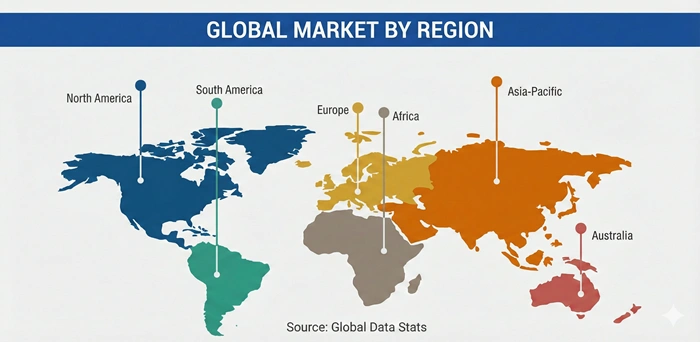
Asia-Pacific maintains commanding leadership in the global automated mining equipment market with approximately 41% share, propelled by the region's enormous coal and metal mining operations, substantial government investments in mining modernization and safety improvements, and rapidly accelerating automation adoption particularly in Australia, China, and India. Australia dominates regional consumption as the world leader in autonomous mining technology deployment with over six hundred autonomous haul trucks operating across iron ore mines in Western Australia's Pilbara region, extensive coal mine automation in Queensland and New South Wales, and pioneering autonomous drill rig implementations establishing operational best practices adopted globally. Australian mining companies including Rio Tinto, BHP, and Fortescue Metals Group lead automation investments driven by compelling safety improvements, productivity gains exceeding twenty percent, and operational cost reductions justifying continued fleet expansions. China represents enormous growth potential with the world's largest coal mining industry undergoing rapid modernization emphasizing safety improvements following historically high accident rates, with government mandates requiring advanced safety technologies and substantial subsidies supporting automation adoption across state-owned and private mining operations.
The regional automated mining equipment market exhibits projected CAGR around 8.2% through 2033 as adoption penetrates beyond pioneering Australian operations into developing markets across India, Indonesia, and Southeast Asian nations where growing mining activities and improving technology accessibility support market expansion. Major equipment manufacturers including Caterpillar, Komatsu, Hitachi, and Epiroc maintain strong regional presence through local manufacturing facilities, extensive distribution networks, and dedicated technical support organizations providing installation, training, and ongoing maintenance services. The market demonstrates unique characteristics including strong government involvement in large mining projects, emphasis on technology transfer and local capability development, and growing domestic equipment manufacturing capabilities particularly in China where companies including XCMG and Sany develop autonomous mining equipment for domestic and export markets. Mining industry labor dynamics including workforce aging in Australia and persistent safety challenges in China and India create powerful incentives for automation adoption addressing both skilled worker shortages and safety improvement imperatives. Regional market opportunities continue expanding as underground coal mine automation increases addressing particularly hazardous environments, precious metal mining operations adopt autonomous technologies improving security and operational control, and critical mineral extraction projects implement automation supporting efficient resource recovery.
Middle East and Africa
Mining Sector Expansion and Economic Diversification Strategies Fuel Rapid Growth
Middle East and Africa emerges as the fastest-growing regional market for automated mining equipment with projected CAGR exceeding 9.8% through 2033, driven by substantial mining sector investments supporting economic diversification strategies, expanding resource extraction activities across multiple commodity types, and growing adoption of advanced technologies addressing operational challenges including skilled labor shortages and harsh environmental conditions. South Africa dominates regional activity as the continent's most developed mining economy with extensive gold, platinum, diamond, and coal operations increasingly implementing automation technologies to improve safety in deep underground mines historically experiencing high accident rates and address persistent labor challenges including strikes and workforce availability issues. Saudi Arabia and UAE represent rapidly emerging markets as Gulf nations diversify economies beyond petroleum dependence through mining sector development, with substantial government investments in mining infrastructure, technology adoption, and regulatory frameworks supporting modern mining practices including automation deployment.
The regional automated mining equipment market demonstrates approximately 12.5% share of global consumption characterized by rapid growth from relatively small base as mining operations modernize and adopt international best practices. Leading international mining companies operating in the region including AngloGold Ashanti, Gold Fields, Sibanye-Stillwater, and emerging Middle Eastern mining ventures drive automation adoption through partnerships with technology providers and implementation of proven systems from other regions. The market benefits from government support programs offering financing assistance, technology grants, and regulatory incentives encouraging mining sector modernization and safety improvements. Regional mining operations face unique challenges including extreme temperatures in Middle Eastern desert environments, deep mining depths in South African operations exceeding three kilometers, and infrastructure limitations in remote African mining regions that automation technologies help address through improved operational efficiency and reduced dependence on large on-site workforces. Market opportunities continue expanding as African nations including Ghana, Tanzania, Zambia, and Democratic Republic of Congo develop substantial mineral resources, Middle Eastern countries pursue critical mineral extraction supporting manufacturing ambitions, and established South African mining sector transitions toward higher technology intensity addressing declining ore grades and increasing extraction depths.
Top Key Players
-
Caterpillar Inc (United States)
-
Komatsu Ltd (Japan)
-
Hitachi Construction Machinery Co Ltd (Japan)
-
AB Volvo (Sweden)
-
Sandvik AB (Sweden)
-
Atlas Copco AB (Sweden)
-
Hexagon AB (Sweden)
-
Trimble Inc (United States)
-
Autonomous Solutions Inc (United States)
-
Rockwell Automation Inc (United States)
-
ABB Ltd (Switzerland)
-
Liebherr Group (Germany)
-
Epiroc AB (Sweden)
-
Joy Global Inc (United States)
-
Boart Longyear Ltd (Australia)
Recent Developments
-
October 2025: Caterpillar Inc reported strong third-quarter results with sales reaching USD 17.6 billion representing a ten percent increase year-over-year, with the company's autonomous mining fleet continuing to gain traction among global mining customers driven by demonstrated productivity improvements, enhanced safety features, and compelling cost-efficiency benefits that deliver measurable return on investment for operations seeking competitive advantages.
-
September 2025: Komatsu Ltd issued the Komatsu Report 2025 outlining the company's strategic growth initiatives under new CEO Takuya Imayoshi, emphasizing continued advancement of automation technologies, expansion of equipment offerings including electric-powered mining equipment, enhancement of global sales and service distribution networks, and commitment to developing innovative solutions supporting mining customers' sustainability objectives while improving operational performance.
-
September 2024: Nature Fresh Farms launched collaboration with Koidra integrating AI-powered automation technologies to improve greenhouse operations, representing broader trend of autonomous systems and artificial intelligence adoption across industries including mining where similar technologies optimize environmental management, resource utilization, and operational monitoring delivering productivity improvements and cost reductions.
-
March 2024: Multiple industry reports highlighted that autonomous mining technology adoption continues accelerating globally with over sixty-five thousand collision avoidance system units deployed worldwide by Hexagon, demonstrating substantial market penetration of advanced safety technologies that complement fully autonomous equipment deployments and address safety concerns in mixed autonomous-conventional fleet environments during transition periods.
-
February 2024: Global mining industry analysis confirmed that approximately thirty-six percent of mining companies have implemented automation technologies representing significant increase from previous years, with industry projections indicating continued rapid adoption driven by proven safety improvements, documented productivity gains, and improving economic justification as technology costs decline while operational benefits become better understood.
Market Trends
Integration with Broader Digital Mine Ecosystems and Sustainability Initiatives
The automated mining equipment market is experiencing fundamental transformation as autonomous systems increasingly integrate with comprehensive digital mine ecosystems encompassing all operational aspects from exploration and planning through extraction, processing, and rehabilitation. Modern automated mining equipment no longer operates in isolation but functions as components within integrated operations management platforms that coordinate equipment scheduling, optimize material flows, manage maintenance activities, and provide real-time operational visibility to management teams located remotely from mine sites. Cloud-based mine management systems aggregate data from autonomous trucks, drills, loading equipment, processing facilities, and environmental monitoring stations creating unified operational pictures enabling holistic optimization identifying bottlenecks, predicting issues, and recommending interventions maximizing overall mine productivity rather than individual equipment utilization. Digital twin technologies create virtual replicas of entire mining operations enabling simulation of operational changes, testing of autonomous system programming modifications, and training of operators in risk-free virtual environments before implementing changes in actual mining operations. This ecosystem integration represents evolution from point automation solutions toward comprehensive digital transformation fundamentally changing how mining operations function.
Sustainability imperatives and environmental regulations are driving automated mining equipment market evolution toward cleaner, more efficient operations that minimize ecological footprints while maintaining or improving productivity standards. Electric and hybrid autonomous mining equipment is emerging as viable alternatives to traditional diesel-powered machinery, with manufacturers developing battery-electric haul trucks, hydrogen fuel cell drilling rigs, and hybrid loading equipment that substantially reduce greenhouse gas emissions, eliminate diesel particulate pollution, and decrease noise levels affecting surrounding communities. Autonomous systems inherently support sustainability objectives through optimized route planning reducing unnecessary travel and fuel consumption, precise material handling minimizing waste generation, and continuous operation enabling processing of lower-grade ores economically viable only through efficient automated extraction. Mining companies increasingly market sustainability credentials to investors, regulators, and communities with automation playing central roles in demonstrating environmental responsibility, meeting emissions reduction commitments, and achieving certifications including ISO environmental management standards. The automated mining equipment market benefits from growing alignment between operational efficiency objectives and environmental performance as technologies delivering productivity improvements simultaneously advance sustainability goals creating win-win value propositions.
Segments Covered in the Report
By Equipment Type:
-
Autonomous Haul Trucks
-
Ultra-Class Haul Trucks
-
Large Haul Trucks
-
Rigid Dump Trucks
-
-
Automated Drilling Rigs
-
Rotary Drills
-
Down-the-Hole Drills
-
Blast Hole Drills
-
-
Autonomous Load Haul Dump
-
Electric LHD
-
Diesel LHD
-
-
Robotic Dozing Systems
-
Others
-
Autonomous Excavators
-
Robotic Ore Sorting Systems
-
Automated Conveyor Systems
-
By Technology:
-
Semi-Autonomous
-
Driver-Assisted Systems
-
Remote-Controlled Equipment
-
Supervised Autonomous Operation
-
-
Fully Autonomous
-
Complete Autonomous Operation
-
Fleet Management Systems
-
Integrated Automation Platforms
-
By Application:
-
Surface Mining
-
Open-Pit Mining
-
Strip Mining
-
Quarrying Operations
-
-
Underground Mining
-
Room and Pillar Mining
-
Longwall Mining
-
Block Caving
-
By Region:
-
North America
-
United States
-
Canada
-
Mexico
-
-
Europe
-
United Kingdom
-
Germany
-
Sweden
-
Finland
-
Russia
-
Rest of Europe
-
-
Asia-Pacific
-
Australia
-
China
-
India
-
Japan
-
Indonesia
-
Rest of Asia-Pacific
-
-
Latin America
-
Chile
-
Peru
-
Brazil
-
Rest of Latin America
-
-
Middle East and Africa
-
South Africa
-
Saudi Arabia
-
UAE
-
Rest of Middle East and Africa
-
Frequently Asked Questions
Question 1: What is the projected size of the automated mining equipment market by 2033?
Answer: The global automated mining equipment market is expected to reach approximately USD 10.00 billion by 2033, growing from USD 4.81 billion in 2026. This substantial expansion reflects accelerating adoption of autonomous mining technologies driven by compelling safety improvements, demonstrated productivity gains, and improving economic justification as implementation costs decline while operational benefits become better documented.
Question 2: Which region currently dominates the automated mining equipment market?
Answer: Asia-Pacific leads the global automated mining equipment market with approximately 41% market share, driven by massive coal and metal mining operations particularly in Australia, China, and India. Australia dominates regional consumption as the world leader in autonomous mining technology deployment with over six hundred autonomous haul trucks operating across iron ore and coal mines.
Question 3: What are the primary drivers of automated mining equipment market growth?
Answer: The automated mining equipment market growth is primarily driven by imperative to improve mining safety and eliminate workplace fatalities, acute skilled labor shortages affecting mining operations globally, compelling productivity improvements documented at automated operations, and improving economic justification as technology costs decline. Regulatory requirements mandating enhanced safety measures and corporate responsibility commitments further accelerate adoption.
Question 4: Which equipment type holds the largest share in the automated mining equipment market?
Answer: Autonomous haul trucks represent the dominant equipment segment accounting for approximately 38.6% of the global automated mining equipment market. This leadership reflects substantial capital value of these massive vehicles, extensive proven track records demonstrating operational benefits, and strategic importance in surface mining operations where material transportation represents critical production processes.
Question 5: What is the expected CAGR for the automated mining equipment market from 2026 to 2033?
Answer: The automated mining equipment market is projected to grow at a CAGR of 8.55% from 2026 to 2033. This robust growth rate reflects sustained expansion driven by technology maturation enabling broader adoption, expanding applications into underground mining operations, growing adoption in developing mining regions, and increasing recognition that automation represents essential technology for competitive mining operations addressing safety, productivity, and sustainability imperatives.