
API Management Market Overview
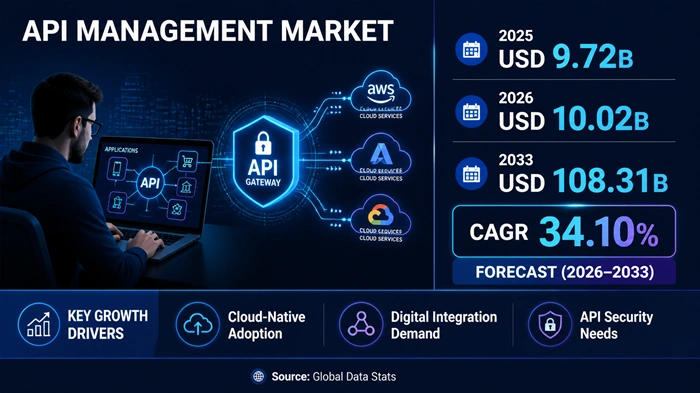
The global API management market size is valued at USD 9.72 billion in 2025 and is predicted to increase from USD 10.02 billion in 2026 to approximately USD 108.31 billion by 2033, growing at a CAGR of 34.10% from 2026 to 2033.
This remarkable surge reflects the accelerating digital transformation across industries as organizations increasingly rely on application programming interfaces to connect applications, enable seamless data exchange, and build robust digital ecosystems that support innovative business models. The API management market encompasses comprehensive platforms and solutions that help enterprises design, publish, secure, monitor, and analyze APIs throughout their entire lifecycle while ensuring optimal performance, compliance, and developer experience.
Modern businesses recognize APIs as critical infrastructure enabling cloud migration, microservices architectures, mobile application development, and integration of third-party services that collectively drive competitive advantage in digital-first economies. The API management market benefits from widespread adoption of cloud-native technologies, proliferation of mobile and web applications, surge in IoT device connectivity, and strategic shift toward open banking, healthcare interoperability, and partner ecosystem development. Organizations across banking, financial services, insurance, retail, healthcare, telecommunications, and government sectors deploy API management solutions to monetize data assets, accelerate innovation cycles, improve operational efficiency, and deliver superior customer experiences through seamless omnichannel engagement powered by secure and scalable API infrastructure.
AI Impact on the API Management Industry
Intelligent Automation Transforms Lifecycle Management and Security Operations
Artificial intelligence fundamentally reshapes the API management market by introducing intelligent capabilities that automate policy generation, detect anomalies in real-time, optimize performance dynamically, and enhance security posture through predictive threat identification and automated response mechanisms. AI-powered features including natural language processing for API documentation, machine learning algorithms for traffic pattern analysis, cognitive analytics for usage insights, and automated testing frameworks dramatically reduce manual overhead while improving accuracy and operational efficiency. The API management market witnesses accelerated AI adoption with leading platforms integrating capabilities such as auto-classification of API specifications, intelligent routing based on workload patterns, predictive scaling to anticipate demand fluctuations, and behavioral analytics that identify unusual access patterns indicating potential security breaches before they escalate into major incidents.
Organizations leveraging AI-enhanced API management solutions experience substantial operational improvements including 40-60% reduction in time required for API development and deployment, enhanced security through automated threat detection that identifies vulnerabilities missed by traditional rule-based systems, and superior developer experiences through intelligent recommendations and automated documentation generation. The API management market benefits from generative AI applications that create API specifications from natural language descriptions, generate code samples automatically for multiple programming languages, and produce comprehensive documentation that accelerates developer onboarding and reduces support burden. Leading vendors including Google Cloud with Apigee, Microsoft Azure API Management, AWS API Gateway, and IBM API Connect invest heavily in AI research and development to differentiate offerings through advanced analytics, automated governance enforcement, and intelligent monetization features that position API management as strategic enabler rather than simple infrastructure layer.
Growth Factors
Digital Transformation and Cloud Adoption Drive Explosive Market Expansion
The API management market experiences exceptional growth driven by enterprise-wide digital transformation initiatives that fundamentally restructure IT architectures around microservices, containerization, and cloud-native development patterns requiring sophisticated API infrastructure for seamless service orchestration and integration. Organizations migrating legacy monolithic applications to modern distributed systems depend on robust API management platforms to handle complex routing, security enforcement, traffic management, and monitoring across hybrid and multi-cloud environments. This architectural evolution creates organic demand for comprehensive API lifecycle management capabilities that extend beyond basic gateway functionality to encompass design governance, developer portals, analytics dashboards, and monetization frameworks. The API management market capitalizes on widespread cloud adoption with approximately 79% of deployments utilizing cloud-based platforms that offer elastic scalability, reduced infrastructure overhead, and rapid deployment compared to traditional on-premises installations.
The explosion of mobile and web applications combined with proliferation of Internet of Things devices generates unprecedented API traffic volumes requiring specialized management infrastructure to ensure consistent performance, security, and reliability at scale. Modern applications average 50-200 API calls per user session with high-traffic platforms processing billions of requests daily, creating technical demands that manual management approaches cannot satisfy. The API management market benefits from regulatory mandates including open banking directives, healthcare interoperability requirements, and data protection frameworks such as GDPR and CCPA that necessitate rigorous API governance, security controls, and audit capabilities. Industry-specific drivers include financial services pursuing API-based ecosystem strategies for embedded finance and partner integration, healthcare organizations implementing FHIR-compliant APIs for patient data exchange, retail enterprises enabling omnichannel commerce through mobile and IoT connectivity, and telecommunications providers monetizing 5G network capabilities through API exposure to third-party developers and enterprise customers.
Market Outlook
Sustained High-Growth Trajectory Supported by Technology Innovation and Market Maturation
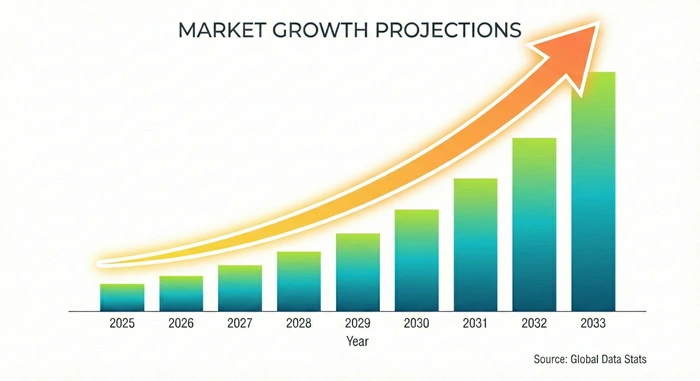
The API management market outlook remains exceptionally bullish through 2033 as multiple converging trends including AI integration, microservices adoption, hybrid cloud proliferation, and API-first development methodologies collectively sustain double-digit expansion across geographic regions and industry verticals. North America maintains dominant market leadership accounting for approximately 42% revenue share driven by concentration of technology companies, early adoption of cloud-native architectures, and mature digital transformation programs across Fortune 500 enterprises. The API management market witnesses intensifying competition as hyperscale cloud providers leverage integrated platform advantages, independent software vendors emphasize specialized capabilities, and open-source alternatives gain traction among developer communities seeking cost-effective solutions with extensive customization flexibility.
Asia Pacific emerges as the fastest-growing regional market with CAGR exceeding 36% as the region experiences rapid digital adoption, expanding technology workforce, government initiatives promoting smart city development, and aggressive cloud investment by regional hyperscalers. The API management market transformation toward hybrid deployment models reflects enterprise requirements balancing cloud scalability with on-premises data sovereignty, regulatory compliance, and legacy system integration constraints. Market maturation drives consolidation through strategic acquisitions as major technology vendors expand capabilities, vertical specialization intensifies particularly in highly regulated industries, and platform convergence integrates API management with adjacent functions including service mesh, event streaming, and API security to deliver comprehensive solutions addressing complete integration requirements. The API management market evolution toward outcome-based pricing models, consumption-based billing structures, and developer-centric experiences positions the industry for sustained expansion as APIs become foundational infrastructure enabling digital business innovation and competitive differentiation across all economic sectors.
Expert Speaks
-
Sundar Pichai, CEO of Alphabet, highlighted during Q3 2025 earnings that Google's Gemini models process 7 billion tokens per minute through direct API usage by customers, demonstrating the massive scale and strategic importance of API infrastructure in delivering AI capabilities to enterprises globally.
-
Satya Nadella, CEO of Microsoft, emphasized during Q3 2025 earnings that Microsoft's planet-scale cloud and AI infrastructure combined with domain-specific Copilots drives broad technology diffusion, with continued aggressive investment in both capital and talent to capture the substantial opportunity in API-enabled AI services.
-
Andy Jassy, CEO of Amazon Web Services, announced plans to invest over 100 billion dollars in 2025 primarily in AI infrastructure including data centers, processors, and networking gear that support API Gateway and related services, reflecting extraordinary demand signals for scalable API management capabilities.
Key Report Takeaways
-
North America dominates the API management market with approximately 42% revenue share driven by concentration of major technology companies, advanced digital infrastructure, early cloud adoption, and robust demand from BFSI, healthcare, and retail sectors requiring enterprise-grade API governance and security capabilities.
-
Asia Pacific represents the fastest-growing region with exceptional CAGR of 36.20% from 2026 to 2033, fueled by rapid digital transformation, expanding developer communities, government smart city initiatives, increasing mobile penetration, and aggressive cloud infrastructure investments by regional and global hyperscalers.
-
Cloud-based deployment models dominate with approximately 79.55% market share in 2025, driven by scalability advantages, reduced infrastructure costs averaging 40% savings versus on-premises, faster deployment timelines, and seamless integration with cloud-native application architectures and DevOps workflows.
-
Hybrid deployment architectures emerge as fastest-growing segment with projected CAGR of 21.10% through 2033, addressing enterprise requirements for balancing public cloud elasticity with on-premises data residency, regulatory compliance, sensitive workload control, and legacy system integration in distributed environments.
-
Services segment demonstrates exceptional growth with CAGR of 26.70% as enterprises outsource complex API architecture design, policy configuration, security implementation, and ongoing operations due to internal skill shortages in specialized areas including GraphQL optimization, distributed tracing, and AI-powered policy generation.
-
BFSI sector leads vertical adoption with largest industry share driven by open banking mandates, embedded finance strategies, regulatory compliance requirements, partner ecosystem development, and digital banking transformation initiatives requiring sophisticated API management, monetization, and security capabilities for external developer engagement.
Market Scope
| Report Coverage | Details |
|---|---|
| Market Size by 2033 | USD 108.31 Billion |
| Market Size by 2025 | USD 9.72 Billion |
| Market Size by 2026 | USD 10.02 Billion |
| Market Growth Rate from 2026 to 2033 | CAGR of 34.10% |
| Dominating Region | North America |
| Fastest Growing Region | Asia Pacific |
| Base Year | 2025 |
| Forecast Period | 2026 to 2033 |
| Segments Covered | Component, Deployment Model, Organization Size, Platform, Vertical |
| Regions Covered | North America, Europe, Asia Pacific, Latin America, Middle East & Africa |
Market Dynamics
Drivers Impact Analysis
Cloud-Native Transformation and Microservices Adoption Accelerate Infrastructure Demand
| Impact Factor | (≈) % Impact on CAGR Forecast | Geographic Relevance | Impact Timeline |
|---|---|---|---|
| Cloud-Native Digital Transformation | 4.2% | Global (North America and Europe Lead) | 2026-2033 |
| Mobile and Web Application Proliferation | 3.8% | Asia Pacific Core with Global Spillover | 2026-2030 |
| Multi-Cloud and Hybrid IT Investments | 3.5% | North America, Europe | 2026-2033 |
| Microservices Architecture Adoption | 3.2% | Global (Technology Sector Led) | 2026-2033 |
| Regulatory Compliance Requirements | 2.6% | Europe, North America | 2026-2033 |
| IoT Device Connectivity Expansion | 2.3% | Asia Pacific, North America | 2027-2033 |
The API management market derives substantial momentum from widespread cloud-native digital transformation initiatives that fundamentally restructure application architectures around containerized microservices requiring sophisticated API infrastructure for service discovery, traffic routing, security enforcement, and observability across distributed systems. Organizations transitioning from monolithic legacy applications to modern cloud-native patterns depend entirely on robust API management platforms to orchestrate complex service interactions, implement consistent security policies, and maintain operational visibility across hundreds or thousands of microservices deployed dynamically. This architectural evolution creates technical requirements that traditional integration approaches cannot satisfy, driving adoption of advanced API gateways, service meshes, and comprehensive management platforms. The API management market benefits as enterprises recognize APIs as foundational infrastructure rather than tactical integration layer, elevating investment priority and expanding solution scope beyond basic gateway functionality.
Mobile and web application proliferation generates exponential API traffic growth with modern applications heavily dependent on backend APIs for data retrieval, business logic execution, and third-party service integration. The API management market experiences surge in demand as organizations deploy consumer-facing applications that must handle millions of concurrent users, maintain sub-second response times, and provide consistent experiences across diverse devices and network conditions. AI-enhanced features including real-time transcription, on-device vision processing, and personalized recommendations dramatically increase payload sizes and API call frequencies, creating infrastructure demands that reinforce requirements for dynamic quota management, intelligent caching, and predictive scaling capabilities. Multi-cloud and hybrid IT investments by Fortune 500 organizations create architectural complexity where API management becomes essential coordination layer ensuring consistent security, governance, and monitoring across heterogeneous infrastructure spanning multiple hyperscalers and on-premises data centers. Regulatory mandates including open banking directives requiring standardized API interfaces for financial data sharing, healthcare interoperability regulations mandating FHIR-compliant APIs, and data protection frameworks necessitating rigorous access controls and audit trails create compliance-driven demand for enterprise-grade API management solutions with comprehensive governance and security capabilities.
Restraints Impact Analysis
Implementation Complexity and Security Concerns Challenge Adoption Momentum
| Impact Factor | (≈) % Impact on CAGR Forecast | Geographic Relevance | Impact Timeline |
|---|---|---|---|
| High Implementation and Infrastructure Costs | -2.4% | Emerging Markets, SME Segment | 2026-2033 |
| Data Security and Privacy Concerns | -2.1% | Global (Europe Particularly Sensitive) | 2026-2033 |
| Technical Complexity and Skills Shortage | -1.8% | All Regions | 2026-2033 |
| Legacy System Integration Challenges | -1.5% | Enterprises with Established IT | 2026-2030 |
| API Governance and Documentation Overhead | -1.2% | All Organization Sizes | 2026-2033 |
High implementation costs represent significant barriers for the API management market particularly among small and medium enterprises with limited IT budgets and resource constraints that struggle to justify substantial upfront investments in comprehensive platforms. Organizations face expenses including platform licensing fees, cloud infrastructure consumption charges, professional services for architecture design and implementation, ongoing operational costs for monitoring and maintenance, and training expenditures to develop internal expertise. The API management market encounters resistance as total cost of ownership calculations reveal multi-year investments required for successful deployments, especially when considering integration complexity with existing systems, customization requirements for specific business processes, and ongoing upgrade cycles to maintain current functionality and security patches.
Data security and privacy concerns create substantial hesitation around API deployments as organizations recognize that APIs represent potential attack vectors exposing sensitive business logic and data assets to unauthorized access if improperly configured or inadequately protected. The API management market must address escalating threat landscape with API attacks growing 400% according to recent industry analysis, driven by automated scanning tools, credential stuffing attacks, and sophisticated exploitation of business logic vulnerabilities. Regulatory compliance requirements including GDPR, CCPA, HIPAA, and PCI DSS create complex obligations for data protection, audit logging, and breach notification that many organizations struggle to implement correctly across distributed API ecosystems. Technical complexity and skills shortage constrain the API management market as enterprises encounter difficulties recruiting and retaining qualified personnel with specialized expertise in API architecture, security protocols, performance optimization, and emerging technologies such as GraphQL, gRPC, and event-driven patterns. Legacy system integration challenges create implementation friction as organizations attempt to expose decades-old mainframe applications and proprietary systems through modern API interfaces, requiring substantial transformation work, careful performance tuning, and extensive testing to ensure reliability and security standards. API governance and documentation overhead burdens development teams with maintaining accurate specifications, ensuring consistent design patterns, managing version compatibility, and providing comprehensive developer resources that require sustained effort often deprioritized under delivery pressure.
Opportunities Impact Analysis
Emerging Technologies and Vertical Specialization Create Expansion Pathways
| Impact Factor | (≈) % Impact on CAGR Forecast | Geographic Relevance | Impact Timeline |
|---|---|---|---|
| AI and Machine Learning Integration | 3.9% | Global (Technology Hubs Lead) | 2026-2033 |
| API Monetization and Ecosystem Development | 3.2% | North America, Europe | 2026-2033 |
| Industry-Specific Vertical Solutions | 2.7% | All Regions | 2027-2033 |
| 5G Network API Exposure | 2.3% | Asia Pacific, North America | 2027-2033 |
| Open Banking and Embedded Finance | 2.1% | Europe, North America | 2026-2033 |
| API Security Specialized Solutions | 1.9% | Global | 2026-2033 |
The API management market stands to gain substantially from AI and machine learning integration that enables intelligent automation across the entire API lifecycle including design recommendations based on usage patterns, automated policy generation from natural language requirements, predictive scaling that anticipates traffic fluctuations, and advanced threat detection identifying anomalous behavior patterns indicating security incidents. Generative AI applications create entirely new service categories including automated API specification generation from application code, intelligent documentation creation that maintains consistency and completeness, and code generation producing client libraries across multiple programming languages that accelerate developer adoption. The API management market benefits from AI-powered analytics providing actionable insights into API performance bottlenecks, usage trends informing product strategy, and recommendation engines suggesting optimization opportunities that improve efficiency and reduce costs.
API monetization and ecosystem development represents substantial untapped opportunity as organizations transition from viewing APIs as internal infrastructure to recognizing external revenue potential through direct API product sales, developer platform fees, and revenue-sharing partnerships enabled by sophisticated billing engines and marketplace platforms. The API management market expansion into monetization capabilities enables entirely new business models including API-as-a-product strategies, embedded finance offerings, data-as-a-service platforms, and partner ecosystem development that create network effects and competitive moats. Industry-specific vertical solutions create differentiation opportunities as vendors develop deep domain expertise and pre-built integrations for sectors including healthcare with FHIR compliance and EHR connectivity, financial services with open banking standards and payment gateway integration, retail with omnichannel commerce and inventory management APIs, and telecommunications with 5G network slicing and edge computing exposure. The API management market benefits from 5G network deployment creating opportunities for telecommunications providers to monetize network capabilities through API exposure enabling ultra-low-latency applications, edge computing integration, and network slicing for specialized use cases. Open banking mandates and embedded finance trends drive substantial demand for API management solutions with specialized capabilities including regulatory compliance frameworks, consent management, strong customer authentication, and partner onboarding workflows tailored to financial services requirements. API security specialized solutions address escalating threat landscape through dedicated capabilities including API-specific web application firewalls, zero-trust architecture implementation, automated vulnerability scanning, and runtime protection that complements general API management platforms or integrates as specialized security layer for high-risk deployments.
Segment Analysis
By Deployment Model
Cloud Platforms Dominate with Hybrid Architectures Demonstrating Fastest Growth Trajectory
Cloud-based deployment maintains dominant position with approximately 79.55% market share in 2025, driven by compelling advantages including elastic scalability enabling dynamic capacity adjustment based on demand fluctuations, reduced infrastructure investment eliminating substantial upfront capital expenditure, faster deployment timelines averaging weeks versus months for on-premises installations, and seamless integration with cloud-native application architectures. Organizations adopting cloud-based API management solutions report average infrastructure cost reductions of 40% compared to on-premises alternatives while simultaneously achieving 30% faster API deployment cycles through automated provisioning and integrated DevOps workflows. The API management market witnesses cloud dominance across small and medium enterprises that lack resources for substantial infrastructure investment and large enterprises pursuing multi-cloud strategies requiring consistent API management capabilities across AWS, Microsoft Azure, and Google Cloud Platform environments.
Hybrid deployment architectures emerge as the fastest-growing segment with exceptional CAGR of 21.10% through 2033, addressing enterprise requirements for balancing public cloud scalability advantages with on-premises data residency mandates, regulatory compliance constraints, sensitive workload control, and legacy system integration necessities in distributed heterogeneous environments. The API management market benefits from hybrid model adoption particularly among financial services institutions subject to stringent data sovereignty regulations, healthcare organizations managing protected health information requiring on-premises storage, and government agencies with security clearance requirements preventing full cloud migration. Leading platforms including Microsoft Azure API Management with Arc-enabled gateways, Google Apigee Hybrid, and AWS Outposts enable containerized gateway deployment in customer-controlled infrastructure while maintaining centralized policy orchestration, analytics aggregation, and unified management experience. Regional patterns show strongest hybrid growth in Europe and North America where privacy regulations, established on-premises infrastructure investments, and risk-averse organizational cultures create preference for graduated cloud adoption strategies. Key vendors serving this segment include Microsoft (United States), Google Cloud (United States), IBM (United States), and Red Hat (United States) offering comprehensive hybrid capabilities with strong enterprise support and integration with existing technology investments.
By Component
Platform Solutions Dominate While Services Segment Demonstrates Exceptional Growth Momentum
Platform and solution components capture dominant market share at approximately 61.35% of 2025 revenue, encompassing comprehensive software suites providing core API management capabilities including gateway functionality, developer portal infrastructure, analytics dashboards, security policy enforcement, traffic management, and lifecycle governance tools. Organizations prioritize platform investments to establish foundational infrastructure supporting digital transformation initiatives, with selection criteria emphasizing scalability, security robustness, integration breadth, performance characteristics, and total cost of ownership considerations. The API management market witnesses platform competition intensifying as hyperscale cloud providers leverage integrated advantages with adjacent cloud services creating pull-through demand, while independent software vendors emphasize specialized capabilities, multi-cloud portability, and superior developer experiences differentiating against bundled alternatives.
Services segment demonstrates exceptional growth with CAGR of 26.70% through 2033 as enterprises increasingly outsource complex API architecture design, implementation, ongoing operations, and optimization to specialized providers due to internal skill shortages and strategic focus on core business competencies rather than infrastructure management. The API management market benefits from rising services demand across consulting for API strategy development and governance framework design, professional services for platform implementation and integration with existing systems, managed services for 24x7 operations and performance optimization, and training programs addressing skills gaps in API security, GraphQL optimization, distributed tracing, and AI-powered policy generation. Services acceleration reflects increasing API management complexity as organizations deploy sophisticated architectures requiring specialized expertise in areas including multi-cloud orchestration, service mesh integration, API monetization platform configuration, and advanced security implementations. Regional distribution shows North America and Europe leading services adoption with mature outsourcing markets and consultant ecosystems, while Asia Pacific demonstrates rapid growth as regional system integrators and global service providers expand delivery capabilities. Leading services providers include Accenture (Ireland/United States), Deloitte (United States), Capgemini (France), Cognizant (United States), and Wipro (India) combining domain expertise with technical capabilities and global delivery infrastructure serving multinational enterprises with complex requirements.
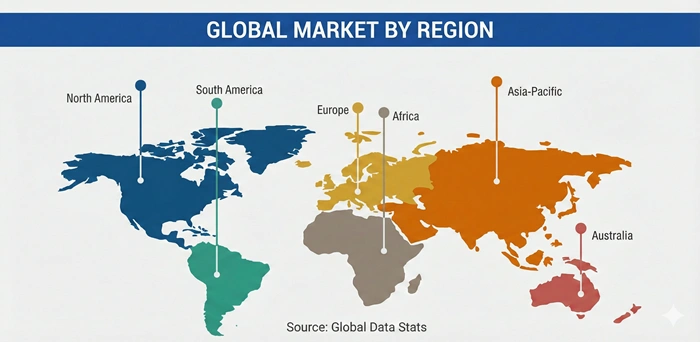
Regional Insights
North America
Market Leadership Through Technology Innovation and Early Adoption Advantages
North America maintains commanding API management market leadership with approximately 42% revenue share driven by concentration of major technology companies headquartered in the region, advanced digital infrastructure supporting sophisticated cloud-native architectures, early adoption of microservices and containerization patterns, and substantial API traffic volumes from digital-first enterprises across financial services, healthcare, retail, and technology sectors. The regional market benefits from mature venture capital ecosystem funding API-focused startups, robust developer communities contributing to open-source initiatives, and corporate cultures emphasizing innovation and calculated risk-taking that accelerate new technology adoption. Organizations in North America demonstrate willingness to invest substantially in comprehensive API management platforms recognizing strategic value beyond simple cost reduction, creating larger average contract values and broader deployment scopes compared to other regions.
The API management market in North America demonstrates robust CAGR of approximately 33.50% from 2026 to 2033 as continued digital transformation across traditional industries, expansion of API monetization strategies, and hybrid cloud adoption sustain demand growth despite market maturity in some segments. Leading companies dominating the regional landscape include Amazon Web Services (United States) maintaining premier positioning through ubiquitous AWS adoption and API Gateway integration with broader cloud platform, Microsoft (United States) leveraging Azure ecosystem advantages and enterprise customer relationships, Google Cloud (United States) differentiating through Apigee platform with advanced AI capabilities and developer-friendly features, IBM (United States) serving large enterprises with hybrid deployment requirements, and MuleSoft/Salesforce (United States) combining API management with comprehensive integration platform. The regional market also features innovative challengers including Kong (United States) with open-source heritage and cloud-native architecture, Postman (United States) expanding from API development tools into management capabilities, and numerous specialized vendors targeting vertical segments or specific use cases with differentiated functionality.
Asia Pacific
Fastest Regional Growth Powered by Digital Adoption and Infrastructure Investment
Asia Pacific emerges as the fastest-growing regional API management market with exceptional CAGR of 36.20% from 2026 to 2033, driven by rapid digital transformation across emerging economies, expanding technology workforce with strong engineering capabilities, aggressive cloud infrastructure investment by regional and global hyperscalers, government initiatives promoting smart city development and digital economy growth, and increasing mobile penetration creating API-driven application demand. The regional market benefits from large developer populations in India, China, Southeast Asia, and Australia combined with lower cost structures enabling competitive pricing for both platform deployments and professional services. Organizations in Asia Pacific demonstrate high receptivity to cloud-based deployment models with less legacy infrastructure constraints compared to established Western enterprises, accelerating adoption of modern API management platforms and architectural patterns.
The API management market in Asia Pacific represents approximately 28% regional share with substantial growth potential as digital maturity increases across diverse economies at varying development stages. Regional market leaders include Alibaba Cloud (China) serving Chinese market with localized platform and domestic data residency, Tencent Cloud (China) leveraging WeChat ecosystem and gaming industry relationships, Amazon Web Services (United States with extensive regional infrastructure) maintaining strong presence through global enterprise accounts and startup adoption, Microsoft Azure (United States with regional data centers) capturing enterprise customers with existing Microsoft relationships, and Google Cloud (United States with regional expansion) targeting developer communities and modern cloud-native organizations. Market dynamics include rising competition from regional players including NTT Data (Japan), Infosys (India), Tata Consultancy Services (India), and DXC Technology (United States with significant Asia operations) providing services and implementation support. The regional market faces challenges including fragmented regulatory environments, varying data sovereignty requirements, diverse language and cultural considerations, and infrastructure maturity differences requiring flexible go-to-market strategies and localized platform capabilities to address specific market needs effectively.
Top Key Players
-
Amazon Web Services Inc. (United States)
-
Microsoft Corporation (United States)
-
Google Cloud (Alphabet Inc.) (United States)
-
IBM Corporation (United States)
-
Oracle Corporation (United States)
-
MuleSoft (Salesforce) (United States)
-
Red Hat Inc. (United States)
-
TIBCO Software Inc. (United States)
-
SAP SE (Germany)
-
Kong Inc. (United States)
-
Axway Software (France)
-
Software AG (Germany)
-
Broadcom Inc. (United States)
-
Postman Inc. (United States)
-
WSO2 (United States)
Recent Developments
-
Microsoft Azure (2025): Expanded API Management capabilities through Arc 2.0 enabling seamless hybrid cloud deployment with containerized gateways running anywhere while maintaining centralized policy orchestration, introduced enhanced AI-powered threat detection and automated policy generation, and deepened integration with Azure ecosystem including GitHub, Microsoft 365, and Dynamics for enterprise workflow connectivity.
-
Google Cloud (2025): Enhanced Apigee platform with advanced AI-based insights including auto-classification of API specifications, real-time traffic optimization, and intelligent developer recommendations, expanded multi-cloud support enabling consistent API management across Google Cloud Platform, AWS, and Azure environments, and achieved 7 billion tokens per minute processing through Gemini model API access demonstrating massive scale capabilities.
-
Amazon Web Services (2025): Announced over 100 billion dollar investment in AI infrastructure primarily supporting API Gateway, EventBridge, and related services addressing extraordinary demand signals, introduced enhanced integration between API Gateway and AWS Lambda for serverless architectures, and expanded regional presence with additional edge locations improving latency for globally distributed API deployments.
-
IBM (2024-2025): Strengthened API Connect platform with enhanced hybrid deployment capabilities supporting Red Hat OpenShift containers, introduced AI-powered API lifecycle automation reducing manual configuration overhead, and expanded industry-specific solutions particularly for financial services and healthcare with pre-built compliance frameworks and regulatory templates.
-
Kong (2024-2025): Released Kong Gateway 3.0 with enhanced service mesh capabilities, improved Kubernetes-native deployment models, and expanded plugin ecosystem supporting specialized use cases, completed significant funding rounds totaling over 175 million dollars supporting product development and market expansion, and grew customer base substantially particularly among cloud-native organizations and developer-focused enterprises.
Market Trends
Convergence with Adjacent Technologies and Platform Consolidation Reshape Competitive Landscape
The API management market experiences fundamental transformation as standalone gateway functionality evolves toward comprehensive integration platforms converging API management with service mesh infrastructure, event streaming capabilities, API security specialized functions, and developer experience tools creating unified solutions addressing complete application connectivity requirements. Leading vendors pursue platform consolidation strategies through organic development and strategic acquisitions, bundling API management with adjacent capabilities to increase customer value, reduce vendor proliferation, and capture larger wallet share within enterprise technology stacks. This convergence reflects customer preferences for integrated platforms over best-of-breed point solutions, driven by desires to reduce operational complexity, minimize integration overhead, standardize on fewer vendor relationships, and achieve better total cost of ownership through bundled pricing and simplified procurement processes.
Platform-native advantages intensify competitive dynamics as hyperscale cloud providers leverage deep integration with core infrastructure services creating seamless developer experiences and natural adoption paths for organizations already committed to specific cloud platforms. The API management market witnesses strategic battles where AWS embeds API Gateway ubiquitously across serverless and container services, Microsoft integrates API Management deeply with Azure ecosystem and developer tools, and Google differentiates Apigee through advanced AI capabilities and multi-cloud positioning. Open-source alternatives gain substantial traction particularly among developer communities and cloud-native organizations, with projects including Kong, Tyk, and KrakenD offering extensive customization flexibility, community-driven innovation, and cost advantages attracting price-sensitive segments and organizations preferring avoid vendor lock-in. Market maturation drives vertical specialization as vendors develop industry-specific solutions with pre-built integrations, compliance frameworks, and domain expertise particularly valuable in highly regulated sectors including financial services, healthcare, and government where generic platforms require substantial customization. The API management market evolution toward consumption-based pricing, developer-centric experiences, and outcome-focused metrics positions industry for continued expansion as APIs become foundational infrastructure enabling digital innovation across all economic sectors.
Segments Covered in the Report
By Component:
-
Solutions/Platform
-
Services (Professional Services, Managed Services)
By Deployment Model:
-
Cloud-Based
-
On-Premises
-
Hybrid
By Organization Size:
-
Large Enterprises
-
Small and Medium Enterprises (SMEs)
By Platform:
-
API Gateway
-
API Portal
-
API Security
-
API Analytics and Monitoring
-
API Lifecycle Management
-
Other Platforms
By Vertical:
-
Banking, Financial Services, and Insurance (BFSI)
-
Healthcare and Life Sciences
-
Retail and E-commerce
-
IT and Telecommunications
-
Government and Public Sector
-
Manufacturing
-
Media and Entertainment
-
Other Verticals
By Region:
-
North America (United States, Canada, Mexico)
-
Europe (United Kingdom, Germany, France, Italy, Spain, Rest of Europe)
-
Asia Pacific (China, India, Japan, Australia, South Korea, Singapore, Rest of Asia Pacific)
-
Latin America (Brazil, Argentina, Rest of Latin America)
-
Middle East & Africa (UAE, Saudi Arabia, South Africa, Rest of MEA)
Frequently Asked Questions
Question 1: What is the API management market size and growth forecast?
Answer: The global API management market is valued at USD 9.72 billion in 2025 and projected to reach USD 108.31 billion by 2033, growing at a CAGR of 34.10% from 2026 to 2033. This exceptional growth reflects accelerating digital transformation and cloud-native architecture adoption across industries worldwide.
Question 2: Which region dominates the API management market currently?
Answer: North America leads the API management market with approximately 42% revenue share driven by technology company concentration and digital infrastructure maturity. Asia Pacific represents the fastest-growing region with 36.20% CAGR fueled by rapid digital transformation and substantial cloud investments.
Question 3: What are the key drivers of API management market growth?
Answer: Primary drivers include cloud-native digital transformation, mobile and web application proliferation requiring API infrastructure, microservices architecture adoption, multi-cloud investments, and regulatory compliance mandates. Organizations increasingly recognize APIs as strategic infrastructure enabling innovation and competitive differentiation.
Question 4: Which deployment model leads API management market adoption?
Answer: Cloud-based deployment dominates with 79.55% market share driven by scalability advantages and cost reductions averaging 40% versus on-premises. Hybrid architectures represent the fastest-growing segment at 21.10% CAGR addressing data sovereignty and regulatory compliance requirements.
Question 5: How is AI technology impacting the API management market?
Answer: AI fundamentally reshapes the API management market through intelligent automation of policy generation, real-time anomaly detection, predictive scaling, and automated threat identification. Organizations leveraging AI-enhanced solutions experience 40-60% reduction in development time and superior security through behavioral analytics.