
Anti-Drone Market Overview
The global anti-drone market size is valued at USD 2.88 billion in 2025 and is predicted to increase from USD 3.44 billion in 2026 to approximately USD 17.31 billion by 2033, growing at a CAGR of 25.80% from 2026 to 2033.
The anti-drone market represents a critical security technology segment that encompasses sophisticated detection, tracking, identification, and mitigation systems designed to protect critical infrastructure, military installations, airports, public events, and sensitive government facilities from unauthorized unmanned aerial vehicle intrusions. These advanced counter-drone solutions integrate multiple technologies including radar systems, radio frequency scanners, electro-optical sensors, infrared cameras, and various neutralization methods ranging from signal jamming to kinetic interception, delivering comprehensive airspace protection against evolving drone threats. The market's exceptional growth trajectory reflects escalating security concerns from malicious drone activities, increasing defense modernization investments, rapid proliferation of commercial and recreational drones, and technological advancements incorporating artificial intelligence and machine learning for enhanced threat detection capabilities.
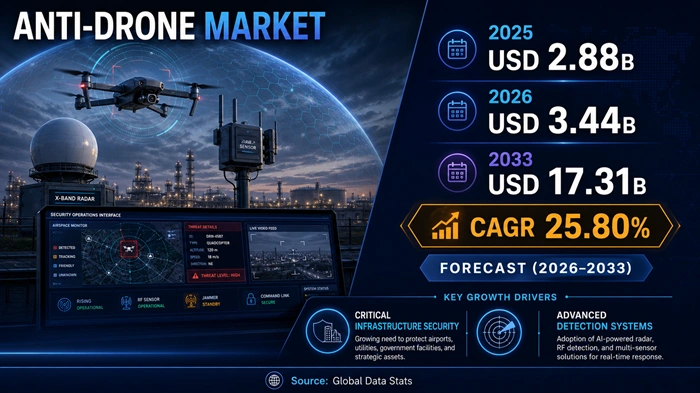
Safeguarding Critical Airspace Through Advanced Detection and Neutralization Technologies
Organizations across defense, homeland security, commercial, and government sectors are recognizing that the democratization of drone technology has created unprecedented security vulnerabilities requiring robust countermeasures. The accessibility and affordability of consumer drones combined with their increasing sophistication have enabled threat actors to conduct surveillance, smuggling, espionage, and even potential attacks on protected locations. Anti-drone systems provide essential defensive capabilities that enable security forces to detect hostile unmanned aerial vehicles at safe distances, accurately classify threats to minimize false alarms, and deploy appropriate countermeasures that neutralize dangers while complying with regulatory frameworks governing airspace management and electromagnetic spectrum usage.
AI Impact on the Anti-Drone Industry
Revolutionizing Threat Detection Through Intelligent Pattern Recognition and Autonomous Response Systems
Artificial intelligence is transforming the anti-drone market by introducing unprecedented capabilities for distinguishing legitimate aerial vehicles from genuine threats while dramatically reducing false positive rates that previously plagued detection systems. Machine learning algorithms trained on vast datasets of drone flight patterns, radio frequency signatures, and visual characteristics can instantly differentiate between birds, authorized aircraft, recreational drones, and potentially hostile unmanned systems with accuracy levels impossible for human operators to achieve manually. These AI-powered platforms continuously learn from new encounters, adapting their classification models to recognize emerging drone types and evolving evasion tactics that adversaries employ to bypass security measures. Leading anti-drone manufacturers are deploying neural networks that analyze multiple sensor inputs simultaneously, fusing radar tracking data with radio frequency signals and optical imagery to create comprehensive threat profiles that enable confident identification decisions within seconds of initial detection. This intelligent fusion approach eliminates the ambiguity that single-sensor systems experience when environmental conditions degrade individual sensor performance.
The integration of artificial intelligence extends beyond detection to encompass autonomous response orchestration that coordinates multiple countermeasure assets without requiring continuous human intervention. Advanced AI systems evaluate incoming threat characteristics including approach vector, speed, altitude, and payload capacity to automatically recommend optimal mitigation strategies from available options including radio frequency jamming, GPS spoofing, net capture, or kinetic interception. These intelligent command and control platforms can manage simultaneous engagements against drone swarms, prioritizing threats based on proximity to protected assets and estimated time to impact while allocating countermeasure resources efficiently across multiple attack vectors. Natural language processing enables operators to interact with anti-drone systems through conversational interfaces, querying threat status or issuing engagement authorization commands using plain language rather than complex technical protocols. Computer vision algorithms are enhancing optical sensor performance through automated tracking that maintains visual contact with small, fast-moving targets even in cluttered urban environments where buildings and foliage create challenging backgrounds. This comprehensive application of AI throughout the anti-drone market is creating force-multiplier effects that enable small security teams to protect large areas against sophisticated coordinated drone attacks.
Growth Factors
Rising Unauthorized Drone Incidents and Defense Modernization Driving Market Expansion
The dramatic increase in unauthorized drone sightings near airports, military bases, government buildings, and critical infrastructure is creating urgent demand for anti-drone systems as organizations recognize the serious safety and security risks these incidents pose. International aviation authorities have documented thousands of drone encounters near airports globally, with several incidents forcing temporary runway closures that disrupted operations for thousands of passengers and created substantial economic losses. Military installations worldwide report regular drone intrusions where unmanned systems conduct surveillance of sensitive facilities, photograph classified equipment, or probe defensive postures to identify vulnerabilities. The proliferation of commercially available drones with extended flight times, high-definition cameras, and autonomous operation capabilities has lowered barriers for both recreational users and malicious actors, creating persistent airspace management challenges. High-profile events including the 2018 Gatwick Airport shutdown that affected 140,000 travelers and cost airlines millions, drone attacks on Saudi oil facilities in 2019, and ongoing use of weaponized drones in conflict zones have elevated counter-drone priorities across government and commercial sectors. Organizations can no longer dismiss drone threats as hypothetical concerns but must implement robust anti-drone capabilities as essential components of comprehensive security architectures.
Global defense modernization initiatives are channeling substantial investments toward anti-drone technologies as military forces recognize that small unmanned systems represent asymmetric threats that traditional air defense systems were never designed to counter. Conventional radar networks optimized for detecting large aircraft and missiles struggle to track small drones flying at low altitudes with minimal radar cross-sections, creating dangerous surveillance and reconnaissance gaps. Military planners have observed how non-state actors and adversary forces employ inexpensive drones to conduct intelligence gathering, guide artillery fire, deliver improvised explosives, and overwhelm defensive positions through coordinated swarm attacks. The effectiveness of drone operations in recent conflicts has prompted armed forces worldwide to prioritize counter-unmanned aerial system capabilities, driving procurement programs for integrated air defense solutions specifically designed for small drone threats. Government agencies including homeland security departments, border protection forces, and law enforcement organizations are implementing anti-drone systems to secure critical infrastructure including power generation facilities, communication networks, government buildings, and public gatherings where drone-based attacks could create mass casualties or strategic disruptions. This multi-sector investment wave spanning defense, security, and commercial applications creates sustained growth momentum that extends well beyond typical procurement cycles for military equipment.

Market Outlook
Strong Growth Trajectory Supported by Technology Innovation and Regulatory Development
The anti-drone market outlook remains exceptionally positive as technological advancements continuously enhance system capabilities while reducing costs, expanding market accessibility beyond high-budget military customers to commercial and municipal users. The proliferation of sensor technologies including passive radio frequency detectors that identify drone control signals without emitting detectable energy, compact solid-state radars with electronic scanning capabilities, and affordable high-resolution cameras with sophisticated image processing is enabling manufacturers to develop cost-effective systems appropriate for protecting smaller facilities and events. The emergence of software-defined anti-drone platforms that leverage commercial-off-the-shelf hardware reduces proprietary equipment requirements, allowing updates and capability enhancements through software modifications rather than expensive hardware replacements. Cloud-based threat intelligence sharing networks enable anti-drone systems deployed across different locations to exchange information about emerging drone types, evasion techniques, and effective countermeasures, creating collective defense capabilities that continuously improve through crowdsourced operational experience. This democratization of counter-drone technology is expanding the addressable market far beyond traditional defense customers into commercial sectors including sports venues, corporate campuses, energy facilities, and transportation hubs.
Evolving regulatory frameworks governing anti-drone system deployment and operation are creating clarity that reduces implementation uncertainties while establishing legal foundations for expanded countermeasure authorities. Governments worldwide are developing legislation that authorizes specific organizations to deploy counter-drone technologies while establishing operational parameters that balance security requirements against privacy protections and electromagnetic spectrum management. Aviation regulators are implementing remote identification requirements for drones that will enhance detection capabilities by mandating broadcast of registration and location information, creating additional data sources that anti-drone systems can leverage for threat assessment. International cooperation on counter-drone standards is facilitating technology interoperability and information sharing across allied nations, enabling coordinated defense of shared borders and critical transportation corridors. The establishment of designated testing facilities where anti-drone manufacturers can validate system performance against realistic threat scenarios is accelerating technology maturation while providing customers with standardized performance metrics for procurement evaluations. These regulatory developments combined with persistent threat evolution ensure sustained market expansion extending throughout the forecast period and beyond.
Expert Speaks
-
Tyler Griffin, Counter-UAS Director at Lockheed Martin Corporation, emphasized that integrating diverse sensors through user-optimized command and control systems helps simplify threat identification, with the company's complementary technology offerings converting collected data into actionable information through open architecture approaches that deliver agile, layered defense solutions accelerating outcomes relative to dynamic threats facing military and civilian customers worldwide.
-
James Taiclet, Chairman, President and CEO of Lockheed Martin Corporation, stated that the company is demonstrating new approaches to counter evolving small unmanned aerial system threats through scalable, layered defense systems designed to detect, track, identify and defeat drones, with successful field demonstrations showcasing abilities to perform mitigation techniques against individual targets and incoming drone swarms representing critical steps in delivering effective, integrated counter-UAS solutions.
-
Christopher Calio, President and CEO of RTX Corporation, highlighted that the company's partnership with Shield AI to integrate autonomous software including Hivemind autonomy systems and Visual Detection and Ranging sensor software into RTX's Multi-Spectral Targeting Systems enhances AI-based sensor autonomy to detect and track maritime and airborne drone swarms, upgrading both new and existing platforms to address the increasingly sophisticated threats customers face globally.
Key Report Takeaways
-
North America dominates the anti-drone market with approximately 44.3% market share valued at around USD 1.52 billion in 2026, driven by escalating security concerns, stringent regulations against unauthorized drone activities, substantial defense and homeland security budgets, and proactive government investments in counter-drone technologies protecting critical infrastructure across the United States and Canada.
-
Asia Pacific represents the fastest-growing regional market with a projected CAGR of 28.2%, fueled by rapid defense modernization programs including China's Made in China 2025 and India's Make in India initiatives, increasing drone-related security incidents near borders and airports, expanding smart city infrastructure requiring airspace protection, and substantial government investments in surveillance and security technologies.
-
Hardware component holds the largest segment share accounting for approximately 68.4% of total market value, reflecting essential roles that detection hardware including radar systems, radio frequency sensors, electro-optical cameras, infrared detectors, and jamming equipment play in identifying and neutralizing unauthorized drones across military, commercial, and government applications worldwide.
-
Military and defense application contributes the most significant revenue representing roughly 42.6% of total market value, as armed forces worldwide prioritize counter-unmanned aerial system capabilities to protect personnel, equipment, and facilities from reconnaissance, surveillance, and attack threats that small drones present in contemporary conflict environments and peacetime operations.
-
Ground-based deployment type dominates with the largest market share at approximately 58.2%, preferred for reliable deployment at fixed installations, ease of integration with existing security infrastructure, continuous monitoring capabilities, and ability to incorporate multiple detection technologies providing comprehensive protection for military bases, airports, critical infrastructure, and permanent facilities.
-
Detection and disruption application segment will exhibit the strongest growth trajectory expected to grow at a CAGR of 26.4% with expanding market share exceeding 64%, driven by demand for comprehensive threat management solutions that combine early identification capabilities with effective neutralization options enabling complete counter-drone workflows from initial detection through confirmed threat elimination.
Market Scope
| Report Coverage | Details |
|---|---|
| Market Size by 2033 | USD 17.31 Billion |
| Market Size by 2025 | USD 2.88 Billion |
| Market Size by 2026 | USD 3.44 Billion |
| Market Growth Rate from 2026 to 2033 | CAGR of 25.80% |
| Dominating Region | North America |
| Fastest Growing Region | Asia Pacific |
| Base Year | 2025 |
| Forecast Period | 2026 to 2033 |
| Segments Covered | Component, Deployment Type, Technology, Application, End Use, Region |
| Regions Covered | North America, Europe, Asia Pacific, Latin America, Middle East & Africa |
Market Dynamics
Drivers Impact Analysis
Escalating Security Threats and Airport Safety Concerns Propelling Market Growth
| Driver | (≈) % Impact on CAGR Forecast | Geographic Relevance | Impact Timeline |
|---|---|---|---|
| Rising unauthorized drone activities near critical infrastructure and airports | +8.2% | Global | 2026-2033 |
| Increasing defense and military adoption of counter-UAS systems | +7.4% | North America, Europe, Asia Pacific | 2026-2033 |
| AI and machine learning integration enhancing detection accuracy | +5.8% | Global | 2027-2033 |
The alarming frequency of unauthorized unmanned aerial vehicle sightings near international airports, government facilities, military installations, and critical infrastructure is creating unprecedented urgency for comprehensive anti-drone market solutions as organizations recognize potentially catastrophic consequences of drone-related security breaches. Aviation safety authorities worldwide have documented exponential growth in drone encounters near airports, with incidents ranging from near-misses with commercial aircraft to deliberate attempts to disrupt operations through sustained drone presence in restricted airspace. The 2018 Gatwick Airport incident that closed operations for 36 hours, affected over 1000 flights, and impacted 140,000 passengers demonstrated how even suspected drone activity can trigger massive disruptions with multimillion-dollar economic consequences. Similar incidents at Newark, Dubai, Frankfurt, and numerous other major airports have elevated counter-drone priorities for aviation authorities, airport operators, and airline companies who recognize that traditional perimeter security measures provide no protection against airborne threats. The proliferation of long-endurance consumer drones capable of flying several kilometers from operators has expanded threat perimeters far beyond fence lines, requiring detection systems that can identify hostile unmanned vehicles at sufficient distances to enable interception before they reach restricted zones.
Military and defense organizations globally are accelerating anti-drone market investments as operational experience from recent conflicts demonstrates the effectiveness of small unmanned systems for reconnaissance, surveillance, targeting, and direct attack missions. Armed forces have observed how adversaries and non-state actors employ commercially available drones modified with improvised explosives to conduct precision strikes against high-value targets including command posts, ammunition depots, and armored vehicles, often at costs measured in thousands of dollars compared to millions for traditional precision weapons. The asymmetric threat posed by drone swarms where multiple coordinated unmanned vehicles simultaneously attack from different vectors overwhelms conventional air defense systems designed for traditional aircraft and missiles. Military planners recognize that protecting forward operating bases, naval vessels, convoys, and troop concentrations requires specialized counter-drone capabilities that can detect small radar signatures, track multiple targets simultaneously, and deploy appropriate countermeasures ranging from electronic warfare to kinetic interception. National defense strategies across NATO countries, Asia-Pacific allies, and Middle Eastern nations now explicitly prioritize counter-unmanned aerial system development and procurement, driving sustained multi-year investment cycles that support anti-drone market expansion across hardware, software, and service segments.

Restraints Impact Analysis
High Implementation Costs and Regulatory Uncertainties Limiting Market Penetration
| Restraint | (≈) % Impact on CAGR Forecast | Geographic Relevance | Impact Timeline |
|---|---|---|---|
| Substantial capital requirements for comprehensive system deployment | -3.6% | Commercial Sector, Small Organizations | 2026-2029 |
| Complex regulatory frameworks governing countermeasure authorities | -2.8% | North America, Europe | 2026-2030 |
| False positive challenges and risk of disrupting legitimate operations | -2.2% | Commercial Applications | 2026-2028 |
The significant capital expenditures associated with deploying comprehensive anti-drone systems represent substantial barriers to market adoption, particularly for commercial organizations, municipal governments, and smaller facilities operating with constrained security budgets. Enterprise-grade counter-drone solutions require investments spanning multiple sensor types for redundant detection coverage, sophisticated command and control software integrating diverse data sources, trained operators capable of interpreting threat information and authorizing countermeasures, and various effector systems appropriate for different threat scenarios and operational environments. Total system costs can range from hundreds of thousands to several million dollars depending on area coverage requirements, desired detection ranges, and neutralization capabilities, creating financial hurdles that many potential customers struggle to justify through traditional return-on-investment frameworks. The challenge intensifies for organizations requiring protection across multiple distributed facilities where each location needs independent counter-drone capabilities or interconnected systems sharing threat intelligence and response coordination. Ongoing operational expenses including maintenance contracts, software updates, operator training, regulatory compliance activities, and periodic system upgrades add recurring costs that compound initial capital outlays, potentially making anti-drone market solutions economically unfeasible for applications where threat probabilities appear low despite potentially catastrophic consequences.
Complex and evolving regulatory frameworks governing anti-drone system deployment and countermeasure authorities create implementation uncertainties that slow market adoption as organizations navigate legal complexities surrounding electromagnetic spectrum usage, privacy protections, and liability considerations. Radio frequency jamming and GPS spoofing countermeasures popular for their non-kinetic disruption capabilities face strict regulations in many jurisdictions due to potential interference with legitimate communications, navigation systems, and nearby electronic equipment. Deployment of kinetic counter-drone systems including net guns, projectile interceptors, and trained birds of prey raises safety concerns about collateral damage risks, particularly in urban environments where falling debris or disabled drones could injure bystanders or damage property. Privacy advocacy groups challenge optical surveillance systems integral to many anti-drone platforms, arguing that continuous monitoring of airspace inevitably captures images of individuals and private property beyond legitimate security requirements. Legal liability questions surrounding false positives where counter-drone systems engage authorized aircraft or situations where countermeasures fail to neutralize actual threats create risk management complexities that discourage deployment by risk-averse organizations. The lack of standardized certification frameworks for validating anti-drone system performance and safety makes procurement decisions difficult as customers struggle to objectively compare competing solutions or verify manufacturer capability claims.
Opportunities Impact Analysis
Smart City Expansion and Commercial Infrastructure Protection Creating Growth Avenues
| Opportunity | (≈) % Impact on CAGR Forecast | Geographic Relevance | Impact Timeline |
|---|---|---|---|
| Smart city and urban infrastructure security expansion | +4.6% | Asia Pacific, Middle East | 2027-2033 |
| Critical infrastructure protection across energy and utilities | +3.8% | Global | 2026-2033 |
| Large event and venue security applications | +2.9% | North America, Europe | 2026-2030 |
The rapid expansion of smart city initiatives worldwide is creating substantial opportunities for anti-drone market growth as municipal governments recognize that comprehensive urban security requires airspace protection alongside traditional ground-based surveillance systems. Modern smart cities integrate extensive sensor networks, communication infrastructure, automated transportation systems, and centralized management platforms that could face significant disruption from malicious drone activities including surveillance of sensitive installations, interference with autonomous vehicle operations, or attacks on critical nodes in interconnected urban systems. Metropolitan areas hosting major sporting events, political summits, and cultural celebrations require temporary anti-drone protection during high-profile gatherings where threat risks spike dramatically compared to normal operating conditions. Permanent installations protecting government buildings, transportation hubs, and landmark structures create ongoing demand for counter-drone systems tailored to dense urban environments where traditional countermeasures may prove impractical due to population density and infrastructure complexity. The integration of anti-drone capabilities into broader smart city security architectures enables information sharing between counter-drone sensors and other surveillance systems, creating comprehensive situational awareness that enhances threat detection while optimizing resource allocation across multiple security domains. Asia-Pacific and Middle Eastern regions experiencing rapid urbanization and substantial smart city investments represent particularly attractive markets where anti-drone adoption can occur during initial infrastructure deployment rather than retrofitting mature urban environments.
The energy and utilities sector presents significant anti-drone market opportunities as critical infrastructure operators recognize vulnerabilities that unmanned aerial systems pose to power generation facilities, electrical transmission networks, natural gas pipelines, water treatment plants, and petroleum refineries. These facilities often span large geographic areas with lengthy perimeters that traditional security approaches struggle to protect comprehensively, creating opportunities for adversaries to conduct reconnaissance, identify vulnerabilities, or execute attacks using drones capable of approaching from any direction including aerial vectors that conventional perimeter defenses ignore. The potential consequences of successful attacks on energy infrastructure including widespread power outages, environmental disasters from pipeline ruptures, or contamination of water supplies create strong security imperatives that justify substantial counter-drone investments. Regulatory agencies increasingly mandate enhanced security measures for critical infrastructure operators, with counter-drone capabilities emerging as essential components of comprehensive protection strategies. The distributed nature of energy assets including wind farms, solar installations, and pipeline networks creates demand for mobile anti-drone systems that can redeploy to different locations based on threat intelligence or rotate protection across multiple facilities with limited security budgets. Industrial facilities producing hazardous materials, storing explosive substances, or operating processes that could cause catastrophic releases face similar drone threat profiles, expanding addressable markets beyond traditional energy sector boundaries into chemical manufacturing, defense production, and pharmaceutical industries.

Segment Analysis
Hardware Component
Market Leadership Through Essential Detection and Mitigation Equipment
The hardware component dominates the anti-drone market with an impressive 68.4% revenue share, reflecting the fundamental importance of physical detection and neutralization equipment including radar systems, radio frequency scanners, electro-optical cameras, infrared sensors, acoustic detectors, and various jamming devices that comprise the technological foundation of counter-drone capabilities. Organizations prioritize hardware investments because detection sensors and effector systems deliver the tangible operational capabilities necessary for identifying drone threats and deploying countermeasures that neutralize unauthorized unmanned vehicles before they compromise protected assets. The segment encompasses sophisticated radar equipment utilizing electronic scanning arrays, passive radio frequency detectors identifying drone control signals without alerting operators to surveillance presence, high-resolution optical systems tracking small targets across multi-kilometer ranges, and directional jamming antennas disrupting command links between drones and controllers. Hardware performance directly determines system effectiveness measured through metrics including detection range, classification accuracy, tracking persistence, and neutralization success rates that collectively define protection capabilities customers receive. North America represents the strongest regional market for anti-drone hardware with approximately 45% of segment revenue, driven by substantial defense procurement budgets, extensive critical infrastructure requiring protection, and sophisticated threat environments demanding advanced sensor technologies. Leading hardware providers including Lockheed Martin, Raytheon Technologies, Thales Group, and Leonardo continuously innovate through internal research and strategic acquisitions that expand product portfolios and enhance technical performance.
The hardware segment is projected to maintain steady growth with a CAGR of 24.8% through 2033 as manufacturers develop next-generation sensors incorporating solid-state technologies, miniaturization enabling portable deployments, and enhanced processing capabilities supporting edge analytics that reduce latency between detection and response. The transition from mechanically scanned radars toward active electronically scanned arrays is improving multi-target tracking capabilities essential for countering drone swarms while reducing maintenance requirements and enhancing reliability through elimination of moving parts. Integration of multiple sensor modalities into unified hardware platforms reduces system complexity and deployment costs compared to separate standalone sensors, accelerating adoption particularly among commercial customers and smaller military forces with limited technical support capabilities. The emergence of counter-drone-specific hardware optimized for small unmanned vehicle detection addresses limitations of traditional air defense sensors that struggle with low radar cross-sections and slow flight speeds characteristic of drone threats. Asia Pacific is experiencing particularly robust hardware segment growth with a CAGR exceeding 27%, driven by defense modernization programs across China, India, Japan, and South Korea combined with expanding commercial and critical infrastructure protection requirements. The military and defense sector represents the highest-value application area as armed forces deploy comprehensive counter-drone hardware suites protecting forward operating bases, naval vessels, mobile convoys, and strategic facilities against increasingly sophisticated unmanned threats. The segment benefits from technology spillovers as innovations developed for defense applications progressively become available for commercial markets, expanding addressable opportunities beyond traditional military customers into corporate security, event protection, and critical infrastructure defense applications.
Detection and Disruption Application
Comprehensive Threat Management Driving Fastest Growth
The detection and disruption application segment represents the largest category in the anti-drone market, accounting for approximately 64.1% of total revenue and experiencing the fastest projected growth at a CAGR of 26.4% through 2033, reflecting strong customer preference for integrated solutions that combine threat identification capabilities with effective neutralization options enabling complete counter-drone workflows. Organizations recognize that detection-only systems providing situational awareness without disruption capabilities leave them vulnerable to identified threats they cannot mitigate, while disruption systems lacking robust detection produce unacceptable false positive rates that risk engaging authorized aircraft or friendly drones. Integrated detection and disruption platforms deliver comprehensive protection by identifying potential threats at maximum standoff distances, classifying targets through multi-sensor fusion that distinguishes hostile drones from birds or legitimate aircraft, tracking target trajectories predicting intercept points, and deploying appropriate countermeasures ranging from radio frequency jamming to kinetic interception based on threat characteristics and operational constraints. This end-to-end capability resonates strongly with customers seeking turnkey solutions rather than assembling component systems from multiple vendors with integration challenges and unclear accountability for overall system performance. The anti-drone market segment encompasses diverse technology approaches including electronic warfare systems disrupting command and control links, GPS spoofing that commandeers drone navigation forcing return-to-home or controlled landing, directed energy weapons physically damaging unmanned vehicles, and net capture systems providing non-destructive interdiction options.
The detection and disruption segment experiences particularly strong growth across commercial applications where customers lack technical expertise for operating complex standalone systems and require simplified solutions with automated threat response capabilities minimizing operator skill requirements. Sports stadiums, corporate campuses, energy facilities, and transportation hubs deploy integrated platforms that provide security personnel with clear threat alerts and pre-authorized response options executable through simple user interfaces rather than complex command sequences. North America and Europe represent the strongest regional markets for detection and disruption systems with collective market share exceeding 67%, driven by mature security markets, sophisticated threat awareness, and regulatory frameworks increasingly authorizing countermeasure deployment by qualified commercial entities beyond traditional military and law enforcement users. Leading solution providers including Dedrone, DroneShield, Advanced Radar Technologies, and Blighter Surveillance Systems focus primarily on integrated platforms optimized for specific use cases including airport protection, critical infrastructure security, or mobile force protection. The segment benefits from artificial intelligence integration that enhances automated threat classification while recommending optimal countermeasure selection based on engagement rules and collateral damage considerations, reducing operator cognitive load during high-stress threat scenarios. Asia Pacific and Middle East regions show the fastest detection and disruption segment growth rates exceeding 28% CAGR, propelled by smart city security investments, critical infrastructure protection programs, and military modernization initiatives across countries including India, China, UAE, and Saudi Arabia that recognize comprehensive counter-drone capabilities as strategic security priorities. The application segment's expansion is further supported by declining technology costs as commercial sensor production scales increase while effector technologies mature from experimental prototypes into reliable operational systems suitable for continuous duty cycles protecting high-value assets.

Regional Insights
North America
Maintaining Market Dominance Through Advanced Technology and Strategic Investments
North America commands the dominant position in the global anti-drone market with approximately 44.3% revenue share valued at around USD 1.52 billion in 2026, driven by the region's sophisticated defense industrial base, substantial homeland security investments, stringent airspace regulations, and proactive approach toward emerging security threats including unauthorized drone activities. The United States accounts for over 82% of North American demand, hosting major military installations, extensive critical infrastructure, busy commercial airports, and high-profile public venues that all require robust counter-drone protection. The region benefits from leading technology companies including Lockheed Martin, Raytheon Technologies, Boeing, and numerous specialized counter-drone firms that collectively drive innovation through substantial research investments and close collaboration with military and security customers. North American organizations lead globally in counter-drone deployment with hundreds of systems protecting military bases, government buildings, airports, and special events, generating operational experience that informs technology refinement and capability development. The region's anti-drone market is projected to grow at a CAGR of 24.6% through 2033 as existing systems undergo capability upgrades while new installations expand protection coverage to additional facilities and emerging threat scenarios.
The concentration of defense spending throughout North America creates distinct competitive advantages including access to substantial procurement budgets, extensive testing and evaluation infrastructure, comprehensive threat intelligence networks, and sophisticated user communities demanding cutting-edge capabilities. The U.S. Department of Defense operates multiple counter-drone programs across military services with dedicated budgets supporting technology development, system acquisition, and operational deployment protecting installations worldwide. Homeland security agencies including the Transportation Security Administration, Customs and Border Protection, and Secret Service deploy anti-drone systems protecting airports, border regions, and special security events including presidential inaugurations and international summits. The Federal Aviation Administration actively promotes counter-drone technology development through partnerships with airports and industry stakeholders working to establish operational frameworks balancing security requirements against airspace management responsibilities. Canada contributes additional demand through defense procurement programs protecting military facilities and government institutions while supporting counter-drone technology development through innovation funding programs. The North American market exhibits particularly strong adoption of artificial intelligence-enhanced systems incorporating machine learning for improved threat classification and autonomous response capabilities that extend protection effectiveness while reducing operator workload. The region's regulatory environment increasingly authorizes counter-drone deployment by qualified commercial entities beyond traditional military and law enforcement users, expanding market opportunities into corporate security, critical infrastructure protection, and private event security applications where threat awareness drives investment decisions despite uncertain return-on-investment calculations.
Asia Pacific
Experiencing Fastest Regional Growth Through Defense Modernization and Infrastructure Protection
Asia Pacific represents the fastest-growing regional market for anti-drone systems with a projected CAGR of 28.2% from 2026 to 2033, propelled by aggressive defense modernization programs, escalating security concerns from drone-enabled smuggling and espionage activities, rapid smart city development requiring comprehensive security infrastructure, and government initiatives promoting indigenous technology development. China dominates regional demand with over 51% of Asia Pacific market share, driven by the country's massive military establishment, extensive border security requirements, growing number of critical infrastructure assets, and strategic emphasis on developing domestic counter-drone capabilities reducing dependence on foreign technology providers. The Chinese government provides substantial support for anti-drone technology development through military procurement contracts, research funding programs, and policies favoring domestically produced security equipment over imported alternatives. India contributes substantial growth momentum as its military services implement counter-drone programs protecting strategic installations along disputed borders where adversaries have employed unmanned systems for reconnaissance and potential offensive operations. The region currently captures approximately 27% of global anti-drone market share valued near USD 0.93 billion in 2026, with accelerating growth expected as technology maturation reduces costs while expanding commercial applications beyond defense into airport security, critical infrastructure protection, and event security.
The presence of rapidly growing economies throughout Asia Pacific combined with increasing technology sophistication is creating dynamic competitive environments where international vendors compete against emerging local manufacturers offering cost-competitive alternatives tailored to regional requirements. Companies including Japanese defense contractors, South Korean electronics firms, and numerous Chinese technology companies are developing anti-drone solutions incorporating radar systems, radio frequency detection, optical tracking, and various countermeasure technologies. Japan and South Korea maintain sophisticated anti-drone markets serving advanced military forces, extensive commercial aviation infrastructure, and high-profile events requiring temporary security enhancements. Southeast Asian nations including Singapore, Thailand, and Indonesia are implementing counter-drone systems protecting airports, government buildings, and energy facilities as drone proliferation raises security awareness among infrastructure operators and law enforcement agencies. The region exhibits particularly strong growth in ground-based system deployment with CAGR exceeding 29%, reflecting preferences for fixed installations protecting permanent facilities combined with mobile systems providing flexible protection for temporary deployments. Asia Pacific benefits from substantial government investments in border security, critical infrastructure protection, and smart city development that collectively create sustained demand for counter-drone technologies. The region's anti-drone market increasingly emphasizes integrated detection and disruption capabilities delivered through turnkey solutions rather than component-based systems requiring complex integration, driving demand for suppliers offering comprehensive platforms with automated threat response capabilities suitable for operators with limited technical training.
Top Key Players
-
Lockheed Martin Corporation (United States)
-
Raytheon Technologies Corporation (United States)
-
Thales Group (France)
-
Leonardo S.p.A. (Italy)
-
Israel Aerospace Industries Ltd. (Israel)
-
Rafael Advanced Defense Systems Ltd. (Israel)
-
Saab AB (Sweden)
-
The Boeing Company (United States)
-
Dedrone Holdings Inc. (United States)
-
DroneShield Ltd. (Australia)
-
Blighter Surveillance Systems Ltd. (United Kingdom)
-
Airbus SE (Netherlands)
-
Liteye Systems Inc. (United States)
-
Advanced Radar Technologies S.A. (Spain)
-
SRC Inc. (United States)
Recent Developments
-
Lockheed Martin Corporation (February 2025) unveiled its scalable Counter-Unmanned Aerial System solution called Sanctum featuring modular design, advanced AI-driven detection and tracking software, and open systems architecture allowing rapid integration of best-of-breed sensors and effectors, with successful field demonstrations showcasing abilities to detect, track, and perform mitigation techniques against individual small drones and incoming swarm attacks representing critical milestones in delivering effective integrated solutions for evolving counter-UAS mission requirements.
-
Rafael Advanced Defense Systems Ltd. (May 2025) introduced a cutting-edge mobile Counter-Unmanned Aerial System integrated onto the Plasan StormRider 4x4 tactical armored vehicle representing major advancement in mobile force protection, offering compact high-mobility solution combining advanced detection capabilities with soft-kill electronic warfare and hard-kill kinetic interceptors providing 360-degree rapid protection against hostile drones in real time for military convoy protection and tactical operations.
-
Raytheon Technologies Corporation (April 2025) signed a term sheet with UAE's Tawazun Council to jointly produce the Coyote counter-UAS interceptor systems within the United Arab Emirates built upon initial cooperation deal signed in 2023, aiming to localize counter-drone technology in Abu Dhabi through strategic partnership establishing regional manufacturing capabilities and technology transfer supporting Middle Eastern defense modernization programs.
-
RTX Corporation (July 2025) partnered with Shield AI to integrate autonomous software including Hivemind autonomy system and Visual Detection and Ranging sensor software into RTX's Multi-Spectral Targeting System, enhancing AI-based sensor autonomy to detect and track maritime and airborne drone swarms with collaboration upgrading both new and existing MTS platforms deployed across military forces globally addressing increasingly sophisticated unmanned threats.
-
Blighter Surveillance Systems Ltd. (June 2025) unveiled the B422LR smart border surveillance radar capable of detecting a person up to 15 kilometers away using just 4 Watts of power, featuring low-power electronic-scanning radar providing 360-degree coverage without mechanical rotation making it ideal for remote border monitoring applications and perimeter security installations requiring extended operation on solar power or battery systems.
Market Trends
Integration of Directed Energy Weapons and Software-Defined Platforms Reshaping Market Landscape
The anti-drone market is experiencing fundamental transformation as directed energy weapons including high-power lasers and microwave systems transition from experimental concepts into operational capabilities offering precise, cost-effective neutralization options with virtually unlimited magazines compared to kinetic interceptors requiring physical ammunition replenishment. Laser counter-drone systems deliver focused energy beams that disable unmanned vehicles through thermal damage to critical components including flight control electronics, propulsion motors, or optical sensors, achieving successful engagements within seconds of target acquisition at ranges extending several kilometers. High-power microwave systems emit directional electromagnetic pulses that disrupt or permanently damage electronic circuits throughout target drones, offering simultaneous engagement capabilities against multiple unmanned vehicles including swarm attacks where kinetic interceptors struggle with target saturation. These directed energy technologies provide particularly attractive operational economics for high-threat environments requiring numerous daily engagements where cost-per-shot advantages over missile-based interceptors deliver substantial lifecycle savings despite higher initial acquisition costs. Military forces worldwide are accelerating directed energy weapon procurement and field testing, with systems transitioning from laboratory prototypes into deployment-ready configurations protecting forward operating bases, naval vessels, and strategic installations. Commercial adoption remains constrained by regulatory uncertainties, power supply requirements, and safety considerations surrounding laser operations in civilian environments, though these barriers are gradually diminishing as technology matures and operational frameworks develop.
The convergence of anti-drone capabilities with software-defined architectures is fundamentally reshaping market dynamics as vendors transition from proprietary hardware-centric systems toward open platforms where capabilities are delivered primarily through software with commercial-off-the-shelf hardware components. Modern counter-drone architectures leverage standardized sensor interfaces, open-source processing frameworks, and modular software applications that enable customers to select best-of-breed components from multiple vendors rather than accepting complete integrated systems from single suppliers. This architectural evolution reduces customer lock-in while fostering innovation through competitive software ecosystems where specialized developers contribute advanced algorithms for threat classification, tracking optimization, or countermeasure coordination without requiring hardware expertise. Cloud-based threat intelligence platforms aggregate detection data from distributed anti-drone installations worldwide, applying machine learning algorithms that continuously improve classification accuracy through exposure to diverse drone types and operational environments. Software-defined radios enable counter-drone systems to adapt jamming waveforms dynamically based on detected drone control protocols, maintaining effectiveness against evolving threats through firmware updates rather than hardware replacements. The trend toward software-defined platforms is democratizing anti-drone technology access as organizations can deploy capable systems using computing hardware they already possess for other security functions, reducing incremental costs while simplifying procurement processes. This architectural shift particularly benefits commercial customers and smaller military forces who gain access to sophisticated capabilities previously available only through expensive proprietary systems while creating new market entry opportunities for software specialists and algorithm developers lacking traditional defense hardware expertise.
Segments Covered in the Report
By Component
-
Hardware (Radar Systems, RF Sensors, Electro-Optical/Infrared Systems, Acoustic Sensors, Jammers, Kinetic Effectors)
-
Software (Detection Software, Command and Control, Analytics and Reporting)
-
Services (Installation and Integration, Training and Support, Maintenance)
By Deployment Type
-
Ground-Based (Fixed, Mobile, Handheld)
-
UAV-Based
-
Hybrid Systems
By Technology
-
Radar Detection Systems
-
Radio Frequency Scanning
-
Electro-Optical/Infrared
-
Acoustic Detection
-
Hybrid Multi-Sensor Systems
By Application
-
Detection Only
-
Detection and Disruption
-
Kinetic Neutralization
By End Use
-
Military and Defense
-
Homeland Security
-
Commercial (Airports, Critical Infrastructure, Corporate Facilities, Events)
-
Government Facilities
By Region
-
North America (United States, Canada, Mexico)
-
Europe (United Kingdom, Germany, France, Italy, Spain, Rest of Europe)
-
Asia Pacific (China, Japan, India, South Korea, Australia, Southeast Asia, Rest of Asia Pacific)
-
Latin America (Brazil, Argentina, Rest of Latin America)
-
Middle East & Africa (UAE, Saudi Arabia, South Africa, Rest of Middle East & Africa)
Frequently Asked Questions
Question 1: What is the projected anti-drone market size by 2033?
Answer: The global anti-drone market is projected to reach approximately USD 17.31 billion by 2033, growing from USD 3.44 billion in 2026. This substantial growth reflects escalating security concerns from unauthorized drone activities, increasing defense modernization investments, and technological advancements enhancing detection and neutralization capabilities worldwide.
Question 2: Which region currently dominates the anti-drone market?
Answer: North America dominates the anti-drone market with approximately 44.3% market share driven by substantial defense spending, stringent airspace regulations, and proactive security investments. However, Asia Pacific represents the fastest-growing region with a CAGR of 28.2%, fueled by defense modernization programs and expanding infrastructure protection requirements.
Question 3: What are the primary applications driving anti-drone market growth?
Answer: The detection and disruption application represents the largest segment with 64.1% market share, providing comprehensive threat management from identification through neutralization. Military and defense applications contribute 42.6% of revenue as armed forces prioritize counter-drone capabilities, while commercial applications including airports and critical infrastructure show the fastest growth rates.
Question 4: How is artificial intelligence impacting the anti-drone market?
Answer: Artificial intelligence is revolutionizing the anti-drone market by dramatically improving threat classification accuracy, reducing false positives, and enabling autonomous response coordination against drone swarms. AI-powered systems analyze multiple sensor inputs simultaneously, continuously learn from operational experience, and can manage complex engagement scenarios with minimal human intervention.
Question 5: What factors are restraining anti-drone market expansion?
Answer: Substantial capital investment requirements and complex regulatory frameworks represent primary market restraints limiting adoption among commercial customers and smaller organizations. Additionally, false positive challenges, legal uncertainties surrounding countermeasure authorities, and concerns about collateral damage risks create deployment hesitations particularly in urban environments with dense populations and infrastructure.