
Air Cooled Condenser Market Overview
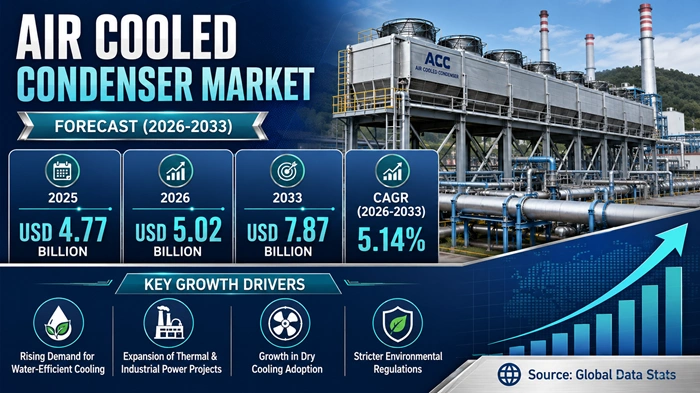
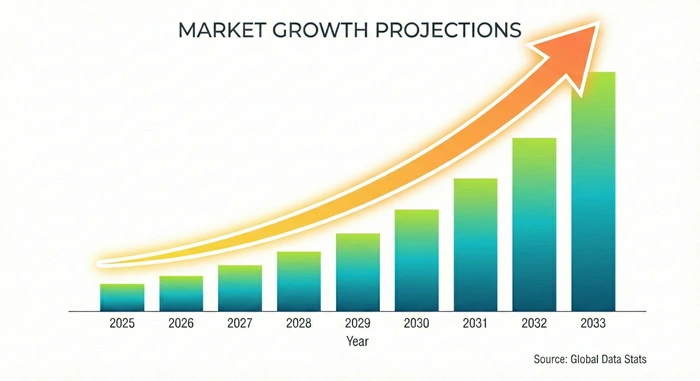
The global air cooled condenser market size is valued at USD 4.77 billion in 2025 and is predicted to increase from USD 5.02 billion in 2026 to approximately USD 7.87 billion by 2033, growing at a CAGR of 5.14% from 2026 to 2033.
Air cooled condensers represent critical heat rejection equipment utilizing ambient air as cooling medium rather than water, condensing exhaust steam from turbines or process vapors through finned tube bundles with forced-draft or natural-draft air circulation. These systems eliminate water consumption associated with wet cooling towers delivering operational advantages in water-scarce regions while reducing environmental impact. The air cooled condenser market encompasses applications across thermal power plants, industrial manufacturing facilities, HVAC systems, and chemical processing operations where reliable, efficient heat rejection proves essential for process performance, energy efficiency, and regulatory compliance.
AI Impact On The Air Cooled Condenser Industry
Optimizing Performance And Predictive Maintenance Through Intelligent Analytics
Artificial intelligence revolutionizes air cooled condenser operations by enabling real-time performance optimization, predictive maintenance, and energy efficiency improvements previously unattainable through conventional control systems. Machine learning algorithms analyze operational data including ambient conditions, fan speeds, tube temperatures, approach temperatures, and power consumption identifying optimal operating points maximizing heat rejection while minimizing auxiliary power consumption. Computer vision systems inspect tube bundles, fin conditions, and structural integrity during maintenance outages detecting corrosion, fouling, mechanical damage, and component degradation invisible to visual inspection. The air cooled condenser market benefits from AI-driven condition monitoring reducing unplanned outages, optimizing cleaning schedules, and extending equipment lifespans through proactive interventions addressing degradation before failures occur.
Digital twin technology creates virtual replicas of physical condenser systems enabling engineers to simulate operational scenarios, validate control strategies, and optimize maintenance procedures without disrupting actual facility operations. AI-powered fouling prediction models forecast tube bundle contamination rates based on ambient air quality, operational hours, and environmental conditions scheduling cleaning interventions minimizing performance degradation while avoiding unnecessary maintenance activities. The air cooled condenser market witnesses enhanced reliability as automated fault detection systems identify abnormal vibrations, bearing temperatures, fan imbalances, and tube leaks within milliseconds implementing protective actions preventing cascading failures and equipment damage. Smart sensors continuously monitor critical parameters transmitting data to cloud-based analytics platforms providing operators real-time visibility into system performance, efficiency metrics, and optimization opportunities enabling data-driven operational decisions improving plant economics and environmental performance throughout extended service periods.
Growth Factors
Water Scarcity And Environmental Regulations Driving Market Expansion
Global water scarcity intensifies as population growth, urbanization, and climate change strain freshwater resources creating compelling drivers for air cooled condenser adoption eliminating consumptive water use associated with conventional wet cooling systems. Thermal power plants historically consuming 20-50% of industrial water withdrawals face increasing regulatory pressures and water availability constraints particularly in arid regions including Middle East, western United States, Australia, and water-stressed areas across Asia and Africa. The air cooled condenser market expands rapidly as environmental regulations establish discharge limits, withdrawal restrictions, and zero liquid discharge requirements favoring dry cooling technologies over water-intensive alternatives. Industrial facilities including refineries, chemical plants, and manufacturing operations adopt air cooled condensers addressing corporate sustainability commitments, water cost reduction objectives, and operational resilience improving facility water efficiency while maintaining process cooling requirements.
Government policies worldwide establish frameworks promoting water conservation through incentives, mandates, and technical standards supporting dry cooling adoption. United States Environmental Protection Agency cooling water intake regulations require facilities minimize environmental impact while state programs in California, Nevada, and southwestern states mandate water-efficient technologies. The air cooled condenser market benefits from renewable energy deployment as concentrated solar power installations in desert regions and geothermal facilities in water-limited areas specify air cooling as essential technology enabling project development in optimal resource locations unsuitable for wet cooling. Power plant repowering projects replacing aging infrastructure with modern efficient generation adopt dry cooling technology addressing water constraints, environmental concerns, and regulatory requirements. Industrial expansion across water-scarce regions including Middle East petrochemical complexes, Asian manufacturing corridors, and Latin American mining operations drives substantial air cooled condenser demand as facilities require reliable cooling infrastructure operating independently of water availability constraints.
Market Outlook
Technology Innovation And Hybrid Systems Shaping Industry Evolution
Advanced materials including aluminum alloys, composite structures, and enhanced-surface tubes improve heat transfer efficiency, reduce weight, and extend operational lifespans addressing traditional limitations of steel construction susceptible to corrosion and fouling. Finned tube designs incorporating microchannel configurations, optimized fin geometries, and anti-fouling coatings enhance thermal performance while reducing material consumption and installation costs. The air cooled condenser market witnesses growing adoption of modular designs enabling phased capacity additions, transportation advantages, and accelerated installation schedules reducing project timelines and financial risks. Variable-speed fan drives optimize auxiliary power consumption adapting air flow to changing ambient conditions and heat rejection requirements achieving 20-30% energy savings compared to fixed-speed configurations while reducing noise emissions addressing community concerns near populated areas.
Hybrid wet-dry cooling systems emerge combining air cooled condensers with supplemental evaporative cooling modules optimizing performance across varying seasonal conditions. During peak summer temperatures when air cooling efficiency declines, evaporative assist sections provide supplemental capacity maintaining design performance while consuming 90% less water than conventional wet towers. The air cooled condenser market benefits from digital integration as IoT sensors, automated controls, and remote monitoring capabilities enable predictive maintenance, performance optimization, and fleet management across distributed installations. Advanced computational fluid dynamics modeling optimizes condenser layouts, fan configurations, and structural designs maximizing performance while minimizing costs. Noise reduction innovations including acoustic enclosures, low-noise fan designs, and optimized blade geometries address regulatory requirements and community acceptance particularly for installations near residential areas. Technology convergence with energy storage, renewable generation, and grid flexibility applications positions air cooled condensers as enabling infrastructure supporting diverse energy technologies across evolving power generation landscapes.
Expert Speaks
-
Larry Culp, Chairman and CEO at General Electric, emphasized through recent communications that water availability increasingly constrains power generation development globally, noting that GE's dry cooling technologies enable project deployment in water-scarce regions while meeting environmental regulations and sustainability objectives, positioning the company to serve growing market demand for water-efficient cooling solutions across thermal, nuclear, and concentrated solar power applications.
-
Patrick Pouyanné, Chairman and CEO at TotalEnergies, highlighted during sustainability presentations that industrial water management represents critical operational priority as facilities adopt technologies minimizing freshwater consumption and environmental impact, emphasizing that air cooled condensers deployed across refining and petrochemical operations deliver significant water savings supporting corporate water stewardship commitments while maintaining operational reliability.
-
Claudio Descalzi, CEO at Eni, noted through annual reports that sustainable operations require continuous innovation in resource efficiency, stating that adoption of air cooling technologies across industrial facilities reduces water footprint while improving operational flexibility particularly in water-constrained environments where conventional cooling proves impractical or environmentally unacceptable.
Key Report Takeaways
-
Asia Pacific dominates the air cooled condenser market capturing approximately 41% regional share valued around USD 1.96 billion in 2025, driven by rapid industrialization, massive power generation capacity additions, severe water scarcity across multiple countries, environmental regulations promoting water conservation, and substantial infrastructure investment across emerging economies.
-
North America emerges as fastest-growing region with projected CAGR exceeding 5.6% through 2033, fueled by aging infrastructure replacement, environmental regulations restricting water use, renewable energy development in arid regions, industrial facility modernization, and technology innovation advancing dry cooling performance and economics.
-
Hybrid systems represent the largest type segment accounting for approximately 54% market share due to optimal balance between performance and water conservation, proven reliability across diverse applications, cost-effectiveness versus pure dry cooling, and operational flexibility adapting to varying environmental conditions.
-
Power generation applications contribute the most significant demand representing roughly 58% of total market as thermal power plants, concentrated solar facilities, geothermal installations, and nuclear plants adopt air cooling addressing water constraints, environmental regulations, and operational requirements in water-limited regions.
-
Steel maintains dominant material position commanding nearly 62% market share owing to structural strength requirements, proven durability, cost-effectiveness for large installations, established manufacturing infrastructure, and extensive operational track record across diverse environmental conditions.
-
Industrial segment exhibits fastest end-user growth projected to expand at 5.8% CAGR through 2033 with market share reaching approximately 31%, driven by chemical plant expansion, refinery modernization, manufacturing facility growth in water-scarce regions, and corporate sustainability commitments promoting water-efficient technologies.
Market Scope
| Report Coverage | Details |
|---|---|
| Market Size by 2033 | USD 7.87 Billion |
| Market Size by 2025 | USD 4.77 Billion |
| Market Size by 2026 | USD 5.02 Billion |
| Market Growth Rate from 2026 to 2033 | CAGR of 5.14% |
| Dominating Region | Asia Pacific |
| Fastest Growing Region | North America |
| Base Year | 2025 |
| Forecast Period | 2026 to 2033 |
| Segments Covered | Type, Material, Application, End-User, Region |
| Regions Covered | North America, Europe, Asia-Pacific, Latin America, Middle East and Africa |
Market Dynamics
Drivers Impact Analysis
Water Resource Constraints And Sustainability Imperatives Accelerating Technology Adoption
| Factor | (≈) % Impact on CAGR Forecast | Geographic Relevance | Impact Timeline |
|---|---|---|---|
| Water scarcity pressures | 24-30% | Arid regions, water-stressed areas globally | 2026-2033 |
| Environmental regulations | 20-26% | Developed markets, emerging economies | 2026-2033 |
| Industrial expansion | 17-23% | Asia Pacific, Middle East, Latin America | 2026-2033 |
Freshwater availability constraints intensify globally as agricultural demands, municipal requirements, and industrial consumption strain limited supplies particularly across Middle East, North Africa, western United States, central Asia, and semi-arid regions worldwide. Thermal power plants consuming substantial water volumes for cooling face mounting pressure from competing demands including drinking water, irrigation, and ecosystem preservation. The air cooled condenser market expands as utilities adopt dry cooling technology eliminating 90-95% water consumption compared to conventional wet towers enabling continued operations during drought conditions, compliance with stringent withdrawal limits, and reduced environmental impact. Industrial facilities operating in water-scarce regions including desert petrochemical complexes, mining operations in arid zones, and manufacturing plants in water-stressed basins specify air cooling as essential technology ensuring operational continuity regardless of water availability fluctuations.
Regulatory frameworks worldwide establish increasingly stringent cooling water standards addressing thermal pollution, aquatic ecosystem protection, and consumptive water use. United States Clean Water Act Section 316(b) regulations require facilities minimize cooling water intake impacts while zero liquid discharge requirements eliminate wastewater discharges. The air cooled condenser market benefits from European Union environmental directives, Chinese water conservation policies, and emerging market regulations promoting sustainable industrial practices. Corporate sustainability commitments drive voluntary adoption as companies establish water reduction targets, pursue green building certifications, and respond to investor expectations regarding environmental stewardship. Reputational considerations motivate facilities adopt water-efficient technologies demonstrating environmental leadership and community responsibility. Climate change adaptation strategies recognize water scarcity as growing operational risk driving proactive investments in water-independent cooling infrastructure ensuring long-term operational viability and regulatory compliance across evolving environmental frameworks.
Restraints Impact Analysis
High Capital Costs And Performance Penalties Limiting Adoption Pace
| Factor | (≈) % Impact on CAGR Forecast | Geographic Relevance | Impact Timeline |
|---|---|---|---|
| Capital cost premium | -15 to -20% | Cost-sensitive markets | 2026-2033 |
| Efficiency penalties in hot climates | -12 to -17% | High ambient temperature regions | 2026-2033 |
| Land footprint requirements | -9 to -14% | Space-constrained installations | 2026-2033 |
Air cooled condensers command significant capital cost premiums compared to conventional wet cooling systems with installed expenses 2-4 times higher for equivalent capacity creating substantial financial barriers particularly for budget-constrained projects in developing markets. Initial investment includes extensive tube bundles, fan systems, structural steel, electrical infrastructure, and control systems requiring substantial upfront expenditure before generating operational savings. The air cooled condenser market faces adoption challenges as project developers prioritize lowest initial cost over lifecycle benefits despite water savings and reduced operating expenses. Economic analyses comparing alternatives require sophisticated modeling incorporating water costs, availability risks, regulatory compliance expenses, and long-term operational considerations beyond simple capital cost comparisons.
Performance penalties under high ambient temperature conditions create operational challenges as air cooling effectiveness degrades during summer peak periods when power demand reaches maximum levels. Power plants equipped with dry cooling experience capacity derating of 5-15% during hot weather reducing electricity generation exactly when grid needs prove greatest. The air cooled condenser market confronts efficiency concerns as higher turbine backpressures associated with air cooling reduce thermal efficiency compared to water-cooled alternatives increasing fuel consumption and operational costs particularly in consistently hot climates. Fan auxiliary power consumption represents 1-3% of plant gross generation reducing net output and increasing production costs. Space requirements prove substantial as air cooled condensers occupy 3-5 times footprint of equivalent wet towers creating site constraints particularly for retrofit applications at existing facilities with limited available land. Noise emissions from large fan installations require mitigation measures including acoustic barriers, setbacks from populated areas, or operational restrictions creating additional costs and siting challenges particularly near residential communities.
Opportunities Impact Analysis
Concentrated Solar Power And Data Center Applications Creating Growth Pathways
| Factor | (≈) % Impact on CAGR Forecast | Geographic Relevance | Impact Timeline |
|---|---|---|---|
| Concentrated solar power deployment | +18 to +24% | High solar resource regions | 2027-2033 |
| Data center cooling requirements | +16 to +22% | Technology hubs globally | 2027-2033 |
| Modular nuclear reactor integration | +14 to +19% | Advanced nuclear markets | 2028-2033 |
Concentrated solar power development creates substantial opportunity as utility-scale installations in desert regions including southwestern United States, Middle East, North Africa, Australia, and Chile require dry cooling technology due to water unavailability at optimal solar resource locations. CSP facilities utilize air cooled condensers as enabling technology supporting project development in high-insolation areas where conventional wet cooling proves impractical. The air cooled condenser market captures growing demand as global CSP capacity projections indicate substantial growth supporting renewable energy targets and dispatchable clean generation requirements. Thermal energy storage integration with CSP creates extended operating hours and grid flexibility advantages positioning technology as valuable complement to variable wind and solar generation. Government incentives, renewable energy mandates, and declining technology costs improve CSP economics driving project development and associated dry cooling equipment demand.
Data center proliferation creates emerging application as facilities adopt liquid cooling systems for high-density computing equipment requiring heat rejection infrastructure. Hyperscale data centers locating in water-scarce regions specify air cooled condensers eliminating water consumption while meeting sustainability commitments. The air cooled condenser market benefits from edge computing deployment and artificial intelligence workload growth driving cooling capacity requirements across distributed installations. Waste heat recovery opportunities emerge as data center thermal output potentially serves district heating applications, industrial processes, or agricultural operations creating integrated energy systems maximizing resource efficiency. Modular nuclear reactor commercialization presents substantial opportunity as small modular reactors designed for distributed deployment, remote locations, and flexible siting utilize air cooling technology enabling installation in water-limited areas. Advanced reactor designs incorporating passive safety systems, simplified operations, and standardized manufacturing align with dry cooling technology supporting deployment flexibility. Geothermal power expansion in water-constrained regions drives air cooled condenser adoption as binary cycle plants extract thermal energy from geothermal resources requiring efficient heat rejection infrastructure operating independently of surface water availability.
Segment Analysis
By Type: Hybrid
Operational Flexibility And Performance Optimization Establishing Segment Leadership
Hybrid systems dominate the air cooled condenser market capturing approximately 54% share valued around USD 2.58 billion in 2025 owing to optimal balance between water conservation and thermal performance combining dry cooling operation majority of year with supplemental evaporative assist during peak summer conditions. Hybrid configurations achieve 90-95% water savings versus conventional wet cooling while avoiding performance penalties associated with pure dry cooling during extreme ambient temperatures. Modular wet sections activate automatically when conditions exceed design thresholds maintaining turbine backpressure within acceptable limits preserving power generation capacity and efficiency. The air cooled condenser market benefits from hybrid systems' proven reliability across diverse climates, operational flexibility adapting to varying conditions, and cost-effectiveness versus oversized pure dry systems designed for worst-case conditions.
North America and Middle East lead hybrid system deployment with power plants and industrial facilities adopting technology balancing water conservation with performance requirements. Asia Pacific adoption grows as utilities recognize operational advantages particularly in regions experiencing seasonal temperature extremes. The air cooled condenser market sees this segment maintaining steady growth near 5.0% CAGR through 2033 as technology evolution improves control systems, optimizes wet-dry transitions, and enhances overall system efficiency. Leading equipment manufacturers including SPX Cooling Technologies, Enexio, EVAPCO, and Hamon Group offer comprehensive hybrid solutions spanning standardized designs and customized configurations addressing specific project requirements. Technology focus includes advanced controls optimizing wet-dry operation, corrosion-resistant materials extending component life, and noise reduction features addressing community concerns. Repowering applications increasingly specify hybrid systems as optimal retrofit solution maintaining performance while dramatically reducing water consumption compared to existing wet towers.
By Application: Power Generation
Baseload Capacity And Water Constraints Driving Segment Dominance
Power generation applications represent the largest segment in the air cooled condenser market commanding approximately 58% share valued around USD 2.77 billion in 2025, driven by thermal power plants including coal, natural gas, concentrated solar, and geothermal facilities adopting dry cooling addressing water availability constraints and environmental regulations. Baseload power generation requiring continuous operations proves particularly sensitive to cooling water availability as supply disruptions or regulatory restrictions threaten generation continuity and grid reliability. The air cooled condenser market benefits from power sector emphasis on operational reliability, long-term water security, and environmental compliance positioning dry cooling as strategic technology ensuring sustained operations across varying hydrological and regulatory conditions. Nuclear facilities considering dry cooling for new builds and future reactor designs recognize technology enabling siting flexibility and operational independence from surface water sources.
Asia Pacific leads power generation air cooled condenser adoption with China, India, and Southeast Asia installing substantial capacity supporting massive electricity demand growth in water-constrained regions. Middle East thermal facilities specify dry cooling as essential technology in desert environments. The air cooled condenser market witnesses this segment growing at robust 5.2% CAGR through 2033 driven by renewable energy integration, fossil fuel plant efficiency improvements, and emerging nuclear technologies. Leading power equipment suppliers including GE Steam Power, Siemens Energy, Mitsubishi Power, and Doosan Enerbility integrate air cooling technology into turnkey generation projects. Combined cycle power plants increasingly adopt dry cooling as natural gas generation expands across water-limited regions. Concentrated solar power facilities in southwestern United States, Spain, Morocco, and Chile specify air cooled condensers enabling project development in optimal solar resource areas. Technology improvements reducing performance penalties, cost reductions through manufacturing efficiencies, and operational experience validating long-term reliability support continued power sector adoption.
Regional Insights
Asia Pacific
Industrialization And Water Scarcity Cementing Regional Market Leadership
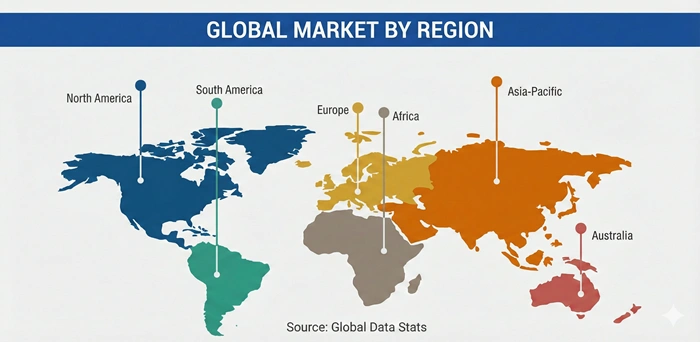
Asia Pacific dominates the air cooled condenser market commanding approximately 41% global share valued at USD 1.96 billion in 2025, projected to reach USD 3.21 billion by 2033 growing at 5.3% CAGR. China establishes overwhelming regional leadership through massive power generation capacity additions in water-scarce western provinces, industrial expansion across water-stressed regions, and government policies promoting water conservation technologies. State power companies adopt dry cooling for coal-fired plants in arid northern regions addressing water allocation limits and environmental regulations. The air cooled condenser market benefits from substantial infrastructure investment as Five-Year Plans allocate resources toward sustainable industrial development, water-efficient technologies, and environmental protection. India represents major growth opportunity as power sector expansion, manufacturing growth, and chronic water scarcity drive air cooled condenser adoption across thermal plants, industrial facilities, and commercial developments.
Southeast Asian nations including Vietnam, Thailand, and Indonesia specify dry cooling for power projects in water-limited areas while industrial facilities adopt technology addressing corporate sustainability commitments and regulatory requirements. Japan maintains technological leadership through advanced manufacturing capabilities and domestic market serving power utilities and industrial customers. The air cooled condenser market witnesses regional manufacturing concentration as Chinese suppliers including Jiangsu Longgang Power Equipment and Shandong Envicool produce equipment serving domestic and export markets. International manufacturers including SPX, Hamon, and Baltimore Aircoil maintain regional operations. Technology adaptation addressing high humidity conditions, typhoon-resistant designs, and corrosion protection for coastal installations advances regional capabilities. Government policies promoting water conservation, environmental regulations tightening discharge standards, and industrial development priorities position Asia Pacific maintaining dominant market position throughout forecast period.
North America
Environmental Regulations And Infrastructure Renewal Driving Fastest Regional Growth
North America emerges as fastest-growing region in the air cooled condenser market with CAGR exceeding 5.6% from 2026 to 2033, with market value expanding from approximately USD 1.34 billion in 2025 toward USD 2.11 billion by 2033. United States leads regional growth through Environmental Protection Agency cooling water regulations requiring facilities minimize environmental impact, state programs in western regions mandating water-efficient technologies, and utility sector infrastructure modernization replacing aging wet cooling systems. The air cooled condenser market captures momentum from concentrated solar power deployment across southwestern states where dry cooling proves essential technology enabling project development in high-insolation desert locations. Natural gas combined cycle plants in water-constrained regions specify air cooling addressing permitting requirements and long-term water security concerns.
Industrial facilities including refineries, chemical plants, and manufacturing operations adopt dry cooling technology meeting corporate sustainability targets, addressing water cost escalation, and ensuring operational continuity amid growing water allocation competition. Canada implements water conservation policies promoting efficient technologies while Mexican industrial expansion drives equipment demand. The air cooled condenser market benefits from North American technology leadership as manufacturers develop advanced materials, hybrid configurations, and digital control systems exported globally. Leading regional players including SPX Cooling Technologies, Baltimore Aircoil Company, and Evapco supply domestic and international markets. Research institutions and national laboratories advance dry cooling technology through government-funded programs. Technology innovation, environmental regulations, infrastructure investment, and water resource constraints position North America as primary growth engine for global air cooled condenser expansion throughout forecast period.
Top Key Players
-
SPX Cooling Technologies, Inc. (United States)
-
Hamon Group (Belgium)
-
Baltimore Aircoil Company (United States)
-
EVAPCO, Inc. (United States)
-
Enexio Management GmbH (Germany)
-
GEA Group AG (Germany)
-
Paharpur Cooling Towers Ltd. (India)
-
SPIG S.p.A. (Italy)
-
Thermal Engineering International (USA) Inc. (United States)
-
Chart Industries, Inc. (United States)
-
Güntner GmbH & Co. KG (Germany)
-
Alfa Laval AB (Sweden)
-
Babcock & Wilcox Enterprises, Inc. (United States)
-
Honeywell International Inc. (United States)
-
Johnson Controls International plc (Ireland)
Recent Developments
-
SPX Cooling Technologies (September 2024): Secured major contract supplying hybrid dry-wet cooling system for 600-megawatt combined cycle power plant in Middle East, featuring advanced modular design with intelligent controls optimizing water conservation while maintaining peak performance during extreme ambient conditions, demonstrating technology leadership serving water-scarce regions requiring reliable baseload generation capacity.
-
Hamon Group (July 2024): Announced completion of air cooled condenser installation at concentrated solar power facility in North Africa, providing 250-megawatt heat rejection capacity enabling plant operation in desert environment with zero water consumption, validating dry cooling technology supporting renewable energy deployment in optimal solar resource locations previously unsuitable for conventional wet cooling systems.
-
Baltimore Aircoil (October 2024): Launched next-generation hybrid cooling tower incorporating advanced materials, optimized fin geometries, and variable-speed drives achieving 25% energy savings versus previous designs while reducing water consumption 95% compared to conventional wet systems, addressing industrial customer requirements for sustainable, cost-effective cooling solutions across diverse applications.
-
EVAPCO (August 2024): Introduced modular air cooled condenser system designed for rapid deployment supporting data center applications, featuring factory-assembled modules enabling 50% reduction in on-site installation time while delivering superior thermal performance and noise reduction characteristics critical for installations in populated technology corridors and urban environments.
-
Enexio (June 2024): Secured contract providing air-cooled heat exchangers for geothermal power plant in water-limited region, demonstrating technology adaptation supporting renewable energy development where conventional cooling proves impractical, with corrosion-resistant materials and advanced controls ensuring long-term reliable operation in challenging geothermal conditions.
Market Trends
Advanced Materials And Noise Reduction Technologies Reshaping Product Development
Material innovation advances air cooled condenser performance as aluminum alloys, composite structures, and enhanced-surface tubes improve heat transfer coefficients while reducing weight and installation costs. Aluminum construction delivers corrosion resistance advantages particularly in coastal or industrial environments where steel tubes experience accelerated degradation. Microchannel heat exchanger technology borrowed from automotive applications achieves superior thermal performance with dramatically reduced refrigerant charges and material consumption. The air cooled condenser market witnesses growing adoption of advanced coatings including anti-fouling treatments, corrosion protection, and hydrophobic surfaces extending maintenance intervals and improving long-term performance. Additive manufacturing enables complex fin geometries optimizing air flow patterns and heat transfer characteristics impossible with conventional fabrication methods. Composite fan blades deliver weight reduction, corrosion resistance, and aerodynamic optimization improving efficiency while reducing noise generation. Modular tube bundle designs facilitate maintenance, enable selective replacement, and support phased capacity expansions accommodating evolving facility requirements without complete system replacement.
Noise reduction innovations address community concerns and regulatory requirements as installations near populated areas require acoustic compliance. Low-noise axial fan designs incorporating optimized blade geometries, tip clearance management, and aeroacoustic enhancements reduce sound emissions 5-10 decibels versus conventional configurations. The air cooled condenser market benefits from variable-speed drives enabling noise-sensitive night-time operation at reduced speeds minimizing community disturbance while maintaining adequate cooling capacity during lower ambient temperatures. Acoustic enclosures, barrier walls, and sound-attenuating materials mitigate noise propagation toward sensitive receptors. Computational fluid dynamics modeling optimizes fan arrangements, air flow patterns, and structural configurations minimizing turbulence and associated noise generation. Advanced control algorithms adapt fan operations to ambient conditions, heat loads, and time-of-day considerations optimizing performance, energy consumption, and noise emissions simultaneously. Digital integration enables predictive maintenance as vibration monitoring, bearing temperature sensors, and acoustic analysis detect developing mechanical issues before catastrophic failures occur. Remote monitoring platforms provide operators real-time visibility into system performance across distributed installations enabling proactive interventions, performance optimization, and fleet management.
Segments Covered In The Report
By Type
-
Hybrid
-
Indirect Dry Cooling System
-
Heller System
-
Others
By Material
-
Steel
-
Aluminum
-
Copper
-
Others
By Application
-
Power Generation (Thermal, Concentrated Solar, Geothermal)
-
Manufacturing
-
HVAC Systems
-
Oil and Gas
-
Chemical Processing
-
Others
By End-User
-
Power Plants
-
Industrial Facilities
-
Commercial Buildings
-
Petrochemical Facilities
-
Data Centers
By Region
-
North America (United States, Canada, Mexico)
-
Europe (Germany, United Kingdom, France, Italy, Spain, Rest of Europe)
-
Asia-Pacific (China, India, Japan, South Korea, Australia, Southeast Asia, Rest of Asia-Pacific)
-
Latin America (Brazil, Argentina, Chile, Rest of Latin America)
-
Middle East and Africa (Saudi Arabia, UAE, South Africa, Rest of MEA)
Frequently Asked Questions
Question 1: What is the expected size of the air cooled condenser market by 2033?
Answer: The global air cooled condenser market is projected to reach approximately USD 7.87 billion by 2033, expanding from USD 5.02 billion in 2026. This growth reflects increasing water scarcity concerns, stringent environmental regulations promoting water conservation, industrial expansion in water-limited regions, and technology improvements enhancing dry cooling performance and cost-effectiveness.
Question 2: Which region dominates the air cooled condenser market currently?
Answer: Asia Pacific dominates the air cooled condenser market with approximately 41% market share due to rapid industrialization, massive power generation capacity additions, severe water scarcity across multiple countries, and substantial infrastructure investment. The region benefits from government policies promoting water-efficient technologies, manufacturing capabilities, and growing environmental awareness supporting sustained adoption.
Question 3: What CAGR will the air cooled condenser market experience from 2026 to 2033?
Answer: The air cooled condenser market will grow at a compound annual growth rate of 5.14% from 2026 to 2033. This expansion reflects water resource constraints intensifying globally, environmental regulations tightening cooling water standards, renewable energy deployment in arid regions, and industrial facilities adopting water-independent cooling technologies addressing operational resilience and sustainability commitments.
Question 4: Which application holds the largest share in the air cooled condenser market?
Answer: Power generation applications command the largest share at approximately 58% due to thermal power plants, concentrated solar facilities, and geothermal installations adopting dry cooling addressing water availability constraints and environmental regulations. The air cooled condenser market benefits from baseload generation requirements prioritizing operational reliability and long-term water security through water-independent cooling infrastructure.
Question 5: What are the primary growth drivers for the air cooled condenser market?
Answer: Primary drivers include water scarcity pressures requiring water-efficient technologies, environmental regulations restricting cooling water withdrawals and discharges, and industrial expansion in water-stressed regions. The air cooled condenser market also benefits from concentrated solar power deployment in desert environments, corporate sustainability commitments promoting water conservation, data center growth requiring reliable cooling, and technology innovations improving performance while reducing costs supporting broader adoption.