
AI Avatar Market Overview
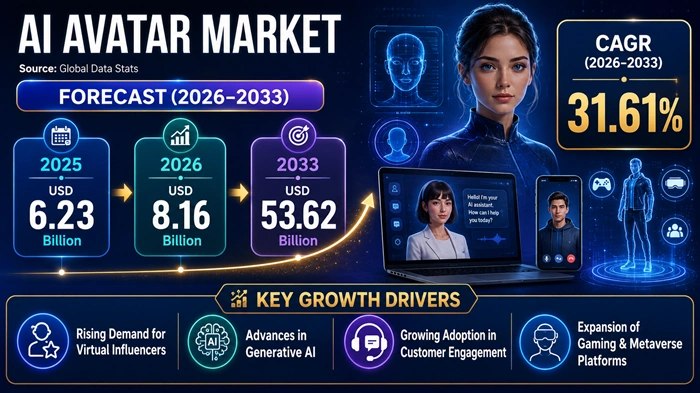
The global AI avatar market size is valued at USD 6.23 billion in 2025 and is predicted to increase from USD 8.16 billion in 2026 to approximately USD 53.62 billion by 2033, growing at a CAGR of 31.61% from 2026 to 2033.
An AI avatar is a digitally generated, often lifelike human representation powered by generative AI, computer vision, and natural language processing that can speak, express emotion, and interact with users in real time. Businesses across marketing, customer service, education, and entertainment are rapidly adopting these digital personas to scale personalized communication without the cost of live human presenters. Breakthroughs in generative AI, growing metaverse adoption, and rising demand for round-the-clock, multilingual virtual interaction are together fueling explosive growth in this fast-emerging technology category.
AI Impact on the AI Avatar Industry
How Advances in Generative Models, Voice Synthesis, and Real-Time Rendering Are Reshaping the Capabilities and Realism of AI Avatars
Generative AI itself is the foundational technology powering this entire market, and rapid improvements in large language models, voice cloning, and facial animation are making avatars dramatically more lifelike and responsive than they were just a couple of years ago. Modern avatar platforms can now generate a fully animated, speaking digital human from a short script in minutes, complete with natural lip-sync, emotional expression, and multilingual voice output. This has collapsed production timelines that once required professional video studios and human presenters, allowing brands and educators to produce personalized video content at a scale that was previously unimaginable.
Real-time rendering breakthroughs are also enabling interactive AI avatars capable of holding live conversations with users, a capability increasingly deployed in customer service kiosks, virtual sales assistants, and interactive training simulations. These avatars can now read a customer's tone and adjust their responses accordingly, creating an experience that feels closer to a genuine human interaction than earlier scripted chatbot systems. As underlying generative models continue to improve in speed and realism, the AI avatar market is expected to see further blurring of the line between recorded and live-interactive avatar experiences, opening new commercial applications across nearly every customer-facing industry.
Growth Factors
Falling Content Production Costs, Metaverse Expansion, and Enterprise Demand for Scalable Personalization Are the Three Most Influential Growth Drivers
The dramatic reduction in the cost and time required to produce professional-quality video content is one of the most powerful growth factors behind rising avatar adoption. What once required hiring actors, renting studios, and scheduling reshoots can now be accomplished by a single marketing employee using an avatar platform in a fraction of the time and cost. This accessibility has opened avatar-based content creation to small and mid-sized businesses that previously could never afford professional video production, significantly widening the addressable customer base for the AI avatar market.
Growing enterprise demand for scalable, multilingual customer engagement is a second major driver, as businesses look to deliver personalized video communication and virtual assistance to global customer bases without proportionally scaling headcount. The continued expansion of metaverse platforms, virtual events, and immersive gaming environments is also creating strong tailwinds, as these digital spaces inherently require avatar-based identities and interactive characters. Combined with rising consumer comfort interacting with AI-driven digital personas across social media and e-commerce platforms, these factors are creating durable, multi-year demand for avatar technology across a rapidly expanding set of use cases.
Market Outlook
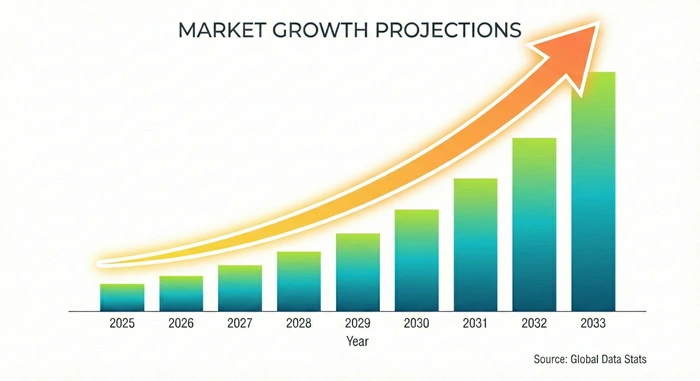
The AI Avatar Market Is Positioned for Explosive Growth Through 2033 as Avatars Move From Novelty Tool to Core Business Infrastructure
The long-term outlook for AI avatars remains extremely strong as the technology transitions from an experimental marketing novelty into core infrastructure for corporate training, customer service, and digital content production. As avatar realism continues to improve and production costs keep falling, enterprises are expected to increasingly replace traditional video production workflows entirely with avatar-based systems for internal training, product explainer content, and multilingual customer communication. This structural shift toward avatar-first content strategies is expected to be one of the biggest catalysts for sustained volume growth over the next several years.
Looking further ahead, the industry is likely to see growing consolidation as larger technology companies acquire specialized avatar startups to build comprehensive, end-to-end digital human platforms. Deeper integration between avatar technology and augmented and virtual reality hardware is also expected to unlock new immersive applications in retail, healthcare, and virtual events. These dynamics point toward an AI avatar market that will remain one of the fastest-growing segments within the broader generative AI ecosystem well into the next decade.
Expert Speaks
-
"AI avatars are becoming a fundamental way businesses communicate with customers at scale, and the realism and responsiveness of these digital humans are improving faster than almost any other AI application we track." — CEO, Microsoft Corporation.
-
"We are seeing surging demand across enterprises for avatar-based training and customer engagement tools, and our continued investment in generative video technology reflects how quickly this category is scaling." — CEO, Adobe Inc.
-
"Digital humans and AI avatars represent one of the most compelling applications of generative AI today, and we expect this technology to become a standard interface across virtual environments and enterprise platforms." — CEO, NVIDIA Corporation.
Key Report Takeaways
-
North America leads the AI avatar market with an estimated 38% revenue share in 2025, supported by early AI technology adoption, strong presence of leading generative AI companies, and high enterprise digital content spending.
-
Asia Pacific is the fastest-growing region, projected to expand at a CAGR near 35% through 2033, driven by rapid digital transformation, high smartphone penetration, and expanding metaverse and gaming investment.
-
Enterprises across marketing and customer service represent the largest customer base, using avatars extensively to scale personalized communication without proportional headcount growth.
-
Marketing and advertising applications contribute the most to overall demand, as brands use avatars to produce scalable, personalized video content at a fraction of traditional production costs.
-
Noninteractive avatar generation remains the most widely used process today, valued for its lower development complexity and ease of deployment across content platforms.
-
The interactive avatar segment is projected to grow fastest going forward, expected to hold close to 40% market share by 2033 while expanding at a CAGR near 37% during the forecast period.
Market Scope
| Report Coverage Details | Details |
|---|---|
| Dominating Region | North America |
| Fastest Growing Region | Asia Pacific |
| Base Year | 2025 |
| Forecast Period | 2026 to 2033 |
| Segments Covered | By Platform, By Type, By Application, By End User, By Region |
| Regions Covered | North America, Europe, Asia Pacific, Latin America, Middle East & Africa |
Market Dynamics
Drivers Impact Analysis
Falling Production Costs and Rising Enterprise Personalization Demand Are the Most Commercially Significant Drivers of Market Growth
| Driver | (≈) % Impact on CAGR Forecast | Geographic Relevance | Impact Timeline |
|---|---|---|---|
| Falling cost and time required to produce avatar-based video content | ~35% | Global, led by North America | Short to long-term |
| Rising enterprise demand for scalable, multilingual customer engagement | ~28% | North America, Europe, Asia Pacific | Short to medium-term |
| Expansion of metaverse platforms and immersive gaming environments | ~22% | Asia Pacific, North America | Medium to long-term |
| Growing consumer comfort with AI-driven digital interaction | ~15% | Global | Ongoing |
The dramatic decline in the cost and effort required to produce professional-quality avatar video content is the most powerful driver behind rapid adoption in the AI avatar market, as small and mid-sized businesses that previously could not afford studio production now use avatar platforms to create marketing and training content in-house. This democratization of content creation is pulling in a much broader customer base than the enterprise-only adoption seen in the technology's early years.
Rising enterprise demand for scalable, multilingual customer engagement is a second significant driver, as global businesses look to deliver consistent, personalized communication across markets without proportionally scaling human headcount. Combined with the continued expansion of metaverse platforms and immersive gaming environments that inherently require avatar-based identities, these drivers together sustain extremely strong, multi-year demand growth across the global avatar technology landscape.
Restraints Impact Analysis
The Uncanny Valley Effect and High Development Costs for Hyper-Realistic Avatars Are the Two Primary Constraints Limiting Faster Market Growth
| Restraint | (≈) % Impact on CAGR Forecast | Geographic Relevance | Impact Timeline |
|---|---|---|---|
| Uncanny valley effect reducing user trust in overly realistic avatars | ~34% | Global | Short to medium-term |
| High development cost for fully interactive, real-time avatar systems | ~30% | Global | Short-term |
| Data privacy and deepfake misuse concerns | ~24% | North America, Europe | Medium to long-term |
| Technical limitations in achieving seamless emotional expressiveness | ~12% | Global | Ongoing |
The uncanny valley effect, where hyper-realistic but slightly imperfect avatars create discomfort rather than trust among users, remains a meaningful barrier to broader adoption in customer-facing applications. Brands must carefully balance realism with approachability, and getting this balance wrong can undermine consumer confidence in avatar-based communication.
High development costs associated with building fully interactive, real-time conversational avatar systems also limit adoption among smaller businesses to simpler, noninteractive avatar formats. Growing concern around deepfake misuse and data privacy tied to voice and likeness cloning technology is further prompting regulatory scrutiny in North America and Europe. These restraints do not reverse the underlying growth trend but do introduce meaningful friction that moderates the pace of adoption for more advanced avatar capabilities within the broader AI avatar market.
Opportunities Impact Analysis
Integration With AR and VR Platforms and Expansion Into Emerging Digital Economies Represent the Most Significant Untapped Growth Opportunities
| Opportunity | (≈) % Impact on CAGR Forecast | Geographic Relevance | Impact Timeline |
|---|---|---|---|
| Deeper integration of AI avatars with AR and VR platforms | ~38% | Global | Medium to long-term |
| Expansion of avatar adoption in emerging digital economies | ~33% | Asia Pacific, Latin America, MEA | Medium to long-term |
| Growing use of AI avatars as shopping and web navigation interfaces | ~29% | North America, Europe | Short to medium-term |
Deeper integration between AI avatars and augmented and virtual reality platforms presents one of the largest untapped opportunities in the market, as immersive commerce, virtual events, and remote collaboration environments increasingly require lifelike digital representations. Companies that successfully merge avatar technology with AR and VR hardware are positioned to capture significant new revenue as immersive digital experiences move further into the mainstream.
Emerging digital economies across Asia Pacific and Latin America represent a second major growth avenue as smartphone penetration rises and local content creators and businesses adopt avatar tools for social media and e-commerce engagement. Vendors that build affordable, localized avatar products for these fast-growing markets stand to capture a growing share of the AI avatar market as avatars increasingly become standard interfaces for online shopping and web navigation globally.
Segment Analysis
By Application
Marketing and Customer Service Applications Together Anchor the Largest Share Within AI Avatar Market Demand
Marketing and advertising applications hold the largest share of the AI avatar market, accounting for roughly 32% of total application revenue with a CAGR near 33% through 2033. Brands increasingly use avatars to produce scalable, personalized video advertisements and social media content without the cost and scheduling constraints of traditional video shoots. North America leads this segment because of its concentration of digital marketing agencies and early corporate adoption of generative AI content tools. Leading companies operating in this space include Synthesia, HeyGen, and D-ID, all of which have built strong customer bases among marketing teams seeking fast, affordable avatar-based video production.
Customer service applications represent the second-largest contributor, benefiting from growing enterprise interest in avatar-based virtual assistants that can handle routine customer inquiries around the clock across multiple languages. This application segment is expanding especially quickly across Asia Pacific, where large e-commerce platforms and telecom companies are deploying interactive avatars to manage high customer inquiry volumes cost-effectively. Companies such as SenseTime in China and various regional AI platform providers have built strong reputations delivering avatar-based customer engagement tools across this geography. Growing enterprise confidence in avatar-based service delivery continues to reinforce demand growth across both of these leading segments within the AI avatar market.
By Platform
Digital Human and Metaverse Avatar Platforms Represent the Fastest-Evolving Categories Within AI Avatar Technology
Digital human avatar platforms account for a substantial and growing share of the AI avatar market, supported by strong CAGR growth above 32% as enterprises increasingly favor photorealistic digital presenters for corporate communication, training, and news content production. These platforms have become particularly popular among media companies and educational institutions seeking cost-effective alternatives to hiring on-camera talent for repetitive or multilingual content needs. Companies such as DeepBrain AI and Synthesia have established leading positions in this platform category through continuous improvements in facial realism and voice synthesis quality.
Metaverse and 3D avatar platforms represent the fastest-growing platform category, expected to expand at a CAGR near 36% as virtual worlds, gaming environments, and social platforms increasingly require customizable avatar identities for user representation. Asia Pacific is emerging as a particularly strong growth region for this platform type, driven by massive gaming populations and government-backed metaverse investment initiatives across China and South Korea. Tencent and various regional gaming and social media platforms are increasingly competing for avatar customization market share as demand accelerates across the broader AI avatar market landscape.
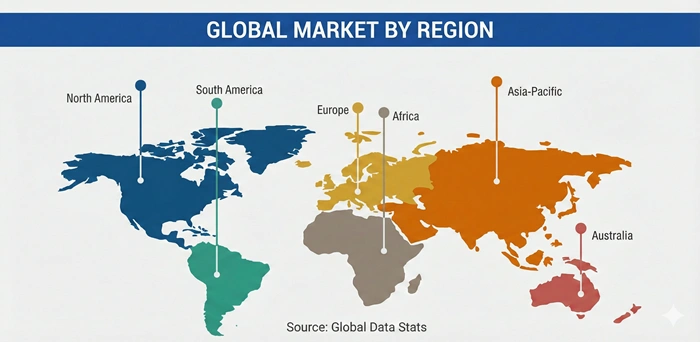
Regional Insights
North America
Early AI Adoption and Strong Generative AI Company Presence Keep North America at the Top of the AI Avatar Market
North America commands the largest share of the global AI avatar market, holding close to 38% of total revenue in 2025 with a regional CAGR near 30% through 2033. Strong presence of leading generative AI companies, high enterprise digital marketing spending, and early corporate adoption of avatar-based content tools keep demand consistently high throughout the region. Leading companies such as Microsoft and Meta Platforms, both headquartered in the United States, continue to invest heavily in avatar and digital human research, reinforcing the region's technology leadership position.
The region's mature digital advertising ecosystem, combined with strong venture capital funding for avatar technology startups, further reinforces this leadership position within the broader avatar technology landscape. Large enterprises across finance, retail, and media routinely integrate avatar-based tools into customer communication and internal training programs, creating deep and recurring commercial relationships with leading platform providers. This combination of technology depth, funding availability, and early enterprise adoption ensures North America remains the anchor region for AI avatar market revenue generation over the coming years.
Asia Pacific
Rapid Digital Transformation and Massive Gaming Populations Make Asia Pacific the Fastest-Growing Region
Asia Pacific is the fastest-growing region in the AI avatar market, projected to expand at a CAGR near 35% through 2033 while currently holding around 24% of global revenue share. Rapid digital transformation, extremely high smartphone penetration, and massive gaming and social media populations across China, Japan, and South Korea are together driving this accelerated regional growth. Companies such as Tencent Holdings in China and various regional gaming platforms are scaling avatar customization features rapidly to meet surging consumer demand for personalized digital identities.
Growing government support for metaverse and digital economy initiatives, combined with expanding e-commerce platforms that increasingly use avatar-based virtual influencers and shopping assistants, continues to widen the region's addressable opportunity. India and Southeast Asian markets are also contributing meaningfully through fast-growing social media user bases and rising interest in avatar-based content creation tools. As local platform capacity expands further and avatar technology becomes more affordable, Asia Pacific is expected to narrow its overall revenue gap with North America over the coming several years within the broader AI avatar market.
Customization Available for This Report
Region-wise and country-wise customized reports are available for organizations seeking deeper geographic insight into the AI avatar market. Our research team can tailor market analysis, competitive intelligence, trends, and growth opportunities specifically for any of the regions and countries listed below, offering detailed information aligned to your selected market and keyword combination.
North America
-
U.S., Canada, Mexico — detailed enterprise adoption trends, funding analysis, and competitive positioning
Europe
-
U.K., Germany, France, Italy, Rest of Europe — regulatory frameworks, digital marketing trends, and key player analysis
Asia Pacific
-
China, India, Japan, South Korea, Australia, Rest of Asia Pacific — gaming and metaverse investment, smartphone penetration, and local platform capacity
Latin America
-
Brazil, Argentina, Rest of Latin America — emerging digital adoption and e-commerce integration trends
Middle East & Africa
-
UAE, Saudi Arabia, Rest of MEA — digital economy investment and market entry opportunities
Top Key Players
-
Microsoft Corporation (United States)
-
Meta Platforms Inc. (United States)
-
NVIDIA Corporation (United States)
-
Adobe Inc. (United States)
-
Synthesia Ltd. (United Kingdom)
-
HeyGen Inc. (United States)
-
D-ID Ltd. (Israel)
-
Soul Machines Ltd. (New Zealand)
-
Tencent Holdings Ltd. (China)
-
SenseTime Group Inc. (China)
-
DeepBrain AI Inc. (South Korea)
-
UneeQ Ltd. (New Zealand)
-
Replika Inc. (United States)
-
Reallusion Inc. (Taiwan)
Recent Developments
-
In 2025, Synthesia raised significant new funding to expand its enterprise-focused avatar video platform, strengthening its position among corporate training and marketing customers.
-
In 2025, HeyGen expanded its multilingual avatar dubbing capabilities, allowing enterprises to localize video content across dozens of languages using a single avatar recording.
-
In 2025, Meta Platforms advanced its digital human research initiatives, integrating more realistic avatar rendering into its social and virtual reality platforms.
-
In 2026, NVIDIA expanded its digital human framework tools, enabling developers to build more emotionally expressive, real-time interactive avatars for enterprise applications.
-
In 2026, Tencent Holdings deepened its investment in avatar customization features across its gaming and social media platforms, strengthening its position in the Asia Pacific avatar technology landscape.
Market Trends
Convergence of Generative AI, Real-Time Interactivity, and Immersive Platforms Is Reshaping the AI Avatar Landscape
One of the clearest trends shaping the industry is the shift from static, pre-recorded avatar videos toward fully interactive, real-time conversational avatars capable of engaging users in live dialogue. This is transforming avatars from a content production tool into genuine interactive interfaces, opening new applications in virtual sales assistance, interactive customer support, and live virtual events that were not previously feasible.
A second notable trend is the growing integration of AI avatars into immersive AR and VR environments, as virtual worlds and metaverse platforms increasingly require customizable, lifelike digital identities for user representation and brand engagement. As avatar realism continues to improve and rendering costs decline, adoption is expanding rapidly beyond early enterprise use cases into mainstream consumer applications, reinforcing sustained long-term demand growth across the AI avatar market.
Segments Covered in the Report
By Platform
-
Digital Human
-
3D Avatars
-
Metaverse Avatars
-
Customized Avatars
By Type
-
Interactive Avatars
-
Noninteractive Avatars
By Application
-
Marketing and Advertising
-
Customer Service
-
Education and Training
-
Entertainment and Gaming
-
Others
By End User
-
Enterprises
-
Individual Consumers
By Region
-
North America (U.S., Canada, Mexico)
-
Europe (U.K., Germany, France, Italy, Rest of Europe)
-
Asia Pacific (China, India, Japan, South Korea, Australia, Rest of Asia Pacific)
-
Latin America (Brazil, Argentina, Rest of Latin America)
-
Middle East and Africa (UAE, Saudi Arabia, Rest of MEA)
❝ Built for Every Level — From Startups to Industry Giants ❞
Here Is Exactly How This Report Works for You
-
For tier 1 technology companies and institutional investors, this report delivers granular competitor revenue analysis across Microsoft, Meta Platforms, and NVIDIA, alongside geopolitical technology risk assessment supporting confident investment and acquisition decisions.
-
For tier 2, tier 3 companies, avatar technology startups, and mid-level platform providers, this report identifies the highest-growth application segments and most commercially accessible regional markets, offering an evidence-based roadmap for entering or expanding within the AI avatar market.
-
For all decision-makers across the digital human value chain, this report translates complex supply-demand shifts and evolving regulatory dynamics into clear, actionable strategic intelligence supporting stronger product development and commercialization decisions through 2033.
Frequently Asked Questions
Question 1: What is the current size of the AI avatar market and how large will it grow by 2033?
Answer: The AI avatar market was valued at USD 6.23 billion in 2025. It is projected to reach approximately USD 53.62 billion by 2033 at a CAGR of 31.61%.
Question 2: Which region leads the AI avatar market today?
Answer: North America leads the AI avatar market with roughly 38% revenue share. Strong generative AI company presence and early enterprise adoption support this position.
Question 3: Which region is growing the fastest in the AI avatar market?
Answer: Asia Pacific is the fastest-growing region in the AI avatar market. Rapid digital transformation and massive gaming populations are driving this expansion.
Question 4: Who are the leading companies in the AI avatar market?
Answer: Microsoft, Meta Platforms, and NVIDIA are top companies in the AI avatar market. They lead through strong generative AI and digital human research capabilities.
Question 5: Which application segment generates the most revenue in the AI avatar market?
Answer: Marketing and advertising applications generate the largest share of the AI avatar market. Customer service is the second-largest and fastest-growing application segment.