
Access Control Market Overview
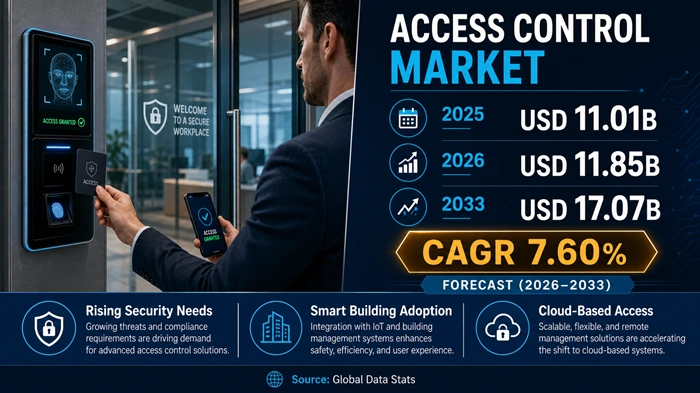
The global access control market size is valued at USD 11.01 billion in 2025 and is predicted to increase from USD 11.85 billion in 2026 to approximately USD 17.07 billion by 2033, growing at a CAGR of 7.60% from 2026 to 2033.
The access control market represents a critical component of modern security infrastructure, encompassing solutions that regulate and monitor physical and digital entry points across commercial, residential, government, and industrial facilities.
Growing security concerns, increasing cyber threats, and the rapid adoption of advanced technologies such as biometrics, artificial intelligence, and cloud-based solutions are driving unprecedented demand for sophisticated access control systems worldwide. Organizations across industries are investing heavily in these systems to protect valuable assets, ensure regulatory compliance, and enhance operational efficiency through real-time monitoring and centralized management capabilities.
AI Impact on the Access Control Industry
Transforming Security Through Intelligent Automation and Predictive Capabilities
Artificial intelligence is fundamentally reshaping the access control market by introducing intelligent automation, predictive threat detection, and adaptive decision-making capabilities that significantly enhance security effectiveness. AI algorithms enable advanced pattern recognition in biometric systems, allowing for more accurate identification even in challenging conditions while reducing false rejections and unauthorized access attempts. Machine learning models continuously analyze access patterns to identify anomalies, predict potential security breaches, and automatically adjust security protocols based on real-time risk assessments.
The integration of AI with access control systems extends beyond basic authentication to enable sophisticated applications such as behavioral biometrics, facial recognition under various lighting conditions, and multi-factor authentication that adapts based on threat levels. AI-powered access control solutions provide organizations with autonomous defense capabilities that scale security operations without proportional increases in personnel, allowing security teams to focus on strategic initiatives while AI handles routine monitoring and threat detection. Furthermore, AI-driven analytics provide valuable insights into facility usage patterns, enabling organizations to optimize space allocation, improve energy efficiency, and enhance overall operational decision-making.
Growth Factors
Rising Security Threats and Regulatory Compliance Requirements Fuel Market Expansion
The escalating frequency and sophistication of security threats, including data breaches, unauthorized physical access, theft, and cyber-attacks, are compelling organizations to implement robust access control market solutions across all operational facilities. Commercial enterprises, government agencies, and industrial facilities face mounting pressure to protect sensitive information, valuable assets, and personnel from both external threats and internal vulnerabilities. Regulatory bodies worldwide are enforcing stricter compliance requirements across industries such as healthcare, finance, and government, mandating implementation of certified access control systems that demonstrate expertise, authoritativeness, and trustworthiness in protecting critical infrastructure.
Technological advancements in biometric authentication, Internet of Things integration, cloud-based management platforms, and mobile credentials are removing traditional barriers to adoption while simultaneously expanding functionality and improving user experience. The proliferation of smart city initiatives, urban development projects, and intelligent building systems creates substantial opportunities for access control integration, as these solutions become foundational components of comprehensive security ecosystems. Additionally, the shift toward hybrid work environments and the increasing adoption of bring-your-own-device policies necessitate flexible, scalable access control solutions that can accommodate diverse user populations and device types while maintaining stringent security standards.
Market Outlook
Strong Growth Trajectory Driven by Digital Transformation and Security Innovation
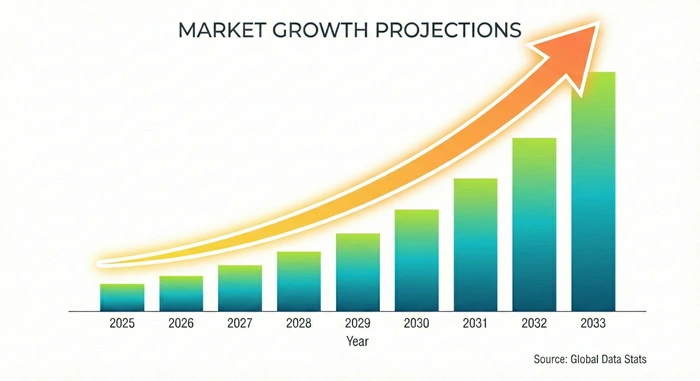
The access control market outlook remains exceptionally positive as organizations across industries prioritize security investments and embrace digital transformation initiatives that incorporate advanced authentication technologies. The transition from traditional lock-and-key systems to intelligent, networked solutions represents a fundamental shift in how organizations approach physical and logical security, creating sustained demand for hardware upgrades, software platforms, and managed services. Market participants are expanding their geographical reach through strategic partnerships, mergers and acquisitions, and collaborative alliances that enhance product portfolios and strengthen distribution networks.
Cloud-based access control solutions are experiencing particularly rapid growth as organizations recognize the advantages of centralized management, remote monitoring capabilities, reduced infrastructure costs, and seamless scalability. The residential segment presents significant expansion opportunities as smart home adoption accelerates and consumers increasingly value convenience, remote management, and integration with broader home automation ecosystems. Industry analysts project that continued innovation in contactless authentication, mobile credentials, and biometric technologies will sustain market momentum throughout the forecast period, with particularly strong growth anticipated in emerging markets where infrastructure development and security awareness are rising rapidly.
Expert Speaks
-
Tomer Weingarten, Co-Founder and CEO of SentinelOne, emphasized that in 2026, AI serves as the ultimate force multiplier for security ecosystems, enabling partners to scale services without linearly increasing headcount while delivering faster and more effective security outcomes through autonomous AI-powered defense mechanisms.
-
Kevin Lynch, CEO and Board Member of Optiv, stated that 2026 represents a defining year for cybersecurity where innovation accelerates rapidly, threat actors become increasingly adaptive, and organizations must view cybersecurity as a fundamental business strategy rather than a technical afterthought to maintain competitive advantage.
-
Industry leaders across major security technology providers collectively acknowledge that technology rationalization has transitioned from a recommendation to a strategic mandate, with boards demanding evidence of return on investment for every security expenditure, consolidation of overlapping tools, and clear demonstrations of how security investments enhance organizational resilience.
Key Report Takeaways
-
North America leads the global access control market with over 40% market share in 2025, driven by substantial commercial sector investments and high security awareness across enterprises, while the region is projected to maintain dominance throughout the forecast period due to continued adoption of advanced technologies and stringent regulatory requirements.
-
Asia Pacific represents the fastest-growing regional market, expected to register the highest CAGR from 2026 to 2033, fueled by rising incidents of security breaches, rapid urbanization, government infrastructure investments, and increasing adoption of smart building technologies across emerging economies.
-
The commercial industry vertical dominates market applications, accounting for more than 35% share in 2025, as businesses invest heavily in protecting valuable assets, ensuring employee safety, and maintaining compliance with regulatory standards, while the residential segment shows accelerated growth potential driven by smart home adoption.
-
Hardware components maintain market leadership with 54% share in 2025, encompassing biometric scanners, electronic locks, card readers, and access control panels, though software solutions are anticipated to grow at faster rates throughout the forecast period due to increasing demand for centralized management platforms.
-
Managed services represent the fastest-growing service category, holding over 40% market share in 2025 with robust growth expected through 2033, as organizations increasingly prefer outsourced security management that centralizes access privilege administration and reduces internal resource requirements.
-
Biometric authentication technology demonstrates exceptional growth potential, with facial recognition and fingerprint scanning systems gaining widespread adoption across commercial, government, and residential applications due to enhanced security, improved user experience, and decreasing technology costs.
Market Scope
| Report Coverage Details | |
|---|---|
| Market Size by 2033 | USD 17.07 Billion |
| Market Size by 2025 | USD 11.01 Billion |
| Market Size by 2026 | USD 11.85 Billion |
| Market Growth Rate from 2026 to 2033 | CAGR of 7.60% |
| Dominating Region | North America |
| Fastest Growing Region | Asia Pacific |
| Base Year | 2025 |
| Forecast Period | 2026 to 2033 |
| Segments Covered | Component, Service Type, Industry Vertical, Technology, Region |
| Regions Covered | North America, Europe, Asia Pacific, Latin America, Middle East & Africa |
Market Dynamics
Drivers Impact Analysis
Escalating Security Concerns and Technological Advancements Propel Market Growth
| Factor | (≈) % Impact on CAGR Forecast | Geographic Relevance | Impact Timeline |
|---|---|---|---|
| Rising security threats and cyber-attacks | 2.5% | Global, particularly North America and Europe | Immediate and ongoing |
| Smart city and IoT integration | 1.8% | Asia Pacific, North America | Medium to long-term |
| Cloud-based solution adoption | 1.5% | Global focus | Immediate to medium-term |
| Regulatory compliance requirements | 1.2% | North America, Europe | Ongoing |
The accelerating frequency of security breaches, data theft, unauthorized access incidents, and sophisticated cyber-attacks is fundamentally driving demand for advanced access control market solutions across all industry verticals and geographic regions. Organizations recognize that traditional security measures prove inadequate against modern threats, necessitating intelligent systems that provide real-time monitoring, automated threat detection, and comprehensive audit trails to protect physical and digital assets. Commercial enterprises, particularly those managing sensitive data or high-value assets, are investing substantially in multi-layered access control systems that integrate biometric authentication, behavioral analytics, and adaptive security protocols to minimize vulnerability to both external attacks and internal threats.
Technological innovation continues transforming the access control market landscape through integration of artificial intelligence, machine learning algorithms, biometric recognition systems, and Internet of Things connectivity that dramatically enhance system capabilities while improving user experience. Cloud-based platforms enable centralized management of distributed facilities, remote monitoring capabilities, automatic software updates, and scalable architecture that adapts to organizational growth without requiring substantial infrastructure investments. Mobile credential adoption eliminates traditional physical access cards, providing users with convenient smartphone-based authentication that supports biometric verification, multi-factor authentication, and dynamic credential issuance while reducing administrative overhead and improving security through encrypted communications.
Restraints Impact Analysis
High Implementation Costs and Integration Challenges Moderate Adoption Rates
| Factor | (≈) % Impact on CAGR Forecast | Geographic Relevance | Impact Timeline |
|---|---|---|---|
| High initial investment costs | -1.5% | Emerging markets, small businesses | Short to medium-term |
| Legacy system integration complexity | -0.8% | Established enterprises globally | Medium-term |
| Privacy and data security concerns | -0.6% | Europe, North America | Ongoing |
| Technical skill gaps | -0.5% | Developing regions | Medium to long-term |
Substantial upfront costs associated with hardware procurement, software licensing, professional installation, system configuration, and employee training present significant barriers to access control market adoption, particularly for small and medium-sized enterprises with limited capital budgets and emerging market organizations facing economic constraints. Advanced biometric systems, enterprise-grade access control panels, encrypted communication infrastructure, and comprehensive management software require considerable initial investment that may not deliver immediate return on investment, causing budget-conscious organizations to delay implementation or opt for less sophisticated solutions that provide adequate security without premium features.
Organizations with existing security infrastructure face complex integration challenges when attempting to modernize legacy systems or incorporate new access control market technologies into established environments, often encountering compatibility issues, protocol mismatches, and architectural limitations that increase implementation costs and extend deployment timelines. Privacy concerns surrounding biometric data collection, storage security, regulatory compliance requirements, and potential misuse of personal information create hesitation among some organizations and individual users, particularly in regions with strict data protection regulations that impose substantial liability for security breaches or unauthorized data access. Additionally, successful implementation and ongoing management of sophisticated access control systems require specialized technical expertise that remains scarce in many markets, limiting adoption among organizations lacking internal capabilities or access to qualified service providers.
Opportunities Impact Analysis
Emerging Technologies and Market Expansion Create Substantial Growth Prospects
| Factor | (≈) % Impact on CAGR Forecast | Geographic Relevance | Impact Timeline |
|---|---|---|---|
| Residential and smart home adoption | 1.3% | Global, particularly developed markets | Medium to long-term |
| AI and predictive analytics integration | 1.1% | North America, Asia Pacific | Medium-term |
| Contactless and touchless solutions | 0.9% | Global focus | Immediate to medium-term |
| Emerging market infrastructure development | 0.7% | Asia Pacific, Latin America, Middle East | Long-term |
The residential market segment presents exceptional growth opportunities for the access control market as smart home adoption accelerates globally and consumers increasingly prioritize convenience, remote management capabilities, and integration with comprehensive home automation ecosystems. Modern residential access control solutions provide homeowners with smartphone-based controls, visitor management features, temporary credential issuance for service providers, and seamless integration with video surveillance, alarm systems, and voice-activated virtual assistants that enhance both security and lifestyle convenience. Market penetration in residential applications remains relatively low compared to commercial adoption, indicating substantial untapped potential as technology costs decline, installation processes simplify, and consumer awareness increases regarding smart home security benefits.
Artificial intelligence integration creates transformative opportunities within the access control market by enabling predictive threat detection, behavioral biometric authentication, automated incident response, and intelligent analytics that provide actionable insights beyond traditional access logging. AI-powered systems can identify unusual access patterns, predict potential security incidents before they occur, automatically adjust authentication requirements based on real-time risk assessment, and provide facility managers with optimization recommendations regarding space utilization and operational efficiency. The global shift toward contactless interactions, accelerated by health concerns and hygiene awareness, drives demand for touchless biometric systems, mobile credentials, and proximity-based authentication that eliminate physical contact with shared surfaces while maintaining robust security standards. Rapid infrastructure development across emerging markets in Asia Pacific, Latin America, and the Middle East creates substantial demand for modern security systems as new commercial buildings, residential complexes, government facilities, and industrial sites incorporate access control as foundational components of their security architecture.
Segment Analysis
Hardware Component Dominance
Physical Infrastructure Maintains Leadership Through Essential System Foundation
Hardware components maintain a commanding position within the access control market, accounting for approximately 54% of total market share in 2025, as these physical elements constitute the foundational infrastructure upon which all access control functionality depends. This segment encompasses diverse products including biometric scanners such as fingerprint readers and facial recognition cameras, electronic locks and electromechanical strikes, proximity card readers supporting various credential formats, access control panels serving as system controllers, and specialized devices like turnstiles, security gates, and mantrap systems for high-security applications. Organizations continue prioritizing hardware investments because these tangible components directly interface with users, physically secure entry points, and determine system reliability, with many enterprises adopting hardware sales-driven business models that bundle equipment procurement with ongoing maintenance contracts.
North America leads global hardware adoption with substantial commercial sector demand driven by office tower retrofits, mixed-use development projects, and return-to-office initiatives that necessitate upgraded credential management systems supporting multi-tenant environments. Leading manufacturers including ASSA ABLOY from Sweden, dormakaba Group from Switzerland, and Allegion from Ireland dominate the hardware segment through extensive product portfolios, established distribution networks, and strong relationships with system integrators and security consultants who specify their products for major installations. The Asia Pacific region demonstrates the fastest hardware growth rate, with emerging economies investing heavily in security infrastructure for new construction projects, government facilities, and commercial developments where modern access control market systems become mandatory components of building codes and security standards. Despite software segment growth outpacing hardware in percentage terms, the hardware component will maintain significant absolute value throughout the forecast period as system expansions, technology upgrades, and replacement cycles drive continuous demand for physical access control devices.
Software Segment Rapid Growth
Centralized Management Platforms Drive Accelerated Software Adoption
Software solutions represent the fastest-growing component within the access control market, experiencing rapid adoption as organizations recognize that centralized management platforms, analytics capabilities, and system integration features provide substantial operational advantages beyond basic access control functionality. Modern access control software enables administrators to manage user credentials across multiple facilities from unified interfaces, establish sophisticated access policies based on roles and time parameters, generate comprehensive audit reports for compliance documentation, and integrate with complementary security systems including video surveillance, intrusion detection, and visitor management platforms. Cloud-based software architectures particularly accelerate segment growth by eliminating on-premises server requirements, enabling remote system management from any internet-connected device, providing automatic software updates that maintain security currency, and offering scalable pricing models that reduce initial investment barriers.
Integrated access control software commands approximately 45% of the North American component market in 2025, reflecting strong enterprise demand for solutions that consolidate security management, enforce policy-based access controls, and track real-time facility activity through intuitive dashboards that support data-driven decision making. Major software providers including Johnson Controls from Ireland, Honeywell International from the United States, and NEC Corporation from Japan invest heavily in research and development to enhance their platforms with artificial intelligence capabilities, predictive analytics, mobile management applications, and application programming interfaces that facilitate integration with enterprise systems. The access control market software segment particularly benefits from recurring revenue models through subscription-based pricing, annual maintenance contracts, and ongoing support services that provide vendors with predictable income streams while giving customers continuous access to latest features and security updates. Europe demonstrates strong software adoption driven by stringent data protection regulations requiring comprehensive access logging and audit capabilities, while Asia Pacific markets show accelerating interest as organizations transition from standalone systems to networked solutions supporting distributed operations.
Regional Insights
North America Market Leadership
Established Security Infrastructure and Commercial Investment Drive Regional Dominance
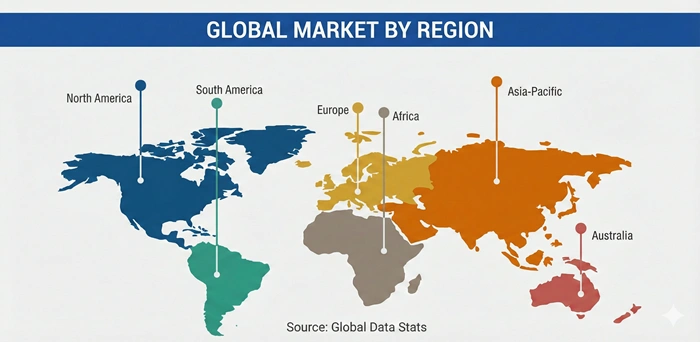
North America commands the global access control market with over 40% regional share in 2025, maintaining leadership through substantial commercial sector investments, high security awareness among enterprises, widespread technology adoption, and stringent regulatory environments that mandate robust access control implementations across multiple industries. The United States represents the primary growth engine within North America, with the national market valued at USD 3.79 billion in 2025 and projected to reach USD 3.94 billion in 2026, driven by extensive commercial building portfolios, return-to-office initiatives following remote work transitions, and ongoing modernization of legacy security systems across corporate campuses. Commercial buildings contribute approximately 42% of regional demand, reflecting the concentration of office towers, mixed-use developments, and retail facilities that require sophisticated multi-tenant credential management, occupancy analytics integration, and environmental systems coordination.
Major corporations headquartered throughout North America, including technology giants, financial institutions, healthcare organizations, and manufacturing enterprises, prioritize access control market investments to protect intellectual property, ensure employee safety, maintain regulatory compliance, and demonstrate commitment to stakeholder security. Leading regional suppliers such as Honeywell International, Allegion, and AMAG Technology maintain strong market positions through comprehensive product portfolios spanning hardware, software, and services, complemented by extensive channel partner networks and established relationships with security integrators serving enterprise clients. Government facilities at federal, state, and local levels implement advanced access control systems supporting multi-factor authentication, biometric verification, and comprehensive audit capabilities to protect sensitive information and critical infrastructure in accordance with cybersecurity frameworks and physical security standards. The regional market demonstrates strong momentum for cloud-based solutions, with approximately 45% of North American deployments leveraging cloud architectures that enable centralized management of geographically distributed facilities, reduce on-premises infrastructure requirements, and facilitate rapid scaling to accommodate organizational growth.
Asia Pacific Fastest Growth
Rapid Urbanization and Infrastructure Investment Drive Exceptional Regional Expansion
Asia Pacific emerges as the fastest-growing regional access control market, expected to register the highest compound annual growth rate from 2026 to 2033, propelled by accelerating urbanization, substantial infrastructure investments, rising security awareness, increasing cyber threat incidents, and widespread adoption of advanced technologies across emerging economies. The region benefits from presence of numerous technology startups, established manufacturers, and growing demand across commercial, military and defense, government, and industrial verticals that collectively drive robust market expansion. China demonstrates particularly strong growth potential with government infrastructure investments and smart city initiatives expected to generate a CAGR exceeding 12% through 2033, while India, Southeast Asian nations, and developed markets including Japan, South Korea, and Australia contribute substantial demand across diverse application segments.
Commercial developments including office complexes, shopping centers, hospitality facilities, and mixed-use properties throughout Asia Pacific increasingly incorporate access control market solutions as standard security infrastructure, with developers recognizing that modern access management systems enhance property values, attract quality tenants, and satisfy corporate occupier requirements for sophisticated security capabilities. Regional technology leaders such as Suprema from South Korea, Dahua Technology from China, and Hikvision from China compete effectively against international suppliers through competitive pricing, localized product features, regional distribution networks, and government procurement preferences supporting domestic manufacturers. The region's substantial mobile workforce and widespread bring-your-own-device policies create unique security challenges that drive adoption of network access control systems providing authentication mechanisms and access control frameworks ensuring only authorized users and devices connect to corporate resources. Government cybersecurity initiatives throughout Asia Pacific, including regulatory frameworks requiring enhanced security postures and promotion of cybersecurity best practices, accelerate acceptance of access control solutions as essential components of comprehensive security strategies protecting critical infrastructure and sensitive data.
Top Key Players
-
ASSA ABLOY (Sweden)
-
dormakaba Group (Switzerland)
-
Johnson Controls (Ireland)
-
Allegion (Ireland)
-
Honeywell International Inc. (United States)
-
Thales Group (France)
-
Hanwha Techwin Co. Ltd. (South Korea)
-
Schneider Electric SE (France)
-
NEC Corporation (Japan)
-
IDEMIA (France)
-
Matrix Comsec (India)
-
AMAG Technology Inc. (United States)
-
HID Global (United States)
-
Gallagher Security (New Zealand)
-
Suprema Inc. (South Korea)
-
Dahua Technology Ltd. (China)
-
Hikvision (China)
-
ButterflyMX (United States)
-
Openpath (United States)
-
Genea (United States)
Recent Developments
-
ASSA ABLOY (2025): In January 2025, ASSA ABLOY signed a definitive agreement to acquire 3millID Corporation and Third Millennium Systems Ltd., specialized companies operating within the readers and credentials segment for physical access control based in the United States and United Kingdom, strengthening the company's technology portfolio and expanding its geographic reach in key markets.
-
Honeywell International (2024): In June 2024, Honeywell announced completion of its acquisition of Carrier Global Corporation's Global Access Solutions business for USD 4.95 billion, positioning Honeywell as a comprehensive provider of security solutions for the digital age with substantial opportunities for accelerated innovation in the fast-growing cloud-based services and solutions space.
-
Mobile Communications America (2025): In April 2025, Mobile Communications America announced acquisition of Presidio Inc.'s Physical Security Integration business, underscoring strategic commitment to providing innovative and customizable security solutions to clients while enhancing workplace safety, security, and operational efficiency capabilities.
-
Milestone Systems (2024): In July 2024, Milestone Systems announced its merger with cloud-based video surveillance solutions provider Arcules, combining their respective strengths in video management software, analytics capabilities, and cloud-based solutions to create an enhanced integrated security platform.
-
Suprema (2024): In July 2024, Suprema launched CLUe, an advanced cloud integration platform for biometric access control designed to provide scalable and centralized system management that promotes enhanced security effectiveness and operational efficiency across distributed facilities.
Market Trends
Contactless Authentication and Mobile Credentials Transform User Experience
The global transition toward contactless authentication methods and mobile credentials represents a fundamental shift in access control market technology adoption, driven by heightened hygiene awareness, user convenience preferences, and smartphone ubiquity across all demographic segments. Touchless biometric systems utilizing facial recognition, iris scanning, and palm vein recognition eliminate physical contact with shared surfaces while maintaining robust security standards, addressing both health concerns and operational efficiency objectives in high-traffic environments. Mobile credentials that transform smartphones into secure access devices provide users with convenient authentication experiences, enable temporary credential issuance for visitors and contractors, support remote management through cloud platforms, and incorporate multi-factor authentication combining device possession, biometric verification, and behavioral analytics.
Organizations increasingly recognize that mobile-based access control market solutions reduce administrative overhead associated with physical credential management, eliminate costs related to card production and distribution, and enhance security through encrypted communications and dynamic credential protocols that prove more difficult to compromise than traditional proximity cards. The popularity of smartphones and mobile device penetration globally facilitates rapid adoption of mobile access credentials, particularly among younger generations comfortable with smartphone-based authentication and organizations supporting bring-your-own-device policies that extend to physical access control. Technology vendors respond to market demand by developing comprehensive mobile credential ecosystems supporting multiple smartphone platforms, providing flexible deployment options accommodating diverse organizational requirements, and ensuring backward compatibility with existing access control infrastructure to facilitate gradual transition from traditional credentials.
Segments Covered in the Report
By Component:
-
Hardware
-
Biometric Readers
-
Card Readers
-
Electronic Locks
-
Access Control Panels
-
Multifactor Authentication Systems
-
-
Software
-
Access Control Management Software
-
Security Management Platforms
-
Integration Software
-
-
Services
-
Managed Services
-
Professional Services
-
By Service Type:
-
Managed Services
-
Professional Services
-
Installation and Integration
-
Support and Maintenance
-
Consulting Services
-
By Industry Vertical:
-
Commercial
-
Offices
-
Retail
-
Hospitality
-
-
Residential
-
Single-Family Homes
-
Multi-Family Buildings
-
Gated Communities
-
-
Government
-
Federal Facilities
-
State and Local Buildings
-
Critical Infrastructure
-
-
Industrial
-
Manufacturing Facilities
-
Warehouses
-
Logistics Centers
-
-
Healthcare
-
Education
-
Transportation
By Technology:
-
Biometric Systems
-
Fingerprint Recognition
-
Facial Recognition
-
Iris Recognition
-
Palm Vein Recognition
-
-
Card-Based Systems
-
Proximity Cards
-
Smart Cards
-
-
Cloud-Based Systems
-
Mobile-Based Systems
-
Hybrid Systems
By Region:
-
North America
-
United States
-
Canada
-
Mexico
-
-
Europe
-
United Kingdom
-
Germany
-
France
-
Italy
-
Spain
-
Rest of Europe
-
-
Asia Pacific
-
China
-
Japan
-
India
-
South Korea
-
Australia
-
Southeast Asia
-
Rest of Asia Pacific
-
-
Latin America
-
Brazil
-
Argentina
-
Rest of Latin America
-
-
Middle East & Africa
-
United Arab Emirates
-
Saudi Arabia
-
South Africa
-
Rest of Middle East & Africa
-
Frequently Asked Questions
Question 1: What is the projected access control market size by 2033?
Answer: The global access control market is projected to reach USD 17.07 billion by 2033, growing from USD 11.85 billion in 2026 at a CAGR of 7.60%.
Question 2: Which region dominates the access control market currently?
Answer: North America dominates the access control market with over 40% share in 2025, driven by substantial commercial investments and stringent regulatory requirements.
Question 3: What are the key drivers of access control market growth?
Answer: Key drivers include escalating security threats, regulatory compliance requirements, smart city initiatives, cloud-based solution adoption, and technological advancements in biometric authentication.
Question 4: Which industry vertical leads access control market adoption?
Answer: The commercial sector leads with more than 35% market share in 2025, driven by investments in protecting assets, ensuring employee safety, and maintaining compliance standards.
Question 5: How is AI transforming the access control market?
Answer: AI enables intelligent automation, predictive threat detection, behavioral biometrics, and adaptive security protocols that enhance access control effectiveness while reducing operational overhead.