
3D Printing in Medical Applications Market Overview
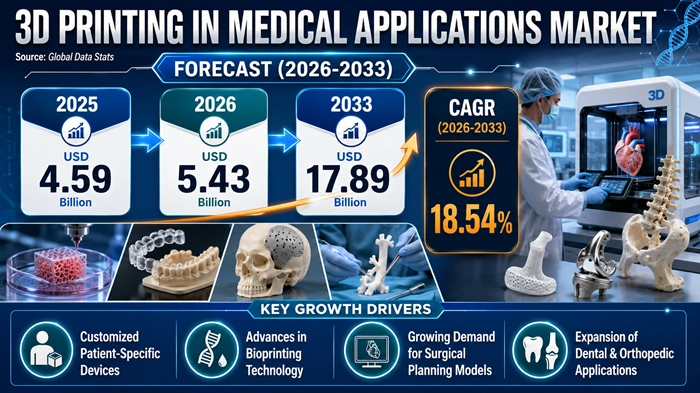
The global 3D printing in medical applications market size is valued at USD 4.59 billion in 2025 and is predicted to increase from USD 5.43 billion in 2026 to approximately USD 17.89 billion by 2033, growing at a CAGR of 18.54% from 2026 to 2033.
This technology uses additive manufacturing techniques to create patient-specific surgical guides, implants, prosthetics, anatomical models, and increasingly, bioprinted tissue structures directly from digital scans. Hospitals and medical device manufacturers are rapidly adopting these tools because they allow for highly customized solutions that fit individual patient anatomy far more precisely than mass-produced alternatives. Rising demand for personalized healthcare, advances in biocompatible printing materials, and growing surgical planning applications are together fueling strong, sustained growth across this fast-evolving segment of medical technology.
AI Impact on the 3D Printing in Medical Applications Industry
How Artificial Intelligence Is Accelerating Design Optimization, Surgical Planning, and Quality Control Across Medical 3D Printing Workflows
Artificial intelligence is playing an increasingly central role in how medical 3D printing companies design and validate patient-specific devices before they ever reach the printer. AI-powered image segmentation tools can now automatically convert CT and MRI scan data into precise 3D anatomical models in a fraction of the time it previously took skilled technicians to manually trace and reconstruct patient anatomy. This acceleration is particularly valuable for time-sensitive surgical cases where clinicians need patient-specific guides or implants produced quickly ahead of scheduled procedures.
Beyond design, machine learning algorithms are being deployed to predict and correct potential print failures before they occur, analyzing historical print data to flag material or structural issues that could compromise the final device. This is helping manufacturers reduce costly reprints and improve consistency across production batches, which matters greatly in a regulated medical device environment where quality control failures carry serious consequences. As AI-driven design automation and predictive quality tools become more sophisticated, companies operating in the 3D printing in medical applications market are increasingly using these capabilities to differentiate their platforms and win contracts with hospital systems seeking faster, more reliable turnaround times.
Growth Factors
Rising Demand for Personalized Implants, Advances in Biocompatible Materials, and Expanding Surgical Planning Adoption Are the Three Most Influential Growth Drivers
Growing clinical demand for patient-specific implants and prosthetics is one of the most powerful growth factors sustaining momentum in this market, as surgeons increasingly recognize that custom-fit devices produce better functional outcomes and shorter recovery times compared to standard, off-the-shelf alternatives. This is especially true in complex orthopedic, craniomaxillofacial, and dental procedures, where anatomical variation between patients makes generic implants far less effective. As hospitals continue investing in in-house or outsourced 3D printing capabilities to support these procedures, demand for medical-grade printing systems and materials keeps expanding steadily.
Continuous advances in biocompatible printing materials represent a second significant driver, as newer polymers, metals, and bioresorbable materials allow manufacturers to produce implants and devices that integrate more safely and effectively with human tissue. The broader expansion of 3D-printed anatomical models for preoperative surgical planning is also gaining strong traction, as surgeons use these physical models to rehearse complex procedures and improve precision during actual operations. Combined with growing interest in bioprinting research aimed at eventually producing functional tissue and organ structures, these factors continue reinforcing durable, multi-year demand growth across the global 3D printing in medical applications market.
Market Outlook
The 3D Printing in Medical Applications Market Is Positioned for Rapid Expansion Through 2033 as Personalized Medicine Becomes Mainstream
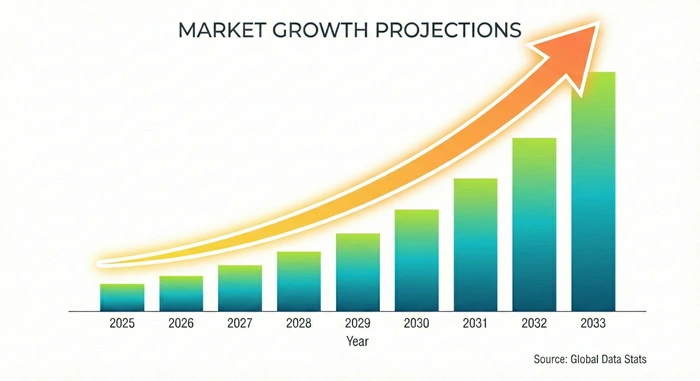
The long-term outlook for medical 3D printing remains extremely strong as personalized medicine continues moving from a specialized niche into standard clinical practice across major hospital systems. As printing speed increases and material costs decline, more hospitals are expected to bring 3D printing capabilities in-house rather than relying entirely on outsourced service providers, creating new revenue opportunities for equipment and material manufacturers. This shift toward point-of-care manufacturing is likely to reshape the competitive landscape, favoring companies that can deliver compact, hospital-friendly printing systems alongside their traditional industrial-scale offerings.
Looking further ahead, continued research investment in bioprinting technology is expected to gradually unlock more advanced applications, including functional tissue constructs and eventually more complex organ structures, though full clinical translation of these capabilities remains a longer-term prospect. Growing regulatory clarity around 3D-printed medical devices in major markets is also expected to accelerate adoption by reducing approval uncertainty for manufacturers. These dynamics point toward a 3D printing in medical applications market that will remain one of the fastest-growing segments within the broader medical technology industry through 2033.
Expert Speaks
-
"Personalized, patient-specific devices are no longer a novelty in medicine; they are becoming an expected standard of care, and our continued investment in medical-grade 3D printing platforms reflects that shift." — CEO, Stratasys Ltd.
-
"We are seeing accelerating hospital adoption of point-of-care 3D printing for surgical planning and custom implants, and this trend is reshaping how we design our medical technology portfolio." — CEO, 3D Systems Inc.
-
"Advances in biocompatible materials are opening entirely new clinical applications for additive manufacturing, and we expect this momentum to continue strongly across the medical device industry." — CEO, GE HealthCare.
Key Report Takeaways
-
North America leads the 3D printing in medical applications market with an estimated 40% revenue share in 2025, supported by advanced healthcare infrastructure, strong regulatory frameworks, and high adoption of personalized surgical solutions.
-
Asia Pacific is the fastest-growing region, projected to expand at a CAGR near 21% through 2033, driven by expanding healthcare investment, rising surgical volumes, and growing local manufacturing capacity across China and India.
-
Hospitals and ambulatory surgical centers represent the largest customer base, relying on 3D printing for custom surgical guides, implants, and preoperative planning models.
-
Prosthetics and implants applications contribute the most to overall demand, given their direct impact on patient outcomes in orthopedic and craniomaxillofacial procedures.
-
Fused deposition modeling technology remains the most widely used process, valued for its cost-effectiveness and versatility across anatomical model production.
-
The tissue engineering and bioprinting segment is projected to grow fastest going forward, expected to hold close to 18% market share by 2033 while expanding at a CAGR near 24% during the forecast period.
Market Scope
| Report Coverage Details | Details |
|---|---|
| Dominating Region | North America |
| Fastest Growing Region | Asia Pacific |
| Base Year | 2025 |
| Forecast Period | 2026 to 2033 |
| Segments Covered | By Technology, By Application, By End User, By Region |
| Regions Covered | North America, Europe, Asia Pacific, Latin America, Middle East & Africa |
Market Dynamics
Drivers Impact Analysis
Rising Demand for Personalized Implants and Advancing Biocompatible Materials Are the Most Commercially Significant Drivers of Market Growth
| Driver | (≈) % Impact on CAGR Forecast | Geographic Relevance | Impact Timeline |
|---|---|---|---|
| Growing clinical demand for patient-specific implants and prosthetics | ~35% | Global, led by North America | Short to long-term |
| Advances in biocompatible printing materials and polymers | ~28% | North America, Europe | Medium-term |
| Expanding use of 3D-printed models for preoperative surgical planning | ~22% | Global | Short to medium-term |
| Growing bioprinting research investment for tissue engineering | ~15% | North America, Europe, Asia Pacific | Long-term |
Growing clinical demand for patient-specific implants and prosthetics is the most powerful driver behind sustained investment in the 3D printing in medical applications market, as surgeons increasingly recognize that custom-fit devices deliver better functional outcomes than standard, mass-produced alternatives across complex orthopedic and craniomaxillofacial procedures. This clinical preference is creating durable, recurring demand from hospital systems and medical device manufacturers alike.
Advances in biocompatible printing materials are a second significant driver, enabling manufacturers to produce implants and devices that integrate more safely with human tissue while meeting increasingly rigorous regulatory standards. Combined with expanding use of 3D-printed anatomical models for preoperative surgical planning and growing bioprinting research investment, these drivers together sustain strong, multi-year demand growth across the global medical 3D printing landscape.
Restraints Impact Analysis
High Equipment Costs and Regulatory Approval Complexity Are the Two Primary Constraints Limiting Faster Market Growth
| Restraint | (≈) % Impact on CAGR Forecast | Geographic Relevance | Impact Timeline |
|---|---|---|---|
| High upfront cost of medical-grade 3D printing equipment and materials | ~34% | Global | Short to medium-term |
| Complex regulatory approval pathways for patient-specific devices | ~31% | North America, Europe | Medium-term |
| Limited reimbursement coverage for 3D-printed medical devices | ~21% | Global | Short-term |
| Shortage of trained technicians for medical printing operations | ~14% | Asia Pacific, Latin America | Ongoing |
The high upfront cost of medical-grade 3D printing equipment and specialized biocompatible materials remains a meaningful barrier, particularly for smaller hospitals and clinics that lack the capital budget to invest in in-house printing capabilities. This cost sensitivity often pushes smaller healthcare providers toward outsourced printing services rather than direct equipment ownership.
Complex regulatory approval pathways for patient-specific devices, which often require case-by-case clinical validation rather than standard mass-production approval processes, also slow the pace at which new applications reach clinical practice. Limited reimbursement coverage for 3D-printed devices in many healthcare systems further constrains broader hospital adoption. These restraints do not reverse the underlying growth trend but do introduce meaningful friction that moderates the pace of expansion within the 3D printing in medical applications market, particularly in cost-sensitive and less-regulated healthcare markets.
Opportunities Impact Analysis
Point-of-Care Hospital Printing and Bioprinting Research Breakthroughs Represent the Most Significant Untapped Growth Opportunities
| Opportunity | (≈) % Impact on CAGR Forecast | Geographic Relevance | Impact Timeline |
|---|---|---|---|
| Expansion of point-of-care 3D printing within hospital systems | ~37% | North America, Europe | Medium-term |
| Advancing bioprinting research toward functional tissue applications | ~34% | Global | Long-term |
| Growing medical device manufacturing capacity in emerging economies | ~29% | Asia Pacific, Latin America | Medium to long-term |
Expanding point-of-care 3D printing capabilities directly within hospital systems presents a significant opportunity for equipment manufacturers, as more healthcare providers seek to reduce turnaround times for custom surgical guides and implants by printing on-site rather than outsourcing to external service bureaus. Companies that can deliver compact, easy-to-operate printing systems suited to clinical environments are well positioned to capture this growing segment.
Continued advances in bioprinting research toward functional tissue and eventually organ applications represent a longer-term but potentially transformative opportunity for companies willing to invest in this frontier technology. Growing medical device manufacturing capacity across emerging economies in Asia Pacific and Latin America also creates significant expansion opportunities as local healthcare infrastructure investment accelerates, positioning early-moving companies to capture a growing share of the global 3D printing in medical applications market.
Segment Analysis
By Application
Prosthetics and Implants Applications Anchor the Largest Share Within 3D Printing in Medical Applications Market Demand
Prosthetics and implants applications hold the largest share of the 3D printing in medical applications market, accounting for roughly 36% of total application revenue with a CAGR near 19% through 2033. Surgeons increasingly rely on custom-printed implants for orthopedic, dental, and craniomaxillofacial procedures because these devices fit individual patient anatomy far more precisely than standardized alternatives. North America leads this segment because of its advanced healthcare infrastructure and strong regulatory pathways supporting patient-specific device approval. Leading companies operating in this space include Stratasys, 3D Systems, and Materialise, each maintaining strong hospital and medical device manufacturer relationships across the region.
Surgical guides and preoperative planning models represent the second-largest application segment, benefiting from growing surgeon preference for physical anatomical models that allow procedure rehearsal before actual operations. This application segment is expanding especially quickly across Asia Pacific, where rising surgical volumes and expanding hospital infrastructure are driving strong adoption of 3D-printed planning tools. Companies such as EnvisionTEC and various regional medical technology providers have built strong reputations delivering surgical planning solutions across this growing geography. Growing surgeon confidence in 3D-printed planning accuracy continues to reinforce demand growth across both leading application segments within the 3D printing in medical applications market.
By Technology
Fused Deposition Modeling and Stereolithography Represent the Two Most Widely Adopted Technologies in Medical 3D Printing
Fused deposition modeling accounts for a substantial share of the 3D printing in medical applications market, supported by strong CAGR growth near 17% as hospitals and manufacturers favor this cost-effective, versatile technology for producing anatomical models and surgical guides. This technology's relative affordability and ease of operation make it particularly popular among hospitals building in-house printing capabilities for the first time. Companies such as Stratasys and 3D Systems have established leading positions in this technology category through continuous improvements in print speed and material compatibility.
Stereolithography represents a fast-growing technology segment, expected to expand at a CAGR near 21% through 2033 as manufacturers increasingly favor its superior surface finish and precision for producing detailed surgical guides and dental applications. Europe is showing particularly strong growth in this technology category, driven by advanced dental and orthopedic device manufacturing capacity across the region. Companies including EOS GmbH and Formlabs maintain strong positions serving this precision-focused technology segment, reinforcing steady growth across both leading technology categories within the broader 3D printing in medical applications market.
Regional Insights
North America
Advanced Healthcare Infrastructure and Strong Regulatory Frameworks Keep North America at the Top of the 3D Printing in Medical Applications Market
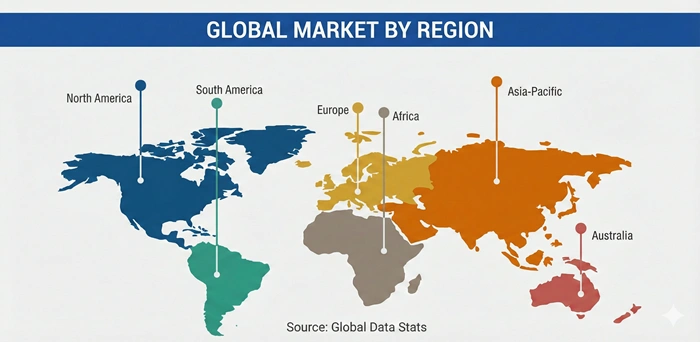
North America commands the largest share of the global 3D printing in medical applications market, holding close to 40% of total revenue in 2025 with a regional CAGR near 17% through 2033. Advanced healthcare infrastructure, strong regulatory frameworks supporting patient-specific device approval, and high adoption of personalized surgical solutions keep demand consistently strong throughout the region. Leading companies such as Stratasys and 3D Systems, both headquartered in the United States, dominate medical printing equipment and material contracts across major hospital systems and medical device manufacturers.
The region's mature reimbursement environment, combined with strong academic and research investment in bioprinting technology, further reinforces this leadership position within the broader medical technology landscape. Large hospital networks routinely integrate 3D printing capabilities into surgical planning workflows for complex orthopedic and craniomaxillofacial procedures. This combination of infrastructure maturity, regulatory clarity, and clinical adoption ensures North America remains the anchor region for 3D printing in medical applications market revenue generation over the coming years.
Asia Pacific
Expanding Healthcare Investment and Rising Surgical Volumes Make Asia Pacific the Fastest-Growing Region
Asia Pacific is the fastest-growing region in the 3D printing in medical applications market, projected to expand at a CAGR near 21% through 2033 while currently holding around 23% of global revenue share. Expanding healthcare investment, rising surgical procedure volumes, and growing local manufacturing capacity across China and India are together driving this accelerated regional growth. Companies such as United Imaging Healthcare in China and various regional medical device manufacturers are scaling operations rapidly to meet surging demand for personalized surgical solutions.
Growing government investment in advanced healthcare infrastructure, combined with rising middle-class populations demanding better access to specialized surgical procedures, continues to widen the region's addressable opportunity for medical 3D printing providers. Japan, South Korea, and Australia are also contributing meaningfully through mature healthcare systems and growing interest in personalized implant technology. As regulatory frameworks mature and local manufacturing capacity expands further, Asia Pacific is expected to narrow its overall revenue gap with North America over the coming several years within the broader 3D printing in medical applications market.
Customization Available for This Report
Region-wise and country-wise customized reports are available for organizations seeking deeper geographic insight into the 3D printing in medical applications market. Our research team can tailor market analysis, competitive intelligence, trends, and growth opportunities specifically for any of the regions and countries listed below, offering detailed information aligned to your selected market and keyword combination.
North America
-
U.S., Canada, Mexico — detailed hospital adoption trends, regulatory pathway analysis, and competitive positioning
Europe
-
U.K., Germany, France, Italy, Rest of Europe — dental and orthopedic manufacturing trends and key player analysis
Asia Pacific
-
China, India, Japan, South Korea, Australia, Rest of Asia Pacific — healthcare infrastructure investment, surgical volume growth, and local manufacturer analysis
Latin America
-
Brazil, Argentina, Rest of Latin America — emerging hospital adoption and market entry opportunities
Middle East & Africa
-
UAE, Saudi Arabia, Rest of MEA — healthcare investment trends and specialized surgical center growth
Top Key Players
-
Stratasys Ltd. (United States)
-
3D Systems Inc. (United States)
-
Materialise NV (Belgium)
-
EOS GmbH (Germany)
-
Formlabs Inc. (United States)
-
GE HealthCare Technologies Inc. (United States)
-
Renishaw plc (United Kingdom)
-
EnvisionTEC Inc. (United States)
-
Organovo Holdings Inc. (United States)
-
United Imaging Healthcare Co. Ltd. (China)
-
Nano Dimension Ltd. (Israel)
-
Desktop Metal Inc. (United States)
Recent Developments
-
In 2025, Stratasys expanded its medical-grade material portfolio to support a broader range of biocompatible surgical guide and anatomical model applications.
-
In 2025, Materialise strengthened its partnership network with major hospital systems to expand point-of-care 3D printing adoption for personalized surgical planning.
-
In 2025, 3D Systems introduced enhanced software tools for automated patient-specific implant design, reducing production turnaround time for hospital customers.
-
In 2026, GE HealthCare deepened investment in additive manufacturing research aimed at expanding personalized orthopedic implant capabilities.
-
In 2026, EOS GmbH advanced its metal 3D printing systems for medical device manufacturing, improving precision for complex implant geometries.
Market Trends
Convergence of Point-of-Care Printing, Bioprinting Research, and Personalized Medicine Is Reshaping the 3D Printing in Medical Applications Landscape
One of the clearest trends shaping the industry is the growing shift toward point-of-care 3D printing directly within hospital systems, allowing clinicians to produce custom surgical guides and anatomical models on-site rather than waiting for outsourced service providers. This is significantly reducing turnaround times for time-sensitive surgical cases and is pushing more hospitals to invest in dedicated in-house printing capabilities.
A second notable trend is the accelerating research investment in bioprinting technology aimed at eventually producing functional tissue constructs, reflecting the broader industry ambition to move beyond structural implants toward biologically integrated solutions. As personalized medicine continues gaining mainstream clinical acceptance and printing technology becomes more accessible to smaller healthcare providers, this trend is reinforcing sustained long-term demand growth across the 3D printing in medical applications market.
Segments Covered in the Report
By Technology
-
Stereolithography
-
Fused Deposition Modeling
-
Selective Laser Sintering
-
Electron Beam Melting
-
Others
By Application
-
Surgical Guides
-
Prosthetics and Implants
-
Tissue Engineering
-
Wearable Devices
-
Others
By End User
-
Hospitals
-
Ambulatory Surgical Centers
-
Research Institutes
-
Others
By Region
-
North America (U.S., Canada, Mexico)
-
Europe (U.K., Germany, France, Italy, Rest of Europe)
-
Asia Pacific (China, India, Japan, South Korea, Australia, Rest of Asia Pacific)
-
Latin America (Brazil, Argentina, Rest of Latin America)
-
Middle East and Africa (UAE, Saudi Arabia, Rest of MEA)
❝ Built for Every Level — From Startups to Industry Giants ❞
Here Is Exactly How This Report Works for You
-
For tier 1 medical technology companies and institutional investors, this report delivers granular competitor revenue analysis across Stratasys, 3D Systems, and Materialise, alongside geopolitical and regulatory risk assessment supporting confident investment and acquisition decisions.
-
For tier 2, tier 3 companies, medical technology startups, and mid-level manufacturers, this report identifies the highest-growth application segments and most commercially accessible regional markets, offering an evidence-based roadmap for entering or expanding within the 3D printing in medical applications market.
-
For all decision-makers across the medical device value chain, this report translates complex supply-demand shifts and evolving regulatory dynamics into clear, actionable strategic intelligence supporting stronger product development and commercialization decisions through 2033.
Frequently Asked Questions
Question 1: What is the current size of the 3D printing in medical applications market and how large will it grow by 2033?
Answer: The 3D printing in medical applications market was valued at USD 4.59 billion in 2025. It is projected to reach approximately USD 17.89 billion by 2033 at a CAGR of 18.54%.
Question 2: Which region leads the 3D printing in medical applications market today?
Answer: North America leads the 3D printing in medical applications market with roughly 40% revenue share. Advanced healthcare infrastructure and strong regulatory frameworks support this position.
Question 3: Which region is growing the fastest in the 3D printing in medical applications market?
Answer: Asia Pacific is the fastest-growing region in the 3D printing in medical applications market. Expanding healthcare investment and rising surgical volumes are driving this expansion.
Question 4: Who are the leading companies in the 3D printing in medical applications market?
Answer: Stratasys, 3D Systems, and Materialise are top companies in the 3D printing in medical applications market. They lead through strong hospital partnerships and medical-grade material innovation.
Question 5: Which application segment generates the most demand in the 3D printing in medical applications market?
Answer: Prosthetics and implants generate the largest share of demand in the 3D printing in medical applications market. Surgical guides and planning models form the fast-growing second-largest segment.