
3D Camera Market Overview
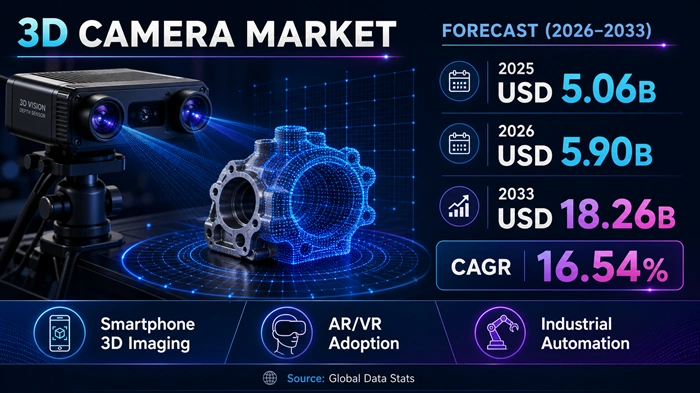
The global 3D camera market size is valued at USD 5.06 billion in 2025 and is predicted to increase from USD 5.90 billion in 2026 to approximately USD 18.26 Billion by 2033, growing at a CAGR of 16.54% from 2026 to 2033.
The 3D camera market encompasses imaging devices that capture depth information alongside standard two-dimensional visuals, creating three-dimensional representations of scenes and objects through advanced technologies including time-of-flight, stereo vision, and structured light.
Rising demand for immersive experiences, accelerating adoption of augmented reality and virtual reality technologies, and increasing integration of 3D cameras in consumer electronics drive substantial market expansion worldwide. Industries across entertainment, gaming, healthcare, manufacturing, autonomous vehicles, and robotics increasingly recognize that three-dimensional imaging delivers superior performance compared to traditional two-dimensional systems. The market benefits from technological advancements including artificial intelligence integration, improved depth sensing accuracy, miniaturization enabling smartphone incorporation, and enhanced processing capabilities that expand application possibilities.
AI Impact on the 3D Camera Industry
Intelligent Processing and Enhanced Depth Perception Transform Imaging Capabilities
Artificial intelligence is fundamentally revolutionizing the 3D camera market by introducing intelligent image processing, enhanced depth perception algorithms, and automated scene understanding capabilities that significantly improve imaging quality and expand application possibilities. AI algorithms enable 3D cameras to automatically identify objects within captured scenes, distinguish foreground elements from background components, optimize exposure settings based on lighting conditions, and generate highly accurate depth maps even in challenging environments with reflective surfaces or varying illumination. Machine learning models continuously improve depth estimation accuracy by training on extensive image datasets, allowing systems to predict missing depth information, fill gaps in point clouds, and deliver consistent performance across diverse real-world scenarios.
The integration of AI with 3D camera technology transforms industrial automation applications through intelligent defect detection, precise dimensional measurement, and automated quality control that reduces reliance on manual inspection processes. AI-powered 3D cameras in manufacturing environments automatically identify product anomalies, measure component dimensions with sub-millimeter accuracy, compare captured 3D models against design specifications, and flag deviations requiring corrective action without human intervention. Healthcare applications particularly benefit from AI-enhanced 3D imaging as autonomous diagnostic systems leverage depth-sensing capabilities combined with artificial intelligence to improve patient positioning, automate scanning procedures, verify image quality in real-time, and expand access to diagnostic services in underserved regions. Furthermore, AI-driven depth prediction enables consumer electronics including smartphones to deliver professional-quality portrait photography through accurate background blur simulation, enhanced augmented reality experiences through precise virtual object placement, and improved facial recognition security through three-dimensional biometric authentication.
Growth Factors
Consumer Electronics Integration and Immersive Technology Adoption Drive Market Expansion
The aggressive integration of 3D cameras into consumer electronics, particularly smartphones and tablets, represents the primary driver propelling 3D camera market growth as manufacturers differentiate products through advanced imaging capabilities that enhance photography, videography, and augmented reality experiences. Leading smartphone manufacturers including Apple, Samsung, and Huawei incorporate time-of-flight sensors and depth-sensing cameras into flagship devices enabling features such as portrait mode photography with precise background separation, face unlock biometric security, augmented reality applications with accurate virtual object placement, and enhanced low-light photography through improved computational imaging. Consumer demand for superior imaging quality, particularly among younger demographics who prioritize social media content creation and immersive experiences, motivates continuous innovation in 3D camera technology integrated into mobile devices.
The explosive growth of augmented reality and virtual reality applications across entertainment, gaming, education, and industrial training creates substantial demand for 3D cameras that capture immersive content and enable interactive experiences. Gaming consoles, VR headsets, and AR-enabled smartphones require depth-sensing cameras for motion tracking, gesture recognition, environmental mapping, and realistic virtual object interaction that delivers compelling user experiences. The 3D camera market benefits from industrial applications including manufacturing quality control, robotic vision systems, automated warehouse operations, and inventory management where three-dimensional imaging provides critical depth perception enabling precise object manipulation, collision avoidance, and dimensional verification. Additionally, autonomous vehicle development accelerates 3D camera adoption as self-driving systems require accurate depth perception for obstacle detection, distance measurement, pedestrian identification, and navigation in complex environments where LiDAR and radar systems complement camera-based perception.
Market Outlook
Technological Innovation and Expanding Applications Sustain Growth Momentum
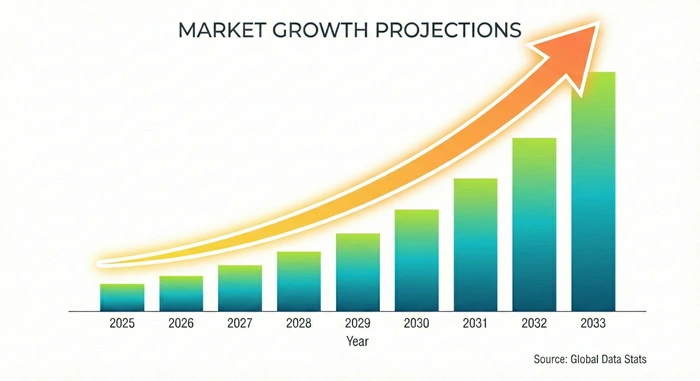
The 3D camera market outlook remains exceptionally positive as converging technological trends including 5G network deployment, edge computing advancement, and miniaturization enable new applications previously constrained by processing power, bandwidth limitations, or physical size requirements. Market participants continue investing heavily in research and development to enhance 3D camera performance through improved sensor resolution, extended depth sensing range, reduced power consumption, faster frame rates, and compact form factors suitable for space-constrained applications. The integration of time-of-flight technology with CMOS image sensors delivers cost-effective solutions that balance performance and affordability, accelerating mass market adoption across consumer electronics and industrial applications.
Smart home automation and security applications present substantial growth opportunities as 3D cameras enable advanced features including facial recognition access control, occupancy detection for energy management, fall detection for elderly care, and intrusion detection with improved accuracy compared to traditional 2D systems. The entertainment and media production industries demonstrate increasing adoption of professional-grade 3D cameras for content creation including 360-degree video production, volumetric capture for virtual reality experiences, motion capture for animation and visual effects, and three-dimensional live event broadcasting. Healthcare sectors show accelerating interest in 3D imaging for applications ranging from surgical planning and patient monitoring to telemedicine consultations and medical training simulations where depth perception enhances clinical outcomes. Industry analysts project continued market expansion throughout the forecast period with particularly strong growth anticipated in emerging markets where rising disposable incomes, smartphone penetration, and technology awareness create expanding customer bases.
Expert Speaks
-
Roland Rott, President and CEO of Imaging at GE HealthCare, emphasized that GE HealthCare remains committed to developing innovative technologies that redefine and enhance patient care, expressing enthusiasm about leveraging physical AI for autonomous imaging systems with NVIDIA technology to improve patient access and address critical challenges including growing workloads and persistent staffing shortages affecting healthcare facilities worldwide.
-
Suk-Jea Hahn, Executive Vice President of Samsung Electronics' Global Mobile B2B Team, stated that the Samsung 360 Round represents a testament to Samsung's leadership in the VR market, having developed a product containing innovative VR features that allow video producers and broadcast professionals to easily produce high-quality 3D content, with the combination of livestreaming capabilities, IP65 water and dust resistance, and 17 lenses making this camera ideal for diverse use cases.
-
Industry experts from Signify Research highlight that the medical imaging sector in 2026 emphasizes a fundamental shift from price-focused procurement to value-based acquisition and lifecycle management, with imaging systems required to move beyond hardware performance metrics to deliver measurable clinical, operational, and economic outcomes that address radiologist wellbeing and enable personalized patient care.
Key Report Takeaways
-
North America leads the global 3D camera market with substantial regional share driven by early technology adoption, strong presence of major technology companies, significant investment in AR and VR development, and advanced consumer electronics markets across the United States and Canada.
-
Asia Pacific represents the fastest-growing regional market, expected to register the highest CAGR exceeding 32% from 2026 to 2033, fueled by massive smartphone production capacity in China, rapid consumer electronics adoption across emerging economies, and substantial manufacturing sector investments in automation technologies.
-
Consumer electronics dominate market demand accounting for the largest application share in 2025 as smartphones, tablets, gaming consoles, and laptops increasingly incorporate 3D cameras for enhanced photography, augmented reality experiences, and biometric security features.
-
Time-of-flight technology maintains market leadership with approximately 40% share in 2025, valued for superior speed, accuracy, real-time depth sensing capabilities, and successful integration into smartphones, automotive systems, robotics, and industrial automation applications.
-
The augmented reality and virtual reality segment demonstrates fastest growth potential, projected to expand at exceptional CAGR through 2033, driven by aggressive 3D imaging integration in smartphones, increasing accessibility of AR and VR technologies, and innovations enabling single-exposure 3D data capture.
-
Target-free cameras represent the fastest-emerging product category expected to grow at accelerated rates as these systems deliver greater flexibility for diverse applications without requiring calibration targets, simplifying deployment across industrial inspection, robotics, and autonomous vehicle scenarios.
Market Scope
| Report Coverage Details | |
|---|---|
| Market Size by 2033 | USD 18.26 Billion |
| Market Size by 2025 | USD 5.06 Billion |
| Market Size by 2026 | USD 5.90 Billion |
| Market Growth Rate from 2026 to 2033 | CAGR of 16.54% |
| Dominating Region | North America |
| Fastest Growing Region | Asia Pacific |
| Base Year | 2025 |
| Forecast Period | 2026 to 2033 |
| Segments Covered | Technology, Type, Application, End User, Region |
| Regions Covered | North America, Europe, Asia Pacific, Latin America, Middle East & Africa |
Market Dynamics
Drivers Impact Analysis
Smartphone Proliferation and AR VR Adoption Accelerate Market Penetration
| Factor | (≈) % Impact on CAGR Forecast | Geographic Relevance | Impact Timeline |
|---|---|---|---|
| Consumer electronics integration | 5.2% | Global, particularly Asia Pacific | Immediate and ongoing |
| AR and VR technology growth | 4.3% | North America, Asia Pacific, Europe | Medium-term |
| Industrial automation demand | 3.7% | Global focus | Medium to long-term |
| Autonomous vehicle development | 2.8% | North America, Europe, China | Long-term |
The widespread integration of 3D cameras into consumer electronics, particularly smartphones and tablets, serves as the most significant driver propelling 3D camera market expansion globally. Smartphone manufacturers continuously enhance device differentiation through advanced imaging capabilities including portrait mode photography leveraging depth information for professional-quality background blur, facial recognition biometric security requiring precise three-dimensional face mapping, and augmented reality applications demanding accurate depth perception for realistic virtual object placement. The global smartphone market shipping over 1.2 billion units annually creates massive volume opportunities for 3D camera suppliers as penetration rates increase from flagship devices into mid-range segments through technology maturation and cost reduction. Consumer preferences, particularly among younger demographics, increasingly favor devices offering superior photography and video capabilities suitable for social media content creation, driving manufacturer investments in advanced imaging technologies.
The explosive growth of augmented reality and virtual reality applications across entertainment, gaming, education, remote collaboration, and industrial training creates substantial demand for 3D cameras capable of capturing immersive content and enabling interactive experiences. Gaming platforms integrate 3D cameras for motion tracking, gesture recognition, and full-body capture that delivers compelling interactive gameplay without traditional controllers, while VR content creation requires specialized cameras capturing 360-degree three-dimensional video for realistic virtual experiences. The 3D camera market benefits from industrial automation trends as manufacturers implement machine vision systems incorporating 3D imaging for quality inspection, dimensional measurement, robotic guidance, and bin picking applications where depth perception proves essential for reliable autonomous operation. Autonomous vehicle development programs across automotive manufacturers and technology companies require comprehensive perception systems combining 3D cameras with LiDAR and radar for redundant depth sensing supporting safe navigation, obstacle avoidance, and pedestrian detection in complex urban environments.
Restraints Impact Analysis
High Costs and Technical Complexity Create Adoption Barriers
| Factor | (≈) % Impact on CAGR Forecast | Geographic Relevance | Impact Timeline |
|---|---|---|---|
| High device and component costs | -2.1% | Price-sensitive emerging markets | Short to medium-term |
| Technical integration complexity | -1.4% | Industrial applications globally | Ongoing |
| Limited awareness and expertise | -1.1% | Emerging markets | Medium-term |
| Privacy and security concerns | -0.8% | Global, particularly Europe | Ongoing |
Substantial costs associated with professional-grade 3D cameras incorporating advanced sensors, precision optics, and sophisticated processing capabilities create significant barriers to 3D camera market adoption across price-sensitive applications and emerging market segments. High-end industrial 3D cameras suitable for manufacturing inspection, metrology, and robotic vision applications command prices ranging from thousands to tens of thousands of dollars, exceeding budget constraints for small and medium-sized enterprises seeking to implement automation technologies. Component costs including time-of-flight sensors, structured light projectors, high-resolution image sensors, and specialized processing units remain elevated compared to conventional 2D camera modules, limiting integration into cost-conscious consumer electronics below flagship smartphone tiers.
Technical complexity surrounding 3D camera integration, calibration, programming, and maintenance requires specialized engineering knowledge that many organizations lack internally, creating dependencies on external consultants and system integrators that increase implementation expenses and project timelines. The 3D camera market faces adoption challenges in industrial applications where successful deployment demands expertise in computer vision algorithms, point cloud processing, depth map optimization, and integration with robotic control systems or manufacturing execution platforms. Limited awareness and understanding of 3D camera benefits, capabilities, and application possibilities in emerging markets constrains adoption as potential customers remain unfamiliar with technology advantages compared to traditional 2D imaging systems. Additionally, privacy concerns surrounding facial recognition capabilities, depth mapping of living spaces, and biometric data collection create hesitation among consumers and regulatory scrutiny in regions with strict data protection regulations including Europe's General Data Protection Regulation.
Opportunities Impact Analysis
Emerging Applications and Technology Convergence Create Substantial Growth Prospects
| Factor | (≈) % Impact on CAGR Forecast | Geographic Relevance | Impact Timeline |
|---|---|---|---|
| Healthcare and medical imaging | 2.6% | Global, particularly developed markets | Medium-term |
| Smart home and IoT integration | 2.2% | North America, Europe, Asia Pacific | Medium-term |
| Drone and aerial imaging | 1.8% | Global focus | Medium to long-term |
| Retail and e-commerce applications | 1.5% | Global, particularly urban markets | Medium-term |
Healthcare and medical imaging applications present exceptional growth opportunities within the 3D camera market as hospitals, clinics, and medical device manufacturers adopt three-dimensional imaging for surgical planning, patient monitoring, diagnostic procedures, and telemedicine consultations where depth perception enhances clinical outcomes. Three-dimensional imaging enables precise anatomical reconstruction for surgical navigation, accurate wound measurement for healing assessment, non-contact patient positioning for radiation therapy, and realistic medical training simulations preparing practitioners for complex procedures. Autonomous imaging systems incorporating AI-powered 3D cameras address healthcare workforce shortages by automating patient positioning, optimizing scan parameters, and verifying image quality without constant technician supervision.
Smart home automation and Internet of Things integration create substantial opportunities as 3D cameras enable advanced features including gesture-based device control, occupancy detection for intelligent lighting and climate systems, fall detection for elderly care, and enhanced security through three-dimensional facial recognition that proves more difficult to spoof than 2D systems. The drone and unmanned aerial vehicle market demonstrates increasing adoption of 3D cameras for applications including aerial surveying, infrastructure inspection, precision agriculture, and environmental monitoring where depth information enhances data collection quality. Retail and e-commerce sectors show growing interest in 3D scanning solutions enabling virtual try-on experiences for clothing and accessories, accurate body measurement for custom sizing, three-dimensional product visualization, and augmented reality showroom experiences that bridge online and physical shopping. The 3D camera market benefits from entertainment content creation trends as streaming platforms, social media networks, and content creators demand tools for producing immersive experiences including 360-degree video, volumetric capture, and three-dimensional live broadcasting.
Segment Analysis
Time-of-Flight Technology Dominance
Speed and Accuracy Maintain Market Leadership Position
Time-of-flight technology commands the dominant position within the 3D camera market, accounting for approximately 40% of total market share in 2025, as this depth-sensing method delivers superior speed, accuracy, and real-time performance essential for diverse applications across consumer electronics, automotive systems, robotics, and industrial automation. ToF cameras measure depth by calculating the time required for emitted light pulses to reflect off objects and return to the sensor, enabling accurate distance measurement with minimal latency suitable for real-time applications requiring immediate depth information. The technology offers particular advantages including compact sensor designs suitable for smartphone integration, consistent performance across varying lighting conditions, and simplified processing requirements compared to stereo vision systems requiring extensive computational resources for depth calculation. Major smartphone manufacturers including Apple, Samsung, and Huawei incorporate ToF sensors into flagship devices for enhanced portrait photography, accurate augmented reality experiences, and secure facial recognition biometric authentication.
North America demonstrates particularly strong time-of-flight adoption with technology companies, automotive manufacturers, and industrial automation providers leveraging ToF cameras for applications ranging from autonomous vehicle perception to warehouse robotics, while leading manufacturers including Sony Corporation from Japan, Intel Corporation from the United States, and pmdtechnologies from Germany dominate the segment through advanced sensor technologies and established industry relationships. The 3D camera market ToF segment benefits from continuous innovation including longer sensing ranges extending depth measurement capabilities beyond five meters, higher resolution sensors capturing detailed depth maps, and improved power efficiency enabling extended battery life in mobile applications. Industrial automation particularly values ToF technology for robotic guidance, conveyor sorting, pallet dimensioning, and quality inspection where rapid depth acquisition enables high-speed processing without compromising accuracy. The automotive sector demonstrates accelerating ToF camera adoption for in-cabin monitoring systems tracking driver attention and occupant positioning, while autonomous vehicle programs integrate ToF sensors providing supplementary depth information complementing LiDAR and radar perception systems.
Consumer Electronics Application Leadership
Smartphone Integration Drives Substantial Market Share and Growth
The consumer electronics application segment maintains market leadership within the 3D camera market, representing the largest demand share in 2025 as smartphones, tablets, gaming consoles, and laptops increasingly incorporate three-dimensional imaging capabilities that enhance user experiences across photography, videography, gaming, and augmented reality. Smartphones particularly drive segment dominance as manufacturers differentiate flagship devices through advanced camera systems incorporating depth sensors enabling portrait mode photography with professional-quality background blur, night mode imaging enhanced by depth information, and augmented reality applications requiring accurate virtual object placement. The proliferation of short-form video content on social media platforms including TikTok, Instagram, and Snapchat motivates consumers to seek devices offering superior imaging capabilities, with 3D camera features providing competitive differentiation that influences purchasing decisions. Gaming applications leverage 3D cameras for immersive experiences including motion tracking that translates physical movements into game controls, facial expression capture for avatar animation, and full-body scanning for personalized character creation.
Asia Pacific leads consumer electronics adoption globally, driven by massive smartphone production in China, rapid technology acceptance across young demographics in India and Southeast Asia, and aggressive pricing strategies making advanced features accessible to broader market segments, while manufacturers including Samsung Electronics from South Korea, Xiaomi Corporation from China, and Oppo from China effectively serve regional consumers through competitively priced devices featuring 3D imaging capabilities. North America demonstrates strong consumer electronics demand with technology-savvy consumers willing to invest in premium devices offering cutting-edge features, creating substantial market opportunities for flagship smartphones, professional cameras, and gaming systems incorporating advanced 3D imaging technologies. The 3D camera market consumer electronics segment benefits from rapid technology cycles as annual smartphone refresh patterns drive continuous innovation and feature enhancement, with manufacturers competing to deliver superior depth-sensing performance, higher resolution captures, and novel applications that attract consumer interest. Tablet computers increasingly incorporate 3D cameras supporting augmented reality applications for education, interior design visualization, and entertainment experiences, while laptop manufacturers explore integration for enhanced video conferencing with background replacement and biometric security.
Regional Insights
North America Market Leadership
Technology Innovation and Early Adoption Drive Regional Dominance
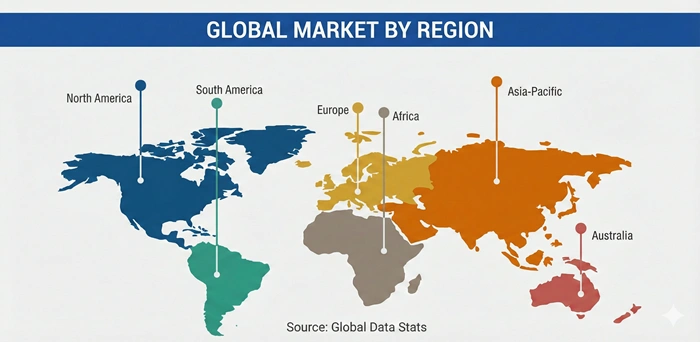
North America commands substantial leadership within the 3D camera market, maintaining significant regional share driven by early technology adoption, strong presence of leading technology companies including Intel, Microsoft, and Apple, substantial venture capital investment in AR and VR startups, and advanced consumer electronics markets characterized by premium product demand. The United States represents the primary growth engine within North America with the national market valued at USD 1.60 billion in 2024 and projected to expand at 14% CAGR through 2033, driven by government initiatives supporting advanced manufacturing, defense applications requiring 3D imaging capabilities, and consumer enthusiasm for cutting-edge technology. Technology hubs including Silicon Valley, Seattle, and Boston concentrate innovative startups developing novel 3D camera applications spanning autonomous vehicles, robotic vision, medical imaging, and entertainment content creation.
Major corporations headquartered throughout North America including Intel Corporation, GoPro, Faro Technologies, and Matterport maintain strong market positions through comprehensive product portfolios spanning consumer, professional, and industrial 3D camera systems complemented by software platforms enabling capture processing and visualization. The 3D camera market in North America particularly emphasizes professional and industrial applications with manufacturing facilities implementing machine vision systems for quality control, construction companies deploying 3D scanning for building documentation, and healthcare providers adopting depth-sensing cameras for patient monitoring and surgical planning. Canada demonstrates growing adoption across natural resource industries including mining and forestry where 3D imaging supports surveying, volumetric measurement, and safety monitoring applications, while government research initiatives fund advanced imaging technology development. The region benefits from mature distribution infrastructure including specialized machine vision distributors, consumer electronics retailers, and direct manufacturer channels ensuring product availability and technical support across diverse customer segments.
Asia Pacific Fastest Growth
Manufacturing Scale and Consumer Adoption Drive Exceptional Regional Expansion
Asia Pacific emerges as the fastest-growing regional 3D camera market, expected to register the highest CAGR exceeding 32% from 2026 to 2033, propelled by massive electronics manufacturing capacity concentrated in China, Taiwan, Japan, and South Korea, rapid smartphone adoption across emerging economies, and substantial government investments in industrial automation and smart manufacturing initiatives. The region encompasses the world's largest smartphone production with over 70% of global units manufactured in Asia Pacific creating natural demand for camera components including 3D imaging modules, while electronics manufacturing services providers maintain extensive supply chains supporting rapid technology integration. China represents the largest national market within Asia Pacific with consumer electronics production, growing AR and VR content creation, and government policies promoting artificial intelligence and automation driving substantial 3D camera adoption.
Japan demonstrates particular strength in professional 3D camera development with companies including Sony Corporation, Canon, Nikon, and Fujifilm leveraging decades of imaging expertise to create advanced depth-sensing solutions serving industrial inspection, robotics, and entertainment applications, while the country's projected revenue of USD 5.23 billion by 2030 reflects robust market momentum. Leading regional manufacturers including Samsung Electronics, LG Electronics, and Panasonic from Asia Pacific effectively serve local markets through competitive pricing, localized product features, extensive distribution networks, and strong relationships with consumer electronics brands. The 3D camera market in Asia Pacific benefits from rising disposable incomes enabling more consumers to afford premium smartphones and electronics incorporating 3D cameras, while growing awareness of augmented reality experiences and 3D content creation motivates technology adoption. Industrial sectors across automotive manufacturing, electronics assembly, and precision machining implement 3D vision systems for quality assurance, robotic guidance, and measurement applications supporting quality improvement and productivity enhancement objectives.
Top Key Players
-
Sony Corporation (Japan)
-
Intel Corporation (United States)
-
Canon Inc. (Japan)
-
Samsung Electronics Co. Ltd. (South Korea)
-
Nikon Corporation (Japan)
-
Panasonic Holdings Corporation (Japan)
-
LG Electronics Inc. (South Korea)
-
Fujifilm Holdings Corporation (Japan)
-
GoPro Inc. (United States)
-
Microsoft Corporation (United States)
-
Ricoh Company Ltd. (Japan)
-
Basler AG (Germany)
-
Faro Technologies Inc. (United States)
-
Matterport Inc. (United States)
-
Orbbec Inc. (China)
Recent Developments
-
Teledyne Imaging (2024): In February 2024, Teledyne Imaging announced acquisition of Netherlands-based camera manufacturer Adimec Holding B.V for an undisclosed fee, with Adimec specializing in customized high-performance industrial and scientific cameras solving applications where image quality proves paramount, further supplementing Teledyne's large portfolio and enabling market share growth while strengthening presence in the EMEA market.
-
Sony Corporation (2024): Sony unveiled the Torchlight advanced visualization facility at Sony Pictures integrating 3D and virtual production technologies with Epic Games' Unreal Engine enabling new storytelling techniques, while introducing the Eye-sensing Light Field Display for lifelike 3D imagery visible without glasses and launching the AI-powered PTZ camera BRC-AM7 demonstrating leadership in 3D imaging and CMOS sensor markets.
-
NVIDIA and GE HealthCare (2025): In March 2025, NVIDIA announced collaboration with GE HealthCare to advance innovation in autonomous imaging focused on developing autonomous X-ray technologies and ultrasound applications, with the partnership building autonomy into medical imaging systems to understand and operate in the physical world enabling automation of complex workflows including patient placement, image scanning, and quality checking.
-
Samsung Electronics (2024): Samsung expanded its VR camera portfolio with continued development of 360-degree 3D content capture solutions for professional video producers and broadcast professionals, emphasizing high-quality imaging capabilities with advanced features supporting livestreaming, durability in challenging environments, and comprehensive content management systems.
-
LMI Technologies (2024): TKH's subsidiary LMI Technologies specializing in 3D laser-triangulation cameras continued product portfolio expansion serving industrial automation and machine vision applications with enhanced measurement accuracy, faster processing speeds, and improved integration capabilities supporting manufacturing quality control and robotic guidance systems.
Market Trends
Miniaturization and AI Integration Transform Product Capabilities
The rapid miniaturization of 3D camera components enabling integration into compact consumer electronics represents a transformative trend within the 3D camera market, as manufacturers develop smaller sensors, lenses, and processing units that fit smartphone form factors without compromising depth-sensing performance. Advanced packaging technologies including system-in-package designs integrate multiple components into single modules reducing physical footprint, while micro-optics and MEMS-based structured light projectors deliver miniature solutions suitable for mobile devices. Smartphone manufacturers leverage miniaturized time-of-flight sensors and compact stereo camera arrays to implement depth-sensing capabilities supporting portrait photography, facial recognition, and augmented reality applications that enhance device value propositions and differentiate products in competitive markets. The trend toward thinner devices with larger displays creates additional challenges requiring 3D camera components occupying minimal space while maintaining or improving performance compared to previous generations.
Artificial intelligence integration enhancing 3D camera capabilities through intelligent depth prediction, scene understanding, and automated optimization represents another critical trend reshaping the 3D camera market landscape. AI algorithms analyze captured images to predict depth information in areas where direct measurement proves difficult due to occlusions, reflective surfaces, or textures lacking distinct features, generating complete depth maps from partial data. Neural network models trained on extensive 3D datasets enable single-image depth estimation supporting applications where traditional stereo or structured light approaches prove impractical, while edge AI processing within camera modules reduces latency and enables real-time performance. Industrial applications particularly benefit from AI-enhanced 3D cameras as intelligent defect detection systems automatically identify product anomalies, dimensional measurement algorithms achieve higher accuracy through machine learning optimization, and robotic vision systems demonstrate improved object recognition and grasp planning. Healthcare imaging applications leverage AI-powered autonomous systems that automatically optimize patient positioning, adjust scan parameters, verify image quality, and flag potential issues for radiologist review supporting workflow efficiency and diagnostic accuracy.
Segments Covered in the Report
By Technology:
-
Time-of-Flight
-
Stereo Vision
-
Structured Light
By Type:
-
Target Camera
-
Target-Free Camera
By Application:
-
Consumer Electronics
-
Smartphones
-
Tablets
-
Laptops
-
Gaming Consoles
-
-
Healthcare
-
Surgical Planning
-
Patient Monitoring
-
Diagnostic Imaging
-
-
Industrial
-
Quality Inspection
-
Robotic Guidance
-
Dimensional Measurement
-
-
Automotive
-
Autonomous Vehicles
-
Driver Monitoring
-
Parking Assistance
-
-
Entertainment & Media
-
3D Content Creation
-
VR Video Production
-
Motion Capture
-
-
Robotics
-
Navigation
-
Object Manipulation
-
Bin Picking
-
-
Security & Surveillance
-
Facial Recognition
-
Intrusion Detection
-
Perimeter Monitoring
-
By End User:
-
Smartphones & Tablets
-
Professional Cameras
-
Gaming Consoles
-
Drones & UAVs
-
Industrial Vision Systems
-
Medical Imaging Devices
-
Security Systems
By Region:
-
North America
-
United States
-
Canada
-
Mexico
-
-
Europe
-
Germany
-
United Kingdom
-
France
-
Italy
-
Rest of Europe
-
-
Asia Pacific
-
China
-
Japan
-
South Korea
-
India
-
Southeast Asia
-
Rest of Asia Pacific
-
-
Latin America
-
Brazil
-
Argentina
-
Rest of Latin America
-
-
Middle East & Africa
-
United Arab Emirates
-
Saudi Arabia
-
South Africa
-
Rest of Middle East & Africa
-
Frequently Asked Questions
Question 1: What is the projected 3D camera market size by 2033?
Answer: The global 3D camera market is projected to reach USD 18.26 billion by 2033, growing from USD 5.90 billion in 2026 at a CAGR of 16.54%.
Question 2: Which region leads the 3D camera market currently?
Answer: North America leads the 3D camera market with substantial share in 2025, driven by early technology adoption and strong presence of major technology companies.
Question 3: What are the key drivers of 3D camera market growth?
Answer: Key drivers include consumer electronics integration, augmented reality and virtual reality technology growth, industrial automation demand, and autonomous vehicle development requiring depth perception.
Question 4: Which technology leads the 3D camera market?
Answer: Time-of-flight technology leads with approximately 40% market share in 2025, valued for superior speed, accuracy, and real-time depth sensing capabilities.
Question 5: How is AI impacting the 3D camera market?
Answer: AI enables intelligent depth prediction, automated scene understanding, enhanced defect detection, and autonomous healthcare imaging systems that improve performance and expand applications.